

How Salesforce work starts in Detroit
Abstrakt Solutions is a Salesforce Consulting Partner for Detroit-region automotive suppliers, engineering firms, lenders and health systems. We implement, integrate, optimize and manage Salesforce across southeast Michigan. Detroit is one of our focus markets.
What buyers here usually run into
- 1
Program-based selling
Automotive suppliers win business program by program, over long timelines. Standard opportunity models often need rethinking to track programs, volumes and renewals.
- 2
Engineering-led organizations
When engineering drives the business, CRM adoption can lag. Salesforce has to fit into how engineers and account managers already work.
- 3
High-volume lending
Mortgage businesses need lead routing, nurturing and handoffs that keep pace with rate-driven swings in volume.
Budget, team and partner questions
What drives cost
In Detroit, program-based forecasting and integration drive cost. Modeling vehicle programs and platform volumes takes more design than a standard pipeline, and ERP and production feeds add integration work. For lenders, loan origination integration and compliance review of marketing journeys are the main drivers.
Admin or partner
Engineering-led suppliers often have strong IT but limited Salesforce depth, so a partner handles design and integration while internal staff handle adoption. Mortgage companies frequently keep an admin internal and use managed services to absorb volume-driven changes.
What buyers ask a partner
Ask for experience with program-based selling and Manufacturing Cloud forecasting, how the partner integrates production volume data, and for lenders, how they have connected a loan origination system. Ask how they drive adoption among engineers who prefer their existing tools.
The local economy and its biggest industries (4)
| Sector | Share of 2024 GDP | Where Salesforce fits |
|---|---|---|
| Manufacturing Salesforce for manufacturing → | 14.5% | Automotive suppliers and industrial manufacturers manage OEM relationships, long program timelines, quoting and service. Salesforce helps when program, account and ERP data come together in one view. |
| Professional, scientific, and technical services Salesforce for professional services → | 11.5% | Engineering, design and consulting firms serving the auto industry need pursuit pipelines, resource planning and client history across programs. |
| Health care and social assistance Salesforce for health & life sciences → | 8.2% | Large health systems use Salesforce for patient engagement, referral management and contact-center service, designed around privacy requirements. |
| Finance and insurance Salesforce for mortgage & lending → | 6.0% | Mortgage lenders and financial services firms need lead management, borrower communication and broker relationships at high volume, with compliant marketing. |
Source: U.S. Bureau of Economic Analysis, GDP by county (CAGDP2), 2024, summed to the metro area; private sectors only, excluding real estate and government. “At least” marks sectors where BEA suppresses some county figures.
Regional target sectors named by local economic development groups: Mobility & Automotive, Advanced Manufacturing, Corporate & Professional Services, Research, Engineering & Design, Logistics, Digital Technology.
Salesforce products that fit Detroit (6)
In the order we lead with them here, from the industries above.
Salesforce Sales Cloud
The CRM where sales pipeline lives, when it is built right.
Salesforce Revenue Cloud / CPQ
Configure-price-quote, billing, subscription management, and quote-to-cash on Salesforce.
Salesforce Service Cloud
The operating system for modern customer service, case, knowledge, voice, and AI agent assist together.
Salesforce Marketing Cloud
Cross-channel marketing, email, mobile, journey, and Data 360-powered personalization at scale.
Salesforce Field Service
Scheduling, dispatch, mobile work orders and parts for teams that work on site.
Salesforce Agentforce
AI agents that handle real work inside Sales Cloud, Service Cloud, and Marketing Cloud.
AI on the plant floor and in Detroit service desks
Manufacturing is Detroit's largest private sector, at 14.5 percent of metro GDP in 2024, and the professional, scientific and technical services that support it add another 11.5 percent. For suppliers in that chain, the most useful AI rarely looks glamorous. It reads a customer's quality complaint and attaches a summary to the case. It drafts a response to a quote status request using fields already in Sales Cloud. It helps a field technician look up a repair procedure from the knowledge base while standing at a machine. Health care organizations, the third-largest sector, can apply the same case-summary pattern to referral intake. Each of these depends on part numbers, accounts and service histories being accurate before an agent touches them.
- Quality complaint case summaries
- Quote status reply drafts
- Technician repair procedure lookup
Services buyers here usually need (7)
Salesforce Implementation in Detroit
In the Detroit region, implementation decisions are shaped by the auto industry's sales cycle. Suppliers win work one vehicle program at a time, engineering firms sell hours against those programs, and lenders and health systems operate at high volume beside them. We run discovery workshops with each business unit, design objects for programs, platforms and volumes where they apply, build and test in a sandbox, and roll out in phases so each group goes live on a model that fits how it earns revenue.
By industry in Detroit
- 1
Manufacturing
Vehicle production drives most of the region's manufacturing, which at about 14.5% of 2024 GDP is the metro's largest private sector. For suppliers, the implementation hinges on how programs are modeled: whether a program is an opportunity, a custom object or a sales agreement, and how awarded volumes turn into forecast revenue. We settle that design first, alongside Revenue Cloud for quoting, because every report and integration built later depends on it.
- 2
Research, Engineering & Design
The Detroit Regional Partnership targets research, engineering and design, a sector full of firms whose customers are automakers and their suppliers. Implementing Salesforce for them means linking pursuits to the programs they support, recording which engineers and skills a bid assumes, and keeping client history across program generations. The data model should make total work with a given automaker easy to see, even when contracts arrive through several supplier tiers.
- 3
Logistics
Logistics is another Partnership target sector, serving the region's plants with freight, warehousing and just-in-time delivery. A logistics implementation centers on accounts with many shipping locations, rate agreements and service cases for delays or damage. We model locations and lanes as related records, connect Service Cloud cases to the shipments involved and keep rate quotes structured, so sales can see which customers generate service issues and which generate margin on each lane.
Raise before scoping
Decide how programs are modeled
Supplier revenue depends on vehicle programs that run for years, so the choice between opportunities, custom program objects or Manufacturing Cloud sales agreements has long consequences. We prototype the options with your real programs in a sandbox and pick the one that both sales and finance can report from.
Set the calendar at kickoff
Workshop, training and go-live windows are agreed with your teams at kickoff and placed around launch dates and plant schedules.
Bring engineering into discovery
Engineers rarely volunteer to update a CRM, yet their estimates and change requests drive supplier revenue. Including engineering leads in discovery, and giving them views of the quote requests and program changes they care about, turns them into contributors rather than reluctant users.
Salesforce Integration in Detroit
Detroit-area integrations usually revolve around the ERP and the program. Suppliers need part numbers, pricing, releases and shipments to line up with Salesforce opportunities and forecasts; engineering firms need won work to become staffed projects in their finance or PSA system; lenders need loan milestones in front of the people managing relationships. Each value gets an agreed owning system, each connection gets MuleSoft, Workato or a direct API as the fit requires, and every flow gets monitoring so failures surface quickly.
By industry in Detroit
- 1
Professional, scientific, and technical services
Professional, scientific and technical services is about 11.5% of metro GDP, a sector closely tied to engineering and design for vehicle programs. For these firms, the key integration connects Salesforce opportunities to project, timesheet and billing systems. When a pursuit is won, the project, budget and staffing plan should be created automatically, and utilization and invoicing should flow back to the account, so account leads see both pipeline and delivery for each client.
- 2
Mobility & Automotive
Suppliers in the Partnership's mobility and automotive sector receive customer schedules, releases and forecasts through automaker portals and EDI, and much of that data lands only in the ERP. Integrating selected ERP data into Salesforce, such as shipped volumes by program and open releases, lets account teams compare awarded business to actual demand without exporting spreadsheets. We keep EDI processing in the ERP and bring summarized results into Salesforce on a schedule.
- 3
Logistics
Logistics providers, another Partnership target sector, run transportation and warehouse management systems that hold the operational truth about every customer. Salesforce needs a filtered view of it: volumes by lane, service exceptions and on-time performance tied to the account. We design those feeds as summaries rather than raw event streams, which keeps API and storage use sensible while giving sales and account management the context they need for renewals and pricing.
Raise before scoping
Keep the ERP as price master
Supplier prices depend on contracts, surcharges and annual reductions negotiated with each customer. Keeping the ERP as the pricing source and syncing approved prices into Revenue Cloud avoids two versions of the truth, provided both teams agree who updates what and how often.
Normalize plant identifiers
Manufacturers with several plants often run more than one ERP, or different versions of the same one. Integration design should normalize customer and part identifiers in middleware rather than in Salesforce, so adding or retiring a plant system does not require reworking the CRM.
Budget for error handling
Most integration effort after launch goes into records that do not match, not into the connection itself. We define reconciliation rules, route errors to named owners with alerts and provide a runbook, so a failed sync on a Monday morning is noticed by your team before a customer notices it.
Salesforce Optimization in Detroit
In the Detroit region, a lot of optimization work comes down to adoption among people who never asked for a CRM. Account managers at suppliers and engineers at design firms will use Salesforce when it saves them time, and abandon it when it asks for duplicate entry. We study usage data, interview those users, simplify layouts, move old workflow automation into maintained Flows and rebuild the program and pipeline reports that leadership reviews.
By industry in Detroit
- 1
Retail trade
Retail trade contributes about 6.9% of metro GDP, including dealership groups and retailers with service and loyalty programs. Their Salesforce orgs often accumulate campaign fields, case types and automations from several agencies or admins. Optimization trims case categories to ones supervisors can act on, merges duplicate customer records created by different channels and rebuilds reporting so marketing, service and store leaders read the same numbers about the customers they share.
- 2
Advanced Manufacturing
Advanced manufacturing is a Detroit Regional Partnership target sector, and manufacturers in it often bought Salesforce for pipeline visibility but never connected it to quoting or service. The result is reps keeping quotes in email and service history in the ERP. We simplify the opportunity process, surface ERP order and quote data inside the account view and replace spreadsheet uploads with automated updates, so opening Salesforce gives reps something back.
- 3
Corporate & Professional Services
Corporate and professional services is another Partnership target sector, covering shared-service centers and consulting firms. Their orgs tend to suffer from reports built by each department on its own definitions of pipeline and utilization. We agree the core metrics with leadership, rebuild dashboards on those definitions, retire the duplicates and add validation so the fields feeding them are actually filled in. A few trusted reports get used far more than many competing ones.
Raise before scoping
Build for the account manager
Supplier account managers juggle customer portals, engineering changes and ERP releases. Salesforce earns a place in that day only if the account page shows open quotes, program status and recent issues together. We design that single view first, then remove fields and steps that do not support it.
Untangle automation by object
Order-of-execution problems appear when three generations of automation update the same account. We map each rule, consolidate the logic into Flows organized by object and trigger type, and test the combined result in a sandbox, since Salesforce no longer supports the older tools.
Measure adoption after changes
An optimization project should end with evidence. We set a few measures before changes go live, such as logins by role, opportunities updated in the past week or cases closed with a reason, and review them with your team after relaunch to decide what to adjust.
Salesforce Managed Services in Detroit
Managed services for Detroit-area companies covers the steady work that keeps Salesforce useful after launch. We take admin requests, test each seasonal Salesforce release in a sandbox against your automation and integrations, keep quoting rules and price data current, and work through a backlog prioritized with your owner. Model-year changes, new programs and lending volume swings all create change requests, and a team with admin, developer and architect skills absorbs them without a hiring cycle.
By industry in Detroit
- 1
Health care and social assistance
Health care and social assistance is about 8.2% of metro GDP, and the region's large health systems run Salesforce for patient access, referrals and contact centers. Managed services in that setting is change control under privacy rules: every permission change reviewed, sandbox testing before releases touch patient-facing processes, and an audit trail of what changed and why. We also maintain the integrations that feed scheduling and referral data, which break quietly when source systems upgrade.
- 2
Mobility & Automotive
Mobility and automotive is a Detroit Regional Partnership target sector, and what suppliers in it sell keeps shifting toward electrified components, software and new service models. Each shift turns into Salesforce work, such as new product families in CPQ, revised forecast categories or additional account teams. A managed services backlog lets those changes land in planned releases instead of competing with daily user requests for a single admin's time. We size each item and agree priority with sales operations.
- 3
Finance and insurance
Mortgage lenders and other financial firms in the region see sharp swings in volume when rates move, and their Salesforce orgs need adjusting each time: lead routing rules, nurture journeys, staffing of queues. Managed services keeps someone ready to make those changes quickly, tests Marketing Cloud journeys before they reach borrowers and reviews consent handling as rules and products change. The result is an org that bends with the market rather than lagging behind it.
Raise before scoping
Protect quoting during releases
Seasonal Salesforce releases can change behavior in CPQ, Flow and Lightning pages. For suppliers whose quotes feed customer commitments, we run regression tests on pricing and approval scenarios in a preview sandbox before each release reaches production, and report anything that behaves differently.
Separate run and change work
Password resets and report tweaks should not wait behind a new integration, and vice versa. We run two lanes: user support handled as it arrives, and roadmap work scheduled into planned releases, each with its own reporting so you can see where time goes.
Cover the start of the day
For operations that need early help, such as lending teams starting the day on new leads, we agree which request types need a first response at the start of your day and plan staffing around them.
Salesforce Health Checks in Detroit
A health check tells a Detroit-area company what its Salesforce org really contains before it commits to a new cloud, a partner change or Agentforce. We review permissions and sharing, measure data quality on accounts, programs and cases, inventory automation, code and installed packages, and check how integrations with ERP and other systems behave. The result is a ranked list of findings with effort estimates, weighted toward security and data issues that would undermine AI or reporting.
By industry in Detroit
- 1
Health care and social assistance
Large health systems in the region hold patient engagement, referral and contact-center data in Salesforce, often across several departments that configured their own pieces. A health check examines who can see and export protected information, whether portal and guest access is locked down and how Shield or encryption is set up. It also finds overlapping automation from departments that built separately, a common cause of duplicate outreach to the same patients.
- 2
Manufacturing
Supplier orgs usually carry the most technical debt in quoting: CPQ price rules, product options and approval chains added for each new customer requirement. A health check inventories those rules, identifies ones that never fire or conflict, and measures quote performance. It also reviews how ERP integrations handle mismatches, since a failing price sync is often the hidden reason reps distrust quotes. Findings are ranked so the fixes that restore quote accuracy come first.
- 3
Finance and insurance
Lenders and other financial firms in southeast Michigan face scrutiny over how they market and communicate. A health check tests whether consent and opt-out data is reliable, whether Marketing Cloud or Account Engagement connections honor it, and whether users hold broader record access than their roles require day to day. We also look at data volumes, since high-volume lead objects can degrade performance and storage long before anyone reports a problem.
Raise before scoping
Check CPQ before scaling quoting
Quoting configurations grow with each customer program and rarely get pruned. Before adding product lines or users to Revenue Cloud, review price rules, product rules and approval processes for redundancy and performance, so the expansion does not multiply existing problems.
Establish AI readiness facts
Agentforce draws on the records, knowledge and permissions it is given. A readiness review measures duplicate rates, missing values on key fields and access scope, so you know which data an agent could rely on and which would need cleanup before a pilot.
Include integration users
Integration and service accounts often hold system administrator rights granted during a project and never reduced. The review lists every such user, what it can reach and whether its access matches what the integration actually does, which is a frequent security gap in older orgs.
Salesforce Migration in Detroit
Detroit-region migrations often involve long-lived systems: a homegrown database built around the ERP, an older CRM a division adopted years ago, or quote history kept in shared spreadsheets. Moving that into Salesforce means deciding which history still matters, matching customers who appear under several names and plant locations, and loading programs, quotes and contacts in the right order. We test every load in a sandbox, reconcile counts and plan a short freeze for the final cutover.
By industry in Detroit
- 1
Finance and insurance
Finance and insurance is about 6.0% of metro GDP, and the region's mortgage and lending businesses handle very large contact and lead volumes. Migrating them from an older CRM or marketing platform means deduplicating borrowers and referral partners, carrying consent and opt-out status accurately and preserving the lead-source history marketing uses to measure spend. We treat consent fields as the highest-risk part of the mapping, because an error there sends messages people declined.
- 2
Manufacturing
Manufacturers moving to Salesforce typically hold customer data in the ERP, in an old CRM and in each rep's files, often with the same automaker listed under several buying locations. We design an account hierarchy first, map every source record to a parent and site, and decide which quotes and program records to bring over. Loading closed quotes with their part numbers gives new users history they can search from the day they log in.
- 3
Digital Technology
Digital technology is a Detroit Regional Partnership target sector, and software and technology firms here frequently start on HubSpot or another lightweight CRM before outgrowing it. Migration involves mapping lifecycle stages, subscription and renewal data, and product usage fields into Salesforce objects, then reconnecting marketing automation. We sequence the move so marketing and sales switch together, avoiding a stretch where leads flow into one system and deals close in another.
Raise before scoping
Untangle plant and division accounts
The same customer may appear as a corporate entity, several purchasing locations and individual plants across your old systems. Agreeing the account hierarchy before mapping prevents a migration that loads each variation as a separate account and splits the relationship's history.
Treat consent as critical data
Opt-outs, communication preferences and consent dates must survive a migration intact, especially for lenders and healthcare organizations. We map them explicitly, test them in trial loads and verify samples record by record, since these fields are where migration errors carry the most regulatory risk.
Move marketing and CRM together
If marketing automation connects to the old CRM, migrating only the CRM breaks lead flow. We plan both moves on one timeline, reconnect forms, scoring and lead routing to Salesforce, and keep the old path open briefly in parallel so no inquiry falls through.
Salesforce Implementation Rescue in Detroit
When a Detroit-region implementation fails, the design often never matched how the business actually sells or serves. Quoting that ignores program pricing, forecasts that cannot hold awarded volumes and service processes built without technicians are familiar patterns. We assess what exists, stabilize what blocks daily work, decide for each component whether to keep, fix or rebuild, then complete the scope and relaunch with training for every role affected. Documentation is left behind for your own team.
By industry in Detroit
- 1
Mobility & Automotive
A stalled project at a supplier in the mobility and automotive sector frequently traces back to quoting that could not handle customer-specific price reductions, tooling amortization and part variants across programs. Recovery starts by writing down the real pricing logic with finance and sales, then deciding which CPQ rules can be corrected and which must be rebuilt. Stabilizing quote output comes first, because customers are waiting on those documents and every wrong quote erodes confidence further.
- 2
Health care and social assistance
Health system projects stall when patient engagement, referral and contact-center teams each expect different outcomes from one build. A rescue brings those groups back to a shared scope, checks that privacy controls in the partial build are sound and finishes the pieces that deliver value soonest, often referral tracking or contact-center case handling, before returning to the broader roadmap. Clinical and privacy leads review each relaunch step, so trust is rebuilt alongside the system.
- 3
Advanced Manufacturing
Field Service is a common sticking point for manufacturers who service equipment in customer plants. Scheduling that ignores technician skills, multi-day jobs that break the dispatch console and mobile apps nobody tested offline can stall adoption entirely. We stabilize scheduling policies and work order templates first, test the mobile experience with real technicians and relaunch region by region, so problems surface while the rollout is still small enough to fix.
Raise before scoping
Separate symptoms from causes
Users report symptoms: slow pages, wrong prices, missing records. The recovery assessment traces each back to its cause in design, data or code, so fixes address the source rather than adding yet another workaround on top of the original problem.
Reset expectations with leadership
After a failed launch, executives want a date and users want proof. We present the recovery plan with the keep, fix and rebuild decisions, the order of work and the risks, and agree which early fixes will show users that the system is improving.
Relaunch with the skeptics
Account managers and technicians who gave up on the first version are the best testers for the second. Involving them in acceptance testing, and training them first at relaunch, turns yesterday's critics into credible advocates for the recovered org.
Industry plays in Detroit (4)
Salesforce for Detroit Manufacturers
For Detroit-area manufacturers, Salesforce works best when it models programs rather than one-off deals. Suppliers win platforms that run for years, so opportunities need volumes, start-of-production dates and renewals attached, and quotes have to reflect ERP pricing and engineering changes. We design the data model around that selling motion, connect it to the ERP, and give engineering, sales and service one view of each customer program.
Manufacturing is the metro's largest private sector, at about 14.5% of 2024 GDP by the Bureau of Economic Analysis's county figures, well ahead of any other industry. The Detroit Regional Partnership puts mobility and automotive at the top of its target list, alongside advanced manufacturing and research, engineering and design. The regional mix leans on long-cycle programs, tiered supplier relationships and engineering-heavy organizations, which shapes how Salesforce should be configured here more than headcount or revenue does.
Use cases to open with
- 1
Program and platform tracking
A single award can cover several model years. We model programs as parent records with annual volume forecasts and start-of-production milestones, so account teams can see revenue at risk when a platform slips and leadership can roll forecasts up by customer, plant and program instead of reconciling spreadsheets.
- 2
Quoting that matches the ERP
Price breaks, tooling amortization and engineering change requests make supplier quotes complex. Revenue Cloud or CPQ, fed by ERP part and cost data through an integration, keeps quotes consistent and routes non-standard pricing for approval, so sales stops re-keying numbers the plant already has.
- 3
Service on installed equipment
Machine builders and industrial suppliers carry service obligations long after the sale. Field Service with asset records, warranty terms and parts inventory lets dispatchers schedule the right technician and gives the account team a full history of every installed unit before the next renewal conversation.
Raise before scoping
Design for engineering users
Engineering-led organizations adopt CRM slowly when it duplicates their tools. Keep required fields to what drives decisions, surface drawings and change status from source systems, and let engineers work from list views rather than long record pages.
Settle the system of record
Decide early which system owns parts, prices, customers and orders. Most suppliers keep the ERP as the master for cost and fulfillment and let Salesforce own pipeline, quotes and service history, with a clear sync schedule between them.
Plan for tiered relationships
Selling to OEMs and to other tier suppliers at the same time complicates account hierarchies and visibility. Map parent accounts, buying centers and sharing rules before build, because retrofitting them after launch touches every report and dashboard.
Salesforce for Detroit Lenders
For Detroit-area lenders with wholesale or correspondent channels, the customer is often a mortgage broker or partner lender rather than the borrower. Salesforce can manage those partners as accounts: onboarding and approval, account executive territories, loan submissions and pull-through by broker, and communications when pricing or guidelines change. Retail teams use the same org for borrower leads and nurturing. We connect it to the loan origination and pricing systems so account executives see partner performance without waiting for a weekly report.
Finance and insurance makes up 6% of Detroit metro GDP in the Bureau of Economic Analysis's 2024 county figures, smaller than manufacturing at 14.5% or professional services at 11.5%, yet the Detroit Regional Partnership still lists financial services among its seven target industries. Mortgage volume anywhere rises and falls with rates, so lenders here need a Salesforce design that handles surges and slowdowns without rework, and that serves partner channels as well as individual borrowers. Brokers and correspondents also tend to shift business quickly between lenders when pricing or turn times change, which makes partner-level visibility a daily need.
Use cases to open with
- 1
Broker onboarding and approval
Before a broker can submit loans, it needs an application, license verification, agreements and sometimes financial review. An Experience Cloud portal can collect documents and signatures, while Salesforce tracks each broker's approval stage, license expirations and annual recertification. Account executives know which brokers are ready to submit, and compliance has a record of every approval decision and the documents behind it.
- 2
Account executive territories
Wholesale and correspondent account executives manage many broker relationships across territories. Salesforce can show each executive their brokers ranked by submissions, fundings and pull-through, flag partners whose volume is falling, and log calls and visits. Sales leaders can rebalance territories and target coaching using the same data, rather than relying on spreadsheets from the origination system. Newly approved brokers get a structured ramp plan with check-ins.
- 3
Partner communications at speed
Pricing changes, guideline updates and product launches need to reach every approved broker contact quickly and accurately. Marketing Cloud can send targeted announcements by channel, state and product, track opens and clicks by partner, and trigger follow-up tasks for account executives when an important update goes unread by a high-volume broker. Broker contacts manage their own subscription preferences. Unread critical notices escalate to a phone call.
Raise before scoping
Surge capacity and routing
Rate-driven waves can multiply submissions and borrower leads within days. Design queues, assignment rules and automation that scale without manual reconfiguration, test them against peak volumes, and make sure reporting still performs when record counts jump. Plan the slowdown as well, when the focus shifts to purchase business.
Partner data from the LOS
Submissions, fundings and pull-through by broker come from the loan origination and pricing systems. Agree how often that data syncs, how brokers and branches are matched to Salesforce accounts, and which system is the record for partner status, so account executives trust the numbers they see.
Licensing and oversight
Lenders are expected to oversee the brokers and correspondents they approve, including licensing and performance. Track licenses, approvals, watch lists and terminations in Salesforce with an audit trail, and confirm with compliance what documentation your oversight program requires. We flag these as design questions; your compliance officers set the rules.
Salesforce for Detroit Health and Life Sciences
Detroit-area health organizations deal with patients, referring physicians and, often, the region's large employers as direct customers for occupational health, wellness and on-site clinics. Salesforce can manage those employer contracts like business accounts, support physician liaison teams that grow referrals, and run patient access across hospitals and clinics. Medical technology companies use the same platform to sell to providers. We keep clinical data in the EHR, design HIPAA-aware permissions, and integrate scheduling and referral systems.
Health care and social assistance ranks third among Detroit's private sectors, behind manufacturing and professional services, with 8.2% of metro GDP in 2024 by the Bureau of Economic Analysis's reckoning. Health care is absent from the regional partnership's target industries, which lead with mobility and automotive and include research, engineering and design. For CRM design, that points beyond patients: a health system in a manufacturing-heavy metro may also sell occupational health, screenings and on-site clinics to employers, and those contracts need account management of their own. Patients and employer customers should both be modeled from the start.
Use cases to open with
- 1
Employer health program accounts
Health systems selling occupational health, injury care, screenings or on-site clinics to employers need business-style account management. Salesforce can track each employer's contract, locations, services, contacts and utilization reported from clinical systems, with renewal opportunities opened well before expiration. Account managers see which employers are growing and which are at risk, and service teams handle employer requests such as scheduling bulk screenings through cases.
- 2
Physician liaison and referral growth
Physician liaisons visit practices to strengthen referral relationships. Salesforce gives them territory plans, visit logs, referral trends by practice and specialty, and follow-up tasks when volume changes. Service line leaders see which outreach efforts line up with referral growth, and marketing can support liaisons with targeted materials for practices considering new services or specialists. When a practice's referrals shift to another system, the liaison hears about it from a dashboard rather than months later.
- 3
Medical technology sales to providers
Device and health technology companies sell to hospital committees that include clinicians, supply chain, IT and finance. Salesforce can track value analysis committee submissions, product evaluations, contracts and implementation milestones, while Service Cloud supports installed products and clinician questions. Engineering-led companies also benefit from routing product feedback gathered by sales and support to development teams, so a clinician's suggestion does not disappear into someone's inbox.
Raise before scoping
Employer data versus PHI
Employer customers receive aggregate utilization and program results, not individual patient details, except where a patient has authorized it. Design data flows and reports that keep employer-facing information separate from PHI, and have your privacy officer approve what each employer may receive before the first report is sent.
Multiple EHRs and entities
Regional health systems formed through mergers may run more than one EHR or scheduling platform. Plan patient matching, referral data integration and reporting across those systems, and decide which identifiers Salesforce uses, so records do not duplicate or conflict when a patient appears in two legacy systems.
Adoption among device engineers
Medical technology teams with engineering backgrounds expect clean data and precise workflows. Keep layouts focused, automate data capture where possible, and involve product and engineering staff in design sessions, so the system supports how they evaluate field performance and improve devices instead of adding administrative work.
Salesforce for Detroit Professional Services Firms
Detroit's professional services firms often sell engineering capacity: design, simulation, testing, software and program management for automotive, mobility and industrial clients. Salesforce should connect demand to client programs, match opportunities to scarce skills, and manage rate cards and statements of work across many client departments. We integrate it with PSA or resource planning so business development sees who is available, and design permissions that respect client confidentiality around unreleased vehicles and technologies.
Only manufacturing outweighs professional, scientific and technical services in the Detroit economy: the latter generated 11.5% of metro GDP in 2024, per Bureau of Economic Analysis county estimates, against manufacturing's 14.5%. The Detroit Regional Partnership lists corporate and professional services and research, engineering and design among its target industries, alongside mobility and automotive. The region also counts nearly 200 technology support assets and a mobility innovation district in Corktown. Much of the professional services work here is therefore engineering-intensive and tied to vehicle and mobility programs rather than general business advisory.
Use cases to open with
- 1
Program-linked demand planning
Engineering services demand follows client vehicle and technology programs, with work rising and falling at each milestone. Salesforce can link opportunities to client programs and phases, with expected headcount by skill and timing. When a program slips or accelerates, business development and resource managers can see the effect on demand, adjust staffing plans and discuss alternatives with the client before gaps or overruns appear on the invoice.
- 2
Skills-based opportunity staffing
Winning work depends on having the right specialists, such as battery, controls, software or validation engineers. Integrated with PSA or resource management, Salesforce can show available people by skill and clearance when an opportunity reaches proposal stage, and flag skills the firm must hire or subcontract. Leaders see which capabilities limit growth and where to invest in recruiting or training.
- 3
Rate cards and statements of work
Clients with many departments negotiate different rate cards, terms and purchase order processes, and a firm may hold several agreements with one manufacturer. Revenue Cloud or CPQ can store rate cards by client and role, generate statements of work with standard language, and route exceptions for approval. Purchase orders, extensions and change orders stay linked to the original agreement, which makes renewal and billing discussions far easier.
Raise before scoping
Protecting client prototype information
Clients share details of unreleased vehicles and technologies under strict agreements. Restrict access to client and program records by team, use code names where clients ask for them, avoid storing confidential designs in Salesforce, and document your controls so client security reviews and audits can be answered quickly.
PSA and resource ownership
Resource assignments, time and project financials belong in PSA or project accounting systems. Agree what flows into Salesforce, such as availability by skill and project margins, and how often it refreshes, so business development sees reliable information without duplicating detailed planning that resource managers already maintain elsewhere.
Supplier onboarding with clients
Large manufacturers require supplier registration, insurance certificates, security questionnaires and sometimes on-site safety training before engineers can start. Track those requirements per client in Salesforce, with expiration dates and named owners, so new statements of work are not held up by an expired certificate or a missing form.
Case studies to send (3)
From the industries this market leans on. Client names are anonymized and these projects are not specific to Detroit.
The Detroit Salesforce market brief, Q4 2026
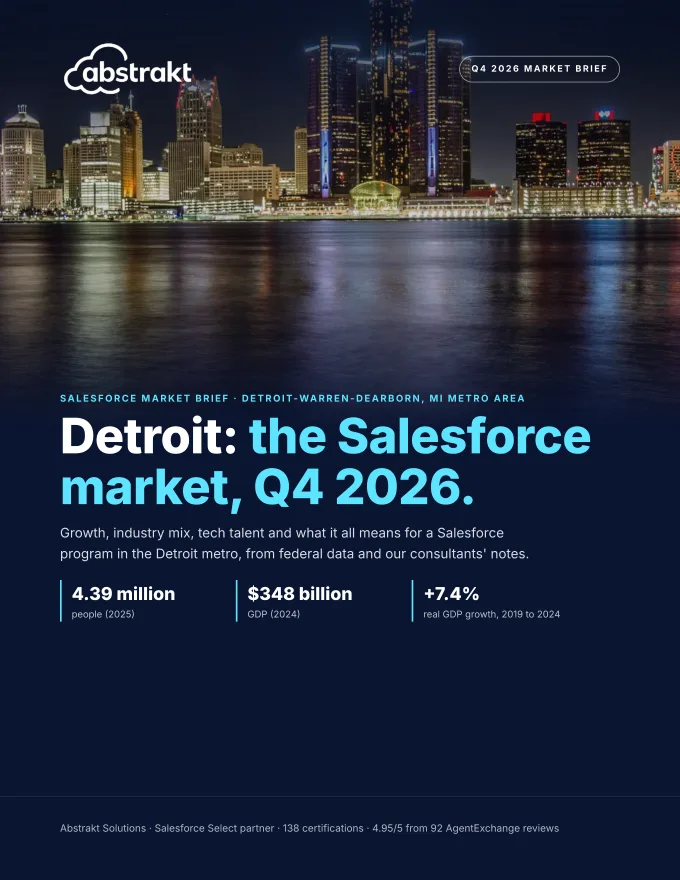
A free 23-page PDF with Detroit's growth ranked against 100 metros, its industry mix, tech wages and nearby markets. It is offered on the public Detroit page; send your customer there or get a copy for your own prep.
Get the Detroit brief →Co-sell with Abstrakt in Detroit
Working a Detroit account? Bring in a named consultant for discovery, scoping or a health check. We reply within 4 business hours.