

How Salesforce work starts in Toledo
Toledo companies, along with those across Lucas, Wood, Fulton and Ottawa counties, work with Abstrakt Solutions as their Salesforce Consulting Partner. Toledo is one of our focus markets.
What buyers here usually run into
- 1
OEM program tracking
Automotive suppliers win business by vehicle program, with volumes that change over the program’s life. Salesforce works when it models programs, platforms and forecasts rather than generic opportunities.
- 2
ERP data sales never sees
Sales and service teams at manufacturers often cannot see production, shipment or quality data held in ERP and plant systems. Integration closes that gap without re-keying.
- 3
Patient and member engagement
Health systems and insurers need outreach, referral and service workflows with consent and access controls built in from the first release.
Budget, team and partner questions
What drives cost
In Toledo, cost follows ERP and plant-system integration, how vehicle programs and engineering changes are modeled, and whether piece-price quoting needs Revenue Cloud. Health systems and banks add consent and access design; distributors add portal scope.
Admin or partner
Tier suppliers here often have strong engineering and IT staff but no Salesforce specialist, so a partner covers program modeling and integration while an internal owner runs priorities. Community banks and agencies more often outsource administration entirely.
What buyers ask a partner
Ask for automotive references that model programs and platforms, not just opportunities, and how the partner monitors ERP integrations in production. Banks should ask how household and access models are designed before automation.
The local economy and its biggest industries (4)
| Sector | Share of 2024 GDP | Where Salesforce fits |
|---|---|---|
| Manufacturing Salesforce for manufacturing → | 21.7% | Drivetrain and parts suppliers work in long OEM programs, while building-materials and solar-panel manufacturers manage distributor, project and service relationships. Both need quoting and ERP-linked order data in front of sales. |
| Health care and social assistance Salesforce for health & life sciences → | at least 8.8% | Hospitals, clinics and social services together form Northwest Ohio's second-largest private sector, behind only manufacturing. Providers, physician groups and health services firms use Salesforce for referral management, patient outreach and contact-center service under strict privacy controls. |
| Finance and insurance Financial Services Cloud → | 6.3% | Community banks, credit unions and insurance agencies in Lucas and Wood counties need household views, loan and policy pipelines, and marketing that respects consent. |
| Wholesale trade Experience Cloud → | 5.1% | Distributors and logistics firms, part of RGP’s logistics and distribution target, need order status, customer portals and service connected to warehouse and ERP systems. |
Source: U.S. Bureau of Economic Analysis, GDP by county (CAGDP2), 2024, summed to the metro area; private sectors only, excluding real estate and government. “At least” marks sectors where BEA suppresses some county figures.
Regional target sectors named by local economic development groups: Advanced Manufacturing, Automotive, Energy, Food Processing, Logistics & Distribution, Data Centers.
Salesforce products that fit Toledo (6)
In the order we lead with them here, from the industries above.
Salesforce Sales Cloud
The CRM where sales pipeline lives, when it is built right.
Salesforce Revenue Cloud / CPQ
Configure-price-quote, billing, subscription management, and quote-to-cash on Salesforce.
Salesforce Service Cloud
The operating system for modern customer service, case, knowledge, voice, and AI agent assist together.
MuleSoft
Enterprise API platform, for connecting Salesforce, ERP, data warehouses, and the rest of your stack.
Salesforce Experience Cloud
Customer, partner, and employee portals built on Salesforce.
Salesforce Agentforce
AI agents that handle real work inside Sales Cloud, Service Cloud, and Marketing Cloud.
Toledo's automotive and health sectors: realistic AI uses
Manufacturing accounted for 21.7% of Toledo's metro GDP in 2024 by BEA's measure, with automotive, food processing and energy named as regional targets. Tier suppliers deal with a steady stream of dealer and OEM quality tickets; AI can summarize each ticket's history and draft a first response that a quality engineer edits. Food processors have a document problem too, and an agent can check incoming vendor certificates against lot paperwork. Health care, the second largest private sector, fits drafted responses for billing and access questions. Forecasting support also helps sales teams compare program volumes with pipeline. Part numbers, customer hierarchies and knowledge ownership should be settled first, and reviewers must see what source the agent relied on.
- Quality ticket histories and first drafts
- Reading supplier certificates and lot records
- Comparing program volumes with pipeline
Services buyers here usually need (7)
Salesforce Implementation in Toledo
A Toledo implementation usually begins with a question about what a customer record has to hold. Automotive suppliers need vehicle programs and platforms, solar and energy firms need projects and installed assets, and building-materials makers need distributors and job sites. We settle that structure in discovery workshops with plant and office staff, build in a sandbox, connect the ERP where sales depends on it, and go live in phases so one team is productive in Salesforce before the next one starts.
By industry in Toledo
- 1
Manufacturing
Manufacturing's share of 2024 metro GDP, about 21.7%, is the largest of any private sector here, so plant realities shape most Toledo implementations we scope. For building-materials, solar and component makers, the implementation choice that decides success is the product and asset model: which items are quoted, which are installed and serviced, and how distributors and project owners relate to each account. We design that structure before configuring page layouts, because retrofitting it after go-live means migrating the same records twice and retraining every user.
- 2
Automotive
Automotive is one of the six industries the Regional Growth Partnership targets, and suppliers here sell into long vehicle programs rather than single deals. An implementation for a drivetrain or parts supplier therefore starts with a program object carrying platform, launch timing and volume assumptions, with quotes and awards attached to it. Phase one usually covers program tracking and forecasting for the commercial team; engineering change history and supplier quality cases follow once sales trusts the forecasts.
- 3
Energy
Energy sits on RGP's target list next to data centers, and solar and energy-equipment firms in the region pair long project sales with years of service afterward. We implement those as two linked phases. The first models development stages, sites and financing milestones in Sales Cloud; the second adds installed assets, warranty claims and maintenance visits in Service Cloud. Keeping the asset record separate from the opportunity gives service teams a clean history at handoff.
Raise before scoping
Roll out plant by plant
Companies with sites across Lucas, Wood, Fulton and Ottawa counties rarely need every location live on the same day. We usually launch with one business unit's commercial team, prove the data model with real orders, then add sites in waves so local differences surface early instead of all at once.
Bring plant and office staff together
Discovery sessions, sprint reviews and user acceptance testing fit inside your business day, while design workshops and each go-live bring plant and office staff together to decide things jointly.
Draw the ERP boundary first
Suppliers and processors hold pricing, inventory and shipments in ERP. Before building quotes or order views, agree which system owns each field and how often data moves between them. That decision shapes object design, integration effort and user training, so it belongs in phase-one discovery.
Salesforce Integration in Toledo
In Toledo, most Salesforce integration work connects the CRM to the systems that run production and distribution: ERP, warehouse management, EDI and quality databases. We decide which system owns each record, design the data flow in each direction, and build it with MuleSoft, another middleware tool or direct APIs, depending on volume and how many systems are involved. We add error handling, alerts and a written runbook to each connection, so a stalled sync gets noticed before anyone quotes from yesterday's prices.
By industry in Toledo
- 1
Wholesale trade
Wholesale trade represented about 5.1% of 2024 metro GDP, and distributors here depend on data that lives outside Salesforce: stock levels, customer-specific pricing and shipment tracking. The integrations we build usually push accounts and accepted quotes to ERP as orders and pull back invoices, inventory and delivery status. Near-real-time sync matters for availability and price; nightly batches are fine for history. Getting that split right keeps integration effort in proportion to its value.
- 2
Automotive
Suppliers to the vehicle programs assembled and powered in the region exchange forecasts, releases and advance ship notices with OEMs, often through EDI or customer supplier portals. Integration lets account managers see those releases and actual shipments in Salesforce beside the program forecast, so a volume drop shows up in the CRM without manual entry. We also connect quality systems, letting a case opened after a customer complaint reference the part, lot and plant involved from the start.
- 3
Logistics & Distribution
RGP lists logistics and distribution among its targets, and carriers, warehouses and third-party logistics providers in the region run on transportation and warehouse systems with their own customer data. Integration links those systems to Salesforce so customer service sees shipment status on the case, sales sees volume by lane or account, and Experience Cloud portals show customers their own orders, delivery exceptions and proof of delivery without anyone picking up the phone.
Raise before scoping
Name a system of record
Before any connector is built, agree which system owns customers, products, prices and orders. When two systems each think they own the same field, records flip back and forth and nobody trusts either copy. A one-page ownership map, signed by sales, finance and operations, prevents long reconciliation work later.
Map EDI and portal flows
Automotive and distribution customers often exchange data through EDI or their own supplier portals rather than email. Map those flows early, since they determine which events Salesforce needs to receive and how quickly, and whether MuleSoft or a lighter middleware approach fits your volume.
Monitor after go-live
Integrations break quietly when a field changes or a credential expires. We set up logging, error queues and alerts to a named owner, and document how to replay failed messages, so your team learns within hours, not weeks, that order data has stopped flowing.
Salesforce Optimization in Toledo
Optimizing Salesforce for a Toledo company usually means making an existing org match how plant, distribution and service teams work today. We start by measuring what people use: login patterns, fields that are always blank, reports nobody opens. Next come role-specific page layouts, a merge of legacy workflow rules and Process Builder logic into a few maintainable Flows, and a rebuild of the dashboards leadership opens each week. It is incremental work released in small batches, not a rebuild.
By industry in Toledo
- 1
Wholesale trade
Distributors in the Toledo metro, part of the logistics and distribution sector RGP targets, often have reps who open Salesforce only to log a required activity. The fix is usually giving them something worth opening: open orders, back-ordered items and recent service cases on the account page, fed from ERP. We trim the fields reps must fill, turn reorder reminders into automated tasks and build a pipeline view by territory so managers stop requesting spreadsheets.
- 2
Food Processing
Food processing is one of RGP's six target industries, and processors selling to grocers, distributors and food-service buyers juggle promotions, private-label specifications and customer complaints. Optimization for them often centers on service: routing quality complaints to the right plant, linking each case to lot and product, and reporting complaint trends by customer. We also clean up duplicate accounts created when buying groups and their member stores were entered separately over the years.
- 3
Health care and social assistance
Outreach teams at health systems and physician groups frequently work in orgs where each department added its own fields and automation. We map which referral, liaison and patient-communication processes still run, retire the rest, and consolidate reports so a referral source's full history appears in one place. Access is reviewed at the same time, because simplifying screens often exposes permissions broader than anyone intended, and privacy staff want those corrected before the new layouts ship.
Raise before scoping
Measure before removing anything
Field usage, report views and login data show what people actually rely on. We gather that evidence first, then hide or delete items with owner sign-off, because a field that looks unused in the office may still feed a plant report or an ERP export.
Consolidate automation by object
A Toledo org touched by several admins may have workflow rules, Process Builder and Flows all reacting when someone saves one order. We fold them into one Flow per object and trigger point, which makes behavior predictable and ends the save errors users have learned to work around.
Retrain by role afterward
Once changes ship, a short session per role, such as inside sales, field reps and customer service, lands better than a general walkthrough. Each session is sized to its group, whether that team shares one site or is spread across the four-county metro.
Salesforce Health Checks in Toledo
A health check for a Toledo organization is a fixed-scope review of the org as it stands: security and sharing, automation and code quality, integrations, data quality and license use. It suits companies about to add a cloud, change partners or turn on Agentforce, and those that simply stopped trusting the system. We review metadata and configuration, interview key users and deliver a ranked list of findings with effort and risk for each, which your team or ours can act on.
By industry in Toledo
- 1
Health care and social assistance
Health care and social assistance made up at least 8.8% of 2024 metro output, the largest share of any private sector after manufacturing. For providers, the health check looks hardest at who can see what: profiles and permission sets on patient-related objects, guest access on any portal, field history on consent, and whether integration users hold more access than they need. Findings are ranked by exposure so privacy officers can act first on what matters most.
- 2
Finance and insurance
Examiners at a credit union or community bank want proof of two things: who can reach member data, and who changed a setting and when. A health check reviews sharing rules, login policies, multi-factor authentication settings, field-level security on financial data and audit trail coverage. We also look for automation that sends customer data to outside systems without logging it. The report gives compliance teams specific items to remediate instead of a general recommendation to tighten security.
- 3
Energy
Energy companies in RGP's target sector often run Salesforce alongside project, asset and field systems, with integrations built at different times by different vendors. The health check inventories those connections, checks credentials and error handling, and flags duplicate asset or site records that make service reporting unreliable. Before an energy firm adds Agentforce to service or sales, we confirm the asset and case data the agents would read is complete enough to trust.
Raise before scoping
Check data before AI
Agentforce and other AI features answer from your records. If accounts are duplicated, case notes are free text only or key fields are mostly blank, agents will give confident but weak answers. We grade how prepared your records are for each agent job you have in mind.
Include integration users
The accounts that connect ERP, marketing and portal tools to Salesforce frequently hold admin-level rights nobody has questioned since setup. We list each one, what it can read and write, when its credentials were last rotated and whether it is still in use, then recommend reductions.
Turn findings into a plan
A long list of issues is hard to act on. We group findings by risk and effort, mark quick fixes your admin can make in days, and outline larger items as scoped projects, so leadership decides what to fund rather than what to worry about.
Salesforce Managed Services in Toledo
Toledo companies that buy managed services usually already depend on Salesforce and have one overloaded administrator, or none since the last one left. We take over the request queue, rank it with your business owners each month, and deliver configuration, Flow automation, reports and integration fixes. Salesforce's seasonal upgrades get a sandbox rehearsal first, with regression checks on quoting, portals and service consoles. Shift schedules matter in a metro this reliant on plants, so deployment windows are agreed in advance to avoid your busiest hours.
By industry in Toledo
- 1
Health care and social assistance
Hospital networks and physician groups in northwest Ohio adjust their Salesforce setup constantly: new referral sources, revised consent language, access for newly affiliated clinics. Managed services gives those changes a controlled path. Every request is logged, built and tested in a sandbox, then approved by a named owner before deployment. Permission sets are reviewed on a schedule, so staff who changed roles do not keep access to patient-facing records they no longer need for their work.
- 2
Finance and insurance
Community banks, credit unions and insurance agencies together make finance and insurance a slice of about 6.3% of 2024 metro GDP. Their Salesforce backlogs fill with product launches, rate changes and new disclosure text, each small but each needing documentation. We keep a readable change log, maintain the feeds from core and policy systems, and test every release against the sharing rules that keep branch, lending and wealth teams in their own lanes.
- 3
Advanced Manufacturing
Advanced manufacturing heads RGP's target list, and manufacturers here often own an org that has grown by accretion: a quoting tool, a distributor portal, a handful of custom objects added by different admins. Under managed services we maintain all of it as one system. Pricing updates, new product lines and portal user requests go through the same queue, and we retire automation that duplicates newer Flow logic as we touch each area.
Raise before scoping
Agree deployment windows with plants
Plants and distribution centers run shifts that office teams tend to forget. We set deployment windows with operations leaders so changes to service consoles or order views never land in the middle of a shift change, and we tell affected users in plain language what is about to move.
Plan capacity by quarter
Plant managers file requests alongside sales, service and finance, and each group believes its item is urgent. We review the queue monthly with owners but plan capacity by quarter, so larger items such as a new product line or a portal redesign get scheduled deliberately rather than squeezed between small tickets.
Write down what exists
Many orgs in the region were built by an admin who has since moved on. In the first months we document what each automation, integration user and scheduled job does, which makes later changes safer and gives your team a usable reference if the engagement ever ends.
Salesforce Implementation Rescue in Toledo
Troubled Salesforce projects in Toledo tend to share a few causes: a design that treated program-based manufacturing like simple deal selling, an ERP integration promised but never finished, or a partner who left mid-build. Rescue begins with triage. We review the org, open work and prior decisions, talk to the people meant to use it, and report plainly what can be kept. Then we propose a phased recovery plan and, if you want, deliver it with our own consultants.
By industry in Toledo
- 1
Automotive
Automotive suppliers often come to a rescue after an implementation created an opportunity for every part and release, so forecasts double-count and reps stop updating them. Triage for them tests whether a program-level structure can be added on top of existing records or whether the opportunity data must be rebuilt. We usually keep accounts, contacts and quote history, restructure forecasting around programs, and relaunch with the commercial team that feels the pain most.
- 2
Advanced Manufacturing
Among the advanced manufacturers RGP recruits, stalled projects frequently involve quoting. A CPQ rollout that never matched ERP pricing leaves reps working in spreadsheets while licenses sit idle. Rescue starts with the product catalog and price logic, validated against real orders, before any interface changes. Once quotes match what finance expects, we reconnect the ERP handoff and bring reps back in small groups, fixing what they report between each wave of the relaunch.
- 3
Health care and social assistance
Health organizations sometimes launch Salesforce for referrals or patient outreach and then pause it when privacy concerns surface late. Rescue there begins with a security review of what was built: data exposed through reports, portal guest access and integration users. We fix the access model first and document every change for privacy officers, then restart the rollout department by department, beginning with the team whose workflow is simplest to prove out.
Raise before scoping
Secure the inheritance
If a previous partner is leaving, collect sandboxes, credentials, design documents, backlog exports and any code repository before access ends. Missing pieces are a common cause of delay in a rescue, and they are far easier to gather while the outgoing team is still reachable.
Separate symptoms from causes
Users report slow pages, missing data and broken automation, but those usually trace back to a handful of design decisions. Triage groups complaints by root cause so the recovery plan fixes a few underlying problems rather than chasing dozens of tickets one at a time.
Give leadership an early checkpoint
Anyone who signed off on the first budget will want something working in hand before releasing money for the recovery. We set an early checkpoint around a small, visible win, such as a working forecast view or a corrected integration, before committing to the full recovery plan and its later phases.
Salesforce Migration in Toledo
Migrations for Toledo-area companies often start from a mix of sources: an older CRM, an ERP customer list and spreadsheets kept by long-tenured reps. We inventory each source, map it to the Salesforce data model, and clean duplicates, stale contacts and inconsistent account names before loading anything. Test loads run in a sandbox, business owners sign off on samples, and cutover is scheduled around month-end close and plant calendars so no one loses a day of work.
By industry in Toledo
- 1
Finance and insurance
Community banks, credit unions and insurance agencies in Lucas and Wood counties often run a legacy contact manager beside the core system, plus referral logs in spreadsheets. Migration for them is mostly relationship data: householding individuals correctly, linking business owners to their companies, and bringing across only the activity history staff will actually use. Sensitive fields are classified before loading, so the new org's permissions are right from the first day users sign in.
- 2
Food Processing
Processors in RGP's food processing target sector frequently carry customer data in several places: a broker list, an ERP customer master and a complaint log kept by quality staff. We merge those into one account structure, map brokers and buying groups as related accounts, and convert complaint history into Service Cloud cases linked to product. The cleanup usually reveals duplicate ship-to records that are worth correcting in the ERP at the same time.
- 3
Wholesale trade
Distributors moving to Salesforce tend to have large account lists where one customer appears under several names, branches and ship-to addresses. We standardize names and addresses, build a parent-child hierarchy from ERP bill-to and ship-to data, and assign ownership by territory before the load. Reps then open Salesforce on day one and find their accounts already structured the way they sell to them, with open orders visible where the integration allows.
Raise before scoping
Decide what history to keep
Not every old activity or closed deal deserves migration. Agree with sales and service leaders how many years of history to bring, which record types to archive, and where archived data will live, so the new org starts useful rather than cluttered.
Clean in the source first
Fixing duplicates and bad addresses in the old system, or in a staging database, is cheaper than cleaning after load. We run matching rules, flag conflicts for owners to resolve and keep a log of every merge that auditors and managers can review later.
Time cutover around close
Finance teams and plants both have calendar pressure. We schedule the final load away from month-end close and major production changeovers, freeze edits in the old system briefly, and leave it read-only afterward so staff can still check a record if needed.
Industry plays in Toledo (3)
Salesforce for Toledo Manufacturers
Toledo's manufacturing base is broad, so Salesforce designs vary more than they would in a single-industry town. Automotive suppliers need program-level forecasts, building-materials makers need specification selling through architects, distributors and contractors, and solar manufacturers negotiate multi-year supply agreements with project developers. Sales Cloud and CPQ cover the core, MuleSoft connects ERP and plant data, and Service Cloud handles warranty and technical claims. We help each company decide which motion deserves the first release instead of configuring everything at once.
Few metros lean on factories as heavily as Toledo: the Bureau of Economic Analysis credits manufacturing with 21.7% of 2024 GDP, far more than any other private sector. Of the six industries the Regional Growth Partnership pursues across its 17-county territory, four involve making or moving goods: automotive, advanced manufacturing, food processing, and logistics and distribution, with energy and data centers rounding out the list. The region sits 45 miles from Detroit and has a large vehicle assembly base, and its manufacturers also turn out building materials, solar panels and drivetrains in Lucas and Wood counties and the surrounding area. That mix spans consumer vehicles, construction products and utility-scale energy equipment.
Use cases to open with
- 1
Specification selling for building products
Building-materials manufacturers create demand when architects and engineers write their products into specifications, then fulfill through distributors and contractors. Salesforce can track projects from design through bid, record which firms specified the product and alert reps when a substitution is requested. Leaders see pull-through by distributor and region instead of relying on shipment data alone, and marketing learns which specifiers matter most.
- 2
Solar supply agreements
Module manufacturers sell large volumes to project developers under multi-year agreements with delivery schedules and price adjustments. Salesforce can hold agreement terms, scheduled deliveries and change requests by project, linked to ERP shipments. Commercial teams see which projects are on track, which are delayed by permitting or interconnection, and where volume might be reallocated to another customer. Finance gets a cleaner view of contracted revenue by quarter and by project.
- 3
Warranty and field claims
Automotive, glass and solar products all carry warranty obligations that stretch for years. Service Cloud cases tied to part numbers, lots and customers let quality teams group claims, request returned samples and document root cause. Account managers then walk into customer reviews knowing exactly which issues are open and what has been done about each one. Recurring failure modes surface in reports long before they appear in a customer's supplier rating.
Raise before scoping
Map several go-to-market models
Diversified manufacturers may sell direct to OEMs, through distributors and to project developers at once. Define separate sales processes and record types for each motion, but keep shared accounts and products so leadership can report across the business without reconciling separate systems.
Leave room for new product lines
Ohio's EV workforce and smart mobility initiatives, along with the region's energy target, push suppliers toward new products and customers. Keep product hierarchies flexible, avoid hard-coding programs into automation and review reporting structures regularly so the org adapts rather than needing a rebuild.
Include plant and quality users
Claims, capacity and change requests depend on information from quality engineers and schedulers. Give them focused views and notifications, integrate quality systems rather than duplicating entry, and involve them in design workshops so the process fits how plants actually work.
Salesforce for Toledo Health Systems
In Toledo, health organizations often manage relationships beyond the patient: employers buying occupational health and wellness services, physicians being recruited to the region, and nursing and home-health partners receiving discharged patients. Salesforce gives these relationships structure. Sales Cloud tracks employer contracts, Service Cloud and Experience Cloud handle partner referrals and communication, and Agentforce can take routine requests once processes are stable. Patient-facing work runs on the same platform, with privacy controls designed before any protected health information arrives.
Only the factories outrank hospitals, clinics and social services in the Toledo metro, where health care and social assistance produced no less than 8.8% of 2024 GDP according to the Bureau of Economic Analysis. With manufacturing producing 21.7% of the metro economy, local providers also face a large employer audience for occupational health, workforce wellness and direct-contracting services, alongside the usual patient and referral relationships.
Use cases to open with
- 1
Employer health contracts
Occupational health, wellness and direct-to-employer programs are sold much like business services. Each employer becomes an account with its contract, the plant or warehouse locations covered and a renewal date; injury-care requests and scheduling problems arrive as cases linked to that employer. Account managers see utilization summaries before renewal conversations, and leaders learn which employer segments, such as plants or distribution centers, are growing fastest. Marketing can target similar employers once the profile of a good client is clear.
- 2
Physician recruitment pipeline
Recruiting physicians and advanced practitioners involves long timelines, site visits, licensing and onboarding tasks. Tracking candidates as a pipeline with stages, interview feedback and offer status helps recruitment teams coordinate with department chairs. Onboarding checklists then make sure credentialing, equipment and schedules are ready when a new clinician starts, rather than being chased in the first week. Recruiters can also report time-to-fill by specialty to leadership.
- 3
Post-acute partner coordination
Discharge planners send patients to skilled nursing, rehab and home-health partners across Lucas and Wood counties. An Experience Cloud partner portal can share referral packets, collect acceptance responses and track outcomes. Case managers see which partners accept quickly and which referrals stall, without chasing faxes and phone calls, and leaders can compare partner performance over time. Readmission follow-up can use the same partner records.
Raise before scoping
Define PHI boundaries early
Employer contracts and physician recruitment rarely need clinical data, but referral workflows do. Separate those processes by record type and permission set, encrypt sensitive fields, and confirm HIPAA-related design decisions with your privacy officer before integrations begin. Audit who can export reports that contain patient details.
Coordinate with the EHR team
Hospital EHR teams manage tightly controlled change calendars. Engage them early on interface specifications for discharge events or referrals, align testing windows with their release schedule and agree on who monitors each integration after go-live. Document interface failures and the manual fallback so staff know what to do if a feed stops.
Make the portal worth using
Post-acute partners juggle several hospital portals already. Keep yours quick to use, show only actionable referrals and provide status updates they value, such as expected discharge dates, or partners will drift back to phone calls and fax. Ask a few partner administrators to test the portal before launch and act on their feedback.
Salesforce for Toledo Insurers and Agencies
Insurers and agencies in the Toledo area serve an economy weighted toward manufacturing, so commercial property, liability, workers' compensation and group benefits matter as much as personal lines. Salesforce helps agencies and carriers work renewals and remarketing early, coordinate producers and account managers on large commercial accounts, and handle service requests such as certificates and endorsements. The foundation is usually Financial Services Cloud tied to your agency management or policy platform, with an Experience Cloud portal added once clients or wholesale partners need self-service.
Insurance has no separate line in Bureau of Economic Analysis GDP tables; it is bundled with banking and investment into a finance and insurance total worth 6.3% of Toledo's 2024 metro output, the fourth-biggest private share. The Regional Growth Partnership does not target insurance, concentrating instead on automotive, advanced manufacturing, energy, food processing, logistics and data centers. The economy local insurers protect is distinctive, though: manufacturing alone accounts for 21.7% of GDP, and health care and social assistance adds at least 8.8%. That mix makes commercial lines and employee benefits central to many agency books.
Use cases to open with
- 1
Commercial renewal pipeline
Manufacturing accounts renew on fixed dates with long preparation: exposure updates, loss runs, submissions to markets and proposals. Months before each expiration date, the renewal appears as its own opportunity, with marketing tasks split between producer and account manager and every carrier response logged beside it. Managers spot renewals at risk early enough to act, instead of learning about them in the final days.
- 2
Certificates and endorsement requests
Contractors and manufacturers need certificates of insurance and policy changes quickly, often for customers or projects with deadlines. An Experience Cloud portal or email-to-case flow captures those requests, routes them to service staff with policy details from the agency system, and tracks turnaround. Clients see status without calling, and staff spend less time chasing missing information from the requester, even at peak renewal times.
- 3
Group benefits enrollment support
Employers with large workforces, such as plants and hospitals, need help every enrollment season. Salesforce can track each employer group's renewal, plan changes, enrollment meetings and employee questions as cases, and Marketing Cloud can send reminders to eligible employees. Account managers see open issues across the group, and producers get a clear record of service before the next renewal meeting.
Raise before scoping
Keep the policy system authoritative
Your agency management or policy administration platform stays the home for policy terms, premium and claims history. Salesforce should hold relationships, pipelines and service activity, with integration bringing in summaries and status. Decide the sync direction for each field so producers never wonder which premium figure is correct.
Track licensing and consent
Producers must be licensed for the lines they sell, and marketing to prospects is subject to consent and privacy rules, including Ohio's insurance data security law for licensees. Track licenses and appointments in Salesforce, capture consent by channel, and limit access to sensitive personal information.
Separate commercial and personal lines
Commercial accounts involve many contacts, locations and policies, while personal lines revolve around households. Use distinct record types, page layouts and processes for each so neither team works around fields meant for the other, and reporting shows each book's retention accurately.
Case studies to send (3)
From the industries this market leans on. Client names are anonymized and these projects are not specific to Toledo.
The Toledo Salesforce market brief, Q4 2026
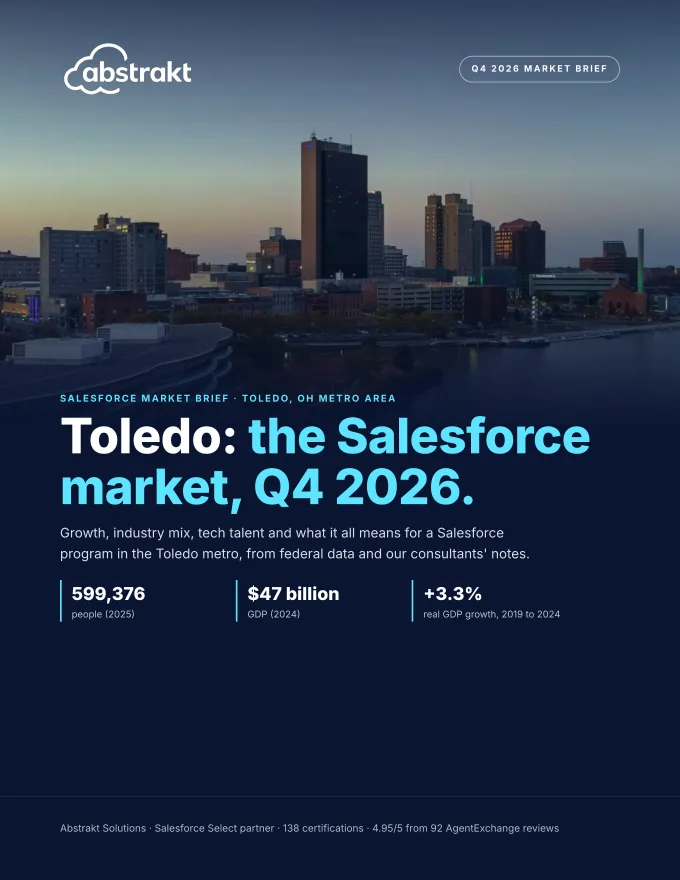
A free 21-page PDF with Toledo's growth ranked against 100 metros, its industry mix, tech wages and nearby markets. It is offered on the public Toledo page; send your customer there or get a copy for your own prep.
Get the Toledo brief →Co-sell with Abstrakt in Toledo
Working a Toledo account? Bring in a named consultant for discovery, scoping or a health check. We reply within 4 business hours.