

How Salesforce work starts in Greensboro
In Greensboro, High Point and across the Triad, Abstrakt Solutions helps furniture makers, manufacturers and distributors run sales, service and dealer channels on Salesforce. Greensboro is one of our focus markets.
What buyers here usually run into
- 1
Dealer and retailer channels
Furniture, apparel and consumer-products companies often sell through retailers and showrooms, so account hierarchies, order history and co-op programs need a clear structure.
- 2
Plant data out of reach
Manufacturers commonly keep pricing, inventory and order status in ERP, leaving sales and service teams to ask around. Integration closes that gap.
- 3
Agent and policyholder service
Insurance and financial operations handle high volumes of service requests where response times, audit trails and record privacy all matter.
Budget, team and partner questions
What drives cost
Triad project scope is driven by channel complexity: how many retailer hierarchies, rep groups and showroom relationships the model has to carry. ERP integration depth and the number of portal users add more, and moving off an old dealer database adds data cleanup time.
Admin or partner
Many Greensboro manufacturers have one person who owns Salesforce alongside other duties, and that rarely covers ERP integration and portal upkeep. A common split is an internal owner for users and reports, with a partner handling integration, releases and larger changes.
What buyers ask a partner
Ask a prospective partner to walk through how they would model a retailer with many stores and an independent rep who covers part of it. Ask how they keep ERP the source for pricing and inventory, and what they would build first if budget only allowed one phase.
The local economy and its biggest industries (4)
| Sector | Share of 2024 GDP | Where Salesforce fits |
|---|---|---|
| Manufacturing Salesforce for manufacturing → | 16.6% | Aviation, battery, apparel and furniture makers in and around Guilford County manage dealer relationships, engineered quotes and after-sale service that all depend on ERP data. |
| Wholesale trade Experience Cloud → | 8.6% | With supply chain and logistics on the Chamber’s target list and large distribution operations arriving, wholesalers here need account management, order visibility and self-service portals for B2B customers. |
| Health care and social assistance Salesforce for health & life sciences → | 8.0% | Health care is the metro’s third-largest private sector, and life sciences is a GROW target. Providers and life-sciences companies use Salesforce for patient and customer service, referrals and compliant outreach. |
| Finance and insurance Salesforce for insurance → | 6.8% | Insurers and financial firms in the Greensboro area need agent and policyholder views, service case handling and compliant marketing. |
Source: U.S. Bureau of Economic Analysis, GDP by county (CAGDP2), 2024, summed to the metro area; private sectors only, excluding real estate and government. “At least” marks sectors where BEA suppresses some county figures.
Regional target sectors named by local economic development groups: Advanced manufacturing (high-skill, high-tech), Aviation, Life sciences, Specialized business services (corporate headquarters, IT, etc.), Supply chain & logistics, Furniture.
Salesforce products that fit Greensboro (6)
In the order we lead with them here, from the industries above.
Salesforce Sales Cloud
The CRM where sales pipeline lives, when it is built right.
Salesforce Service Cloud
The operating system for modern customer service, case, knowledge, voice, and AI agent assist together.
Salesforce Experience Cloud
Customer, partner, and employee portals built on Salesforce.
Salesforce Revenue Cloud / CPQ
Configure-price-quote, billing, subscription management, and quote-to-cash on Salesforce.
Salesforce Field Service
Scheduling, dispatch, mobile work orders and parts for teams that work on site.
Salesforce Financial Services Cloud
Industry CRM for wealth management, banking, insurance, and lending, built for compliance from the start.
Greensboro distributors and makers: sensible AI steps
Manufacturing at 16.6% and wholesale trade at 8.6% of 2024 GDP give the Greensboro metro a strong business-to-business profile. Furniture and aviation suppliers field repetitive questions about availability, specifications, and order changes, and a well-scoped agent can resolve many of them with data pulled from connected systems. Sales teams gain from AI-drafted follow-ups and pipeline reviews that point out deals without recent activity. Aviation maintenance and equipment service crews can get suggested procedures from past jobs. Product data quality decides success here. When the catalog is incomplete, the agent should say so and hand off, a behavior we test before launch.
- Availability and order change answers
- AI-drafted sales follow-ups
- Past-job procedure suggestions
Services buyers here usually need (7)
Salesforce Implementation in Greensboro
Greensboro implementations tend to hinge on the sales channel before anything else. Many manufacturers and furniture companies here sell through dealers, retailers, showrooms and independent reps rather than directly, so the account hierarchy, partner access and order visibility decide whether the system works. We map those relationships in discovery workshops, design the data model and sharing rules before configuring anything, connect or plan the ERP link, and go live in phases, starting with the teams whose processes are clearest.
By industry in Greensboro
- 1
Manufacturing
Factories generate roughly 16.6% of Greensboro–High Point GDP, far ahead of any other private sector, across batteries, aircraft, apparel and furniture. Implementations for manufacturers here must handle products with many variants, dealer and distributor accounts, and after-sale service on equipment in the field. We decide in design how products and price books are structured, whether Revenue Cloud is needed at launch and how installed products link to accounts, because those choices are expensive to reverse once data accumulates.
- 2
Furniture
Furniture appears among the target sectors in the Greensboro Chamber's GROW strategy. For furniture companies, the implementation hinges on modeling the path from factory to consumer: independent reps with territories, retail customers with several locations, and showroom visits that produce orders weeks later. We design territory assignment, retailer account structure and visit tracking together, then decide how much of the order and inventory picture reps see inside Salesforce from the first release.
- 3
Finance and insurance
Life insurers, retirement providers and agencies in the Triad implement Salesforce to give service staff and agents a complete view of a client's policies and interactions. Financial Services Cloud supplies much of the structure, so the work concentrates on integrations with policy administration systems, agent access rules and consent tracking for marketing. We agree those boundaries in the first phase, because every later service process relies on them being settled early and documented.
Raise before scoping
Map the channel before building
Write down every path a product takes to the customer: direct accounts, distributors, retailers, reps and showrooms. Each path needs a role in the data model and a decision about what partners can see. Skipping this step leads to sharing rules that are rewritten after launch.
Plan for trade-event lead surges
Furniture and consumer-products companies can collect a large share of the year's leads in a few days at market events. Assignment rules, duplicate matching and follow-up tasks should be designed and tested before the event, not improvised while the leads are arriving.
Phase ERP visibility deliberately
Sellers want order status and inventory in the first release, but a rushed integration can delay the entire launch. Decide which ERP data phase one really needs, such as open orders, and schedule the rest for a later release once the core system is stable.
Salesforce Integration in Greensboro
For Greensboro companies, the point of integration is simple: sales, service and partner staff should stop phoning the plant or warehouse for answers. Pricing, inventory, orders and shipments live in ERP and warehouse systems, while sales, service and partners work in Salesforce. We map which system owns each field, choose between native connectors, direct APIs and middleware, design real-time calls only where they are needed and build monitoring so a failed sync reaches an admin quickly. Data quality fixes come before the first sync.
By industry in Greensboro
- 1
Retail trade
With retail trade near 7.7% of Greensboro's 2024 GDP, stores and consumer brands carry a sizable customer-service workload. Retailers and consumer brands need their commerce platform, order management and service systems connected so agents can see a customer's orders, returns and shipments on the case. We integrate order summaries rather than every transaction, set clear ownership of customer contact details and handle consent consistently across systems, so a marketing opt-out recorded anywhere is honored in every system that sends email.
- 2
Supply chain & logistics
Supply chain and logistics is one of the Chamber's GROW targets, and large distribution operations have been arriving in Guilford County. For logistics and distribution businesses, integration connects Salesforce with warehouse, transportation and ERP systems so account teams see shipments, exceptions and service levels without asking operations. We build event-based updates for the exceptions customers care about and scheduled syncs for history, keeping API usage and costs predictable during peak season.
- 3
Aviation
Aviation is a GROW target sector, and aircraft builders, maintenance providers and their suppliers rely on quality, maintenance and program systems that must remain the official records. Integration shares status, certifications and milestones with Salesforce so sales and customer service can answer questions, while detailed conformity and airworthiness records stay where they are. Integration users are scoped narrowly and every transfer is logged for quality audits. Customer approvals and their expiration dates are typically the first fields shared.
Raise before scoping
Publish a field ownership list
List every field that exists in more than one system and name its owner. The owner is the only place it can be edited; other systems display or copy it. Publishing that list keeps sellers from correcting an address in Salesforce that the ERP later overwrites.
Plan for on-premises systems
Some manufacturers and distributors still run ERP or warehouse software on their own servers. Reaching those securely requires an agent or middleware inside your network, firewall rules and service credentials, and your IT team should be involved from the first design session.
Clean before connecting
Integrations spread bad data faster than people do. Standardize customer numbers, product codes and address formats in both systems before the first sync, and add validation so new records meet the same standard, or mismatches will multiply across every connected system.
Salesforce Optimization in Greensboro
In Greensboro, optimization work often centers on account data and the channel. Distributors and manufacturers end up with duplicate accounts for each branch, ship-to and billing location, reps who log little and quote tools sellers avoid. We start by measuring what each team uses, then merge duplicates and set matching rules, simplify quoting and approvals, clean up overlapping automation and rebuild the reports leaders use. Changes ship in small releases, each tied to a measure such as quotes created in Salesforce.
By industry in Greensboro
- 1
Wholesale trade
Distributors and other wholesale trade firms, at roughly 8.6% of 2024 output, form the region's second pillar after its factories. Distributors often have Salesforce configured but inside and outside sales still working from ERP screens. Optimization adds order, invoice and credit status to the account, standardizes branch and ship-to structures, sets up follow-up automation for open quotes and gives managers territory reports based on actual orders rather than the logged activity that reps may skip.
- 2
Advanced manufacturing
The GROW strategy targets high-skill, high-tech advanced manufacturing, and makers of batteries, aircraft components and engineered products tend to have complex quoting. When Revenue Cloud or CPQ slows sellers down, we remove rules that do not affect price or configuration, fix templates and approvals and tie quotes to current ERP pricing. Service teams get cases linked to assets and part numbers, so quality issues surface to engineering quickly rather than weeks later.
- 3
Retail trade
Retailers and consumer brands using Service Cloud often find case categories inconsistent and customer history split between channels. Optimization cleans up case types and routing, adds knowledge articles and macros for frequent questions and gives agents a single customer view. Where volumes justify it, an Agentforce agent can then handle order-status questions, but only after the underlying case and knowledge data have been cleaned. Service leaders get dashboards that show why customers contact them.
Raise before scoping
Fix duplicate accounts first
Branch, billing and ship-to records often multiply into near-identical accounts that split activity and confuse reporting. Agree on an account structure, merge duplicates with care for related records and turn on matching rules so the problem does not quietly return within a quarter.
Make the partner portal worth visiting
Reps and dealers stop logging in when the portal holds nothing they need. Adding order status, current price lists, marketing assets and simple lead acceptance gives partners a reason to return, and the activity they log improves your forecast in turn.
Track results per release
Every optimization release should target something observable, such as fewer clicks to create a quote or more cases resolved without escalation. Measuring before and after keeps the work focused on value and gives sponsors evidence that the investment is paying back.
Salesforce Health Checks in Greensboro
A health check for a Greensboro organization often follows years of incremental growth: a partner portal added, a quoting tool bolted on, service teams brought in later. Partner visibility gets examined alongside internal sharing, followed by Apex, flows, connected systems, record quality and how licenses are actually used, all through read-only access. Every item on the resulting list carries a risk rating, an effort estimate and the exact component at fault. Anyone planning Agentforce should run this first; an agent inherits every loose permission and stale record already in place.
By industry in Greensboro
- 1
Health care and social assistance
Providers and social service agencies, together about 8.0% of the Greensboro economy, hold some of the most sensitive records any org will store. For providers, the review focuses on how patient-related information is exposed: permission sets granted for temporary projects, reports and dashboards shared to broad groups, file attachments on case records and service accounts left over from past integrations. Each finding is linked to the affected records and user groups, so privacy staff can prioritize remediation with confidence and document what changed.
- 2
Specialized business services
Corporate headquarters and shared IT functions, a focus of the GROW strategy, tend to own orgs that serve many business units at once. For them, the review looks at governance as much as configuration: who can deploy changes, whether a release process exists, how sandboxes are refreshed and whether each unit's customizations follow shared naming and design standards. The findings give IT leadership a basis for a governance model, not only a fix list.
- 3
Finance and insurance
Life and retirement carriers and agencies expect Salesforce to hold up under examination. The review tests whether agent and advisor access follows the book of business, whether consent records are complete and time-stamped and whether field history and event monitoring cover the changes auditors ask about. Integrations with policy and billing platforms are checked for credentials and permission scope, and findings reference the related compliance obligation clearly where one applies.
Raise before scoping
Review what partners can see
Experience Cloud portals for reps, dealers and retailers are a frequent source of overexposure. Guest user settings, sharing sets and external sharing defaults deserve careful review, because a single misconfiguration can show one partner another partner's accounts, pricing or customer contacts.
Clean knowledge before adding agents
Whatever an agent tells a customer comes from your articles and records. Outdated articles, duplicate cases and inconsistent product data lead to wrong answers delivered with confidence. The health check measures that content and data before a pilot, so the cleanup can be scoped and funded up front.
Check licenses against real usage
Orgs that grew over years often pay for licenses held by inactive users, unused feature add-ons or packages nobody opens. Comparing entitlements with login and usage data can identify savings that help fund the remediation work the review recommends in full.
Salesforce Managed Services in Greensboro
Managed services for Greensboro clients typically supports an org shared by sales, customer service and a partner channel, each with its own requests. We keep one ranked backlog with your internal owner, handle user and permission changes, maintain portals and price books, test each Salesforce release in a sandbox and call on developers or integration specialists only when a ticket requires them. Once a month we sit down with your owner to walk through delivered tickets, the queue ahead and any repeat request that hints at a design problem.
By industry in Greensboro
- 1
Finance and insurance
Insurance carriers, retirement providers and other finance firms make up close to 6.8% of Greensboro's 2024 economy. Insurance and retirement services teams need controlled change: every new field, permission set or service queue reviewed for privacy and logged with its approver. Managed services also covers the steady work of onboarding agents and service staff, updating consent handling as marketing rules change and verifying after each release that policyholder service screens still behave as expected. Audit teams get the change log on request.
- 2
Supply chain & logistics
Supply chain and logistics is a GROW target sector, and distribution and logistics companies here change their Salesforce orgs as customers, lanes and service offerings shift. Ongoing support covers new account types, rate or service fields, customer portal updates and monitoring of the integrations that feed shipment and order data. Tickets touching integrations are tested end to end, so a small change does not interrupt customer-facing status updates at a busy time.
- 3
Furniture
Furniture companies' Salesforce needs follow the market calendar. Before each major trade event we update lead forms, assignment rules and rep territories, then help clear the backlog of follow-ups afterward. Between events, managed services handles collection, fabric and product updates in price books, portal changes for reps and retailers, and report requests from sales leadership, so the org keeps pace with each new season's lines rather than lagging behind them.
Raise before scoping
Keep partner portals maintained
Experience Cloud portals for reps, dealers and retailers need their own attention: user onboarding, content updates, permission reviews and testing after each release. Including them in the managed services scope avoids the familiar pattern where internal users get support while partners quietly stop logging in.
Agree on service priorities
Define in writing what counts as urgent, such as a broken integration or locked-out agents, and what goes into the ranked backlog. Clear categories keep emergencies from waiting and prevent every request from being labeled urgent by whoever raises it.
Watch license and storage use
Seasonal staff, reps and partner users come and go. Reviewing license assignments and storage consumption each quarter frees licenses held by departed users and flags data growth early, which prevents surprise costs at renewal time and keeps audit findings about stale accounts off the list.
Salesforce Migration in Greensboro
Migrations for Greensboro companies often combine several sources: an older CRM, dealer and rep lists kept in spreadsheets, and customer records inside the ERP. Each spells accounts differently and holds its own version of contact details. Each source is profiled, the teams choose what earns a place in the new org, duplicates are merged under agreed survivorship rules, and trial loads repeat until totals and headline reports agree. The final cutover is rehearsed in a sandbox, and the old system stays available read-only afterward.
By industry in Greensboro
- 1
Furniture
Furniture companies often hold years of retailer and rep relationships across spreadsheets, an older CRM and order history in the ERP. Migration matches retailer locations to their parent buying groups, assigns reps and territories consistently and links historical orders so reps see what each store has bought. We clean store names and addresses carefully, since the same retailer frequently appears under several spellings. Showroom contacts collected at past events are deduplicated before loading.
- 2
Health care and social assistance
Providers and health services organizations moving to Salesforce from a legacy CRM or referral database need extra care with privacy. We agree which patient-related fields are migrated at all, apply encryption where required, restrict access during and after the load and document the process for compliance review. Referral sources are deduplicated and linked to accounts, so outreach teams start with a trustworthy list of referring practices and facilities on the first day.
- 3
Specialized business services
Specialized business services, including corporate headquarters and IT functions, is a GROW target sector. Headquarters operations consolidating several business units into one Salesforce org face a migration from multiple CRMs with different field definitions. We create a shared data dictionary, map each source to it, resolve customers that appear in several units and preserve which unit owns each relationship, so consolidated reporting is accurate from the first day. Before go-live, each division head confirms the customers attributed to their unit.
Raise before scoping
Find every shadow list
Beyond the official CRM, sales teams keep rep lists, retailer contacts and trade-event leads in personal spreadsheets. Gather those during discovery, decide which are worth migrating and retire them at cutover, or they will keep competing with Salesforce as the place people trust.
Preserve ownership and history
Users judge a migration by whether their accounts, notes and activity arrived intact. Map record owners carefully, bring over recent activities and key attachments and keep created dates where possible, so history reads correctly and reports on past activity remain meaningful.
Set a clear freeze point
Agree when users stop editing the old system, how late changes are captured and who approves the final load. A clearly communicated freeze avoids the common problem of records updated after extraction silently disappearing from the new org on the migration weekend.
Salesforce Implementation Rescue in Greensboro
Rescues in Greensboro often involve projects that underestimated the channel. A partner portal launched before sharing rules were right, reps saw each other's accounts, and trust collapsed. Others promised ERP-connected quoting and delivered neither. We triage the org, the original scope and the people involved, fix whatever blocks daily work, decide which components to keep, repair or rebuild and relaunch in stages, starting with the group most likely to succeed and influence the rest.
By industry in Greensboro
- 1
Aviation
Aviation suppliers and maintenance providers sometimes stall when Salesforce was designed without room for customer approvals, certifications or aircraft programs, so quality and sales teams kept their own trackers. Recovery adds those structures to the account and opportunity model, connects status from the quality system and migrates what the trackers held. Relaunching with quality and sales together matters in aviation, because both teams must trust the same approval dates before either will give up its spreadsheet.
- 2
Furniture
Furniture makers occasionally launch rep portals before the retailer and territory data behind them is clean, and reps react by abandoning the portal. The recovery pauses new partner onboarding, fixes retailer hierarchies and territory assignments, confirms each rep sees only their own accounts and relaunches with a small group of trusted reps. Their feedback shapes the wider rollout, often timed to begin before the next market event so it lands well.
- 3
Finance and insurance
A common failure point for carriers and financial firms is the policy or core-system connection: it slips, and service staff inherit a CRM without the details they came for. A rescue reduces the integration to the essential policy and client details, delivers that first and relaunches service workflows once staff can see what they need. The remaining integration scope is then planned in smaller releases with clear owners on both sides of the connection.
Raise before scoping
Rebuild partner trust carefully
If partners saw data they should not have, fixing the sharing model is only half of the recovery. Tell affected partners what changed, verify access with a test group before reopening the portal and monitor partner logins closely in the weeks after relaunch.
Reset the scope in writing
Stalled projects usually carry a mix of original requirements, informal promises and changes nobody approved. Write down what the rescue will and will not deliver, confirm it with sponsors and route new requests through a single owner so the scope stops moving.
Keep what already works
Even troubled orgs contain useful pieces: clean data in some objects, working integrations or well-designed layouts. Identifying those during triage protects the investment already made, keeps users on familiar screens and shortens the path to relaunch compared with rebuilding from a blank org.
Industry plays in Greensboro (4)
Salesforce for Greensboro Manufacturers
In the Greensboro-High Point area, manufacturing spans very different selling models: configurable furniture sold to retailers and designers, aviation work priced job by job, and advanced products qualified by engineers. Salesforce has to handle all three without forcing one pipeline on everyone. We usually build a shared account and contact layer, then give each business line its own record types, quoting rules and service processes, with the ERP supplying cost, capacity and order status.
Bureau of Economic Analysis county data put manufacturing at 16.6% of the metro's 2024 GDP, nearly double wholesale trade at 8.6%, the next-largest private sector. For Greensboro and Guilford County, rather than the full metro, the Greensboro Chamber of Commerce's GROW strategy names furniture, aviation and advanced manufacturing among its recruitment targets, next to supply chain and logistics. The Chamber's separate industries list adds chemicals, automotive and apparel. The result is a producer base where made-to-order goods, regulated aircraft work and engineered components share one labor market and often the same suppliers.
Use cases to open with
- 1
Configured furniture orders
Case goods and upholstery come in frames, fabrics and finishes that multiply quickly. CPQ with product rules keeps sales reps from quoting combinations the plant cannot build, pulls lead times from the ERP, and hands a clean order to production. Showroom and market-week contacts land on the same account, so follow-up after a trade event does not depend on a stack of business cards.
- 2
Aviation maintenance job tracking
Maintenance, repair and modification work is sold as discrete jobs with inspections, findings and change orders that can reshape the price midway. We model each aircraft or component as an asset, attach work scopes, estimates and customer approvals to it, and let account staff see exactly where a job stands. Service Cloud cases capture discrepancies raised after delivery, tied back to the original work order so quality and sales review them together.
- 3
Engineering-led technical sales
Advanced manufacturers often win business through design-in cycles, where an application engineer supports a customer's prototype long before volume orders arrive. Opportunity teams, sample requests and technical milestones in Sales Cloud show which designs are progressing and which have stalled at the customer. Forecasts can then separate committed production from pipeline that still depends on the customer's own product launch, which gives planners a more honest view of next year's load.
Raise before scoping
One org, several business models
Diversified Triad manufacturers often run furniture, industrial and aviation lines under one parent. Agree on shared objects, naming and reporting early, and isolate line-specific automation, so a change for one division does not break another division's quoting or service flow.
Aviation records and traceability
Aircraft work depends on part, serial and certification history kept in quality and maintenance systems. Salesforce should reference those records rather than copy them, and access to regulated technical data should follow your quality manual, which we review with your team before design.
Reps who work on the road
Furniture and component reps spend their time in showrooms and customer plants. Mobile layouts, quick visit logging and offline access matter more than dashboards, so plan field testing with real reps before rollout instead of relying on office reviewers alone.
Salesforce for Greensboro Retail and Consumer Brands
Consumer brands around Greensboro typically sell two ways: wholesale to store chains and specialty retailers, and direct to shoppers online. Salesforce works when those channels share one product and customer foundation but keep their own processes. Buyers get account plans, line reviews and reorder visibility; shoppers get service and marketing driven by what they bought. We connect order and inventory data from the ERP or commerce platform so both teams see the same stock and the same history.
Retail trade accounted for 7.7% of the metro's 2024 GDP by Bureau of Economic Analysis county figures, and wholesale trade for 8.6%, which together outweigh any sector except manufacturing. The Greensboro Chamber lists consumer products and apparel among the area's industries, and its GROW strategy for Greensboro and Guilford County targets supply chain and logistics. That combination points to brands that design, source and ship from the Triad, selling through national retailers as well as their own channels, rather than a market defined mainly by local storefronts.
Use cases to open with
- 1
Retailer account planning
Selling into a chain means seasonal line reviews, assortment decisions and promotional calendars negotiated with a small buying team. Sales Cloud account plans hold those commitments, track which styles were accepted per season, and let brand managers compare sell-in against targets by retailer. Reorder alerts built from ERP shipment data help reps call buyers before an item runs out on the shelf.
- 2
Direct shopper service
When a brand also sells online, shoppers contact it about sizing, returns and late deliveries, usually in bursts around promotions and holidays. Service Cloud with order data from the commerce platform lets agents see purchases, shipping status and prior contacts on one screen. Knowledge articles answer fit and care questions consistently, and Agentforce can take routine order-status requests once the underlying order data is complete and trustworthy.
- 3
Marketing from purchase history
Marketing Cloud uses what shoppers bought, returned and browsed to time emails and messages around the product calendar and seasonal launches. Data 360 (formerly Data Cloud) can unify profiles from the online store, loyalty program and service records, so a customer who just filed a return is not sent a promotion for the same item a day later. Consent and channel preferences travel with each profile, which keeps outreach within what each shopper agreed to.
Raise before scoping
Separate wholesale and consumer data
Store buyers and individual shoppers need different objects, sharing rules and privacy handling. Keeping business accounts and person records distinct from the start avoids merged reports that mix a retailer's purchase orders with a shopper's return requests, and it keeps consumer data out of wholesale reps' views.
Style, color and size data
Apparel and home goods carry large variant catalogs that change each season. Decide how much product detail Salesforce needs, usually style level with variants referenced from the ERP or product information system, so the org stays fast and reports remain readable.
Retailer data arriving late
Point-of-sale and inventory files from retail partners come in varying formats and on different schedules. Plan a staging and validation step before that data reaches account plans, or reps will lose trust in the numbers the first time a feed breaks.
Salesforce for Greensboro Insurers and Agencies
For insurers and agencies around Greensboro, Salesforce usually has two jobs at once: keep producers productive and keep policyholder service orderly. Financial Services Cloud gives each household or business a single record with policies, claims status and open requests pulled from the policy administration system. Service Cloud routes calls, emails and web forms to the right team, and renewal work surfaces early enough to act. We keep the policy system as the source of truth and let Salesforce own relationships, activity and service.
Finance and insurance accounts for 6.8% of the Greensboro-High Point metro's 2024 GDP in Bureau of Economic Analysis county data, the fifth-largest private sector after manufacturing, wholesale trade, health care and retail. The Greensboro Chamber of Commerce includes financial services in the industries list on its Economy page, and its GROW strategy targets specialized business services such as corporate headquarters and IT. Insurance work here therefore spans producer-facing sales, back-office service and shared operations that support policyholders well beyond Guilford County, all drawing on the same regional labor pool.
Use cases to open with
- 1
Producer and agency management
Carriers that sell through independent agencies need to know which producers write profitable business and which are drifting away. Salesforce holds each agency as an account with appointments, licenses, production and loss ratios loaded from policy systems. Territory managers log visits, spot agencies whose submissions have slowed, and plan joint marketing, while leadership sees production by region without waiting on a monthly spreadsheet from finance.
- 2
Policyholder service at volume
Address changes, certificate requests, billing questions and coverage inquiries arrive through phone, email and web forms. Service Cloud turns each one into a case, routes it by line of business and skill, and gives representatives the policy summary and prior interactions on one screen. Supervisors watch queue age and first-contact resolution, and knowledge articles keep answers consistent when new staff join the team.
- 3
Renewal and retention outreach
For agencies and direct writers alike, the renewal conversation decides whether a policyholder stays or shops elsewhere, so timing matters a great deal. Salesforce can create renewal tasks well ahead of expiration, flag accounts with recent claims or complaints, and trigger reminders through Marketing Cloud. Account managers see which commercial policies need a review call and which personal-lines households could benefit from cross-sell conversations about coverage they hold elsewhere.
Raise before scoping
Policy system as source
Coverage limits, premium and billing status belong to the rating and billing platforms you already run. Decide which fields Salesforce displays, which it stores and how often data syncs, so service staff are never looking at a stale limit or an outdated balance when a policyholder calls.
Protecting consumer financial data
Policyholder records carry personal financial details, and some lines include health information. Plan field-level security, encryption and role-based sharing with your compliance lead, and treat GLBA obligations and any applicable state insurance privacy rules as design inputs rather than afterthoughts during build.
Agents outside your walls
Independent agents will not log into a system that feels like extra work. If you open an Experience Cloud portal for submissions or status checks, keep it narrow, fast and mobile-friendly, and test it with a few friendly agencies before inviting everyone else.
Salesforce for Greensboro Health and Life Sciences
Around Greensboro, health care and life sciences meet at two points: care delivery that depends on referrals and patient access, and research-driven companies that sell to labs, growers or clinicians. Salesforce can serve both if the design respects clinical systems. Providers use Service Cloud and Experience Cloud for scheduling help, referral intake and follow-up, while life-sciences teams use Sales Cloud for scientific accounts. Protected health information stays governed, and the EHR remains the clinical record.
Care providers and social assistance organizations generate 8% of the Greensboro-High Point economy by the BEA's 2024 county numbers, trailing only manufacturing and wholesale trade among private industries. The Greensboro Chamber of Commerce's GROW strategy lists life sciences among its recruitment targets for Greensboro and Guilford County, alongside advanced manufacturing and aviation. Research capacity supports that goal: a 105,000 sq ft nanoscience and nanoengineering facility sits in a university research park, and the Chamber cites seven colleges and universities in the Guilford County area with 54k+ total enrollment.
Use cases to open with
- 1
Referral intake and tracking
Orthopedic, cardiology and imaging groups in the Triad live on inbound referrals from primary care offices and urgent care clinics. Salesforce can capture each referral from fax, portal or phone as a record, track it through scheduling, and alert staff when one stalls. Physician liaisons see which referring offices send patients, which have slowed down and where a visit or a quick call would help.
- 2
Patient access and communication
Patients call about appointments, prep instructions, billing and records, often to several departments. Service Cloud gives access-center staff one view of the patient's open requests with the right privacy controls, and Agentforce can answer routine questions such as directions or preparation steps. Reminders and post-visit surveys go out through consented channels, and the EHR stays the record for anything clinical.
- 3
Research and commercial partnerships
Life-sciences startups and established firms in the Triad work with university labs, contract partners and early customers at the same time. Sales Cloud can track sponsored research agreements, sample requests and pilot programs next to commercial opportunities. Business development leaders then see which collaborations are turning into revenue and which need attention, instead of reconstructing the picture from email before every board meeting.
Raise before scoping
HIPAA and data boundaries
Where Salesforce holds protected health information, you need a business associate agreement, careful field-level security and audit trails. Many teams store only the minimum clinical detail and link back to the EHR. Your privacy officer should sign off on those limits while the data model is still on paper.
EHR and lab system integration
Scheduling, referral status and patient demographics usually originate in the EHR, while research firms rely on lab or quality systems. Plan integration through MuleSoft or vendor APIs early, agree on matching rules for patients and providers, and test with real volumes before go-live.
Two audiences, one org
Organizations serving both clinicians and commercial buyers need separate record types, page layouts and sharing rules. A research scientist and a patient-access representative should never see each other's data by default, so design the permission model before building screens or reports.
Case studies to send (3)
From the industries this market leans on. Client names are anonymized and these projects are not specific to Greensboro.
The Greensboro Salesforce market brief, Q4 2026
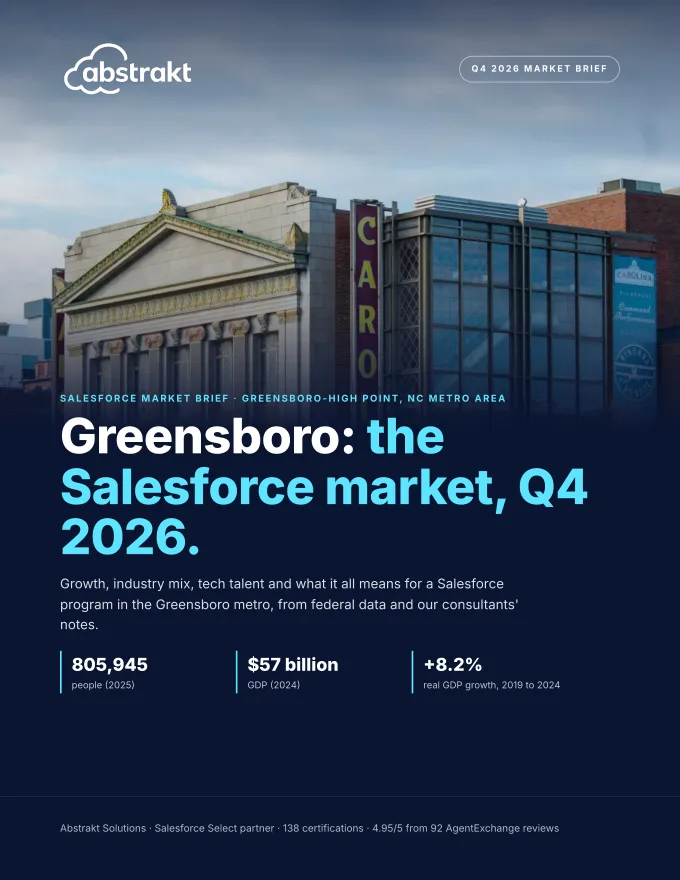
A free 25-page PDF with Greensboro's growth ranked against 100 metros, its industry mix, tech wages and nearby markets. It is offered on the public Greensboro page; send your customer there or get a copy for your own prep.
Get the Greensboro brief →Co-sell with Abstrakt in Greensboro
Working a Greensboro account? Bring in a named consultant for discovery, scoping or a health check. We reply within 4 business hours.