

How Salesforce work starts in Durham
Life sciences, research and health organizations throughout the Durham-Chapel Hill metro work with Abstrakt Solutions, a Salesforce Consulting Partner, on implementation, integration and support. Durham is one of our focus markets.
What buyers here usually run into
- 1
Regulated life-sciences data
Pharma and biotech companies need Salesforce designs where validation, consent and access to medical or product-quality data are settled before launch.
- 2
Research and grant-funded work
Research organizations often track sponsors, proposals and deliverables in separate tools, which makes pipeline and capacity hard to see in one place.
- 3
Many systems, one customer
Technology and financial firms commonly run marketing, product and billing data in separate platforms. Integration and clean data come before AI features pay off.
Budget, team and partner questions
What drives cost
Durham costs are shaped by validation and documentation requirements for life sciences workflows, the number of quality, clinical and ERP systems to connect, and how consent is handled across patients, donors and research participants. Startups at the earlier stage spend far less because their scope is mostly pipeline design.
Admin or partner
Large biopharma companies here usually run Salesforce internally and bring in partners for specific programs and integration. CROs, research institutes and startups more often use managed services, keeping a business owner who understands the regulatory constraints.
What buyers ask a partner
Ask how the partner documents testing for validated workflows and what evidence they hand over at go-live. Research organizations should ask for references that tie proposals or grants to delivery records, not just a sales pipeline.
The local economy and its biggest industries (4)
| Sector | Share of 2024 GDP | Where Salesforce fits |
|---|---|---|
| Manufacturing Salesforce for health & life sciences → | 20.6% | Much of Durham’s manufacturing output is pharmaceutical and biomanufacturing, led by multinational drug and biologics producers in the county. Salesforce work here centers on account management, medical inquiries and complaint handling with strict audit trails. |
| Professional, scientific, and technical services Salesforce for professional services → | 12.8% | Nonprofit research institutes and technology companies around Research Triangle Park manage long sales cycles, sponsor and partner relationships, and reporting for leadership. |
| Health care and social assistance Salesforce for health & life sciences → | 7.8% | With two university-affiliated academic medical systems in the metro, health care organizations here need patient and referral workflows, donor and community outreach, and service designed around privacy rules. |
| Finance and insurance Financial Services Cloud → | 6.3% | Finance and insurance contributes 6.3% of 2024 metro GDP, and wealth, insurance and fintech firms in the Triangle need client views, supervised communications and compliant marketing. |
Source: U.S. Bureau of Economic Analysis, GDP by county (CAGDP2), 2024, summed to the metro area; private sectors only, excluding real estate and government. “At least” marks sectors where BEA suppresses some county figures.
Regional target sectors named by local economic development groups: Life Sciences (pharma/biopharma manufacturing, ag biotech, medical devices, CROs, gene therapy), Advanced Manufacturing, Healthcare, Technology (incl. cybersecurity, defense technology, fintech), CleanTech (incl. EV & battery tech), AgTech.
Salesforce products that fit Durham (6)
In the order we lead with them here, from the industries above.
Salesforce Service Cloud
The operating system for modern customer service, case, knowledge, voice, and AI agent assist together.
Salesforce Sales Cloud
The CRM where sales pipeline lives, when it is built right.
Salesforce Agentforce
AI agents that handle real work inside Sales Cloud, Service Cloud, and Marketing Cloud.
MuleSoft
Enterprise API platform, for connecting Salesforce, ERP, data warehouses, and the rest of your stack.
Salesforce Financial Services Cloud
Industry CRM for wealth management, banking, insurance, and lending, built for compliance from the start.
Tableau
Executive analytics, embedded dashboards, and CRM Analytics built on Tableau.
Durham life sciences and the limits of AI automation
Manufacturing is 20.6% of Durham's metro GDP in 2024, with pharmaceutical and biopharma production prominent among regional targets, and professional, scientific, and technical services add 12.8%, including contract research. In those settings, AI is most useful on commercial and operational work, not regulated decisions. Contract research teams can summarize sponsor correspondence and track open requests. Commercial groups can triage inbound inquiries from labs and hospitals. Medical information teams might pilot grounded answers, but only from reviewed, versioned content with a pharmacist or scientist approving responses. Validation expectations mean each workflow needs documented testing, so we scope a small first release and build the evidence trail alongside it.
- Sponsor correspondence summaries
- Lab and hospital inquiry triage
- Reviewed medical information answers
Services buyers here usually need (7)
Salesforce Implementation in Durham
Implementing Salesforce in the Durham-Chapel Hill metro often means designing for regulated or research-driven work. Drugmakers need medical inquiry and complaint handling with audit trails, contract research firms track proposals through award, and technology companies around Research Triangle Park sell through long enterprise cycles. We run discovery with each group, agree on a data model and access rules, build in a sandbox with validation documentation where required, and launch in phases so the first teams are productive while later workstreams are still being built.
By industry in Durham
- 1
Manufacturing
Manufacturing produced 20.6% of Durham-Chapel Hill GDP in 2024, the largest private share, and a large part of that output comes from drug and biologics plants. Implementations for these companies need a data model that keeps commercial accounts apart from medical and quality interactions, with Service Cloud handling inquiries and product complaints under strict audit trails. We document requirements and test evidence in a form quality teams can use for validation, and agree which records must stay out of the CRM entirely.
- 2
Life Sciences
The Greater Durham Chamber's economic development arm lists life sciences, including contract research organizations, medical devices and gene therapy, among its focus clusters. Each of those needs a different build. A CRO's org revolves around bids, budgets and awarded studies, while a device maker needs installed-base records, service contracts and field visits. A gene therapy company still years from launch may need only partner and site relationships. We decide which pattern applies during discovery, before any objects are designed.
- 3
Technology
The Research Triangle Regional Partnership names technology, including cybersecurity, defense technology and fintech, as a Triangle target. Software and hardware firms implementing Salesforce typically need account-based selling with partner channels, forecasts by product line and a clean handoff from sales to onboarding. For defense technology suppliers, we also design restricted record access from the outset, since program information cannot be visible to everyone who happens to hold a Salesforce license.
Raise before scoping
Plan validation documentation early
Life-sciences companies may need to validate Salesforce functions that touch product quality or safety reporting. Decide which processes fall in scope, and produce requirements, test scripts and evidence as part of the build, rather than reconstructing them for a quality reviewer afterward.
Keep scientific data in its home
Trial results, lab data and clinical records belong in specialized systems. Salesforce should hold relationships, proposals and summaries, with links back to the source. Drawing that boundary early prevents a Durham CRM from turning into an unmanaged copy of regulated data.
Keep a written decision log
Life sciences projects pull in quality, regulatory and commercial leads whose calendars rarely line up. Record each build review and log every design decision with its owner, so anyone who missed a session can catch up and sign off without reopening settled questions.
Salesforce Integration in Durham
Durham organizations tend to run many specialized systems, and integration decides whether Salesforce becomes a trusted view or another silo. Pharma and device companies connect ERP, quality and safety systems; research organizations link proposal, grant and project tools; technology and financial firms feed product usage, billing and custodial data into customer records. We map ownership for each data element, design flows through MuleSoft or APIs, protect regulated fields in transit and build monitoring with clear owners.
By industry in Durham
- 1
Professional, scientific, and technical services
At 12.8% of GDP, Durham-Chapel Hill's research, engineering and consulting firms rank second only to manufacturing among private sectors. Research institutes and consultancies often run proposals in Salesforce, projects in a project management tool and time and billing in finance software. Integrating them lets business development see burn rates and follow-on opportunities without asking project managers. We sync summaries rather than detailed timesheets, keeping volumes low and sensitive rate data out of general view.
- 2
Life Sciences
Pharmaceutical and device companies usually connect Salesforce to ERP for orders, to quality systems for complaints and to safety databases for adverse event reporting. Those handoffs are regulated and inspected, so we design them with acknowledgments, reconciliation reports and audit logs, and we validate them where required. Commercial data, such as account, contact and territory updates, can move through lighter, faster flows because it carries a different level of risk.
- 3
Finance and insurance
Wealth and insurance firms need custodial positions, policy data and planning information visible in Financial Services Cloud without letting CRM users edit source records. We design scheduled or event-driven loads from each system, restrict sensitive fields by role and keep a transfer log. For firms with many custodians, carriers and planning tools, MuleSoft provides a reusable layer that makes adding the next custodian or carrier far less work than another point-to-point build.
Raise before scoping
Separate regulated and commercial flows
Integrations carrying complaints or adverse events need stricter controls than those moving account updates. Design them as distinct flows with their own monitoring, alerting and validation package, so a change to a commercial sync never forces revalidation of a safety process.
Summarize before syncing
Research and billing systems produce detailed records that Salesforce users rarely need line by line. Aggregate hours, spend or usage before loading, which respects API limits, controls storage costs and keeps sensitive rate or participant detail in the system that already protects it.
Document every mapping
Durham organizations often maintain integrations across several departments, vendors and funding cycles, and the person who built a flow is rarely the one who later fixes it. A shared mapping document listing fields, transformations, owners, schedules and error handling lets future admins, vendors and auditors understand every flow without reverse-engineering it from logs.
Salesforce Optimization in Durham
Durham orgs that need tuning have usually absorbed several rounds of hiring, new products or acquired teams. A technology firm or research organization that added teams, products and acquisitions ends up with overlapping automation, duplicate fields and reports that disagree. We examine usage data and interview users, then streamline layouts, merge Flows, repair data quality rules and rebuild the dashboards leadership reviews. Where analysis needs more than Salesforce reports can provide, Tableau takes over. Changes are delivered in small, tested releases, so the org improves without a disruptive rebuild.
By industry in Durham
- 1
Finance and insurance
The metro's finance and insurance firms, 6.3% of Durham-Chapel Hill output, include wealth managers and insurers with advisor-heavy orgs. Advisors in those orgs often ignore half of each page because it was laid out for another team's process. Optimization tailors layouts by role, automates follow-ups that assistants currently track by hand, and restores confidence in household and asset reporting. We review compliance fields with supervision staff before changing them, since some must remain even when advisors rarely touch them.
- 2
Professional, scientific, and technical services
Research institutes, engineering firms and consultancies often track proposals, projects and sponsors in Salesforce alongside separate project tools. The result is duplicate entry and pipeline reports that miss funded work. We simplify the proposal lifecycle, remove fields that duplicate the project system and rebuild capacity and win-rate dashboards, so leaders see which sponsors and practice areas deserve investment. Grant-funded groups also get reporting that separates awards, renewals and new pursuits clearly.
- 3
Technology
Software and networking companies in the Triangle frequently run orgs shaped by several sales leaders in succession, each adding stages and fields. We consolidate opportunity stages, align forecast categories with how the business actually commits numbers, and remove automation that sends duplicate notifications. Product usage and support data can be surfaced where they improve renewal and expansion conversations. The goal is an org reps open willingly, not one they update in a rush before forecast calls.
Raise before scoping
Agree on metric definitions first
Two Durham dashboards showing different pipeline totals usually reflect two private definitions of bookings or an active customer. Settle those definitions with finance, research and sales leadership before rebuilding reports, then publish them in a glossary where every Durham report builder and analyst can find them.
Consolidate before adding AI
An agent answering sponsors or customers will draw on whatever fields exist, including the stale ones nobody cleaned up. Removing duplicate fields and clarifying automation is often the most useful preparation for AI, even when the stated goal is simply cleaner screens, and it costs far less than cleaning up after a pilot misfires.
Use Tableau where reports struggle
Salesforce reports handle operational views well, but cross-object trends, blended finance data and long histories suit Tableau better. Moving heavy analysis there lets you retire dozens of fragile summary fields and report types, simplifies the org and gives Durham analysts tools designed for exploration.
Salesforce Managed Services in Durham
In Durham, the case for outside Salesforce support rests on audit-ready change control nearly as much as on spare hands. Health systems, drugmakers and investment firms need every configuration change requested, approved, tested and recorded. We handle user administration, automation fixes, reports and small enhancements from a ranked backlog, assess each Salesforce seasonal release against your org and deploy on an agreed schedule. Work is tracked in a shared queue your admin and business owners can see, and a monthly review sets priorities for the next cycle.
By industry in Durham
- 1
Health care and social assistance
Health care and social assistance makes up about 7.8% of metro GDP, anchored by two university-affiliated academic medical systems. Their Salesforce teams juggle patient outreach, referral workflows, donor relations and community programs, often with separate owners for each. Managed services gives them one queue for all of it, with privacy review built into every change, prompt access removal when staff leave, and release testing on the outreach journeys and referral routing clinicians depend on.
- 2
Finance and insurance
Wealth, insurance and fintech companies across the Triangle run Salesforce under supervision rules that make every configuration change a compliance event. Ongoing support for them means change control an auditor can follow, regular access reviews, careful handling of Financial Services Cloud upgrades and reporting requests delivered without opening sensitive fields to broad audiences. We also keep integration monitoring current as custodial and planning systems change underneath.
- 3
Life Sciences
Commercial, medical and quality teams in the county's pharmaceutical and device companies often share one org while working under very different rules. Managed services must respect those boundaries: validated processes change only through documented procedures, while sales-side reports and layouts can move faster. We run separate release tracks for regulated and non-regulated work, keep test evidence current and flag any Salesforce seasonal update that could touch validated functionality before it reaches production.
Raise before scoping
Separate regulated change tracks
If some processes are validated, route changes to them through a stricter path with impact assessment and testing evidence. Everything else can move faster, which keeps the whole org from being slowed to the pace of its most controlled function.
Define ownership across departments
Academic medical centers, research institutes and larger companies in Durham often have several departments sharing one org. Agree on who approves changes for each area and how conflicts are resolved, so the managed team is never left arbitrating between competing requests.
Review access every quarter
Turnover in research, clinical and consulting roles can leave accounts active longer than intended. A scheduled review of users, permission sets, connected apps and integration accounts closes those gaps and gives security teams a record they can show auditors on request.
Salesforce Health Checks in Durham
Durham organizations often ask for a health check when an auditor, a customer security review or an AI initiative raises questions nobody can answer quickly. The work spans who can see and export what, how each connected system authenticates, what Flow and Apex do on save, and how complete the core objects are, backed by interviews with admins and heavy users. Findings are ranked by risk and effort, with a clear note on anything that could affect validated processes, regulated data or readiness for Agentforce.
By industry in Durham
- 1
Healthcare
Healthcare is one of the Greater Durham Chamber's focus clusters, and provider organizations here use Salesforce for outreach, referrals and philanthropy as well as patient service. A health check traces where protected information appears, including reports, files, email templates and integration logs, and compares actual access with policy. We also review event monitoring and field history settings, so the organization can reconstruct who viewed or changed a sensitive record, and when, if asked.
- 2
Life Sciences
In the metro's pharmaceutical, device and gene therapy companies, some Salesforce functions support regulated processes such as complaint intake or medical inquiries. The review checks whether those functions still match their validated state, whether changes since validation were documented and whether permissions allow edits that should require approval. Findings are separated into regulated and commercial areas in the written report, so quality and commercial leaders can each act on the items they own.
- 3
Technology
Technology, cybersecurity and defense technology firms often face customer security questionnaires that probe their CRM in detail. A health check produces the supporting evidence in one place: session and password policies, multi-factor coverage, integration permissions, connected apps, data export controls and audit logging. It also surfaces technical debt such as unused managed packages, stale Apex classes, abandoned test users and duplicate automation that slows the org and complicates future AI work.
Raise before scoping
Include connected apps and packages
Many orgs accumulate connected apps and installed packages with broad access, some from trials that ended long ago. Inventory them, confirm each has a named owner and a current purpose, and remove or restrict the rest as part of the review before an auditor finds them first.
Score data quality per use case
General data quality scores hide what matters. Measure completeness and accuracy on the fields a specific process or AI use case depends on, such as case categories or account industry, so findings translate directly into go or no-go decisions for each planned pilot.
Bring compliance into the readout
Share findings with security, compliance and quality leaders together in one session rather than separate briefings. In Durham's regulated industries, their priorities and upcoming inspections shape which fixes go first, and involving them early avoids a second round of review after remediation begins.
Salesforce Migration in Durham
Migration projects in Durham often involve data built up by researchers, business developers and program staff in tools never designed for sharing: departmental databases, spreadsheets, a legacy CRM or several at once. We inventory those sources, agree on a target model, map fields, standardize values and remove duplicates in staging. Trial loads run in a sandbox where users confirm their own records. Regulated information is classified first, so only data that belongs in Salesforce is moved and nothing sensitive lands without controls.
By industry in Durham
- 1
Professional, scientific, and technical services
Research organizations and consultancies frequently hold sponsor and client history across proposal archives, shared drives and a contact database. Migrating that into Salesforce means linking contacts to the right institutions, reconstructing proposal outcomes and carrying over award values leadership uses for win-rate analysis. We agree on how far back history should go and archive the rest where proposal teams can still search it. Lists kept by individual researchers are merged carefully so relationships survive staff departures.
- 2
Health care and social assistance
Health systems and community providers moving outreach, donor or referral data into Salesforce must decide what counts as protected information before anything moves. We classify fields, carry over communication preferences and consent, and load clinical references only as identifiers linked back to the EHR. Grateful-patient and donor programs need extra care, because rules about using patient information for fundraising shape which fields may transfer at all, and development officers should confirm those rules before mapping starts.
- 3
Technology
Technology startups and scale-ups around Research Triangle Park often outgrow a starter CRM once enterprise deals, partner channels and renewals appear. Migration moves accounts, contacts, open deals and relevant activity, while redesigning stages and fields rather than copying the old tool's limitations. We also bring subscription terms and renewal dates across accurately, and reconcile them against billing, since errors there distort forecasts and customer success work in the first quarter after cutover.
Raise before scoping
Classify data before moving it
Durham organizations often hold research, clinical or personal financial information alongside ordinary contact details. Tag each source field by sensitivity and decide whether it belongs in Salesforce, needs restricted visibility or should stay in its current system, before anyone writes a mapping.
Gather personal contact lists early
Individual scientists, advisors and sales staff keep their own contact lists. Collect those spreadsheets and address books early, deduplicate them against the main sources and confirm ownership, so valuable relationships are not lost and nobody is surprised to find their contacts reassigned.
Keep the legacy freeze short
Plan a brief edit freeze on the old system, run the final load plus a delta of recent changes, and open Salesforce to users right after validation. Leave the legacy tool in view-only mode for a period so people can check history while they build trust in the new records.
Salesforce Implementation Rescue in Durham
Rescue work in Durham frequently involves projects that underestimated regulated or research-specific requirements. A build may have launched without validated complaint handling, without the sponsor and proposal structures researchers need, or with integrations that were never finished. We start with triage: reviewing the org, contracts, backlog, test evidence and user feedback. Then we agree on what to keep, repair or rebuild, and deliver a phased recovery that restores the processes people need most before adding what was deferred.
By industry in Durham
- 1
Manufacturing
For drug and biologics manufacturers, a troubled Salesforce launch can create regulatory exposure as well as frustration, particularly if complaints or medical inquiries were moved into an incomplete system. Recovery starts by confirming that every regulated intake path works end to end and that records reach quality and safety teams. Only after that do we address commercial features, territory reporting and the user experience improvements the original project left unfinished, in an order the quality lead has approved.
- 2
Professional, scientific, and technical services
Research institutes and consultancies sometimes end up with an org modeled like a product sales business, where proposals, sponsors and awards do not fit. Proposal managers end up tracking the real status of each bid in side files outside the org. Rescue redesigns the model around proposals, sponsors and funded work, migrates what was captured correctly, and rebuilds the pipeline and capacity reports leadership wanted in the first place, so business developers have a reason to return.
- 3
Finance and insurance
Wealth and insurance firms may inherit a Financial Services Cloud project that loaded client data but left supervision, consent or custodial integrations incomplete. Advisors quickly lose interest when balances are missing, stale or simply wrong. Recovery closes supervision and consent gaps first, then finishes or replaces the custodial integrations and retrains advisors on a streamlined process, with dashboards that show household activity, open service requests and follow-ups in one place.
Raise before scoping
Review test evidence honestly
If validation was part of the original plan, find out which tests were actually executed and documented. Gaps here define much of the recovery work for life-sciences organizations, and discovering them late can delay go-live after other issues are fixed.
Interview people who stopped using it
Users who abandoned the system explain its real problems more clearly than status reports. Talk with a sample from each Durham team, including the loudest skeptics and the quiet dropouts, and let their feedback shape the priority list before any code changes.
Contain scope during recovery
Rescue projects attract new requests because leaders sense momentum. Keep a separate parking list for new ideas and address them only once the promised scope works in production, or recovery will stall for the same reasons the first project did.
Industry plays in Durham (4)
Salesforce for Durham Health and Life Sciences
In Durham and Chapel Hill, health and life sciences covers contract research, gene therapy and device development as well as patient care. Salesforce supports each differently. Research organizations use it for sponsor relationships, proposals and study awards. Therapy and device companies use it for engagement with clinicians and for patient support programs. Providers use it around the EHR for access and outreach. We start by mapping which of these motions you run and which data rules apply to each.
Health care and social assistance produced 7.8% of 2024 metro GDP in Bureau of Economic Analysis county data, but life sciences reaches further, since pharmaceutical manufacturing is counted within manufacturing, the region's largest private sector. Durham Economic Development, part of the Greater Durham Chamber of Commerce, lists life sciences as a cluster that spans biopharma manufacturing, ag biotech, medical devices, contract research organizations and gene therapy, alongside a separate health care cluster. Research Triangle Park, founded in 1959, covers 7,000 acres with more than 385 companies and sits at the center of three Tier-1 research universities.
Use cases to open with
- 1
Contract research business development
Contract research organizations win work through requests for proposal, bid defense meetings and master service agreements with sponsors. Sales Cloud can model each opportunity by therapeutic area, study phase and service scope, attach budgets and proposal versions, and track sponsor decision makers across programs. Leadership sees awarded backlog alongside pipeline, and capacity planners get early notice of studies likely to start in each region.
- 2
Clinician and investigator engagement
Therapy developers and device makers build relationships with physicians, investigators and key opinion leaders long before launch. A Salesforce data model for healthcare professionals, institutions and interactions, with rules for what field teams may discuss and record, keeps engagement compliant and visible. Medical affairs and commercial teams share contact history while seeing only the fields their role permits under company policy.
- 3
Patient support programs
Rare disease and gene therapy patients often need help with benefits verification, financial assistance, travel and treatment scheduling. Service Cloud case management, with Experience Cloud portals for patients and caregivers, coordinates those steps across case managers, specialty pharmacies and treatment centers. Consent is captured at enrollment and governs every later contact, and program reporting keeps outcomes data separate from commercial dashboards so field teams never see patient-level details.
Raise before scoping
Validated systems and GxP
When Salesforce records support regulated activities, such as complaints, adverse event intake or controlled documents, your quality team may require computer system validation. Decide early which processes fall in scope, and build test scripts and change control into the project plan instead of adding them before go-live.
Healthcare professional compliance
Interactions with physicians carry transfer-of-value reporting and promotional review obligations. Configure meal, sample and payment tracking so data flows to your aggregate spend process, and restrict free-text fields where reps might record off-label or sensitive content that compliance would rather not store.
Patient data separation
Patient support data is protected health information and must stay walled off from sales and marketing users. Use separate record types, sharing rules and sometimes separate orgs, plus a business associate agreement, and document how HIPAA obligations map to each role before loading any patient records.
Salesforce for Durham Manufacturers
Manufacturing around Durham is less about high-volume assembly and more about regulated, science-heavy production: biologics and drug products, medical devices, and components for batteries and clean energy. Salesforce supports the commercial and customer side of that work, including contract manufacturing proposals, hospital device approvals, clean technology qualification, customer quality communication and service on installed equipment. We connect it to ERP, quality and manufacturing systems so sales commitments reflect real capacity and compliance status.
At 20.6% of 2024 metro GDP in Bureau of Economic Analysis county figures, manufacturing leads every private sector in Durham-Chapel Hill; professional and technical services follows at 12.8%. Durham Economic Development lists advanced manufacturing as its own cluster and places pharma and biopharma manufacturing inside its life sciences cluster. The Research Triangle Regional Partnership adds clean technology, including electric vehicle and battery technology, to its list of regional industries. A large share of production here is therefore regulated, science-driven output rather than general industrial work.
Use cases to open with
- 1
Contract manufacturing proposals
Contract development and manufacturing work begins with technical feasibility, tech transfer planning and capacity reservation, long before the first batch is released. Sales Cloud can track each program's product type, scale, timeline and required suites or lines, while CPQ assembles proposals from standard service line items and approved rates. Business development and operations then look at the same pipeline, so the same capacity is never promised to two clients.
- 2
Customer quality communication
Clients of regulated manufacturers expect prompt, documented responses to deviations, change notifications and audit requests. Service Cloud cases linked to customer programs and lots give account managers a clear record of every communication and commitment, while the quality management system remains the source for investigations. Experience Cloud can give each client a secure place to see notices, track open requests and download the documents it is entitled to.
- 3
Device sales through value analysis
Medical device manufacturers selling to hospitals must get past value analysis committees and honor group purchasing contract terms before a surgeon's preference turns into an order. Sales Cloud can track committee submissions, evidence packages, contract tiers and trial evaluations per facility, so reps know exactly what each hospital has approved. Contract pricing from the ERP keeps quotes aligned with what purchasing departments expect to see.
Raise before scoping
Where regulated records live
Batch records, deviations and change controls belong in validated quality and manufacturing systems. Salesforce should link to them and summarize status for customer teams, not duplicate them. Settling that boundary early keeps Salesforce out of validation scope unless you deliberately choose otherwise.
Client confidentiality by design
Contract manufacturers serve competing clients in the same facility. Account and program data must be visible only to the staff assigned to each client, so sharing rules, record ownership and reporting access need careful design and documented testing before any client data is loaded.
Integrating capacity data
Proposals are only credible when they reflect real suite, line and equipment availability. Plan an integration with ERP and scheduling systems, or at least a disciplined capacity review step before quotes go out, so sales does not commit to start dates that operations cannot meet.
Salesforce for Durham Professional Services Firms
Professional services in the Durham-Chapel Hill area lean heavily toward research, scientific and technical work. Firms respond to requests for proposals, manage sponsor or client relationships over years, and staff projects with scarce specialists. Salesforce gives them one place to track proposals, budgets, contracts and delivery capacity. Sales Cloud and Revenue Cloud handle pursuits and pricing, dashboards connect pipeline to staffing, and integrations with project and finance systems show margin while work is still underway.
Scientific, technical and consulting work adds up to 12.8% of Durham-Chapel Hill output in the BEA's 2024 county series, a runner-up only to manufacturing's 20.6%. Durham Economic Development's life sciences cluster explicitly includes contract research organizations, and the Research Triangle Regional Partnership targets technology, including cybersecurity, defense technology and fintech. The research park at the region's center covers 7,000 acres with more than 385 companies and more than 55,000 people working there daily, a concentration of scientific and technical clients that few metros this size can match.
Use cases to open with
- 1
Proposal and bid management
Research and consulting firms answer detailed requests for proposals with budgets, staffing plans and compliance documents. Sales Cloud tracks each pursuit from pre-positioning through submission and award, with deadlines, reviewers and pricing assumptions attached. Revenue Cloud or CPQ builds budgets from standard rate cards, so proposals stay consistent and leaders can see win rates by client type, practice and proposal lead.
- 2
Sponsor and client relationships
Contract research organizations and scientific consultancies often work with the same sponsor across many studies or projects. Salesforce can map sponsors, their therapeutic or business units, decision makers and past engagements, so account leads know the full history before the next bid. Relationship health scores built from delivery data and survey feedback flag accounts at risk before a renewal is lost.
- 3
Pipeline tied to staffing
Winning work the firm cannot staff is almost as bad as losing it. Linking weighted pipeline to required roles and start dates shows resource managers which skills, such as biostatistics, regulatory writing or security engineering, will be short next quarter. Tableau dashboards combine Salesforce pipeline with utilization from the project system, so leaders can decide whether to hire, subcontract or pass on a pursuit.
Raise before scoping
Confidential client information
Life-sciences sponsors and technology clients share confidential study designs, product plans and pricing. Restrict access by account team, use field-level security for sensitive terms, and keep scientific documents in controlled repositories linked from Salesforce. Confirm contractual confidentiality obligations before opening records firm-wide.
Project and finance integration
Delivery data lives in project management, time tracking and finance systems. Decide which records flow into Salesforce, such as project status, burn and invoices, and which stay behind a link. Clean handoffs from won opportunity to project setup prevent the double entry that frustrates delivery managers.
Partner and expert adoption
Senior scientists and partners bring in much of the business but resist administrative tools. Make logging relationships quick through email and calendar integration, and give them dashboards they value. Adoption improves when leaders use Salesforce reports in pipeline reviews instead of separate spreadsheets.
Salesforce for Durham Wealth Managers
Wealth managers in the Durham-Chapel Hill area often serve clients whose finances are tied to research institutions, health systems, startups and technology employers: equity awards, academic retirement plans, practice ownership and liquidity events. Financial Services Cloud organizes households, accounts, goals and relationships, while integrations bring in custodial balances and planning data. Advisors see a complete picture before each meeting, operations teams track service requests, and compliance gets documented communications and reviews without extra spreadsheets.
The BEA's 2024 county figures credit banks, insurers and investment firms with 6.3% of Durham-Chapel Hill output, a modest slice next to plants and consulting firms. Wealth management is not itself a regional target, but the Research Triangle Regional Partnership's technology focus includes fintech. The local client base is distinctive: a startup hub in Durham supports 275+ startups across four locations, the research park draws more than 55,000 people each day, and health care and educational services each add a measurable share of output. Those households bring equity compensation, academic benefits and business-sale planning.
Use cases to open with
- 1
Household and equity tracking
Founders and technology employees hold stock options, restricted units and private shares with vesting dates and liquidity events. Financial Services Cloud can record those holdings alongside custodial accounts and link family members, trusts and entities. Advisors get alerts before vesting dates, blackout windows or lockup expirations, so tax planning and diversification conversations happen on time rather than after the fact, and the planner can model scenarios with current numbers.
- 2
Onboarding and service workflows
New client onboarding involves account opening, transfers, beneficiary forms and document collection. Salesforce can guide operations staff through each step, track outstanding items, and let clients upload documents through a secure Experience Cloud portal. Service requests such as distributions, required minimum distributions or address changes follow the same pattern, with deadlines, approvals and status visible to advisors, operations managers and, where appropriate, the client.
- 3
Segmented client communication
Physicians, faculty and founders care about different topics at different times. Marketing Cloud can send approved content by segment: academic retirement plan updates, practice-sale considerations or equity compensation reminders. Engagement data flows back to the household record, so advisors know which clients read the year-end planning note, who clicked on the equity-compensation webinar and who may need a personal call instead of another email.
Raise before scoping
Books and records obligations
RIAs and broker-dealers face SEC and FINRA requirements for recordkeeping, communications review and supervision. Plan archiving for email and messaging, approval workflows for marketing content and audit trails on client records. We build to the recordkeeping standard your compliance officer sets, not to our own reading of the rules.
Custodial and planning integrations
Balances, positions and transactions come from custodians, while plans live in financial planning software. Decide how often data syncs and which system is authoritative for each field, especially when households hold accounts at more than one custodian. Nightly custodial feeds work for most firms, with real-time needs handled selectively for trading desks or cash movements.
Private holdings data quality
Pre-IPO shares, private fund interests and equity grants rarely arrive through custodial feeds. Define how advisors record them, who verifies valuations, how often they are refreshed and how vesting schedules are entered, so net worth reports and planning alerts reflect reality rather than stale estimates from last year's review.
Case studies to send (3)
From the industries this market leans on. Client names are anonymized and these projects are not specific to Durham.
The Durham Salesforce market brief, Q4 2026
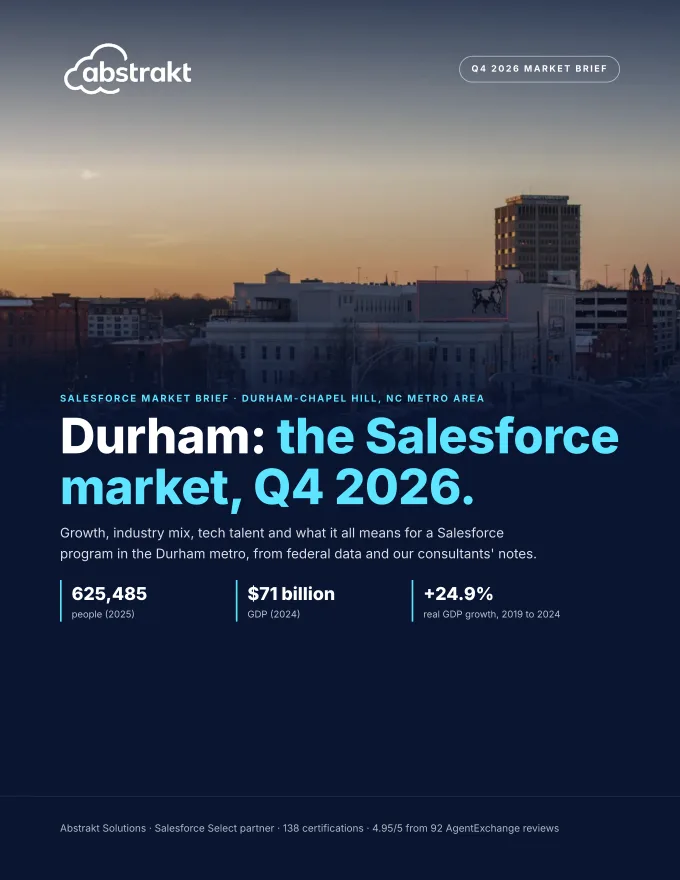
A free 25-page PDF with Durham's growth ranked against 100 metros, its industry mix, tech wages and nearby markets. It is offered on the public Durham page; send your customer there or get a copy for your own prep.
Get the Durham brief →Co-sell with Abstrakt in Durham
Working a Durham account? Bring in a named consultant for discovery, scoping or a health check. We reply within 4 business hours.