

How Salesforce work starts in Winston-Salem
Abstrakt Solutions is a Salesforce Consulting Partner for manufacturers, health organizations and financial firms in Forsyth County, from downtown Winston-Salem's Innovation Quarter outward, and in Davie, Davidson, Stokes and Yadkin counties. Winston-Salem is one of our focus markets.
What buyers here usually run into
- 1
Sell-through data from retail partners
Consumer-products manufacturers often receive retailer and distributor data in different formats and on different schedules, so getting it into account plans takes deliberate integration work.
- 2
Care, research and philanthropy side by side
Health organizations linked to a medical school manage patients, study participants and donors, each with its own consent and access rules that Salesforce has to respect.
- 3
Traceability in aerospace work
Aviation suppliers need quotes, certifications and service records that line up with part and serial histories, which pushes quality-system integration to the front of the project.
Budget, team and partner questions
What drives cost
In Winston-Salem, cost tracks the retail and distributor data a manufacturer needs to bring in, quality-system integration for aerospace suppliers, and the separate consent rules health organizations apply to patients, study participants and donors. Multi-division manufacturers consolidating onto one org also spend more on data cleanup.
Admin or partner
Manufacturers with several divisions often have an internal Salesforce owner and use a partner for integration and consolidation. Startups in Innovation Quarter and smaller lenders typically outsource administration until sales volume justifies a dedicated hire.
What buyers ask a partner
Ask for references involving retail sell-through data or aerospace traceability, depending on your business. Health organizations should ask how the partner designs sharing when patients, research participants and donors live in the same org.
The local economy and its biggest industries (4)
| Sector | Share of 2024 GDP | Where Salesforce fits |
|---|---|---|
| Manufacturing Salesforce for manufacturing → | 21.7% | Tobacco products and aircraft systems show how the metro's largest sector spans consumer goods and aerospace. For these companies, Salesforce has to handle retail and distributor relationships, configured quotes and after-sale service, all fed by ERP. |
| Health care and social assistance Salesforce for health & life sciences → | 11.7% | Innovation Quarter links clinical care with research in a sector that trails only manufacturing locally, at 11.7% of 2024 metro GDP. Salesforce work in this sector covers patient access, referral management and research-participant outreach, with privacy controls in place from the start. |
| Finance and insurance Financial Services Cloud → | 6.4% | Banks, lenders and insurers make up a sector worth about 6.4% of the metro's 2024 output, and they need relationship views, compliant marketing and dependable handoffs to service. |
| Professional, scientific, and technical services Salesforce for professional services → | at least 5.3% | A homegrown retail-promotions data company and the headquarters and business services sector that Greater Winston-Salem, Inc. targets point to data, analytics and service firms whose sales and delivery teams need one shared account view. |
Source: U.S. Bureau of Economic Analysis, GDP by county (CAGDP2), 2024, summed to the metro area; private sectors only, excluding real estate and government. “At least” marks sectors where BEA suppresses some county figures.
Regional target sectors named by local economic development groups: Advanced Manufacturing, Healthcare & Life Sciences, Technology & High Growth Entrepreneurship, Headquarters & Business Services, Aviation & Aerospace.
Salesforce products that fit Winston-Salem (6)
In the order we lead with them here, from the industries above.
Salesforce Sales Cloud
The CRM where sales pipeline lives, when it is built right.
Salesforce Service Cloud
The operating system for modern customer service, case, knowledge, voice, and AI agent assist together.
Salesforce Revenue Cloud / CPQ
Configure-price-quote, billing, subscription management, and quote-to-cash on Salesforce.
Salesforce Marketing Cloud
Cross-channel marketing, email, mobile, journey, and Data 360-powered personalization at scale.
Salesforce Data 360 (Data Cloud)
Unify customer data into a real-time profile that powers segmentation, analytics, and AI.
Salesforce Field Service
Scheduling, dispatch, mobile work orders and parts for teams that work on site.
Health and manufacturing AI priorities for Winston-Salem
Two sectors define Winston-Salem in BEA's 2024 numbers: manufacturing at 21.7% of metro GDP and health care and social assistance at 11.7%. For health organizations, the practical AI project is reducing administrative load, for example summarizing patient-access and referral cases so staff pick up where a colleague left off. Clinical judgment stays with clinicians, and protected data needs field-level restrictions. Manufacturers can use Agentforce with Field Service to prepare technicians with equipment history before a service call, and to draft visit reports afterward for review. Consumer-facing brands in the region may add Marketing Cloud content drafting. Governance, including who approves agent actions, should be written down early.
- Referral case handoff summaries
- Equipment history briefings for technicians
- Draft visit reports for review
Services buyers here usually need (7)
Salesforce Integration in Winston-Salem
Integration in Winston-Salem usually centers on manufacturing data: ERP orders and pricing, quality and certification records, and retailer or distributor sell-through feeds. We decide which system owns each record, then choose MuleSoft, Workato, Data 360 (formerly Data Cloud) or a direct API connection according to volume and the number of systems involved. Each connection comes with error handling, reconciliation reports, alerts and a runbook your team can follow, so sales and service see accurate information without anyone rekeying it.
By industry in Winston-Salem
- 1
Advanced Manufacturing
Advanced manufacturing heads Greater Winston-Salem, Inc.'s list of target sectors. Manufacturers in it typically need Salesforce connected to ERP for products, prices, orders and invoices, and sometimes to plant systems for production status. We design those flows so quotes use current ERP pricing, accepted quotes create sales orders automatically and account managers see shipments and open invoices on the account. Each flow has a named owner for failures, agreed with operations before launch.
- 2
Aviation & Aerospace
Aviation and aerospace suppliers, another of the region's target sectors, depend on traceability. Integration here links Salesforce quotes and service cases to part numbers, revisions, serial histories and certifications held in ERP and quality systems. We pull approved-part and certification status into Salesforce so reps cannot quote an unapproved configuration, and push repair and overhaul requests back to operations. Access to any defense-related data is restricted at the integration layer, not only inside Salesforce.
- 3
Retail trade
Retail matters here twice over: as a sector of its own and as the channel through which many local manufacturers sell. Retail partners send sales and inventory data in their own formats, so integrating those feeds means standardizing store, product and week identifiers, loading summarized data rather than every transaction, and refreshing it on a schedule the category team agrees to. Data 360 (formerly Data Cloud) or a simpler scheduled import can do the work, depending on how many retailers and formats are involved.
Raise before scoping
Summarize retailer data first
Loading every point-of-sale transaction into Salesforce strains storage and slows reports. Aggregate retailer feeds by account, product and week before loading, and keep line-level detail in a warehouse or in Data 360 (formerly Data Cloud), where analysts can still reach it when they need to.
Treat quality systems as sources
Certification and part-approval data should come from your quality system, not be retyped into Salesforce. Integrate it read-only, show status where reps work and block quotes on expired or missing approvals automatically, so compliance never depends on someone remembering to check a separate screen.
Insulate Salesforce from ERP changes
If an ERP upgrade or replacement is on your roadmap, build the Salesforce side against a stable integration layer. Switching ERP later then means changing one set of connections rather than every process that depends on order and pricing data.
Salesforce Implementation in Winston-Salem
Implementations in Winston-Salem often have to serve customers several steps removed: retailers and distributors for consumer-goods makers, operators and airframers for aerospace suppliers, patients and research participants for health organizations. We design the data model around those indirect relationships first, because they drive reporting and integration. Releases follow in phases, each configured and proven in a sandbox, loaded with cleaned records and paired with training for the roles it touches.
By industry in Winston-Salem
- 1
Manufacturing
With manufacturing producing about 21.7% of 2024 metro GDP, by far the largest private share, many of the region's implementations start on a plant or distribution floor. The first design questions are how to represent retail and distributor accounts, how configured products and price books will be maintained, and where after-sale service records live. We usually launch account management and quoting together, since reps judge the system by how fast they can price a deal, and add service or field work later.
- 2
Healthcare & Life Sciences
Healthcare and life sciences is one of Greater Winston-Salem, Inc.'s five target sectors, and Innovation Quarter's 330-plus downtown acres link clinical care, research and startups. Implementations for these organizations have to separate patients, research participants, donors and commercial partners, each with its own consent rules. We design those record types and sharing boundaries first, then launch the process carrying the most manual effort today, often referral intake or study recruitment.
- 3
Headquarters & Business Services
Headquarters and business services is another of Greater Winston-Salem, Inc.'s target sectors, covering corporate offices, shared-service centers and data and analytics firms. When these organizations implement Salesforce, the challenge is usually breadth across business units rather than depth in one. We build a common core of accounts, contacts and security, let each unit layer its own processes on top in controlled phases, and set naming and design standards that keep the org coherent as more teams join.
Raise before scoping
Model indirect customers explicitly
Consumer-goods and aerospace suppliers in the metro often sell to one party while serving another. Decide early how retailers, distributors, operators and end customers relate in Salesforce, since changing account structures after launch breaks reports, integrations and sharing rules at the same time.
Capture consent as data
Organizations tied to medical research handle patients, study participants and donors whose permissions differ. Record consent in structured fields rather than notes, and design sharing so each group's information reaches only the teams authorized to use it, with an audit trail compliance can read.
Pilot with one division
Larger Winston-Salem employers rarely move every division at once. Choose a first unit with a committed leader and clear processes, go live there, and use what it teaches to refine the template for the divisions that follow, rather than guessing at everyone's needs up front.
Salesforce Optimization in Winston-Salem
Winston-Salem orgs that need optimization have usually been extended by several admins or partners, each solving one department's problem. We start with evidence, from login and field-completion data to interviews with the people who avoid the system, then remove the friction they describe: unused required fields, overlapping automation, duplicate accounts and reports built on inconsistent definitions. Automation is consolidated into maintainable Flows, dashboards are rebuilt around agreed numbers and each team gets brief training on what changed.
By industry in Winston-Salem
- 1
Professional, scientific, and technical services
Professional, scientific and technical services contribute at least 5.3% of 2024 metro GDP, and the data, analytics and consulting firms in that group often run pursuits, renewals and delivery in one org that each practice has customized separately. Optimization aligns their stages, retires duplicate fields and rebuilds utilization and pipeline reporting so leadership compares practices on the same basis. We also connect delivery milestones to renewal opportunities, so account managers hear early when a project is in trouble.
- 2
Manufacturing
Manufacturers in the metro frequently run Salesforce beside ERP, CPQ and retailer data feeds, and over time reps lose trust in what they see. We check whether account hierarchies still match how retailers and distributors are organized, whether quote templates and price rules reflect current products, and which reports rely on stale data. Cleaning those foundations usually does more for adoption than new features, because reps stop double-checking every number in another system.
- 3
Technology & High Growth Entrepreneurship
Technology and high-growth entrepreneurship is one of the five sectors Greater Winston-Salem, Inc. targets. Startups that set Salesforce up quickly during early growth often reach a point where investor reporting, renewals and support no longer fit the original setup. Optimization rebuilds stage definitions, separates new business from expansion and tidies subscription and support data, so founders can answer board questions from Salesforce rather than a spreadsheet assembled by hand each month.
Raise before scoping
Trace changes to named problems
Each optimization change should trace back to a problem a user or leader described. That keeps the project focused, makes the value easy to explain to sponsors and prevents a cleanup from turning into an open-ended redesign that nobody asked for.
Clean hierarchies before reports
Retail and distributor account structures in consumer-goods orgs drift as customers merge and rename. Fix parent-child relationships and ownership before rebuilding dashboards, or sell-through and revenue reports will keep rolling up to the wrong accounts no matter how well they are designed.
Measure adoption afterward
Optimization only counts if behavior changes. Agree a short set of adoption measures before work starts, such as logins, pipeline updates or cases closed in Salesforce, and review them after relaunch, and again a few months on, to confirm the changes took hold.
Salesforce Health Checks in Winston-Salem
Winston-Salem organizations usually ask for a health check just before a change: a new admin, a partner switch, a renewal or plans to deploy Agentforce. Our reviewers test how well different groups of records are kept apart, then work outward to external access, data completeness on key objects, automation and packages, integrations and reports, and the way people use the system. The output ranks findings by risk and effort, so you know what to fix first and what can safely wait.
By industry in Winston-Salem
- 1
Health care and social assistance
Health care and social assistance produces about 11.7% of 2024 metro GDP, second only to manufacturing among private sectors, and health organizations here often run Salesforce for patient access, referrals, research recruitment and philanthropy in one org. A health check tests whether those populations are truly separated: whether fundraising staff can see patient data, whether research consent is stored as structured fields and whether reports or exports reveal more than intended.
- 2
Finance and insurance
Banks, lenders and insurers in the metro rely on Salesforce for regulated processes, so the review centers on evidence an examiner would ask for. We check least-privilege access, deactivated users and dormant integration accounts, field history tracking on sensitive data and encryption where it matters. We also assess whether client records are clean enough for AI summaries, since an assistant that misreads relationships creates compliance risk as well as bad advice.
- 3
Headquarters & Business Services
Headquarters and business services, a target sector for Greater Winston-Salem, Inc., often means one org shared by many units. A health check measures the technical debt that sharing creates: duplicate fields added by different teams, automation that conflicts across units, profiles copied rather than designed and packages installed for projects that ended. The findings help set standards so each new unit adds value to the org rather than more clutter.
Raise before scoping
Test separation with real users
Patient, research and donor data in health-related orgs must stay apart. Test sharing by logging in as real user types from each team, not just by reading settings, because gaps often appear through reports, list views and related lists that nobody thought to check.
Audit connected apps
Integrations and third-party apps accumulate over years. List each connected app and integration user in the Winston-Salem org, what data it can reach and who owns it, and remove anything tied to a vendor or project that has already ended.
Line up owners for the fixes
An unassigned finding tends to become next year's finding. Agree before the review starts who will address high-risk items, whether your admin, a partner or a managed services team, so urgent fixes are not left waiting for a new budget cycle.
Salesforce Managed Services in Winston-Salem
In Winston-Salem, managed services often supports orgs shared by several business units, each with its own priorities and its own idea of urgent. One ranked backlog, agreed with your owner, governs the work: user, report and automation requests, release reviews in a sandbox ahead of users, and developer or integration help brought in only when a ticket calls for it. A regular review shows what shipped, what is queued and which recurring requests point to a design flaw worth fixing once.
By industry in Winston-Salem
- 1
Finance and insurance
Finance and insurance, about 6.4% of 2024 metro GDP, includes a long list of smaller banks, credit lenders and insurers spread across the metro's five counties. For them, ongoing Salesforce work centers on controlled change: approved access requests, tested edits to fields that feed regulatory reports, and marketing consent that survives every release. We handle those as documented tickets, so examiners can follow each change from request to deployment.
- 2
Aviation & Aerospace
Aviation and aerospace is one of Greater Winston-Salem, Inc.'s target sectors, and suppliers here run Salesforce processes that must stay aligned with quality systems and part revisions. Under managed services we maintain quote templates and approval rules as part numbers change, update asset and service records for repair work and keep ERP and quality integrations healthy after each release. Access for defense-related programs is reviewed on a schedule rather than left to drift.
- 3
Health care and social assistance
Hospital systems, clinics and social service agencies in the metro often run Salesforce for referrals, patient outreach and community programs without a specialist on staff. Their tickets tend to be new referral sources, fresh campaign audiences and program dashboards, and each is delivered inside the sharing design that walls off patient information. Scheduling and records integrations are retested after every seasonal release, so referrals keep flowing rather than stalling where nobody looks.
Raise before scoping
Set rules for cross-unit requests
A field renamed for one business unit can quietly break a report that a sister unit relies on. Agree that every request touching shared objects is reviewed for cross-unit impact, and that the backlog owner, not the loudest department, decides when conflicts arise between business units.
Keep quality data in sync
Aerospace and medical suppliers depend on Salesforce matching their quality systems. Include checks on certification, part revision and approval data in routine managed work, so a lapsed certificate or retired part never appears on a quote that goes out to a customer.
Reserve time for structural fixes
A backlog made only of small requests never reaches the structural work that would reduce them. Hold part of each month's capacity for technical debt and automation cleanup, and review that list with your owner alongside new requests so it keeps moving.
Salesforce Migration in Winston-Salem
Migrations in Winston-Salem range from established lenders leaving an aging CRM to young companies outgrowing a free tool. The method holds across both: inventory the sources, agree mappings and which history to keep, deduplicate and standardize records before loading, and prove the result with sandbox loads reconciled against source counts. The switchover itself is scheduled to the day, with a brief pause on edits, and our consultants stay close through the first days of live use.
By industry in Winston-Salem
- 1
Retail trade
In a metro where retail trade adds about 6.6% of 2024 GDP, the typical retail migration we see involves shoppers recorded separately by the web store, the rewards program and the email platform, each under a different ID. We match customers across those sources, bring forward consent and preferences exactly and load purchase summaries instead of every transaction, so service and marketing start from a single customer view instead of three partial ones.
- 2
Finance and insurance
Smaller banks, lenders and insurers in the metro often migrate from CRMs installed long ago, customized heavily by successive administrators and linked only loosely to the core banking or policy system. We untangle households, relationships and account ownership before loading, decide which history compliance requires and keep consent and contact restrictions intact. Sensitive columns get a field-level comparison after every trial load, and nobody receives access in production until the permission design has passed its own test.
- 3
Technology & High Growth Entrepreneurship
Startups in Innovation Quarter and elsewhere in the city, part of the technology and high-growth sector the region targets, typically begin on a lightweight CRM and migrate when investors, partners and a support team demand more structure. Deals, subscriptions, reseller partners and support tickets each find a home in Salesforce, founders keep the correspondence they lean on, and the board deck starts drawing from live reports. The first release stays simple, because small teams cannot absorb a heavy system mid-growth.
Raise before scoping
Agree on a matching key early
Records from commerce, marketing and legacy CRM systems rarely share a key. Decide which identifier, such as email, customer number or tax ID, will match records across sources, and fix gaps in it before test loads begin rather than after duplicates appear.
Keep compliance history reachable
Lenders and insurers may need old correspondence long after it stops being useful in daily work. Archive it in a searchable, access-controlled store rather than loading it into Salesforce, and confirm the retention approach in writing with compliance before cutover day.
Rebuild, rather than copy, automation
Automation from an old CRM usually encodes old processes. Document what each rule does, decide whether the business still needs it and rebuild the survivors in Flow, instead of recreating every legacy behavior in the new org out of habit.
Salesforce Implementation Rescue in Winston-Salem
Troubled Salesforce projects in Winston-Salem often trace back to integration left for later: a manufacturing or health org launched without the ERP, quality or clinical data users needed, and staff kept the old system open beside it. Before touching any configuration we lock down admin credentials and gather whatever documentation exists, then label every open issue as a work stopper, a data polluter or a later item. Blockers are fixed first, remaining components are judged on evidence and the recovery is released in stages that each team can absorb.
By industry in Winston-Salem
- 1
Advanced Manufacturing
Advanced manufacturers sometimes inherit a CPQ build that looked finished at sign-off but breaks on real orders: product rules that allow invalid configurations, discounts that skip approvals or prices that drift from ERP. We reproduce those failures in a sandbox, fix the rules that stop accurate quotes going out and connect pricing to ERP properly. Only then do we revisit deferred scope such as service contracts or partner ordering, re-planned with the people who will use it.
- 2
Healthcare & Life Sciences
Health and life sciences organizations, a target sector for the region, sometimes stall when a project tries to serve clinical, research and philanthropic teams in one release. Triage splits them apart. We confirm that patient and participant data in the partial build is properly restricted, finish the single process with the clearest owner and relaunch there. The other groups follow in later releases once the sharing model has proven itself in daily use.
- 3
Professional, scientific, and technical services
Data, analytics and consulting firms occasionally commission a Salesforce build that tries to cover sales, delivery and billing at once, and the project stalls when delivery teams will not adopt time or project screens. Rescue narrows the scope to what leaders need now, usually pipeline and account data, stabilizes it and sets project tracking aside for a redesign with the people who will use it every day, once leaders trust the numbers again.
Raise before scoping
Find the missing integration
Many stalled orgs lack the data that would have made them useful. Identify which ERP, quality or clinical information users check elsewhere, and deliver at least an interim feed early, since adoption rarely recovers while people still need two screens open.
Separate catalog errors from rule errors
Quoting failures can come from configuration or from the product and price data feeding it. Test each failing quote against clean data before rewriting rules, since many CPQ recoveries need a corrected catalog more than a redesigned engine, and the catalog is quicker to fix.
Relaunch where support is strongest
Choose a first team whose leader wants the system to work and whose process is well understood. Their visible success builds credibility for the recovery and gives other teams in the organization a concrete reason to return to Salesforce willingly.
Industry plays in Winston-Salem (4)
Salesforce for Winston-Salem Manufacturers
Manufacturing is the backbone of the Winston-Salem economy, and headquarters operations are one of the region's recruitment targets, so producers here often coordinate several plants or divisions from one head office. Salesforce should give that head office a consistent view of customers, pipeline and service across every business unit while letting each division sell its own way. We consolidate CRMs where it makes sense, build aftermarket and service processes that turn installed products into recurring revenue, and integrate ERP data from each plant.
More than a fifth of the Winston-Salem metro's 2024 economy, 21.7% by Bureau of Economic Analysis county data, came from manufacturing, nearly double health care's 11.7%. Greater Winston-Salem, Inc. lists advanced manufacturing first among its five target sectors, alongside headquarters and business services, aviation and aerospace, healthcare and life sciences, and technology and high-growth entrepreneurship. The metro spans Forsyth, Davie, Davidson, Stokes and Yadkin counties, so a single manufacturer may operate a downtown office and plants in smaller towns nearby, each with its own habits and systems.
Use cases to open with
- 1
One org across divisions
Manufacturers that grew through acquisition often run a different CRM, or none, in each division. A single Salesforce org with shared accounts, division-specific record types and a common reporting layer lets leadership see total relationship value with key customers. Divisions keep their own sales stages and quoting rules, and cross-selling becomes visible instead of relying on informal introductions between sales teams.
- 2
Aftermarket parts and service
Every machine or system a manufacturer ships becomes a source of later revenue through spare parts, repairs, upgrades and service agreements. Service Cloud and Field Service, with asset records linked to original orders, help teams identify units nearing maintenance intervals, quote parts proactively and schedule technicians efficiently across the region. Experience Cloud gives customers a way to order parts, check warranty status and request service without calling the plant.
- 3
Capital equipment projects
Engineered-to-order equipment sales involve specifications, drawings, milestone payments and long lead times, with engineering reviewing every change. Sales Cloud can track each project from inquiry through engineering review, quote revisions and order, with CPQ supporting configurable options and pricing rules. After the order is booked, key milestones from ERP keep account managers informed, so customers receive proactive updates rather than having to chase status themselves.
Raise before scoping
Division autonomy versus standards
Divisions value their own processes, but leadership needs data that can be compared across the company. Agree on shared definitions for accounts, products, stages and forecast categories, then allow variation only where it genuinely reflects a different sales motion, not simply long-standing habit.
Multiple ERPs and plant systems
Acquired plants often keep their own ERP systems for years. Map customer and product identifiers across them, decide how Salesforce presents a combined customer view, and plan integration in phases, beginning with the plants and data sets that matter most to sales and service.
Service revenue ownership
Aftermarket revenue often falls between sales, service and parts teams, and nobody quite owns it. Assign clear ownership for service contracts, parts quotes and renewals in Salesforce, with dashboards showing installed base coverage so no opportunity goes unclaimed for lack of an owner.
Salesforce for Winston-Salem Health and Life Sciences
Health care in Winston-Salem reaches from a downtown academic and innovation hub out to small towns across the surrounding counties. Salesforce helps organizations manage that reach: patient access and outreach for rural communities, education and event programs for clinicians, and partnering pipelines for life sciences startups and licensing teams. We design each around the EHR or other systems of record, with PHI protections and role-based access settled before build begins.
Apart from manufacturing, only health care and social assistance exceeds a tenth of the local economy, with 11.7% of 2024 output in Bureau of Economic Analysis county statistics. Greater Winston-Salem, Inc. names healthcare and life sciences among its five target sectors. Innovation Quarter, a downtown innovation district of more than 330 acres, is anchored by a medical school and brings research, startups and established companies into one area. With the metro stretching across Forsyth, Davie, Davidson, Stokes and Yadkin counties, health organizations serve both an urban research center and rural communities.
Use cases to open with
- 1
Rural patient access and outreach
Patients in outlying counties may travel long distances for specialty care, which makes missed follow-up appointments more likely. Service Cloud can manage scheduling requests, reminders and transportation or telehealth options in one workspace, while Marketing Cloud runs screening and preventive care campaigns by county and language preference. Access teams track no-show patterns by location and adjust outreach wherever gaps appear, instead of applying one approach everywhere.
- 2
Clinician education and events
Medical education, continuing education and professional events require registration, credit tracking, speaker management and follow-up surveys. Salesforce with Marketing Cloud can handle invitations, registrations, attendance and certificates, and maintain a lasting history of each clinician's participation. Program leaders see which topics draw attendance, which formats work best and which referring communities engage most, which helps them plan the next season of programs.
- 3
Startup and licensing partnering
Life sciences startups and technology transfer teams manage relationships with investors, corporate partners and licensees over long periods. Sales Cloud can track each opportunity by technology, stage, terms under discussion and the status of confidentiality agreements. Leaders see the whole partnering pipeline at a glance, and nothing depends on one person's inbox when team members change roles or leave the organization.
Raise before scoping
PHI and outreach consent
Patient outreach relies on consent and preferences that vary by channel. Store consent explicitly, respect opt-outs across every connected system and limit PHI in marketing tools to what each campaign truly needs, with a business associate agreement and HIPAA review completed before launch.
Confidential partnering data
Licensing and partnering discussions involve confidential terms and intellectual property. Restrict access by team, track agreements and their expiration dates, and avoid storing detailed technical disclosures in Salesforce when a secure document management system is better suited to hold them.
Serving five counties
Different counties may have different referral patterns, clinic locations and community partners. Design territories, queues and reporting that reflect geography, so leaders can see where access problems exist and direct staff, transportation help and outreach budgets to the places that need them.
Salesforce for Winston-Salem Professional Services Firms
Professional services firms in Winston-Salem often depend on a few large corporate, manufacturing and health clients, with a growing share of work from startups and research ventures. Salesforce helps them diversify without losing track of anchor accounts. Sales Cloud maps client organizations and buying centers, Revenue Cloud or CPQ produces consistent statements of work, and Marketing Cloud nurtures prospects outside the core client list. Integration with project and finance systems links pipeline, delivery capacity and margins.
Professional, scientific and technical services are at least 5.3% of the Winston-Salem metro's 2024 GDP in BEA county figures, where some data are withheld, ranking fifth behind manufacturing, health care, retail and finance. Greater Winston-Salem, Inc. names headquarters and business services as one of its five target sectors, together with technology and high growth entrepreneurship, healthcare and life sciences, advanced manufacturing, and aviation and aerospace. A downtown innovation district of 330+ acres, anchored by a medical school, gives consultancies and technical firms a steady stream of research and startup clients.
Use cases to open with
- 1
Mapping large corporate clients
Firms serving headquarters operations and manufacturers sell to many departments inside the same client, each with its own budget and decision makers. Sales Cloud account hierarchies, buying-center contacts and relationship maps show where the firm already works, who sponsors each engagement and where new services could fit. Account leaders plan expansion with facts, and the firm reduces risk when a key sponsor leaves.
- 2
Startup and research clients
Consultancies working with ventures in the innovation district often start with small, fast engagements that grow as funding arrives. Salesforce can track founders, funding stages, investors and referral sources alongside opportunities, and remind account leads to reconnect after a raise. Firms can then build a portfolio of emerging clients without letting promising relationships go quiet between projects, and partners can see which early bets have grown into meaningful annual revenue.
- 3
Statements of work and change orders
Engagements for large Triad clients often change scope midstream as priorities shift. With a quoting tool, each amendment is logged against the signed agreement, priced from the same rate table and approved by the right partner. Delivery managers and finance see the current contract value at any moment, and leadership can analyze which services regularly exceed estimates and need repricing before the next proposal goes out.
Raise before scoping
Concentration on anchor clients
When a few clients drive most revenue, reporting should show that exposure clearly. Build dashboards for revenue concentration, renewal timing and sponsor changes, and make sure relationship data is shared across the team rather than held by a single partner who could leave.
Confidential client information
Health, manufacturing and corporate clients share sensitive plans, pricing and sometimes regulated data with their advisors. Restrict records to engagement teams, keep deliverables in controlled repositories linked from Salesforce, and confirm contractual obligations, especially where protected health information or employee data is involved.
Handoff from sale to delivery
When a deal closes, the delivery lead should inherit the scope, assumptions and client contacts without a separate kickoff scramble. Define the fields delivery needs, automate project creation in the professional services or finance system, and make sure change orders flow back into Salesforce so account teams see current value.
Salesforce for Winston-Salem Lenders
Lending in the Winston-Salem area is often relationship-based: community banks, credit unions and mortgage lenders compete on local knowledge and service rather than price alone. Salesforce helps loan officers and relationship managers manage that. Financial Services Cloud tracks borrowers, households and businesses with their loans and deposits; referral partners such as real estate agents and builders get their own records; and Marketing Cloud nurtures prospects over long buying cycles. Underwriting and disclosures never move out of the origination platform.
Finance and insurance makes up 6.4% of the Winston-Salem metro's 2024 GDP by the BEA's county figures, ranking fourth among private sectors behind manufacturing at 21.7%, health care and retail. Lending is not among Greater Winston-Salem, Inc.'s five target sectors, so it shows up within that broader finance and insurance share. Its borrowers link to the targets, though: manufacturers and aviation suppliers need equipment and working capital loans, health workers and researchers buy homes, and the metro spans five counties, from Forsyth and Davidson to Davie, Stokes and Yadkin.
Use cases to open with
- 1
Mortgage pipeline and referral partners
Mortgage loan officers rely on real estate agents, builders and past clients for referrals. Salesforce tracks each partner's referrals, closed loans and communication history, so officers know which relationships to invest in. Borrower leads flow into structured follow-up with tasks and reminders, and milestones from the loan origination system update partners automatically, reducing the calls asking where a file stands and giving officers time back for new applicants.
- 2
Business lending relationships
Commercial lenders manage manufacturers, suppliers and professional practices with loans, deposits and treasury services. Financial Services Cloud gives relationship managers a single view of each business, its owners and related entities, with renewal dates, covenant reviews and pipeline for new credit. Teams coordinate across lending, deposits and treasury rather than working from separate spreadsheets, and credit administration can see upcoming reviews across the whole portfolio.
- 3
Long-cycle borrower nurturing
Many prospects are not ready to borrow when they first inquire. Marketing Cloud can nurture them with rate updates, homebuying education or small-business content based on interests and consent, and alert officers when engagement rises. Past borrowers get check-ins when refinancing or home equity could help them, keeping the lender top of mind across years rather than a single transaction, and every message respects the consent and preferences on file.
Raise before scoping
Consumer lending compliance
Mortgage and consumer lending involve fair lending, privacy and marketing rules, including GLBA and requirements on communications and adverse action. Configure consent tracking, approved templates and audit trails, and have your compliance officer confirm requirements. We design to the rules your team sets, not legal interpretations.
Origination system integration
Nothing about underwriting, pricing exceptions or closing documents moves into the CRM. Decide which milestones and fields flow into Salesforce, how often, and how leads move from Salesforce into origination, so officers do not re-key data and managers can trust pull-through reporting.
Credit union and bank data
Core banking systems hold deposits and loan servicing for both banks and credit unions. Bring in summaries that help relationship conversations, protect sensitive account details with field-level security, and plan examiner-ready audit trails for any access to member or customer financial information.
Case studies to send (3)
From the industries this market leans on. Client names are anonymized and these projects are not specific to Winston-Salem.
The Winston-Salem Salesforce market brief, Q4 2026
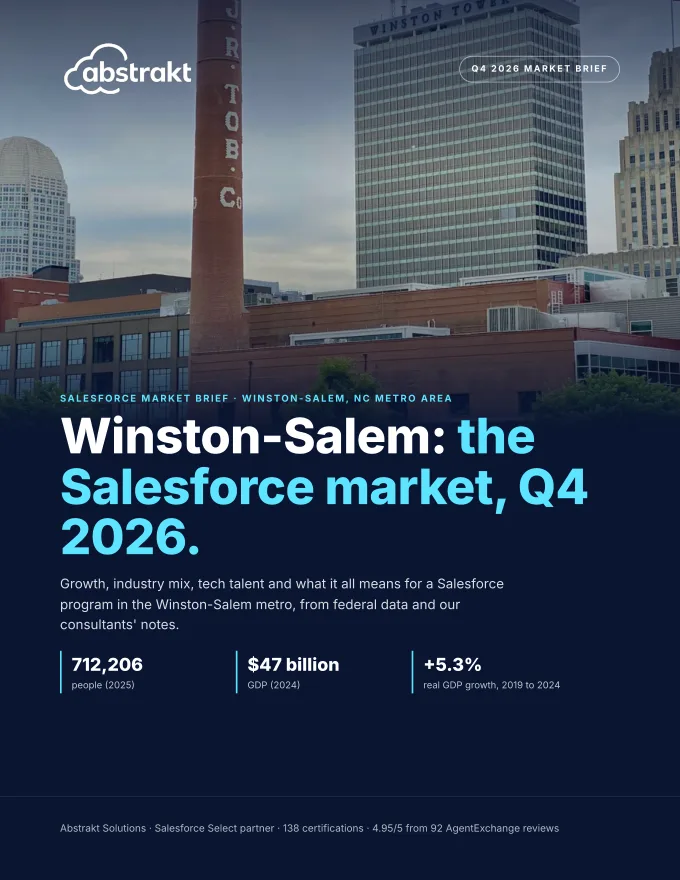
A free 23-page PDF with Winston-Salem's growth ranked against 100 metros, its industry mix, tech wages and nearby markets. It is offered on the public Winston-Salem page; send your customer there or get a copy for your own prep.
Get the Winston-Salem brief →Co-sell with Abstrakt in Winston-Salem
Working a Winston-Salem account? Bring in a named consultant for discovery, scoping or a health check. We reply within 4 business hours.