

How Salesforce work starts in Raleigh
Life sciences companies, technology firms and professional services practices in Raleigh, Cary and throughout Wake County rely on Abstrakt Solutions for Salesforce consulting. Raleigh is one of our focus markets.
What buyers here usually run into
- 1
Outgrowing a starter CRM
Fast-growing software and services companies often start on a lighter CRM and hit its limits as teams, products and reporting needs grow. A planned migration avoids losing history along the way.
- 2
Sales and support in separate tools
Tech companies commonly run sales in one system and support tickets in another, which hides renewal risk. Putting both on Salesforce gives account teams the full picture.
- 3
Regulated client data
Financial services and healthcare IT firms need record access, consent and audit trails designed in from the start rather than added after launch.
Budget, team and partner questions
What drives cost
Raleigh scope often depends on what is being replaced: migrating history from a starter CRM, consolidating sales and support tools, or connecting project and finance systems. Financial services and healthcare IT firms add record access and audit design.
Admin or partner
Fast-growing software and services companies here often start with managed services and hire an internal admin as teams and products multiply. Banks and insurers usually keep internal staff and use a partner for integration and compliance design.
What buyers ask a partner
Ask how the partner migrates history from a lighter CRM without losing it, and how they would bring support data next to renewals. Regulated firms should ask about audit trails and consent.
The local economy and its biggest industries (4)
| Sector | Share of 2024 GDP | Where Salesforce fits |
|---|---|---|
| Professional, scientific, and technical services Salesforce for professional services → | at least 12.2% | Raleigh's largest private sector includes consulting, engineering and technology services firms that need pursuit pipelines, project delivery and client reporting in one system. |
| Finance and insurance Financial Services Cloud → | 8.2% | Banks, insurers and wealth managers in the Triangle need household and relationship views, compliant marketing and service workflows that hold up to review. |
| Manufacturing Salesforce for manufacturing → | 8.0% | Advanced manufacturing is a Wake County target sector. Manufacturers here usually need quoting, distributor management and service history tied to ERP. |
| Information Service Cloud → | 7.9% | Enterprise IT, open source software and video game companies are among Wake County's technology employers. Tech firms tend to need subscription sales, support and product data working together. |
Source: U.S. Bureau of Economic Analysis, GDP by county (CAGDP2), 2024, summed to the metro area; private sectors only, excluding real estate and government. “At least” marks sectors where BEA suppresses some county figures.
Regional target sectors named by local economic development groups: Life Sciences, Advanced Manufacturing, Technology, Cleantech/Smart Grid.
Salesforce products that fit Raleigh (6)
In the order we lead with them here, from the industries above.
Salesforce Sales Cloud
The CRM where sales pipeline lives, when it is built right.
Salesforce Service Cloud
The operating system for modern customer service, case, knowledge, voice, and AI agent assist together.
Salesforce Financial Services Cloud
Industry CRM for wealth management, banking, insurance, and lending, built for compliance from the start.
Salesforce Marketing Cloud
Cross-channel marketing, email, mobile, journey, and Data 360-powered personalization at scale.
Salesforce Data 360 (Data Cloud)
Unify customer data into a real-time profile that powers segmentation, analytics, and AI.
Salesforce Agentforce
AI agents that handle real work inside Sales Cloud, Service Cloud, and Marketing Cloud.
Where Agentforce fits in the Research Triangle economy
Professional, scientific and technical services make up at least 12.2 percent of Raleigh's 2024 metro GDP, with wholesale trade at 9.0 percent and finance and insurance at 8.2 percent. Contract research groups and technology consultancies in that first category handle long, detailed inquiries; AI can condense them into a summary and suggest a next step for the account owner. Wholesalers benefit from reply drafting on order and shipment questions, pulled from records in Sales Cloud and Service Cloud. Banks and insurers can run a self-service agent against a reviewed knowledge base for routine account questions. Decide up front which objects the agent may read, which actions it may take, and who reviews its output before customers see it.
- Research inquiry condensing and next steps
- Shipment question reply drafts
- Routine banking self-service answers
Services buyers here usually need (7)
Salesforce Implementation in Raleigh
Raleigh-area companies implementing Salesforce are often growing quickly and selling something technical: engineering and consulting services, research tools, software or grid technology. That means long evaluations, several stakeholders per deal and a delivery phase that matters as much as the sale. We design the data model around those realities, including how projects, contracts and renewals relate to accounts, build and test in a sandbox, load clean data and train each team. Releases are phased so sales can go live before service and marketing follow.
By industry in Raleigh
- 1
Professional, scientific, and technical services
No private sector in the Raleigh-Cary metro is larger, with a floor of 12.2% of 2024 output in BEA's data. Engineering practices, management consultancies and technical contractors in Wake County usually buy Salesforce to see proposals, active engagements and client health side by side. The design choice that shapes everything is how opportunities hand off to projects: whether delivery lives in Salesforce, in a separate project tool or in both. We settle that in discovery, because it determines the objects, integrations and dashboards that follow.
- 2
Life Sciences
Wake County Economic Development names life sciences as a target sector. Companies selling research products, lab services or clinical technology to institutions face long buying cycles with scientific, procurement and compliance contacts on every deal. Implementation for them means modeling institutions, departments and principal investigators clearly, tracking evaluation and contracting milestones on each opportunity, and keeping any regulated information out of fields where it does not belong. Where institutions ask for portals or document exchange, we plan that access in the first release as well.
- 3
Cleantech/Smart Grid
Cleantech and smart grid is another county target sector. Companies here sell to utilities and large energy users through pilots, proposals and regulatory approvals that can stretch over long periods. We implement Sales Cloud with stages that reflect those gates, account plans that map engineering, procurement and regulatory contacts, and reporting on pilot outcomes, so leaders can see which programs are likely to become contracts. Utility contacts and pilot sites are loaded before launch, so sellers begin with accurate history rather than empty accounts.
Raise before scoping
Design the sale-to-delivery handoff
For services and technology firms, what happens after signature matters as much as the sale. Decide early how closed opportunities create projects, onboarding records or service entitlements, so customer-facing teams inherit every commitment made during the sales process. Capture those commitments as structured fields, not free-text notes.
Plan for rapid headcount growth
Fast-growing Triangle companies add sellers and support staff quickly. Build roles, territories and permission sets that scale by assignment rather than by one-off exceptions, so onboarding a new team member takes minutes and access stays consistent. New regions or product lines should need configuration, not redesign.
Keep marketing in the roadmap
Even when marketing automation is a later phase, the contact, campaign and consent fields it needs should exist in the first release. Retrofitting lead source and consent data after launch is far harder than capturing it correctly from the start.
Salesforce Migration in Raleigh
Many Raleigh-area companies begin on a lightweight CRM, often chosen when the company was a handful of people, and reach its limits once products, teams and reporting needs multiply. A migration to Salesforce is the moment to fix what the old system allowed: duplicate contacts, inconsistent stages and free-text fields that should have been picklists. We inventory the source data, map it to a Salesforce model designed for where the company is going, clean and deduplicate it in staging, test in a sandbox and plan a short cutover.
By industry in Raleigh
- 1
Technology
Technology companies, a Wake County target sector, frequently migrate after a funding round or rapid hiring exposes the limits of their first CRM. Their data includes free users, trials, paying customers and partners, all mixed together. Migration for them separates those groups clearly, carries subscription and renewal dates across accurately and connects marketing history, so both sales and customer success start in Salesforce with a reliable picture of every account.
- 2
Information
Software and media businesses in the information sector often run sales in one CRM and support in a separate help desk. Moving both onto Salesforce means migrating accounts and contacts once, then linking historical tickets to the right customers so account teams can see support history alongside renewals. We decide with you how much ticket history is worth moving and archive the rest in an accessible format. Historical support volume per account often becomes a useful early warning for renewal risk.
- 3
Finance and insurance
The finance and insurance share of Raleigh-Cary GDP stood at 8.2% in 2024. Banks, insurers and advisory firms moving to Financial Services Cloud need their client data restructured into households, financial accounts and relationships, which rarely exist cleanly in older systems. We design that structure first, then migrate client, account and activity data into it, preserving consent and communication preferences exactly, so compliance teams can sign off before advisors start work. Asking advisors to spot-check households they know well before sign-off catches mapping errors fast.
Raise before scoping
Redesign, do not replicate
Copying the old CRM's fields and stages into Salesforce carries its problems forward. Use the migration to design a model that fits the business today, then map old data to it, retiring fields that only supported workarounds. The result is simpler for users and easier to maintain.
Separate users from buyers
Technology companies often have far more free users and community members than customers. Decide which of them become contacts, which become leads and which stay in marketing systems, so sales is not flooded with records it cannot act on. Marketing can still nurture the rest from its own platform.
Rehearse the cutover
Do a complete dress rehearsal in a sandbox, then have the staff who know the data compare totals, links between records and spot-checked samples. A rehearsed cutover keeps downtime short and avoids surprises on the first morning in Salesforce. Fix anything found and rehearse again.
Salesforce Integration in Raleigh
Integration in the Raleigh area usually connects Salesforce to one of three kinds of systems: ERP for manufacturers and distributors, product and usage platforms for technology companies, and billing or subscription systems for anyone with recurring revenue. We start by naming the system of record for each data type, then choose the right pattern for each flow, whether real-time API, scheduled sync, middleware or Data 360 (formerly Data Cloud) ingestion. Alerts, retry logic and written runbooks ship with the integration, so your IT staff can own it after handover.
By industry in Raleigh
- 1
Manufacturing
At 8.0% of 2024 metro output, manufacturing sits just below finance, and Wake County lists advanced manufacturing among its targets. Plants in the county typically want sellers to see ERP prices, stock on hand and shipment dates without leaving Salesforce, and want signed quotes and new customer records sent back automatically. We keep ERP as the owner of products and prices, sync on a schedule that matches how often they change and surface order status on the account so sellers stop calling operations for updates.
- 2
Wholesale trade
Distributors need Salesforce and the ERP to agree on accounts, ship-to locations and credit status. Integration for them is often mostly about customer master data: one account structure shared by both systems, clean mapping of parent companies and branches and invoice or order history summarized in Salesforce rather than copied line by line. Reps get the purchasing picture they need while storage and API consumption stay modest. Credit holds and payment terms appear on the account so sellers know before quoting.
- 3
Technology
Technology companies in the county's target sector want product usage, support tickets and billing linked to the account record. We bring usage signals into Data 360 (formerly Data Cloud), where they can be summarized into health scores, then surface those scores in Sales Cloud and Service Cloud. Subscription and invoice data from billing systems flows in on a schedule, so account managers see renewal risk before the renewal conversation starts. Support tickets from the help desk link to the same account, completing the picture for customer success.
Raise before scoping
Summarize high-volume data
Product usage events and invoice lines can run into large volumes quickly. Storing summaries in Salesforce and keeping detail in Data 360 (formerly Data Cloud) or the source system protects storage limits and keeps pages fast for users. Users get the context without the clutter.
Plan for API limits
Every Salesforce org has daily API allowances, and poorly designed syncs can exhaust them. Batching updates, using change events and avoiding unnecessary polling keep integrations reliable as data volume grows with the business. We estimate API consumption during design, before anything is built, and leave headroom for future integrations.
Assign an owner for failures
Someone must receive and act on integration errors. Decide who that is, what the alert looks like and how failed records are retried, so problems are corrected within hours rather than discovered weeks later in a report. A short runbook explains what each common error means and how to resolve it.
Salesforce Optimization in Raleigh
Most Raleigh optimization requests arrive a few growth spurts after launch. An org configured for a small team now serves several departments, with automation added by different people over the years and hundreds of reports nobody maintains. We interview users, review automation, data quality and reporting, then fix what slows people down: consolidating flows, removing unused fields, simplifying screens and rebuilding dashboards around real decisions. Distributors, professional services firms and life sciences companies here each bring a different version of the problem, so priorities are set with your team.
By industry in Raleigh
- 1
Wholesale trade
Wholesalers generated 9.0% of 2024 metro GDP, placing the sector just behind professional services. Distributors often run Salesforce alongside an ERP, and reps end up re-keying orders or ignoring the CRM entirely. Optimization for them centers on account views that show order history and open quotes in one place, activity capture that does not require manual logging and territory reports that let sales managers see which customers are buying less than last year.
- 2
Professional, scientific, and technical services
Consulting and engineering firms frequently find that their pipeline and utilization reports disagree with finance. Optimization aligns opportunity stages and probability rules with how the firm actually forecasts, removes duplicate accounts created by different practice groups and sets up dashboards that partners and practice leaders can review in minutes. Reducing required fields at early stages usually raises data quality rather than lowering it. Practice leaders then review the same numbers finance does, which ends most debates about the forecast.
- 3
Life Sciences
Life sciences sellers and account managers in the region often face heavy data entry for evaluations, samples and institutional contacts. We review which fields are truly needed for compliance or reporting, automate the rest where possible and redesign page layouts around the steps a representative takes. Marketing and sales then share one view of engagement, so field teams know which institutions have responded to recent campaigns before they call. Compliance-required fields remain, but they are grouped at the stage where the information actually becomes known.
Raise before scoping
Measure adoption before changing
Login history, record updates and report usage show where people actually work in Salesforce and where they avoid it. Starting from that evidence keeps the optimization focused on real friction instead of assumptions about what users need. We share that baseline with you before recommending any change.
Retire before you add
Unused fields, inactive flows and abandoned reports slow the org and confuse users. Removing them first, with a record of what was retired, makes every later improvement simpler and reduces risk in future releases and integrations. Retired items stay documented in case anyone asks for them.
Fix duplicate accounts
Growing firms often create the same customer several times across teams or regions. Merging duplicates and adding matching rules restores trust in account reports and stops sellers from contacting the same client without knowing about each other. Territory and ownership rules then keep future records tidy.
Salesforce Health Checks in Raleigh
Raleigh-area health checks usually follow a trigger: an audit, a customer security review, new leadership or plans for Agentforce or Data 360 (formerly Data Cloud). Working read-only, we look at authentication, profiles, sharing, Apex, flows, integrations, record quality and how much of the org people really use. Each item in the report points to the exact component at fault and carries a risk and effort rating, so work can start the same week. Financial, life sciences and software firms here weigh findings differently, and we tailor the review accordingly.
By industry in Raleigh
- 1
Finance and insurance
For banks, insurers and wealth managers, the health check focuses on who can see client financial data, how consent and communication preferences are stored, whether field history covers sensitive changes and which integrations copy data elsewhere. We also check Financial Services Cloud configuration against current features, since older orgs often carry custom objects that duplicate what the product now provides and complicate future upgrades. Each finding notes which regulatory concern it touches, which helps compliance officers prioritize.
- 2
Life Sciences
Life sciences companies, a Wake County target sector, need confidence that Salesforce handles regulated interactions properly. Our review checks how medical, sample or clinical information is captured and restricted, whether audit trails cover the right fields and whether validated processes have changed without documentation. The findings give quality and compliance teams a clear list of gaps and the configuration evidence they need for their own reviews. Where gaps appear, we suggest configuration changes that keep validated processes stable.
- 3
Information
Software and media companies in the information sector often built their orgs quickly, with developers adding triggers, custom code and packages as needs arose. The health check measures that technical debt: test coverage, conflicting automation, unused packages and hard-coded values. It also reviews data quality on accounts and subscriptions, which determines whether renewal forecasts and any Agentforce use cases can be trusted. Each debt item comes with a suggested order of repair, so the team can tackle it between product releases.
Raise before scoping
Tie the review to a decision
Name the decision the review should inform, whether an AI pilot, another cloud, an audit or a license renewal. Stating that decision up front focuses the review on the findings that affect it and keeps the report actionable. Pilots built on clean data give a fair test of what AI can do for your teams.
Clean data before AI
Whatever quality of data Agentforce and Data 360 (formerly Data Cloud) receive, they magnify. Duplicate accounts, stale contacts and inconsistent fields lead to poor recommendations. The health check measures data quality so cleanup can be scoped before an AI project starts. Revoking stale tokens is often the quickest security win in the report.
Review connected apps
Growing companies connect many tools to Salesforce over time, and some of those connections outlive the vendor relationship. Reviewing connected apps and their permissions removes unused access and shows which integrations need tighter scopes. Each remaining app gets a named owner.
Salesforce Managed Services in Raleigh
Managed services in the Raleigh area usually support companies whose Salesforce org never stops changing: new products, pricing models, territories and support tiers arrive every quarter. A single admin cannot keep up, and hiring a full team is hard to justify. Our consultants pick up user setup, configuration requests, pre-release regression testing and a ranked improvement list, all tracked against a roadmap your business owner controls. Software, media and financial services firms here use it to keep their orgs clean and secure while their internal staff focus on product and customers.
By industry in Raleigh
- 1
Information
BEA puts the information sector, home to software publishers and media companies, at 7.9% of 2024 metro output. Subscription businesses in this sector change packaging and pricing often, and each change touches products, opportunity fields, renewal automation and reports. A managed services team plans those changes in the backlog, tests them in a sandbox with realistic renewal scenarios and deploys them on a schedule, so sales and customer success are never surprised by broken quotes or reports.
- 2
Finance and insurance
Banks, insurers and wealth managers in the region operate Salesforce under scrutiny from compliance and audit teams. Ongoing support for them includes documented change control, periodic access reviews, release testing on Financial Services Cloud features and careful handling of consent and communication preferences. Every change is logged with who requested it, who approved it and when it was deployed, which makes examinations and internal audits far easier to prepare for.
- 3
Technology
Technology is a Wake County target sector, and the county cites regional expertise in analytics, open source, healthcare IT, cloud computing and cybersecurity. Companies in those fields often have engineers who could administer Salesforce but should not be spending their time on it. Managed services gives them a dedicated consultant for routing, entitlements, dashboards and integrations, while the engineering team stays on the product roadmap. Requests are logged and prioritized alongside engineering sprints, so nothing waits on a busy developer.
Raise before scoping
Agree a change calendar
Pricing launches, fiscal year starts and territory changes create predictable peaks in Salesforce work. Mapping them onto a shared calendar lets the managed services team prepare configuration in advance rather than rushing it the week of the change. Quiet periods are then used for cleanup and larger improvements.
Use a sandbox for everything
Direct edits in production are the main source of broken automation in growing orgs. Routing every change through a sandbox, with a brief test and approval step, adds little time and prevents the incidents that damage user confidence. Emergency fixes follow the same path, only faster.
Watch license and storage use
Rapid hiring and product data growth can push licenses and storage past what was purchased. Regular monitoring as part of managed services shows when to reassign inactive licenses, archive old records or plan a purchase before renewal negotiations. It also shows which teams are underusing seats.
Salesforce Implementation Rescue in Raleigh
Stalled Salesforce projects in the Raleigh area frequently share a cause: a growing company scoped for the business it hoped to become, and the build collapsed under too many requirements at once. Others lost their implementation partner or internal champion mid-project. The first step is a triage of the org, the contract scope and the people who were involved, with anything blocking daily work fixed immediately. Then each component gets a keep, repair or rebuild decision, and we relaunch in smaller releases that the business can absorb.
By industry in Raleigh
- 1
Advanced Manufacturing
Advanced manufacturing is a target sector for Wake County Economic Development, and rescues in this area usually involve quoting or ERP integration that never worked properly. We stabilize the connection first, narrowing it to the product, price and order data that sellers need most, then rebuild quote templates and approval rules. Service and distributor features are relaunched only once sellers trust the numbers in front of them. Distributor and service users rejoin in later releases, each with its own training.
- 2
Professional, scientific, and technical services
Consulting and engineering firms sometimes launch Salesforce with a design built for product sales, then find that practice leaders ignore it. Recovery means reworking opportunities around pursuits and projects, connecting to the resourcing or billing system and removing fields that nobody fills in. We relaunch with one practice group first, prove the forecast is accurate and then extend the design to the rest of the firm. Each later practice joins with its own short training and a named champion.
- 3
Cleantech/Smart Grid
Cleantech and smart grid companies, another county target sector, can outgrow a rushed first build quickly as pilots turn into programs. Typical symptoms are opportunities that cannot represent multi-phase utility contracts and reports that cannot separate pilots from commercial deals. We redesign those structures, migrate live programs into them and retrain the team, keeping everything that already works. Reporting then separates pilot revenue from commercial contracts so leaders can see what is converting. Utility contacts, program phases and approval dates are carried across intact.
Raise before scoping
Find the real cause
Failed projects rarely fail for one reason. Scope, design, data, integrations, sponsorship and training can each contribute. A structured triage separates those causes so the recovery addresses the ones that actually stopped progress, not just the most visible symptoms. We document the causes so they are not repeated.
Protect what already works
Even troubled orgs usually contain sound configuration and clean data somewhere. Identifying and preserving it avoids paying twice for the same work and reassures users that the recovery builds on their effort rather than discarding it. Nothing is deleted until its replacement is proven.
Relaunch in smaller releases
A second big-bang launch repeats the risk of the first. Smaller releases, each with its own training and success measures, rebuild confidence step by step and let leadership see progress early in the recovery. Each release has a clear owner and a date.
Industry plays in Raleigh (4)
Salesforce for Raleigh Professional Services Firms
Professional services is the largest private sector in the Raleigh metro, and much of it is knowledge work: IT services and cloud consultancies, analytics and data firms, engineering practices and contract research organizations. Salesforce helps these firms see pipeline by practice, price statements of work consistently and keep renewals and expansions from slipping. We design around how your firm sells, whether through fixed-fee projects, time and materials or managed-service subscriptions, and connect Salesforce to the tools that track time, projects and billing.
Firms selling technical and scientific expertise are the Raleigh-Cary metro's largest private industry, at least 12.2% of 2024 GDP by the Bureau of Economic Analysis's county data, ahead of wholesale trade and finance. Wake County Economic Development targets technology alongside life sciences, advanced manufacturing and cleantech and smart grid. Local specialties such as open-source software, health care IT and cyber defense create a large market for consulting and implementation work. Startups spun out of local university research add a steady stream of young companies that become clients, partners or competitors of established services firms.
Use cases to open with
- 1
Statements of work and pricing
Technology and analytics consultancies often price by role, rate card and phase, with discounts negotiated for larger commitments. Revenue Cloud or CPQ can build consistent statements of work from approved rates and deliverable templates, route margin exceptions to practice leaders, and hand estimated hours to project planning when the deal closes. Sales cycles shorten, and leadership can finally compare estimated and delivered margin by client and service line.
- 2
Renewal and expansion tracking
Managed services, support retainers and multi-phase programs make up a growing share of revenue for many Raleigh firms. Sales Cloud can track contract end dates, consumption and client health, then create renewal opportunities well ahead of expiration. Account leaders see which clients are expanding, which are at risk, and where a second practice, such as data engineering or security, might add value.
- 3
Research sponsor relationships
Contract research, testing and engineering firms work with corporate sponsors, universities and agencies that fund studies over long periods. Salesforce can hold sponsors, projects, proposals and funding milestones in one record, with Marketing Cloud managing technical newsletters and conference follow-up. Business development teams see which relationships generate repeat work and which sponsors are due for a conversation about the next study.
Raise before scoping
Decide where projects live
Most firms already run projects, time and billing in a PSA, ERP or accounting tool. Pick one system to open the project record at contract signature, then feed hours and invoiced amounts into Salesforce nightly so nobody retypes figures and utilization reports stay current.
Keep practice leaders engaged
Practice heads in technical firms often manage client relationships personally. Involve them in defining stages and reports, keep required fields short, and make logging meetings easy from email, or Salesforce will become a sales-only tool that misses where much of the revenue actually originates.
Handle client data responsibly
Firms serving health care, research or public sector clients may receive sensitive information during delivery. Keep delivery artifacts in approved repositories, store only commercial data in Salesforce, and define access rules so client confidentiality commitments are honored across sales, delivery and marketing teams.
Salesforce for Raleigh Wealth Managers
Many Raleigh advisors serve clients whose wealth comes from technology and research careers: founders with concentrated stock, employees with equity grants and professionals planning around vesting and liquidity events. Salesforce helps firms track those planning milestones next to ordinary household data, run consistent service calendars and communicate compliantly at scale. We implement Financial Services Cloud, connect custodial and planning tools, and design processes that let a growing practice add advisors without losing the personal service that won clients in the first place.
Wealth management in Raleigh falls under finance and insurance, which accounts for 8.2% of metro GDP in the Bureau of Economic Analysis's 2024 county figures; the data does not separate out advisory firms. The client base is shaped by the region's knowledge economy. Professional, scientific and technical services make up at least 12.2% of GDP and information another 7.9%, and Wake County Economic Development targets technology and life sciences. A university research campus in Raleigh has launched more than 190 startups, producing founders and early employees with complex planning needs.
Use cases to open with
- 1
Equity compensation milestones
Clients with stock options, restricted stock and employee purchase plans face vesting dates, exercise windows and tax deadlines through the year. Financial Services Cloud can store grants and key dates per household and generate tasks for advisors and planners ahead of each event. Advisors reach clients before decisions are due, and the firm builds a repeatable process for a specialty that is otherwise easy to mishandle.
- 2
Household and liquidity planning
When a founder sells a company or an employer goes public, a household's situation changes quickly. Salesforce can track planning projects, including tax, estate, charitable and cash-flow work, with outside attorneys and accountants linked to the household. Managers see which liquidity events are in progress, and advisors keep every professional involved on the same timeline. After the event, the plan shifts to ongoing investment, giving and family governance, and the record carries that history forward.
- 3
Prospect and referral nurturing
Growth in a technology-heavy market often comes through referrals from accountants, attorneys and existing clients. Salesforce tracks referral sources and the households they send, while Marketing Cloud delivers approved educational content on topics like equity awards or retirement plan rollovers. Advisors see which prospects are engaging, and compliance keeps an archive of every message sent. Referral partners can be thanked and updated on schedule, which keeps introductions coming.
Raise before scoping
Integrate custodial and planning data
Advisors need accurate balances, positions and plan results. Connect custodians, portfolio accounting and planning software through supported integrations, decide refresh timing, and settle how held-away and private company assets are recorded so the household view is complete and trusted by advisors and clients alike.
Respect SEC and FINRA supervision
Securities regulators expect written supervision of what advisors send and a defensible record of who can see client files. Work through message capture, pre-approval of marketing and permission sets with your compliance lead, updating the written design whenever a process changes. Regulatory judgments remain with compliance; the system enforces them.
Model concentrated positions clearly
Private company stock, restricted shares and options do not behave like ordinary securities. Decide how they are valued and displayed in Salesforce, and label estimates clearly, so advisors do not overstate a household's liquid wealth in reviews or planning conversations.
Salesforce for Raleigh Manufacturers
Manufacturing in Raleigh leans toward engineered, technical products rather than high-volume commodity parts. Many local makers sell grid and energy equipment to utilities, components to installers and integrators, or instruments and materials to life sciences customers. Salesforce can manage long utility procurement cycles, give channel partners a portal for leads and warranty claims, and keep quality documentation linked to each customer. We connect it to ERP and quality systems so engineering, sales and service share one account history.
Factories here produce 8% of Raleigh's output in BEA's 2024 county data, a solid fourth place in a metro where consultants, engineers and software firms dominate with no less than 12.2%. Wake County Economic Development, working with the Greater Raleigh Chamber, lists advanced manufacturing as a target alongside life sciences, technology and cleantech with smart grid. Its talent story rests on the region's universities and a community college, and on a research park described as the largest in the country, spread across 7,000 acres. Manufacturers here sell engineering-heavy products to utilities, labs and technology buyers.
Use cases to open with
- 1
Utility bid and RFP tracking
Grid equipment and smart-meter suppliers answer utility requests for proposal that can take many months, with prequalification, pilot deployments and board approvals along the way. Sales Cloud can track each bid's stages, evaluation team, technical questions and competitors, and store reusable responses. Leaders see which utilities are moving toward award, and engineering knows what pilot support it must plan for.
- 2
Installer and integrator channel
Cleantech makers often sell through certified installers and system integrators rather than directly to end customers. An Experience Cloud partner portal can register deals, share leads, distribute training and collect warranty claims, while channel managers track certification status and partner performance in Salesforce. Product teams learn from warranty trends which components fail and where, feeding design improvements back into engineering.
- 3
Quality-linked customer records
Suppliers to pharmaceutical and biotech manufacturers must provide certificates of analysis, change notifications and audit support to customers operating under strict regulations. Salesforce can record each customer's quality agreements, required notifications and audit history, and alert account teams when a change affects them. Service Cloud handles quality inquiries with lot numbers attached, so nothing is missed when a customer's auditor asks.
Raise before scoping
Long cycles, honest forecasts
Utility and life sciences deals can run for many months. Use stages that reflect real milestones such as prequalification, pilot and board approval, set probability rules accordingly, and review stalled opportunities every month so forecasts do not assume every pilot converts into a production order.
Validated systems stay separate
When customers operate in GxP-regulated environments, your quality management and batch records may need validation. Keep those in validated systems, link to them from Salesforce, and confirm with quality leaders which Salesforce records and automations, if any, fall within validation scope and change control.
Clean product and asset data
Warranty, service and channel reporting depend on accurate product, serial and installation data. Decide whether ERP or a product information system is the master, sync a clean catalog on a schedule, and require partners to capture installation addresses, dates and serial numbers the same way every time.
Salesforce for Raleigh Health Care and Life Sciences
In Raleigh, health and life sciences show up less as a single large sector and more as a network of research companies, healthcare IT vendors and care providers. Salesforce fits each role differently. Life sciences firms manage relationships with physicians, sites and partners under strict promotional rules. Healthcare IT companies sell to and support hospitals. Providers handle patient access and referrals. We design each org around its real customers, and keep protected health information only where a workflow truly needs it.
Health care and social assistance does not appear among the five largest private sectors in Raleigh's 2024 Bureau of Economic Analysis figures, which are led by professional, scientific and technical services, wholesale trade, finance and insurance, manufacturing and information. Instead, the industry shows up through Wake County Economic Development's life sciences target and through the healthcare IT expertise it cites among regional strengths. Large hospital systems serve the county, and the state university's research campus in Raleigh hosts more than 70 industry, government and nonprofit partners, with 190-plus startups launched from it.
Use cases to open with
- 1
Compliant HCP engagement
Life sciences companies interact with physicians, investigators and key opinion leaders under rules on promotion, sampling and transfers of value. Salesforce can track each healthcare professional's interactions, approved materials, consent, meals and meeting history, and flag any activity that needs compliance review before it is finalized. Medical affairs and commercial teams keep separate views, which helps maintain the required boundaries between scientific exchange and promotion.
- 2
Hospital client onboarding
Healthcare IT vendors win a hospital contract, then face security reviews, interface builds, training and go-live across many departments. Each signature can spawn a go-live plan in Salesforce, listing interface builds, training dates and open risks for everyone from the account executive to the support lead. Customer success tracks adoption and open tickets by client, giving early warning when a hospital relationship is heading toward a difficult renewal.
- 3
Provider access and referrals
Hospital systems and clinic groups in Wake County receive referrals and appointment requests through many channels. Faxes, portal submissions and phone requests can all become Service Cloud cases in one queue, with EHR status attached, while Agentforce fields parking, directions and prep questions. Physician liaisons use the same records to see which Wake County practices refer regularly, which have slowed down and which have never sent a patient at all.
Raise before scoping
Know which role you play
A healthcare IT vendor may need no patient data in its CRM, while a provider needs a lot and a life sciences company needs HCP rather than patient records. Decide this early, because it drives licensing, business associate agreements and security design.
Promotional and transparency rules
Life sciences firms face rules on promotional content, sampling and reporting payments to physicians. Configure approved content libraries, capture spend data consistently from day one, and work with compliance to define which interactions require review or reporting before reps start logging activity.
Integrate with clinical systems carefully
Providers and healthcare IT vendors often need EHR data in Salesforce. Limit it to what staff use, such as appointments and referral status, use standard interfaces like FHIR where available, and document every data flow for privacy and security review.
Case studies to send (3)
From the industries this market leans on. Client names are anonymized and these projects are not specific to Raleigh.
The Raleigh Salesforce market brief, Q4 2026
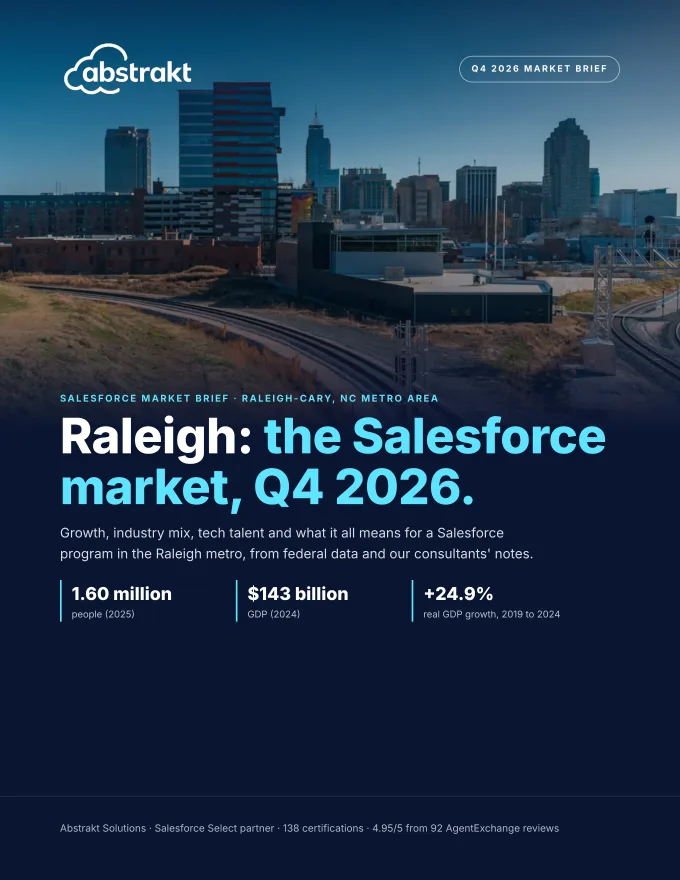
A free 26-page PDF with Raleigh's growth ranked against 100 metros, its industry mix, tech wages and nearby markets. It is offered on the public Raleigh page; send your customer there or get a copy for your own prep.
Get the Raleigh brief →Co-sell with Abstrakt in Raleigh
Working a Raleigh account? Bring in a named consultant for discovery, scoping or a health check. We reply within 4 business hours.