

How Salesforce work starts in Columbia
Abstrakt Solutions is a Salesforce Consulting Partner for organizations in Columbia, West Columbia, Lexington and Irmo and out through Richland, Lexington and Kershaw counties. Columbia is one of our focus markets.
What buyers here usually run into
- 1
Member service at carrier volume
Health and life insurers field a steady stream of member, broker and employer questions, and routing each one to the right team with full policy context is where many service desks lose time.
- 2
Engineered quotes kept in spreadsheets
Machinery and chemical producers frequently price by specification and volume, so approval chains stall when discount rules and cost sheets sit in files outside the CRM.
- 3
Loan relationships hidden in core systems
Agricultural and farm-credit lenders follow borrowers through seasonal cycles and field visits, yet those details often stay in loan platforms that relationship and service staff cannot open.
Budget, team and partner questions
What drives cost
Columbia cost drivers depend on the sector: carriers and lenders spend on field-level security, policy or loan system integration and service console design, while machinery and chemical producers spend on Revenue Cloud pricing rules and ERP connections. Duplicate records and older Classic orgs add cleanup before new work begins.
Admin or partner
Carriers here commonly run an internal Salesforce team with strict change control and bring in a partner for integration, new lines of business or Financial Services Cloud work. Manufacturers, medical suppliers and retailers more often outsource administration until the workload supports a hire.
What buyers ask a partner
Ask for experience with insurance or lending data models and protected data access if you are a carrier or lender, or Revenue Cloud and ERP integration if you manufacture. Ask how the partner handles release approvals and audit documentation.
The local economy and its biggest industries (4)
| Sector | Share of 2024 GDP | Where Salesforce fits |
|---|---|---|
| Manufacturing Salesforce for manufacturing → | 9.3% | Manufacturing is the metro’s largest private sector at 9.3% of 2024 GDP, and the Alliance’s anchor list centers on machinery and chemicals. Industrial producers in the Midlands need dealer and distributor accounts, spec-based quote approvals and ERP order status visible to sales. |
| Finance and insurance Salesforce for insurance → | at least 8.2% | A health plan, a life and accident carrier and a farm credit bank give Columbia an uncommon blend of health coverage, life and accident insurance and agricultural lending. Carriers and lenders here rely on member or broker service consoles, case routing and role-based access to regulated records. |
| Retail trade Salesforce for retail & consumer goods → | 8.1% | Retail trade is the metro’s third-largest private sector, at 8.1% of 2024 GDP, and the Alliance’s regional assessment names logistics among its high-performing clusters, so goods reach buyers through stores and online channels alike. Regional retailers and consumer brands selling through those channels use Salesforce for loyalty programs, customer service and buyer relationships. |
| Health care and social assistance Salesforce for health & life sciences → | at least 7.4% | Health care and social assistance contributes at least 7.4% of 2024 metro GDP, while the Alliance counts life sciences and medical supplies among its emerging industries. Hospitals track referrals and physician relations; medical suppliers manage hospital contracts and reorders. |
Source: U.S. Bureau of Economic Analysis, GDP by county (CAGDP2), 2024, summed to the metro area; private sectors only, excluding real estate and government. “At least” marks sectors where BEA suppresses some county figures.
Regional target sectors named by local economic development groups: Machinery (anchor industry), Chemicals & Plastics (anchor industry), Energy Technologies (anchor industry), Food & Beverage Manufacturing (emerging industry), Automotive (emerging industry), Life Sciences & Medical Supplies (emerging industry).
Salesforce products that fit Columbia (6)
In the order we lead with them here, from the industries above.
Salesforce Service Cloud
The operating system for modern customer service, case, knowledge, voice, and AI agent assist together.
Salesforce Financial Services Cloud
Industry CRM for wealth management, banking, insurance, and lending, built for compliance from the start.
Salesforce Sales Cloud
The CRM where sales pipeline lives, when it is built right.
Salesforce Revenue Cloud / CPQ
Configure-price-quote, billing, subscription management, and quote-to-cash on Salesforce.
Salesforce Field Service
Scheduling, dispatch, mobile work orders and parts for teams that work on site.
MuleSoft
Enterprise API platform, for connecting Salesforce, ERP, data warehouses, and the rest of your stack.
Columbia's manufacturers and insurers: where AI helps first
Columbia's leading private sectors are closely matched: in 2024 manufacturing produced 9.3 percent of metro GDP, finance and insurance at least 8.2 percent, and retail trade 8.1 percent. Machinery and chemicals producers can use AI to triage distributor leads and draft technical answers from approved product literature. Insurers and financial service operations handle high volumes of routine service requests, which suits case summaries and suggested replies that a representative reviews before sending. Store operators can let an assistant resolve common purchase and pickup inquiries. Before switching anything on, map which teams own which data, retire duplicate records, and write the knowledge articles the AI will rely on.
- Distributor lead triage for manufacturers
- Suggested replies for insurance requests
- Store and order self-service
Services buyers here usually need (7)
Salesforce Implementation in Columbia
Columbia implementations usually serve one of two worlds: carriers and lenders handling member, broker and borrower service, or manufacturers pricing engineered products. Manufacturing leads the metro's private economy at 9.3% of 2024 GDP, with finance and insurance close behind. For either, we settle the data model first, covering groups and households, producers, dealers and installed equipment, then phase the rollout and train each team before its own launch.
By industry in Columbia
- 1
Finance and insurance
The Central SC Alliance names financial services among the region's high-performing clusters, and health, life and accident coverage is a notable part of that mix. Implementations for insurers here begin with member, group and producer structures in Financial Services Cloud, plus service case types for enrollment, claim status and billing questions. Protected health information shapes the sharing model from the first workshop, since access rules are costly to reshape once thousands of records and users depend on them.
- 2
Machinery
The Alliance's plan counts machinery among the Midlands' anchor industries, and equipment makers implementing Salesforce need a product catalog that reflects configurable options, dealers and distributors set up as partner accounts, and installed equipment tracked as assets for service and parts. We build that structure first, layer Revenue Cloud quoting on top once the catalog is clean, and agree on how booked orders pass to ERP before any screens are designed or demonstrated to sales.
- 3
Health care and social assistance
Health care adds at least 7.4% of 2024 metro GDP, much of it generated by hospital systems. For them, implementation typically covers physician relations, referral intake and patient access, with clinical records left in the EHR. We define exactly what patient information Salesforce may hold, configure field-level security and audit trails in the first release, and design referral queues around how requests actually reach the hospital today, whether by fax, phone or portal.
Raise before scoping
Inventory request types by channel
Carriers and lenders here receive requests by phone, email, portal and broker. List every channel and request type, the team that should own it and the response customers expect, so queues, entitlements and case record types reflect real work from the day Salesforce goes live.
Train each group before its launch
Carriers, lenders and manufacturers in the Midlands rarely switch every team over on the same day. Schedule each group's training in the days just before its own go-live, using familiar accounts in a sandbox copy, so the lessons are still fresh when the switch happens.
Clean the catalog before quoting
Manufacturers eager for automated quotes should first standardize products, options and price books. Quoting rules built on an inconsistent catalog multiply errors. Treat catalog cleanup as its own phase, and add Revenue Cloud once engineering and sales agree on how products are described.
Salesforce Integration in Columbia
Columbia integration work reflects the metro's two economic anchors. Insurers and lenders connect Salesforce to policy administration, claims and loan servicing systems so service staff see status without switching screens. Manufacturers connect it to ERP for pricing, orders and shipments, and sometimes to plant or quality systems. We define ownership for every data element, choose APIs, scheduled syncs or MuleSoft to match volumes and systems, and add monitoring so failures are fixed before agents or reps notice anything missing.
By industry in Columbia
- 1
Finance and insurance
Carriers and agricultural lenders in the Midlands typically run core platforms that update on overnight cycles. We integrate them with Salesforce by syncing policy, claim and loan summaries on a schedule, passing service requests back through controlled interfaces and displaying detail on demand rather than copying it. That design keeps protected and financial data in the systems built to hold it, while member and borrower service staff still see what they need.
- 2
Automotive
Automotive is one of the Alliance's emerging industries, and suppliers selling into vehicle programs juggle forecasts, releases and quality issues from demanding customers. Integrating Salesforce with ERP and quality systems lets account managers see program volumes, shipments and open corrective actions beside each customer relationship. We usually pass summarized data and key events rather than every transaction, which keeps the integration reliable when release volumes spike near model changeovers or launch dates for new vehicle programs.
- 3
Chemicals & Plastics
Chemical and plastics producers often need Salesforce linked to ERP and laboratory or quality systems, since customers ask about grades, certificates of analysis and delivery timing. Integration brings order status, shipment tracking and quality documents into the account view, and routes technical questions to the right specialists with product details attached. Keeping formulation and costing data in ERP protects sensitive information while sales still sees the answers customers ask about most often.
Raise before scoping
Respect core system change windows
Policy, loan and ERP platforms often have strict release calendars and limited API capacity. Coordinate integration testing with those calendars early, and design Salesforce processes to cope if a nightly sync runs late, so service staff are not stranded when a batch fails.
Carry only fields users need
Integrations moving member health, borrower or pricing data need encryption, dedicated integration users and logging. Review which fields each connection carries and drop any that Salesforce users never look at, which shrinks both risk and the scope of future security reviews.
Plan reusable APIs
When several projects need the same customer or product data, building each integration separately creates duplication. An API-led approach with MuleSoft exposes shared services once, which makes later projects faster and keeps business rules consistent across every connected system and team.
Salesforce Migration in Columbia
Migrations in Columbia often involve long-established organizations with records spanning decades: members and brokers at carriers, borrowers at lenders, dealers and installed equipment at manufacturers. We profile every source, agree with each business owner what moves and what is archived, and deduplicate before loading. Mapping protects consent, compliance and relationship history. Trial loads in a sandbox continue until counts and spot checks reconcile, and cutover is timed around each department's calendar.
By industry in Columbia
- 1
Professional, scientific, and technical services
Engineering, consulting and technical firms, which together generate 6.9% of 2024 metro GDP as a sector, often reach Salesforce from spreadsheets, shared drives or project tools. Their records tend to be organized by project rather than client, so the migration regroups proposals and engagements under the right account, reconciles contact roles and flags clients that appear under several names. Older proposals can stay in a document archive linked from the account.
- 2
Food & Beverage Manufacturing
Food and beverage manufacturing is an emerging industry in the Alliance's plan, and producers moving to Salesforce frequently hold buyer data in spreadsheets by retailer, distributor or product line. Migration consolidates those files into one customer list, resolves conflicting pricing notes with sales managers and carries over the promotional and broker history buyers expect reps to remember. Complaint records move with product and date details, so quality staff can still spot patterns.
- 3
Health care and social assistance
Hospital systems migrating physician relations, referral or outreach data often start from older CRMs or departmental databases. We check what patient information those sources actually hold, migrate only what policy allows, and preserve referral history and physician relationships with their original dates and owners. Access is restricted during the load itself, and testing confirms that field-level security works as designed before any physician liaison or referral coordinator sees a migrated record.
Raise before scoping
Translate legacy codes carefully
Older systems store status, product and region values as codes that only long-serving staff understand. Build a translation table with those people, test it on real records, and retire codes that no longer apply, so Salesforce picklists reflect current business language.
Plan around enrollment and quarter-end
Carriers face open enrollment, lenders have quarter-end reporting and plants schedule maintenance shutdowns. Pick a cutover window clear of those peaks, and confirm it with every affected department early, so training and support are not squeezed by other deadlines competing for the same people.
Reconcile business totals, not just rows
Beyond record counts, compare key totals such as open opportunities, active policies or installed assets between the old and new systems. Business-level reconciliation, signed off by owners, catches mapping mistakes that technical checks miss and builds confidence before the old system is retired.
Salesforce Optimization in Columbia
Service consoles are where most Columbia optimization work begins. Carriers, lenders and hospital systems here run busy consoles where each extra click or misrouted case costs time. We study how agents and managers work, then simplify consoles and case layouts, tune routing and entitlements, consolidate legacy automation into Flow and rebuild service and sales dashboards on agreed definitions. Manufacturers get the same treatment for quoting and approvals. Each change set reaches production in a modest release, accompanied by a one-page note for whichever team it touches.
By industry in Columbia
- 1
Manufacturing
Manufacturers, which produce the largest share of the metro's private output, often run Salesforce alongside spreadsheets for pricing and forecasting. Optimization targets the reasons behind those spreadsheets: approval chains with too many steps, quote templates that need manual edits and forecast categories that do not match how sales leaders think. We streamline approvals in Revenue Cloud, fix templates and align forecasting, so reps stop keeping parallel files on their laptops.
- 2
Life Sciences & Medical Supplies
Life sciences and medical supplies is one of the Alliance's emerging industries. Medical suppliers selling to hospitals often track contracts, reorders and complaints in Salesforce but lack reliable reporting across them. Optimization links complaints to products and lots, tidies contract and account data, and builds dashboards for sales and quality leadership, so shifts in reorder volume or complaint patterns show up well before the next quarterly business review with a hospital customer.
- 3
Energy Technologies
Energy technologies is an Alliance anchor industry and one of the clusters its assessment calls high-performing. Equipment and services firms in this field often have opportunities with long, many-stakeholder cycles that sales teams stop updating. Optimization simplifies stages, adds guided paths and key-date reminders, and connects field service history to accounts, which helps renewals and upgrade offers reach the right utility or industrial customer at the right time instead of after a competitor calls.
Raise before scoping
Sit with agents first
Spend a normal shift beside service agents. Count screens opened per case, note fields they skip and watch for copy-paste between systems. Those observations point to the console changes that save the most time, which usage reports alone rarely reveal.
Consolidate overlapping automation
Orgs maintained by several admins over the years often hold workflow rules, process builders, triggers and flows on the same objects. Inventory all of it, retire duplicates and rebuild the rest in Flow with clear naming, then test thoroughly so the cleanup does not create new errors.
Define service metrics consistently
Define handle time, first-contact resolution and backlog the same way across every team and queue before building service dashboards. Consistent definitions let managers compare queues fairly and give leadership numbers they can trust in operational reviews, budget cycles and staffing discussions.
Salesforce Managed Services in Columbia
Columbia organizations with regulated service operations need Salesforce maintained carefully, not just quickly. Managed services covers user and permission administration, enhancements from a ranked backlog, release preview testing, integration monitoring and report requests, delivered by a consistent team. Every change is tested in a sandbox, approved and logged before it reaches production. Standing meetings and support hours are set against your Eastern clock, even though our consultants sit in the Central zone.
By industry in Columbia
- 1
Finance and insurance
Finance and insurance contributes at least 8.2% of 2024 metro GDP, including carriers and agricultural lenders with large service operations. For them, managed services means disciplined change control around member and borrower processes: scheduled access reviews, documented deployments, regression testing of case routing and entitlements before each release, and quick help when a console problem slows agents. Audit trails then show examiners exactly how each change was requested, approved and deployed.
- 2
Chemicals & Plastics
Chemicals and plastics is both an Alliance anchor industry and a high-performing cluster in its regional assessment. Producers here update Salesforce often: new grades and formulations in the catalog, customer-specific pricing, safety data sheet requests and technical service cases. A managed service handles those changes steadily and keeps quote approvals and service routing aligned with the organization, so commercial teams are not left waiting weeks for small but necessary changes.
- 3
Retail trade
Retailers and consumer brands, part of a retail sector worth 8.1% of 2024 metro GDP, use Salesforce in the Midlands for customer service, loyalty and marketing lists, and their needs spike before holidays and promotions. A managed service plans capacity around those peaks: testing routing and email templates ahead of busy periods, adjusting queues for seasonal staff and keeping knowledge articles current so agents answer the same question the same way at every store and on every channel.
Raise before scoping
Cover the early Eastern hour
Our team starts an hour after Columbia's workday begins. Agree how early-morning issues are reported and who covers them, and schedule planned deployments for times when both teams are online, so nothing important sits in a queue at the start of your day.
Log every production deployment
Regulated organizations should keep a record of what changed, why, who approved it and when it reached production. Ask the managed service to maintain that log and link it to backlog items, so audits and internal reviews can be answered from records that already exist.
Review the backlog with executives
Once a quarter, walk through the backlog and delivered work with business leaders, not only admins. That conversation reveals shifting priorities, retires stale requests and keeps the service focused on outcomes leadership cares about rather than an ever-growing ticket list.
Salesforce Health Checks in Columbia
Because finance and insurance and health care together make up a large share of Columbia's economy, many local orgs hold sensitive data, and a health check starts there. The work begins with who can view, change and export member and patient records, including through integration accounts, and then turns to data quality, automation, code, packages and adoption. Every finding carries a risk score, an effort estimate and a suggested remedy. The report also shows what needs attention before an Agentforce pilot, since AI features inherit whatever access and data problems already exist.
By industry in Columbia
- 1
Finance and insurance
Carriers and lenders here answer to regulators and business partners who ask how customer data is protected. The review traces every route to member and borrower records, including list views, reports, APIs and email, and checks that encryption, event monitoring and retention settings match written policy. Findings reference the exact setting involved, so compliance officers and admins can agree on corrective actions and document them ahead of the next examination.
- 2
Health care and social assistance
Hospital systems using Salesforce for referrals and physician relations sometimes store more clinical detail than intended in notes and attachments. A health check scans for that, reviews field-level security and report sharing, and checks whether guest users or portals expose records to people outside the organization. It also looks at how long patient-related data is kept, since retention settings often go unexamined for years after the original launch team moves on.
- 3
Life Sciences & Medical Supplies
For medical suppliers and life sciences firms, the health check focuses on whether complaint and adverse event intake is complete and traceable: required fields, audit history on key records, and alerts when cases age without action. We also check that customer contract data is consistent, since pricing and reorder reports depend on it, and flag customizations that lack tests, since those would slow any change that quality staff must validate before release.
Raise before scoping
Review portal and guest access
Member, broker and customer portals widen who can reach Salesforce. Check guest user permissions, sharing sets and self-registration settings as part of the review, since misconfigured public access is among the more serious exposures an outside review can uncover in regulated orgs.
Include the integration layer
Much of an org's risk sits in its connections to policy, loan and ERP systems. Review each integration user's permissions, credential storage, error handling and logging, and confirm every connection still has an owner, since unmanaged integrations can fail or leak data unnoticed.
Schedule a follow-up review
Set a date a few months after the health check to confirm fixes landed and nothing new has drifted. A short follow-up keeps findings from stalling, and it shows auditors and leadership that the organization acts on what reviews uncover.
Salesforce Implementation Rescue in Columbia
Rescue engagements in Columbia usually follow one of two patterns: a service console for members, brokers or borrowers that agents avoid, or a manufacturing project whose equipment and quoting data never came together. First come the fixes that unblock daily work; after that, the signed scope is laid beside the org as built and the way staff actually use it. The recovery plan separates components that work from those needing repair or replacement, and delivers the rest in short releases, each followed by retraining for the teams it touches.
By industry in Columbia
- 1
Machinery
Machinery makers' rescues often involve aftermarket service: installed equipment was never migrated properly, so parts quotes and service cases lack the asset history they depend on. Recovery rebuilds the installed base from ERP and service records, links it to accounts and dealers, and restores parts and service processes on top. Sales quoting is then reviewed with the benefit of accurate equipment data, which often resolves complaints that looked like quoting problems.
- 2
Finance and insurance
Insurance and lending projects often stall when the service design meets real volume: routing rules that misfire, entitlements that do not match contracts and consoles loaded with too many components. Recovery rebuilds case routing around how work is really divided, repairs the core system feed that supplies policy or loan status, and pilots the revised console with a single service team. Broader rollout follows once handle times and agent feedback show improvement.
- 3
Energy Technologies
Energy technology companies with long utility and industrial sales cycles sometimes end up with an org where opportunities, service contracts and installed equipment are disconnected, often because each piece was built separately. Recovery links them: contracts tied to assets, assets tied to accounts, renewals generated from contract end dates. With those connections restored, sales and service stop keeping their own spreadsheets and customers get one consistent answer about what they own and when it renews.
Raise before scoping
Stabilize before redesigning
Resist the urge to redesign everything at once. Fix the failures that stop work, such as broken integrations, locked records or permission errors, then assess the broader design with a calmer team. Stabilization buys the time and credibility needed for bigger decisions.
Engage compliance early
In insurance, lending and health settings, a failed project may have left sensitive data in the wrong places or with the wrong access. Bring compliance into the assessment early, so any exposure is contained promptly and the recovery plan reflects regulatory requirements from the start.
Share a believable recovery timeline
Stakeholders burned by missed dates need a plan they can believe. Share a recovery timeline built from the assessment, with milestones described in weeks or months and tied to visible outcomes, and report progress honestly, including any setback, at each release.
Industry plays in Columbia (3)
Salesforce for Columbia Insurers and Agencies
Columbia's insurance economy leans toward health, life and workplace benefits, which means carriers serve employers, members, brokers and enrollers at the same time. Salesforce, typically Financial Services Cloud with Service Cloud, brings those audiences into one model: employer groups and their policies, members and their service history, and producers with their appointments and commissions. We add Experience Cloud portals for employer administrators and brokers and connect everything through MuleSoft to policy, claims and billing platforms that remain the systems of record.
Carriers, agencies, banks and other financial firms together make up the Columbia metro's second-largest private sector after manufacturing; Bureau of Economic Analysis data put finance and insurance at no less than 8.2% of 2024 GDP, with some county detail held back. The Central SC Alliance's regional assessment names financial services as one of the region's high-performing clusters, alongside chemicals and plastics, logistics and energy technologies, citing strong sales outside the region, specialization and job growth. For carriers and agencies, that means competing for experienced service, underwriting and technology staff while serving customers well beyond the Midlands.
Use cases to open with
- 1
Worksite benefits enrollment support
Voluntary and group benefits are often sold at the workplace through brokers and enrollment specialists, with short enrollment windows and many questions. Salesforce can track each employer case from sale through enrollment, schedule enrollers, and give HR administrators a portal for census files, plan documents and requests. After enrollment closes, carriers can see participation by employer and broker, and service teams inherit a complete history instead of scattered emails.
- 2
Member service at carrier volume
Health and life carriers receive steady volumes of calls, chats and messages about eligibility, claims, ID cards and billing. Service Cloud routes each contact by product, group and reason, shows policy and claim status from core systems, and gives agents knowledge articles for consistent answers. Agentforce can resolve routine requests, like replacement cards or claim status, while complex or sensitive questions go to trained staff with the context already gathered.
- 3
Broker and producer service desk
Brokers call carriers about appointments, commissions, quotes and client issues, and a slow response can move business elsewhere. A producer service desk on Service Cloud, combined with an Experience Cloud broker portal, lets producers check commission statements, submit requests and track cases. Distribution leaders see which brokers generate the most business and service demand, and where relationships need attention before renewal season or a competitor's visit.
Raise before scoping
Core system integration plan
Policy administration, claims and billing systems hold the authoritative data, and many carriers run several generations of them. Map which data each role needs, build reusable MuleSoft APIs instead of point-to-point connections, and test response times at realistic call volumes before agents rely on them.
Regulatory and privacy obligations
Health information may fall under HIPAA, consumer financial data under GLBA, and carriers must satisfy state insurance regulations and data security laws. Your compliance officers and counsel should map each rule to specific products and states, and the Salesforce design should then encode consent, retention, audit logging and access to match.
Portal access by audience
Employer administrators, brokers, enrollers and members each need a different slice of data. Define permissions and sharing for each audience before building portals, test with realistic groups and agencies, and schedule periodic access reviews as brokers change agencies and employers change carriers or plans.
Salesforce for Columbia Manufacturers
Manufacturers around Columbia commonly price by specification, volume and delivery requirement rather than a fixed catalog, and many also depend on aftermarket parts and service revenue. Salesforce helps when quoting rules, customer trials and installed equipment are managed in the same system as the customer relationship. We combine Sales Cloud and CPQ or Revenue Cloud for engineered pricing, Field Service or a parts portal for aftermarket business, and integrations that keep ERP costs, inventory and order status current.
Plants and factories produced 9.3% of the Columbia metro's 2024 GDP by the Bureau of Economic Analysis measure, the top share among private industries and a step above finance and insurance. Of the six industries the Central SC Alliance targets, three are established manufacturing strengths it calls anchors (machinery, chemicals and plastics, energy technologies), and three it treats as emerging, among them automotive plus life sciences and medical supplies. Its regional assessment also calls chemicals and plastics a high-performing cluster. That describes manufacturers that sell engineered equipment and specified materials to other producers, often across long qualification and approval cycles.
Use cases to open with
- 1
Engineered quotes with approvals
Machinery builders and custom fabricators price configurations, options and volume breaks that are hard to manage in spreadsheets. CPQ or Revenue Cloud can guide sales engineers through valid configurations, pull current costs from the ERP, and route discounts or non-standard terms through approval. Quotes become consistent, margins are visible before commitment, and sales leaders can see where approvals slow deals.
- 2
Customer trials for specified materials
Chemical and plastics producers often must pass customer trials before a material is approved for production. Sales Cloud can track each trial with the customer plant, product grade, sample shipments, test results and approval status. Commercial teams see which trials are close to conversion and which have stalled at the customer's lab, technical service can coordinate follow-up, and leadership can forecast volume once a grade is approved.
- 3
Aftermarket parts and service revenue
Equipment manufacturers earn repeat revenue from spare parts, upgrades and service after the original sale. An Experience Cloud portal lets customers look up their equipment, order parts and request service, while Field Service schedules technicians. Installed-base records tied to serial numbers help sales teams identify upgrade opportunities and warn customers before critical parts become obsolete or unavailable, which protects both uptime and the relationship.
Raise before scoping
Clean product and cost data
Configuration and pricing rules depend on accurate part, cost and option data. Decide whether the ERP or PLM system owns each item, clean the data before loading CPQ, and define how engineering changes flow into Salesforce so quotes never use retired components.
Trial and approval tracking
Standard opportunity stages do not capture sample shipments, lab tests or customer qualification steps. Add a trial object or custom stages with owners and target dates, and connect results from technical service, so forecasts reflect real approval progress rather than a salesperson's optimism about a customer's lab schedule.
Installed-base data quality
Aftermarket selling needs accurate records of what equipment each customer owns. Plan a migration from warranty, service and ERP records, reconcile serial numbers and ship-to locations, and assign an owner to keep installed-base data current as equipment moves or is retired.
Salesforce for Columbia Health and Life Sciences
In Columbia, health and life sciences covers two different kinds of customer relationship. Providers manage patients, referring physicians and community programs. Medical supply and life sciences manufacturers sell to hospitals, clinics and distributors, then field product questions and complaints. Salesforce can serve both: Service Cloud and Experience Cloud for patient access and outreach, Sales Cloud and Service Cloud for B2B accounts and product support. We design privacy and quality boundaries up front so each side stays compliant.
Care providers rank fourth in Columbia's private economy at a minimum of 7.4% of 2024 GDP, a Bureau of Economic Analysis figure that undercounts because some county values are suppressed. The Central SC Alliance's 2025-2028 strategic plan lists life sciences and medical supplies as an emerging target industry for its eight-county region, alongside food and beverage manufacturing and automotive. The state's flagship university in Columbia enrolls more than 35,000 students, and a state-chartered public nonprofit founded in 1983 funds innovation from the city, with an affiliate that lends to and invests in South Carolina companies. Those resources support early-stage life sciences companies.
Use cases to open with
- 1
Hospital and distributor accounts
Medical supply makers sell through group purchasing agreements, distributors and direct hospital relationships, often all at once. Sales Cloud can map each health system's facilities, value analysis committees and contract status, link distributor sales data, and track new product evaluations. Account managers see which facilities have trialed a product and which committee meetings are coming, so they prepare instead of reacting to a lost bid.
- 2
Product complaints and inquiries
Clinicians and purchasing staff call with product questions, backorders and possible complaints. Service Cloud can separate routine questions from potential complaints, capture required details on first contact, and pass potentially reportable events to the quality system with the product, lot and customer already attached. Customer service answers availability questions from ERP data, and quality teams receive consistent intake instead of forwarded emails with key facts missing.
- 3
Patient outreach programs
Providers running screenings, chronic condition programs or community clinics need to reach the right patients and track follow-up. Marketing Cloud and Service Cloud can manage outreach lists built from approved data, record consent and preferences, and route responses to schedulers or care navigators. Program leaders see participation and follow-up rates by community, and patients receive messages through the channel they chose.
Raise before scoping
HIPAA and business associates
Before any patient detail enters the org, sign Salesforce's BAA and lock clinical fields to the few roles that need them. Keep clinical detail in the EHR where possible, and have your privacy officer approve the data map before patient outreach or portals are built.
Complaint intake discipline
For a supply manufacturer, every mention of a product failure may start a regulatory clock. Define which inquiries count as potential complaints, the required fields for each, and how they pass to the quality system, then test the process with quality staff before go-live.
Keep B2B and patient data apart
An organization that both provides care and sells products must keep patient records away from commercial teams. Separate record types, permission sets and possibly orgs, and document why, so auditors, regulators and business partners can see exactly how and where the data boundaries were drawn.
Case studies to send (3)
From the industries this market leans on. Client names are anonymized and these projects are not specific to Columbia.
The Columbia Salesforce market brief, Q4 2026
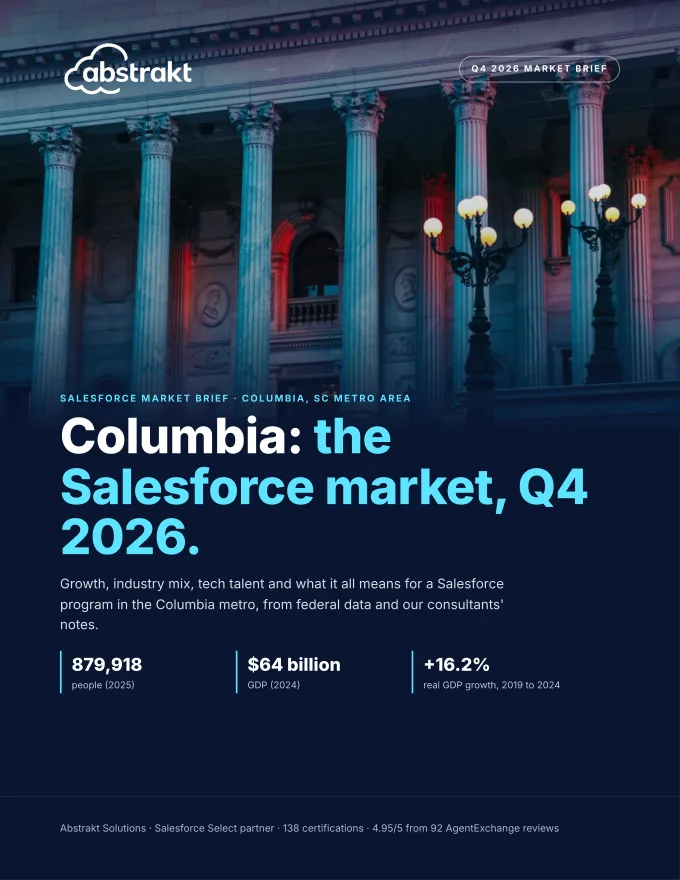
A free 23-page PDF with Columbia's growth ranked against 100 metros, its industry mix, tech wages and nearby markets. It is offered on the public Columbia page; send your customer there or get a copy for your own prep.
Get the Columbia brief →Co-sell with Abstrakt in Columbia
Working a Columbia account? Bring in a named consultant for discovery, scoping or a health check. We reply within 4 business hours.