

How Salesforce work starts in Hartford
Abstrakt Solutions is a Salesforce Consulting Partner working with companies in Hartford, West Hartford and East Hartford and out through Bloomfield, Windsor, Farmington and New Britain. Hartford is one of our focus markets.
What buyers here usually run into
- 1
Producers and policyholders in separate systems
Carriers and agencies commonly keep policy administration, agency management and claims data in core platforms outside Salesforce, so service reps and producers end up looking at different versions of the same customer.
- 2
Regulated communications
Insurance and health businesses have to record consent, disclosures and complaint handling carefully, and marketing automation built without those rules in mind creates audit exposure.
- 3
Quoting against specifications
Precision manufacturers supplying engine and defense programs often price against drawings, revisions and certifications, which a basic price-book setup cannot represent.
Budget, team and partner questions
What drives cost
Hartford costs come from core-system integration, complaint handling and communications that must satisfy regulators, and the access controls carriers expect. Manufacturers add cost when quoting needs drawing revisions, certifications and export-control restrictions.
Admin or partner
Carriers here typically have internal Salesforce teams and need partners for architecture, integration and peak releases. Agencies, insurtechs and machine shops more often outsource administration and keep a business owner internal.
What buyers ask a partner
Ask for insurance references with policy-system integration, how the partner documents complaint handling for audits, and how they design access for export-controlled data. Ask how they explain what an AI feature saw and suggested.
The local economy and its biggest industries (4)
| Sector | Share of 2024 GDP | Where Salesforce fits |
|---|---|---|
| Finance and insurance Salesforce for insurance → | 16.5% | Carriers, agencies, brokers and insurtech startups drawn by the Insurtech Corridor operate in the shadow of the capital's long-established national carriers. Their Salesforce work centers on producer and policyholder records, complaint handling that holds up to regulators, and data exchange with policy administration systems. |
| Manufacturing Salesforce for manufacturing → | 13.0% | Aerospace and industrial manufacturers here rely on a supplier base of machine shops and metal fabricators that quote to drawings and revisions and follow engine and defense programs for years. |
| Health care and social assistance Salesforce for health & life sciences → | 8.8% | Health care is one of the Alliance's six major industries, and providers, benefits administrators and health-plan service teams in the region need member and patient interactions tracked with privacy controls set before launch. |
| Professional, scientific, and technical services Salesforce for professional services → | 7.6% | Actuarial, consulting and IT services firms tend to sell multi-year engagements to a handful of large carriers, so mapping many stakeholders inside each account matters more than lead volume. |
Source: U.S. Bureau of Economic Analysis, GDP by county (CAGDP2), 2024, summed to the metro area; private sectors only, excluding real estate and government. “At least” marks sectors where BEA suppresses some county figures.
Regional target sectors named by local economic development groups: Insurance & Financial Services, Aerospace & Defense, Advanced Manufacturing, Health Sector / Healthcare, Broadcasting / Broadcast Media, Logistics & Distribution.
Salesforce products that fit Hartford (6)
In the order we lead with them here, from the industries above.
Salesforce Financial Services Cloud
Industry CRM for wealth management, banking, insurance, and lending, built for compliance from the start.
Salesforce Service Cloud
The operating system for modern customer service, case, knowledge, voice, and AI agent assist together.
Salesforce Sales Cloud
The CRM where sales pipeline lives, when it is built right.
Salesforce Experience Cloud
Customer, partner, and employee portals built on Salesforce.
Salesforce Revenue Cloud / CPQ
Configure-price-quote, billing, subscription management, and quote-to-cash on Salesforce.
MuleSoft
Enterprise API platform, for connecting Salesforce, ERP, data warehouses, and the rest of your stack.
AI for Hartford insurance and aerospace teams
Insurance defines Hartford's economy, with finance and insurance at 16.5% of metro GDP in 2024 and manufacturing close behind at 13%. For carriers and brokers, AI earns its place by reading first-notice-of-loss documents, summarizing claim files, and drafting policyholder correspondence that an adjuster approves. Aerospace and precision manufacturers can apply similar document reading to supplier quality records and customer inquiries. Forecasting support for sales leaders is a third, quieter use. None of it replaces licensed judgment, and firms need to explain how automated steps reached a result, so we design agents to assist rather than decide, with clear logs of what each one saw and suggested.
- Claim file summarization
- Policyholder letter drafting
- Supplier quality record review
Services buyers here usually need (7)
Salesforce Integration in Hartford
Integration is often the largest part of Salesforce work in Hartford. Insurers and agencies need policy, claims, billing and commission data from core platforms; manufacturers need ERP orders, shipments and quality data; distributors need warehouse and transportation feeds. We map field ownership, choose between MuleSoft, native connectors and direct APIs based on system count and volume, and build with monitoring, retry logic and documentation. Producers, service reps and account managers then see one customer picture without switching applications.
By industry in Hartford
- 1
Finance and insurance
Carriers and agencies in Hartford keep policy administration, agency management and claims data in core platforms that will not move to Salesforce. Integration brings policy summaries, renewal dates, claims status and commissions into Financial Services Cloud so producers and service reps work from the same record. We set sync frequency by use: near real time for claims status that policyholders ask about, overnight for commission and book-of-business data. Commission disputes shrink when producers can see the same figures as finance.
- 2
Manufacturing
Manufacturing contributes about 13% of 2024 metro GDP, and the Alliance estimates downstream metal products in the Hartford Region generate $2.4 billion in output. Suppliers in that chain need Salesforce linked to ERP so won quotes become orders without re-entry and account managers see delivery performance before customer reviews. We keep routings, inventory and costing in ERP and bring over only the order, shipment and quality data commercial teams use.
- 3
Logistics and distribution
The Alliance describes the Hartford region as the Northeast's premier logistics and distribution hub. Distributors and third-party logistics providers here need warehouse and transportation systems feeding Salesforce with order status, exceptions and claims, so customer teams can respond without chasing operations. We push exceptions as events, summarize routine activity and give account managers volume and service trends for each customer. Claims and damage reports open as cases linked to the shipment, so nothing depends on someone forwarding an email.
Raise before scoping
Name the authoritative system
Policy status, mailing address, producer code: each shared field needs one authoritative system, agreed in writing. Core insurance and ERP platforms usually win, and Salesforce either displays their data or writes back through controlled processes, never through users editing the same field in two places.
Engage core-system vendors early
Many policy and claims platforms are hosted or maintained by vendors with fixed release calendars and API rules. Contact those vendors at the start, confirm which APIs and test windows are available, and build the integration timeline around their constraints.
Reconcile every exchange daily
Regulated businesses need to prove data moved correctly. Log each transaction, reconcile record counts every day and alert a named owner on failures, so discrepancies are caught before a producer, policyholder or auditor stumbles across them. Keep the logs long enough to answer audit questions.
Salesforce Implementation in Hartford
Most Hartford implementations are shaped by insurance. Carriers, agencies and the firms that serve them already run policy administration, agency management and claims platforms, so Salesforce goes in as the relationship and service layer on top. We decide early between Financial Services Cloud and Sales Cloud, define which system owns each field, design security with regulators and auditors in mind, and phase go-lives by team.
By industry in Hartford
- 1
Finance and insurance
Carriers, agencies, banks and investment firms combine for roughly 16.5% of Hartford-area GDP in the 2024 BEA data, the biggest private slice. For an insurer or agency, implementation choices center on the Financial Services Cloud insurance model: how producers, policyholders, policies and claims relate, which data syncs from core platforms and which is maintained in Salesforce. We settle those relationships and the permission model compliance expects during design, since changing them after producers are live is disruptive.
- 2
Aerospace and defense
The MetroHartford Alliance lists aerospace and defense among the region's six major industries, and the metro hosts jet-engine production alongside many smaller suppliers. Implementing Salesforce for those suppliers means program-based opportunities, quotes tied to drawings and revisions, and customer scorecards. Where defense work is involved, we design access so export-controlled technical data stays out of the CRM or is tightly restricted, and we make that call before any records are loaded.
- 3
Broadcasting
Broadcasting is another of the Alliance's six major industries, with national sports and radio companies based in the region. Media sales teams implementing Salesforce need advertiser and agency hierarchies, campaign-level opportunities and inventory references that link to traffic and billing systems. We model agencies and advertisers separately, with relationship records between them, so commissions, credit and renewals follow the right party when an advertiser changes agencies. Revenue reporting then reconciles cleanly with the billing system.
Raise before scoping
Choose the right insurance cloud
Financial Services Cloud includes insurance-specific objects and relationship views, while Sales Cloud is simpler to configure and maintain. Base the decision on how much of your process revolves around policies, producers and households rather than on feature lists, and make it before design starts.
Build in regulatory evidence
Connecticut insurers and health businesses must be able to show how consent, complaints and disclosures are captured. Build those records and their audit trails into phase one, rather than adding them after an examination or internal audit asks where the evidence lives.
Roll out channel by channel
Carriers selling through independent agents, captive producers and direct channels often benefit from launching one channel at a time. Each group has different data, permissions and portal needs, and a staggered rollout keeps training focused and post-launch support manageable. It also leaves room to fix issues before the next channel starts.
Salesforce Migration in Hartford
Hartford migrations frequently involve insurance data, which means relationships matter as much as records. Producers, policyholders, households and businesses must be linked correctly, and policy detail usually stays in core systems. We inventory each source, deduplicate and standardize data before loading, map it to Financial Services Cloud or Sales Cloud structures, and rehearse the load in a sandbox. Cutover happens in a planned window, followed by reconciliation reports and hands-on help for users during their first days in Salesforce.
By industry in Hartford
- 1
Insurance and financial services
Agencies and carriers moving to Salesforce typically migrate from older CRMs, agency management add-ons and producer spreadsheets. We map clients to person or business accounts, rebuild household and ownership relationships, and bring in producer assignments and renewal dates while leaving detailed policy data in the source platform. Match rules are reviewed with service leaders, because wrongly merging two policyholders creates service and compliance problems that are hard to unwind. Agency staff review a sample of merges before the full load.
- 2
Advanced manufacturing
The Alliance says the Hartford Region's downstream metal products sub-sector touches more than 15,700 jobs. Machine shops and fabricators in that chain often keep customer contacts, RFQs and drawing revisions across email, ERP notes and shared drives. Migration organizes that history into accounts, opportunities and quotes with the right revision references, and archives older files with links from Salesforce, so estimators find past work without searching several systems. Revision history stays attached to each quote.
- 3
Health care and social assistance
Providers, benefits administrators and health service organizations migrating to Salesforce must move member or patient-related data without exposing it. We classify fields before extraction, restrict who can see migrated data from the first load, and exclude clinical detail that does not belong in a CRM. Encryption, masking in test sandboxes and documented reconciliation give privacy officers the evidence they need to approve cutover. Nothing moves to production until counts and access checks pass in a sandbox.
Raise before scoping
Map relationships, not just records
Insurance and health data depends on links between people, households, businesses, producers and providers. Plan how each relationship will be represented in Salesforce before extracting anything, so the migration rebuilds connections instead of loading isolated records. Producer-to-client links deserve particular care.
Mask sensitive data in trials
Trial migrations should use masked or subset data wherever possible, particularly for policyholder and member information. That keeps sensitive records out of sandboxes a larger project team can reach, while still testing mappings and volumes realistically. Only the final production load needs real records.
Train producers on their book
Producers and service reps judge a migration by whether they can find their book of business on day one. Train them with their own migrated data in a sandbox before cutover, and hand out quick reference guides for the searches they run most often.
Salesforce Optimization in Hartford
In Hartford, optimization work often starts with an org built for one line of business and later extended to others without redesign. We measure actual usage, interview users in each group and review automation and reporting. The fixes that follow are practical: role-specific layouts and record types, legacy workflow rules and Process Builder moved into Flow, quoting tuned where it slows reps, and dashboards rebuilt around the questions leaders actually ask. Improvements ship in regular releases, so teams see progress without a disruptive relaunch.
By industry in Hartford
- 1
Professional, scientific, and technical services
Advisory, actuarial and technical firms sit behind about 7.6% of 2024 metro output. Many adopted Salesforce for pipeline, then left account planning and delivery tracking in spreadsheets. Optimization brings those into the org: stakeholder maps for large carrier clients, account plans linked to opportunities and forecasting that reflects multi-year engagements. We also remove stages and fields that no longer match how partners actually sell, and add a simple health indicator for each major client relationship.
- 2
Advanced manufacturing
Advanced manufacturing is one of the Alliance's six major industries, and machine shops and metal fabricators here quote against drawings and revisions. Many installed CPQ tools that became too rigid or too complex over time. Optimization reviews product rules and pricing logic, removes rarely used options, adds approval paths for margin and lead-time exceptions, and connects quote data to account dashboards, so estimators and sales managers work from the same numbers.
- 3
Broadcasting
Broadcast sales teams track advertisers, agencies and campaigns under tight deadlines, and Salesforce orgs in this field accumulate custom objects for every new product or sponsorship format. We consolidate those objects, clean up agency and advertiser relationships, and rebuild revenue reporting by product line and agency, so sales leaders stop reconciling Salesforce against billing-system spreadsheets before every forecast call. We also align opportunity stages with how agencies and direct advertisers actually buy, so pipeline reports stop overstating what is likely to air.
Raise before scoping
Separate lines of business
When personal lines, commercial lines or different practices share one org, use record types, layouts and permission sets for each group rather than one crowded design. Every team sees what it needs, and a change for one group stops breaking processes for another.
Tune CPQ with estimators present
Pricing rules can look right on paper and fail in practice. Review quotes alongside the estimators and sales engineers who build them, measure how long a typical quote takes, and remove steps that add effort without protecting margin. Keep the rules that genuinely prevent errors.
Agree on report definitions
Different teams often calculate pipeline, retention or win rate differently, producing conflicting dashboards. Settle definitions with leadership, rebuild reports to match and retire the duplicates, so meetings discuss the business instead of whose number is right. Assign an owner to each definition.
Salesforce Health Checks in Hartford
For Hartford organizations, a Salesforce health check is often driven by governance: an internal audit, a vendor-risk questionnaire from a carrier client, or a planned AI rollout. We review permissions, sharing, encryption and audit settings, automation and code, packages, integrations, data quality and adoption, and interview key users. The written report puts the riskiest problems at the top and notes how much work each fix takes. Insurers and health organizations get evidence for auditors; manufacturers learn whether sensitive technical data sits somewhere it should not.
By industry in Hartford
- 1
Finance and insurance
Insurers, agencies and financial firms, which lead the metro's private economy, face frequent scrutiny of how customer data is handled. A health check reviews who can view and export policyholder information, whether field history and audit trails cover regulated data, and how complaint and consent records are captured. We also examine the integration users connected to core systems, which often hold broader access than any person in the org. Findings reference the internal policies your compliance team already uses.
- 2
Health sector
Health organizations in the region, from providers to benefits administrators, need proof that protected information in Salesforce is limited to the right people. We test profiles, sharing, portal visibility and report exposure, look for sensitive details in free-text fields and email templates, and confirm encryption and event monitoring settings. Findings are written for privacy and compliance officers as well as for the Salesforce administrators who will fix them. We also check that the business associate agreement covers the features in use.
- 3
Aerospace and defense
Aerospace and defense suppliers across the region must keep controlled technical data out of places it does not belong. The health check searches files, notes and custom fields for drawings, specifications or export-sensitive details, reviews external sharing and partner access, and confirms that departed users and contractors are deactivated. The result is a remediation plan your compliance lead can act on and track through to closure. The access review is repeatable, so you can rerun it each quarter.
Raise before scoping
Prepare for carrier security reviews
Hartford vendors selling to carriers routinely receive detailed security questionnaires. A health check documents how Salesforce access, encryption, logging and integrations actually work, so answers are accurate and consistent rather than assembled from memory under a deadline. It also shortens the time to respond.
Assess AI readiness honestly
Before Agentforce or other AI touches customer records, confirm data completeness, duplicate levels and permission scope on the objects involved. The health check states plainly whether those objects are ready or which cleanup has to happen first. An honest no is more useful than an optimistic yes.
Rank technical debt by risk
Old workflow rules, unused fields and abandoned code are not equally dangerous. Prioritize items that affect security, data integrity or upcoming releases, and schedule cosmetic cleanup later, so remediation effort goes where it reduces real exposure. Some debt can safely wait for a quiet quarter.
Salesforce Managed Services in Hartford
Hartford organizations tend to need managed services once Salesforce has become central to producers, service reps or client teams but internal capacity has not kept pace. We handle the daily request queue, review each seasonal release against insurance and health workflows, maintain integrations with core systems and work through enhancements in the order your owner sets. Changes carry the documentation and approvals regulated businesses expect. Admins, developers and architects join as needed, with one lead consultant accountable for continuity.
By industry in Hartford
- 1
Insurance and financial services
The MetroHartford Alliance, without citing a year, estimates the insurance sector adds $15.8 billion annually to the regional economy. Carriers and agencies relying on Salesforce need stable producer data, service processes and policy-system integrations more than new features. Managed services keeps those running: monitoring sync jobs, adjusting producer hierarchies when appointments change, updating complaint workflows when rules shift, and testing each release against the insurance objects the business depends on.
- 2
Health care and social assistance
Health plans, providers and social service agencies together account for about 8.8% of 2024 metro output. Those running Salesforce, along with benefits administrators, generate constant change: member service scripts, provider network updates, outreach campaigns. We make those changes with privacy controls reviewed each time, keep an audit trail of every deployment, and make sure new fields holding protected information receive the right security before anyone starts entering data into them. Privacy officers receive a monthly summary of changes that touched sensitive data.
- 3
Professional, scientific, and technical services
Actuarial, consulting and IT services firms in Hartford often sell long engagements to a small number of large carriers. Their Salesforce needs evolve with each major client: new stakeholder maps, delivery tracking, account plans and renewal forecasts. A managed team keeps pace with those requests and supplies developer time for integrations with time-tracking and billing systems, a skill these firms rarely keep on staff for their own internal tools. Continuity matters, since partners notice at once when a client dashboard breaks.
Raise before scoping
Keep an auditable change trail
Insurers and health organizations should be able to show who requested, approved and tested each Salesforce change. Use a ticketing process tied to deployments and store the test evidence with it, so an auditor's question can be answered quickly rather than after days of digging.
Watch core-system sync jobs
Connections to policy administration, claims or member systems are often the most fragile part of the org. Monitor them daily, include them in every release test and assign a named owner, since a silent failure leaves producers or service reps working from stale data.
Split support and roadmap capacity
Allocate hours for day-to-day support and separate hours for improvements such as portals or AI pilots. Without that split, small urgent requests consume every available hour, and the strategic projects leadership asked for never actually get started. Protect a fixed share of each month for roadmap work.
Salesforce Implementation Rescue in Hartford
Most troubled Hartford projects we see failed on integration, on scope, or on both. An insurance project promised policy and claims data inside Salesforce that never arrived reliably, or a manufacturer's CPQ build grew too complex to maintain. Triage comes first: a read of the org against the original scope, conversations with sponsors and users, and a list of whatever blocks daily work. Stabilization comes next, then decisions on what to keep, fix or rebuild, and a phased completion plan built around the relaunch.
By industry in Hartford
- 1
Insurance and financial services
Insurance rescues commonly involve Financial Services Cloud projects where the data model was customized heavily instead of using standard insurance objects, or where core-system integrations failed. We map the build against standard structures, decide which customizations to retire, and stabilize the policy and claims feeds with monitoring. Producers get a usable view of their book first, before service automation and portals are relaunched. Relaunch then happens one distribution channel at a time.
- 2
Manufacturing
Manufacturers, whose output is second only to finance and insurance in the metro, often reach us after quoting projects stall. Rules written for every pricing exception, product structures that mirror engineering rather than selling, and ERP integrations that fail silently are typical causes. We simplify the catalog and rules, move exceptions to approvals, repair the order handoff to ERP and relaunch with estimators involved in testing. Won quotes then flow to ERP without re-entry.
- 3
Professional, scientific, and technical services
Consulting and IT services firms sometimes implement Salesforce with ambitious resource planning, project tracking and billing features that never gain adoption. Rescue narrows scope back to what drives the business: pipeline, account planning for major clients and forecasting. We stabilize those, integrate with the tools the firm already uses for delivery and billing, and reintroduce extra features only when teams ask for them. Leadership gets a forecast it can rely on before anything else is added back.
Raise before scoping
Compare the build to standard
Many troubled insurance and manufacturing orgs recreated functionality Salesforce already provides. Identify where standard Financial Services Cloud objects or CPQ features could replace custom work, since moving back to standard reduces maintenance and makes future releases safer. Standard features also come with Salesforce's own documentation.
Fix integrations before features
A CRM without reliable policy, claims or order data loses users quickly. Repair monitoring, error handling and reconciliation on existing integrations before building anything new, so producers and account managers regain trust in what they see on screen. Reliable data is the foundation of the relaunch.
Give one sponsor final say
Rescues stall when every decision needs a committee. Appoint one sponsor with authority to approve scope and trade-offs, meet with them weekly and record each decision, so recovery work proceeds without reopening questions that were already settled. Share the decision log with the whole project team.
Industry plays in Hartford (4)
Salesforce for Hartford Insurers and Agencies
In Hartford, insurance Salesforce work usually starts inside a large carrier's line of business or with a firm that sells to carriers, not with a blank-slate agency. The useful design separates distribution, meaning producers, appointments and agency performance, from policyholder service, and keeps policy, billing and claims data in the core systems that own it. We build Financial Services Cloud or Service Cloud around those boundaries, integrate the policy platforms, and set the security model before any agent or service rep logs in.
In the Bureau of Economic Analysis's 2024 county data, insurers and other financial firms generate 16.5% of Hartford-area GDP, the largest private share, with manufacturing next at 13%. The MetroHartford Alliance lists insurance and financial services first among its six target industries, a list that also covers aerospace and defense, advanced manufacturing and health care. AdvanceCT ranks Hartford eighth nationally for fintech leaders, and the Alliance points to an insurtech corridor linking Connecticut and the UK that draws startups seeking proximity to established carriers. Buyers here range from enterprise lines of business to young vendors selling into them.
Use cases to open with
- 1
Producer and agency management
Carriers that distribute through independent agents need appointments, licensing status, commission tiers and production by line tracked against each agency. Financial Services Cloud gives distribution teams agency hierarchies and producer records, and a partner portal on Experience Cloud lets agencies submit business, check status and download materials without calling a territory manager for every question. Distribution leaders then see which agencies are growing and which are quietly slipping.
- 2
Policyholder service across lines
Commercial and personal lines often run on different policy platforms, so a service rep answering a billing question may need three screens. Service Cloud, fed read-only policy, billing and claims summaries through MuleSoft, puts the relevant details on one case view, while routing sends coverage questions to licensed staff and simple requests to self-service. Complaint cases carry their own fields and timestamps so they can be reported separately.
- 3
Insurtech sales into carriers
Startups and software vendors in the region sell to a small number of large carriers, where one deal involves underwriting, claims, IT, procurement and security reviewers. Sales Cloud configured with buying-committee roles, pilot stages and security questionnaire tracking shows where each carrier stands, and helps a small team forecast long enterprise cycles without guessing. Renewal and expansion opportunities open automatically once a pilot converts.
Raise before scoping
Respect core system ownership
Coverage terms, premiums and claim payments belong in the policy, billing and claims platforms, not in the CRM. Decide which summaries Salesforce displays, how often they refresh and whether any writes flow back, and document it, because carriers' architecture review boards will ask before the integration is approved.
Model licensed and unlicensed work
State producer licensing and appointments determine who may discuss coverage or bind business. Store license states, lines of authority and expiration dates on producer records and use them in routing and assignment rules, so work reaches only people permitted to handle it. Licensing rules vary by state, so have compliance sign off on the routing logic.
Fit enterprise platform governance
Large carriers run Salesforce under central platform teams with release calendars, security reviews and shared components. A line-of-business project has to fit those standards, so agree early on naming, sandbox strategy and who approves deployment, rather than discovering the rules in the final sprint.
Salesforce for Hartford Manufacturers
Manufacturing work in the Hartford region often means machining, forming or assembling parts to a customer's drawing, then supplying them for the life of an engine or defense program. Salesforce should track requests for quote by part number and revision, capture qualification and first-article status, and link long-term agreements to forecasted demand. We configure Sales Cloud and CPQ around that flow, connect ERP and quality data, and restrict sensitive program information so only authorized people can see it.
Factories and machine shops trail only the insurers here: the Bureau of Economic Analysis credits manufacturing with 13% of Hartford-area GDP in 2024, against 16.5% for finance and insurance. The MetroHartford Alliance names aerospace and defense and advanced manufacturing as separate target industries, with logistics and distribution also on its list, which reflects a supply base built around engines, precision components and metal products. Many of these companies are suppliers several tiers below the finished aircraft or system, so their CRM questions center on qualification, repeat orders and program timing rather than marketing volume.
Use cases to open with
- 1
RFQ intake by part revision
Requests arrive as drawing packages with part numbers, revisions, material specs and requested quantities. We model each RFQ with line items tied to part and revision records, attach the drawings from document storage, and route it to estimating with due dates visible to sales. When a revision changes, the quote history stays linked, so nobody prices an obsolete drawing by accident.
- 2
Long-term agreement tracking
Aerospace buyers often award multi-year agreements with price schedules and forecast quantities rather than single orders. Sales Cloud with custom agreement objects, or Manufacturing Cloud sales agreements, records committed pricing and planned volumes, compares them with actual ERP shipments by month, and alerts account managers when a customer's orders drift below plan well before the agreement comes up for renewal.
- 3
Aftermarket and repair quoting
Suppliers that repair or overhaul components sell differently from new production: quick-turn quotes, teardown findings and customer approval before work continues. Service Cloud cases linked to CPQ quotes let the repair team send an estimate, record approval and track turnaround, while sales sees which operators and programs drive repeat repair revenue. Teardown findings attach to the case for the quality team.
Raise before scoping
Control access to program data
Defense-related technical data may fall under export control rules such as ITAR, which restrict who can view it. Keep controlled drawings in approved repositories, store only references in Salesforce, and use permission sets and sharing rules to limit program records. Export classification is a legal determination, so your trade compliance lead should approve the design.
Connect quality, not just ERP
Qualification status, first-article results and corrective actions usually live in a quality system. Sales and customer service need visibility into those statuses to answer buyers accurately, so plan a read-only integration for key quality fields rather than asking engineers to re-enter data in Salesforce.
Keep estimating in charge of cost
Cost models for machined and fabricated parts depend on routings, material and setup assumptions that estimators maintain. CPQ should consume those results and apply approvals and margin rules, not replicate the costing engine, or two versions of the truth will appear within a few quote cycles.
Salesforce for Hartford Health Care Organizations
In the Hartford area, many provider organizations deal constantly with health plans, whether for authorizations, care management programs or value-based contracts. Salesforce is useful when it becomes the place where patient access, referral follow-up and payer coordination are tracked together, while clinical records stay in the EHR. We build Service Cloud and Experience Cloud around that split, connect the EHR and scheduling systems through MuleSoft, and set up permissions so staff see only the patient information their role requires.
Hospitals, clinics and social service agencies together produced 8.8% of Hartford metro GDP in 2024 by Bureau of Economic Analysis county data, a share that trails only insurers and bankers (16.5%) and manufacturers (13%). The MetroHartford Alliance counts health care among its six major industries, though the figures on its health detail page describe all of Connecticut rather than the metro. What sets the region apart is how closely providers sit to health insurers: the same payers whose members they treat are a pillar of the metro economy, so provider work here is often shaped by plan programs and reporting.
Use cases to open with
- 1
Referral and authorization tracking
Specialty practices and outpatient programs lose patients between referral and first visit, often while an authorization is pending with the plan. A Service Cloud queue can hold each referral with its payer, authorization status and next step, alert coordinators when a request stalls, and show managers where referrals leak by source or specialty. Clinical documents remain in the EHR, and Salesforce stores only the operational details coordinators need.
- 2
Care management program enrollment
Health plans in the region fund care management and disease programs that providers help deliver. Salesforce can track eligible patients by program, record outreach attempts and consent, schedule follow-up calls and report enrollment back in the format each plan expects. Coordinators work from one list instead of a spreadsheet per payer, and leadership can see which programs are filling and which need more outreach.
- 3
Patient access portal
Behavioral health and home care organizations field many calls about intake paperwork, visit times and billing questions. An Experience Cloud portal lets patients and families complete forms, see upcoming visits and send secure messages, with each request becoming a case that routes to the right team. Agentforce can answer routine questions from approved content and hand anything clinical to staff.
Raise before scoping
Separate payer and patient data
Organizations that hold both plan-provided member lists and their own patient records should decide how the two match before building anything. Duplicate person records undermine outreach reporting, and mixing data received under different agreements complicates what each team is allowed to see and export.
HIPAA controls before launch
Protected health information in Salesforce calls for a signed business associate agreement, field-level security, audit trails and, often, Shield encryption. Design sharing rules with your privacy officer and compliance staff at the start, not after coordinators and schedulers are already working in the system.
Plan for statewide reporting
Many Hartford-area organizations operate clinics across Connecticut rather than only in the capital region. Build location and service-area fields into the data model early so program and access reports can be split by site, town or payer contract without rework later.
Salesforce for Hartford Professional Services Firms
For Hartford professional services firms, a handful of large insurance and manufacturing clients often account for most revenue. Salesforce should reflect that: account plans for each carrier or plant, opportunities that follow master agreements and statements of work, and forecasts that tell practice leaders who is needed and when. We configure Sales Cloud for relationship-led selling, add CPQ where rate cards and fixed-fee pricing get complicated, and connect project and time systems so won work turns into staffed engagements.
Consulting, legal, engineering, actuarial and IT firms fall under the BEA's professional, scientific and technical services line, worth 7.6% of Hartford's 2024 metro output and ranked fourth. The sector's clients sit mostly in the two larger ones: finance and insurance at 16.5% and manufacturing at 13%. AdvanceCT places the city twelfth nationally among tech talent leaders and highlights two global IT services firms with offices downtown, while the MetroHartford Alliance says startups are drawn to the region's incubators and its access to big-name insurers. Consultancies, actuaries and IT firms here tend to sell deep into a few large accounts.
Use cases to open with
- 1
Carrier account planning
Firms that serve the region's insurers often work with several business units inside one carrier, each with its own sponsor and budget. Account hierarchies in Sales Cloud show every unit, contact role and active engagement, and account plans record whitespace, renewal dates and relationship owners. Partners preparing for a quarterly review see total spend, open proposals and delivery issues for the whole carrier on one page.
- 2
Vendor onboarding as pipeline
Large insurers and manufacturers put new suppliers through security questionnaires, insurance certificates and procurement review before any work can start. Tracking those steps as opportunity stages, with tasks and due dates, shows why a signed deal has not yet produced revenue. It also creates a record of what each client required, which shortens the next onboarding with the same buyer.
- 3
Statement of work renewals
Much of the revenue comes from extending existing statements of work rather than new logos. Salesforce can flag engagements approaching their end date, prompt the account lead to propose an extension, and attach the renewal to the original agreement. Revenue Cloud or CPQ keeps rate cards and discounts consistent, and finance sees what is expected to roll forward next quarter.
Raise before scoping
Integrate with project systems
Hours, invoices and consultant assignments are normally kept in a separate project or ERP platform. Decide which fields come into Salesforce, such as utilization and budget burn, and how often they refresh, so partners trust the numbers without anyone duplicating the project system.
Respect client confidentiality
Firms serving competing insurers must keep each client's information walled off from the others. Use restrictive sharing, private account teams and careful naming on reports and dashboards so a consultant working for one carrier cannot browse notes, pricing or proposals from a rival's engagement.
Keep partner data entry light
Senior consultants resist CRMs that feel like another timesheet. Capture meetings automatically from email and calendar, keep opportunity fields to what drives forecasting and staffing, and give partners a mobile view they can update in a few taps between client meetings.
Case studies to send (3)
From the industries this market leans on. Client names are anonymized and these projects are not specific to Hartford.
The Hartford Salesforce market brief, Q4 2026
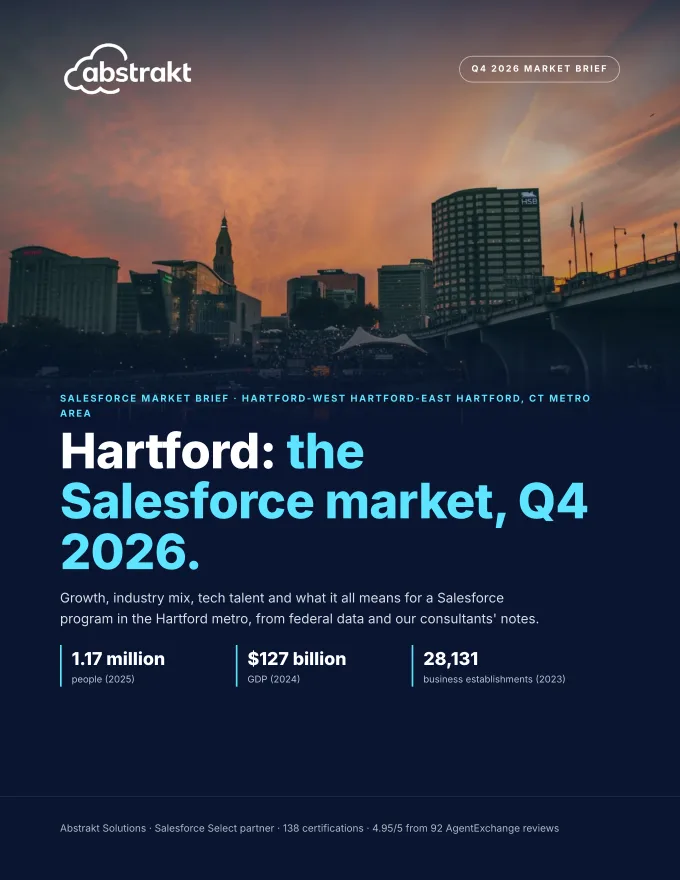
A free 26-page PDF with Hartford's growth ranked against 100 metros, its industry mix, tech wages and nearby markets. It is offered on the public Hartford page; send your customer there or get a copy for your own prep.
Get the Hartford brief →Co-sell with Abstrakt in Hartford
Working a Hartford account? Bring in a named consultant for discovery, scoping or a health check. We reply within 4 business hours.