

How Salesforce work starts in Worcester
Worcester County and neighboring Windham County, Connecticut, make up the region where Abstrakt Solutions does its Central Massachusetts Salesforce consulting. Worcester is one of our focus markets.
What buyers here usually run into
- 1
Scaling life sciences operations
Young biotech and biomanufacturing companies often move from spreadsheets and inboxes to real customer service and order processes quickly, and need a Salesforce design that can grow with them.
- 2
Service on installed equipment
Manufacturers of instruments and industrial products commonly track warranties, service visits and parts outside the CRM, which leaves sales without the full account picture.
- 3
Privacy in health and insurance data
Health systems and insurers need permissions, consent and integrations reviewed carefully, which suits a health check before adding clouds or AI.
Budget, team and partner questions
What drives cost
Worcester scope usually turns on regulated data and installed equipment. Health systems, biotech firms and insurers need permission, consent and integration reviews before building, while instrument makers put their effort into asset records, service contracts and ERP links. Territories that span two states add some address and assignment work.
Admin or partner
Hospitals and insurers here often keep a Salesforce owner inside IT or compliance and bring in a partner for architecture and integrations. Young biotech and robotics companies usually have no admin at all, so managed services fills the gap while processes are still changing.
What buyers ask a partner
Ask for examples of privacy reviews in health or insurance orgs, asset and service contract design for equipment makers, and how the partner documents decisions for audited or validated environments. Ask how they would grow a lean early build as the company scales.
The local economy and its biggest industries (4)
| Sector | Share of 2024 GDP | Where Salesforce fits |
|---|---|---|
| Health care and social assistance Salesforce for health & life sciences → | 11.8% | With Central Massachusetts’ largest health system and a medical school in the city, Worcester providers need patient engagement, referral management and service built around privacy requirements. |
| Manufacturing Salesforce for manufacturing → | 11.5% | Beverage, materials and scientific-instrument makers here sell through distributors and service installed equipment, so quoting, service history and ERP data need to meet in one place. |
| Professional, scientific, and technical services Salesforce for professional services → | 7.2% | Biotech, biomanufacturing and engineering firms growing out of Gateway Park and the city’s incubators need partner, grant and customer pipelines they can report on. |
| Finance and insurance Salesforce for insurance → | 5.6% | Insurers and agencies across Central Massachusetts need agent management, policyholder service and compliant marketing tied to core systems. |
Source: U.S. Bureau of Economic Analysis, GDP by county (CAGDP2), 2024, summed to the metro area; private sectors only, excluding real estate and government. “At least” marks sectors where BEA suppresses some county figures.
Regional target sectors named by local economic development groups: Biotechnology & Life Sciences, Healthcare & Education, Advanced Manufacturing, Robotics, Professional, Scientific & Technical Services.
Salesforce products that fit Worcester (6)
In the order we lead with them here, from the industries above.
Salesforce Service Cloud
The operating system for modern customer service, case, knowledge, voice, and AI agent assist together.
Salesforce Sales Cloud
The CRM where sales pipeline lives, when it is built right.
Salesforce Field Service
Scheduling, dispatch, mobile work orders and parts for teams that work on site.
Salesforce Agentforce
AI agents that handle real work inside Sales Cloud, Service Cloud, and Marketing Cloud.
Salesforce Marketing Cloud
Cross-channel marketing, email, mobile, journey, and Data 360-powered personalization at scale.
MuleSoft
Enterprise API platform, for connecting Salesforce, ERP, data warehouses, and the rest of your stack.
AI in Worcester's hospitals, labs, and machine shops
Health care (11.8% of Worcester's 2024 metro GDP) and manufacturing (11.5%) are nearly even here, and biotech and robotics firms add a research-heavy layer. Hospitals and practices tend to start with patient-facing self-service limited to approved content, plus summaries that help call-center staff handle transfers. Life sciences companies may want an agent that reads inbound partner or supplier documents and fills structured records. Precision manufacturers get value from quote drafting and service-case triage. The honest caveat: most of these organizations have scattered knowledge in shared drives, and an agent grounded on outdated content will confidently give old answers. Curating that library comes before configuration.
- Approved-content patient self-service
- Supplier document intake
- Precision parts quote drafting
Services buyers here usually need (7)
Salesforce Implementation in Worcester
Implementing Salesforce in Worcester usually means designing for two very different kinds of organization: established health care and manufacturing employers with years of data in older systems, and young life sciences and robotics firms moving off spreadsheets. In both cases we begin with the data model, deciding how patients or accounts, sites, products and partners relate. Then we configure in a sandbox, load cleaned data and release in phases, with a workshop ahead of each phase and support through every go-live.
By industry in Worcester
- 1
Health care and social assistance
Health care and social assistance is the metro's largest private sector, at about 11.8% of 2024 GDP. For hospitals, physician practices and community agencies, the first implementation decision is how people are represented: patients, caregivers, referring providers and program participants each need a clear place in the data model. We settle that, along with which clinical details stay in the EHR and never enter Salesforce, before any screens are built, because privacy reviews move faster when sensitive data was scoped out from the start.
- 2
Biotechnology & Life Sciences
The Worcester Regional Chamber of Commerce lists biotechnology and life sciences among the city's growth sectors, and much of that activity is early-stage biomanufacturing and research. These companies implement Salesforce to manage sponsors, collaborators and grant-funded programs rather than a classic sales funnel. We model programs and agreements as their own objects, keep validated quality records in the systems built for them, and phase the rollout so a small team can start quickly and add service or portal capabilities as the company grows.
- 3
Manufacturing
Manufacturers in the metro, from beverage producers to makers of analytical instruments and engineered materials, often implement Salesforce after running sales from ERP screens and shared spreadsheets. The data model questions are about hierarchy: parent companies, plants, distributors and the end customers behind them, plus a product catalog that matches what ERP can price. We map those structures before configuration and plan a first release around account ownership and opportunity tracking, leaving quoting and service for later phases.
Raise before scoping
Plan for two states' records
The Worcester metro includes Windham County, Connecticut, so some organizations serve customers and patients on both sides of the state line. Capture state as a structured field from day one, since consent, licensing and territory rules may differ, and retrofitting it after launch means cleaning every record by hand.
Sequence releases by department
Health systems and larger manufacturers rarely benefit from a single big launch. Release to one department or business line, fix what users report, then extend. Each release gets its own training session, and the data model is designed at the start to hold the later phases without rework.
Separate regulated data early
Decide during design which records are regulated, whether protected health information, validated manufacturing data or insurance policy details, and which belong only in source systems. Salesforce then holds references and status rather than copies, which keeps the security model simpler and makes compliance sign-off faster.
Salesforce Integration in Worcester
The integration work we see in the Worcester metro follows its economy. Manufacturers need Salesforce connected to ERP for pricing, orders and installed equipment; health providers need demographic and appointment data from clinical systems without copying full records; insurers need policy and claims status visible to service staff. We map each data flow first, decide which system owns every field, then build with MuleSoft, a middleware platform or direct APIs, with error handling and monitoring included from the start.
By industry in Worcester
- 1
Manufacturing
Manufacturing contributes about 11.5% of 2024 metro GDP, nearly matching health care. Beverage, materials and instrument makers typically keep item masters, price lists, orders and shipments in ERP, while sales and service work in Salesforce. We design integrations that bring order history and inventory status onto account pages, send approved quotes back to ERP as orders, and link service cases to serial-numbered equipment, so that each team sees the same facts without re-entering them.
- 2
Health care and social assistance
For care providers, the integration question is less about volume than about boundaries. Outreach, referral and patient access teams working in Salesforce need current demographics, appointment status and provider data from the EHR, but clinical documentation should stay where it is. We define exactly which fields cross the boundary, use integration accounts with narrowly scoped permissions, and log every transaction, so privacy officers can see what moves and why before approving the connection.
- 3
Finance and insurance
Insurers and agencies depend on policy administration, billing and claims platforms that were never designed to talk to a CRM. Integration makes that data useful to service representatives and agents: policy summaries, billing status and open claims visible on the customer record, with updates flowing back when contact details change. We usually favor on-demand lookups for sensitive information rather than full copies, which limits what sits in Salesforce and simplifies security reviews.
Raise before scoping
Name a system of record
Decide, field by field, whether ERP, the EHR, the policy platform or Salesforce is the authority for addresses, prices and statuses. Ambiguity here causes most of the integration failures we are asked to fix, especially where manufacturers and health organizations have merged systems over time.
Budget for error handling
Integrations fail quietly unless someone designs for failure. Plan retry logic, alerts to a named owner and a simple error queue that business users can review. Without these, sales and service staff discover problems only when a customer points out the wrong order or address.
Account for older on-premise systems
Some established Central Massachusetts manufacturers and insurers still run on-premise ERP or policy platforms with limited APIs. Those may need middleware, file-based exchanges or a staging database. Identify them in discovery, since they shape both the architecture and the testing effort more than any cloud application does.
Salesforce Health Checks in Worcester
Worcester organizations usually ask for a health check at a decision point: a new privacy officer arrives, an insurer prepares for an examination, a manufacturer plans to add service or quoting, or leadership wants to try Agentforce. We review user access and sharing, login and session policies, data quality, automation and custom code, and every integration account. The result is a prioritized list of risks and improvements, each with a relative effort rating and a recommendation on who should own it.
By industry in Worcester
- 1
Healthcare & Education
The Chamber's pairing of healthcare and education reflects how many care providers and colleges operate in the city, and both handle sensitive personal information. A health check tells them who can see patient, student or donor records, whether sensitive fields are encrypted and audited, and whether any Experience Cloud pages expose data to guest users. We also check whether information that belongs in a clinical or student system has been copied into Salesforce, a common finding in orgs extended over time.
- 2
Finance and insurance
Carriers and agencies are routinely asked to prove how policyholder data is guarded. Our health check documents authentication settings, admin rights, data export permissions, field history and encryption coverage, which gives compliance teams concrete evidence. On the technical side, we flag Apex classes with poor test coverage, integrations that run under personal user accounts and managed packages no longer in use. Each item is ranked by risk so the insurer can fix the most serious gaps before its next review.
- 3
Advanced Manufacturing
Manufacturers planning to add Agentforce, CPQ or field service often want to know whether their org can support it. The health check looks at data readiness, meaning duplicate accounts, inconsistent product records and incomplete asset data, along with automation layers that would conflict with new processes. For manufacturers selling into regulated or defense-adjacent markets, we check whether technical drawings or controlled documents have ended up in files and notes. The findings become the starting scope for the next project.
Raise before scoping
Share the rules you answer to
Tell us up front whether health privacy law, state insurance regulation or security terms in customer contracts apply. We weight each finding against those, so the report speaks to your auditors and reviewers directly rather than listing every best-practice deviation with equal urgency.
Check data before AI pilots
An AI agent sees exactly what its user permissions let it see, and it trusts whatever records it finds. Duplicate contacts, stale accounts or overly broad sharing produce wrong answers or unwanted exposure. Use the health check to pick a pilot area where data is clean and access is well defined.
Include integration users in scope
Integration accounts often hold broad permissions and are rarely reviewed after launch. Ask for every connected app, API user and middleware credential to be inventoried, including those set up by earlier partners, so you know which external systems can read or change Salesforce data today.
Salesforce Optimization in Worcester
In Worcester, optimization requests tend to come from organizations that implemented Salesforce years ago and grew around it: health providers that added programs, manufacturers that absorbed product lines, professional firms that layered on new services. The org still works, but users skip fields, automation fires in ways no one can explain and leadership exports data to spreadsheets. We review usage, retire what is unused, consolidate automation into maintainable Flows and rebuild the reports each role actually needs.
By industry in Worcester
- 1
Professional, scientific, and technical services
Professional, scientific and technical services make up about 7.2% of 2024 metro GDP, and the Chamber lists the sector among the city's priorities. Engineering, research and consulting firms often find their Salesforce org tracks pursuits well but loses sight of work once it is sold. Optimization here usually means tightening opportunity stages, adding a clean handoff to delivery, and building utilization and pipeline reports that partners will use in meetings instead of maintaining their own spreadsheets.
- 2
Health care and social assistance
Care providers and community agencies frequently add Salesforce functionality one grant or program at a time. The result is duplicate intake forms, overlapping email alerts and page layouts crowded with fields only one program uses. We measure which fields are actually filled in, merge redundant processes, and give coordinators focused layouts for their role. Reports are rebuilt around the outcomes funders and leadership ask about, with definitions written down so figures match across departments.
- 3
Advanced Manufacturing
Advanced manufacturing is on the Chamber's list of priority sectors, and manufacturers in the region often carry automation built by several admins over the years: workflow rules, Process Builder remnants and newer Flows all acting on the same opportunity. We inventory every automation, migrate what matters into a small number of documented Flows, and remove the rest. Sales leaders then get forecasting and quote reports that reflect how deals move, not how the system happened to be configured.
Raise before scoping
Start from usage data
Login history, field fill rates and report run counts show where the org is failing users better than a survey does. Pull them before workshops, so conversations with Worcester teams focus on the screens and processes people have already abandoned rather than on general impressions.
Retire legacy automation carefully
Salesforce is phasing out workflow rules and Process Builder. Converting them one for one simply moves the clutter into Flow. Map what each automation is meant to accomplish, combine where possible, and test in a sandbox with realistic records before switching anything off in production.
Define metrics before dashboards
Leaders in health care and manufacturing often ask for dashboards before agreeing on what a qualified referral, an active account or a won deal means. Settle those definitions first. Dashboards built on agreed definitions get used; dashboards built on assumptions get exported and argued over in meetings.
Salesforce Managed Services in Worcester
Many organizations in the Worcester metro run Salesforce with one administrator, or with an IT generalist who inherited it. Managed services adds a bench behind that person: admin requests, Flow changes, integration fixes and preparation for Salesforce's three annual releases, handled from a shared, prioritized backlog. For health care and insurance teams, every change also goes through a documented review so access and privacy settings do not drift. Monthly planning keeps the work tied to business priorities rather than whoever asked loudest.
By industry in Worcester
- 1
Finance and insurance
Finance and insurance contributes about 5.6% of the metro's 2024 GDP, and property and casualty carriers and independent agencies are part of that base. Their orgs change constantly: new products, agency appointments, commission rules and compliance-driven field updates. Under managed services, we queue those requests, test them in a sandbox against existing sharing rules, and deploy on a predictable schedule. Agency and policyholder portals get checked before each Salesforce release, since that is where unexpected permission changes tend to surface first.
- 2
Healthcare & Education
The Chamber groups healthcare and education together as a regional priority, and the city's many colleges and care providers often run Salesforce for admissions, advancement, patient outreach or community programs. These teams usually have a steady stream of small requests: a new intake form, a report for a grant, a change to an email journey. Managed services gives them a place to send that work, with turnaround set by priority, and keeps a written log of what changed so staff turnover does not erase institutional knowledge.
- 3
Manufacturing
Manufacturers' Salesforce orgs in the region typically depend on an ERP connection for pricing, orders and inventory, and when that sync fails, reps notice within hours. Our managed services team monitors integration errors, corrects mappings when ERP fields change, and keeps product and price data aligned. Between fixes, the backlog covers improvements such as distributor reporting or service history on installed equipment, released in small batches that sales and service teams can absorb without disrupting daily work.
Raise before scoping
Agree on a triage order
Decide up front how requests are ranked: production issues, compliance-driven changes, then enhancements. Health and insurance organizations in the region often have legal or privacy reviewers in the loop, so build their sign-off into the process rather than chasing approval after a change is ready to deploy.
Keep an internal owner
Managed services works best when someone inside the organization owns Salesforce priorities, even part-time. That person approves the monthly plan, answers business questions and accepts completed work. Without one, the backlog fills with conflicting requests and the support team ends up deciding priorities it should not be setting.
Plan around seasonal releases
Every Salesforce release, and there are three a year, can alter how Flows or portal pages behave. Review each one in a preview sandbox before it reaches production, paying attention to Flows, integrations and any portal pages. Scheduling that review into the backlog avoids surprises for teams that support patients or policyholders throughout the business day.
Salesforce Migration in Worcester
Migration projects in Worcester range from a biotech startup moving collaborator lists out of spreadsheets to a long-established manufacturer or insurer retiring a CRM customized over many years. The work that matters happens before the data moves: profiling what exists, removing duplicates, agreeing how old fields map to the new model and deciding what history is worth bringing across. Cutover is planned with the business, rehearsed in a sandbox and scheduled when teams can tolerate a short freeze.
By industry in Worcester
- 1
Retail trade
Stores, dealerships and other retail businesses produce about 7.8% of the Worcester metro's 2024 GDP. Regional retailers and dealers often keep customer records in point-of-sale systems, loyalty tools and email platforms that each hold a different version of the same person. Migrating them into Salesforce starts with matching rules: how to recognize one customer across systems, which email address wins, and how consent flags carry over. We run those rules on sample data with your marketing team before the full load.
- 2
Biotechnology & Life Sciences
Young life sciences companies in the city frequently start with spreadsheets, a shared inbox and perhaps a lightweight CRM set up by a founder. By the time they need Salesforce, contact lists for sponsors, suppliers and investors overlap and lack consistent company names. Our migration normalizes those accounts, links contacts to the right organization and imports agreement dates and program status as structured fields, giving the business development team a usable starting point instead of a copy of the old mess.
- 3
Finance and insurance
Insurers and agencies moving to Salesforce usually retire an older CRM or agency management system with years of activity history. The key decisions are how much history to migrate, how to represent policies and households, and how to keep records auditable. We map policies, contacts and producers to the new model, archive what users will rarely need, and validate record counts and key fields with compliance staff before the old system is switched to read-only.
Raise before scoping
Decide what history to keep
Not every closed activity from years past needs to live in Salesforce. Agree on cutoff dates by record type and archive the remainder in an accessible store. That shortens load times, reduces storage costs and gives users a cleaner system from the first day they log in.
Clean in the source first
Deduplicate accounts, standardize addresses and fix obvious errors before extraction whenever the old system allows it. Cleaning after import is slower and risks triggering automation. Organizations with Massachusetts and Connecticut customers should also standardize state values, which later drive territories, consent and reporting.
Rehearse the cutover weekend
Run the full migration at least once in a full sandbox, time it, and have users verify a sample of their own records. That rehearsal reveals mapping gaps and gives an accurate estimate of how long the production freeze will last, so managers can plan staffing around it.
Salesforce Implementation Rescue in Worcester
Stalled Salesforce projects in the Worcester area usually trace back to scope that grew faster than the design: a health provider that added program after program, a manufacturer whose ERP integration was left until last, or a startup that changed direction mid-build. Triage comes first: we read the org alongside the original requirements and change log, and we sit down with the people who have been living with it. Blocking issues get fixed first, then each component is kept, repaired or rebuilt under a revised, phased plan.
By industry in Worcester
- 1
Manufacturing
Manufacturing rescues here often center on an ERP integration or a quoting build that never worked reliably. Reps return to spreadsheets when prices in Salesforce do not match invoices, and management loses faith in the pipeline. We stabilize the data feed first, reconcile products and price books with ERP, and simplify quote logic until results match what finance expects. Once quotes are trusted again, we reintroduce the deferred features one release at a time with the sales team's review.
- 2
Robotics
Robotics is one of the sectors the Worcester Regional Chamber of Commerce promotes, and fast-growing hardware companies sometimes start a Salesforce build, then outgrow its assumptions before launch. A design made for one-off equipment sales cannot track pilots, fleets or software updates. In a rescue, we keep what still fits, usually accounts, contacts and core opportunity stages, and rebuild the asset and deployment layer so the org reflects how the company now sells and supports its machines.
- 3
Health care and social assistance
Care organizations sometimes go live on Salesforce to meet a grant or program date, with consent tracking unfinished and record access wider than anyone intended. When restrictions are imposed after the fact, staff stop using the system. Our rescue starts by closing access gaps and documenting what data is held and why. We then rework intake and referral processes alongside the coordinators who run them, and relaunch program by program with hands-on training at each step.
Raise before scoping
List every administrator first
Start by listing every person and vendor with administrator rights, then rotate integration passwords and API keys set up during the original project. Collect statements of work, change requests and test results, however incomplete, since they explain decisions the org itself cannot.
Separate defects from design
Some problems are bugs that a fix will resolve; others come from a data model or process design that does not fit the business. Classify each issue before prioritizing, because patching design problems wastes budget and leaves users with the same frustrations under a different label.
Rebuild sponsor confidence
Leaders who paid for the first attempt will be skeptical of the second. Agree on a small set of outcomes the rescue will deliver first, report progress against them openly, and demonstrate working features to the teams involved rather than presenting slides about the next phase.
Industry plays in Worcester (3)
Salesforce for Worcester Health and Life Sciences
In Worcester, health care and life sciences meet in unusual ways: an academic medical community runs clinical research, biomanufacturing firms produce for outside clients, and care delivery reaches across the Connecticut line. Salesforce can support each part: patient access and referrals, research participant recruitment with consent tracking, and client intake and project management for contract manufacturers. We usually combine Service Cloud and Marketing Cloud with Sales Cloud for commercial teams, integrated with EHR, clinical trial and manufacturing systems that stay authoritative.
Health care and social assistance is the Worcester metro's largest private sector at 11.8% of 2024 GDP, just ahead of manufacturing, based on Bureau of Economic Analysis figures for a metro that spans Worcester County and Windham County, Connecticut. The Worcester Regional Chamber lists biotechnology and life sciences and healthcare and education among the city's growth sectors. A 46-acre biomanufacturing campus on the former state hospital grounds, a research park that houses a university life sciences and bioengineering center, and biotech incubators give the city a working bridge between research and commercial production.
Use cases to open with
- 1
Contract manufacturing client intake
Biomanufacturers that produce for outside clients receive inquiries about process development, clinical supply and commercial manufacturing. Sales Cloud can capture each inquiry with modality, scale, timeline and regulatory stage, route it to business development and scientific leads, and track proposals through contract signature. Once a program starts, clients can follow milestones and documents in a secure portal instead of relying on status emails.
- 2
Clinical research participant recruitment
Research teams need participants who meet specific criteria and have given the right consents. Marketing Cloud can run approved outreach campaigns, while Service Cloud records screening calls, eligibility decisions and scheduling. Study coordinators see which channels, clinics and messages produce enrolled participants rather than just inquiries, and consent preferences stay attached to each person so future outreach respects what they agreed to.
- 3
Patient access across two states
Patients in Worcester County and northeastern Connecticut may use different insurers, referral rules and primary care networks. A central access team on Service Cloud can manage referrals, scheduling requests and follow-ups with routing by specialty, location and payer, while showing appointment and authorization status from the EHR. Leaders see backlog and turnaround by clinic, and referring offices get timely updates.
Raise before scoping
HIPAA, research and consent
Clinical care, research and marketing each involve different consent and privacy rules. Keep research data, patient records and marketing preferences in separate structures with clear access controls, and involve privacy, IRB and compliance teams in the design so each use of data has a documented basis.
Quality systems stay authoritative
Contract manufacturers operate under GMP requirements, with batch, deviation and quality records held in validated systems. Use Salesforce for client relationships, proposals and communication, integrate status where helpful, and avoid storing regulated quality records in the CRM unless your quality team validates that use.
Two-state data differences
A metro spanning Massachusetts and Connecticut means payers, referral networks and some state regulations differ. Record state and payer on patient-facing processes, route work accordingly, and confirm with counsel how state privacy and health information laws apply to outreach and data sharing.
Salesforce for Worcester Manufacturers
Manufacturing in the Worcester area includes instruments, materials, beverages and a robotics community the Chamber singles out, and many of these companies sell through technical evaluation rather than simple catalog orders. Salesforce helps when pilots, engineered projects and service contracts are managed alongside customer relationships. We commonly use Sales Cloud and CPQ for technical selling, Field Service for installation and preventive maintenance, and Service Cloud for support, integrated with ERP, product data and service systems.
Bureau of Economic Analysis county data leave manufacturing a fraction of a point behind health care in the Worcester metro, with 11.5% of 2024 GDP against 11.8%, and far ahead of retail, the third-largest private sector. The Worcester Regional Chamber names advanced manufacturing and robotics among the city's growth sectors, and a research park created with a local engineering university includes robotics engineering and biomanufacturing training programs. Long-established producers sit alongside newer robotics and automation companies. The result is a technical manufacturing base where engineering expertise and after-sale support matter as much as initial price.
Use cases to open with
- 1
Robotics pilots to fleet orders
Robotics and automation companies often sell through proof-of-concept pilots before a customer commits to multiple units. Sales Cloud can track each pilot with success criteria, site contacts, installed units and results, then convert it into a fleet or rollout opportunity with the pilot's evidence attached for the customer's approval committee. Leaders see which pilots are likely to scale, and engineering can plan support capacity before new deployments start.
- 2
Instrument service contracts and renewals
Instrument and equipment makers depend on service agreements for calibration, preventive maintenance and repairs. Field Service can manage entitlements, schedule maintenance visits and record technician work, while Service Cloud handles customer support. Contract records with renewal dates and full service history let account teams renew agreements before they lapse, price renewals on actual usage, and identify customers whose instruments are ready for replacement or upgrade.
- 3
Engineer-to-order project handoff
Custom machines and engineered systems move from sales to engineering, procurement and production after the order is won. Salesforce can create a project record with milestones, drawings references, approvals and customer contacts when an opportunity closes. Customers can see milestone status in a portal, and sales teams stay informed without chasing engineering for updates, which matters when the same customer is already discussing its next order.
Raise before scoping
Settle product and service data
Complex products need accurate part numbers, configurations, serial numbers and service histories. Decide which systems own each data type, clean installed-base records before migration, and set rules for engineering changes so quotes, work orders and service reports always use current, released information.
Service entitlements and pricing
Service contracts can include coverage levels, response times, parts and calibration schedules. Model those entitlements carefully so technicians and support agents know what the customer is entitled to, and billing can charge correctly for work outside coverage instead of absorbing it as goodwill.
Win over the engineering team
Engineers adopt Salesforce when it saves them time and avoids duplicate work. Show the information they need from PLM, ERP and service systems, limit required fields, and use Salesforce for customer-facing milestones rather than detailed engineering tasks that belong in engineering tools and already have owners.
Salesforce for Worcester Insurers and Agencies
For Worcester-area insurers, much of the work runs through independent agents rather than direct to policyholders. Salesforce can give agents a portal for quotes, submissions and service requests while underwriters and marketing reps see each agency's production and pipeline. Agencies themselves can use Financial Services Cloud to manage commercial accounts, renewals and cross-selling. We connect Salesforce to policy administration or agency management systems, and design privacy controls before any policyholder data is loaded.
Carriers, agencies, banks and other financial firms together generate 5.6% of 2024 output in greater Worcester by the Bureau of Economic Analysis tally; health care, manufacturing, retail and professional services each contribute more. Insurance is not on the Worcester Regional Chamber's list of growth sectors, which centers on life sciences, healthcare and education, advanced manufacturing, robotics and technical services, so carriers and agencies here operate outside the region's main economic development push. The metro spans Worcester County in Massachusetts and Windham County in Connecticut, which means some agencies and carriers work under two states' insurance rules. For commercial lines, the metro's large manufacturing and health sectors are natural prospects.
Use cases to open with
- 1
Independent agent portal
Carriers that sell through independent agencies compete for their attention on every submission. An Experience Cloud portal can let agents submit risks, upload documents, check submission status and request policy changes without calling the underwriter. Underwriters work submissions in Salesforce with full agency context, and marketing reps see which agencies are growing, which are quiet and which have stalled submissions that need a phone call.
- 2
Commercial account service
Manufacturers and life sciences clients bring certificates, endorsements, audits and loss control requests throughout the policy year. Service Cloud can route each request to the right account manager or service team, track turnaround and attach correspondence to the account. Producers see open service issues before renewal meetings, and managers know which accounts consume unusual effort compared with their premium and commission.
- 3
Agency production management
Carrier marketing teams need to know which agencies write which lines, where production is falling and which relationships need investment. Salesforce can combine agency appointments, premium and loss data from policy systems, and activity logs into one view, with dashboards by territory and line. Planning meetings start from shared facts, and agency visits focus on the partners with the most opportunity.
Raise before scoping
Two-state compliance planning
Operating across Massachusetts and Connecticut can mean different licensing, privacy and marketing rules. Map which requirements affect your Salesforce processes, such as producer licensing checks, appointment tracking and consent handling, and confirm the interpretation with compliance before configuration so the build does not bake in a wrong assumption.
Policy system integration
Policy, billing and claims data live in core systems that change slowly. Decide which data Salesforce mirrors, how often it refreshes and how agencies and policies are matched, so underwriters and agents trust what they see in the portal and dashboards.
Agent adoption depends on value
Independent agents use many carrier portals. Make yours faster than calling: pre-filled forms, clear submission status and quick answers. Measure portal use by agency after launch and fix friction early, because agents quietly revert to email when a portal wastes their time.
Case studies to send (3)
From the industries this market leans on. Client names are anonymized and these projects are not specific to Worcester.
The Worcester Salesforce market brief, Q4 2026
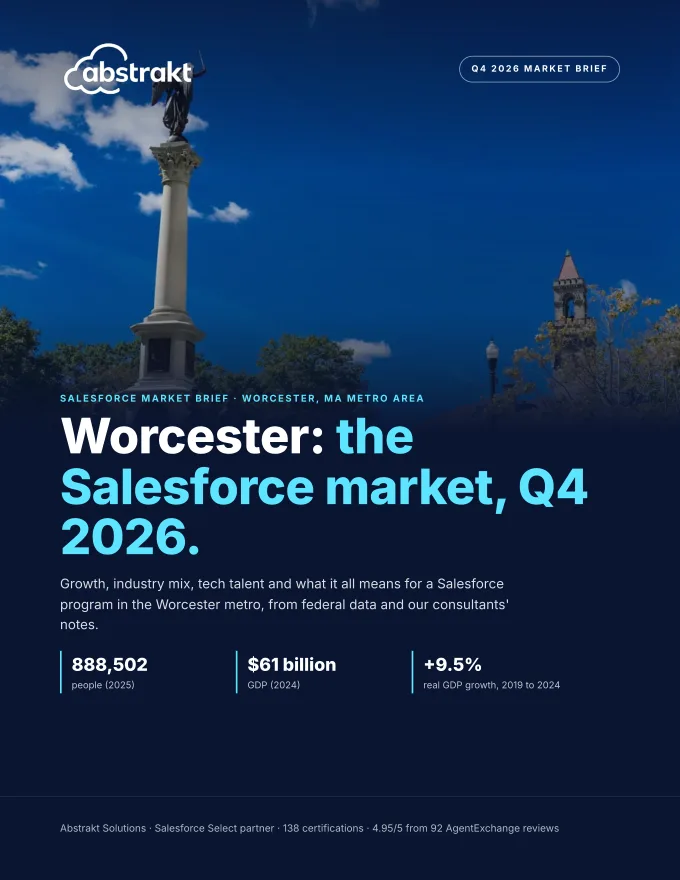
A free 23-page PDF with Worcester's growth ranked against 100 metros, its industry mix, tech wages and nearby markets. It is offered on the public Worcester page; send your customer there or get a copy for your own prep.
Get the Worcester brief →Co-sell with Abstrakt in Worcester
Working a Worcester account? Bring in a named consultant for discovery, scoping or a health check. We reply within 4 business hours.