

How Salesforce work starts in Stamford
Across Stamford, Norwalk, Bridgeport and Danbury, in both the Western Connecticut and Greater Bridgeport planning regions, Abstrakt Solutions works as a Salesforce Consulting Partner with asset managers, insurers and media companies. Stamford is one of our focus markets.
What buyers here usually run into
- 1
Compliance designed into client records
Asset managers, insurers and fintech firms commonly need consent, suitability and communication history stored with the relationship, which a generic CRM setup rarely handles without deliberate design.
- 2
Sponsors and subscribers in one org
Media and telecom businesses often sell to advertisers while also serving large subscriber bases, and combining those two models in one Salesforce org takes careful data and permission planning.
- 3
Fintech growth outpacing the first build
Fast-growing fintech and digital-technology companies frequently outgrow a quick initial Salesforce setup, leaving duplicate objects, brittle automation and integrations nobody fully owns.
Budget, team and partner questions
What drives cost
Stamford projects scale with regulatory scope and client complexity. Custodian and portfolio feeds, entity and trust modeling, consent and communication capture, and access reviews add design and testing; consolidating orgs after a fintech or advisory acquisition adds more.
Admin or partner
Asset managers and insurers here often keep a Salesforce owner on staff for control reasons and use a partner for architecture and integration. Fintech and digital-technology firms frequently outsource administration until the platform settles after rapid growth.
What buyers ask a partner
Ask how the partner documents field-level security and sharing for a compliance review, and how they model an institution alongside a family with trusts and entities. Ask which changes they would require your compliance team to approve before release.
The local economy and its biggest industries (4)
| Sector | Share of 2024 GDP | Where Salesforce fits |
|---|---|---|
| Finance and insurance Salesforce for wealth management → | 17.6% | Consumer lenders, the asset managers AdvanceCT courts and the region's insurers and insurtech firms all operate under close regulatory scrutiny. Financial Services Cloud gives advisors and service teams one governed view of households, accounts and policies. |
| Professional, scientific, and technical services Salesforce for professional services → | 8.8% | Advisory, research and consulting firms, including a global research house and a Big Four practice on local lists, sell renewals and multi-year engagements. Sales Cloud paired with Tableau shows partners where pipeline, renewals and staffing stand. |
| Information Marketing Cloud → | 8.2% | A wrestling-entertainment company, a national sports broadcaster and a cable operator give Stamford an unusual concentration of media and telecom employers, where sponsorship sales, subscriber service and audience marketing each call for their own Salesforce design. |
| Manufacturing Salesforce for manufacturing → | 8.3% | Manufacturers in the Greater Bridgeport and Western Connecticut planning regions often sell engineered or branded goods through distributors. Their reps need quotes, orders and service history pulled from ERP onto the account. |
Source: U.S. Bureau of Economic Analysis, GDP by county (CAGDP2), 2024, summed to the metro area; private sectors only, excluding real estate and government. “At least” marks sectors where BEA suppresses some county figures.
Regional target sectors named by local economic development groups: Financial Services / Asset Management, Fintech & Insurtech, Digital Technology, Digital Media & Film, Insurance.
Salesforce products that fit Stamford (6)
In the order we lead with them here, from the industries above.
Salesforce Financial Services Cloud
Industry CRM for wealth management, banking, insurance, and lending, built for compliance from the start.
Salesforce Sales Cloud
The CRM where sales pipeline lives, when it is built right.
Salesforce Service Cloud
The operating system for modern customer service, case, knowledge, voice, and AI agent assist together.
Salesforce Marketing Cloud
Cross-channel marketing, email, mobile, journey, and Data 360-powered personalization at scale.
Salesforce Data 360 (Data Cloud)
Unify customer data into a real-time profile that powers segmentation, analytics, and AI.
Salesforce Agentforce
AI agents that handle real work inside Sales Cloud, Service Cloud, and Marketing Cloud.
Stamford and Bridgeport firms pairing AI with compliance
Finance and insurance generated 17.6% of the Stamford-Bridgeport metro's GDP in 2024, and asset managers, insurers, and fintech firms set the tone for technology decisions here. Their first AI projects should assist advisors and service staff rather than talk to clients directly. Good candidates include summarizing client interaction history before reviews, extracting fields from account-opening documents, and drafting replies that compliance can approve in one pass. Media and digital firms, part of the 8.2% information share, may move faster on marketing content generation. Across all of them, Data 360 (formerly Data Cloud) identity resolution and tight sharing rules come first, because an agent that blends two households' records is worse than no agent.
- Advisor client history summaries
- Account-opening document extraction
- Compliance-ready reply drafts
Services buyers here usually need (7)
Salesforce Implementation in Stamford
For most Stamford-area companies, implementing Salesforce means designing around relationships that are more complex than a simple account and contact. Asset managers track families, trusts and institutional mandates; insurtech firms sell to carriers and agencies at once; media businesses juggle sponsors and audiences. We map those structures first, agree on phase one with your business owners, build and test in a sandbox, load reconciled data, and train each role before switching the old tools off.
By industry in Stamford
- 1
Finance and insurance
Finance and insurance produced about 17.6% of the metro's 2024 GDP, the largest share of any private sector, and AdvanceCT lists asset management, fintech and insurtech, and insurance among its target sectors. For firms in those lines, implementation turns on how client entities roll up: individuals into households, households into trusts and foundations, institutions into mandates. We model that hierarchy in Financial Services Cloud during design and settle field-level visibility with compliance before configuration begins, so advisors and service staff inherit rules instead of improvising them.
- 2
Information
Media, film and digital-technology businesses give the local economy an unusual profile, and implementing Salesforce for them usually means supporting two revenue models in one org. Advertising and sponsorship sellers need products, flight dates and deliverables on each deal, while audience or subscriber teams need case handling and marketing lists. We give each side its own record types, page layouts and sharing boundaries in the first release, which keeps later additions from colliding with what already works.
- 3
Professional, scientific, and technical services
Consulting, research and advisory firms here usually sell subscriptions, retainers and multi-year engagements rather than one-time products. Their implementations hinge on modeling renewals, contract terms and the partner or practice that owns each relationship, so pipeline reports mean the same thing across offices. We typically launch Sales Cloud with renewal opportunities generated from contract end dates, then add service or client-onboarding processes in a second phase once the sales foundation has been adopted.
Raise before scoping
Agree on the client hierarchy
Wealth and asset management firms rarely agree internally on what a client is: the person, the household or the legal entity. Decide that definition, and how accounts roll up, before any build work, because every report, sharing rule and integration will depend on the answer.
Stage releases around compliance review
Regulated teams in the region often need compliance sign-off on data visibility and communication capture before users log in. Build that review into each phase's schedule rather than treating it as a final gate, so approval does not hold up a finished release for weeks.
Keep phase one deliberately small
Fast-growing fintech and digital companies tend to pile requirements into the first release. A narrower launch covering core sales and clean account data gets people working in Salesforce sooner, and it produces real usage feedback to shape the service, marketing and automation phases that follow.
Salesforce Integration in Stamford
In the Stamford area, integration work most often links Salesforce to financial systems of record: portfolio accounting, custodians, policy administration and billing platforms. Media and technology firms add subscriber, ticketing and product-usage data, while manufacturers need ERP orders and pricing. For each flow we settle which system is the source of truth, pick MuleSoft, Workato or plain APIs according to volume and how often the data changes, and add alerts so a broken sync is caught before an advisor or seller relies on stale numbers.
By industry in Stamford
- 1
Manufacturing
Manufacturing contributes about 8.3% of the metro's 2024 GDP, much of it from companies selling engineered or branded products through distributors. For them, integration usually means bringing ERP orders, invoices, inventory and pricing into Salesforce so reps can answer customer questions without calling operations. We keep the ERP as the system of record for prices and orders, sync only what sales and service need, and design account-matching rules carefully, since customer numbers rarely line up cleanly between the two systems.
- 2
Financial Services / Asset Management
For asset managers, advisors want current holdings, performance and cash movements next to each relationship, but those numbers belong to portfolio accounting and custodial platforms. Integration brings summarized positions and transactions into Financial Services Cloud on a schedule that fits how often they change, rather than streaming every trade. We also map legal entities and accounts carefully, because one household may hold many accounts registered under different names, trusts and custodians.
- 3
Digital Media & Film
Media and entertainment businesses collect audience data in ticketing, streaming, commerce and email platforms that were never designed to share it. Data 360 (formerly Data Cloud) can stitch those identities together for segments and personalized outreach, while raw event streams stay outside the core CRM objects. Sponsorship sales, meanwhile, needs campaign delivery and audience metrics connected to deals. We separate those two flows so fan-level data stays governed while sales teams still see the results they can show sponsors.
Raise before scoping
Name an owner for every field
When Salesforce and another platform both edit the same address, status or balance, records drift apart quietly. Decide which system is authoritative for each shared field before development, and document it, so conflicts are resolved by design rather than by whichever sync happened to run last.
Summarize financial data, don't mirror it
Copying every transaction from a portfolio or policy system into Salesforce inflates storage and slows pages. Most users need balances, recent activity and key dates. Pull detail on demand through an API or a linked view, and keep the bulk of history where it already lives.
Budget for monitoring after launch
Integrations fail in unglamorous ways: expired credentials, a vendor API change, a malformed record. Set up alerts, retry logic and a named owner before go-live, because the cost of a silent failure lands on the client-facing teams relying on the data.
Salesforce Optimization in Stamford
Optimization work in the Stamford area usually begins with a complaint: advisors keep notes elsewhere, sellers update the pipeline the night before a forecast call, or leadership has stopped trusting the dashboards. We interview users, review how the org is really used and find where fields, page layouts and automation get in the way. Then we remove clutter, consolidate overlapping flows, rebuild key reports on clean definitions and retrain people, in short cycles, so improvements reach users steadily.
By industry in Stamford
- 1
Professional, scientific, and technical services
Only finance outranks professional, scientific and technical services among local private industries, and the latter supplied about 8.8% of metro GDP in 2024. Consulting and research firms here often have orgs full of engagement fields, custom objects and status picklists added by different practice leaders. Optimization trims those to what partners actually use, standardizes renewal and pipeline stages across practices, and rebuilds the utilization and bookings reports that leadership reviews, so one dashboard replaces the spreadsheets each practice maintains on the side.
- 2
Finance and insurance
Wealth and insurance teams often have Salesforce in place but work around it, logging client meetings in email and tracking follow-ups in spreadsheets. We look at why: too many required fields, layouts that bury household information, or tasks nobody sees. Fixes typically include streamlined advisor pages, automated action plans for reviews and onboarding, and activity capture that saves advisors time while still giving compliance the complete communication history it expects to see.
- 3
Fintech & Insurtech
Fintech and insurtech companies frequently built Salesforce quickly to support early growth, then layered automation on top as the product and team changed. The result is often several flows and triggers acting on the same record, slow saves and errors nobody can explain. Optimization consolidates that automation, retires fields and objects that no longer reflect the business, and resets pipeline definitions so board and investor reporting comes from the system instead of a separate model.
Raise before scoping
Measure adoption before redesigning
Login counts do not tell you whether advisors or sellers rely on Salesforce. Look at record update patterns, report usage and which fields stay blank, then interview a few heavy and light users. That evidence points to the fixes that change behavior rather than the ones that merely look cleaner.
Retire automation before adding more
Older orgs often carry legacy workflow rules and Process Builder alongside newer flows. Inventory and consolidate them before building anything new, since each additional automation layered on a messy base makes errors harder to trace and slows every record save for users.
Define metrics once for everyone
When sales, finance and practice leaders each calculate pipeline, bookings or retention differently, dashboards turn into debates. Agree on shared definitions first, then rebuild reports and dashboards on them, so leadership meetings spend their time on decisions rather than on reconciling numbers.
Salesforce Managed Services in Stamford
Managed services suits Stamford-area companies whose Salesforce org has grown faster than the one or two people looking after it. Financial and insurance firms add regulatory changes to a backlog already full of user requests, reports and integration fixes; media companies add campaigns and seasonal sales pushes. We take on that backlog through a monthly engagement, prioritize it with your business owners, test changes in a sandbox and deploy on a release schedule, while preparing your org for each seasonal Salesforce release.
By industry in Stamford
- 1
Insurance
Carriers, brokers and insurtech firms operating in the Fairfield region deal with filing changes, new products and distribution agreements that keep altering what Salesforce must capture. Under a managed services arrangement, those changes join a prioritized queue alongside user requests, and each release is tested against the automation that routes submissions, renewals and claims-related cases. Consistent consultants who already know your org mean a regulatory deadline does not begin with someone learning the data model.
- 2
Information
Information businesses, including media, film and telecom, accounted for about 8.2% of metro GDP in 2024. Their Salesforce needs rarely stand still: new sponsorship packages, programming seasons and subscriber offers each bring page changes, campaign lists and reports. Managed services gives these teams a predictable way to absorb that stream, with requests sized, scheduled into regular releases and deployed without disrupting the sales floor in the middle of a major selling window.
- 3
Financial Services / Asset Management
Asset managers typically run lean operations teams, so Salesforce administration falls to someone who also handles other systems. A managed services bench covers the gaps: user provisioning for new advisors, permission changes after an audit finding, report requests from leadership and fixes when a custodial or portfolio data feed stops loading. Every change is logged with who asked for it and why, which gives compliance an easy trail to review later.
Raise before scoping
Protect audit trails during changes
Firms under regulatory oversight need evidence of who changed what in Salesforce and why. Ask any managed services provider how requests are logged, approved and deployed, and make sure sandbox testing and release notes are part of the routine, not something produced only when an examiner asks.
Match release timing to selling cycles
Media and sponsorship businesses have heavy selling periods, and insurers have renewal peaks. Freeze nonurgent deployments during those windows and schedule larger changes for quieter weeks, so users are learning new screens when they actually have time to absorb them.
Keep a single prioritized backlog
When requests arrive by email, chat and hallway conversation, the loudest one tends to win. A shared backlog that business owners rank each month makes trade-offs visible and keeps the managed team focused on the work leadership actually values most, not simply on whatever arrived first.
Salesforce Migration in Stamford
Stamford-area migrations frequently come from wealth or insurance platforms a firm has outgrown, from a CRM inherited through an acquisition, or from spreadsheets that a fast-growing startup never replaced. Before moving anything, we profile the source data, agree on how records map to Salesforce objects, merge duplicates and decide what history is worth bringing. Then we run trial loads, reconcile counts with your team and schedule cutover over a weekend or quiet period, with rollback steps ready.
By industry in Stamford
- 1
Insurance
Insurers and agencies in the region often keep producer, policy and contact records in an agency management system or an older CRM, sometimes alongside an email marketing tool holding its own contact list. Migration merges those sources into one set of accounts and contacts, with policies linked correctly and producer relationships preserved. We pay close attention to consent and do-not-contact flags, since losing them during a move creates compliance exposure that is hard to unwind.
- 2
Digital Technology
Digital-technology and software companies in the Fairfield region commonly start on a lightweight CRM or a marketing platform with sales features, then hit limits on reporting, territories or quoting. Moving to Salesforce means translating deal stages, custom properties and associations into a proper data model rather than recreating them one to one. We also carry over email and meeting history selectively, keeping what sales teams need for context and leaving behind noise that would clutter the new org.
- 3
Health care and social assistance
Health care and social service organizations in southwestern Connecticut often move to Salesforce from donor databases, referral trackers or case-management tools that each hold part of a client's story. Migration consolidates those records while respecting who is permitted to see what, particularly for sensitive health or service history. We map privacy flags and consent carefully, test access with real user profiles before cutover and keep the legacy system readable for a period in case questions arise.
Raise before scoping
Clean before you move
Duplicates, stale contacts and inconsistent picklist values cost more to fix after migration, when they are tangled with new activity. Profile the source data early, agree on merge rules with the people who know the clients, and load only records that meet an agreed quality bar.
Decide how much history migrates
Bringing every note and email from a decade-old system clutters the new org and slows the project. Agree with compliance and sales leadership on which history must move, which can be archived and searchable elsewhere, and which can safely stay behind.
Rehearse the cutover end to end
A full trial migration into a sandbox, followed by reconciliation of record counts and spot checks by users, reveals mapping errors while they are still cheap to fix. Run a rehearsal before the real cutover, and time it so you know how long the final load will take.
Salesforce Health Checks in Stamford
For Stamford-area firms, a health check is usually prompted by an upcoming audit, a new cloud, an Agentforce pilot or doubts about a previous partner's work. The review covers user access and sharing, the code, flows and packages in the org, what each integration user can reach, and the quality of the records that matter most. Findings come back ordered by risk and effort, so problems that could embarrass you in front of an examiner or corrupt an AI answer get fixed first.
By industry in Stamford
- 1
Health care and social assistance
Hospitals, clinics and social service agencies together generated around 7.1% of metro GDP in 2024. Providers and community organizations using Salesforce for referrals, patient outreach or program management hold sensitive information that must be tightly scoped. A health check reviews who can view and export that data, whether guest and portal access is properly restricted, and whether field history and encryption settings meet your policies, then lists concrete steps to close any gaps it finds.
- 2
Fintech & Insurtech
Fintech and insurtech orgs built at startup speed tend to carry technical debt: Apex code whose tests do not reflect real cases, flows that duplicate triggers, and sandboxes that no longer resemble production. A health check sizes that debt, flags automation that could fail at higher volume and reviews connected apps and API users with broad rights. Enterprise customers and investors may ask about these controls during due diligence, so the findings often do double duty.
- 3
Financial Services / Asset Management
Asset managers considering Agentforce or generative AI need to know whether their client data is complete and whether access controls would stop an agent from exposing restricted information. A health check measures duplicate households, missing key fields and stale relationships, and it maps which users and integrations can reach sensitive records. Leadership can then back the AI ideas the data already supports and park the rest until cleanup catches up.
Raise before scoping
Review access before an examination
Regulated firms benefit from checking profiles, permission sets and sharing rules before an examiner or auditor asks. Over time, temporary access for projects and departed staff accumulates quietly. Finding and removing it on your own schedule is far easier than explaining it during a review.
Separate cosmetic from structural findings
Not every issue is urgent. Unused fields and old reports are clutter; broad data export rights or untested code on key processes are risk. A useful review ranks findings so your team spends limited time on the items that carry real security or operational consequences.
Scope managed packages and apps
Orgs in finance and media often have many installed packages and connected apps, some added for a pilot and then forgotten. Each one carries access to data. Include them in the review, confirm who owns each one, and remove whatever no longer earns its place.
Salesforce Implementation Rescue in Stamford
Rescue engagements in the Stamford area typically involve a Financial Services Cloud or multi-cloud project that went live incomplete, or a build that stalled when a partner or internal lead left. We start with a short triage: interviewing stakeholders, reviewing the org, backlog and integrations, and identifying what users need most urgently. From there we recommend what to keep, fix or rebuild, stabilize the pieces blocking daily work first, and then finish the original scope in phases.
By industry in Stamford
- 1
Financial Services / Asset Management
In wealth and asset management, stalled projects often trace back to an unsettled client model: households and entities configured one way, then partially reworked when advisors objected. Rescue starts by confirming the relationship structure with advisors and compliance, then assessing how much existing configuration and loaded data fits it. Where possible we repair rather than rebuild, and we prioritize the advisor workflows that decide whether the system is used at all.
- 2
Insurance
Insurance projects tend to stall at the integration step, when policy, claims or billing data proves harder to connect than the original plan assumed. A rescue reviews what was built, documents the real state of each interface and resets scope so service and distribution teams get a working release, even if some integrations move to a later phase. Clear communication with underwriting and service leaders helps rebuild confidence in the program.
- 3
Digital Media & Film
Media companies sometimes launch Salesforce for sponsorship sales and audience service at once, and the combined design buckles under conflicting requirements from both groups. Rescue separates those needs again, with distinct record types, queues and permissions, and resets the reporting each side expects. We usually stabilize the revenue-facing side first, since sponsorship deals and deliverables have fixed dates, then return to audience service and marketing once sellers trust the system.
Raise before scoping
Triage before assigning blame
When a project has stalled, the first instinct is to find fault. A faster route is an honest inventory of what exists: what works, what is half built and what nobody can explain. That inventory becomes the baseline for decisions about scope, budget and partner.
Secure access and documentation early
If a previous partner is leaving, get admin credentials, deployment scripts, integration details and design documents transferred before relationships cool further. Missing knowledge about how integrations authenticate or where code lives is a frequent reason rescues take longer than expected.
Deliver a visible win quickly
After a bad launch, people stop believing announcements and start watching for evidence. Pick one or two painful problems, such as a broken report or a slow page, fix them within the first weeks, and tell people about the change. Momentum makes the larger recovery plan easier to sustain.
Industry plays in Stamford (4)
Salesforce for Stamford Wealth Managers
Wealth management around Stamford includes independent RIAs, multi-family offices and asset managers that also run private funds. Salesforce needs to represent complex households, trusts and entities, pull custodial and portfolio data from the systems that own it, and document client interactions for supervision. We usually build on Financial Services Cloud, integrate the custodian and portfolio accounting platforms, and keep the interface simple enough for senior advisors who will not tolerate clutter on the screen.
Financial firms dominate the Bridgeport-Stamford-Danbury economy: Bureau of Economic Analysis county data assigns finance and insurance 17.6% of 2024 metro GDP, twice the share of the next sector. AdvanceCT names financial services and asset management as a target industry for the region and says more than 25% of the nation's finance jobs are located inside a 160-mile radius around the city. It separately targets fintech and insurtech and digital technology, so wealth firms here operate inside a dense cluster of investment and financial technology businesses, including many vendors that sell to them.
Use cases to open with
- 1
Household and entity mapping
Wealthy families hold assets through trusts, partnerships, foundations and operating companies, each with different decision makers. Financial Services Cloud relationship groups and account-contact relationships map those structures, show roles such as trustee or beneficiary, and roll up assets across entities, so an advisor preparing for a family meeting sees the full picture instead of disconnected accounts, and the next generation's relationships are captured before wealth transfers.
- 2
Custodian and portfolio data sync
Advisors should not re-key balances or positions. We bring account, balance and performance data from custodians and portfolio accounting systems into Salesforce on a schedule, flag stale feeds, and display summaries on the household record, which lets service associates answer routine questions quickly and gives advisors context before every review meeting. Alerts fire when large cash movements or unusual withdrawals appear.
- 3
Fund investor relations
Asset managers running private funds track prospects, consultants, commitments, capital calls and investor documents. Financial Services Cloud with fundraising stages, commitment records and an Experience Cloud investor portal gives investor relations one system for pipeline and service, and makes reporting to the investment committee far less manual. Document access can be limited by fund, vehicle and investor class, and capital call notices can go out from the portal.
Raise before scoping
Supervision and recordkeeping
RIAs and broker-dealers carry SEC and FINRA books-and-records and supervision expectations. Plan how emails, texts and meeting notes are archived, which activities trigger compliance review, and how exceptions are documented. Salesforce can support these workflows, but your chief compliance officer determines what the firm must keep.
Advisor adoption over features
Senior advisors adopt tools that save them time before client meetings. Start with a meeting-prep view, clean household data and a few automated tasks, then expand, rather than launching every Financial Services Cloud feature at once and asking advisors to learn them all in one sitting.
Map every vendor's data role
Wealth firms rely on custodians, planning software, portfolio accounting and document vaults. Define which vendor holds the authoritative version of each data point, what Salesforce stores versus links to, and how access is revoked across every tool when an employee leaves the firm.
Salesforce for Stamford Insurers and Agencies
Insurance around Stamford spans carriers, commercial brokers, managing general agents and insurtech firms selling data and software to them. Salesforce work here often centers on the flow of business: submissions arriving from brokers, underwriting triage, quote and bind status, and the relationships that drive placement. We configure Financial Services Cloud or Sales Cloud for that pipeline, integrate rating and policy systems, and use Data 360 (formerly Data Cloud) when several sources must combine into one account view.
With finance and insurance at 17.6% of 2024 GDP for the Bridgeport-Stamford-Danbury metro, per Bureau of Economic Analysis county figures, insurers sit inside the region's largest private sector, well ahead of professional services at 8.8%. AdvanceCT lists insurance as a target industry and pairs fintech with insurtech as another, alongside asset management and digital technology. AdvanceCT also counts 13% of the country's tech traded cluster jobs inside a 120-mile radius. For insurers and brokers, that places the business next to a deep bench of software, analytics and financial firms, many of them building insurance technology.
Use cases to open with
- 1
Submission intake and triage
Brokers send submissions by email with applications, loss runs and schedules attached. An intake flow in Salesforce captures each submission, extracts key fields, checks appetite rules and routes it to the right underwriter, so response times become measurable and brokers learn quickly which risks fit. Declined submissions keep a reason code, which sharpens appetite guidance for the next marketing season.
- 2
Broker relationship scorecards
Carriers and wholesalers want to know which brokers bring profitable business. Combining submission, quote, bind and loss ratio data in Salesforce with Tableau or CRM Analytics produces scorecards by broker and line, which guides where marketing underwriters spend time and gives distribution leaders facts for annual broker reviews rather than impressions from the last lunch. Underwriters can drill from a scorecard into individual submissions.
- 3
Unified customer view with Data 360
Firms selling several lines or products often hold customer data in separate policy, billing and marketing systems. Data 360 (formerly Data Cloud) ingests those sources, resolves duplicate identities and presents a unified profile in Salesforce, enabling segmentation for renewals and cross-sell and giving service teams consistent information regardless of which system handled the customer's last transaction. Marketing opt-outs stay attached wherever the profile surfaces.
Raise before scoping
Define appetite rules clearly
Automated triage only works when underwriting appetite is written down precisely: classes, limits, territories and exclusions. Agree on those rules with underwriting leadership, decide who maintains them, and review routing results regularly, since stale appetite rules quietly send good submissions to the wrong desk.
Document extraction needs review
AI tools can pull data from applications and loss runs, but accuracy varies with document format. Keep a human review step for extracted values that affect pricing or eligibility, log every correction, and measure accuracy by line before reducing manual checks on any submission type.
Security for shared insurance data
Insurers handle nonpublic personal and commercial information that GLBA and state insurance data security laws protect. Configure encryption, access monitoring and vendor reviews for any integration touching Salesforce, and have your compliance team confirm how each state's requirements apply to your organization.
Salesforce for Stamford Professional Services Firms
Professional services in Stamford lean toward advisory and research work sold to financial firms and large corporate buyers. Some firms sell subscriptions to research and data; others sell engagements, audits or technology projects. Salesforce needs to handle both models: recurring seats and renewals on one side, scoped engagements and staffing on the other. We configure Sales Cloud and Revenue Cloud or CPQ for subscriptions and proposals, Marketing Cloud for thought-leadership programs, and Tableau so partners see renewals, pipeline and utilization together.
The Bureau of Economic Analysis puts professional, scientific and technical services at 8.8% of Stamford-area metro GDP in 2024, the second-largest private sector after finance and insurance at 17.6%. Much of that work is sold to the larger sector: Fairfield County, by AdvanceCT's count, holds 11.8x the national average concentration of portfolio management companies, and over a quarter of the country's finance jobs sit within a 160-mile drive. Advisory and research firms here sell into one of the densest concentrations of financial and corporate buyers in the country.
Use cases to open with
- 1
Research subscription renewals
Firms selling research and data access manage seats, tiers and renewal dates for each client. Revenue Cloud or CPQ can quote seat changes and multi-year terms consistently, while Sales Cloud tracks renewal risk using usage data pulled from the delivery platform. Account teams see which clients have inactive seats well before renewal and can schedule a usage review instead of discovering the problem at the negotiation table.
- 2
Asset manager relationship mapping
Advisory, audit and consulting work for investment firms involves portfolio managers, operations leaders, compliance officers and sometimes fund boards. Account hierarchies and contact roles in Sales Cloud show who sponsors each engagement and who influences the next one. Partners preparing for a pitch can see every past engagement, proposal and contact across the client's funds and affiliates on a single account page.
- 3
Thought leadership that converts
Webinars, reports and events are how many Stamford firms start conversations with senior buyers. Marketing Cloud can manage invitations and follow-up by audience and topic, record which content each contact engaged with, and pass engaged prospects to the right partner. Reporting then connects specific programs to meetings booked and proposals issued, so marketing spend can be judged on the outcomes partners care about.
Raise before scoping
Separate subscription and project revenue
Recurring research revenue and one-time engagement fees behave differently in forecasts. Use distinct opportunity types, products and reporting so renewal rates, new subscriptions and project bookings are each measured on their own terms, and so leadership never mixes annual recurring revenue with fees that will not repeat.
Independence and conflicts rules
Accounting and advisory firms may face independence restrictions or client conflicts that limit who can pursue which work. Build conflict checks into the opportunity process and restrict visibility where required, so a proposal to one fund does not expose confidential information about another client.
Manage consent across jurisdictions
Firms marketing to clients in several states and abroad face different consent and privacy expectations. Record the source and basis for every marketing contact, honor preferences across all sends, and decide early how Data 360 (formerly Data Cloud) or Marketing Cloud will store and apply them in each region.
Salesforce for Stamford Manufacturers
Manufacturers in Fairfield County operate inside an economy led by finance, research and media, which shapes what they need from Salesforce. Leadership teams here often expect investor-grade reporting, while sales still runs through distributors, reps and key accounts. We set up Sales Cloud to manage channel partners and direct customers, Revenue Cloud or CPQ for configured and engineered products, Service Cloud for warranty and returns, and MuleSoft integration to the ERP so pipeline, orders and margins reconcile with what finance reports.
Manufacturing accounted for 8.3% of metro GDP in 2024 in the Bureau of Economic Analysis's county figures, third among private sectors after finance and insurance and professional services, and just ahead of information at 8.2%. It is not on AdvanceCT's target list for the region, which centers on financial services, fintech and insurtech, digital technology and digital media. The metro itself was redefined around the Western Connecticut and Greater Bridgeport planning regions, so manufacturers are spread well beyond Stamford. AdvanceCT also names a university data science initiative in Stamford as a tech talent partner.
Use cases to open with
- 1
Distributor performance tracking
Channel partners, rather than a direct sales force, carry a large part of the volume for many producers between Stamford and Danbury. Sales Cloud can manage each partner's territory, sell-through, open quotes and marketing funds, with point-of-sale or shipment data loaded from the ERP. Channel managers see which partners are growing the line and which need attention, and an Experience Cloud portal gives distributors pricing, product documentation and deal registration.
- 2
Engineered product quoting
Products built to specification require option rules, engineering review and accurate lead times. Inside Revenue Cloud or CPQ, rules block combinations the plant cannot build, cost data arrives from the ERP overnight, and anything outside standard options lands in an engineering review queue before the customer sees a number. Quotes stay consistent across direct and distributor channels, and margin on each configuration is visible to sales and finance.
- 3
Warranty and returns service
When a product fails in the field, customers want a fast answer and the plant needs the failure data. Service Cloud captures the serial number, installation date and symptoms, checks warranty terms, and authorizes a return or repair. Quality engineers get structured failure reports by product, batch and plant, and customer-facing teams see each claim's status without phoning the warehouse.
Raise before scoping
Reconcile with finance
Leadership used to financial-services-style reporting will compare Salesforce numbers against the ERP. Agree on definitions for bookings, backlog and revenue up front, sync order and invoice data on a set schedule, and build reports that tie out to the general ledger.
Channel conflict rules
Selling direct and through distributors in the same territory invites disputes over credit and pricing. Define deal registration, account ownership and commission rules before the build starts, and encode them in Salesforce so conflicts are handled consistently rather than by whoever escalates loudest.
Plan for multiple sites
With plants and warehouses spread across the redefined metro and often in other states, include site, product line and legal entity in the data model from the start. Reporting by plant, entity and region then works cleanly, and acquisitions can be absorbed without costly rework.
Case studies to send (3)
From the industries this market leans on. Client names are anonymized and these projects are not specific to Stamford.
The Stamford Salesforce market brief, Q4 2026
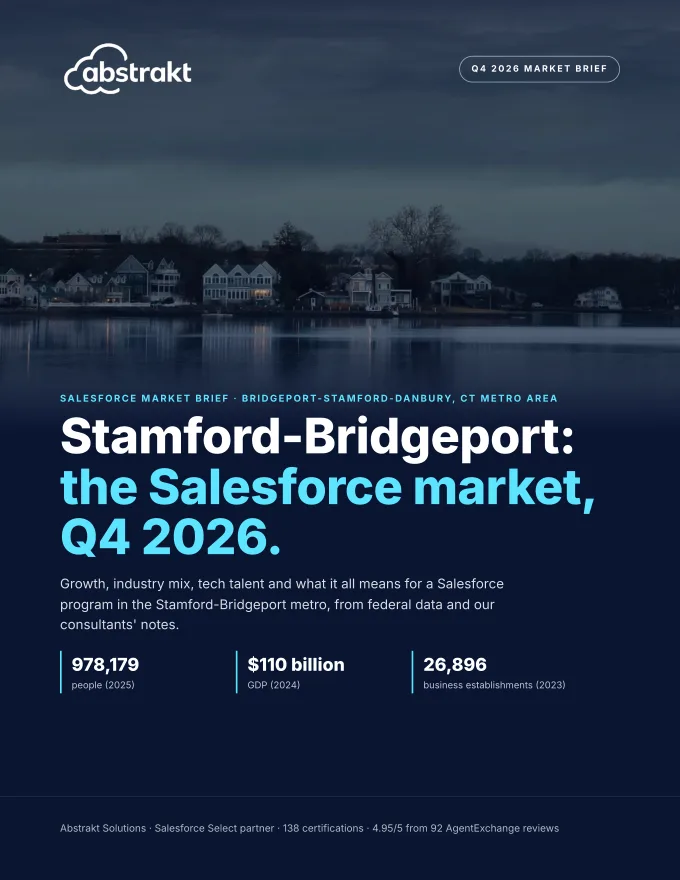
A free 23-page PDF with Stamford's growth ranked against 100 metros, its industry mix, tech wages and nearby markets. It is offered on the public Stamford page; send your customer there or get a copy for your own prep.
Get the Stamford brief →Co-sell with Abstrakt in Stamford
Working a Stamford account? Bring in a named consultant for discovery, scoping or a health check. We reply within 4 business hours.