

How Salesforce work starts in New Haven
Hospitals, biotech companies, colleges and manufacturers in New Haven, North Haven, Wallingford and nearby South Central Connecticut towns partner with Abstrakt Solutions on Salesforce. New Haven is one of our focus markets.
What buyers here usually run into
- 1
Spinouts growing into regulated companies
Biotech spinouts often begin with a spreadsheet of investors and partners, then need documented processes and audit trails as products move toward the clinic or market.
- 2
Many constituencies in one institution
Universities and hospitals commonly run separate systems for students, patients, donors and research partners, which makes a single relationship view hard to reach.
- 3
Consent across research and care
Organizations that touch both clinical care and research often need to record what each person agreed to and who may contact them, which shapes the whole data model.
Budget, team and partner questions
What drives cost
For New Haven organizations, cost tracks the number of constituencies and source systems: student information, EHR, ERP or lab systems each bring their own integration and data cleanup. Consent and research-role modeling adds design time up front, and Marketing Cloud or portal work for applicants, patients or donors adds build and testing.
Admin or partner
Universities and hospital systems here often have an internal Salesforce group but need a partner for integration, new departments joining the org or Data 360 work. Biotech startups and smaller manufacturers usually rely on a managed services arrangement until Salesforce work justifies a dedicated hire.
What buyers ask a partner
Ask for experience with student information system or EHR integration, consent modeling, and audit trails for regulated work. Ask how the partner documents field ownership across departments and how it hands that documentation to your team.
The local economy and its biggest industries (4)
| Sector | Share of 2024 GDP | Where Salesforce fits |
|---|---|---|
| Health care and social assistance Salesforce for health & life sciences → | 11.3% | New Haven’s academic hospital system and a second, expanding hospital network shape care across South Central Connecticut, and practices and care organizations working alongside them need scheduling, referral and outreach tools with strict privacy controls. |
| Educational services Marketing Cloud → | 10.0% | The six colleges and universities REX counts in Greater New Haven manage applicants, students, alumni, donors and research partners, relationships that Salesforce can connect across departments. |
| Manufacturing Salesforce for manufacturing → | 7.6% | Medical-device and hydrogen-equipment production in the region point to manufacturers selling engineered products that need quoting, installed-base service and ERP integration. |
| Professional, scientific, and technical services Salesforce for professional services → | 6.4% | Biotech research companies, lab-services firms and quantum and deep-tech startups track collaborators, grants, investors and pilot customers, which a standard sales pipeline does not capture without adjustment. |
Source: U.S. Bureau of Economic Analysis, GDP by county (CAGDP2), 2024, summed to the metro area; private sectors only, excluding real estate and government. “At least” marks sectors where BEA suppresses some county figures.
Regional target sectors named by local economic development groups: Life Science, Healthcare, Higher Education, Technology, Manufacturing, Arts, Entertainment & Tourism.
Salesforce products that fit New Haven (6)
In the order we lead with them here, from the industries above.
Salesforce Service Cloud
The operating system for modern customer service, case, knowledge, voice, and AI agent assist together.
Salesforce Experience Cloud
Customer, partner, and employee portals built on Salesforce.
Salesforce Marketing Cloud
Cross-channel marketing, email, mobile, journey, and Data 360-powered personalization at scale.
Salesforce Sales Cloud
The CRM where sales pipeline lives, when it is built right.
Salesforce Data 360 (Data Cloud)
Unify customer data into a real-time profile that powers segmentation, analytics, and AI.
Salesforce Agentforce
AI agents that handle real work inside Sales Cloud, Service Cloud, and Marketing Cloud.
New Haven health care and higher education AI fit
Health care and educational services lead New Haven's private economy, at 11.3 and 10.0 percent of metro GDP in 2024, respectively. Hospitals and practices can use AI to summarize patient inquiries and prepare replies that staff approve. Colleges and research institutions can put a knowledge-grounded assistant in front of admissions, financial aid and student service questions, routing edge cases to a counselor. Life science companies and manufacturers can triage partnership and sales leads before a person follows up. Data 360 (formerly Data Cloud) helps unify constituent or patient records across systems, but only after consent flags and privacy rules are defined. Human review remains essential wherever an answer could affect care, enrollment or funding.
- Patient inquiry summaries and replies
- Admissions and financial aid self-service
- Partnership lead triage
Services buyers here usually need (7)
Salesforce Implementation in New Haven
In the New Haven region, implementation projects usually begin with relationships that do not fit a standard sales pipeline. A patient may also be a study participant, an alumnus may be a donor, and a young biotech's investors sit beside its research collaborators. We map those roles into one data model during discovery, decide which objects hold consent and contact preferences, then build in phases: the first team goes live on clean data, and later teams join as each piece proves itself in daily use.
By industry in New Haven
- 1
Health care and social assistance
No private sector outweighs hospitals, practices and care agencies here; together they account for roughly 11.3% of 2024 metro GDP. Implementation for providers and care organizations here starts with deciding what Salesforce will hold and what stays in the clinical record. Referral sources, outreach programs, contact-center requests and community partners usually belong in the CRM, with only the clinical fields staff truly need synced in. Settling that boundary before build keeps protected data scoped tightly and makes privacy review far quicker.
- 2
Higher Education
REX Development lists higher education among the region's key sectors, and colleges here rarely implement Salesforce one office at a time without regretting it. Admissions, advising, career services and advancement each describe the same person differently. We define a shared person and affiliation model before configuring any single department, so a record created during recruitment is still the right record when that student graduates and later gives. Departments then go live one after another without a redesign between them.
- 3
Life Science
Life science is another REX key sector, and companies in it often implement Salesforce while still pre-revenue. The early build tracks investors, academic collaborators, contract research partners and first commercial prospects as separate record types, each with its own stages. We leave room for field history, approvals and validation documentation that regulated work will demand later, without imposing that overhead on day one. The org can then grow alongside the pipeline instead of being rebuilt when a product nears launch.
Raise before scoping
Draw the clinical boundary early
Decide in discovery which health information Salesforce may store, which system remains the source of truth, and how records link between them. That decision drives encryption, field-level security and integration design, and changing it after build means reworking permissions across every object that touches patients.
Model consent as data
Organizations that combine care, research and fundraising need consent recorded per purpose and per channel, not as a single checkbox. Build consent objects in the first phase so marketing, outreach and study recruitment all respect the same preferences from launch day onward.
Plan around the academic calendar
Colleges and teaching hospitals have stretches when staff cannot absorb a new system, such as admissions deadlines, term starts and residency transitions. Schedule go-lives and training in the quieter windows, and let those dates set the phase boundaries rather than an arbitrary project plan.
Salesforce Health Checks in New Haven
Sensitive data sets the order of work in most New Haven reviews. Health, student and research information all carry obligations, and orgs that grew department by department often grant broader access than anyone intended. We examine profiles, permission sets, sharing rules and guest access, then review automation, custom code, integrations and data quality. Findings are ranked by risk and effort, with fixes grouped so you can address the most important ones in weeks and plan the rest into your roadmap.
By industry in New Haven
- 1
Healthcare
Healthcare organizations in the region, a REX key sector, use Salesforce for outreach, referrals and patient service while clinical records stay elsewhere. A health check confirms that protected fields are encrypted where needed, that field-level security matches each role, and that integration users cannot read more than their job requires. We also review portal and guest access, a common source of unexpected exposure. Each finding lists the specific setting to change and who should change it.
- 2
Life Science
For life-science companies, the review covers information that partners and regulators may ask about: who can see collaboration terms, study-related contacts and product complaints, and whether field history is tracked on records that support regulated decisions. Where an organization plans to add validation or quality processes, the health check marks which parts of the org can support them and which need rework before those controls are layered on top of an unstable base.
- 3
Educational services
Colleges and universities hold student records governed by federal privacy rules, and Salesforce orgs often expand across offices without a matching review of access. The health check tests whether advancement staff can see academic records, whether student workers have more access than needed, and whether integrations with the student information system expose unnecessary fields. We rank findings so the registrar and IT security can act on the riskiest ones first.
Raise before scoping
Inventory every connected app
Over years, departments authorize connected apps and integration users for tools they no longer use. Each one is a possible path into your data. We list them with their permissions and last use, so you can revoke what is idle and restrict what remains.
Test readiness for Agentforce
An AI agent inherits the permissions and data quality of the org beneath it. Before a pilot, we check the objects the agent would read, the accuracy of knowledge articles and the sharing model, and flag which fixes must come first.
Turn findings into a roadmap
A list of problems helps only if someone owns each fix. We group findings into quick wins, planned projects and items to monitor, assign suggested owners and estimate effort, so the report feeds directly into budgeting rather than sitting in a shared drive.
Salesforce Integration in New Haven
Most New Haven organizations integrating Salesforce are connecting it to a system that must remain the source of truth: an electronic health record, a student information system, an ERP or a laboratory platform. Field ownership comes first, and the choice among real-time API calls, scheduled batches and event-driven messages follows from how current each value needs to be. Middleware such as MuleSoft makes sense where several systems share data, while simpler connectors serve smaller needs.
By industry in New Haven
- 1
Manufacturing
Manufacturing contributes about 7.6% of 2024 metro GDP, and REX highlights medical-device and hydrogen-equipment production in the New Haven region. For manufacturers here, integration links Salesforce quotes and service cases to ERP pricing, orders, serial numbers and lot history. We map products and accounts between systems first, since mismatched identifiers cause more integration failures than any technical limit, and we route every sync error to an admin queue.
- 2
Life Science
Life science companies, one of REX's key sectors, often run a laboratory information system, a contract tracker and a clinical operations tool beside Salesforce. Integration brings partner, site and study status into the CRM so business development and alliance teams see progress without asking scientists for updates. Sensitive scientific and patient data stays in its own system while Salesforce receives summaries and identifiers, which keeps the regulated boundary clear, auditable and easy to explain to partners.
- 3
Health care and social assistance
For health and social-service organizations, the central integration is with the electronic health record. Salesforce needs demographics, appointments and referral status, but rarely the full chart. We sync only the fields staff use, encrypt protected information, and log every exchange so privacy teams can trace it. Community partners and social-service agencies can send and receive referrals through Experience Cloud, with status flowing back into the same record so no one chases updates by phone.
Raise before scoping
Name a system of record
For every shared field, such as address, status or price, decide which system wins when values differ. Writing that down before building prevents sync loops and silent overwrites, and it gives support staff a clear rule when a user reports that two systems disagree.
Budget for identity matching
Patients, students and customers appear in each system under slightly different names and identifiers. Plan a matching strategy, usually a shared external ID plus rules for exceptions and a review queue for uncertain matches, instead of assuming the data will line up.
Monitor integrations like production
Integrations fail quietly when a credential expires or an upstream field changes. Set up alerts, error logs and a named owner for each connection, so problems surface within hours rather than when a department notices missing records long after the fact.
Salesforce Migration in New Haven
In the New Haven region, migrations often start from many small sources rather than one old CRM. A spinout has an investor spreadsheet and a shared inbox, a college office has a departmental database built years ago, and a consulting firm has contacts spread across partners' address books. We inventory each source, define what the Salesforce record should look like, cleanse and deduplicate in staging, and run test loads in a sandbox until counts reconcile. Cutover is scheduled so nobody maintains two systems for long.
By industry in New Haven
- 1
Professional, scientific, and technical services
Research, engineering and advisory firms belong to a sector worth about 6.4% of 2024 metro GDP, and many arrive at Salesforce with contact lists owned by individual partners, full of duplicates, conflicting titles and no shared history. We merge those into one account and contact structure, bring over the engagement records worth keeping, and tag the source of each record so partners can confirm their relationships arrived intact and nobody's client history went missing.
- 2
Technology
Technology startups, including the quantum and deep-tech ventures REX highlights, typically migrate from a starter CRM or spreadsheet once they hire salespeople or raise a larger round. The migration carries over pipeline stages, lead sources and investor records while adding structure the old tool lacked, such as account hierarchies and product lines. We keep the first Salesforce build simple, so a small team can maintain it while the company grows into more complex processes.
- 3
Higher Education
Colleges moving to Salesforce from departmental databases face years of records in inconsistent formats, from applicant files to alumni addresses. We profile each source, agree a single naming and address standard, match people across offices and load them into a shared model. Historical records that no one needs daily are archived rather than migrated, which keeps the new org fast, the cutover shorter and search results free of long-inactive contacts.
Raise before scoping
Archive rather than migrate everything
Old records carry storage costs and clutter search results. Decide which history users need in Salesforce, which can live in an accessible archive, and which can be retired under your retention policy. Migrating less, deliberately, usually produces a cleaner and faster org.
Preserve research-related restrictions
Records connected to studies, grants or confidential partnerships may carry use restrictions from the source system or from agreements. Carry those flags into Salesforce and apply sharing rules at load time, rather than migrating everything openly and restricting access afterward.
Freeze the source briefly
During the final load, changes in the old system create gaps. Plan a short freeze window, communicate it to every department that uses the source, and keep a log of anything entered during that window so it can be added after cutover.
Salesforce Optimization in New Haven
Optimization work in New Haven tends to follow growth that happened in layers. One department adopted Salesforce, another added its own fields, and a grant-funded program built automation nobody maintains. We interview users in each group, measure login and usage patterns, and review Flows and legacy rules for overlap. Then we simplify page layouts, merge redundant automation and rebuild the dashboards leaders actually open. The goal is fewer clicks for staff and numbers that match across departments, not a new system.
By industry in New Haven
- 1
Retail trade
Stores and online sellers produced about 6.4% of 2024 metro GDP, and the ones that licensed Salesforce for loyalty or service tend to use only part of it: agents answer from email, and marketing pulls lists from a separate platform. Optimization connects service cases, purchase history and campaign responses into views that store and online teams share, and replaces manual exports with scheduled reports. Adoption rises when staff can resolve a customer's question from one screen.
- 2
Healthcare
In healthcare, which REX describes as the region's largest employer sector, care organizations that grow through new sites often find each location configured Salesforce slightly differently, so referral reports and outreach metrics cannot be compared. We standardize intake processes, statuses and queues across sites, retire duplicate automation that fires on the same records, and rebuild dashboards so leaders see referral volume and follow-up time measured the same way everywhere.
- 3
Arts, Entertainment & Tourism
REX includes arts, entertainment and tourism among its key sectors. Venues, cultural nonprofits and visitor organizations commonly run Salesforce for members, donors and ticket buyers, but data arrives from several ticketing and fundraising tools. Optimization tidies those imports, deduplicates patrons, and builds automation that thanks donors and renews members on time. Development staff then spend their days on relationships and board reporting instead of reconciling spreadsheets before each season opens.
Raise before scoping
Measure usage before redesigning
Before touching a layout, we pull login frequency, records created per role and which reports anyone opens. Starting with that evidence keeps optimization focused on the screens and processes that matter, and it gives you a baseline to compare against once the changes are live.
Consolidate automation by object
Orgs built by several departments often have Process Builder, workflow rules and Flows all firing on the same object. Moving that logic into one well-ordered Flow per object makes behavior predictable, speeds up saves and lets future admins understand what happens when a record changes.
Agree on shared definitions
Departments may count a referral, an applicant or an active donor differently. Before rebuilding dashboards, agree on one written definition for each metric leaders review and build every report from it, so the numbers match whichever office presents them at a meeting.
Salesforce Managed Services in New Haven
Managed services in the New Haven area often supports organizations whose Salesforce use spreads faster than their admin capacity. A university adds another department each year, a health organization launches a contact center or a new outreach program, and a startup hires its first sales team. We take over the request queue, review each Salesforce release in a sandbox before it reaches users, keep data quality rules current and work down technical debt in agreed priorities, drawing on admins, developers and architects as each task requires.
By industry in New Haven
- 1
Educational services
Educational services accounts for about 10% of 2024 metro GDP, close behind health care. Colleges often run Salesforce across admissions, student services and advancement, with each office submitting its own requests. A managed team sorts that queue by institutional priority rather than by whoever asks loudest, schedules changes outside enrollment peaks and keeps the shared data model consistent as offices add fields. Release reviews matter here because a single platform change can affect several departments at once.
- 2
Healthcare
REX calls healthcare the biggest source of jobs across its fifteen-town footprint. Provider organizations using Salesforce for referrals, outreach or patient service need changes controlled carefully, since every new field or automation must respect field-level security and audit expectations. Our managed team follows a documented change process, tests permission impacts in a sandbox and keeps a log of who changed what and why. When compliance staff ask how the org is governed, that log answers them directly.
- 3
Technology
Technology is on REX's key-sector list, alongside a growing base of biotech and deep-tech spinouts. Young technology companies seldom need a full-time Salesforce hire, yet their sales process shifts every quarter as pricing, segments and partners evolve. Managed services gives them admin, Flow and integration skills on call, so pipeline stages, dashboards and product-usage data keep pace with the business without a founder or revenue lead doing configuration after hours.
Raise before scoping
Route requests through one intake
At a university or hospital, Salesforce requests arrive from admissions, clinics, development offices and IT, often by email to whoever answered last time. A single intake form with category, urgency and business owner lets the managed team triage consistently and report on where effort goes, which helps leadership decide which offices need more Salesforce investment next.
Review releases against protected fields
Each Salesforce release can change security defaults, sharing behavior or product features. For organizations holding health or student information, we check release notes against the specific objects and fields that carry protected data, test in a sandbox, and brief your compliance contact before anything reaches production.
Keep knowledge inside your organization
Staff turnover is common in academic and startup settings. We document configuration decisions, automation logic and integration settings in a shared knowledge space you own, so a new internal admin or department head can understand the org without relying on anyone's memory.
Salesforce Implementation Rescue in New Haven
New Haven rescues often involve projects that stretched across too many departments at once. A university tried to launch admissions, advising and advancement together, or a care organization combined a CRM rollout with a contact-center change and an EHR integration. We triage the current build, stabilize whatever blocks daily work, and decide component by component what to keep, repair or rebuild. Then we narrow the remaining scope into phases that can go live on their own and finish them with proper testing and training.
By industry in New Haven
- 1
Manufacturing
Manufacturing appears on REX's key-sector list, and stalled projects at manufacturers commonly break down where Salesforce meets ERP. Quotes use outdated pricing, service records lack serial numbers, and reps drift back to spreadsheets. Recovery reconciles products, accounts and assets between the two systems, repairs or replaces the integration, and completes the quoting and service processes, testing each against real orders and service calls before release so the sales team trusts what it sends customers.
- 2
Higher Education
Higher education projects stall when too many offices share one timeline. Each department waits on decisions from the others, and the build drifts. In recovery, we separate what is already usable, often admissions, from what is incomplete, then complete one office at a time on a shared foundation. Governance is reset with a small steering group that settles cross-office questions within days rather than letting them wait for the next committee meeting.
- 3
Health care and social assistance
A late privacy review is a frequent reason care organizations halt a Salesforce build midway. The work already done is usually salvageable, but permissions, encryption and integration scope need redesign. We document what was built, close the privacy gaps first, agree the clinical-data boundary with compliance staff, and then finish the referral or outreach processes the project was meant to deliver, so staff finally get a tool they are allowed to use.
Raise before scoping
Stabilize before you extend
Adding features to an unstable org multiplies problems. Fix login issues, failing automation and broken integrations first, so users regain confidence and the team has a reliable base. Only then resume the remaining scope, with the fixes documented for anyone who joins later.
Reset scope to what matters
Scope written long ago, or written too broadly, rarely fits the organization you are now. Rank remaining features by value and dependency, finish the essentials first, and move the rest to a later phase with its own approval, rather than chasing every original requirement.
Rebuild trust with visible wins
Users who lived through a troubled project may resist another round. Release a few meaningful improvements early, such as faster record pages or a working report leaders want, and communicate progress regularly so people see recovery happening in their own daily work.
Industry plays in New Haven (3)
Salesforce for New Haven Health and Life Sciences
In New Haven, health and life sciences organizations are unusually intertwined. Providers refer into an academic system, biotechs recruit its investigators, and device makers sell to its departments. Salesforce helps each group manage its side of those relationships. Providers use Service Cloud and Experience Cloud for referrals and patient access, biotechs track investigators, sites and partners, and device companies manage accounts and installed equipment. Every design starts with access controls, since protected health information and research data need tighter handling than ordinary sales records.
Care delivery is the single biggest slice of the New Haven metro's private economy: the Bureau of Economic Analysis puts health care and social assistance at 11.3% of 2024 GDP. REX Development, which covers 15 towns in South Central Connecticut, lists life science and healthcare among its key sectors and says the region holds nearly half of Connecticut's biotech firms. It also points to a medical-device manufacturer building a new North Haven campus and a new downtown medical and laboratory building with incubator space. Care, clinical research and company formation therefore sit side by side here.
Use cases to open with
- 1
Investigator and site relationships
Clinical-stage biotechs depend on principal investigators, research coordinators and trial sites. Salesforce can track each site's studies, contacts, feasibility responses and agreement status, and record which investigators advise on which programs. Clinical operations and medical affairs then share one view instead of separate spreadsheets, which matters when several studies compete for the same investigators and coordinators at the same academic center.
- 2
Referral intake for specialty practices
Specialty groups and outpatient providers receiving referrals from across the region need a dependable intake process. Service Cloud can capture each referral, check for missing documents, route it to schedulers by specialty and location, and notify the referring office when the patient has been seen. Practice leaders get referral volume and leakage by source, so they know which relationships need attention and which referral paths are working.
- 3
Patient support programs
Device and therapy companies often run programs that help patients start and stay on treatment. Case management in Service Cloud, a secure Experience Cloud portal and consent-aware Marketing Cloud messages let support teams handle enrollment, reminders and questions. Program data stays separate from commercial sales activity where regulations and company policy require it, and reporting shows where patients drop out of the program.
Raise before scoping
Map HIPAA and research consent
Protected health information, research consent and marketing consent are different things. Define which records hold PHI, which users may view them and what each patient or participant agreed to, then build encryption, field-level security and audit trails around those answers together with your privacy officer.
Separate commercial and medical roles
Life sciences companies generally keep medical affairs interactions apart from sales and marketing. Use record types, sharing and permission sets so notes from medical science liaisons are not visible to commercial teams, and review the design with compliance before the first user logs in.
Integrate with clinical systems carefully
EHRs, trial management systems and lab platforms usually remain the source of truth. Bring in only the data Salesforce users need, such as appointment status or enrollment milestones, and agree on data ownership and refresh timing with each system's administrator before building anything.
Salesforce for New Haven Manufacturers
New Haven-area manufacturers tend to make engineered or regulated products: medical devices, hydrogen and energy equipment, and other technical goods. Salesforce helps them manage long technical sales with engineering involvement, quote configured products accurately, and service installed equipment with traceable records. We connect Sales Cloud and CPQ to the ERP for pricing and order status, add Field Service or Service Cloud for installed-base support, and design access so quality and regulatory teams can trust what the CRM holds.
New Haven's plants and factories account for 7.6% of 2024 metro GDP in Bureau of Economic Analysis county data, a third-place finish behind the hospitals and the colleges. REX Development, the economic development organization for 15 South Central Connecticut towns, lists manufacturing among its key sectors next to life science, healthcare, technology and higher education. REX points to recent capital commitments in the region's production base, including $750 million to $1 billion for medical-device manufacturing in North Haven and $30 million for hydrogen equipment in Wallingford. Local production therefore leans toward regulated and engineered products.
Use cases to open with
- 1
Engineered-system opportunity tracking
Energy equipment such as electrolyzers and fueling systems sells through long evaluations with site studies, engineering reviews and financing decisions. Sales Cloud can track each opportunity through those stages with the technical contacts, project site and funding status attached, and show engineering which proposals need their time. Leadership sees pipeline by stage and application, so plant capacity planning reflects realistic award timing.
- 2
Device service and traceability
Medical-device makers need every service event tied to a serial number, software version and customer site. Service Cloud or Field Service can hold installed-base records, log repairs and preventive maintenance, and flag units affected by a field action. When a hospital calls, the agent sees the device history and any open complaints, and quality teams receive consistent intake data for their own investigations.
- 3
Configured quotes with approvals
Options, service contracts and volume pricing make manual quotes error-prone. CPQ rules can block invalid configurations, pull cost and list prices from the ERP, and route discounts beyond set thresholds to finance. Approved quotes convert to orders without re-keying, and the history of each revision stays visible for audits or customer disputes about what was promised, and sales managers can watch discount trends by product line.
Raise before scoping
Plan for regulated records
Device manufacturers must keep complaint and service records that satisfy FDA expectations. Decide which Salesforce objects belong to regulated processes, control changes to them, and document testing; leave the rest of the org free to evolve without that overhead. Your quality team should approve the boundary.
Serve several buying roles
Hospitals, utilities and industrial buyers involve clinical, technical, procurement and finance contacts in one decision. Model buying roles on opportunities, not just contacts on accounts, so reps can see who has been engaged and who has not, and marketing can target content by role.
Bring ERP data in early
Pricing, inventory and order status live in the ERP, and reps who cannot see them keep calling the plant. Scope that integration in the first phase, decide sync frequency by data type, and make sure product and customer identifiers match across systems before migration.
Salesforce for New Haven Nonprofits
New Haven nonprofits often sit close to large academic and health institutions, so their Salesforce needs go beyond donor management: research and service partnerships, grants from foundations and government, volunteers drawn from students and staff, and program outcomes funders ask to see. We build on Nonprofit Cloud where it fits, bring donors, volunteers, clients and partner institutions into one constituent model, and add Marketing Cloud and Tableau once the data is reliable enough to segment and report on.
Nonprofits have no line of their own in Bureau of Economic Analysis GDP tables. In New Haven their activity is folded into sectors such as the metro's two largest, health care and social assistance at 11.3% of 2024 GDP and educational services at 10%. REX Development, which covers 15 South Central Connecticut towns, lists higher education, healthcare and arts, entertainment and tourism among its key sectors, all fields where mission-driven organizations are common. Local nonprofits therefore work beside large academic and hospital institutions as partners, grantees and competitors for staff and attention.
Use cases to open with
- 1
Grant pipeline and reporting
Foundations, state agencies and federal programs each set their own deadlines, budgets and reporting rules. Salesforce can track applications from letter of inquiry to award, hold deliverables and report due dates as tasks, and connect each grant to the programs and outcomes it funds. Development and program staff work from one calendar, and funder reports draw on the same data as the board dashboard.
- 2
Arts and cultural patron journeys
Theaters, museums and festivals, part of the arts, entertainment and tourism sector REX promotes, turn ticket buyers into members and donors over time. Integrating the ticketing system with Salesforce shows each patron's attendance, membership and giving together, so Marketing Cloud can invite frequent attendees to join and lapsed members to return. Development officers see the full relationship before a major-gift conversation.
- 3
Volunteers and program participants
Organizations delivering tutoring, health outreach or community services often draw volunteers from nearby campuses and hospitals. Volunteer management in Salesforce handles sign-ups, shift scheduling, background-check status and hours, while program records track participants and services delivered. Linking the two shows funders how volunteer effort connects to outcomes, and coordinators can recruit replacements well ahead of the semester breaks that thin their ranks each year.
Raise before scoping
Budget for ongoing administration
Nonprofits often implement well and then lack anyone to maintain the org. Plan for an internal administrator, even part time, or a managed-services arrangement, and keep the design simple enough that a new staff member can learn it. Discounted licenses reduce cost, but configuration still needs care.
Wall off sensitive client data
Programs serving health, housing or youth populations collect information that deserves strict access. Separate client records from donor records with sharing rules, limit who can export, and check whether funders or partners impose their own data requirements, such as HIPAA where a program operates inside a covered health entity.
Define what counts as a constituent
A single person may donate, volunteer, attend events and receive services. Decide early how households, organizations and individual roles are represented, how duplicates are matched and who owns each relationship, so development, programs and marketing are not maintaining conflicting versions of the same supporter.
Case studies to send (2)
From the industries this market leans on. Client names are anonymized and these projects are not specific to New Haven.
The New Haven Salesforce market brief, Q4 2026
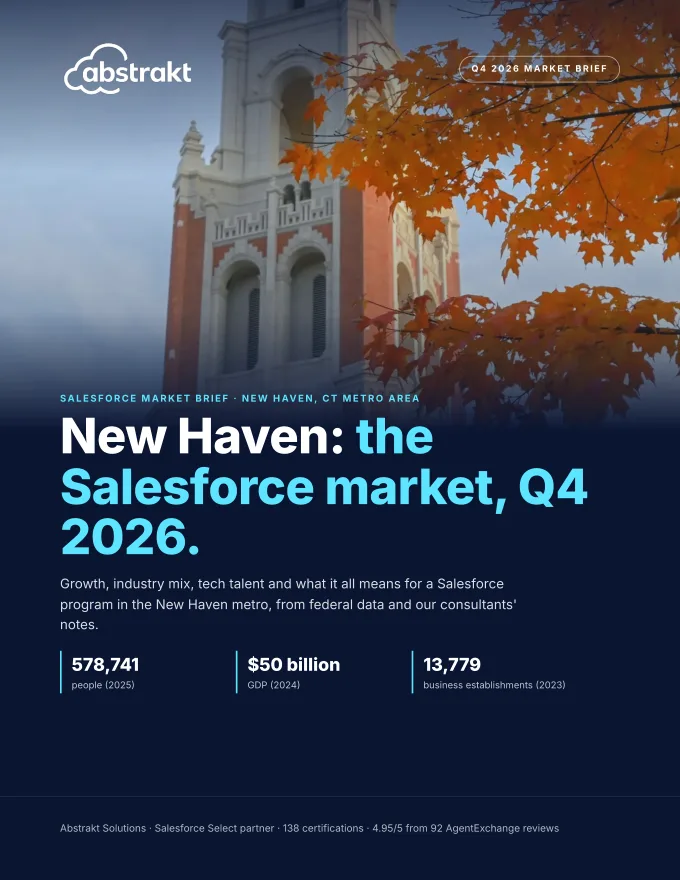
A free 21-page PDF with New Haven's growth ranked against 100 metros, its industry mix, tech wages and nearby markets. It is offered on the public New Haven page; send your customer there or get a copy for your own prep.
Get the New Haven brief →Co-sell with Abstrakt in New Haven
Working a New Haven account? Bring in a named consultant for discovery, scoping or a health check. We reply within 4 business hours.