

How Salesforce work starts in Cincinnati
Insurers, banks, manufacturers and distributors throughout the Cincinnati region in Ohio, Kentucky and Indiana turn to Abstrakt Solutions, a Salesforce Consulting Partner, for implementation, integration and ongoing support. Cincinnati is one of our focus markets.
What buyers here usually run into
- 1
Selling through distributors
Manufacturers and wholesalers often sell through dealers and distributors they can’t see into. Salesforce works best here when partner data, pricing and ERP orders are connected.
- 2
Compliance in financial marketing
Banks and insurers need marketing automation that respects consent, record privacy and review steps, which has to be designed in rather than added later.
- 3
Adoption across large field teams
Organizations with many reps or agents can end up with a system few people use. Rollouts need simple layouts, training and a clear reason for each field.
Budget, team and partner questions
What drives cost
Cincinnati projects grow with the number of core and ERP systems involved and with compliance work: consent, record privacy and review steps for financial marketing. Selling across Ohio, Kentucky and Indiana adds territory and licensing design. Manufacturers that track samples and formulations add custom objects and an R&D handoff.
Admin or partner
Larger insurers and banks in the region often run internal Salesforce teams and need a partner for integration, architecture or a new cloud. Mid-sized manufacturers and wholesalers more often rely on managed services until the volume of changes justifies a full-time hire.
What buyers ask a partner
Ask for experience with insurance data models, tri-state territory design and ERP integration for distributors. Ask how the partner plans adoption for large agent or rep teams, since a system few people use fails quietly.
The local economy and its biggest industries (4)
| Sector | Share of 2024 GDP | Where Salesforce fits |
|---|---|---|
| Finance and insurance Financial Services Cloud → | at least 14.8% | Finance and insurance is the Cincinnati metro’s largest sector, and banks and insurers here need relationship views, agent and advisor workflows, and marketing that passes compliance review. |
| Manufacturing Salesforce for manufacturing → | at least 13.4% | From aerospace suppliers feeding local jet engine production to food, flavoring and chemical producers, Cincinnati manufacturers need quoting, dealer and distributor management, and service tied to ERP. |
| Wholesale trade Sales Cloud → | at least 9.1% | Wholesale trade ranks third in the Cincinnati economy, and distributors serving the region’s manufacturers and retailers need account plans, order and inventory visibility from ERP, and reorder prompts in front of reps. |
| Health care and social assistance Salesforce for health & life sciences → | at least 7.5% | With a children’s hospital and a university anchoring a large research base, health and life-sciences organizations need patient, donor and partner engagement designed around privacy. |
Source: U.S. Bureau of Economic Analysis, GDP by county (CAGDP2), 2024, summed to the metro area; private sectors only, excluding real estate and government. “At least” marks sectors where BEA suppresses some county figures.
Regional target sectors named by local economic development groups: Advanced Manufacturing (Aerospace & Aviation; Automotive; Food, Flavoring & Beverage; Chemicals & Materials), Life Sciences (Biomedical Research; Pharmaceuticals Manufacturing; Medical Device Manufacturing), Business & Professional Services (Back Office Support; Consumer Insights; Financial Services), Technology (Cybersecurity; Data Analysis; Supply Chain Management; Smart Transportation Technologies).
Salesforce products that fit Cincinnati (6)
In the order we lead with them here, from the industries above.
Salesforce Sales Cloud
The CRM where sales pipeline lives, when it is built right.
Salesforce Financial Services Cloud
Industry CRM for wealth management, banking, insurance, and lending, built for compliance from the start.
Salesforce Service Cloud
The operating system for modern customer service, case, knowledge, voice, and AI agent assist together.
Salesforce Revenue Cloud / CPQ
Configure-price-quote, billing, subscription management, and quote-to-cash on Salesforce.
Salesforce Marketing Cloud
Cross-channel marketing, email, mobile, journey, and Data 360-powered personalization at scale.
Salesforce Data 360 (Data Cloud)
Unify customer data into a real-time profile that powers segmentation, analytics, and AI.
Realistic AI roles across Cincinnati finance and industry
BEA figures for 2024 put finance and insurance at no less than 14.8% of Cincinnati metro GDP, manufacturing at no less than 13.4% and wholesale trade at no less than 9.1%. Those three sectors share a common trait: lots of structured paperwork. Insurance and banking teams can use an agent to extract fields from applications and correspondence, then queue exceptions for an underwriter. Consumer-goods and chemical manufacturers can equip service reps with summaries of distributor cases. Wholesalers benefit from lead triage that sorts reorder requests from new-account inquiries. The results depend on inputs. Stale product data, overlapping account records and unclear approval rules will surface in AI output quickly, so clean those up first.
- Extracting fields from insurance applications
- Distributor case summaries for reps
- Separating reorders from new-account leads
Services buyers here usually need (7)
Salesforce Implementation in Cincinnati
For most Cincinnati companies, implementing Salesforce means designing for two things at once: regulated customer relationships and a sales force that crosses the Ohio River every day. We run discovery workshops with each team, settle the account model, territory logic and permissions first, then configure in a sandbox and release in phases, starting with the process that costs the most time today. Data from legacy tools is cleaned before it loads, and each role is trained before its phase goes live.
By industry in Cincinnati
- 1
Finance and insurance
BEA's 2024 county data put finance and insurance at no less than 14.8% of metro output, the largest private share in the region. For property and casualty carriers, banks and wealth firms, the first implementation question is usually whether Financial Services Cloud's household and policy structures fit, or whether Sales Cloud with a lighter model is enough. We also design agent and advisor access in the first phase, because who can see which policyholder shapes every later decision about sharing and reporting.
- 2
Manufacturing
Aerospace suppliers, automotive parts makers and chemical producers in the region tend to sell engineered products with long quote cycles. Implementation for them starts with the product catalog and pricing source, since CPQ rules built on an incomplete catalog have to be rebuilt later. We usually phase it: account and opportunity structure first, quoting second, then service history for installed equipment once the ERP connection is settled and reps trust the numbers they see.
- 3
Life Sciences
REDI Cincinnati lists life sciences, including biomedical research, pharmaceutical manufacturing and medical devices, among its core industries. Companies in this space implementing Salesforce need to decide early what the CRM may hold. We draw a line in design between commercial data and anything touching patients or trials, set field-level security accordingly and document it, so quality and compliance reviewers can sign off before the first user logs in rather than after.
Raise before scoping
Design territories for three states
Reps and customers here move between Ohio, Northern Kentucky and southeast Indiana constantly. Decide in design whether ownership follows county, ZIP code or account relationship, and test the rules against a full account export in a sandbox, before users form habits around a structure that later has to change.
Pick the first phase by pain
Rather than launching every cloud together, start with the process that wastes the most hours now, often quoting for manufacturers or referral tracking for insurers. A narrow first release gets people working in Salesforce within weeks and gives later phases real usage data to design against.
Avoid handoffs between project phases
Handoffs between a sales team, a build team and a support team are where project knowledge usually leaks away. Discovery, configuration, testing, training and weekly reviews stay with the same consultants from kickoff to handover, so decisions made in the first workshop are still remembered at go-live.
Salesforce Integration in Cincinnati
Integration work in Cincinnati most often connects Salesforce to the systems that run production, distribution and policy administration. Manufacturers and wholesalers want order status, pricing and inventory visible to reps; insurers and banks want policy, account and servicing data beside the relationship. We agree in writing which system owns each record, choose between MuleSoft, Workato or direct APIs, build and test with real volumes, and add alerts and a runbook so your own team notices a failed sync first.
By industry in Cincinnati
- 1
Manufacturing
Manufacturing makes up at least 13.4% of the metro's economic output, spanning aerospace components, automotive parts, chemicals and food ingredients. These producers usually keep customers, items and orders in an ERP that predates Salesforce. We typically sync customer accounts both ways, bring orders, shipments and invoices into Salesforce read-only, and push approved quotes back for order entry. Matching rules for customer numbers are designed before any code, because mismatched records are what erode trust in integrated data.
- 2
Wholesale trade
Distributors serving the region's manufacturers and retailers depend on price lists and stock levels that change daily. An integration that shows reps live availability and customer-specific pricing inside Salesforce prevents quotes built from stale spreadsheets. We plan volumes and refresh frequency with the warehouse and pricing teams, since pulling every SKU in real time is rarely necessary, and choose scheduled or event-driven syncs based on how quickly each value actually changes.
- 3
Technology
REDI Cincinnati names supply chain management, data analysis and cybersecurity within its technology sector. Firms building software for those markets typically need Salesforce tied to billing, product usage and support platforms so account teams see adoption and renewal risk in one place. We define which usage events are worth sending, aggregate them before they reach Salesforce to protect storage and API limits, and put every connected app and integration user through a security review.
Raise before scoping
Decide the system of record
For every shared entity, such as customer, product, price and order, write down which system is authoritative and which only reads. Without that, two systems overwrite each other and nobody knows which address or price is correct. It is the single decision that prevents most of the integration failures we are asked to fix.
Plan for unmatched records
Legacy ERP and policy systems in long-established Cincinnati businesses often hold duplicate customers or inconsistent naming. Decide what happens when an incoming record has no match: hold it for review, create it, or reject it with an alert. That rule should exist before go-live, not after the first failed sync.
Assign someone to watch alerts
Monitoring only helps if a person responds. Name an owner for integration alerts on your side, agree on what counts as urgent, and keep a runbook listing common failures and their fixes. Otherwise sync errors accumulate quietly until a customer or a rep stumbles on the problem.
Salesforce Optimization in Cincinnati
Optimizing Salesforce for a Cincinnati company usually means making a large field team want to use a system it already has. Insurers with agent networks, distributors with inside and outside reps, and manufacturers selling through dealers often carry years of added fields, overlapping flows and dashboards nobody quotes in meetings. We study usage data, interview each role, cut what is not used, consolidate automation into maintained Flows and rebuild reports around agreed definitions, then retrain people on the changes.
By industry in Cincinnati
- 1
Wholesale trade
Distributors produce at least 9.1% of the metro's 2024 GDP, and their reps judge Salesforce by one test: does it tell them whom to call next? Optimization for wholesalers typically trims account pages to the fields reps use, surfaces order history and lapsed buyers from ERP data, and replaces a dozen legacy reports with a short set leaders agree on. Reps engage more once the system starts suggesting work instead of only demanding data entry.
- 2
Finance and insurance
Carriers and banks in the region often have agents or bankers who log activity only because they must. We look at field-completion and login data to find where the system asks too much, simplify the screens for those roles, and move repetitive steps such as renewal reminders or referral assignment into Flow. Compliance steps stay intact; the goal is fewer clicks around them, not fewer controls. Managers then get a pipeline view they can coach from.
- 3
Manufacturing
Manufacturers commonly accumulate automation from several admins, with workflow rules, Process Builder and Flow all firing on the same opportunity. That produces slow saves, duplicate tasks and errors nobody can trace. We map every automation on the key objects, merge them into a small number of documented Flows, and test the result against real quoting and order scenarios in a sandbox before switching over, so plant and sales teams get a faster, more predictable system.
Raise before scoping
Measure usage before redesigning
Usage logs tell you more than opinions do. Pull login history, blank-field counts and report views for a few weeks up front so the redesign targets real friction rather than the loudest complaint, and so you can show leadership the improvement afterward using the same measures.
Agree on metric definitions first
Dashboards lose credibility when two departments define a qualified lead or a won deal differently. Settle those definitions in writing with sales, finance and marketing leaders; rebuilding reports without that agreement just produces new charts that people still argue about in the Monday meeting.
Retire fields in stages
Large Cincinnati orgs often have hundreds of custom fields, some feeding integrations or Marketing Cloud segments nobody remembers. Hide candidates from layouts first, watch for complaints or broken syncs over a release cycle, then archive and delete. It is slower than a single purge but avoids unpleasant surprises.
Salesforce Managed Services in Cincinnati
Managed services in Cincinnati usually supports an org that is already central to the business, often at an insurer, bank, health organization or shared-service center where many departments depend on one Salesforce instance. We run a single intake queue, prioritize it with your business owners each month, test every Salesforce release in a sandbox, watch integrations and data quality, and retire old automation gradually. The work is done by admins, developers and architects who learn your org's history before changing it.
By industry in Cincinnati
- 1
Health care and social assistance
With a pediatric research hospital and a public university among the largest local employers, and at least 7.5% of 2024 metro output coming from health care and social assistance, privacy is a constant concern here. Health organizations here revise referral routing, consent capture and staff access regularly. Under managed services each change goes through a written request, sandbox testing and a sign-off step, and every seasonal release is checked for effects on patient-facing data before it reaches production users.
- 2
Finance and insurance
Banks and carriers change products, rates and compliance language through the year, and each change tends to touch Salesforce: new fields, updated approval steps, revised marketing consent. A managed services team absorbs that steady flow of small changes without pulling an internal admin off planned projects. We keep a change log reviewers can read, so an audit question about who altered a sharing rule, and why, already has an answer on file.
- 3
Business & Professional Services
REDI Cincinnati counts back-office support, consumer insights and financial services within business and professional services. Shared-service centers that run operations for several brands or business units often own one Salesforce org with competing requesters. We give each group visibility into the status of its own requests, hold a monthly prioritization with the unit leads and publish plain release notes, so no department is left guessing what changed in its queues or dashboards.
Raise before scoping
Set a monthly prioritization rhythm
Requests arrive from sales, service, marketing and compliance at once. A fixed monthly session where business owners rank the backlog, with us presenting effort and risk for each item, keeps the hours going to changes that matter instead of the ones raised most loudly or most often.
Test releases against compliance settings
Salesforce's three annual releases can alter Flow behavior, permissions and the user interface. For regulated Cincinnati teams, we pair sandbox testing with a check of the consent, audit and field-history settings that compliance depends on, and flag findings well before the release date.
Keep an in-house admin close
Large field teams generate many small requests, such as password resets, report tweaks and layout questions. Many companies keep an internal admin for that front line and route development, integrations and release work to us, with one shared queue so nothing slips between the two groups.
Salesforce Health Checks in Cincinnati
A health check gives a Cincinnati organization a clear picture of its Salesforce org before the next big decision, whether that is a compliance audit, a new cloud or AI features that will read CRM data. We review user access and sharing, connected apps, automation, custom code, data quality and storage, and how closely the org follows current Salesforce practice. The result is a prioritized findings report with effort estimates in plain terms, walked through with your leaders so each owner knows what comes first.
By industry in Cincinnati
- 1
Finance and insurance
Banks and carriers answer to examiners and auditors who ask who can see customer data and how that is controlled. A health check reviews profiles, permission sets, sharing rules and field-level security against the roles you actually have, and lists integration users and connected apps holding more access than they need. We also check whether field history and event monitoring are configured for the evidence compliance teams request, and which gaps would need Shield.
- 2
Health care and social assistance
Health and social-service organizations in the region often expanded Salesforce quickly, adding community partners, volunteers or families as users. The review looks at external access through portals, guest user settings and sharing, where exposure risk tends to hide. It also checks whether protected health information lands in free-text fields or email logs where it was never meant to be, and recommends practical steps to contain it without disrupting care teams.
- 3
Technology
Cybersecurity and data analysis firms are part of REDI Cincinnati's technology sector, and their own customers expect them to handle data carefully. For companies like these, a health check doubles as evidence for security questionnaires: MFA and SSO configuration, API usage, sharing declarations in Apex classes, stale admin accounts and session settings. Findings come ranked by risk, so the fixes that most strengthen your next customer security review are handled first.
Raise before scoping
Audit before adding AI
AI features and agents read whatever records a user can reach. If sharing is loose or data is duplicated, answers will be wrong or overexposed. Tighten permissions and clean the objects the AI will use before switching anything on, and review the result again once pilot users begin testing.
Count the technical debt
Older Cincinnati orgs frequently carry workflow rules, Process Builder and Apex written by admins who have since left. The review lists each automation per object with its purpose where known, so you can decide what to move to Flow, what to retire and what poses a risk during upcoming releases.
Share results with auditors
A written findings report, with remediation tracked to completion, is useful evidence for internal audit and regulators. Plan who receives the report, how findings are logged in your risk system, and when a follow-up review will confirm that the fixes held.
Salesforce Migration in Cincinnati
Migrations for Cincinnati organizations often involve decades of customer history, especially at long-established insurers, banks and manufacturers. The source might be an old on-premise CRM, Microsoft Dynamics, HubSpot, an agency management tool or regional sales teams' spreadsheets. Every source gets inventoried, mapping and history rules are agreed with each department, and duplicates are merged before loading. Sandbox trial loads are reconciled against the originals ahead of a planned cutover freeze, with our team on hand for users on go-live day.
By industry in Cincinnati
- 1
Finance and insurance
Carriers and banks here tend to hold policyholder or client records in several places at once: an agency system, a marketing platform and individual producers' contact lists. Migrating to Salesforce means choosing one identity for each person or household and linking policies and accounts to it. We define matching rules with compliance and operations staff, keep an audit trail of merged records, and bring over consent and communication preferences so marketing does not restart at zero.
- 2
Wholesale trade
Wholesale reps frequently keep their best customer notes outside any system. A migration for a distributor therefore includes gathering those spreadsheets and personal lists, not only exporting the old CRM. We normalize company names, addresses and ship-to locations, match them to ERP customer numbers, and flag orphan contacts for rep review. The cleanup is tedious, but it determines whether reps trust the account list they see on their first day in Salesforce.
- 3
Advanced Manufacturing
REDI Cincinnati includes food, flavoring and beverage producers within its advanced manufacturing sector, alongside aerospace, automotive and chemicals. Flavor and ingredient companies often track sample and project requests in shared inboxes or custom databases. Moving that history into Salesforce requires deciding which requests become records, how formulations relate to customer accounts, and which attachments are archived rather than migrated. We settle those rules with R&D and sales together before any load.
Raise before scoping
Collect the shadow spreadsheets
Many sales teams keep individual files holding contacts and notes the official system never saw. Ask each rep and agent for theirs early, before mapping is finished, so that data can be cleaned and matched rather than discovered after go-live and typed in by hand.
Keep consent with the contact
Opt-outs and communication preferences have to travel with every migrated person, particularly for banks and insurers. Map those fields explicitly and test them in the trial load, since a lost unsubscribe flag creates a compliance problem the first time Marketing Cloud sends an email.
Schedule cutover around quarter-end
Freezing the old system during a busy renewal or quarter-close period invites workarounds. Choose a cutover window with finance and sales leaders, communicate it to users across Ohio, Kentucky and Indiana, and keep the old system read-only for a set period so people can still check history.
Salesforce Implementation Rescue in Cincinnati
When a Cincinnati Salesforce project goes wrong, the cause is usually a mix of unclear ownership, scope that grew without a plan and a design that did not match how the field actually sells. Rescue starts with triage: we review the org, the backlog, contracts and decisions made so far, then interview the people who were supposed to use it. You get an honest account of what is salvageable, a revised plan in phases and, if you choose, our team to deliver it.
By industry in Cincinnati
- 1
Manufacturing
Manufacturers commonly reach us after a quoting or CPQ project stalled halfway, with pricing rules that do not match the ERP and reps back on spreadsheets. Triage for them focuses on the product catalog and pricing logic first, because nothing downstream works until quotes are right. We often keep the account and opportunity structure, rebuild the pricing configuration against real orders, and relaunch quoting to a pilot group before the full sales team.
- 2
Finance and insurance
A failed rollout at a bank or carrier often shows up as agents who log in only when required and managers who still run pipeline meetings from exported spreadsheets. Rescue here tends to center on security and data model fixes, such as household structures built incorrectly or sharing rules that block legitimate work. We fix those first, document the compliance rationale for each change, and then retrain users on a system that finally matches their day.
- 3
Business & Professional Services
Back-office and consumer-insights firms, both named by REDI Cincinnati within business and professional services, sometimes inherit Salesforce projects that were sold as quick wins. Scope then expanded to case management, client portals and custom reporting without the architecture to support it. Our triage separates what clients truly need now from what can wait, stabilizes the core and sets a realistic sequence for the rest, so leaders can explain the plan to their own clients.
Raise before scoping
Freeze scope during triage
Hold off on new feature requests until triage is complete. Adding features to a troubled org makes it harder to see what is broken and why. A short freeze gives the rescue team a stable picture to work from and gives stakeholders a reason to agree on what matters most.
Keep what already works
Stalled projects rarely need to start over. Accounts, contacts and some automation may be sound. Identifying those pieces early protects the investment already made and shortens the path to a working system, which matters when leadership has already waited once for results.
Rebuild trust with a pilot
A second launch meets more skepticism than the first. Relaunch to a small group of respected reps or agents first, fix what they report, and let them explain the changes to colleagues before a wider rollout reaches every location across the tri-state region.
Industry plays in Cincinnati (4)
Salesforce for Cincinnati Insurers and Agencies
For insurers around Cincinnati, Salesforce usually sits between the policy administration system and the people who sell and service coverage. Carriers need to manage appointed agencies and producers across three states, while agencies need a clean household view that shows every policy, renewal date and open claim. We build on Financial Services Cloud, connect it to policy and claims platforms, and give underwriting, distribution and service teams one record to work from instead of several disconnected ones.
Money and risk edge out making things along this stretch of the Ohio River: finance and insurance account for no less than 14.8% of Greater Cincinnati's 2024 GDP by the Bureau of Economic Analysis's county tally, a hair above manufacturing. REDI Cincinnati, the region's economic development organization, lists financial services under its business and professional services target and names cybersecurity and data analysis within its technology target. The metro spans southwest Ohio, northern Kentucky and southeast Indiana, so carriers and agencies here routinely license producers, file forms and serve policyholders under more than one state's rules.
Use cases to open with
- 1
Producer and appointment tracking
Carriers selling through independent agencies need to know which producers are licensed and appointed in Ohio, Kentucky and Indiana, and for which lines. We model agencies, producers, licenses and appointments in Financial Services Cloud with expiration alerts, so distribution teams stop maintaining a separate spreadsheet and underwriters can confirm a producer's standing before binding business. Production by agency then rolls into one scorecard for the field team.
- 2
Household view for agencies
Independent agencies often write home, auto, umbrella and small commercial coverage for the same family across several carriers. A household record in Salesforce pulls policies, renewal dates, claims and service history together, so account managers can spot coverage gaps, schedule remarketing well ahead of renewal and hand off cleanly when a producer retires or a book of business is sold to another agency.
- 3
Claims and policy service
Policyholders call about billing, endorsements and claim status far more than about new coverage. Service Cloud gives adjusters and service reps one case view with policy and claim data pulled from core systems, while Experience Cloud lets agents and customers check status or upload documents themselves. That trims call volume and gives managers a measurable picture of where service requests stall.
Raise before scoping
Map core system ownership
Policy administration, billing and claims platforms stay the systems of record. Decide which fields Salesforce reads, which it writes back, and how often, and involve the core system owners early so integration work does not stall waiting on another team's release calendar.
Plan for multi-state rules
Serving three states means different licensing, disclosure and marketing requirements. Build state as a first-class field on producers, policies and campaigns, and have your compliance team review consent capture and communication templates before launch. We configure controls; your counsel interprets the regulations.
Protect sensitive policyholder data
Claims files can include medical, financial and driver information. Use field-level security, restricted sharing and Shield encryption where appropriate, and limit which roles see claim detail versus policy summary. Review data retention and audit trail settings with security staff before migrating historical records.
Salesforce for Cincinnati Manufacturers
Cincinnati manufacturers often sell on specification rather than catalog price. A flavor house or chemical maker may run samples and trials for months before a customer approves a formula, and an aerospace supplier needs qualification before a single part ships. Salesforce works best here when it tracks that technical path alongside the commercial one: sample requests, project stages, approved specifications and pricing tied to the ERP, all visible to sales, technical service and customer service in the same place.
Greater Cincinnati's factory base is broad: plants produce at least 13.4% of 2024 metro GDP in Bureau of Economic Analysis county data, and wholesale distribution, much of it moving manufactured goods, contributes at least 9.1% more. REDI Cincinnati breaks its advanced manufacturing target into aerospace and aviation, automotive, food, flavoring and beverage, and chemicals and materials. Its life sciences target adds pharmaceutical and medical device manufacturing. That mix favors formulation, specification and qualification-heavy selling over simple transactional orders, and it puts technical staff at the center of most customer relationships.
Use cases to open with
- 1
Sample and trial management
Ingredient, flavor and specialty chemical sales often start with a sample request that turns into lab work, customer trials and reformulation. We model each development project with sample shipments, lab results and customer feedback linked to the opportunity, so technical and commercial teams see where a project stands and leadership can measure how many trials convert into ongoing supply agreements and at what margin.
- 2
Quoting from approved specifications
When price depends on formula, volume tier, packaging and raw material cost, reps cannot quote from a flat price book. Revenue Cloud or CPQ, fed with cost and item data from the ERP, applies pricing rules and routes exceptions for approval. Quotes reference the approved specification, which avoids shipping the wrong grade and gives finance a traceable record when commodity costs move and prices must be reopened.
- 3
Aftermarket and distributor support
Aerospace and industrial suppliers in the region support parts and equipment long after delivery, often through distributors. Experience Cloud gives distributors a portal for orders, documentation and warranty claims, while Service Cloud tracks cases against serial numbers and certifications. Account teams see open issues before renewal talks, and quality gets one place to spot recurring failures by product line, plant or distributor territory.
Raise before scoping
Respect quality system boundaries
Food, pharmaceutical and aerospace producers run regulated quality and document control systems. Salesforce should reference approved specifications and certificates, not replace those systems. Agree early which documents appear in Salesforce, who can view them, and how revisions are synced from the controlled source.
Handle cross-state distribution
Many producers here ship from plants in Ohio, Kentucky and Indiana and sell through wholesalers. Model plants, distributors and ship-to locations carefully so territory, pricing and commissions resolve correctly, and confirm tax and freight fields come from the ERP rather than being keyed by reps.
Bring technical staff along
Chemists, application engineers and quality leads hold much of the customer relationship. Give them a simple way to log trials and findings, ideally from a mobile or list view, and show them the reports that save them time, or their knowledge stays in private notebooks.
Salesforce for Cincinnati Retailers and Consumer Brands
Consumer goods work in Cincinnati usually spans two audiences at once: the retail buyers who decide shelf space and the shoppers who call, write or post about a product. Salesforce can hold both. Key account teams plan volume, promotions and joint business reviews with each retailer, consumer care handles product questions and complaints with lot details attached, and marketing works from a consented consumer profile. We connect the org to ERP, retailer data feeds and research tools so brand, sales and care teams stop trading spreadsheets.
Retail trade contributed at least 6% of Cincinnati metro GDP in 2024 in Bureau of Economic Analysis county data, the fifth sector on the private list, while wholesale trade, at least 9.1%, moves goods to those shelves. REDI Cincinnati folds food, flavoring and beverage into its advanced manufacturing target and lists consumer insights under business and professional services, so brand owners, ingredient suppliers and research firms work side by side.
Use cases to open with
- 1
Retailer joint business planning
Brands and flavor suppliers selling into grocery and mass retail negotiate annual plans, promotions and new-item slots with each buyer. Sales Cloud, or Consumer Goods Cloud for field-heavy teams, keeps each retailer's plan, promotion calendar and deductions history in one account view. Leaders compare planned volume with shipments from ERP and see which promotions actually lifted sales rather than guessing after the quarter closes.
- 2
Consumer care with lot tracing
When a shopper reports an off taste, a damaged package or an allergy concern, the brand needs the product, lot and store captured the first time. Service Cloud records those details, routes safety-related cases to quality staff and tracks replacements or refunds. Trend reports by lot and plant help quality teams spot a problem early, and care agents answer routine questions from an approved knowledge base.
- 3
Consented first-party consumer profiles
Recipe sign-ups, rebates, sweepstakes and care contacts all produce consumer data that often sits in separate tools. Data 360 (formerly Data Cloud) can unify those sources into one consented profile, and Marketing Cloud can use it for segments and journeys. Insight teams gain a cleaner view of which households engage with which products and campaigns, without buying another list or copying files between agencies.
Raise before scoping
Consent across every entry point
Consumer data arrives through promotions, websites, care calls and partner agencies, each with its own consent language. Map where permission is captured, store it with the record, and honor opt-outs everywhere before building segments, because re-permissioning a large database later costs far more.
Retailer and syndicated data feeds
Point-of-sale files, syndicated market data and retailer portals each report differently. Decide which measures sales teams truly need in Salesforce, how often they refresh and how products are matched across sources, rather than trying to load every column from every feed.
One product catalog to trust
Items, pack sizes, UPCs and formulations change often in consumer goods. Keep ERP or product information management as the master, sync a clean catalog into Salesforce, and retire discontinued items on a schedule so account plans and care cases point to the right product.
Salesforce for Cincinnati Health Care and Life Sciences
Health organizations in Cincinnati often combine patient care with a heavy research and industry-partnership load. Salesforce helps on both fronts: patient and family access, referral intake and outreach for care teams, and sponsor, licensing and collaboration tracking for research offices. Device and drug manufacturers use it for customer accounts, service and complaint intake. We keep clinical records in the EHR, connect only the data each team needs, and design permissions for protected health information from the first release.
Health care and social assistance produced at least 7.5% of 2024 metro GDP in BEA county data, fourth on the private-sector list behind finance and insurance, manufacturing and wholesale trade. Drug and device production plus biomedical research make up the life sciences target on REDI Cincinnati's industry list. The research base is substantial: REDI says the region's public research university and its children's hospital together contribute over $450 million a year in research, which gives providers here unusually deep clinical research ties. An innovation district announced in 2020 links those institutions with industry.
Use cases to open with
- 1
Family-centered pediatric access
In pediatric care the caller is usually a parent, guardian or foster caregiver, sometimes several for one child. Health Cloud can model those relationships with consent and proxy rules, so agents know who may schedule, receive results or discuss care. Service Cloud routes calls and messages by specialty, and families can use an Experience Cloud portal for forms, directions and appointment preparation.
- 2
Sponsor and industry partnerships
Research offices manage sponsored studies, licensing discussions and corporate collaborations across many investigators, departments and funding cycles. Salesforce can track each sponsor, agreement stage, milestone and contact, with documents stored against the relationship rather than in personal inboxes. Leadership sees which industry partners are active across departments, and new investigators can find prior conversations before approaching a company for another project.
- 3
Device and drug complaint intake
Manufacturers of pharmaceuticals and medical devices must capture product complaints and possible adverse events quickly and completely. Service Cloud gives agents guided intake forms with product, lot and patient-safety questions, routes potentially reportable cases to quality or pharmacovigilance teams, and records every follow-up attempt. Integration with the quality management system keeps investigations and CAPA work there, while customer communication stays in Salesforce.
Raise before scoping
Proxy access for minors
Who may act for a child changes with age, custody and state rules. Work with your privacy and legal staff to define proxy roles, adolescent confidentiality and consent capture, then build them into sharing and portal access instead of relying on agents to remember exceptions.
Separate research from care data
Study participants, sponsor contacts and clinical patients may be the same people under different rules. Decide what research data may enter Salesforce at all, keep it in separately permissioned objects, and involve the IRB or research compliance office before connecting any study system.
Quality system boundaries
For manufacturers, complaint handling falls under quality system regulations. Agree where Salesforce stops and the validated quality system begins, which fields are required for reportability decisions, and how audit trails are kept, so regulators can follow every complaint from first contact to closure.
Case studies to send (3)
From the industries this market leans on. Client names are anonymized and these projects are not specific to Cincinnati.
The Cincinnati Salesforce market brief, Q4 2026
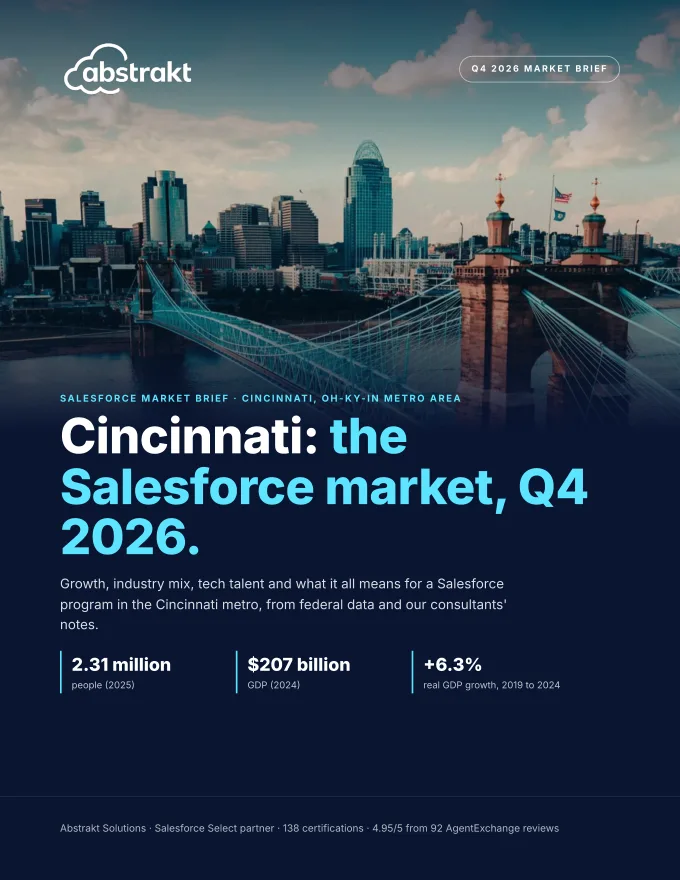
A free 25-page PDF with Cincinnati's growth ranked against 100 metros, its industry mix, tech wages and nearby markets. It is offered on the public Cincinnati page; send your customer there or get a copy for your own prep.
Get the Cincinnati brief →Co-sell with Abstrakt in Cincinnati
Working a Cincinnati account? Bring in a named consultant for discovery, scoping or a health check. We reply within 4 business hours.