

How Salesforce work starts in Louisville
Abstrakt Solutions is a Salesforce Consulting Partner for manufacturers, health organizations and logistics companies in Louisville and Jefferson County, neighboring Bullitt and Oldham counties, and Clark and Floyd counties across the Ohio River in southern Indiana. Louisville is one of our focus markets.
What buyers here usually run into
- 1
Automotive supplier programs
Parts suppliers usually quote against vehicle programs with fixed volumes and model years, so opportunities, price changes and engineering revisions need to roll up by program.
- 2
Health data under strict rules
Insurers, health-IT vendors and care providers must control protected health information closely, which shapes the org design, integrations and any use of AI features.
- 3
Franchise and location networks
Restaurant and consumer brands typically manage franchisees, locations and guests at once, and each group needs different records, permissions and communication.
Budget, team and partner questions
What drives cost
Louisville cost is driven by the plant and claims side: EDI and ERP integration for suppliers, pricing complexity that decides whether Revenue Cloud is needed, and privacy design for insurers and providers. Logistics firms add tracking integrations and portal scope.
Admin or partner
Large manufacturers and insurers here usually keep internal Salesforce owners and use a partner for integration, quoting and privacy-sensitive releases. Mid-sized suppliers, carriers and franchise brands more often outsource administration and add a hire once the org is stable.
What buyers ask a partner
Ask for references with program-based quoting, EDI integration and health data access models. Ask how the partner documents who can see protected information and how they hand ownership to your team.
The local economy and its biggest industries (4)
| Sector | Share of 2024 GDP | Where Salesforce fits |
|---|---|---|
| Manufacturing Salesforce for manufacturing → | at least 16.3% | Vehicle and appliance assembly plants sit at the center of Louisville manufacturing. Suppliers to these plants need program-level forecasts, quality issues and part-level quotes connected to ERP. |
| Health care and social assistance Salesforce for health & life sciences → | at least 9.4% | One Louisville names health insurance, post-acute care and UofL research as anchors of its life sciences cluster, and it counts aging care innovation, backed by the Trager Institute and The Thrive Center, among the region’s strengths. Providers need referral intake, family communication and care transitions tracked without exposing patient data. |
| Finance and insurance Salesforce for insurance → | 8.8% | Banks, insurers and investment firms together form Louisville’s third-biggest private industry by output, behind manufacturing and health care. Banks, insurers and advisory firms on both sides of the river use Salesforce for client relationships, service requests and marketing that respects consent and privacy rules. |
| Transportation and warehousing Service Cloud → | at least 6.9% | One Louisville calls the parcel carrier’s hub here the largest automated package sorting facility in the world, and the same carrier runs a health care lab-logistics facility in the city as well. Carriers, freight brokers and warehouses serving the region need shipper onboarding, rate quotes and exception handling in one system. |
Source: U.S. Bureau of Economic Analysis, GDP by county (CAGDP2), 2024, summed to the metro area; private sectors only, excluding real estate and government. “At least” marks sectors where BEA suppresses some county figures.
Regional target sectors named by local economic development groups: Life Sciences (incl. health IT, medical devices, aging care innovation), Logistics, Automotive, Defense & Aerospace, Food & Beverage, Business Services (named as a major business sector, not one of the five target industries).
Salesforce products that fit Louisville (6)
In the order we lead with them here, from the industries above.
Salesforce Sales Cloud
The CRM where sales pipeline lives, when it is built right.
Salesforce Service Cloud
The operating system for modern customer service, case, knowledge, voice, and AI agent assist together.
Salesforce Revenue Cloud / CPQ
Configure-price-quote, billing, subscription management, and quote-to-cash on Salesforce.
Salesforce Experience Cloud
Customer, partner, and employee portals built on Salesforce.
MuleSoft
Enterprise API platform, for connecting Salesforce, ERP, data warehouses, and the rest of your stack.
Salesforce Data 360 (Data Cloud)
Unify customer data into a real-time profile that powers segmentation, analytics, and AI.
Realistic AI projects for Louisville plants, carriers, and insurers
Louisville's economy mixes heavy manufacturing, logistics, health care, and insurance, with finance and insurance alone at 8.8% of metro GDP in 2024. The right first AI project differs sharply from one of those industries to the next. Plants and auto suppliers benefit from agents that read supplier and dealer correspondence and open properly categorized cases. Logistics and warehousing operations can use shipment-status self-service, if tracking data actually flows into Salesforce. Benefits administrators and health plans can hand eligibility lookups to an agent while members with complex issues reach a person. The shared prerequisite is integration: an agent can only report what the org can see. Human review stays in place wherever a reply carries financial or clinical weight.
- Dealer correspondence case categorization
- Shipment status self-service
- Member eligibility lookups
Services buyers here usually need (7)
Salesforce Implementation in Louisville
Louisville implementations are shaped by manufacturing more than by any other sector. A supplier to vehicle or appliance plants needs Salesforce organized around programs, part numbers and quotes rather than a generic lead-to-opportunity funnel. We design that data model first, decide what ERP keeps, build quoting and service in a sandbox and phase go-lives so sales goes first and quality cases follow. Plant service teams and inside sales test each release with their own part numbers and programs before it goes live.
By industry in Louisville
- 1
Automotive
Automotive is one of One Louisville's five target industries, and two vehicle assembly plants in the metro anchor a supplier base that quotes against platforms and model years. For those suppliers, implementation means a program object tying RFQs, awarded volumes, piece prices and engineering changes together, with Revenue Cloud enforcing tooling charges and annual price-downs. We settle program hierarchy and the ERP boundary in design, because both are costly to rework once quotes and forecasts depend on them.
- 2
Manufacturing
No private sector in the metro comes close to manufacturing, which accounts for at least 16.3% of 2024 GDP. Beyond automotive, the metro hosts appliance and electronics production, and plant suppliers of every kind share similar implementation needs: accounts that mirror customer plants and buying groups, opportunities carrying part-level detail, and service cases linked to shipped products. We phase the rollout so account managers adopt pipeline and quoting first, while warranty and quality processes join in a later release.
- 3
Food and beverage
Food and beverage is another One Louisville target industry, spanning producers, ingredient suppliers and national restaurant groups. Producers selling through distributors and retailers need Salesforce to model brokers, distributor territories and promotional commitments, not just end accounts. Restaurant brands add franchise development and franchisee support. We decide early whether those processes share one org with separate record types or run as distinct designs, since that choice shapes both the security model and every report built afterward.
Raise before scoping
Model programs before opportunities
Automotive and appliance suppliers rarely win a single order; they win a program that runs for years. Build the program record and its links to parts and customer plants first, then hang opportunities, quotes and forecasts beneath it, so reporting rolls up the way leadership already views the business.
Keep ERP as pricing authority
Cost and standard pricing usually live in ERP, and duplicating them in Salesforce invites drift. Decide during design whether CPQ reads prices from ERP, receives a scheduled feed or holds only quote-specific adjustments, and write that decision down before anyone builds a price book.
Schedule training on both riverbanks
One Louisville describes a 15-county region reaching into southern Indiana, and many companies have plants or offices on both sides of the Ohio River. Plan training by location and shift, since plant-based service staff seldom keep the same hours as office-based sales teams.
Salesforce Integration in Louisville
Integration projects in Louisville most often connect Salesforce to ERP at manufacturers, to transportation and warehouse systems at logistics firms, and to billing or clinical platforms in health and life sciences. We start by mapping data ownership and volumes, then match the tool to the job: native connectors, point-to-point APIs or MuleSoft. Every interface gets error handling, monitoring and a documented owner. Sales and service teams see orders, shipments and claims on the account, while operational systems keep authority over their own data.
By industry in Louisville
- 1
Manufacturing
Plant suppliers in the metro depend on ERP for releases, shipments and invoicing, and account managers need that information inside Salesforce before customer reviews. A typical integration pulls orders, shipment performance and open quality issues onto account and program records, and pushes won quotes back to ERP as sales orders. We keep part masters and costing in ERP, sync only what sales and service actually use, and schedule heavy loads outside production reporting windows.
- 2
Logistics
Logistics is a One Louisville target industry, and the chamber describes the city's parcel air hub as the busiest cargo airport in North America. Carriers, freight brokers and third-party warehouses in its orbit need Salesforce to reflect tracking events, claims and rate agreements. We design event-driven feeds for exceptions that require a human response, batch the rest, and give customer teams one view of each shipper's volume, service issues and contract terms.
- 3
Life sciences
One Louisville's life sciences target covers health IT, medical devices and pharmaceutical services. Companies in these fields connect Salesforce to billing platforms, device service records, product registries or health data, each with privacy or regulatory constraints. We define exactly which identifiers and fields cross into Salesforce, encrypt or mask where needed and log every exchange, so security reviews by customers or auditors can be answered from documentation rather than guesswork.
Raise before scoping
Map ownership field by field
For each shared object, record which system creates it, which may update it and which only reads it. Disputes over who owns an address, a price or a status cause most integration defects, and settling them on paper costs far less than debugging them in production.
Test at peak, not average
Logistics and manufacturing volumes spike around holidays, model changeovers and quarter-end. Load-test integrations at those peaks, and check Salesforce API limits and middleware capacity against them before go-live rather than discovering the ceiling during the first busy season. Plan headroom for growth as well.
Decide where EDI feeds land
Suppliers and logistics companies often exchange data with customers through EDI or portals the customer controls. Decide whether those feeds touch Salesforce directly or arrive through ERP first, since that choice determines where errors surface and who is responsible for fixing them.
Salesforce Optimization in Louisville
For Louisville companies, Salesforce optimization usually targets three symptoms: users entering the minimum and tracking the rest elsewhere, automation nobody can fully explain, and reports leaders re-create by hand. We review usage data and interview a sample of users, then simplify layouts by role, consolidate legacy automation into Flow and rebuild the dashboards behind weekly decisions. Because each release is small, franchise, logistics and financial teams notice progress within weeks rather than waiting on one large relaunch.
By industry in Louisville
- 1
Food and beverage
Several national restaurant groups call Louisville home, according to One Louisville, and franchise systems stretch Salesforce in particular ways. Development teams track candidates and territories, operations teams handle franchisee support cases, and marketing runs guest programs. Optimization untangles those uses when they were bolted onto one set of objects: separate record types and layouts, territory rules that prevent double-promising a market, and support dashboards showing which locations raise the most issues and why.
- 2
Transportation and warehousing
Transportation and warehousing ranks fourth among Louisville's private sectors by BEA output, and carriers, brokers and warehouses here often use Salesforce for shipper onboarding and exception handling. Over time case categories drift, queues multiply and response metrics stop meaning much. We rationalize case types, rebuild routing around actual shipper segments and create service reporting that separates carrier-caused delays from customer-caused ones, so account reviews rest on numbers both sides accept.
- 3
Finance and insurance
Louisville banks and insurers commonly adopted Salesforce for sales, then added service and marketing without revisiting the original design. Optimization for them focuses on relationship data: merging duplicate clients, repairing household and business relationships, and simplifying referral paths between branches, advisors and service teams. We also retire campaign automation that ignores consent preferences, which lowers compliance risk while making marketing lists more accurate. Branch managers finally get a reliable view of cross-sell referrals and their outcomes.
Raise before scoping
Start with the side spreadsheets
Ask each team which spreadsheets they still maintain next to Salesforce and why. Those files describe exactly what the org fails to support, whether a missing field, a clumsy process or a report that never loads, and they make a sharper backlog than any satisfaction survey.
Retire before you add
Optimization projects tend to add features. Begin instead by removing unused fields, layouts, reports and automation, which reduces confusion and makes later improvements easier to notice. Archive whatever you remove so it can be restored if someone turns out to need it after all.
Tie each release to a metric
Pick a measurable outcome for every release, such as case resolution time, quote turnaround or the share of opportunities with a recorded next step. Tracking it before and after shows leadership whether the work paid off and keeps the backlog pointed at results.
Salesforce Migration in Louisville
Most Louisville migrations we plan involve more cleanup than transfer. Finance firms bring client records spread across core systems, older CRMs and advisor spreadsheets; defense suppliers bring contracts tracked in documents; service firms bring whatever their last tool allowed. We inventory sources, fix duplicates and gaps before loading, map fields to a Salesforce design built for your process, and rehearse the load in a sandbox. Cutover is scheduled around your busiest periods, and the old system stays read-only afterward.
By industry in Louisville
- 1
Finance and insurance
Banks, insurers and investment firms together produce about 8.8% of the metro's 2024 GDP. Those moving to Salesforce usually consolidate client data from several places, and the difficult part is relationships: which individuals form a household, which businesses share owners, which advisor or agent holds the relationship. We rebuild those links during migration using matching rules your compliance and operations staff approve, and keep account and policy numbers as external IDs so later syncs with core systems stay clean.
- 2
Defense and aerospace
Defense and aerospace is one of One Louisville's target industries, and the region hosts a defense innovation hub at its research university. Suppliers in this field often track contracts, program contacts and proposals in documents and personal inboxes. Migrating them into Salesforce starts with deciding what counts as controlled information, since some technical data may need to stay outside the CRM entirely. We classify fields during mapping and restrict access from the very first import.
- 3
Business services
Business services firms in the metro, including staffing, marketing and consulting companies, frequently arrive from a lighter CRM or a mix of tools each team chose independently. Migration consolidates those into one account and contact model, resolves conflicting ownership and brings forward only the activity history that still informs selling. We also map billing and project references so finance can reconcile Salesforce opportunities with invoices after cutover. Old proposals worth keeping are attached to the right accounts.
Raise before scoping
Preserve legacy record IDs
Load the original record ID from each source system into an external ID field. It makes reconciliation, reruns and future integrations far simpler, and it lets staff find a familiar record quickly while they are still thinking in terms of the old system.
Let data owners approve matching
Deduplication rules look simple until two branches or teams disagree about which record is right. Put the people who know the data in charge of approving match rules and reviewing a sample of merges before the full load runs against production.
Avoid your busiest weeks
Choose a cutover window away from quarter-end, open enrollment or peak shipping periods, depending on your business. A quiet week gives users time to learn the new system and gives the project team room to fix issues without competing with urgent operational work.
Salesforce Managed Services in Louisville
Managed services in Louisville suits organizations whose Salesforce org has grown past what one admin can maintain: a care provider's referral console, a bank's relationship model, a business services firm's pipeline and billing links. We run the request queue, test each seasonal release in a sandbox, keep data quality rules current and chip away at technical debt in the order your owner sets. Specialists rotate in as the work demands, while one lead consultant provides continuity from month to month.
By industry in Louisville
- 1
Health care and social assistance
Health care and social assistance contributes at least 9.4% of 2024 metro GDP, and One Louisville highlights health IT and aging care innovation. Providers, senior living operators and health technology firms here generate a steady flow of Salesforce requests: new referral sources, intake form changes, family communication templates. Our team handles them with protected health information in mind, reviewing field access and report sharing on every change so the org stays compliant as it grows.
- 2
Finance and insurance
Lenders, insurers and wealth advisers in the Kentucky and Indiana parts of the metro rely on Salesforce for client relationships, service requests and consent-based marketing. Managed services for them centers on controlled change: every enhancement documented, tested in a sandbox and approved before deployment, with records of who changed what. We also watch duplicate rules and household relationships, since relationship data degrades quickly when branches and advisors enter records in their own way.
- 3
Business services
One Louisville names business services as a major sector alongside its five target industries. Staffing, marketing, accounting and IT services firms tend to run lean internal teams and treat Salesforce as a side job for someone in operations. A managed arrangement gives them admin coverage for everyday requests, a developer for billing or project-system integrations, and release reviews, without adding a full-time position that the workload may not justify all year.
Raise before scoping
Separate support from roadmap work
Everyday requests and larger enhancements compete for the same hours unless they are tracked apart. Reserve capacity for each, so access fixes and report tweaks keep moving while a new intake process or Data 360 (formerly Data Cloud) project advances on its own schedule.
Log compliance-relevant changes
Health and financial organizations may need to show examiners or auditors how access and automation changed over time. Keep a change log tied to each deployment, with the request, approver and test evidence, instead of reconstructing the history from memory when a question arrives.
Agree escalation rules in advance
Not every problem deserves the same response, and deciding that in the middle of an outage is too late. Define which issues count as urgent, who can raise them and how deployments are timed around plant shifts and month-end, so everyone knows what happens when an order screen breaks.
Salesforce Health Checks in Louisville
Before committing to the next Salesforce investment, Louisville leadership teams usually want to know what they already have. We review user access, sharing, field security, automation, Apex and installed packages, data quality on key objects and adoption patterns, then interview people who depend on Salesforce daily. Each finding is scored for risk and for the effort needed to fix it. Health and life sciences companies typically want to confirm patient data is properly protected; others want to know whether their records are ready for Agentforce or Data 360 (formerly Data Cloud).
By industry in Louisville
- 1
Life sciences
Health IT, medical device and pharmaceutical services companies in One Louisville's life sciences target group often sell to hospitals and insurers who send security questionnaires. A health check helps answer them truthfully: who can export records, which integrations hold broad access, where sensitive fields sit unencrypted and whether audit trails are enabled. We document current controls and gaps, so sales teams stop guessing when a prospect's security team asks how customer data is handled.
- 2
Health care and social assistance
Providers, senior living operators and home-care agencies store referral, family and sometimes clinical information in Salesforce. The health check tests whether that information is limited to the right roles, whether portal users see only their own records, and whether automated emails or reports leak protected data. It also flags free-text fields where staff paste clinical notes, a common and easily overlooked exposure that deserves an explicit policy decision. Portal guest access is reviewed separately.
- 3
Defense and aerospace
Defense and aerospace suppliers growing in the region need confidence that Salesforce is not holding data it should not. We look for technical specifications, drawings or export-controlled details stored in files, notes or custom fields, and review which users and integrations could reach them. The report separates items to remove from the org, items to restrict and items that are safe, giving your compliance lead a concrete plan to follow.
Raise before scoping
Measure data before AI projects
AI features answer from whatever records they can reach, so duplicate accounts, outdated contacts and inconsistent picklists produce unreliable results. Measuring completeness and duplication on the objects an agent will use tells you whether Agentforce work can begin or cleanup must come first.
Inventory installed packages
Orgs collect managed packages over the years, some still licensed but unused, others with broad permissions or unsupported versions. List each one, what it accesses and whether anyone relies on it. Removing dormant packages reduces both security exposure and renewal spend.
Baseline the org before switching partners
If you are changing consultants or bringing support in-house, a health check documents the org's condition at handover. That baseline protects both sides and gives the incoming team a factual starting point instead of relying on the outgoing partner's own summary.
Salesforce Implementation Rescue in Louisville
Louisville rescue engagements usually start after an implementation has consumed its budget without delivering what was promised: quoting that reps avoid, an ERP link that fails nightly, or a service console agents bypass. We run a focused assessment of the org, the original scope and the user experience, then stabilize the failures blocking daily work. After that, each component is marked keep, fix or rebuild, and the project finishes in short releases, followed by a relaunch and retraining for every affected role.
By industry in Louisville
- 1
Automotive
Automotive supplier projects frequently fail on quoting. A CPQ build tries to replicate every spreadsheet formula for tooling, volume tiers and price-downs, becomes too complex to maintain and gets abandoned by estimators. Recovery simplifies the product and pricing model, moves rarely used exceptions into approval steps instead of rules, and ties quotes back to program records, so estimators return to Salesforce because it is faster than the workaround they built.
- 2
Transportation and warehousing
Transportation and warehousing produces at least 6.9% of 2024 metro GDP. Rescues in this sector usually involve integrations that overwhelmed the org: tracking events arriving in huge volumes, automation firing on each one and users facing timeouts. We cut the feed down to actionable events, move heavy processing into middleware or asynchronous jobs, and restore a working service console before reconsidering any of the original project's remaining scope. Agents notice the faster console first.
- 3
Food and beverage
Food and beverage producers and restaurant brands sometimes launch Salesforce with franchise development, franchisee support and guest marketing all in the first phase. When it stalls, every group is frustrated at once. Triage separates the three, stabilizes the process carrying the most business risk, often franchisee support, and sequences the rest, so each team gets a working system before the next one is rebuilt. Each relaunch comes with fresh training for that group.
Raise before scoping
Reread the original contract
Before judging what went wrong, compare the statement of work, change orders and acceptance criteria with what was actually built. The gap clarifies whether the problem was design, delivery or scope growth, and it frames any conversation with the previous partner.
Catalog today's workarounds
Find out which processes staff currently run outside Salesforce and why. Those workarounds show what the failed build missed, and the recovery must address them, or users will keep relying on them even after the relaunch. Ask frontline staff directly; managers often underestimate how many exist.
Protect data during repairs
A half-finished migration usually leaves duplicate or partial records scattered through the org. Freeze bulk updates, back up the org and agree on who may load data until the assessment is done, so repair work does not further damage records people still rely on.
Industry plays in Louisville (3)
Salesforce for Louisville Manufacturers
Louisville manufacturers often sell finished goods that reach consumers through retailers, dealers or distributors, which means the manufacturer carries both business-to-business selling and consumer-facing warranty and service. Salesforce can bring those together: account and channel management for retail and distribution partners, service for end customers who call about a product, and quoting that reflects freight and logistics costs in a metro built around shipping. We connect it to ERP, warranty and logistics systems so each team sees the same order and product history.
Manufacturing is the largest private industry in the Louisville metro by a wide margin, generating at least 16.3% of 2024 GDP in Bureau of Economic Analysis county data. One Louisville's five target industries include automotive, food and beverage, and defense and aerospace alongside logistics and life sciences. An electronics manufacturer also announced a nearly $200 million investment in late 2025 for its first North American production facility in Louisville. Transportation and warehousing, at least 6.9% of GDP, shapes delivery expectations.
Use cases to open with
- 1
Retail and dealer channel management
Makers of appliances, vehicles, parts and branded foods manage relationships with national retailers, regional dealers and distributors, each with different terms and programs. Sales Cloud tracks accounts, promotions, joint business plans and sell-through by partner, while Experience Cloud gives dealers a portal for orders, marketing funds and product training. Channel teams see which partners grow the brand and which programs pay back.
- 2
Consumer warranty and service
When a product reaches a home or business, the manufacturer often handles warranty questions, registrations and service requests directly. Service Cloud manages those contacts across phone, chat and email with product and serial details attached, and routes repairs to authorized servicers. Agentforce can answer routine questions such as registration or manual requests, while agents focus on repairs, replacements and escalations.
- 3
Quoting with freight built in
For heavy or temperature-sensitive products, freight and warehousing can swing margins significantly. Revenue Cloud or CPQ can include shipping lanes, pallet quantities and delivery windows in quotes, pulling rates from ERP or logistics systems. Sales quotes more accurately, finance sees true landed margin by customer, and operations receives orders with delivery requirements already documented. Customers who need faster delivery can be offered expedited options at a clear price.
Raise before scoping
Separate B2B and consumer records
Retail partners, dealers and individual consumers need different data models, privacy controls and service processes. Decide how consumer records relate to the dealer or retailer that sold the product, and apply consumer privacy practices without slowing down business-to-business teams or cluttering their reports.
Integrate warranty and serial data
Warranty systems, product registrations and serial numbers often live in separate databases. Plan which system is authoritative for each, how Salesforce looks up a product during a call, and how warranty claims and parts credits flow back to finance and quality.
Coordinate with plant launches
New production lines and plant investments bring new products, customers and service obligations. Build the Salesforce roadmap alongside launch plans, so product catalogs, pricing, service processes and technician training are ready when the first units ship rather than patched afterward.
Salesforce for Louisville Health and Life Sciences
Louisville's health economy blends hospital systems, post-acute and senior care providers, payers and a cluster of organizations focused on aging and health technology. Salesforce fits where these organizations meet patients, families and members: coordinating transitions from hospital to home, managing inquiries for senior living and home care, and serving health plan members. We build on Service Cloud and Experience Cloud, integrate clinical and administrative systems, and design protected health information controls, consent and family-access rules before any data moves.
Behind the metro's factories, caregiving is Louisville's next-largest private activity, with health care and social assistance accounting for no less than 9.4% of 2024 GDP by the Bureau of Economic Analysis's measure. One Louisville counts life sciences among its target industries, with regional strengths in health IT, medical devices, aging care innovation and pharmaceutical services. A health innovation alliance of headquarter-company CEOs and several groups accelerate aging and health technology, including an optimal aging clinic and institute at the local public research university, which holds R1 status.
Use cases to open with
- 1
Care transitions and family coordination
Moving an older patient from hospital to rehab, home health or senior living involves many handoffs and family members. Service Cloud can track each transition as a case with the patient, designated family contacts, receiving providers and follow-up tasks. Care coordinators see what is pending, families receive updates through approved channels, and leaders see where transitions stall or lead to readmission.
- 2
Senior living and home care inquiries
Senior living communities and home care agencies receive inquiries from adult children, discharge planners and referral agencies, often at moments of crisis. Salesforce can capture each inquiry, schedule tours or assessments, and nurture families through long decision cycles with Marketing Cloud. Referral source reporting shows which hospitals and placement agencies send residents or clients, so outreach effort goes where it pays, and families who paused their search are re-engaged when they are ready.
- 3
Health plan member service
Health insurers and administrators handle calls about eligibility, claims, benefits and care programs. Service Cloud gives agents a unified member view with data from core administration systems, while Agentforce answers routine questions such as ID card requests or claim status. Experience Cloud can give members and brokers self-service portals, reducing call volume and improving satisfaction scores. Care management programs can use the same member record to track outreach and enrollment.
Raise before scoping
Define family and proxy access
Older patients often rely on adult children or legal representatives. Record authorizations, proxies and communication preferences explicitly, and design sharing so family members see only what they are authorized to see, consistent with HIPAA and your privacy policies, and revisit those authorizations when circumstances change.
Integrate across care settings
Hospitals, post-acute providers and home care agencies use different clinical and scheduling systems. Use middleware and standard interfaces where possible, and focus the first release on the events that matter most, such as discharge, admission and first home visit, then add richer clinical detail only if coordinators need it.
Plan for payer data rules
Health plans handle protected health information alongside broker and employer data. Separate member, employer group and broker records, apply minimum-necessary access, and review data sharing in portals with compliance before launch. Brokers should see enrollment status for their groups without seeing claims detail, and employer contacts need even narrower views.
Salesforce for Louisville Insurers and Agencies
Louisville insurance has a strong health and aging-care accent. Health plans and the brokers who sell Medicare and supplemental products need member onboarding, service and outreach that follow strict marketing and privacy rules. On the commercial side, agencies write for trucking firms, freight brokers and distribution centers whose trailers, tenants and shipper contracts turn over all year. Salesforce can serve both: member journeys and broker oversight for health coverage, account rounding and renewal preparation for commercial lines, all connected to enrollment, policy and agency systems.
Banks, insurers and investment firms produced 8.8% of Louisville's 2024 output in the Bureau of Economic Analysis's county figures, the third-largest private sector behind manufacturing and health care. One Louisville does not target insurance as such, but its life sciences cluster reaches into health insurance, and it highlights aging care innovation as a regional strength. On the commercial side, transportation and warehousing contributes at least 6.9% of metro GDP, and One Louisville calls the parcel hub at the airport the busiest cargo airport in North America, which makes cargo, fleet and warehouse coverage a daily concern for local agencies.
Use cases to open with
- 1
New member onboarding journeys
The first months after enrollment decide whether a member understands benefits, picks a primary care provider and stays. Marketing Cloud can run consented welcome journeys by plan and language, while Service Cloud tracks welcome calls, health assessments and open questions. Questions such as how to order a replacement card or find a covered pharmacy can go to Agentforce, which answers from plan-approved text. Care and service teams see which new members have not engaged and reach out early.
- 2
Senior-market broker oversight
Carriers selling Medicare and supplemental products through independent brokers must track certifications, appointments, marketing materials and complaints. Salesforce can hold each broker's certification status by plan year, approved materials, enrollment volume and any grievances, and block credit for sales by uncertified brokers. Compliance teams see issues in one place and can document corrective actions for audits. Complaint trends by broker surface before the regulator asks.
- 3
Logistics and warehouse accounts
Freight carriers, brokers and warehouse operators carry cargo, auto, property, liability and workers' compensation policies with frequent changes in vehicles, locations and contracts. Salesforce can keep schedules current from the agency system, track certificate requests from shippers and landlords, and plan renewals around fleet and facility changes. Producers see where coverage is placed elsewhere and prepare submissions early. Loss runs are attached for underwriters.
Raise before scoping
Medicare marketing rules
Medicare Advantage and Part D outreach follows CMS marketing and communication rules, including consent and timing restrictions. Build journeys, scripts and approvals with your compliance team, record consent and permission-to-contact details, and keep material version history for audits. Rules change each plan year.
PHI across service and sales
Member service records contain protected health information under HIPAA, while broker and agency data may not. Separate them with permission sets, record types and encryption, confirm the business associate agreement, and restrict what brokers can see through any portal. Broker views should show enrollment status only.
Two-state agency operations
Louisville agencies routinely serve clients and hold licenses in both Kentucky and Indiana. Record state consistently on accounts, locations and producer licenses, and use it in routing, reporting and compliance reviews so each state's requirements are easy to follow. Kentucky and Indiana forms also differ.
Case studies to send (3)
From the industries this market leans on. Client names are anonymized and these projects are not specific to Louisville.
The Louisville Salesforce market brief, Q4 2026
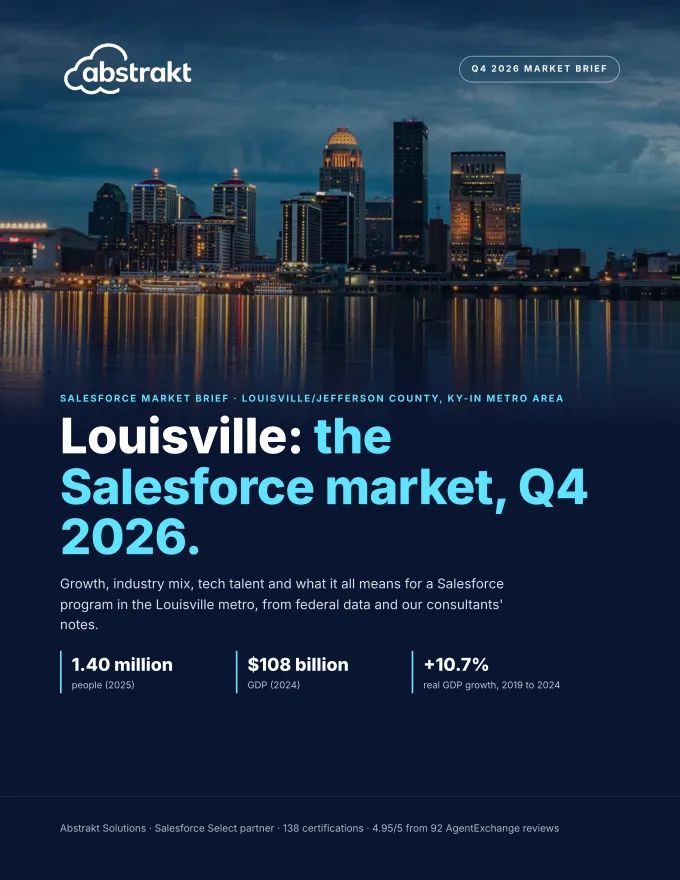
A free 22-page PDF with Louisville's growth ranked against 100 metros, its industry mix, tech wages and nearby markets. It is offered on the public Louisville page; send your customer there or get a copy for your own prep.
Get the Louisville brief →Co-sell with Abstrakt in Louisville
Working a Louisville account? Bring in a named consultant for discovery, scoping or a health check. We reply within 4 business hours.