

How Salesforce work starts in Kansas City
Abstrakt Solutions is a Salesforce Consulting Partner working with engineering, health tech, finance and animal health companies on both the Missouri and Kansas sides of the metro. Kansas City is one of our focus markets.
What buyers here usually run into
- 1
Health-tech data and privacy
Digital health and health-system organizations need Salesforce designs where access, consent and integration with clinical or member systems are right from the start.
- 2
Project-based businesses
Engineering and design firms often track pursuits in spreadsheets and relationships in people’s heads. Salesforce works when it mirrors how pursuits are actually won.
- 3
Security-conscious buyers
With a deep cybersecurity workforce, KC companies tend to scrutinize permissions and integrations closely, which suits a health check before any expansion.
Budget, team and partner questions
What drives cost
Kansas City scope tends to grow with privacy and security requirements: protected health information, permission reviews and integration approvals from security-minded buyers. Engineering firms add cost through the project accounting handoff, and animal health or manufacturing companies through distributor data loads.
Admin or partner
Health-tech companies with growing support and renewal operations often hire an internal admin early and add a partner for integration and architecture. Engineering and design firms with smaller operations teams more often rely on managed services for the whole platform.
What buyers ask a partner
Ask how the partner handles protected health information and Shield decisions, and ask to see a permission model they have documented. Project-based firms should ask how pursuit stages would mirror their go or no-go process.
The local economy and its biggest industries (4)
| Sector | Share of 2024 GDP | Where Salesforce fits |
|---|---|---|
| Professional, scientific, and technical services Salesforce for professional services → | at least 10.0% | Engineering, architecture and design firms such as the region’s large EPC companies run long pursuits and multi-office client relationships. Salesforce helps with pursuit pipelines, capacity planning and client history. |
| Manufacturing Salesforce for manufacturing → | 9.5% | Manufacturers and logistics firms along the I-35 and I-70 corridors need dealer management, quoting and service connected to ERP. |
| Health care and social assistance Salesforce for health & life sciences → | at least 8.3% | With a large health-tech sector and major health systems, Salesforce work here often involves patient or member engagement, referral management and service, designed around privacy requirements. |
| Finance and insurance Financial Services Cloud → | at least 7.6% | Banks, insurers and fintech firms need relationship views, compliant marketing and secure customer self-service. |
Source: U.S. Bureau of Economic Analysis, GDP by county (CAGDP2), 2024, summed to the metro area; private sectors only, excluding real estate and government. “At least” marks sectors where BEA suppresses some county figures.
Salesforce products that fit Kansas City (6)
In the order we lead with them here, from the industries above.
Salesforce Sales Cloud
The CRM where sales pipeline lives, when it is built right.
Salesforce Service Cloud
The operating system for modern customer service, case, knowledge, voice, and AI agent assist together.
Salesforce Experience Cloud
Customer, partner, and employee portals built on Salesforce.
Salesforce Financial Services Cloud
Industry CRM for wealth management, banking, insurance, and lending, built for compliance from the start.
Salesforce Data 360 (Data Cloud)
Unify customer data into a real-time profile that powers segmentation, analytics, and AI.
Salesforce Agentforce
AI agents that handle real work inside Sales Cloud, Service Cloud, and Marketing Cloud.
Kansas City AI use cases rooted in local industry
Three sectors lead Kansas City's private economy in BEA's 2024 figures: professional and technical services (at least 10 percent of metro GDP), manufacturing (9.5 percent) and health care (at least 8.3 percent). Architecture and engineering practices can use Agentforce to sort project inquiries and draft first responses that a principal edits. Manufacturers and animal health producers can let an agent read distributor purchase orders or product questions and match them to the right account. Hospitals and clinics can point patients toward answers in a vetted knowledge base, with handoff to staff for anything clinical. We usually begin with a data review, because an agent that reads duplicate accounts or stale contacts will confidently repeat those errors.
- Project inquiry sorting for designers
- Distributor purchase order matching
- Vetted patient self-service with handoff
Services buyers here usually need (7)
Salesforce Implementation in Kansas City
Salesforce implementations in Kansas City often serve businesses whose revenue does not follow a simple lead-to-order path. Engineering and design firms win work through long pursuits and teaming; animal health companies sell to clinics but fulfill through distributors; banks and fintech firms manage relationships under close security review. We design the data model for those patterns in discovery workshops, configure in a sandbox, migrate clean data, and roll out in phases with training for each role across Missouri and Kansas.
By industry in Kansas City
- 1
Professional, scientific, and technical services
Professional, scientific and technical services is the largest private sector in the metro at no less than 10% of 2024 GDP, and architecture, engineering and design appears on KC.org's list of regional industries. For these firms, implementation centers on pursuits: stages matching real bid decisions, teaming partners and subconsultants on each opportunity, and client history across offices. We also plan how won work passes to project accounting, so delivery does not start from a re-typed spreadsheet.
- 2
Agriculture + Animal Health
KC.org lists agriculture and animal health among the region's industries, and the KC Animal Health Corridor is a named regional initiative. Companies here often sell through veterinarians, feed dealers or distributors while tracking end-customer demand. Implementation starts by modeling both relationships, the recommending clinic or farm and the fulfilling distributor, then adds field visit planning and sell-through data loads. Complaint and adverse-event capture is designed in the first phase, not added later.
- 3
Finance and insurance
Banks, insurers and fintech companies in the region expect security to be scrutinized, and KC.org names fintech and cybersecurity as a regional industry. Implementing Financial Services Cloud or Sales Cloud here means settling household and business relationship models, role hierarchy and field-level security in design. We document each access decision with the reasoning behind it, which shortens the security review that often gates go-live and gives auditors a clear record afterward.
Raise before scoping
Ignore the state line in territories
Customers, reps and offices sit on both the Missouri and Kansas sides of the metro. Base territories and assignment on accounts, industries or county groups rather than state, and keep state-specific details, such as licensing or tax treatment, on the records where they actually apply.
Bring security into discovery
Internal security teams in Kansas City tend to review designs closely. Invite them to discovery, share the sharing model and integration plan early, and agree on SSO and MFA requirements before build, so their approval does not become the last bottleneck before go-live.
Treat launch days as events
Users judge a new system in its first days, so launch support deserves as much planning as the build. Plan discovery, launch-day support and classroom training as dedicated events, with configuration and testing handled by the same consultants in between.
Salesforce Health Checks in Kansas City
For Kansas City organizations, a health check is usually driven by security scrutiny, from customers, internal security teams or auditors, and by plans to add Data 360 (formerly Data Cloud) or Agentforce. Our consultants examine profiles, permission sets and sharing rules, then connected apps, integration users, external access, automation, Apex and data quality, and gauge how closely the org follows current Salesforce practice. Findings are ranked by risk and effort and presented in a working session with a plan your admin or our team can execute.
By industry in Kansas City
- 1
Fintech and Cybersecurity
KC.org names fintech and cybersecurity as a regional industry, and the metro counts roughly 10,000 credentialed cybersecurity professionals. Companies selling into that environment face buyers who inspect vendors closely. A health check for them concentrates on authentication, session policies, connected-app scopes, API access and event monitoring, and produces a clear record of settings and remediations that supports customer security questionnaires and internal audits. Findings touching customer data come first.
- 2
Health care and social assistance
Hospitals, children's health providers and digital health companies in the region hold data that must be protected carefully. The review checks whether protected health information appears in Salesforce and, if so, whether encryption, field history and access controls match your Business Associate Agreement obligations. It also looks at portal and guest user settings and at integrations with clinical or billing systems, where exposure risks tend to appear without anyone noticing.
- 3
Technology
Technology is one of the industries on KC.org's list, and software firms in the region often build extensively on Salesforce. Their health check weighs technical debt as heavily as security: Apex test quality, trigger design, hard-coded values, old API versions and managed packages no one uses. Each finding has a suggested fix and rough effort, so engineering leaders can schedule remediation between product commitments rather than treating it as a separate project.
Raise before scoping
Check readiness before AI
Before Agentforce or Data 360 (formerly Data Cloud) goes live, confirm that permissions limit each agent and user to appropriate data, that knowledge content is current and that key fields are complete. A pre-AI review surfaces the issues that would otherwise appear as wrong or overexposed answers.
Inventory every integration user
Nobody tends to look at integration accounts after setup, yet they frequently carry sweeping access. List each one, its owner, its purpose and its access, and remove or reduce anything that does not match. This single step closes some of the most common gaps security reviewers find.
Turn findings into a tracked plan
A report on a shelf fixes nothing. Load the findings into your backlog with owners and target months, fix the high-risk items first and schedule a follow-up review to confirm the changes held and that no new issues appeared since.
Salesforce Integration in Kansas City
Kansas City integration work splits between two kinds of company. Manufacturers and distributors need Salesforce tied to ERP for orders, pricing and service parts. Health-tech, fintech and software firms need it connected to billing, product usage and support platforms, with security teams reviewing every credential. In both cases we define which system owns each field, choose the tool that suits your volumes and maintenance skills, build with realistic test data, and deliver logging, alerts and a runbook with each connection.
By industry in Kansas City
- 1
Manufacturing
Vehicle assembly, electronics and industrial suppliers together give manufacturing 9.5% of the metro's 2024 GDP. For these companies, the integration that matters most usually links Salesforce with ERP: customer master data, orders, shipments and invoices visible to sales and service. We design customer matching and product mapping first, then decide which updates must be near real time and which can run on a schedule, so the connection stays reliable at production volumes.
- 2
Healthcare
Healthcare is on KC.org's list of regional industries, and more than 120 digital health companies operate here. Health-tech vendors typically connect Salesforce to billing, product telemetry and implementation tools, and sometimes to systems that hold patient data. We keep protected health information in the systems built for it, sending only the identifiers and status Salesforce needs, and document every data flow so privacy reviews and customer security questionnaires have accurate answers.
- 3
Fintech and Cybersecurity
Fintech companies, part of the fintech and cybersecurity industry KC.org lists, integrate Salesforce with payment platforms, loan or account systems and identity providers. Each of those connections is a potential security finding. We use dedicated integration users with minimal permissions, named credentials, encrypted storage for secrets and IP restrictions where supported, and we log calls so security teams can trace any record change back to the system that made it.
Raise before scoping
Let security review the design
Integration credentials and connected apps are frequent audit findings. Share the architecture with your security team before build, including authentication method, scopes and data classification, so approval comes early and the design does not need reworking at the last minute.
Keep sensitive data at its source
Health and financial records usually belong in their systems of record. Consider displaying them on demand or syncing only summaries, rather than copying full details into Salesforce, which enlarges the audit scope and raises storage costs without much benefit to users.
Plan for Data 360 later
If you expect to unify customer data for segmentation or AI, design integrations so the same data can feed Data 360 (formerly Data Cloud) later. Consistent identifiers and clean source APIs built now make that next step much simpler than retrofitting point-to-point connections.
Salesforce Managed Services in Kansas City
Kansas City organizations often turn to managed services once Salesforce supports several functions and a lone admin cannot keep up. Digital health companies need privacy-sensitive changes handled carefully, engineering firms keep adjusting pursuit and reporting setups, and fintech teams want security reviewed with every release. We manage one backlog with you, deliver changes each month, test Salesforce's seasonal releases in a sandbox, watch integrations and data quality, and meet regularly with the owners who set priorities.
By industry in Kansas City
- 1
Health care and social assistance
Health care and social assistance produces at least 8.3% of metro GDP, and the region counts more than 120 digital health companies. Health-tech vendors and providers running Salesforce change implementation workflows, support routing and access frequently. Our managed services team handles those updates through sandbox testing and written approval, keeps protected information out of support cases by design, and reviews each Salesforce release for impacts on customer-facing and clinical-adjacent processes.
- 2
Architecture, Engineering & Design
Architecture, engineering and design firms, one of the industries on KC.org's regional list, tend to revise their Salesforce setup as markets and service lines shift. New sectors, delivery methods or office openings each mean fields, picklists and reports to update. A managed services arrangement handles that steady stream, keeps pursuit dashboards accurate for principals, and maintains the connection to project accounting, so marketing coordinators are not stuck acting as part-time admins.
- 3
Fintech and Cybersecurity
Fintech and cybersecurity appear together on KC.org's industry list, and companies in both fields face constant customer security questionnaires. Managed services for them includes regular access reviews, connected-app audits and monitoring of login and API activity, alongside ordinary enhancement work. We record each configuration change with its approver and purpose, which turns answering a customer's audit request or a SOC 2 evidence query into a matter of pulling a report.
Raise before scoping
Schedule access reviews routinely
Security-conscious Kansas City companies benefit from quarterly reviews of users, permission sets and integration accounts. Building those into the managed services calendar keeps departed employees from retaining access and gives security teams dependable evidence without a scramble before each audit.
Separate requests from roadmap
Small requests and larger initiatives compete for the same hours. Reserve a share of monthly capacity for roadmap work, such as Data 360 (formerly Data Cloud) or Agentforce pilots, so progress continues even in months when day-to-day requests from sales and service teams spike.
Keep documentation current
Each change should update a short record of what the org does and why. When an admin leaves or a new department joins Salesforce, that documentation lets the next person get productive quickly instead of reverse-engineering flows and sharing rules from scratch.
Salesforce Optimization in Kansas City
Optimizing Salesforce for a Kansas City company typically means finding where the org costs time instead of saving it. Banks and insurers often have bankers and agents avoiding cluttered screens; manufacturers and logistics firms have quoting or order steps split between Salesforce and ERP; professional firms have dashboards nobody trusts. We combine usage data with interviews, prioritize fixes by time saved, consolidate automation, clean the underlying data and rebuild reports, releasing improvements in small batches with brief training.
By industry in Kansas City
- 1
Finance and insurance
Finance and insurance contributes at least 7.6% of metro output, including banks, insurers and a fintech community. In these orgs, optimization often starts with the relationship view: bankers or agents need household or business relationships, recent activity and open service items on one screen, not spread across tabs. We simplify those pages, move repetitive tasks such as referral routing or renewal reminders into Flow, and rebuild production reports so managers can coach from them.
- 2
Manufacturing + Logistics
KC.org groups manufacturing and logistics together on its regional industry list, and firms in this space often run quoting, orders and shipment tracking across several tools. Optimization looks at where reps copy data between Salesforce and other systems, where approvals stall, and which reports leaders ignore. We remove duplicate entry, streamline approval paths, and put order and delivery status beside the account so service calls are shorter and answered on the first try.
- 3
Professional, scientific, and technical services
Consulting, engineering and technical firms tend to accumulate opportunity stages, record types and custom fields as they add service lines. Principals end up doubting the pipeline because each office uses it differently. We standardize stages and definitions firm-wide, retire unused fields, fix forecast categories and rebuild the handful of reports leadership actually reviews. Consistency across offices matters more here than any new feature, so we check usage again a few months later to confirm it held.
Raise before scoping
Fix data before dashboards
Reports are only as reliable as the fields beneath them. Deduplicate accounts, fill or retire incomplete fields and add validation for key values before rebuilding dashboards. Otherwise new charts inherit old errors and lose credibility within weeks of their launch.
Cut required fields hard
Each required field slows every record save. Review them with the teams who fill them in and keep only those that drive reporting, routing or compliance. Fewer mandatory fields usually improve the quality of the ones that remain, because people stop entering placeholders.
Sequence AI after cleanup
Agentforce and other AI features work best on a tidy org. Optimization is a sensible step before any pilot, because simpler objects, clean data and clear permissions directly improve the accuracy and safety of AI answers for reps and customers alike.
Salesforce Migration in Kansas City
Migrations in Kansas City often carry specialized data that generic CRM imports mishandle: pursuit histories and teaming records at engineering firms, household relationships at banks, and clinic and distributor links at animal health companies. We inventory each source, map it to a Salesforce design that preserves those relationships, deduplicate and standardize beforehand, and test with sandbox trial loads reconciled against the originals. Cutover happens on a planned date with a short freeze, and users get support from our consultants through the first weeks.
By industry in Kansas City
- 1
Architecture, Engineering & Design
Architecture, engineering and design firms often keep pursuit history in proposal software, marketing spreadsheets or an aging CRM built for project delivery. Migrating that into Salesforce means translating past pursuits into opportunities with outcomes, linking clients to their owners' representatives and subconsultants, and preserving win and loss reasons for later analysis. We work with marketing and business development leads to decide how far back history is worth bringing and which past records are archived instead.
- 2
Finance and insurance
Banks and insurers moving to Financial Services Cloud from another CRM must convert flat contact lists into households, business relationships and financial accounts. That restructuring is most of the work. We build matching rules for people and entities, test them against samples your staff review, carry over consent and complaint records intact, and reconcile every trial load by record type, so compliance can sign off with evidence in hand. Legacy notes outside retention needs are archived.
- 3
Agriculture + Animal Health
Agriculture and animal health companies frequently hold clinic, farm and distributor data in separate spreadsheets kept by territory managers. Migration standardizes names and addresses, links each clinic or farm to the distributors that serve it, and removes duplicates created when reps in neighboring territories recorded the same customer. Visit history and product preferences come across where they support planning; older notes are archived rather than cluttering the new system on day one.
Raise before scoping
Decide history depth per team
Business development may want many years of pursuits, while service needs only open items and recent activity. Agree on depth by object and department instead of one rule for everything, keeping the migration focused and the new org responsive for everyone.
Clean in the source when possible
Some fixes, such as merging duplicate clients or correcting company names, are easier in the old system or a staging database than in Salesforce afterward. Assign owners to clean their records before extraction so the first load is already close to right.
Communicate the cutover clearly
Tell users across both sides of the metro exactly when the old system becomes read-only, where to log activity during the freeze, and who to ask on go-live day. Clear, repeated communication prevents parallel data entry that would otherwise need reconciling later.
Salesforce Implementation Rescue in Kansas City
When a Kansas City Salesforce project stalls, the symptoms vary: a pursuit pipeline nobody updates, a health-tech support process stuck in email, a portal customers avoid. The causes tend to repeat, though: a design that ignored how the business works, weak data and no single owner. Our rescue starts with an independent triage of the org, the plan and the people. We then keep what works, fix the foundations and relaunch in phases.
By industry in Kansas City
- 1
Technology
Software and digital health firms, part of the technology industry on KC.org's list, often come to us after a rapid build that bundled subscription billing, support and customer portals into one launch. Triage usually finds customizations layered on an unstable data model. We stabilize accounts, contracts and entitlements first, pause features that depend on them, and reintroduce portals and automation in later phases once support teams trust the case data again.
- 2
Manufacturing
Manufacturers commonly bring us projects where an ERP integration or quoting build never worked reliably, leaving reps with numbers they cannot trust. Rescue concentrates on the data flowing between systems: we audit mappings, fix matching rules and set up error monitoring before touching the user experience. Once orders and pricing are dependable, adoption problems are much easier to address, because reps finally have a reason to open Salesforce every morning.
- 3
Professional, scientific, and technical services
Engineering, architecture and consulting firms sometimes launch Salesforce with a generic sales process that ignores pursuits, teaming and multi-office relationships. Principals stop trusting the pipeline and marketing coordinators go back to spreadsheets. Our triage involves business development leaders directly, redesigns opportunity stages and relationships around how work is actually won, and migrates the pursuit data into the corrected structure before relaunching office by office, starting where support for the change is strongest.
Raise before scoping
Get an independent view
The team that built a troubled system may not see its flaws. An outside triage, drawing on org metadata, project records and user interviews, gives leadership an unbiased picture and a sound basis for decisions about scope, budget and partners.
Protect the data during recovery
While fixes are underway, stop processes that are actively corrupting data, such as a faulty integration or a flow creating duplicates. Stabilizing data first keeps the cleanup finite and prevents a successful relaunch from inheriting months of bad records and broken reports.
Rebuild adoption deliberately
Users burned by a failed launch need visible improvement and a reason to return. Relaunch with a pilot group, share what changed, and have leaders use Salesforce reports in their own meetings. Showing each team the specific fixes that came from its own complaints does more to rebuild confidence than any announcement.
Industry plays in Kansas City (4)
Salesforce for Kansas City Professional Services
Professional services is the largest private sector in Kansas City, and much of it is project-based: engineering and design firms, consultancies and technology services companies that sell expertise rather than products. Salesforce helps when it tracks pursuits from early intelligence through proposal, connects won work to project and resource planning, and shows principals which clients and sectors are actually profitable. We tailor the model to how your firm pursues work, whether that is public procurement, private negotiated contracts or recurring retainers.
Firms selling expertise make up the biggest slice of Kansas City's private economy: the Bureau of Economic Analysis credits professional, scientific and technical services with at least 10.0% of 2024 metro GDP. The KC industries list includes architecture, engineering and design, technology, and fintech and cybersecurity as target sectors. The region counts 10,000 credentialed cybersecurity workers and more than 120 digital health companies, which means a large pool of firms selling technical expertise to health care, finance and infrastructure clients.
Use cases to open with
- 1
Pursuit and go/no-go tracking
Engineering and design firms often chase large public and private projects months before a request for proposals appears. We model pursuits with client, sector, estimated fee, teaming partners and go/no-go criteria, so business development leaders can prioritize the best-fit opportunities, see hit rates by market and office, and stop committing proposal teams to work they are unlikely to win or cannot staff.
- 2
Proposals and fee estimates
Revenue Cloud or CPQ can assemble fee estimates from rate cards, roles and phases, apply discount rules and produce a consistent proposal document. Principals approve exceptions in Salesforce instead of by email, and estimated hours flow to project planning when the work is won. Over time the firm builds a record of estimated versus actual effort that sharpens future bids.
- 3
Client relationship and marketing
Consultancies and technology service firms depend on repeat clients and referrals. Sales Cloud tracks relationship owners, cross-sell opportunities and client health, while Marketing Cloud runs thought-leadership newsletters, event invitations and webinar follow-up with engagement data flowing back to each contact. Partners see which clients are growing, which have gone quiet and where a second practice area could add value, and marketing can prove which events and articles actually led to new pursuits.
Raise before scoping
Connect PSA and accounting
Time, billing and project accounting usually live in a professional services automation or ERP tool. Decide whether Salesforce or that system owns projects, then sync won opportunities, budgets and actuals so leaders can compare pipeline, backlog and utilization in one dashboard.
Respect partner autonomy
Seasoned principals tend to treat client contacts as a personal book of business. Involve them in design, keep data entry light, and show them reports that answer their questions, such as backlog by client, before asking them to log every conversation.
Plan for teaming and subconsultants
Architecture and engineering firms often team with other firms as prime or sub. Model teaming partners and roles on pursuits so you can report on shared wins, track reciprocity and avoid confusing a partner firm with a client in marketing lists.
Salesforce for Kansas City Manufacturers
Kansas City manufacturers often combine production with heavy distribution, whether they make vehicles and parts, animal health products, food or industrial equipment. Salesforce works best when it gives sales a reliable forecast by customer and product, gives distributors and dealers a portal to order and ask questions, and keeps service history for equipment in the field. We connect it to the ERP so pricing, inventory and order status come from one source and reps stop answering customers from memory.
Factories account for 9.5% of Kansas City's 2024 GDP by the Bureau of Economic Analysis's reckoning, second only to professional services, while wholesalers contribute at least another 7.5%. The KC industries list pairs manufacturing with logistics as a single target sector and separately targets agriculture and animal health. The KC Animal Health Corridor is a named regional initiative. That combination points to manufacturers whose sales, distribution and regulatory needs are tightly linked, and to plants on both sides of the state line that ship through the same regional warehouses.
Use cases to open with
- 1
Run-rate forecasting by account
Producers of components, food ingredients and animal health products often sell under recurring agreements rather than one-off deals. We model agreements with planned volumes by product and month, compare them to actual orders from the ERP, and flag accounts drifting below plan. Sales, operations and finance forecast from the same numbers instead of separate spreadsheets, and supply planning sees demand shifts sooner.
- 2
Distributor and dealer portals
Many Kansas City manufacturers reach customers through distributors, dealers or veterinary channels. Experience Cloud gives those partners a secure place to check pricing, place orders, register deals and download product documentation. Channel managers see partner activity and pipeline alongside direct accounts, which makes territory planning and incentive design much more grounded in real data. Partners also get faster answers without waiting for an inside sales rep to call them back.
- 3
Service and field support
Equipment makers and suppliers of production systems need to support installed assets. Service Cloud tracks cases by asset and customer, and Field Service can schedule technicians by skill and location across Missouri and Kansas. Technicians capture findings and parts used on mobile, even without signal inside a plant, and account managers see full service history before discussing upgrades, retrofits or replacements with the customer.
Raise before scoping
Handle regulated product data
Animal health, food and some industrial products carry labeling, lot and traceability requirements. Keep lot, batch and regulatory data mastered in quality or ERP systems, and bring only what service and sales need into Salesforce, with clear ownership of any recall communication workflow.
Plan logistics data integration
Customers want accurate ship dates and tracking. Decide how order, shipment and inventory status flow from ERP and warehouse systems into Salesforce, how often they refresh, and what reps should say when the data is stale, before promising customers self-service tracking.
Align two-state territories
The metro straddles Missouri and Kansas, and sales territories often cross state lines. Define territories by customer and geography rather than state alone, confirm how tax, pricing and commissions are calculated, and test reports with finance so pipeline and bookings match its view of the business.
Salesforce for Kansas City Health Care and Life Sciences
Kansas City's health economy has three distinct Salesforce buyers. Hospitals and clinics need patient access, referrals and outreach connected to the EHR. Digital health companies sell software to those providers and need pipeline, implementation handoffs and support for hospital clients. Animal health firms sell to veterinary practices, distributors and producers. We design each around its real customer, whether that is a patient, a health system buyer or a veterinarian, and keep protected health information out of places it does not belong.
Hospitals, clinics and care agencies in the metro generate at least 8.3% of output by BEA's 2024 county tally, a floor rather than an exact figure, trailing only professional services and manufacturing. KC.org lists healthcare as a regional target and separately names agriculture and animal health. The regional development council credits an early electronic health records company with starting the local health-tech sector over 40 years ago and counts more than 120 digital health companies based in Kansas City today. A named animal health corridor adds pet nutrition and veterinary drug firms.
Use cases to open with
- 1
Hospital client onboarding
A digital health vendor's win is only the start: contracting, security review, interface build and training follow before a hospital goes live. Salesforce can turn each closed deal into an onboarding project with milestones, owners and risks visible to sales, implementation and support. Customer success sees adoption and open tickets by client, which helps forecast renewals and spot accounts at risk early.
- 2
Veterinary account management
Animal health companies sell through distributors to clinics, hospitals and producers, and reps need to know which practices order, which products they use and when to follow up. Sales Cloud can map practices, veterinarians and distributor relationships, track visits and samples, and pull sell-through data from distributor feeds. Marketing can reach clinics with product education without mixing in consumer pet-owner records.
- 3
Patient access and referrals
Provider organizations on both sides of the state line take calls, referrals and web requests through many front desks. Service Cloud can consolidate them into routed queues, with appointment and referral status pulled from the EHR, and Agentforce can handle directions, forms and scheduling questions within set rules. Leaders track referral leakage and response times by clinic across Missouri and Kansas.
Raise before scoping
Vendor, provider or both
A digital health company may never touch patient data in its CRM, while a provider will. Settle early whether any protected health information enters Salesforce, sign a business associate agreement if it does, and keep support tickets free of PHI through form design and training.
Expect detailed security review
With a deep local cybersecurity workforce, security teams here tend to probe permission models, integrations, connected apps and admin rights closely. Prepare an access matrix, integration inventory and audit logging plan before build, so review happens once instead of stalling go-live.
Two states, one org
Kansas City providers and companies operate in Missouri and Kansas, which affects licensing records, outreach rules and territory design. Model state as a structured field on locations, practitioners and accounts, so reporting, routing and compliance reviews can separate the two when required.
Salesforce for Kansas City Insurers and Agencies
Kansas City insurers and agencies write for an unusual client mix: large engineering and architecture firms needing professional liability, agriculture and animal health businesses, logistics operators and a fintech community. Salesforce can give producers one view of each account's policies and renewals, route service requests to the right team, and let clients submit applications and documents through a secure portal. We integrate it with agency or policy systems and design licensing records for a metro split between Missouri and Kansas.
Carriers, agencies, banks and fintech firms together produced at least 7.6% of Kansas City's 2024 output, the BEA's county figures show, placing finance and insurance fourth on the private list. KC.org does not list insurance by itself, but it targets fintech and cybersecurity together, and the region has 10,000 credentialed cybersecurity workers, a workforce that also shapes how local firms buy and review software. The client base is distinctive: professional, scientific and technical services is the largest private sector here, and KC.org separately targets architecture, engineering and design, as well as agriculture and animal health. Those clients need specialized professional liability and agribusiness coverage.
Use cases to open with
- 1
Design firm renewal applications
Architecture and engineering firms renew professional liability with long applications covering revenue by discipline, project types and claims history. An Experience Cloud portal can collect those answers and documents, prefilled from last year, while Financial Services Cloud tracks each renewal's status, carrier submissions and quotes. Producers stop chasing spreadsheets by email and can start marketing large or complex design accounts to carriers earlier in the cycle.
- 2
Agribusiness account planning
Farm operations, grain handlers and animal health suppliers carry property, equipment, liability and specialty coverages that change with the season and the business. Salesforce can hold each account's locations, equipment schedules and coverage lines, log risk visits and highlight lines written elsewhere. Account teams plan renewals together, and cross-sell opportunities show up on one shared list instead of living in a producer's memory.
- 3
First notice of loss intake
When a policyholder reports a claim, service staff need to capture the facts, connect the right policy and reach the carrier or adjuster fast. Service Cloud can guide intake by loss type, open follow-up tasks and keep the insured updated automatically. Agentforce can answer status questions from synced claim data, while staff stay involved in anything that needs judgment or empathy.
Raise before scoping
Missouri and Kansas licensing
Producers here commonly hold licenses and appointments in both states and sometimes more. Track each license, line of authority and expiration on the producer record, and confirm with compliance which checks must pass before a producer is assigned an account or paid commission.
Plan for security scrutiny
Clients and carriers in this market often send detailed security questionnaires. Document encryption, access controls, integration credentials and audit logging from the start, and consider Shield for field-level encryption and event monitoring when you store sensitive applicant or claim data.
Keep agency system authoritative
Carrier downloads, accounting and policy transactions belong in the agency or policy administration system. Sync only the data producers and service staff need in Salesforce, name the person who resolves conflicts, and avoid parallel entry that slowly erodes trust in both systems.
Case studies to send (3)
From the industries this market leans on. Client names are anonymized and these projects are not specific to Kansas City.
The Kansas City Salesforce market brief, Q4 2026
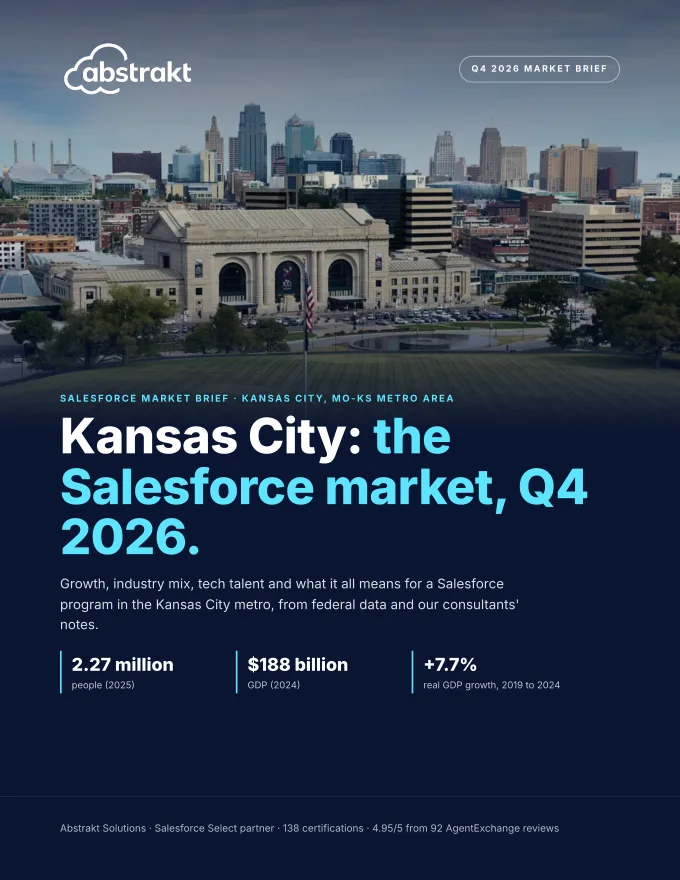
A free 25-page PDF with Kansas City's growth ranked against 100 metros, its industry mix, tech wages and nearby markets. It is offered on the public Kansas City page; send your customer there or get a copy for your own prep.
Get the Kansas City brief →Co-sell with Abstrakt in Kansas City
Working a Kansas City account? Bring in a named consultant for discovery, scoping or a health check. We reply within 4 business hours.