

How Salesforce work starts in Wichita
Wichita aerospace suppliers, health systems, agribusinesses and energy firms, along with companies across Sedgwick, Butler, Harvey and Sumner counties, count on Abstrakt Solutions as their Salesforce Consulting Partner. Wichita is one of our focus markets.
What buyers here usually run into
- 1
Supplier programs that outlast a sales cycle
Aerospace suppliers often win work tied to multi-year aircraft programs, and a standard opportunity pipeline rarely captures rate changes, requalification and repeat orders well.
- 2
Seasonal agriculture and energy accounts
Agribusiness and energy companies commonly sell on seasonal or commodity-driven cycles, so forecasts and account plans need to reflect more than a simple quarterly quota.
- 3
Data locked in plant systems
Manufacturers typically keep orders, quality records and service history in ERP and shop-floor tools, so the people talking to customers work from partial information.
Budget, team and partner questions
What drives cost
In Wichita, cost follows ERP and shop-floor integration, how aircraft programs and sales agreements are modeled, and permission design for controlled technical data. Agribusiness and energy companies add mobile and offline requirements and integration with trading or contract systems.
Admin or partner
Aerospace suppliers here often have engineering and IT strength but little Salesforce depth, so a partner typically covers integration and quoting design while an internal owner runs priorities. Clinics and smaller agribusinesses more often outsource administration entirely.
What buyers ask a partner
Ask for manufacturing references that model programs or sales agreements, not just opportunities. Ask how the partner handles controlled technical data and how they test mobile for reps in rural counties.
The local economy and its biggest industries (4)
| Sector | Share of 2024 GDP | Where Salesforce fits |
|---|---|---|
| Manufacturing Salesforce for manufacturing → | 23.1% | Aircraft builders and the parts, composites and machining suppliers that serve them sit alongside food processing here. Suppliers need long-running customer programs, accurate quotes and order history from ERP visible in one place. |
| Health care and social assistance Salesforce for health & life sciences → | at least 7.4% | With health care and social assistance producing at least 7.4% of 2024 metro GDP and health care on the Partnership’s key-industry list, clinics, specialty practices and home-care agencies need referral tracking and patient outreach that respect privacy rules. |
| Construction Salesforce for construction → | 4.6% | Commercial, industrial and residential contractors in the four-county metro juggle bids, crews and change orders, which Field Service and CPQ estimating can bring together. |
| Professional, scientific, and technical services Salesforce for professional services → | 4.5% | Engineering, testing and IT services firms, including those in GWP’s IT Systems & Support sector, win work through long client relationships, and Salesforce gives leadership a clear view of pursuits and project capacity. |
Source: U.S. Bureau of Economic Analysis, GDP by county (CAGDP2), 2024, summed to the metro area; private sectors only, excluding real estate and government. “At least” marks sectors where BEA suppresses some county figures.
Regional target sectors named by local economic development groups: Advanced Manufacturing & Materials, Aerospace, Agriculture, Healthcare, IT Systems & Support, Energy, Transportation & Logistics.
Salesforce products that fit Wichita (6)
In the order we lead with them here, from the industries above.
Salesforce Sales Cloud
The CRM where sales pipeline lives, when it is built right.
Salesforce Revenue Cloud / CPQ
Configure-price-quote, billing, subscription management, and quote-to-cash on Salesforce.
Salesforce Service Cloud
The operating system for modern customer service, case, knowledge, voice, and AI agent assist together.
Salesforce Field Service
Scheduling, dispatch, mobile work orders and parts for teams that work on site.
MuleSoft
Enterprise API platform, for connecting Salesforce, ERP, data warehouses, and the rest of your stack.
Salesforce Experience Cloud
Customer, partner, and employee portals built on Salesforce.
Wichita aerospace suppliers and the realistic role of AI
Manufacturing produced 23.1 percent of Wichita's metro GDP in 2024, and aerospace sits among the region's named target sectors. Suppliers in that chain handle engineering change notices, quality escapes and customer documentation, all of which AI can read and summarize for a program manager to act on. Sales teams can get help forecasting long-cycle contracts, if opportunity data is disciplined. Field Service technicians can ask an assistant for maintenance procedures stored in the knowledge base. Clinics can steer routine appointment and invoice questions to an agent grounded in approved content. Controlled technical data needs strict permission design first, and a qualified person should approve anything the agent drafts for a customer.
- Engineering change notice summaries
- Long-cycle contract forecasting help
- Maintenance procedure lookup
Services buyers here usually need (7)
Salesforce Implementation in Wichita
A Wichita implementation usually starts from the fact that customer relationships run through long programs, seasons or projects rather than one-off deals. We design the data model around those structures first, whether aircraft programs, crop years or construction jobs, and plan how ERP data will feed them. The build happens in a sandbox and goes live in phases, each with cleaned data and role-by-role training. Our consultants keep the same Central clock as your teams, so a quick design question never waits overnight.
By industry in Wichita
- 1
Manufacturing
Manufacturing contributes about 23.1% of 2024 metro GDP, far ahead of any other private sector, so most local implementations touch a plant somewhere. For aircraft parts, composites and machining suppliers, the work hinges on modeling each customer program as its own record, with part numbers, rate changes and requalification tied to it. We set that up in the first phase alongside quoting, since account managers use both daily, and add service or supplier portals once program data is dependable.
- 2
Agriculture
Agriculture is on the Greater Wichita Partnership's list of key industries, and agribusinesses here sell on seasonal and commodity-driven cycles. Implementing Salesforce for them means structuring accounts around growers, elevators and end buyers, tying forecasts to seasons and contracts, and giving field staff quick visit logging they can use between stops. We test the mobile setup with real reps on real routes before launch, because a tool that fails in a pickup cab will not be used.
- 3
Construction
Contractors across Sedgwick, Butler, Harvey and Sumner counties typically implement Salesforce to bring bids, estimates and crew scheduling into one place. The data model links each opportunity to a project, a site and a set of subcontractors, and change orders need to be tracked against the original estimate. We usually launch bidding and estimating first with Revenue Cloud or CPQ, then add Field Service for crews once project records are consistent enough to schedule from.
Raise before scoping
Model programs, not just deals
Aerospace suppliers and agribusinesses both work in multi-period relationships. Decide in design how programs, seasons or contracts sit above individual opportunities, because reporting, forecasting and integrations all depend on that structure, and reshaping it after launch means rework in every one of them.
Plan ERP data early
Plant orders, shipments and quality records usually live in ERP and shop-floor tools. Identify which of those data sets account managers need in Salesforce and design the integration pattern during discovery, even if the connection itself is built in a later phase of the project.
Design for rural field work
Reps and technicians covering the metro's outlying counties spend long days away from a desk. Build simple mobile layouts, quick actions for visit logging and a short list of required fields, and try them in the field with a few users before rolling out broadly.
Salesforce Integration in Wichita
In Wichita, integration work is dominated by manufacturing: ERP orders, pricing and invoices, quality and certification records, and sometimes shop-floor status. Ownership of each record type is settled up front; tool choice between MuleSoft, Workato and hand-built APIs follows from how many systems talk and how much data moves; and alerting plus reconciliation are built in rather than bolted on. Account managers then see order history and delivery performance in Salesforce, and service teams can answer customers without calling the plant.
By industry in Wichita
- 1
Aerospace
Aerospace suppliers in what GWP calls the Air Capital of the World depend on connecting Salesforce with program, part and quality data. We integrate ERP so quotes use current pricing and accepted quotes create orders, and we bring in delivery performance and certification status so account managers arrive prepared for customer reviews. Serialized parts can be synced as asset records for repair work, with the quality system remaining the source of traceability.
- 2
Advanced Manufacturing & Materials
Advanced manufacturing and materials is one of GWP's key industries, covering composites, machining and specialty materials makers. Their integrations typically connect product masters, price lists and order status from ERP, plus capacity or lead-time data where planning systems provide it. We use MuleSoft when several plant and business systems are involved, since reusable APIs pay off as more connections are added, and lighter tools where just a handful of links are needed.
- 3
Transportation & Logistics
For a logistics firm in one of GWP's key industries, the valuable connection is between customer-facing teams and the systems that track loads, shipments and warehouse activity. We bring exception alerts, proof of delivery and claim status onto the Salesforce account and case, and route new customer setups from Salesforce to operations with the fields dispatch needs. Batch updates cover routine data, while delays and damage claims move as they occur.
Raise before scoping
Design around plant systems
Shop-floor and quality systems in Wichita plants were rarely built to share data. Assess what each can export or expose before designing, and choose file exchange, database views or APIs based on what the system supports reliably under production load.
Protect controlled technical data
Defense-related and export-controlled information should not flow into general Salesforce objects. Filter integrations so only commercial and status data reaches Salesforce, document the boundary for your security and compliance teams to review, and retest it whenever a field mapping or source system changes.
Reconcile, then trust
Before account managers rely on integrated order data, compare totals between ERP and Salesforce for a representative period. Schedule that reconciliation to run automatically afterward, with results sent to a named owner, so drift is caught before it reaches a customer conversation or a quarterly review.
Salesforce Optimization in Wichita
Wichita orgs needing optimization were often built quickly around one group, then extended to others without revisiting the design. We measure usage and field completion, interview the people who work around the system, then remove unnecessary fields, merge duplicates, consolidate overlapping automation into maintainable Flows and rebuild dashboards on agreed definitions. Quick wins come first so teams see results, and short role-based training explains each change. Success means reps opening Salesforce because it helps them, with no reminder from a manager.
By industry in Wichita
- 1
Construction
Construction produces about 4.6% of 2024 metro GDP, and contractors that adopted Salesforce for bidding often find estimators, project managers and crew leads using it unevenly, with change orders recorded in email and job costs elsewhere. Optimization aligns opportunity and project stages with how jobs actually move, simplifies estimating screens and rebuilds win-rate and backlog reporting. Where Field Service is in use, we tighten work types and scheduling rules so crews stop receiving conflicting assignments.
- 2
Energy
Energy is one of GWP's key industries, and energy companies in the region often sell on commodity-driven cycles that a standard quarterly pipeline does not capture. Optimization reworks forecasting so it reflects contracts, volumes and seasons, cleans up account hierarchies for customers with many sites and removes automation built for pricing models no longer in use. Service teams gain simpler case handling for field or supply issues, with categories that match what customers actually report.
- 3
Retail trade
Retailers in the metro frequently run Salesforce for service and customer marketing alongside separate commerce or store systems. Optimization concentrates on the customer record: merging duplicates created by different channels, fixing consent fields, surfacing recent purchases for service agents and trimming case categories to the ones agents actually use. Supervisors get rebuilt dashboards showing response times and backlog they can act on during the day, rather than a weekly export assembled by hand.
Raise before scoping
Start where money is visible
Quoting, forecasting and billing-related reports get leadership attention fastest. Fix the accuracy of those first, then move to less visible improvements such as layout cleanup, so the project earns executive support for the harder, less glamorous cleanup work that follows in later rounds.
Fix duplicates at their source
In many Wichita orgs, the flood of repeated account records traces back to a nightly feed or a trade-show list upload, not to anyone at a keyboard. Trace where each batch of duplicates originates and fix the feed or import process, or the cleanup will need repeating every few months.
Train on what changed
People resist changes they do not understand. Pair each release of improvements with a short, role-specific session showing what moved and why, and collect feedback so the next round of optimization addresses real friction rather than assumed friction, and users feel heard.
Salesforce Health Checks in Wichita
Wichita companies typically commission a health check when an admin changes, an integration keeps failing, a renewal approaches or leadership wants to try Agentforce. Our review walks through access and sharing, data completeness on key objects, automation, code and installed packages, and the health of every integration and report, then adds interviews about how people really use the org. You get a ranked list of findings, with the fixes that reduce the most risk placed first.
By industry in Wichita
- 1
Professional, scientific, and technical services
Professional, scientific and technical services account for about 4.5% of 2024 metro GDP, and engineering, testing and IT services firms in that group often let each practice customize Salesforce. A health check measures the accumulated debt: duplicate fields, unused record types, automation that conflicts across practices and reports built on inconsistent stages. We also check that client data from projects involving sensitive or controlled information is restricted to the people cleared to see it.
- 2
Healthcare
Healthcare is one of GWP's key industries, and clinics, specialty practices and home-care agencies here often use Salesforce for referrals and outreach alongside clinical systems. A health check tests whether patient details have drifted into free-text fields, whether exports and reports are limited to the right roles, and whether integration users hold broader access than their function needs. Each finding is tied to a specific setting your admin can change.
- 3
Energy
Energy companies in the region, another GWP key industry, often run Salesforce for customer contracts, field issues and supply relationships alongside trading or operational systems. The review looks at integration health, data consistency between Salesforce and those systems, sharing for customers with many sites and automation built for pricing or contract models that have changed. We flag which issues would undermine an AI assistant asked to summarize accounts or contracts.
Raise before scoping
Test integrations under review
Many orgs look healthy until an integration fails. Include every ERP, MuleSoft and third-party connection in the health check, reviewing error logs, integration user permissions and reconciliation between systems, not just the Salesforce side of each connection, since failures often start upstream.
Review defense and controlled data
Wichita aerospace and engineering firms may hold information subject to export or contractual controls. Confirm that such data is kept out of Salesforce or restricted properly, and that integrations do not copy it in by accident through a broad field mapping.
Prepare data before an AI pilot
An AI agent inherits the quality and permissions of the data it reads. Use the health check to measure completeness on the objects a pilot would use, fix the worst gaps and restrict any sensitive fields before the agent is switched on.
Salesforce Managed Services in Wichita
For Wichita companies, managed services often means covering an org whose administrator also handles IT, operations or sales operations. The request queue moves to us and gets ranked with your backlog owner; seasonal Salesforce releases are rehearsed before anyone on the plant floor or in the office sees them; and MuleSoft or development specialists step in only for work that calls for them. A regular report shows what was delivered, what is waiting and what the backlog owner has moved up next.
By industry in Wichita
- 1
Health care and social assistance
BEA credits health care and social assistance with at least 7.4% of 2024 metro GDP, a lower-bound figure, and the clinics, specialty practices and home-care agencies within it often use Salesforce for referrals and patient outreach without a dedicated specialist. We handle new referral sources, intake changes and outreach lists while keeping the permission model that protects patient information, and we retest scheduling integrations after every release so appointment data keeps flowing between systems.
- 2
Aerospace
Aerospace sits at the center of the Greater Wichita Partnership's key industries, and suppliers' Salesforce orgs change as programs do. Managed work includes updating program records, part numbers and quote templates when customers change rates or revisions, maintaining approval rules for pricing exceptions and keeping ERP integrations healthy through each release. We also review access on programs with defense ties on a regular schedule, instead of leaving permissions to accumulate.
- 3
IT Systems & Support
IT systems and support is one of GWP's key industries, promoted as growing opportunity in the Silicon Prairie. IT service firms here run Salesforce for contract renewals, managed service agreements and support cases, and their orgs change as offerings do. We maintain entitlements, service contracts and renewal automation, keep case routing aligned with support tiers and build the recurring-revenue and churn reports leadership relies on when planning hiring, pricing and which service lines to grow next.
Raise before scoping
Balance plant and office requests
On a manufacturing org, tickets arrive from the sales desk, the service counter, the quality lab and the controller's office alike. Agree how the backlog owner weighs them, and keep integration fixes that affect orders or shipments at the top, since those failures reach customers faster than a report request does.
Review access on a schedule
Defense-related programs, patient data and customer contracts all call for regular access reviews. Build periodic permission reviews into the managed plan, covering internal users, integration accounts and any partner portal users, so access stays aligned with current roles and departures are caught promptly.
Keep ERP connections monitored
Integrations between Salesforce and ERP break quietly after releases or ERP updates. Include monitoring of integration errors and reconciliation reports in the managed scope, with a named person on your side who is told when orders fail to sync and who can decide what to do next.
Salesforce Migration in Wichita
Wichita migrations frequently start from systems that did one job well for years: an agricultural customer database, a contractor's job-tracking tool or a CRM configured by a long-departed employee. Each of those sources is profiled, and every team signs off on how its fields land and how far back history goes; old codes are translated, repeats merged, and trial loads counted against the originals. Cutover follows a dated plan with a short freeze. Go-live support stays close through the first days after cutover, so questions and data issues get resolved while they are fresh.
By industry in Wichita
- 1
Retail trade
Retail trade contributes about 6.9% of 2024 metro GDP, and retailers moving to Salesforce usually have customer data spread across commerce, point-of-sale and email systems, each assigning its own customer numbers. We match customers across those sources, bring forward opt-ins and suppressions exactly and load order summaries rather than every transaction line. Service and marketing then start from one customer record, and the old systems can be retired or kept read-only.
- 2
Agriculture
Agribusinesses in the region, part of GWP's agriculture key industry, often track growers, buyers and contracts in spreadsheets or a specialized system with few links to a CRM. Migration gives that information structure: growers and buyers as account types, contracts and seasons as related records, and notes turned into activity history others can follow. We time cutover away from planting and harvest peaks and keep the first release simple enough for field staff.
- 3
Professional, scientific, and technical services
Engineering, testing and IT service firms in the metro commonly move from a lighter CRM or a mix of spreadsheets once pursuits, renewals and project delivery need one view. We map clients, pursuits, contracts and projects into Salesforce, decide how much email and meeting history to carry and set up the reports partners use to judge capacity and pipeline. Long client relationships are preserved, since newer staff depend on that history.
Raise before scoping
Time cutover to the calendar
Agricultural businesses have planting and harvest, retailers have holiday peaks and contractors have building season. Pick the switchover date with each affected team's slow period in mind, and leave the legacy tool open in view-only mode so people can confirm a record without editing it.
Standardize names and codes
Legacy systems often store the same county, product or customer type several ways. Build lookup tables that translate old values into clean picklists before loading, so reports in Salesforce group records correctly from the first day and nobody has to fix categories by hand.
Train with migrated data
Training on fictional records hides the problems people will actually face. Use a sandbox loaded with your migrated data for training, so users recognize their own accounts, spot oddities early and report anything that looks wrong before go-live, while fixes are still cheap.
Salesforce Implementation Rescue in Wichita
Wichita rescue work often involves an org launched without the integration it depended on, so sales and service kept checking ERP and treated Salesforce as extra typing. Credentials and whatever documentation exists are secured on the first day; open problems are then tagged as blocking, data-damaging or deferrable. Blockers are fixed first, sometimes with an interim data feed. Each remaining piece is judged on whether it works, and the relaunch happens in stages, with each team supported closely through its own launch.
By industry in Wichita
- 1
Manufacturing
Manufacturers in the metro sometimes end up with a quoting or program-tracking build that fails on real work: program records that do not match how customers order, quotes ignoring ERP pricing or approvals routing to the wrong people. We reproduce those failures in a sandbox, fix what stops quotes and orders first and bring in ERP data so account managers stop cross-checking. Deferred scope, such as supplier portals, is re-planned afterward with the people who will use it.
- 2
Construction
Contractors whose Salesforce project stalled often have bids in Salesforce, schedules in spreadsheets and change orders in email, with nobody sure which is current. Triage restores one reliable path from bid to awarded job, cleans the project records created during the failed rollout and sets Field Service scheduling aside until project data is dependable. Estimators and project managers see value first, and crews follow once their jobs come from a trusted source.
- 3
IT Systems & Support
IT service firms in GWP's IT systems and support sector sometimes stall on Salesforce projects that tried to replace a ticketing tool, a billing system and a CRM at once. Triage separates them: we stabilize accounts, contracts and renewals first, decide whether support cases should stay in the existing tool for now, and connect the two systems so account managers see open tickets. Scope that was bundled under deadline pressure is re-planned in releases.
Raise before scoping
Stop the double entry
When staff enter orders or jobs in two systems, frustration grows daily. Remove the worst duplication early, even with a temporary import or report, because relief from rekeying buys patience for the longer recovery work that follows, and it shows staff that the recovery is real.
Name one decision-maker
Rescues stall again when every department can veto changes. Give one Wichita leader authority to settle scope and priority questions quickly, hold short, regular decision sessions while triage is under way, and record each ruling where everyone can see it.
Document as you recover
Missing documentation is often why a project failed to transfer between people. Record each decision, fix and design choice as the recovery proceeds, in the org and in a shared log, so the next admin or partner does not face the same gap when roles change again.
Industry plays in Wichita (2)
Salesforce for Wichita Manufacturers
Wichita manufacturing is anchored by aviation, and around it sit composites work, testing and certification services and makers of other industrial equipment. Salesforce should reflect those different ways of earning revenue. We set up engineering and testing services as quotable projects, give aftermarket teams a clear view of the operators and fleets they serve, and support dealer networks for equipment makers. Integration with ERP and quality systems keeps sales and service working from the same facts as the plant floor.
Manufacturing produces 23.1% of the Wichita metro's 2024 GDP by Bureau of Economic Analysis county figures, far more than health care at 7.4% or more. The Greater Wichita Partnership calls the region the Air Capital of the World and lists aerospace and advanced manufacturing and materials among its key industries. An aviation research institute founded at the local state university in 1985 provides research, testing, certification and training in composites, digital twin and automated and additive manufacturing. That concentration of engineering capability shapes how local manufacturers sell their products and services.
Use cases to open with
- 1
Testing and engineering service quotes
Composite testing, certification support and engineering services are sold as scoped projects with test plans, specimens, labor estimates and deliverables. Salesforce can capture each request, route it for technical review, and build quotes from standard service components with CPQ. Project managers receive won work with scope intact, and leadership sees demand by service type and customer industry to plan lab capacity.
- 2
Aviation aftermarket sales
Parts, avionics upgrades and modifications for aircraft already in service are sold to operators, maintenance shops and fleet managers, often years after delivery. Salesforce account records that include fleet details, aircraft types, serial ranges and service history help sales teams offer the right upgrade at the right time. Service Cloud tracks technical inquiries and warranty claims, giving account managers full context before each customer conversation or site visit.
- 3
Dealer channels for equipment
Industrial equipment makers in the region often sell through independent dealers rather than a direct sales force. Dealers can sign up, receive leads, enter orders, file warranty claims and claim co-op funds through a single Experience Cloud site. Manufacturers see sell-through and performance by dealer and territory, spot gaps in coverage, and dealers get faster answers without waiting on phone calls, email chains or the next regional meeting.
Raise before scoping
Aerospace quality requirements
Aerospace quality management standards require controlled records for nonconformances, corrective actions and certifications. Salesforce can reference and summarize those records for customer-facing staff, but the formal versions should remain in quality systems, with the integration defined and reviewed by quality leadership before build.
Export controls and program data
Aviation and defense work may involve export-controlled technical data. Decide what Salesforce is allowed to store, restrict technical attachments, vet users appropriately, and consider whether a government-grade environment is required before any process handles controlled information, foreign customers or foreign national employees.
Demand swings and staffing
Aerospace production rates can rise and fall with customer programs, changing headcount and priorities quickly. Keep Salesforce processes simple enough that new or reassigned staff can pick them up fast, and document account ownership so handoffs do not lose customer context along the way.
Salesforce for Wichita Health Systems
Health care in the Wichita area serves a metro where manufacturing employs a large share of the workforce, which gives employer relationships unusual importance alongside patient care. Salesforce helps providers manage both. Service Cloud centralizes patient access and referral intake, Sales Cloud tracks employer contracts for occupational health and wellness programs, and Experience Cloud gives referring physicians and employer partners self-service. Salesforce coordinates around the chart without ever becoming it.
Only aircraft and other factory output, at 23.1%, outweighs medical and social services in the Wichita economy; the BEA's 2024 county tables credit care providers with 7.4% or more, since some figures are suppressed. The Greater Wichita Partnership names healthcare among its seven key industries. The metro covers Butler, Harvey, Sedgwick and Sumner counties, so providers coordinate care across urban and rural communities. The concentration of aerospace and advanced manufacturing employers also shapes demand for occupational health, injury care and employer-sponsored wellness services.
Use cases to open with
- 1
Occupational health for area employers
Manufacturers and aerospace suppliers contract with providers for pre-employment exams, injury care, drug screening and wellness programs. Sales Cloud tracks those employer accounts, contracts, service lines and renewal dates, while Service Cloud manages scheduling requests and results notifications within privacy rules. Account managers see visit volume, turnaround and satisfaction by employer and can plan renewals with data rather than anecdotes, including which plants send the most injury cases after a line change.
- 2
Referral intake across four counties
Cardiology, orthopedic and cancer programs in Wichita draw patients from small-town practices in Sumner, Harvey and Butler counties as well as the city. Each referral becomes a tracked request whose insurance check, appointment and closing note are visible to the sending clinic. Physician liaisons see which practices refer, which have slowed and where access problems are driving patients elsewhere, so outreach focuses on real issues rather than routine lunch visits.
- 3
Patient access and follow-up
A central access team using Service Cloud sees open requests and preferences on one screen, with routine questions answered by Agentforce and clinical matters routed to staff. Post-discharge and follow-up outreach is tracked, so care teams know who has been reached and who needs another call. Callers no longer bounce between departments to ask about parking, prep instructions or a bill, because one team sees every open request.
Raise before scoping
Employer data and patient privacy
Occupational health blends employer contracts with patient information. Employers may receive specific results under authorization, but not broader medical details. Design separate objects and sharing rules for employer accounts and patient records, and have your privacy officer approve exactly what employers can see.
HIPAA safeguards in Salesforce
Before any chart-adjacent data arrives, settle the BAA, which fields get Shield encryption and which roles may open a patient record. Keep clinical documentation in the EHR, store only what coordination requires, and review access regularly as staff change roles, float between clinics or leave the organization.
Rural reach and communication
Patients in Butler, Harvey and Sumner counties may rely on phone and text more than portals. Build outreach around preferred channels, record consent for each, and measure contact rates by county so rural patients do not fall through the cracks of digital-first workflows.
Case studies to send (2)
From the industries this market leans on. Client names are anonymized and these projects are not specific to Wichita.
The Wichita Salesforce market brief, Q4 2026
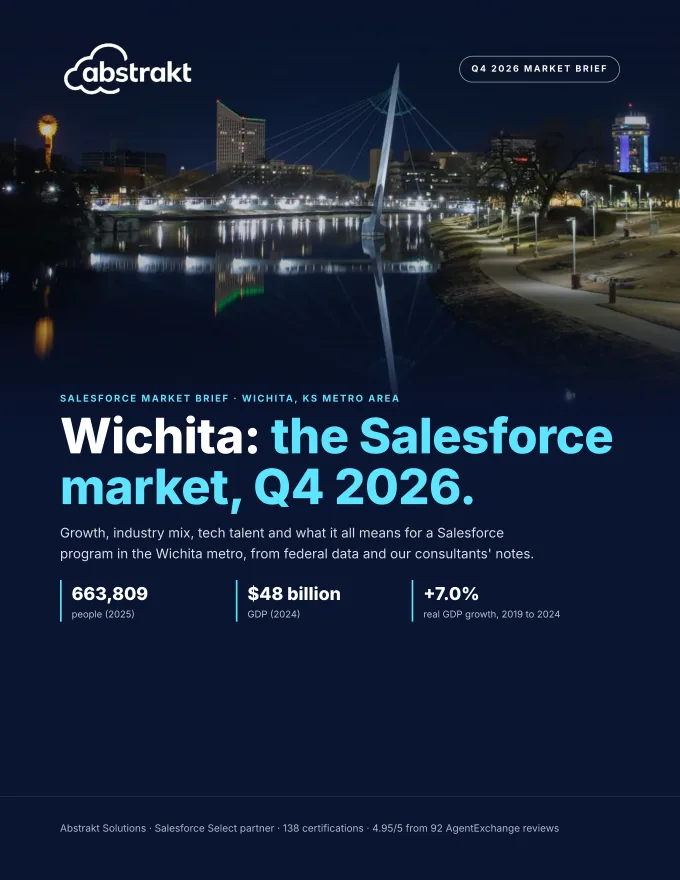
A free 20-page PDF with Wichita's growth ranked against 100 metros, its industry mix, tech wages and nearby markets. It is offered on the public Wichita page; send your customer there or get a copy for your own prep.
Get the Wichita brief →Co-sell with Abstrakt in Wichita
Working a Wichita account? Bring in a named consultant for discovery, scoping or a health check. We reply within 4 business hours.