

How Salesforce work starts in Madison
Madison-area software makers, insurers, manufacturers and health organizations work with Abstrakt Solutions on Salesforce design, build and support. Madison is one of our focus markets.
What buyers here usually run into
- 1
Tech-savvy teams with custom builds
In a software-heavy economy, Salesforce orgs often accumulate custom code and integrations over time, and a health check helps decide what to keep before adding AI.
- 2
Insurance distribution
Insurers and agencies commonly need agents to work their own books privately while leadership sees the whole pipeline.
- 3
Research-to-revenue companies
Life sciences firms spun out of university research typically need to add sales and support processes quickly as products reach the market.
Budget, team and partner questions
What drives cost
In Madison the main cost driver is what is already in the org: years of custom code and integrations built by capable in-house engineers need to be assessed before anything new is added. Subscription and usage data integration adds scope for software firms, while insurers add effort for policy system integration and privacy design.
Admin or partner
Software companies here often have developers who can maintain Salesforce, but they get pulled back to the product. Insurers more often want an internal admin for daily requests plus a partner for integration and release work.
What buyers ask a partner
Ask how the partner decides which custom code to keep, replace with standard features or retire. For insurance work, ask how they model a household with several policy lines and how producers are kept to their own books.
The local economy and its biggest industries (4)
| Sector | Share of 2024 GDP | Where Salesforce fits |
|---|---|---|
| Information Sales Cloud → | 11.2% | Software and health IT companies here, from large platform vendors to consultancies and game studios, need partner, subscription and customer success processes that Salesforce can tie together. |
| Finance and insurance Salesforce for insurance → | 9.5% | With finance and insurance the Madison metro’s second-largest private sector, insurers, agencies and financial firms in the region need agent management, policyholder service and compliant marketing. |
| Manufacturing Salesforce for manufacturing → | 8.9% | Advanced manufacturers and food and beverage producers across south-central Wisconsin need dealer and distributor management, quoting and ERP-connected service. |
| Health care and social assistance Salesforce for health & life sciences → | at least 6.9% | Health systems and diagnostics and life sciences companies near the university need patient, provider and customer service workflows built around privacy rules. |
Source: U.S. Bureau of Economic Analysis, GDP by county (CAGDP2), 2024, summed to the metro area; private sectors only, excluding real estate and government. “At least” marks sectors where BEA suppresses some county figures.
Regional target sectors named by local economic development groups: Advanced Manufacturing, Agriculture, Food & Beverage, Bioscience, Information Communications Technology, Healthcare, Logistics & Distribution.
Salesforce products that fit Madison (6)
In the order we lead with them here, from the industries above.
Salesforce Sales Cloud
The CRM where sales pipeline lives, when it is built right.
Salesforce Service Cloud
The operating system for modern customer service, case, knowledge, voice, and AI agent assist together.
Salesforce Agentforce
AI agents that handle real work inside Sales Cloud, Service Cloud, and Marketing Cloud.
Salesforce Data 360 (Data Cloud)
Unify customer data into a real-time profile that powers segmentation, analytics, and AI.
Salesforce Financial Services Cloud
Industry CRM for wealth management, banking, insurance, and lending, built for compliance from the start.
Tableau
Executive analytics, embedded dashboards, and CRM Analytics built on Tableau.
Madison software, insurance and manufacturing: AI fit
The information sector leads Madison's private economy at 11.2 percent of 2024 metro GDP, ahead of finance and insurance at 9.5 percent and manufacturing at 8.9 percent. Software and health IT companies there typically run large support queues, and Agentforce can summarize tickets, suggest knowledge articles and draft responses for support engineers to edit. Insurers can use AI to extract details from submitted documents and prefill case fields. Food, equipment and bioscience manufacturers can pair Sales Cloud forecasts with AI commentary that highlights slipping deals. The prerequisites are familiar: well-structured case data, articles that reflect the current product, access controls that mirror job roles, and a review step for customer-facing text.
- Support ticket summaries and suggestions
- Insurance document field prefill
- Slipping deal forecast commentary
Services buyers here usually need (7)
Salesforce Health Checks in Madison
A health check for a Madison organization is often driven by how much custom work its own developers have added. Software companies and insurers here frequently carry Apex, integrations and managed packages nobody fully remembers. We review sharing and access, connected apps, code quality and test coverage, automation overlap, data quality and license use, then deliver a ranked list of findings with the specific setting or component behind each. It is the step we recommend before adding Agentforce, since agents act through the permissions and data you already have.
By industry in Madison
- 1
Information Communications Technology
Technology companies expect their own systems to meet the standards they sell to customers, yet internal Salesforce orgs often lag behind. For ICT firms, the review looks closely at connected apps and OAuth scopes, API-only users with broad permissions, Apex without tests and integrations using stored credentials. The findings help engineering leaders decide which items to fix before a customer security questionnaire or an external security audit asks about them. Each item names the component and its owner.
- 2
Finance and insurance
Insurers and financial services companies usually commission a health check before an examination or internal audit. We verify that agents and service staff see only the policies and households they should, that field history covers sensitive changes and that consent records are complete. Integrations with policy, claims and billing systems are checked for the least privilege they need. Findings map to your compliance requirements so auditors can follow each remediation from finding to fix.
- 3
Healthcare
Health care organizations need assurance that patient-related records are protected consistently across profiles, permission sets, reports, list views and portals. The health check traces those paths, checks encryption and event monitoring on sensitive fields and flags any reports that expose protected information to broad groups. Results are ranked by privacy exposure, so the first fixes close the largest gaps rather than the easiest ones. We also confirm that deactivated staff accounts cannot still reach patient data through integrations or shared credentials.
Raise before scoping
Audit before switching on Agentforce
An agent answers questions using records it can reach and acts through the permissions of its running user. Checking data quality, knowledge articles and access scope before a pilot reveals what the agent would expose or get wrong, which is far cheaper than discovering it with customers.
Count the custom code honestly
Orgs in technically strong companies often hold more Apex, triggers and Lightning components than anyone has listed. The review inventories them, flags code without tests or with hard-coded IDs, and identifies components that standard features now cover, giving your team a realistic technical debt estimate.
Assign owners to every finding
Findings with nobody's name on them tend to stay open. We walk through the findings with your admin, security lead and business owners, assign each item to someone and group quick fixes separately from larger projects, so remediation starts the following week rather than waiting for a budget cycle.
Salesforce Implementation in Madison
In Madison, a first Salesforce implementation often lands in a company that already has strong technical staff and plenty of homegrown tools. The work is less about teaching the platform than about agreeing on a data model everyone will share: which object holds a customer, a policy, a lab or a subscription, and who owns each record. We run design workshops with each team, build in a sandbox, load cleaned data and phase go-lives so each team is productive before the next one starts.
By industry in Madison
- 1
Information
Information is the metro's largest private sector, at about 11.2% of 2024 GDP, and much of it is software, health IT and computer systems design. Software companies implementing Salesforce need accounts, contracts, subscriptions and support entitlements modeled together, because renewals and customer success depend on all four. We design that structure up front, decide whether billing stays in a separate system, and set up Service Cloud entitlements so support tiers match what customers actually bought. Game studios and consultancies get simpler variants of the same model.
- 2
Finance and insurance
Insurers, agencies and credit unions in the Madison region usually implement Salesforce to give service staff and agents one view of a household or member. Financial Services Cloud supplies policy, claim and relationship objects, so the implementation effort goes into deciding which fields come from the policy administration system, how agent books are kept private from one another, and which permission sets compliance reviewers sign off on. We settle those questions in phase one because every later workflow depends on them.
- 3
Bioscience
MadREP listed bioscience among the region's primary industry sectors, much of it growing out of university research. Diagnostics, reagent and instrument companies selling to labs need a data model that relates individual scientists to their lab, department and institution, plus quoting that handles repeat consumable orders. Implementation for these firms typically starts with Sales Cloud and account hierarchy design, then adds Service Cloud for technical support once products are in customers' hands, so early commercial teams are not held back waiting for a complete build.
Raise before scoping
Decide what homegrown tools become
Technical teams in Madison often built their own tracking databases and scripts before Salesforce arrived. List each one during discovery and decide whether it is retired, integrated or left alone. Leaving that choice until after go-live produces duplicate entry and users quietly returning to the old tool.
Model subscriptions before building screens
For software and health IT sellers, contract terms, renewal dates and support entitlements drive most reporting. Settling how those records relate before building page layouts avoids reworking objects and reports once finance asks for renewal forecasts and customer success asks for usage-based health scores.
Plan privacy for health data
Health systems and diagnostics companies near the university may store information that falls under privacy rules. Decide early which fields are allowed in Salesforce, whether Shield encryption is needed and which integration users can read them, since those answers affect sharing design across every object.
Salesforce Integration in Madison
Integration work in Madison tends to involve more systems than the company's size would suggest. Software firms have billing and product usage platforms, insurers have policy and claims systems, manufacturers have ERP and health organizations have clinical and scheduling systems at the edge of what Salesforce should hold. We map each data flow, decide which system owns each field, choose between APIs, middleware and Data 360 (formerly Data Cloud), and build monitoring so a failed sync is noticed by an admin before a sales rep finds it.
By industry in Madison
- 1
Health care and social assistance
With health care and social assistance at roughly 6.9% of metro GDP and a deep bench of health IT talent nearby, providers here rarely lack integration skills; what they need is a firm rule about what may cross from clinical or scheduling systems into the CRM. We usually bring in only the demographic, referral and appointment details that outreach and service teams need, keep clinical records where they are, and log every integration user's access for privacy review.
- 2
Information
Software and health IT companies want product usage, license counts and support tickets visible on the account so customer success managers can see risk before renewal. Integration here means pulling usage summaries from a data warehouse or product database, often through Data 360 (formerly Data Cloud), and syncing billing status from the finance system. We aggregate before loading, since raw event data would overwhelm Salesforce storage and bury the signal account teams actually need.
- 3
Logistics & Distribution
Logistics and distribution appeared on MadREP's primary sector list, and distributors in the region depend on ERP and warehouse systems for stock, pricing and order status. Integrating those with Salesforce lets inside sales see availability and open orders on the account without calling the warehouse. We typically sync orders and invoices on a schedule, check credit status in real time and write new quotes back to the ERP only after approval.
Raise before scoping
Pick a single source per field
When two systems can edit the same field, they eventually disagree. Our first deliverable is a field-by-field register naming the owning system and the direction of every flow. That map becomes the specification for the build and the reference your admin consults when a value looks wrong.
Aggregate high-volume data first
Product telemetry and transaction data from software and insurance systems can reach volumes Salesforce is not designed to store. Summarize it upstream or in Data 360 (formerly Data Cloud) and bring only the metrics people act on, such as active users per account or claims opened this quarter.
Monitor integrations like production systems
Every integration needs alerting, retry logic and a named owner. We set up error logs and notifications so failures reach an admin instead of accumulating unnoticed, and we document how to replay failed records, which keeps a silent sync failure from corrupting weeks of pipeline data.
Salesforce Optimization in Madison
Optimization in Madison usually starts with an org that has been live for years and was shaped by several admins and partners. Users work around slow screens, managers export data to spreadsheets, and automation built in different eras collides. We review adoption by team, consolidate workflow rules and flows into a maintainable set, rebuild the reports leadership actually uses in Tableau or native dashboards, and remove fields nobody fills in. Changes are delivered in short releases, each with a measurable adoption or time-saving goal.
By industry in Madison
- 1
Manufacturing
About 8.9% of Madison's metro GDP comes from manufacturing, a sector whose advanced end MadREP counted as a priority. Manufacturers in the region often have Salesforce configured for opportunity tracking but still quote, forecast and log service calls elsewhere. Optimization brings those steps back into the org: simpler opportunity stages tied to real sales milestones, quote templates that pull the right products, and dashboards that compare forecast to shipped orders from the ERP.
- 2
Agriculture, Food & Beverage
Food and beverage producers and agricultural suppliers selling to distributors and retailers often track promotions, samples and broker activity outside Salesforce. Optimization here focuses on making field reps want to log visits: mobile layouts with only the fields they need, account plans that show sell-through by retailer, and automated follow-up tasks after a sample ships. When the data arrives consistently, sales leaders can finally see which promotions and brokers produce reorders.
- 3
Professional, scientific, and technical services
Consultancies and engineering firms in the region, including those placing health IT specialists, commonly run pipeline in Salesforce and staffing in a separate tool. Optimization links the two with a lighter model, cleans up opportunity types that multiplied over the years and rebuilds utilization and bench reports so partners stop keeping private spreadsheets. We also retire automation that sends emails nobody reads, which is often the quickest way to regain user goodwill.
Raise before scoping
Measure adoption before changing anything
Login counts say little. We look at which record types, fields and reports each team actually uses and where data is entered elsewhere. That baseline tells us which fixes matter most and lets you show leadership, weeks later, whether the changes worked.
Consolidate automation onto flows
Many older Madison orgs still run workflow rules and process builders alongside newer flows, sometimes firing on the same record. Rebuilding that logic as one documented flow per object and trigger point ends the collisions, shortens save times and gives future Agentforce actions automation they can depend on.
Retire before you add
Unused fields, page layouts and reports make every screen harder to read. Retiring them before adding features often improves adoption more than any new capability, and it shrinks the surface area that future releases and audits must cover for years to come.
Salesforce Managed Services in Madison
Managed services for Madison organizations usually picks up where a lean internal team runs out of hours. Software companies, insurers and health organizations here add users, products and integrations steadily, and every addition creates admin work. We keep a single ranked backlog agreed with your owner, test each seasonal Salesforce release in a sandbox, handle user and permission changes, and assign developers or architects only when a request needs them. Monthly reviews with your owner keep that backlog aligned with what the business needs next.
By industry in Madison
- 1
Finance and insurance
Finance and insurance contributes about 9.5% of the metro's 2024 GDP, second only to information. For insurers and agencies, the ongoing work is change control: new agent onboarding, permission requests that need an approval record, product and rider fields added as offerings change, and release testing on the screens service staff use every day. We log every change with its requester and approver, which gives internal audit a history without extra paperwork from your operations team.
- 2
Information Communications Technology
Information communications technology was one of MadREP's primary sectors, with healthcare IT and software publishing called out as strengths. Software and services companies in this group tend to have admins who are also engineers, and their orgs grow custom code quickly. Managed services here combines code review, test coverage maintenance and deployment through a pipeline, so an engineer's quick fix does not break a renewal flow. We also retire fields and automations that product teams stopped using once a feature was sunset.
- 3
Healthcare
Hospitals, clinics and health services organizations change their Salesforce orgs in response to new programs, referral sources and privacy requirements. As a managed services partner, we handle those requests as tickets that include a privacy review: who will see the new field, which integration user reads it and whether it needs encryption. Monthly reporting shows what changed, and the backlog keeps outreach and service requests from competing informally for the same admin's attention.
Raise before scoping
Name one internal owner
Managed services works best when one person on your side ranks requests and approves releases. In organizations with many departments, such as insurers or health systems, that owner prevents the loudest team from setting priorities and keeps the backlog tied to business goals rather than to whoever asked last.
Test releases against custom code
Orgs in software-heavy companies carry more Apex and integrations than typical. Each Salesforce release is checked in a sandbox against that code, the flows that depend on it and the integrations that call it, so problems surface before users see them rather than on the Monday after an upgrade.
Keep documentation current
When admins change, undocumented decisions become expensive. We record why each field, flow and permission set exists as part of every ticket, so knowledge stays with the org instead of with a person, and a new internal hire can take over a well-understood system.
Salesforce Migration in Madison
Migrations in Madison often start from a system someone in the company built: a custom database, a spreadsheet workbook with macros or an early CRM extended by in-house developers. They hide years of undocumented rules. We profile the source data, agree what is worth moving, deduplicate accounts and contacts, map old fields to the new data model and run trial loads in a sandbox until record counts and key reports reconcile. On cutover weekend the legacy database becomes read-only; it stays searchable for lookups, but nobody can add to it.
By industry in Madison
- 1
Professional, scientific, and technical services
Close to 8.0% of Madison's 2024 output came from consultancies, engineering practices and other professional, scientific and technical services firms. Consultancies and engineering firms moving to Salesforce usually bring client lists, pursuit history and staffing notes from a mix of spreadsheets and an older CRM. We merge duplicate clients created by different partners, convert pursuit history into opportunities with consistent stages and move notes and files so relationship history is not lost when the old tool is switched off.
- 2
Finance and insurance
Insurance agencies and credit unions migrating from an industry-specific CRM or agency management tool face strict expectations around record retention and consent. Migration planning covers which historical activities and communications must be kept, how consent and opt-out flags translate into Salesforce, and how household relationships are rebuilt in Financial Services Cloud. We reconcile counts of households, policies and contacts before cutover so compliance teams can sign off with confidence. Anything left behind is archived in a documented location.
- 3
Bioscience
Life sciences companies spun out of university research often run commercial activity in spreadsheets until the first products gain traction. Migrating that data means turning lists of scientists, labs and institutions into a proper account hierarchy, standardizing institution names and linking past orders or quotes to the right lab. Cleanup at this stage prevents duplicated institutions, which otherwise distort territory planning and reporting for years. We also flag records missing consent for marketing emails.
Raise before scoping
Profile data before mapping it
Source systems often contain fields used for different purposes over time. Profiling each field's values, fill rates and duplicates before mapping reveals the real rules behind the data and prevents loading years of inconsistencies into a new org where they would be harder to spot.
Decide what history to keep
Years of logged calls and emails rarely all need to come across. Agree with each team which records, notes and attachments must move, which can be summarized and which should be archived elsewhere, because migrated volume affects storage costs, load times and search quality.
Run a parallel reconciliation
Before cutover, compare record counts, pipeline totals and key reports between the old and new systems. Differences are investigated and explained rather than waved through as rounding. That reconciliation is what gives finance and leadership confidence to stop using the old reports.
Salesforce Implementation Rescue in Madison
Rescue work in Madison often follows an ambitious internal build: capable developers customized Salesforce heavily, then left or moved to product work, and the org became hard to change. Other projects stalled when a partner exited or scope kept expanding. Our first weeks go to triage: reading the org and the original requirements, talking with the people involved and unblocking daily work. Only then do we rule on each component, keeping, repairing or rebuilding it, and relaunch in stages users can absorb.
By industry in Madison
- 1
Information
Software companies sometimes launch Salesforce with the sales team in mind and bolt on renewals, support and customer success later, each built by a different person. A rescue for them reconciles the account, contract and subscription records so renewals forecast correctly, replaces fragile custom code with standard features where possible and relaunches customer success views once the underlying data is trustworthy. Engineering time is freed because the org no longer needs constant patching.
- 2
Healthcare
Health organizations occasionally stall mid-project when privacy questions surface late, after objects and integrations are already built. Recovery pauses new features, reviews what patient-related data sits where, redesigns sharing and encryption where needed and then resumes the rollout with the compliance team involved from the start. Outreach or referral teams are usually relaunched first, because they tend to have the clearest workflows and the fastest path to results that sponsors can see.
- 3
Advanced Manufacturing
Advanced manufacturing sat among MadREP's primary sectors, and manufacturers here sometimes find that a quoting or service project promised too much in its first phase. The usual recovery trims product rules down to those that actually affect price, finishes the half-built ERP connection and relaunches quoting for one product line before extending it to the others. Service and dealer processes follow once sellers see accurate numbers and stop keeping backup spreadsheets.
Raise before scoping
Stop the scope growth first
Stalled projects usually have a backlog that grew faster than the build. Freeze new requests during triage, then rank what remains by what users need to do their jobs. A shorter, agreed list is what allows a rescued project to reach a relaunch date.
Recover the missing documentation
When the original developers are gone, the org itself is the documentation. We inventory metadata, automation and integrations, interview remaining users and sponsors, and write down what each component does. That record guides the rescue and prevents the next team from facing the same gap.
Relaunch with one team
Choose the team with the clearest process and the most to gain, relaunch with them first and let their results persuade others. A visible success inside the company rebuilds confidence among executives and skeptical users more effectively than any presentation about the recovery plan.
Industry plays in Madison (4)
Salesforce for Madison Insurers and Agencies
Madison's insurers operate in a technology-heavy region, so their Salesforce orgs are often already customized and connected to many internal systems. The opportunity is usually to make the platform more coherent: coaching agents with clear production data, keeping policyholders informed during claims, and unifying households that hold several policies. We work with Financial Services Cloud, Service Cloud and Data 360 (formerly Data Cloud), with Tableau for distribution analytics, and we pay close attention to existing custom code before adding new automation or AI.
In the Madison metro, only the information sector (11.2%) tops finance and insurance, which the Bureau of Economic Analysis credits with 9.5% of 2024 GDP. That puts a large insurance presence inside an economy where software and information work lead. The regional economic development partnership that set the area's target sectors, whose duties moved to the Greater Madison Chamber in late 2025, focused on information and communications technology, bioscience, healthcare and advanced manufacturing rather than naming insurance directly. Insurers here therefore compete for the same software and data talent as the region's technology employers.
Use cases to open with
- 1
Agent coaching with production data
Distribution leaders need to know which agents are growing, retaining customers and following up on quotes. Financial Services Cloud can bring policies, quotes, renewals and activities together by agent, and Tableau dashboards can show trends by line, territory and customer segment. Field leaders use those views in coaching conversations, focusing on specific quote follow-up, retention and cross-line opportunities rather than general targets.
- 2
Claims status communication
Policyholders want timely updates after a loss, and uncertainty drives repeated calls to agents and claim staff. Service Cloud can receive claim status events from the claims system, trigger proactive messages, and give agents and service staff a clear timeline. Agentforce can answer routine status questions using current claim data, handing complex or sensitive situations to adjusters or service representatives.
- 3
Unified multi-line household view
Many customers hold auto, home, umbrella, life or business coverage across several systems. Data 360 (formerly Data Cloud) can unify customer profiles from policy, billing, claims and service data, identifying households and relationships. Agents and service teams see total relationship value and recent events, while analytics highlight retention risks and coverage gaps that justify a review. Agents can then act on those signals from the same household record.
Raise before scoping
Govern existing customizations
Mature orgs often contain custom objects, code and integrations built by several teams over time. Review technical debt, test coverage and ownership before adding new features, and retire unused components so future AI and data initiatives run on a stable foundation.
Privacy across lines of business
Customer data may include consumer financial information, health information for certain products and state-regulated insurance records. Define consent, access and retention rules by data type and product, and have compliance and legal teams confirm how GLBA, HIPAA and state requirements apply.
Identity resolution rules
Unifying households requires clear matching rules for names, addresses, policies and business entities. Start with high-confidence matches, route uncertain ones to a data steward for review, and monitor results so agents never see incorrect relationships or two different customers merged into one record.
Salesforce for Madison Health and Life Sciences
Health and life sciences in Madison include care delivery, bioscience research and a strong healthcare information technology sector. Salesforce can support software companies managing implementations and customer success, diagnostics and bioscience firms serving provider and research customers, and health organizations improving patient engagement. We usually build on Service Cloud and Sales Cloud, add Experience Cloud for customer or patient self-service, and introduce Agentforce once knowledge and data controls are ready, while clinical and regulated records remain in their validated systems.
Care providers and social assistance organizations supply no less than 6.9% of the Madison metro's 2024 GDP; the Bureau of Economic Analysis suppresses part of the county detail, so that number is a floor. The information sector, at 11.2%, is larger, and the regional economic development partnership's archived materials name healthcare information technology as one of its sub-sector strengths. The same partnership targeted healthcare and bioscience and described the region's biosciences as driven largely by the flagship university, which reported more than $1.3 billion in research investment in 2019. A university-affiliated research park established in 1984 supports early-stage and growing life sciences companies.
Use cases to open with
- 1
Health IT implementation and customer success
Healthcare software companies manage long implementations, go-live events, support cases and renewals with hospitals and clinics. Salesforce can track implementation milestones, customer health scores, support issues and executive relationships in one account view. Customer success teams see risks early, such as a delayed go-live or a spike in critical cases, and leadership can connect product adoption and support experience to renewal forecasts instead of treating them as separate reports.
- 2
Diagnostics provider and research accounts
Diagnostics and bioscience companies may sell tests, instruments or reagents to physicians, hospitals, laboratories and researchers. Sales Cloud can manage account coverage, samples, evaluations and contracts, while Service Cloud handles orders, technical support and result questions. Order and result status can be read from the laboratory systems on demand, so the regulated records themselves never live in Salesforce. Field reps and technical support then handle a clinic's question about a delayed result from the account page itself.
- 3
Patient engagement and digital front door
Health organizations can use Service Cloud, Experience Cloud and Agentforce to answer common questions, route requests and support patients across web, phone and messaging. Patients get consistent answers about appointments, billing and services, while staff see prior interactions. Clinical questions escalate to the right team, and leaders monitor response times and recurring issues by channel and topic, which feeds back into knowledge articles and staffing.
Raise before scoping
Separate commercial and clinical data
Software and diagnostics companies may encounter protected health information in support or testing workflows. Limit PHI to approved processes, use business associate agreements where required, and restrict access. Before implementation, the privacy and compliance function should walk through the data model field by field, especially for support cases where customers may attach patient-identifiable files.
Validated systems stay authoritative
Laboratory, quality and clinical systems may be subject to FDA, CLIA or other regulatory controls. Let Salesforce carry the customer conversation and a status summary, and leave the controlled record where your quality system and auditors expect to find it.
Plan for technical users
Madison organizations often have strong internal technology teams. Agree on architecture standards, release management and code review with them early, so Salesforce enhancements fit enterprise practices and do not create another unmanaged application. Shared tooling for source control and automated testing helps both teams move faster.
Salesforce for Madison Manufacturers
Many Madison manufacturers earn as much after the first sale as from it: consumables, reagents, replacement parts, service plans and repeat food or ingredient orders. Salesforce should make that recurring business visible. Sales Cloud tracks new placements and distributor pipeline, Service Cloud and Field Service support the installed base, and Revenue Cloud handles quotes and renewals for service agreements. We connect it to the ERP for orders and inventory, and keep custom code to a minimum in an economy full of capable developers.
In Madison, information work, at 11.2% of 2024 GDP, outweighs factories; Bureau of Economic Analysis data place manufacturing third at 8.9%, just behind finance and insurance. The regional economic development partnership whose duties passed to the Greater Madison Chamber in late 2025 listed advanced manufacturing, agriculture, food and beverage, and bioscience among its primary sectors. It described the biosciences as driven largely by the region's major research university, which reported over $1.3 billion in research investment in 2019, and a research park established in 1984 supports growth companies in engineering and life sciences. Many producers sell to laboratories and food buyers.
Use cases to open with
- 1
Consumables and reorder signals
Instrument and bioscience suppliers depend on customers reordering reagents, kits and parts. Salesforce can bring order history from the ERP onto each account, flag customers whose reorders are late compared with their usual pattern, and create tasks for inside sales. Marketing Cloud can remind labs before supplies typically run out, and account managers see which placed instruments are generating little consumable revenue.
- 2
Installed base and service plans
A lab analyzer or a filling line is only as valuable as its uptime. Field Service can track each installed unit, its service plan and history, and schedule on-site technicians or remote diagnostic sessions depending on the fault. Service agreement renewals appear as opportunities well before expiration, and product teams can see recurring failure modes by model, which feeds engineering priorities and warranty cost planning.
- 3
Distributor and research channels
Selling to universities, research institutes and food companies often involves distributors, procurement portals and grant-funded budgets. Sales Cloud can track which channel handles each account, register opportunities with distributors, and record grant timing that affects when a lab can buy. Sales leaders forecast by channel and customer type, and marketing targets researchers by discipline, application and the funding cycle of their department.
Raise before scoping
Resist unnecessary custom code
Companies with strong in-house developers often build custom solutions where standard features would work. Custom code adds maintenance and can complicate upgrades and AI features later. Set a rule that configuration comes first, and review every proposed custom component against that standard.
Model the installed base
Recurring revenue depends on knowing which unit sits in which lab or plant, under which agreement. Decide how assets are created from ERP shipments, how transfers between departments or customers are handled, and who keeps records accurate after service visits.
Food and lab regulations
Food producers and bioscience suppliers may face traceability, quality and labeling rules. Keep lot and quality records in the systems built for them, reference them from Salesforce cases, and confirm with quality staff which complaint details must be captured at intake.
Salesforce for Madison Consulting and IT Services Firms
Regional economic development materials point to strengths in healthcare IT and computer systems design, so many Madison services firms sell skilled people who implement and support software. For them, the hardest problem is matching skilled consultants to client demand. Salesforce can connect pipeline to people: opportunities that specify roles, skills and certifications, a view of who rolls off which project when, and client health tracking across long engagements. We configure Sales Cloud and related tools around that staffing model and connect them to time and billing systems.
By Bureau of Economic Analysis count for 2024, 8% of Madison's economic output comes from professional, scientific and technical firms, a notch below information, finance and insurance, and manufacturing. The region's former economic development partnership listed information communications technology among its primary sectors, citing a national business magazine that ranked the Madison Region among the top five locations for information jobs. It named sub-sector strengths in healthcare information technology, software publishing, computer systems design and games development. Computer systems design is part of professional services, so much of this sector here consists of firms that implement, integrate and support software for clients.
Use cases to open with
- 1
Pipeline tied to staffing
A consulting firm's forecast is only useful if it shows who will do the work. Opportunities can carry the roles, skills, certifications and start dates each engagement needs, and a resource view shows consultants rolling off current projects. Staffing managers match the two, recruiting sees gaps early, and leaders avoid signing work the bench cannot deliver or leaving consultants idle between projects.
- 2
Consultant skills and certifications
Health IT and software clients often require consultants with specific product certifications or experience. Salesforce can hold each consultant's skills, certifications, expiration dates and project history, making it easier to propose qualified people quickly when a client asks for résumés. Firms can also see where certifications are expiring, which vendor exams are most in demand, and plan training before a client requirement goes unmet.
- 3
Client health across engagements
Long implementation and support engagements can drift without anyone noticing until renewal. Salesforce can track client health from project status, open support cases, survey results and how recently an executive sponsor was contacted, and alert account leaders when signals weaken. Leaders review at-risk accounts together in a regular meeting, and expansion opportunities appear when clients are clearly satisfied and asking for more.
Raise before scoping
Choose a resource tool
Sales Cloud handles pipeline and client relationships, but detailed scheduling of consultants usually belongs in professional services automation software. Decide which tool owns assignments, bench and utilization, then integrate the two, rather than building a homegrown scheduling engine inside Salesforce that someone must maintain.
Protect client data access
Health IT consultants may work with client systems that contain protected health information. Keep client PHI out of your own Salesforce org, record only engagement and relationship details, and confirm business associate and contract obligations with your compliance lead before consultants start logging notes.
Technical users expect polish
Consultants and engineers notice clumsy interfaces quickly. Invest in clean page layouts, fast list views, useful automation and good mobile access, and gather feedback from a few skeptical consultants early, because technical staff will build side spreadsheets if the CRM slows them down.
Case studies to send (3)
From the industries this market leans on. Client names are anonymized and these projects are not specific to Madison.
The Madison Salesforce market brief, Q4 2026
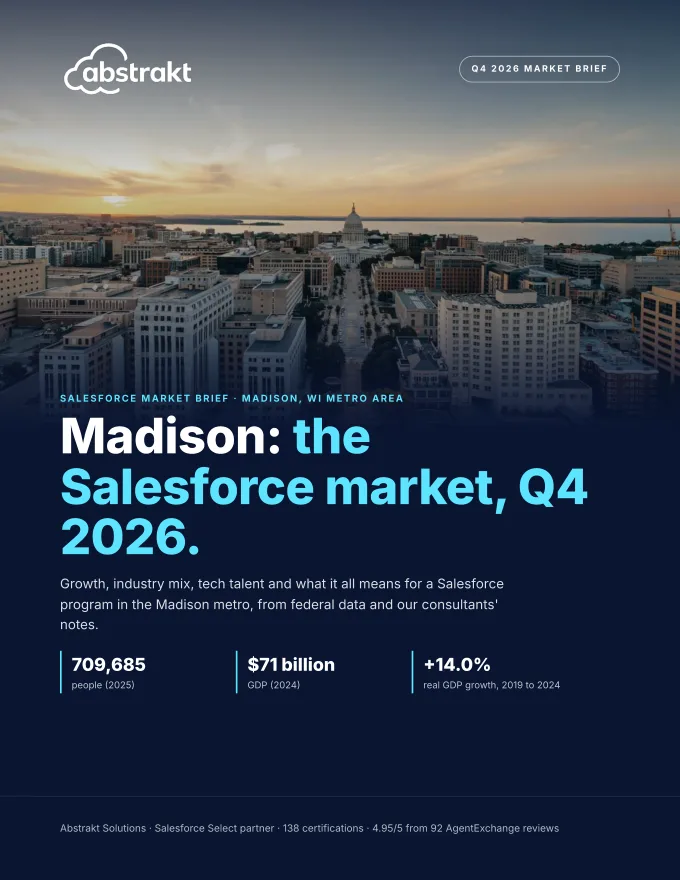
A free 25-page PDF with Madison's growth ranked against 100 metros, its industry mix, tech wages and nearby markets. It is offered on the public Madison page; send your customer there or get a copy for your own prep.
Get the Madison brief →Co-sell with Abstrakt in Madison
Working a Madison account? Bring in a named consultant for discovery, scoping or a health check. We reply within 4 business hours.