

How Salesforce work starts in Melbourne
Abstrakt Solutions is a Salesforce Consulting Partner serving companies across Brevard County, from Titusville south through Melbourne to Palm Bay. Melbourne is one of our focus markets.
What buyers here usually run into
- 1
Government-facing pipelines
Defense and space contractors commonly pursue work through bids, teaming agreements and contract vehicles that a standard B2B sales process does not model well.
- 2
Strict data-handling rules
Companies serving defense customers often face firm limits on where data lives and who can see it, so Salesforce access design needs attention before sensitive information moves in.
- 3
Headcount rising faster than process
Firms scaling up around new programs frequently add people faster than they add structure, and partner and customer data ends up scattered across spreadsheets and inboxes.
Budget, team and partner questions
What drives cost
On the Space Coast, access design is the scope driver buyers miss: deciding what data may live in Salesforce and who may see it takes real design and testing time. Configured quoting, ERP integration and multi-year program structures add the rest.
Admin or partner
Firms growing around new programs often add people faster than process, and a single new admin struggles to keep up with integration and security work. A partner for architecture and releases plus an internal owner for users and reports is a common arrangement.
What buyers ask a partner
Ask how the partner keeps controlled technical information out of Salesforce and documents access decisions. Ask how they would model a pursuit with several teaming partners and a recompete date, and how quotes reach your ERP.
The local economy and its biggest industries (4)
| Sector | Share of 2024 GDP | Where Salesforce fits |
|---|---|---|
| Manufacturing Salesforce for manufacturing → | 19.5% | Aircraft, spacecraft and defense-technology builders and the suppliers around them make up much of Brevard’s manufacturing base, with long programs and configured products that call for careful quoting and ERP integration. |
| Professional, scientific, and technical services Salesforce for professional services → | 8.5% | Engineering, applied R&D and communications-technology firms near Florida Tech and the prime contractors track teaming partners, bids and contract vehicles, which suits Sales Cloud built around a defined pursuit process. |
| Health care and social assistance Salesforce for health & life sciences → | 7.4% | Hospitals, clinics and home-health agencies serving a county that stretches from Titusville to Palm Bay need patient outreach, referral tracking and service designed with privacy in mind. |
| Construction Salesforce for construction → | 5.9% | Contractors putting up industrial facilities, offices and homes as aerospace projects land in the county need estimates, subcontractor schedules and job costs tracked together. |
Source: U.S. Bureau of Economic Analysis, GDP by county (CAGDP2), 2024, summed to the metro area; private sectors only, excluding real estate and government. “At least” marks sectors where BEA suppresses some county figures.
Regional target sectors named by local economic development groups: Aerospace & Defense, Communications, Advanced Manufacturing, Aviation (business aviation), Applied R&D / STEM-intensive industries.
Salesforce products that fit Melbourne (6)
In the order we lead with them here, from the industries above.
Salesforce Sales Cloud
The CRM where sales pipeline lives, when it is built right.
Salesforce Revenue Cloud / CPQ
Configure-price-quote, billing, subscription management, and quote-to-cash on Salesforce.
Salesforce Experience Cloud
Customer, partner, and employee portals built on Salesforce.
Salesforce Service Cloud
The operating system for modern customer service, case, knowledge, voice, and AI agent assist together.
MuleSoft
Enterprise API platform, for connecting Salesforce, ERP, data warehouses, and the rest of your stack.
Tableau
Executive analytics, embedded dashboards, and CRM Analytics built on Tableau.
Space Coast aerospace suppliers and careful AI adoption
On the Space Coast, BEA data show factories and plants generating 19.5% of 2024 metro GDP, with aerospace, defense, and communications listed as local target industries. Those firms handle long technical documents, so AI that reads requirements and change requests and summarizes them for engineers and program managers is a sensible first step. Engineering and technical services companies can add opportunity triage and proposal support. Controlled technical information is the constraint; some content should never reach an AI agent at all, and permissions must reflect that before a pilot begins. Where agents are appropriate, humans keep approving outbound communication and each retrieval is logged for later review.
- Requirements and change request summaries
- Proposal support for technical services
- Retrieval logging for audits
Services buyers here usually need (7)
Salesforce Implementation in Melbourne
On the Space Coast, a Salesforce implementation usually has to model work that is won through proposals and delivered over years. Defense and space suppliers pursue programs with teaming partners; engineering firms track bids and contract vehicles; providers manage referrals under privacy rules. We design objects for pursuits, programs and relationships first, decide what sensitive information must stay outside the org, and build access controls before loading data. Delivery runs in phases, with a design workshop before each build and hands-on support at every go-live.
By industry in Melbourne
- 1
Aerospace & Defense
Aerospace and defense is among the sectors the Space Coast's economic development commission highlights. Suppliers here rarely fit a standard lead-to-opportunity funnel. An implementation for them adds records for programs, task orders and teaming agreements, links each pursuit to the government end customer and the prime, and tracks proposal milestones through submission. Sharing rules limit sensitive pursuits to assigned staff, and technical data stays in the repositories approved for it, with Salesforce holding only a reference.
- 2
Professional, scientific, and technical services
Engineering, testing and technical-services firms contribute about 8.5% of Brevard's 2024 GDP. Their revenue depends on relationships with prime contractors and agencies more than on marketing volume. We set up Sales Cloud with account hierarchies that reflect divisions and program offices, opportunity stages that follow capture and proposal work, and a pipeline report by contract vehicle. Resource forecasting can follow later, once pursuit data is consistently entered. Proposal managers get a view of upcoming due dates across every active bid.
- 3
Health care and social assistance
Hospitals, clinics and home-health agencies serving a county that runs the length of the coast often start with referral management and patient access. We implement Service Cloud or Health Cloud around intake queues, referral-source accounts and outreach tasks, keep diagnoses and clinical notes in the medical record system, and configure field-level security so each role sees only what its work requires. Training is scheduled by shift so clinical staff are not pulled from patient care.
Raise before scoping
Design pursuit objects early
Government-facing sales needs objects the standard model lacks: programs, contract vehicles, teaming partners and period-of-performance dates. Deciding their structure before configuration begins keeps reports consistent and avoids rebuilding the pipeline once proposals start flowing through it. Retrofitting them later means migrating every open pursuit.
Separate controlled data upfront
Companies serving defense customers should document which information never enters Salesforce and how users reach it instead. Settling this during design lets security staff approve the architecture once, rather than reviewing every new field and attachment type as the org grows.
Train each end of the county
Brevard stretches from Titusville to Palm Bay. When teams sit at both ends, schedule separate sessions for the northern and southern groups so staff learn near their own desks instead of losing half a day to the drive. Recordings of each session go to anyone who could not attend.
Salesforce Integration in Melbourne
For Space Coast companies, integration usually connects Salesforce to an ERP that holds part numbers, pricing, orders and shipments, and sometimes to program-management or estimating tools. We start by mapping which system owns each piece of data, then pick the right method per flow: native APIs for simple lookups, scheduled syncs for history, MuleSoft when several systems share information. Each flow logs errors and alerts a named person, and we test with real quotes and orders before switching anything on in production.
By industry in Melbourne
- 1
Advanced Manufacturing
Advanced manufacturers in Brevard County build configured and long-lead products, so quotes must reflect ERP costs, lead times and approved pricing. We integrate the product catalog and price books from the ERP into Revenue Cloud, send accepted quotes back as orders, and return order status, shipments and invoices to the account. Engineering change data stays in its own system, with Salesforce showing only what sales and service need. Sales engineers stop emailing planners to confirm lead times.
- 2
Aviation (business aviation)
Parts and service suppliers to business-aviation manufacturers depend on accurate part availability and warranty history. Integration brings inventory and order status from the ERP into Service Cloud, links warranty claims to the serial numbers they concern, and gives account managers visibility into open repairs for each operator. Where an OEM customer requires a portal, Experience Cloud can present the same data without exposing internal systems directly. Service coordinators then answer operator questions from a single screen.
- 3
Construction
Contractors often estimate in one tool, manage projects in another and bill from accounting software. Integrating those with Salesforce lets estimators start from a won opportunity, carries job numbers and contract values into project systems, and returns progress and billing figures to the account. Owners then see bids, active work and receivables in one place without assembling a weekly spreadsheet from three sources. Change orders are captured against the original opportunity, so margin erosion becomes visible early.
Raise before scoping
Map ownership field by field
Decide which platform is authoritative for customers, parts, prices and order status before building. Put the answer in a shared table with an owner per field. When a buyer disputes a number, support staff can see at a glance where the correct value lives and who may change it.
Keep controlled data out
Defense-related integrations should move only commercial data into Salesforce. Exclude technical drawings, specifications and anything restricted, and document the exclusion so security reviewers can confirm the integration design without inspecting every mapping themselves. Revisit the exclusion list whenever a field is added to a mapping, since that is how restricted content slips in.
Build monitoring in from day one
Every integration fails occasionally. Log each transaction, retry automatically where it is safe, and alert a named owner when a record cannot be processed. Monitoring planned at the start costs far less than chasing silent failures after launch. Give that owner a short runbook for the common failures.
Salesforce Health Checks in Melbourne
For companies on the Space Coast, a health check tends to be triggered by a customer's security questionnaire, a renewal decision or plans for AI features. Four areas get attention: who holds access, integration accounts and connected apps included; the flows, code and packages piling up as technical debt; gaps and duplicates in customer data; and dashboards that may disagree with source systems. The report ranks each issue by risk and effort, cites the evidence, and recommends a fix, with a brief summary written for executives.
By industry in Melbourne
- 1
Aerospace & Defense
Defense suppliers are regularly asked by primes and agencies how customer information is protected. A health check provides the evidence: profile and permission-set design, users with elevated rights, multi-factor authentication, session and login restrictions, and a scan for attachments or fields that may contain information that should not be in the CRM. Each item is labeled so your security lead can file it against whatever framework the customer uses. Stale logins belonging to departed program staff are listed for removal.
- 2
Health care and social assistance
Health care is a smaller slice of the Brevard economy than manufacturing, at about 7.4% of 2024 GDP, yet its Salesforce users face the strictest access questions. When referral or outreach teams work in Salesforce, the question is whether patient details reach anyone beyond them. We check sharing, reporting and export permissions on records containing patient details, review portal access, and look for free-text fields where clinical details have crept in. Each finding comes with a remediation step. We also confirm that people who left the organization lost access promptly.
- 3
Communications
Communications companies often run large support operations with many integrations and managed packages. A health check reviews those for reliability and risk: failing syncs, unused packages still holding permissions, case automation that conflicts, and knowledge content that is out of date. It also assesses readiness for Agentforce, since AI support agents draw on case history and articles that need to be accurate and properly permissioned. Unused packages are listed with the permissions they still hold.
Raise before scoping
Scan for out-of-place data
Attachments, notes and long text fields can collect information that was never meant for the CRM. A health check should sample them, especially in defense and health settings, and recommend both cleanup and controls that stop it recurring. Include email-to-case attachments in the sample.
Assess AI readiness honestly
An AI agent inherits every flaw in the records and sharing model beneath it. Before a pilot, check duplicates, outdated knowledge articles and overly broad sharing. An honest assessment may postpone the pilot, but it prevents an agent from giving wrong answers or revealing records.
Book remediation time now
Findings age quickly as the org keeps changing. Reserve capacity for fixes before the review begins, whether internal staff, a managed-services team or a short follow-on project, so the highest-risk items close while evidence is fresh. Nothing should leave the findings meeting without a name beside it.
Salesforce Optimization in Melbourne
Space Coast companies that grew quickly around new programs often have orgs assembled in a hurry: fields added for one proposal, automation built by whoever had time, reports that answer last year's questions. Optimization sorts that out. We measure how each team actually uses the org, list every automation on key objects, and compare dashboards with finance figures. Then we simplify screens, consolidate or retire flows, rebuild the reports leaders rely on, and retrain users in short sessions tied to their daily work.
By industry in Melbourne
- 1
Applied R&D / STEM-intensive industries
The economic development commission says the Space Coast has the largest share of STEM-related jobs in Florida. Research and engineering firms here tend to track grants, contracts, collaborators and pilot customers in the same org, often with inconsistent record types. We consolidate those into a clear structure, add automation that reminds teams of reporting deadlines and renewal dates, and give leadership a single view of funding and pipeline by program.
- 2
Construction
Construction accounts for about 5.9% of metro GDP, and contractors here build facilities for the aerospace projects landing in the county as well as homes and offices. Their orgs often hold bids that were never closed out, duplicate general-contractor accounts and estimates stored as attachments. Optimization cleans up the bid pipeline, standardizes project records and builds a win-rate and backlog view that estimators and owners will actually use. Estimators stop keeping private lists of bids on the side.
- 3
Aviation (business aviation)
Business-aviation manufacturers and their parts and service suppliers appear among the commission's highlighted sectors. Their Salesforce users are often split between OEM account managers and aftermarket service staff, each with separate habits. We align account ownership across both groups, retire overlapping automation that sends duplicate notifications, and build dashboards showing parts and service revenue by operator, so the two teams work from one account picture. Operator contacts are merged so each flight department has a single owner of record.
Raise before scoping
Start from usage data
The org's own audit trail reveals which screens people skip and which reports nobody opens. Reviewing those before interviews keeps the conversation factual and points straight at the team or process that needs the most attention, rather than the loudest complaint.
Trim fields before adding features
Orgs built proposal by proposal accumulate fields nobody fills in. Removing or hiding unused ones shortens page layouts, speeds data entry and makes validation rules easier to maintain. It is usually the fastest adoption gain available. Survey users first to confirm which fields they still rely on.
Tie reports to program reviews
Leaders at program-based companies review pipeline and backlog on a fixed rhythm. Build dashboards that match the agenda of those meetings, with the same groupings and terms, so preparing the review means opening Salesforce rather than rebuilding slides. Leaders notice quickly when a dashboard saves them work.
Salesforce Managed Services in Melbourne
Many Space Coast companies are adding staff around new programs, and their Salesforce orgs absorb the change: new users, new product lines, new partner relationships. Managed services gives them a standing team for that churn. We handle user setup and permissions, build enhancements through a sandbox, test each seasonal Salesforce upgrade against critical processes, and keep a ranked backlog reviewed monthly with your owner. Administrators, developers and an architect share the work, so capacity scales with the program pipeline.
By industry in Melbourne
- 1
Manufacturing
Manufacturing is the largest private sector in the metro at about 19.5% of 2024 GDP, driven by aircraft, spacecraft and defense-electronics builders and their suppliers. Their Salesforce backlogs fill with product catalog updates, pricing changes, quote template edits and new approval paths as programs start and end. A managed team keeps those changes flowing in order, protects configure-price-quote rules from accidental breakage, and documents each change for quality and contracts staff.
- 2
Communications
The economic development commission cites one of the nation's largest concentrations of communications-sector employment on the Space Coast. Communications-technology companies often run Service Cloud for technical support alongside Sales Cloud for account management. Managed services keeps entitlements, case routing and knowledge articles current as products change, tunes queues when support volumes shift and makes sure new hardware or service lines are reflected in both sales and support processes. Support leaders get a monthly view of backlog and response trends.
- 3
Health care and social assistance
Providers along the coast frequently have Salesforce in one department, such as referral management or community outreach, without a dedicated admin behind it. We become that support: maintaining intake forms and queues, adding users as staff turn over, building reports for department leaders and checking each change against privacy requirements. Requests come through one intake channel so clinical managers are not chasing individual consultants. Every deployment note records which fields and permissions were touched.
Raise before scoping
Plan for program-driven onboarding
When a new contract ramps up, dozens of users may need access in a short window. Agree on a standard onboarding bundle of profile, permission sets, training links and a starter dashboard, so the managed team can provision people quickly and consistently.
Protect quoting logic
Configure-price-quote rules are easy to break with an innocent product change. Route every catalog or pricing request through a sandbox with regression tests on typical quotes, and keep a log that sales operations can check when a quote looks wrong.
Hold a monthly priority review
A short meeting each month between your Salesforce owner and our lead keeps the backlog honest. It confirms what shipped, reorders what is next against current business goals, and removes requests that no longer matter before anyone spends time on them.
Salesforce Migration in Melbourne
Space Coast migrations often start with a company that grew around a new program and outpaced its tools. Contacts sit in personal inboxes, pursuits in spreadsheets, and customer history in an entry-level CRM. We gather those sources, profile and deduplicate them, agree which history is worth keeping, and map it into a Salesforce structure designed for how the company now sells. Trial loads land in a sandbox for user review, and cutover happens on a planned date so no one keeps working in the old tools.
By industry in Melbourne
- 1
Professional, scientific, and technical services
Engineering and technical-services firms often run business development from a shared spreadsheet of pursuits and a contact list kept by each principal. Migrating them means reconciling company names across both, linking contacts to the right division or program office, and converting past pursuits into opportunities with win and loss reasons. The history is what makes future capture planning possible, so we preserve it carefully rather than starting fresh. Principals also get their personal contacts back, deduplicated and linked to the right accounts.
- 2
Communications
Communications-technology companies moving from an older CRM or a ticketing tool need customer accounts, installed products and support history carried over together. We map legacy tickets to Service Cloud cases, preserve product and serial references so warranty and renewal dates stay accurate, and merge duplicate accounts created by separate sales and support systems. Agents then see a customer's full history from day one instead of switching back to the retired tool.
- 3
Applied R&D / STEM-intensive industries
Start-ups coming out of the county's applied innovation hub and coworking programs usually keep investors, grant officers, pilot customers and research partners in spreadsheets. A migration for them is compact but decision-heavy: which relationships become accounts, how grants and pilots are tracked and what counts as a sales opportunity. Getting those choices right at the move saves a restructure when the company begins raising or hiring. We keep the first data model small enough to explain on one page.
Raise before scoping
Collect data from inboxes too
In fast-growing firms, key relationships often live only in personal email and phone contacts. Ask each seller and program lead to export their contacts before the migration, so the new org holds the full network rather than just the shared spreadsheet.
Agree a history cutoff
Decide how far back closed pursuits, tickets and activities should come across. Anything beyond the line goes to an archive staff can still search. A clear cutoff keeps the new org fast and uncluttered while still preserving the history leadership actually consults. Write the rule down so later questions have an answer.
Rehearse the cutover
Do a complete dress rehearsal in a sandbox, record how long each object takes to load, and ask users to open accounts they know well. The rehearsal exposes mapping errors and tells you how long the real cutover will take, so the switch can happen over a quiet period.
Salesforce Implementation Rescue in Melbourne
Space Coast rescues frequently follow a project that was scoped for one program and then overtaken by growth or a change in priorities. The org went live half-finished, quoting never matched the ERP, or access design did not pass a security review. Our first step is an inventory of the build, sorting working pieces from broken ones and flagging whatever halts users each morning. Stabilization fixes those blockers first. Then each component is kept, repaired or rebuilt based on evidence, and the remaining scope is finished with testing, documentation and training.
By industry in Melbourne
- 1
Manufacturing
Manufacturers in the county commonly stall on configure-price-quote. Product rules were modeled for an early catalog, pricing never synchronized with the ERP, and reps went back to spreadsheets for anything complicated. Recovery rebuilds the catalog from the ERP's authoritative data, repairs pricing and approval logic, and tests quotes against recent real orders. Reps return to Salesforce once its quotes match what finance invoices. Approval rules are simplified so discounts route to the right manager on the first try.
- 2
Aerospace & Defense
Defense projects sometimes halt when a security review finds the access design too loose or sensitive information stored in the org. Months can pass, and the people who designed the org may no longer be around. We address the reviewer's findings first, tightening sharing, removing restricted content and documenting access, and then complete the pursuit and program tracking the business was waiting for, with security staff approving the revised design.
- 3
Health care and social assistance
A common Brevard pattern is an intake build that went live on schedule yet made coordinators click more than the paper process did. Rescue starts by watching intake coordinators at work, then simplifies screens, fixes routing that strands requests and connects the missing pieces of patient identification. The goal is a process staff prefer to the fax and phone workarounds they drifted back to. Referral sources are cleaned up at the same time, so outreach reports mean something again.
Raise before scoping
Collect what the last partner left
Gather statements of work, designs, change logs and credentials before triage. Knowing what was promised and changed along the way turns recovery choices into facts and helps resolve any dispute about incomplete scope with the prior vendor. Store everything in one shared folder your team controls.
Fix daily blockers first
New features can wait until broken integrations, failing automation and access errors are resolved. Users forgive missing functionality more readily than tools that fail them every morning, and stabilization gives the recovery its first visible win. Publish the list of fixed issues so users notice the progress.
Involve skeptical users early
Invite a few respected users who disliked the first launch into testing. Their feedback improves the design, and when they endorse the re-launch, colleagues listen far more closely than they would to a project announcement from management. Keep them involved through the first weeks after launch.
Industry plays in Melbourne (4)
Salesforce for Melbourne Manufacturers
In Brevard County, manufacturing Salesforce projects usually start from the pursuit, not the lead. Aerospace, communications and defense builders chase awards through capture plans, teaming partners and formal proposals, then deliver against contracts that span several years. We configure Sales Cloud so capture stages, bid decisions and contract vehicles are explicit, use CPQ for configured hardware and spares, and set record access so program information reaches only the people cleared to see it. The ERP stays the source for cost, inventory and shipments.
Bureau of Economic Analysis county data credit manufacturing with 19.5% of Brevard County's 2024 GDP, the biggest private share and more than twice what professional, scientific and technical services contribute. Brevard County's economic development commission lists aerospace and defense, communications, advanced manufacturing, business aviation and applied R&D as the industries it pursues, and it says the county holds the largest share of STEM-related jobs in Florida. Many local manufacturers are either aerospace and defense primes or the machine shops, electronics firms and test labs that supply them.
Use cases to open with
- 1
Capture and proposal pipeline
Defense and space work is won long before a purchase order arrives. We add capture stages, bid or no-bid approvals, proposal due dates and contract vehicle fields to opportunities, and link each pursuit to the teaming partners involved. Leadership can then compare probability-weighted pipeline by customer and program, and business development stops tracking pursuits in a proposal manager's personal spreadsheet.
- 2
Configured hardware and spares quoting
Communications and avionics builders sell configurations, options and long-tail spares, often under customer-specific pricing agreements and repair terms. CPQ enforces valid combinations, pulls standard cost from the ERP and routes margin exceptions to finance before anything reaches the customer. Spares and repair quotes follow the same rules, so the aftermarket team can respond quickly without asking engineering to re-validate every part number.
- 3
Supplier and partner collaboration
Primes on the Space Coast rely on a web of smaller suppliers, and those suppliers often answer to several primes at once. An Experience Cloud portal can share RFQs, delivery schedules and corrective-action requests with approved partners, keeping those exchanges out of scattered email threads and giving quality and purchasing a timestamped record of what each supplier was asked and when.
Raise before scoping
Decide what never enters Salesforce
Export-controlled technical data and classified information need clear boundaries. Agree with security and compliance leads which fields, files and programs stay in controlled systems, then design record types and sharing so Salesforce holds relationship and commercial data only. Revisit that rule whenever the company wins a new program.
Model primes and partners separately
One company may be your customer on one program, a teaming partner on a second and a competitor on a third. Use account relationships and roles rather than a single account type field, or pipeline reports will double count and partner visibility will be wrong.
Integrate cost and schedule systems
Defense manufacturers often run the ERP alongside separate project accounting and scheduling tools. Map which system owns cost, delivery dates and contract line items before building integrations, and use MuleSoft or native connectors so program managers see status without keying it twice.
Salesforce for Melbourne Professional Services Firms
For engineering and technical services firms around Melbourne and Palm Bay, Salesforce has to track people as carefully as deals. Revenue depends on winning task orders, staffing them with the right labor categories and keeping specialized staff billable. We set up Sales Cloud for pursuits and recompetes, use CPQ or structured rate tables for labor-based proposals, and connect project accounting so Tableau dashboards show backlog, bench and utilization together instead of in separate monthly reports.
Technical and scientific firms punch above their size in Brevard: the Bureau of Economic Analysis puts professional, scientific and technical services at 8.5% of 2024 metro GDP, trailing only manufacturing. The two are closely linked here. Brevard County's economic development commission names applied R&D and STEM-intensive industries among its targets beside aerospace, defense and communications, and it runs a NASA technology docking assistance program. A 100,000-square-foot applied innovation hub at a local technical university and an active startup coworking community add early-stage firms, so the sector ranges from large engineering contractors to small specialist consultancies.
Use cases to open with
- 1
Recompete and task-order tracking
Services contracts end, and recompetes come around on a known schedule. We store period-of-performance end dates, option periods and incumbent status on contract records, then trigger capture tasks well before a recompete opens. Business development leaders see which revenue is up for renewal next year and which new task orders are realistic, rather than discovering expirations when a solicitation posts.
- 2
Labor-category proposal pricing
Proposals priced by labor category, rate year and location need consistent math. Salesforce can hold approved rate tables and let proposal managers build price volumes from them, with approvals for discounts or new categories. The same data later shows which categories and rate levels win most often, which helps leadership set competitive rates for the next bid season without guessing.
- 3
Bench and utilization visibility
A win is only good news if the firm can staff it. Connecting pipeline to resource data shows which skills are committed, which people roll off soon and where hiring is needed. Tableau dashboards combining weighted pipeline with project accounting help operations leaders decide when to recruit ahead of an award and when to wait for the contracting officer's decision.
Raise before scoping
Respect contract-accounting boundaries
Firms with government contracts usually keep timekeeping and indirect rates in accounting systems built for those rules. Let those systems remain authoritative and bring only summarized backlog, funded value and utilization into Salesforce, so audits never depend on CRM data and finance keeps control of the numbers.
Keep partner agreements current
Teaming agreements, NDAs and subcontract terms pile up quickly in a county with many primes and specialists. Store agreement status and expiration dates on partner accounts with document links, so capture managers know who they can legally team with before they pick up the phone.
Get technical staff contributing
Engineers and scientists often own the customer relationship but resist CRM entry. Log meetings from email and calendar automatically, keep capture updates short and give principal investigators a view of their own pursuits, so participation feels useful rather than administrative.
Salesforce for Melbourne Health Care
Health care in Brevard County is delivered along a narrow county that stretches a long way north to south, so the Salesforce work usually centers on getting each patient to the right location and keeping referral sources informed. We configure Service Cloud for centralized intake and scheduling, give referring practices and partner agencies an Experience Cloud portal, and add Agentforce for routine questions only after the processes underneath are stable. Only staff with a clear need can open protected health information, while diagnoses and clinical notes never leave the EHR.
Brevard's hospitals, clinics and social-service agencies accounted for 7.4% of 2024 county GDP according to the Bureau of Economic Analysis, which ranks them fourth among private sectors, behind manufacturing, professional and technical services, and retail. The Economic Development Commission of Florida's Space Coast does not name health care among its targets, which center on aerospace and defense, communications, business aviation, advanced manufacturing and applied R&D. Providers here therefore serve a workforce shaped by engineering and defense employers, and the large project announcements the EDC highlights bring new households that need a primary care home as well as new jobs.
Use cases to open with
- 1
New-resident patient onboarding
Households arriving with new aerospace and defense jobs often have no established physician in the county. A web and phone intake flow in Service Cloud captures insurance, preferred location and specialty needs, then routes each request to the scheduling team for the nearest open panel. Marketing Cloud follows with a welcome series and appointment reminders, and reporting shows which intake sources produce completed first visits rather than abandoned requests.
- 2
Referral intake across the county
Referral orders reach Brevard specialists from Titusville, Melbourne and Palm Bay offices alike, some faxed, some phoned and some submitted online. Logging every referral as a case with its source, payer and status lets coordinators work one queue, see which referrals are stalled waiting on records, and tell referring offices where each patient stands. Liaisons use the same data to spot practices whose referral volume is slipping and plan visits accordingly.
- 3
Home-health visit coordination
Home-health and hospice agencies cover long drives up and down the coast. Field Service can schedule nurses and therapists by territory and skill, give them mobile visit checklists, and capture notes that sync once coverage returns. Intake staff see visit status for each patient, and managers compare planned against completed visits by area, so staffing follows where referrals actually originate.
Raise before scoping
Decide where PHI lives
Many Brevard providers only need appointment and referral status in Salesforce, not diagnoses or clinical notes. Agree which fields count as protected health information, confirm a business associate agreement is in place, and restrict objects and reports accordingly, so clinical detail stays in the EHR and the CRM holds only what outreach and scheduling require.
Plan territories by geography
A county this long makes territory design a real decision. Assign referral liaisons, home-health staff and scheduling queues to north, central and south areas where that matches how patients travel, and keep those definitions in one place so routing rules, reports and dashboards all use identical boundaries.
Limit AI to administrative topics
Agentforce can answer questions about hours, directions and appointment preparation well. Start with that narrow list, route anything touching symptoms or clinical advice to trained staff, and review conversations regularly with your clinical and compliance leads before widening the topics the agent is allowed to handle.
Salesforce for Melbourne Construction Firms
Contractors in Brevard County often work two different markets at once: secure industrial and aerospace facilities for program-driven clients, and the homes and retail space that follow new jobs into the county. Salesforce helps when it tracks each pursuit from prequalification to award, carries estimates into CPQ, and hands won jobs to Field Service for crews and subcontractors. We connect it to the accounting or project system that owns job cost, so estimators, project managers and owners work from the same numbers.
Construction contributed 5.9% of Brevard County's 2024 GDP in Bureau of Economic Analysis data, the fifth-largest private sector. It is not on the target list of the Economic Development Commission of Florida's Space Coast, yet it follows directly from that list. The aerospace and defense investments the EDC highlights, including projects of $40 million and $61 million and a group of aviation projects topping $155 million, all need hangars, plants and offices, and the jobs they bring need housing, schools and shops.
Use cases to open with
- 1
Prequalification and bid tracking
Industrial and aerospace owners often require safety records, bonding capacity and past-project references before a contractor may bid. Salesforce can hold each owner's prequalification status and expiration, track invitations to bid and go/no-go decisions, and show estimators which packages are due soon. Leadership sees hit rates by owner type, so the firm can decide whether secure facility work or commercial projects deserve more estimating time.
- 2
Estimates that become job budgets
Estimators build takeoffs in their own tools, but the summarized estimate, alternates and exclusions belong on the opportunity. CPQ can assemble proposals from standard assemblies and approved markups, route exceptions for approval, and pass the awarded scope to the project system as its starting budget. Change orders then reference the original line items instead of starting from a blank spreadsheet, and margin fade becomes visible job by job.
- 3
Subcontractor and crew scheduling
Residential builders and specialty trades moving between subdivisions in Palm Bay and job sites in the north of the county need to know who is where each day. Field Service schedules crews and subcontractor visits, captures inspections and punch-list photos on mobile, and alerts superintendents when a delayed trade will push the next one. Homeowners or general contractors receive status updates without calling the office.
Raise before scoping
Plan for controlled-site restrictions
Work on defense and space facilities may limit what photos, drawings or site details can be stored in a commercial cloud. Agree with those clients what may enter Salesforce, keep sensitive documents in approved repositories, and use record types and sharing so restricted projects are visible only to authorized staff.
Keep accounting as job-cost master
Leave retainage, pay applications and detailed job cost where they already live, in your construction accounting package. Salesforce needs summarized budget, billed-to-date and change-order status for context, synced on a clear schedule, so sales and field teams see project health without anyone reconciling two sets of figures by hand.
Separate residential and commercial processes
A homebuilder's sales process, with lots, options and buyer financing, looks nothing like a commercial bid. If one firm does both, use separate record types, page layouts and pipelines so each team gets fields that match its work and reports never blend unlike revenue.
Case studies to send (3)
From the industries this market leans on. Client names are anonymized and these projects are not specific to Melbourne.
The Melbourne Salesforce market brief, Q4 2026
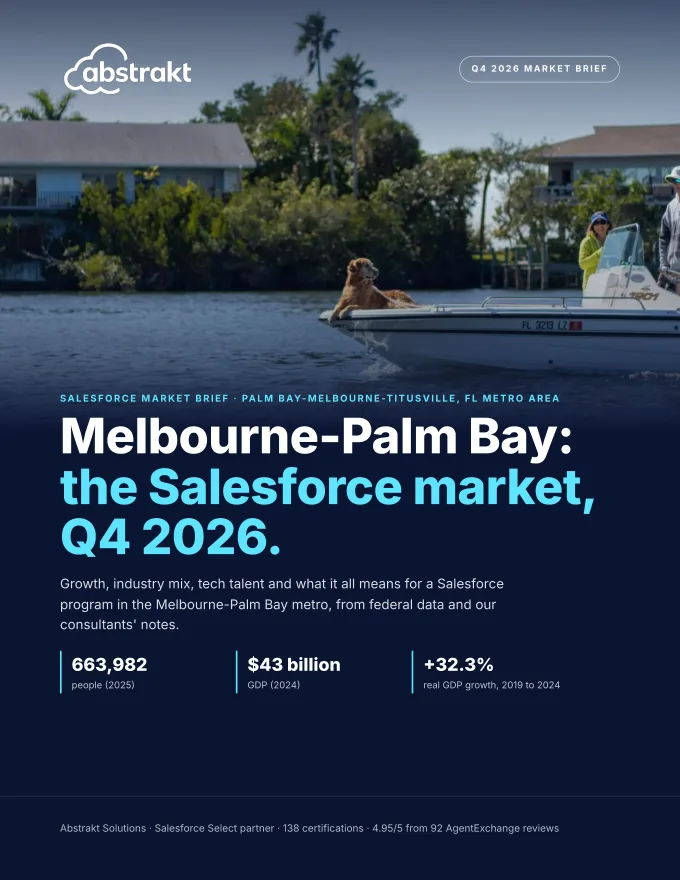
A free 24-page PDF with Melbourne's growth ranked against 100 metros, its industry mix, tech wages and nearby markets. It is offered on the public Melbourne page; send your customer there or get a copy for your own prep.
Get the Melbourne brief →Co-sell with Abstrakt in Melbourne
Working a Melbourne account? Bring in a named consultant for discovery, scoping or a health check. We reply within 4 business hours.