

How Salesforce work starts in Daytona Beach
Health care providers, retailers, contractors and manufacturers in Daytona Beach, Ormond Beach, Deltona and the rest of Volusia and Flagler counties are the focus of our Salesforce consulting here. Daytona Beach is one of our focus markets.
What buyers here usually run into
- 1
Dealer and distributor channels
Manufacturers that sell through dealers commonly struggle to share leads, orders and warranty claims with them. A partner portal gives dealers and the factory the same view of each customer.
- 2
Crews spread across a county
Construction and installation businesses often dispatch by phone and whiteboard. Mobile work orders with photos, checklists and cost tracking against the estimate show which jobs make money.
- 3
Research partners beside customers
Aviation and life-sciences organizations frequently mix grants, industry partners, startups and paying customers. Salesforce needs separate pipelines for each so partnership activity does not distort revenue forecasts.
Budget, team and partner questions
What drives cost
Daytona Beach scope depends mostly on how many customer touchpoints you connect: EHR and scheduling for providers, point of sale and loyalty for retailers, dispatch and job costing for contractors, and dealer portals for manufacturers. Storm-driven surges add capacity planning for service teams.
Admin or partner
Most retailers, contractors and dealer manufacturers here are better served by managed services than a full-time hire at first. Hospital systems more often have internal staff who take ownership once the build is done.
What buyers ask a partner
Ask the partner how they would handle a sudden surge in service requests after a storm, and how dealers would see warranty claims. For providers, ask what they configure before and after a BAA is in place.
The local economy and its biggest industries (4)
| Sector | Share of 2024 GDP | Where Salesforce fits |
|---|---|---|
| Health care and social assistance Salesforce for health & life sciences → | 10.8% | Health care and social assistance supplies 10.8% of the metro's 2024 GDP, more than any other private sector, and life sciences is one of Team Volusia EDC's targets. Providers here use Salesforce for referral intake, patient outreach and contact-center service, with access and consent designed in from the start. |
| Retail trade Salesforce for retail & consumer goods → | 9.9% | Retail is the metro's second-largest private sector at 9.9% of 2024 GDP, spanning chains, local shops and consumer brands. Retailers need loyalty, service and marketing driven by one customer record that includes store and online purchases. |
| Construction Salesforce for construction → | 6.8% | Builders, trade contractors and installation companies, part of a construction sector worth 6.8% of the metro's 2024 GDP, need estimates, crew schedules and job costs in one system instead of spread across spreadsheets. |
| Manufacturing Salesforce for manufacturing → | 5.7% | Manufacturing's 5.7% share of 2024 metro GDP and Team Volusia EDC's aviation, aerospace and advanced manufacturing targets point to configured products, dealer networks and warranty service that must connect to ERP. |
Source: U.S. Bureau of Economic Analysis, GDP by county (CAGDP2), 2024, summed to the metro area; private sectors only, excluding real estate and government. “At least” marks sectors where BEA suppresses some county figures.
Regional target sectors named by local economic development groups: Aviation & Aerospace, Advanced Manufacturing, Headquarters, Life Sciences, Logistics & Distribution, Finance and Insurance, Information Technology, Professional Services.
Salesforce products that fit Daytona Beach (6)
In the order we lead with them here, from the industries above.
Salesforce Service Cloud
The operating system for modern customer service, case, knowledge, voice, and AI agent assist together.
Salesforce Sales Cloud
The CRM where sales pipeline lives, when it is built right.
Salesforce Field Service
Scheduling, dispatch, mobile work orders and parts for teams that work on site.
Salesforce Experience Cloud
Customer, partner, and employee portals built on Salesforce.
Salesforce Marketing Cloud
Cross-channel marketing, email, mobile, journey, and Data 360-powered personalization at scale.
Salesforce Agentforce
AI agents that handle real work inside Sales Cloud, Service Cloud, and Marketing Cloud.
Where AI helps Daytona Beach service businesses
Daytona Beach's economy is service-heavy: health care at 10.8% of 2024 metro GDP, retail at 9.9%, construction at 6.8%, and accommodation and food services at 5.0%. Hospitality operators and retailers field the same booking, return, and order questions again and again, which suits grounded self-service. Home builders and contractors can use AI to summarize warranty requests and assign them to the correct trade. Aviation and aerospace firms, a regional target, may prefer document extraction for maintenance or training records. Each of these relies on up-to-date content and accurate customer records. Agents should hand off smoothly to staff when a question falls outside what they can answer reliably.
- Booking and return self-service
- Builder warranty request routing
- Maintenance record document extraction
Services buyers here usually need (7)
Salesforce Implementation in Daytona Beach
Across Volusia and Flagler counties, a first Salesforce build usually has to serve very different kinds of work in one org: patient referrals at a care provider, research partners at an aviation company, or bids and crews at a contractor. We spend discovery drawing the records each team handles and how they relate, then configure in a sandbox, load cleaned data and release in phases. The first phase covers the process that hurts most today, and each later phase goes live on its own.
By industry in Daytona Beach
- 1
Health care and social assistance
Care providers form the metro's biggest private sector, near 10.8% of 2024 GDP, ahead of retail at 9.9%. For a clinic network or home-care agency here, the opening release tends to be whatever moves a referral from fax or phone into a tracked queue. We fix the boundary with the clinical record before building, design queues by service line, and configure consent capture so outreach teams only contact people who have agreed to hear from them.
- 2
Aviation & Aerospace
Aviation and aerospace heads Team Volusia EDC's target list, and the aeronautical university's research park adds a startup incubator and engineering facilities to the county. Companies near that ecosystem implement Salesforce to keep customers, suppliers, research collaborators and program milestones apart. We model programs as their own records rather than stretching opportunities to fit them, and we agree early which technical or export-sensitive details must never be stored in the CRM at all.
- 3
Construction
Builders and trade contractors add roughly 6.8% of metro GDP. For them, implementation means the estimate, the job and the crew schedule living on one connected set of records, so a won bid becomes a job without re-keying. Field Service handles dispatch and mobile checklists for installers working across the county, and job costs roll up against the original estimate. We configure the bid pipeline first, since every later report depends on it being right.
Raise before scoping
Separate partners from paying customers
Organizations tied to university research, grants or incubators often have partners who never buy anything. Give those relationships their own record types and stages, so the sales forecast counts only real revenue and partnership activity still has a proper home.
Design for crews on the road
Installers and service technicians spread between the coast and the western side of the county need a mobile layout that works on a phone in a truck. Settle the handful of fields they must complete on each visit before building anything for the office.
Launch when your managers can support it
Book workshops and checkpoints around crew and office schedules, including early slots before trucks leave the yard, and put go-live cutovers on days when managers are in the office to answer questions.
Salesforce Integration in Daytona Beach
Integration projects in the Daytona Beach area usually connect Salesforce to one operational system that already works: an ERP holding orders and serial numbers, a warehouse system tracking shipments, or an agency management platform with policies. We map which system owns each field, pick a pattern that matches how current the data must be, and build error handling so failures are noticed. Where a manufacturer sells through dealers, we also connect a partner portal so dealers see the same order and warranty status as your staff.
By industry in Daytona Beach
- 1
Manufacturing
Manufacturing contributes about 5.7% of 2024 metro GDP, and Team Volusia EDC is courting more of it through its advanced manufacturing and aviation and aerospace targets. For a manufacturer selling through dealers, integration carries configured orders, hull or serial numbers and warranty registrations between ERP and Salesforce. Dealers then log service claims through Experience Cloud, the factory sees them against the right unit, and parts and credits flow back to ERP without anyone keying them twice.
- 2
Logistics & Distribution
Team Volusia EDC singles out logistics and distribution for recruitment. Distributors and warehouse operators field constant questions about where an order is, and the answer usually lives in a warehouse or transportation system rather than in Salesforce. Integration surfaces shipment status, delivery exceptions and proof of delivery on the account and the case, so customer service can answer on the first call and sales can see which customers keep hitting delays.
- 3
Finance and Insurance
For insurance agencies and brokerages, a Team Volusia EDC target sector, the key connection is between Salesforce and the agency management system that holds policies, premiums and carriers. We sync policy summaries and renewal dates into Financial Services Cloud or Sales Cloud, keep the agency system as the record of truth for coverage details, and send service requests back as tasks. Producers then plan renewals from one screen instead of two.
Raise before scoping
Match serial numbers across systems
Warranty and service integrations fail when a unit's identifier is formatted differently in ERP, the dealer portal and Salesforce. Agree one format and a rule for legacy records before any build, and test with real serial numbers from older model years.
Decide how fresh data must be
Order status that updates hourly may be fine for sales, while a service agent on a live call may need it immediately. Choosing real-time, near-real-time or scheduled sync field by field keeps integration cost and complexity only where they are justified.
Give every integration an owner
Smaller companies often lack an integration team, so connections fail silently when a password expires or a vendor changes an endpoint. Name one person to receive alerts for each integration, document how to restart it, and review the error log on a regular schedule.
Salesforce Optimization in Daytona Beach
Most optimization requests we see from Daytona Beach organizations come a few years after launch. The original design fit the business at the time, but new locations, services and staff have been added without anyone revisiting it. We watch people work, review usage data and automation, and interview the managers who read reports. The fixes are usually practical: fewer required fields, one Flow per object instead of several overlapping tools, list views that match daily jobs, and a handful of dashboards built on agreed definitions.
By industry in Daytona Beach
- 1
Accommodation and food services
Hotels, resorts and restaurant groups make up close to 5% of the metro's 2024 GDP. Those that use Salesforce for group sales, events or guest service often find it drifted into a contact list with a few reports attached. Optimization rebuilds the group-booking pipeline so sales managers can see tentative and confirmed business at a glance, links guest complaints to the right property, and automates the follow-up that used to depend on someone remembering.
- 2
Health care and social assistance
Care organizations in the county often expanded Salesforce one program at a time, and each program built its own queues, statuses and reports. Staff moving between programs relearn the system each time, and leaders cannot compare waiting times from one program to the next. We standardize the shared steps, keep program-specific fields where they are truly needed, clean up duplicate patient and referrer records, and rebuild reporting so every program is measured the same way.
- 3
Professional Services
Professional services appear on Team Volusia EDC's industries page, covering accounting, legal, engineering and consulting firms. In firms like these, partners often stop using Salesforce because entering activities takes longer than it saves. Optimization trims page layouts, adds email and calendar capture so activity logs itself, and gives each partner a single view of their clients and open work. Time saved for billable staff is the measure that decides whether the changes stick.
Raise before scoping
Watch users before changing anything
A short session sitting with a front-desk coordinator or a sales manager reveals more than any survey. We note the workarounds people use, such as sticky notes, side spreadsheets or duplicate entry, and design the fixes around removing those first.
Retire automation you no longer need
Older orgs often carry workflow rules and Process Builder flows written for processes that ended long ago. Each one slows saves and confuses troubleshooting. We list every automation, confirm with owners what is still needed, and migrate the survivors into maintainable Flows.
Fix duplicates before building dashboards
A dashboard counting the same guest, patient or client twice misleads everyone who reads it, and leaders stop trusting it quickly. Merge existing duplicates, add matching rules that block new ones at entry, and only then rebuild the reports leadership uses for decisions.
Salesforce Health Checks in Daytona Beach
Health checks for Daytona Beach organizations often begin with a practical worry: a portal, an integration or a new AI feature is planned, and nobody is sure what the org currently exposes. We review profiles, permission sets, sharing, guest and portal users, connected apps and integration accounts, then look at automation, custom code, data quality and adoption. Every finding gets a risk rating and an effort estimate, and the report ends with an ordered list of fixes your team or ours can start on straight away.
By industry in Daytona Beach
- 1
Life Sciences
Team Volusia EDC wants more life-sciences employers in the county. Smaller device, diagnostics and research companies often set up Salesforce quickly and add regulated processes later, such as complaint handling or distributor oversight. A health check shows whether complaint records carry field history, whether distributors or reps can see more than their territory, and which automations touch records that quality staff may later have to defend in an inspection or partner audit.
- 2
Health care and social assistance
Hospitals and care agencies here hold protected health information in Salesforce for referrals, outreach and scheduling. We test whether each role sees only what it needs, whether sensitive fields are encrypted, whether integration users pull more than their purpose requires, and whether portal or guest access exposes anything unintended. Findings are ranked by privacy risk, so the compliance office can act on the most serious ones before a planned audit or AI pilot.
- 3
Finance and Insurance
Insurance agencies and financial firms, targeted by Team Volusia EDC, keep policyholder, claims and financial details in Salesforce alongside sales activity. The review checks whether producers can see books that are not theirs, whether admins have been granted broader rights than needed, how long sensitive data is kept, and which exports or reports could leak customer information. We note which findings a carrier or examiner would most likely ask about.
Raise before scoping
Review portal and guest access
Experience Cloud sites for patients, dealers or policyholders are a frequent source of unintended exposure, because guest-user and sharing settings are easy to misconfigure. We test each site as an outside user would and list anything visible that should not be.
Clear debt before adding AI
Agentforce reads the same records and permissions your users do. If duplicates, outdated knowledge articles or loose sharing exist today, an agent repeats those mistakes at scale. The check marks which fixes must precede an AI pilot and which can follow.
Include integrations and packages
Installed packages and integration users often hold broad permissions granted years ago and never revisited. We list each one, what it can read and change, and whether it is still used, so dormant access can be removed and active access narrowed.
Salesforce Managed Services in Daytona Beach
Managed services for Daytona Beach companies usually replaces a part-time arrangement: an office manager or IT generalist who inherited Salesforce and handles it between other duties. We take over the request queue, run each Salesforce release through a sandbox before your users see it, and keep a prioritized backlog of enhancements and technical debt that we review with you on a regular schedule. Admins, Flow builders, developers and an architect are available as each request needs them, so you are not hiring for skills used occasionally.
By industry in Daytona Beach
- 1
Finance and Insurance
Finance and insurance is one of Team Volusia EDC's target industries, and an insurance brokerage is among the regional companies the EDC names. Agencies and brokerages running Salesforce need renewal automation, producer book security and agency-system syncs kept working as carriers and products change. A managed team monitors those renewal jobs, adjusts sharing when producers join or leave, and checks each Salesforce release against the policy and commission objects your staff rely on.
- 2
Retail trade
Among the metro's private sectors, retail sits second at near 9.9% of 2024 GDP, less than a point behind health care. Retailers using Salesforce for loyalty, customer service or promotions produce a steady stream of small requests: a new campaign audience, a changed case category, a store added to a territory. Managed services clears those promptly, keeps marketing consent data accurate and stops one-off fixes from piling up into technical debt.
- 3
Information Technology
Information technology appears among Team Volusia EDC's targets, and young firms from the aeronautical university's incubator are part of the local mix. Small software and IT service companies often need Salesforce changes every sprint, such as new product lines, subscription fields or partner deal registration, without the budget for a full-time admin. A managed arrangement gives them configuration, Flow and integration help on demand, with a release log so their own engineers know what changed.
Raise before scoping
Capture the part-time admin's knowledge
When the person who kept Salesforce running part time moves on, their knowledge usually leaves with them. We begin with a short handover and org review, write down how key automations and integrations work, and store that record where your team can find it.
Hold releases for busy weeks
Retailers and hospitality businesses have periods when no one wants system changes. Tell us your blackout weeks, and we schedule enhancements and Salesforce release testing around them, so nothing new or unfamiliar reaches staff in the middle of your busiest trading days.
Report on what the retainer delivered
Owners of smaller firms want to see value from ongoing spend. We keep a plain log of every request, its status and the time it took, and review it with you so priorities for the coming period reflect what the business actually needs.
Salesforce Migration in Daytona Beach
Two kinds of Daytona Beach migration show up most often. Local contractors and retailers are leaving spreadsheets, accounting-system contacts or a basic CRM they outgrew. Companies setting up headquarters or regional operations in the county often arrive with a legacy CRM from elsewhere that needs cleaning before anyone relies on it. In both cases we inventory the sources, agree what the Salesforce record should hold, deduplicate and standardize in staging, then rehearse the load in a sandbox before a short, planned cutover.
By industry in Daytona Beach
- 1
Headquarters
Team Volusia EDC lists headquarters operations among its target industries. A company moving head-office functions to the county often brings a CRM that several divisions customized separately. Before migrating, we decide which divisional fields and processes survive, retire the rest, and map everything to a single model. Relocation is a natural moment to shed years of clutter, so the new office starts with clean data rather than an exact copy of the old one.
- 2
Construction
Contractors across the county often run bids and jobs from spreadsheets, an estimating tool and the accounting system. Migrating such a firm means turning scattered customer names, project addresses and bid histories into accounts, sites and opportunities that link together. We standardize addresses, match customers who appear under several spellings, and bring over enough past bids to show win rates by job type without importing every abandoned estimate or draft.
- 3
Retail trade
Retailers moving customer data into Salesforce usually pull from a point-of-sale system, an email platform and a loyalty list that do not agree with one another. Migration merges those into one customer record, carries email consent with its source and date, and keeps purchase summaries rather than every transaction line. Marketing can then segment on real buying behavior from the first campaign after cutover, without a separate list to reconcile by hand.
Raise before scoping
Carry consent with its history
Email and text opt-ins must arrive in Salesforce with the date and source that prove them. Migrate consent as dated data rather than a bare checkbox, reconcile counts after each test load, and keep sends paused until the final numbers match.
Keep closed bids that teach something
Old estimates are useful for win-rate and pricing analysis but clutter daily views. Migrate closed bids from a recent period with outcome and job type, archive older ones outside Salesforce, and hide lost bids from the default list views estimators open.
Map divisions before loading
When a relocating company brings data from several divisions, each may use different account types and stages. Agree a single mapping for every picklist value and record type before the first test load, so reports work correctly the day after cutover.
Salesforce Implementation Rescue in Daytona Beach
Rescue work in Daytona Beach usually involves smaller organizations where one champion drove the Salesforce project and then left, or where a low-cost build went live without the processes it promised. Users drifted back to spreadsheets and paper, and leaders are unsure whether to push on or start again. We assess the org against what the business needs now, fix the problems that stop daily work, and decide piece by piece what to keep. Then we finish the essential scope in phases and retrain the people who gave up on it.
By industry in Daytona Beach
- 1
Advanced Manufacturing
Advanced manufacturing is a Team Volusia EDC target, and manufacturers' stalled projects often share a pattern: quotes and orders were meant to flow to ERP, but the integration was never finished. Reps quote in Salesforce, then re-enter orders elsewhere, and trust erodes. Recovery reconciles the product catalog and account records between systems, completes or rebuilds the integration, and proves it against real orders before asking reps to rely on it again.
- 2
Construction
Contractors sometimes buy Salesforce and Field Service together, then find the mobile app confusing and the scheduling rules incomplete. Crews go back to phone calls and the office to whiteboards. We simplify the technician app to the fields that matter on site, set territories and skills correctly, and relaunch dispatch with one crew or region first. Once that group is working reliably, the rest of the field team follows with the same training.
- 3
Health care and social assistance
Some care providers in the county now run two intake processes at once: the Salesforce one leadership bought and the fax-and-spreadsheet routine staff never gave up. In recovery we find where the paper or fax process still runs alongside Salesforce, remove the duplicate work, and fix permission problems that forced workarounds. Relaunch happens program by program with hands-on training, so coordinators see that the new process is faster than the one they returned to.
Raise before scoping
Find out why users left
Before fixing anything, ask the people who stopped using Salesforce what went wrong. The answers are usually specific, such as too many required fields, a slow page or a missing report, and they give the recovery plan its first and most visible priorities.
Recover the missing documentation
When the original champion or partner is gone, nobody may know why the org works as it does. We document objects, automation, integrations and permissions directly from the org itself, so your team has a written baseline to work from instead of guesswork.
Relaunch smaller than the original
A second attempt that tries to deliver everything at once repeats the first failure. Relaunch the process that matters most to one team, prove it works, then add the rest in phases with each one tested and trained before it goes live.
Industry plays in Daytona Beach (4)
Salesforce for Daytona Beach Health Care
Health organizations in the Daytona Beach area work in a competitive market, with two large hospital systems and many independent practices. Salesforce helps them understand and strengthen relationships: which physicians refer where, how quickly patients reach an appointment, and whether follow-up happens after discharge. We typically combine Service Cloud for access centers, Marketing Cloud for consent-based outreach and Experience Cloud for patient or referring-provider portals, adding Agentforce for routine questions once workflows and data are dependable.
No private industry contributes more to the Deltona–Daytona Beach–Ormond Beach economy than health care and social assistance, which accounted for 10.8% of 2024 GDP in Bureau of Economic Analysis data, ahead of retail trade. Team Volusia EDC includes life sciences among its target industries, alongside aviation, advanced manufacturing and information technology. Because the metro spans Volusia and Flagler counties, with population centers both on the coast and inland around Deltona, access, travel distance and coordination across many locations are practical concerns for providers.
Use cases to open with
- 1
Physician relations management
Liaisons responsible for growing referrals need to know which practices send patients, which have drifted and why. Salesforce can combine visit notes, referral volumes from scheduling data and open issues raised by each office. Leaders then direct liaison time toward practices where service problems, not competition, are causing referrals to slip, and track whether fixes bring the volume back over the following quarter.
- 2
Centralized patient access
When patients call to schedule, reschedule or ask about bills, a central access team needs one screen. Service Cloud with omni-channel routing, a knowledge base and integration to scheduling systems shortens calls and keeps answers consistent across locations. Supervisors get real queue and abandonment data instead of anecdotes about hold times, and can staff to the patterns they see. Patients who prefer text or online messaging can be served through the same console.
- 3
Follow-up after hospital discharge
Care teams working to reduce avoidable readmissions can use Salesforce to assign follow-up calls after discharge, track medication questions and escalate concerns to a nurse. Automated reminders and an Agentforce assistant can handle routine confirmations, leaving nurses and care coordinators time for patients whose answers suggest they need attention. Reports show completion rates by unit so managers can close gaps.
Raise before scoping
Scope PHI deliberately
Not every workflow needs clinical detail. Decide which processes truly require protected health information, keep the rest to demographics and contact preferences, and apply encryption, field-level security and event monitoring wherever PHI does live, in line with HIPAA and your compliance team's policies.
Keep the EHR authoritative
Clinical documentation belongs in the EHR. Pull appointments, encounters or discharge events into Salesforce through a controlled integration and avoid duplicate data entry. Agree with IT on which events trigger outreach so staff are never working from stale or incomplete information.
Supervise AI assistance closely
Automated agents in health care must stay within approved topics and hand off quickly to people. Start Agentforce on narrow tasks such as appointment confirmations, review transcripts regularly and keep any clinical question routed to licensed staff rather than answered automatically.
Salesforce for Daytona Beach Manufacturers
Manufacturing in the Daytona Beach area is smaller than health care or retail but more specialized: marine builders, aviation and aerospace suppliers and precision shops. Salesforce fits when it follows how each sells. Marine companies need dealer orders, build slots and warranty claims connected; aviation suppliers need engineering-led opportunities and quality documentation; job shops need faster, accurate quotes. We usually start with Sales Cloud and an Experience Cloud dealer or partner portal, then add Service Cloud or Field Service for aftersales work.
In Bureau of Economic Analysis data, manufacturing supplied 5.7% of the Deltona–Daytona Beach–Ormond Beach metro's 2024 GDP, fourth among private sectors after health care, retail and construction. Team Volusia EDC targets aviation and aerospace, advanced manufacturing and logistics and distribution, among others. An aeronautical university's research park in Daytona Beach adds an applied aviation and engineering research hangar, a low-speed wind tunnel and a startup incubator to that mix. Local manufacturers therefore range from established marine brands to early-stage aerospace ventures still proving their technology.
Use cases to open with
- 1
Dealer orders and build slots
Boat builders commonly allocate production slots to dealers and confirm options well ahead of delivery. Salesforce can manage dealer orders, option selections and build schedules, showing each dealer the status of their boats through a portal. Sales managers see allocation by region and model year, and production planning receives firm orders with fewer late changes that disrupt the line. Dealer inventory reports also show which models are aging on lots.
- 2
Aerospace engineering pursuits
Aviation suppliers and startups near the research park often win work through technical collaboration before a purchase order exists. Opportunities can track engineering contacts, test milestones, samples and required certifications, with documents attached. That keeps business development and engineering aligned on which programs are real, what the customer still needs to approve, and when revenue can reasonably be forecast. Grant-funded work can be tracked separately so it does not inflate the commercial pipeline.
- 3
Warranty and owner service
Aftersales work drives loyalty for marine and aviation products. Service Cloud cases tied to hull or serial numbers, owner records and dealer relationships make warranty claims traceable, and Field Service can schedule factory technicians when dealers need help. Patterns in claims feed back to engineering so recurring defects are fixed at the source rather than repaired one boat at a time. Owners get faster answers, and dealers spend less time chasing claim status.
Raise before scoping
Model the dealer relationship
Dealers are customers, partners and sometimes rivals for the same buyer. Define how leads are assigned, what dealers can see in the portal and how retail owner data is shared, and put those rules in dealer agreements as well as in Salesforce sharing settings.
Handle serialized products properly
Boats, engines and aerospace components are tracked by serial number throughout their lives. Use Salesforce assets linked to ERP serial records, keep ownership transfers current and make sure warranty terms follow the unit, not the original buyer, unless your policy says otherwise.
Right-size for smaller teams
Many Volusia County manufacturers run lean sales and service teams. Keep the first release focused, rely on standard features before custom code and plan for ongoing admin support, either in-house or through managed services, so the org does not stall after launch.
Salesforce for Daytona Beach Construction Firms
Contractors around Daytona Beach range from specialty trades installing insulation, roofing and mechanical systems to builders and general contractors working on homes, warehouses and commercial space. Salesforce works best when it ties selling to scheduling: leads and bids from builders and property owners, estimates that become work orders, and crews dispatched across Volusia and Flagler counties with mobile checklists and photos. We connect it to accounting so every job's actual cost can be compared with its estimate.
Only health care and retail outrank builders and specialty trades in the Deltona–Daytona Beach–Ormond Beach economy; the Bureau of Economic Analysis puts construction at 6.8% of the metro's 2024 GDP. Manufacturing adds 5.7% and accommodation and food services 5%, and both depend on facilities that contractors build, renovate and maintain. Team Volusia EDC does not target construction directly, but its targets, including logistics and distribution, headquarters, advanced manufacturing and aviation, all bring building projects. With population spread from the beach cities to Deltona and into Flagler County, contractors cover long service areas every day.
Use cases to open with
- 1
Builder account programs
Specialty trades working for production homebuilders win business community by community, with pricing set by plan and option. Sales Cloud can track each builder account, its active communities, negotiated price sheets and upcoming phases, and CPQ generates plan-level quotes from those sheets. When a builder releases new lots, the trade knows which pricing applies and roughly how many crews the phase will need.
- 2
Daily dispatch across two counties
Crews driving between Deltona, the beach cities and Flagler County lose hours to poor routing. Field Service schedules jobs by territory, skill and inspection deadline, optimizes routes, and gives installers mobile work orders with checklists and before-and-after photos. Dispatchers reshuffle the day when a builder's site is not ready, and homeowners or superintendents receive arrival notices automatically instead of calling for them.
- 3
Callbacks and warranty work
Warranty callbacks eat margin when nobody tracks them. Service Cloud logs each callback against the original job, crew and materials, routes it for scheduling, and reports repeat issues by installer or product. Builders submit and follow callbacks through a portal, and managers can see whether problems cluster by crew, supplier or community, which points training and purchasing at the real cause.
Raise before scoping
Model builders, communities and lots
Production-builder work needs a data model deeper than account and opportunity. Decide how builders, communities, plans, lots and jobs relate before build, because pricing, scheduling and warranty reporting all depend on that structure and are hard to rework once crews are using it.
Prepare for storm-driven surges
After major storms, roofing, restoration and repair requests can spike far beyond normal capacity. Design intake queues, triage rules and temporary crew assignments ahead of time, and make sure Field Service scheduling can accommodate subcontracted crews brought in to help with the backlog.
Tie job cost to estimates
Margin reporting depends on comparing actual labor and materials to what was estimated. Capture time and material use on the mobile work order, sync costs from accounting on a set schedule, and agree on job and cost-code identifiers across systems before go-live.
Salesforce for Daytona Beach Retailers
Retailers around Daytona Beach sell to two audiences: residents who shop every week and visitors who may buy once a year. Salesforce helps by building one customer profile from store, online and loyalty data, then using it to tailor messages to each group, run service from the same record, and measure what campaigns actually sell. Data 360 (formerly Data Cloud) unifies the sources, Marketing Cloud handles journeys, and Service Cloud gives staff the context to resolve questions quickly.
Shops, grocers and other retailers account for 9.9% of 2024 GDP in the Deltona–Daytona Beach–Ormond Beach metro, according to Bureau of Economic Analysis county figures; only health care contributes more. Accommodation and food services add another 5% of GDP, a sign that visitors as well as residents drive local spending on the coast and inland. Team Volusia EDC does not target retail, focusing instead on aviation, manufacturing, logistics, headquarters and similar sectors. The metro spans Volusia and Flagler counties, coastal and inland, so retailers serve distinct communities with different shopping habits.
Use cases to open with
- 1
Resident and visitor segmentation
A shopper with a local address and weekly purchases needs different messages than a visitor who bought once during an event weekend. Data 360 (formerly Data Cloud) can combine point-of-sale, e-commerce and loyalty data, classify customers by visit pattern, and pass those segments to Marketing Cloud. Residents receive replenishment and loyalty offers, while visitors get reasons to buy online after they go home.
- 2
Store-level service and pickup
Buy-online-pick-up-in-store, special orders and returns generate questions that stores answer inconsistently. Service Cloud routes those inquiries to a central team or the right store, shows order history and fulfillment status on the case, and lets staff send updates by text or email. Managers see which locations have slow pickup times or frequent order problems and can fix staffing or process.
- 3
Loyalty program management
Loyalty programs work when members can see their points and rewards and the business can see which rewards change behavior. Salesforce Loyalty Management, or a connected loyalty platform, tracks enrollment, tiers and redemptions, while Marketing Cloud triggers reminders about expiring rewards. Reports compare member and non-member spending by store so leadership can judge whether the program earns its cost or needs a different reward structure.
Raise before scoping
Plan consent and messaging rules
Florida retailers texting and emailing customers must honor opt-ins, opt-outs and quiet hours under federal and state telemarketing rules. Store consent by channel and source, sync it across every system that sends messages, and have counsel review the approach, because mistakes here create legal exposure quickly.
Link shoppers across channels
Store purchases often lack an email address, while online orders have one. Decide which identifiers, such as loyalty number, phone and email, link records, how confident a match must be, and how customers are merged, before any segmentation is built on top of the data.
Staff for seasonal peaks
Visitor-driven peaks bring more questions, orders and returns in short windows. Build routing, macros and knowledge articles that seasonal staff can learn quickly, and make sure licenses and permission sets can be added and removed without admin bottlenecks each time the calendar turns.
Case studies to send (3)
From the industries this market leans on. Client names are anonymized and these projects are not specific to Daytona Beach.
The Daytona Beach Salesforce market brief, Q4 2026
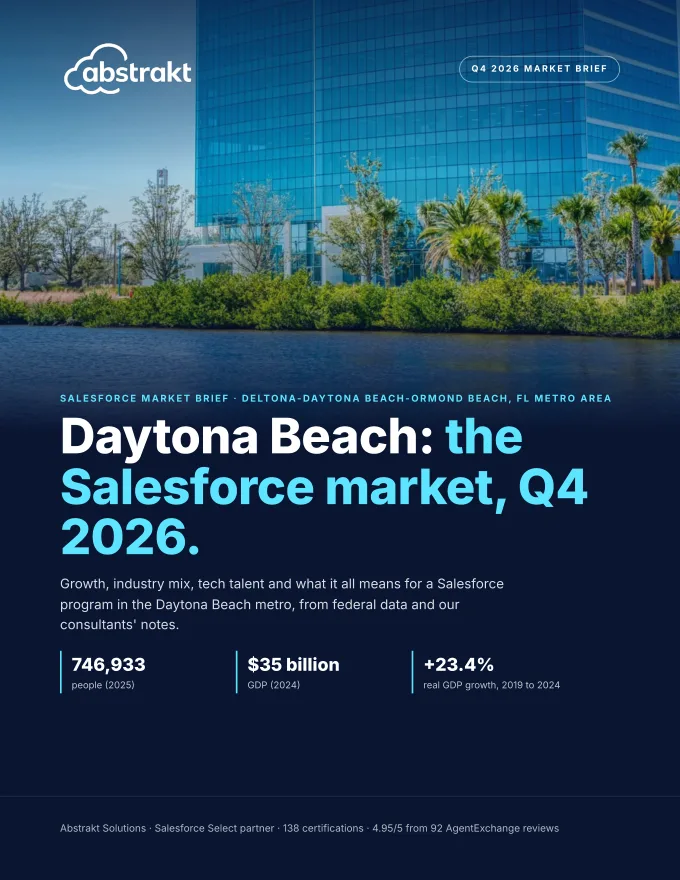
A free 23-page PDF with Daytona Beach's growth ranked against 100 metros, its industry mix, tech wages and nearby markets. It is offered on the public Daytona Beach page; send your customer there or get a copy for your own prep.
Get the Daytona Beach brief →Co-sell with Abstrakt in Daytona Beach
Working a Daytona Beach account? Bring in a named consultant for discovery, scoping or a health check. We reply within 4 business hours.