

How Salesforce work starts in Miami
Abstrakt Solutions is a Salesforce Consulting Partner for trade, professional services and healthcare companies across South Florida, from Miami-Dade to Broward and Palm Beach. Miami is one of our focus markets.
What buyers here usually run into
- 1
Cross-border customers
Companies serving Latin America need multi-currency, multi-language processes and data models that reflect how international accounts are actually managed.
- 2
Hospitality and guest service
Travel and hospitality businesses need service at volume across channels, where routing and knowledge matter as much as sales.
- 3
Growing past starter tools
A large base of fast-growing small and mid-sized firms means many teams outgrowing spreadsheets and lighter CRMs at the same time.
Budget, team and partner questions
What drives cost
Miami costs are driven by multi-currency and translation setup, the number of country-specific processes, and integration with ERP, freight or reservation systems. Firms leaving a lightweight CRM also pay for duplicate cleanup and field mapping before data moves.
Admin or partner
Many South Florida companies are small or mid-sized and have no dedicated Salesforce admin yet. A managed services partner usually covers configuration, integrations and bilingual training, with an operations or sales leader owning priorities.
What buyers ask a partner
Ask for multi-currency, multi-language and cross-border references, and how the partner handles WhatsApp or other messaging channels in Service Cloud. Ask whether training and documentation can be delivered in Spanish.
The local economy and its biggest industries (4)
| Sector | Share of 2024 GDP | Where Salesforce fits |
|---|---|---|
| Professional, scientific, and technical services Salesforce for professional services → | 9.2% | Agencies, consultancies and technology services firms, many serving Latin American clients, need pipeline and account management across languages and time zones. |
| Wholesale trade Integration → | 9.0% | Importers, exporters and distributors need order, shipment and customer data connected across countries and currencies, which puts integration at the center of any Salesforce project. |
| Health care and social assistance Salesforce for health & life sciences → | 7.1% | Health systems and healthcare services companies use Salesforce for patient engagement, scheduling and contact-center service, with privacy designed in. |
| Finance and insurance Financial Services Cloud → | 6.4% | Banks, wealth managers and insurers serving domestic and international clients need relationship views and compliant communications. |
Source: U.S. Bureau of Economic Analysis, GDP by county (CAGDP2), 2024, summed to the metro area; private sectors only, excluding real estate and government. “At least” marks sectors where BEA suppresses some county figures.
Regional target sectors named by local economic development groups: Aviation & Aerospace, Trade & Logistics, Finance, Technology, Life Sciences & Healthcare, Creative Industries.
Salesforce products that fit Miami (6)
In the order we lead with them here, from the industries above.
Salesforce Sales Cloud
The CRM where sales pipeline lives, when it is built right.
Salesforce Service Cloud
The operating system for modern customer service, case, knowledge, voice, and AI agent assist together.
Salesforce Experience Cloud
Customer, partner, and employee portals built on Salesforce.
Salesforce Marketing Cloud
Cross-channel marketing, email, mobile, journey, and Data 360-powered personalization at scale.
Salesforce Financial Services Cloud
Industry CRM for wealth management, banking, insurance, and lending, built for compliance from the start.
Salesforce Agentforce
AI agents that handle real work inside Sales Cloud, Service Cloud, and Marketing Cloud.
Practical Agentforce uses for Miami trade and services
Start with wholesale trade, which accounted for 9.0% of the Miami metro economy in 2024. Distributors handling import and export accounts receive order-status, pricing and documentation questions, often in more than one language, and an agent grounded in current catalog and shipment records can prepare answers for staff to check. Professional services, at 9.2%, benefit from lead triage that scores inbound inquiries and routes them to the right partner. Retailers, at 7.5%, can use knowledge-grounded self-service for returns and store policies. The groundwork is unglamorous: deduplicated accounts, clear field-level permissions, multilingual articles someone owns, and review steps before an agent speaks to customers.
- Preparing answers on trade shipment status
- Scoring and routing inbound service inquiries
- Self-service for returns and policies
Services buyers here usually need (7)
Salesforce Implementation in Miami
For most Miami companies, implementing Salesforce means designing for more than one country from day one. Distributors, professional firms and healthcare groups across Miami-Dade, Broward and Palm Beach often sell in several currencies and languages, and many are replacing spreadsheets rather than an older CRM. We settle currency handling, translation, territories and record ownership during design, build and test in a sandbox, load cleaned data, then train each team on the screens it will use, in the language it works in.
By industry in Miami
- 1
Wholesale trade
Wholesale trade produced about 9.0% of the metro's 2024 GDP, nearly level with professional services, and trade and logistics is a Beacon Council target sector. Importers and exporters implementing Salesforce need an account model that reflects buyers in several countries, price lists by currency, and order status visible without a phone call to the warehouse. We design account hierarchies, currency rules and the ERP handoff together in the first phase, because each one constrains the others and retrofitting them later means reworking reports and sharing.
- 2
Professional, scientific, and technical services
By output, the biggest private slice of the Miami economy belongs to agencies, consultancies and technology services firms. An implementation for them centers on pursuit pipeline, engagement tracking and client reporting, often for clients across Latin America as well as the U.S. We keep the first release narrow: opportunity stages that match how work is actually won, a clean account structure, and dashboards partners will open. Project and resource tracking can follow once the pipeline data has earned people's trust.
- 3
Health care and social assistance
Physician groups, clinics and healthcare services companies here usually implement Salesforce to run appointment requests, patient outreach and contact-center service for callers who may prefer English or Spanish. Privacy decisions come first: which patient data enters Salesforce at all, who can see it, and how consent is recorded. We agree those rules with compliance before configuration starts, then build Service Cloud queues and knowledge articles in both languages so agents give the same answer whichever language a caller uses.
Raise before scoping
Decide currency rules early
Switching on multi-currency takes minutes; deciding the corporate currency, whether to use dated exchange rates and how forecasts roll up takes real discussion. Settle those in design, since quotas, reports and commission calculations all depend on them, and changing course later means reloading historical opportunities.
Pick one territory logic
Teams across Miami-Dade, Broward and Palm Beach may split accounts by county, by country served or by product line. Choose one primary territory model for launch and document the exceptions, rather than encoding every informal arrangement into assignment rules nobody can explain a year later.
Keep the first release tight
Many South Florida firms are moving from spreadsheets to their first real CRM. A focused first release covering accounts, contacts, pipeline and a handful of reports gets people using the system; service, marketing and portals are easier to add once the basics are trusted.
Salesforce Migration in Miami
Most Miami migrations start from spreadsheets, shared inboxes or a lighter CRM that a growing firm has outgrown. Source data often mixes English and Spanish entries, several currencies and inconsistent country formats, so cleanup matters more than the load itself. Our sequence is to catalog each source, decide field by field what earns a place in Salesforce, clean and merge records before they load, rehearse the move in a sandbox until counts reconcile, and switch over outside your peak selling weeks.
By industry in Miami
- 1
Finance and insurance
The Beacon Council targets finance for growth, and BEA figures put finance and insurance at about 6.4% of the metro's 2024 output. Wealth managers, insurance agencies and lenders moving to Salesforce often bring client records from a portfolio system, an agency management tool and personal spreadsheets. Migration means linking those into households or relationships, carrying over the activity history compliance may ask for, and restricting sensitive fields before anyone logs in, not after the first audit question.
- 2
Retail trade
Retailers switching to Salesforce usually hold customer data in a commerce platform, a loyalty tool and an email service, each with its own identifiers. A migration has to decide which record wins when the same shopper appears in all three, and which consent flags carry across. We merge on agreed rules, preserve opt-out status exactly, and load purchase summaries rather than every transaction, which keeps the new org fast and gives marketers segments they can use immediately.
- 3
Technology
Miami's startup community, part of a Beacon Council target sector, produces many companies that begin on free or low-cost CRMs and move to Salesforce once enterprise deals, investor reporting or a second sales team arrive. Their data is usually recent but loosely structured. We define stages and required fields before migration, link product usage data to accounts, and bring over only the history that affects forecasting, so the new org starts cleaner than the one it replaces.
Raise before scoping
Standardize names and countries
Company and contact names entered by bilingual teams appear with and without accents, legal suffixes and translated terms. Standardize country codes, accent handling and legal-entity naming before deduplication runs, or matching rules will miss obvious duplicates and create a second cleanup project right after go-live.
Load deals in original currency
When migrating closed opportunities, load each one in the currency it was sold in, along with the historical rate if you plan to use dated exchange rates. Converting everything to dollars during migration throws away information that finance and regional managers will ask for later.
Choose a quiet cutover window
Pick a cutover date away from quarter-end and your heaviest selling weeks, announce a short freeze on the old system, and plan a final delta load for late changes. A team caught working in two systems during a busy period tends to cling to the old one.
Salesforce Integration in Miami
For many Miami companies, integration is the core of the Salesforce project rather than an add-on. Firms moving goods between the U.S., Latin America and the Caribbean keep orders, shipments, invoices and customs details in ERP and logistics systems, and sales needs that picture without re-keying it. We decide which system owns each record, choose between MuleSoft, Workato or direct APIs based on volume and upkeep, handle currency and address differences in the mapping, and add alerts so failed syncs surface right away.
By industry in Miami
- 1
Wholesale trade
Distributors and importers are a large part of the metro's economy, and the value they get from Salesforce depends on ERP data. Reps need credit status, open orders and invoice history for each account, often in the buyer's currency. We bring orders and invoices across as read-only records, keep pricing authoritative in one place, and reconcile customer identifiers across countries so a buyer with branches in several markets appears as one hierarchy rather than a dozen unrelated accounts.
- 2
Aviation & Aerospace
Aviation and aerospace is a Beacon Council target sector, and parts suppliers, maintenance providers and service firms around the region's airports run on quality and inventory systems that sit outside the CRM. Integration lets account teams see part availability, repair order status and certification documents alongside the customer record. Because those source systems are regulated and slow to change, we usually integrate through middleware with read access first, adding write-back only where a clear business case exists.
- 3
Life Sciences & Healthcare
The Beacon Council also targets life sciences and healthcare, a field where integration choices carry privacy weight. Healthcare services companies and device distributors here typically need Salesforce connected to scheduling, billing or electronic health record systems without copying more protected data than the workflow requires. We design each integration to carry the minimum fields needed, log every transfer and keep clinical detail in the source system, so contact-center and sales teams have context without Salesforce becoming a second medical record.
Raise before scoping
Normalize international addresses
Address formats, tax identifiers and phone numbers differ across Latin American countries, and integrations that assume U.S. formats reject or mangle those records. Agree canonical formats and validation in the integration design, and route exceptions to a queue someone owns instead of letting them fail without anyone noticing.
Decide who converts currency
When the ERP and Salesforce both store amounts, choose which system converts currencies and at what rate. Mismatched conversion logic is a common reason pipeline and bookings reports disagree with finance, and it is far easier to settle during design than to reconcile after months of synced data.
Give failed records an owner
Smaller firms often lack an IT team to watch integration logs. Set alerts that reach a named business user in plain language, document the fix for the errors that recur, and include that runbook in the handover or in managed services, so a broken sync is caught the same day.
Salesforce Managed Services in Miami
Managed services for Miami companies usually fills an admin role that was never fully staffed. The Census Bureau counted more than 222,000 business establishments in the metro in 2023, and many of the firms using Salesforce here run it with a part-time owner. We take over the request queue, keep translations and currency tables current as the org changes, review each Salesforce release in a sandbox, and work through enhancements in the order your leadership sets, with a regular review of what shipped and what comes next.
By industry in Miami
- 1
Retail trade
Retail trade accounts for about 7.5% of 2024 metro GDP, and retailers here commonly run storefronts, e-commerce and email marketing in separate tools. For retail teams on Salesforce, managed services is mostly about keeping customer data and marketing connections healthy week to week: watching sync errors between commerce, point-of-sale and Marketing Cloud, adjusting segments ahead of major campaigns, and merging duplicate customer profiles before they distort loyalty and campaign reporting.
- 2
Technology
The Beacon Council lists technology as a target sector and counts about 2,500 startups in Miami's ecosystem. Young software companies change their go-to-market often: new pricing, a second sales motion, a partner program. A managed services team absorbs that churn by adjusting stages, fields and automation as the model shifts, while keeping a change log so the org does not accumulate the undocumented shortcuts that eventually force an expensive rebuild.
- 3
Trade & Logistics
Trade and logistics is one of the Beacon Council's target sectors, and freight forwarders, importers and distributors depend on integrations that tend to break quietly. Our managed services work for these firms includes monitoring the jobs that move orders, shipments and invoices into Salesforce, correcting failed records before sales notices a gap, and handling the steady flow of user, permission and report requests from sales and operations teams working across several countries.
Raise before scoping
Keep translations in step
Every new field, picklist value or email template in a bilingual org needs a translation, or Spanish-speaking users end up with screens in two languages. We treat translation as part of each change's definition of done, so the Translation Workbench stays current instead of drifting further after every enhancement.
Read releases against customizations
A new Salesforce release sometimes shifts Flow behavior, permission defaults or Lightning page components without warning to end users. We read the release notes against your org, test the items that touch your setup in a sandbox, and tell users what is changing before it reaches production, not after the first support ticket arrives.
Name one person to rank requests
When sales, service and marketing all submit requests, the team that asks loudest tends to get served first. One business owner should set the order of the backlog each cycle, and a short report of what shipped keeps spending tied to company priorities rather than inbox volume.
Salesforce Optimization in Miami
Our first question in a Miami optimization engagement is where people go instead of Salesforce, and why. In a market full of fast-growing firms, orgs tend to collect fields, automation and reports faster than anyone retires them. We measure logins and field completion, interview reps and managers, then trim layouts, merge duplicate accounts, fold old workflow rules into Flows and rebuild dashboards around the figures leadership actually reviews. Improvements reach users in small batches, and whichever team is affected gets a brief demo of what moved and why.
By industry in Miami
- 1
Professional, scientific, and technical services
Measured by BEA output, professional and technical services edges out wholesale trade as the top private sector in the metro, around 9.2% of 2024 GDP. At consulting, legal, marketing and technology services firms, the live version of a pursuit often sits in a partner's inbox while Salesforce shows last month's picture. Optimization for them means fewer opportunity fields, stages that mirror how engagements are really won, and a pipeline view partners check before their weekly meeting. Once that view is accurate, updating the system becomes routine rather than a chore.
- 2
Finance and insurance
Wealth managers, insurers and lenders in South Florida frequently serve domestic and international clients from the same team. Over time their orgs gather duplicate household and entity records, compliance fields nobody fills in and reports built one request at a time. We consolidate relationship records, remove fields that no review depends on, and rebuild advisor and management dashboards so they agree with the figures finance reports, which is usually what persuades advisors to rely on the system again.
- 3
Creative Industries
Creative industries are on the Beacon Council's target list, and agencies and production firms here tend to adopt Salesforce quickly and then outgrow their first setup. Typical problems are projects tracked as opportunities, several overlapping lead sources and resourcing done in spreadsheets. We separate new-business pipeline from delivery, standardize how leads are attributed, and give account leads a single page per client showing active work, open proposals and recent billing.
Raise before scoping
Check how each language looks
If Spanish-speaking users see untranslated fields or help text, they stop filling those fields in. An optimization review in Miami should include how the org appears in each active language, since translation gaps often explain low field completion better than any shortfall in training does.
Retire automation in order
When successive admins have each left their mark, one object may fire a workflow rule, a Process Builder and a Flow on the same save. Map what each one does, move the logic into one Flow per object where practical, and deactivate the old versions only after testing, so a cleanup does not silently drop a notification someone depended on.
Agree metric definitions first
Rebuilding reports is wasted effort if sales, finance and leadership define pipeline or bookings differently. Write the definitions down, including how multi-currency deals convert, and build dashboards on them. When one set of numbers is accepted, the side spreadsheets usually fade away without a mandate.
Salesforce Health Checks in Miami
A health check gives a Miami company a clear view of what its Salesforce org actually contains before the next investment. Here that often means an org built quickly by a startup team or a former partner, with admin access spread widely, duplicate international accounts and automation nobody fully understands. Our consultants examine permissions, record quality, automation, leftover customizations, connected systems and usage, talk with the people who rely on the org, and sort every finding by risk and effort so the order of work is obvious.
By industry in Miami
- 1
Health care and social assistance
At roughly 7.1% of the metro's 2024 output, health care and social assistance ranks just behind retail in South Florida. Clinics, physician groups and healthcare services companies that use Salesforce for outreach and patient service need to know exactly where protected information sits and who can reach it. Our review traces those fields through profiles, permission sets, reports, list views and integrations, flags exports and guest access that widen exposure, and ranks the fixes your compliance team should see first.
- 2
Finance and insurance
Banks, wealth firms and insurers serving clients in several countries often have sharing rules layered on through years of reorganization. A health check tests whether an advisor can open accounts outside their book, whether audit trails are enabled on sensitive fields, and whether client communications are logged where examiners expect to find them. Each finding comes with the specific setting to change rather than a general recommendation, so your admin or partner can act on it directly.
- 3
Professional, scientific, and technical services
Consulting and services firms tend to add tools faster than they retire them, leaving managed packages, idle integrations and custom fields that still carry a cost. We inventory installed packages and connected apps, check which still hold active permissions, and measure how many fields on key objects are populated at all. That produces a practical list of what to remove before renewal, or before new products are layered onto an org that is already crowded.
Raise before scoping
Test readiness before Agentforce
AI agents act with the permissions and data they are given. Before any Agentforce pilot, confirm that sharing is tight, duplicate accounts are merged and knowledge articles are current in every language customers use, since an agent answering in Spanish from outdated content creates service problems quickly.
Revisit old connected apps
Fast-growing firms often authorize connected apps for trials that were never formally ended. Review which integrations still hold access, which user accounts they run under, and whether those users have more permission than the job needs. Integration users with full administrator rights are a frequent finding.
Scope every active language
A review that checks only the English experience misses problems. Validation messages, help text and email templates in other languages can be outdated or missing, which affects both data quality and customer communications. Include each active language in scope so the fixes cover the whole org.
Salesforce Implementation Rescue in Miami
When a Salesforce project goes wrong in Miami, the causes are rarely exotic: a design that ignored multi-currency or multi-country selling, data loaded without cleanup, integrations left half-built, or a partner who moved on mid-project. A short review of the org, its data and the original statement of work comes first; urgent blockers get fixed next, and only then do we rule on what stays, what gets repaired and what is rebuilt. The remaining scope is finished with documentation and a relaunch your teams can trust.
By industry in Miami
- 1
Trade & Logistics
Trade and logistics companies, a Beacon Council target sector, are especially exposed when an implementation treats international sales as an afterthought. Stalled projects in this sector often show every country built as its own record type, exchange rates typed in by hand and an ERP connection that was never finished. Recovery usually keeps the account and contact data, replaces the country-by-country clutter with one model, and completes the integration so orders and invoices appear without manual entry.
- 2
Retail trade
Retail projects stall most often around customer data: profiles from commerce, stores and marketing were supposed to merge but never did, and campaigns now reach the same shopper several times. A rescue here starts by confirming that consent and opt-out handling is correct, because errors there carry legal risk. It then rebuilds the matching logic and marketing connections so segments are reliable before the next seasonal or promotional campaign goes out.
- 3
Health care and social assistance
Healthcare organizations sometimes pause a Salesforce launch when compliance raises concerns late in the project. Restarting from scratch is rarely necessary. We map where patient data flows, tighten permissions and sharing, remove fields that should never have been in scope, and document the controls reviewers asked about. The rest of the build, such as queues, case processes and knowledge, is usually salvageable once those privacy questions have clear, documented answers.
Raise before scoping
Secure logins and documents
Departing partners sometimes hold the only copies of admin credentials, integration user passwords and design documents. Confirm that your company controls every admin login, integration account and code repository before recovery begins, so the rescue is not held up by access requests to a firm that is no longer engaged.
Stabilize before redesigning
Teams that have lost confidence need a working system quickly. Fix what blocks daily selling and service first, such as failing automation, broken assignment rules and missing picklist values, then take on design changes. Early, visible fixes buy the patience a longer recovery requires.
Relaunch in every working language
If the first launch failed partly because users found the system confusing, the relaunch has to be easier. Translate what users see, simplify layouts and train in short sessions by team. Quick-reference guides in both English and Spanish help mixed-language teams start from the same understanding.
Industry plays in Miami (3)
Salesforce for Miami Professional Services Firms
For Miami professional services firms, clients often sit in several countries and relationships run through referrals from other advisors, banks and family offices. Salesforce keeps those relationships visible across partners and offices, handles engagements in more than one currency and language, and ties marketing and events to new matters and engagements. We build the pipeline around how your firm is introduced to clients and how engagements are scoped and billed, then connect it to time and billing systems.
Miami's biggest private industry by output is professional work: scientific, technical and professional services made up 9.2% of metro GDP in 2024, according to county data from the Bureau of Economic Analysis. The Miami-Dade Beacon Council's target industries include finance, technology, and trade and logistics, all heavy buyers of legal, accounting and advisory work. The market page for Miami points to cross-border clients and a large base of fast-growing smaller firms, which describes much of the demand service firms here see: international structures, growing companies and relationships that span borders.
Use cases to open with
- 1
Referral source tracking
Many engagements start with an introduction from another law firm, a banker, an accountant or a family office. Recording referral sources as accounts and contacts, and linking each new matter or engagement to the introducer, shows partners which relationships actually send work, prompts reciprocal introductions and helps business development plan events around the sources that matter most. Referral sources that have gone quiet show up on a simple dashboard.
- 2
Cross-border client structures
Clients often include parent companies abroad, U.S. subsidiaries, trusts and individuals in several countries. Salesforce account hierarchies and relationship maps can reflect those structures, while multi-currency support lets fees and pipeline be recorded in the client's currency and reported in dollars. Partners then see the whole relationship rather than one entity at a time. Country and language preferences also guide which partner leads each conversation.
- 3
Bilingual marketing and events
Seminars, client alerts and events in English and Spanish are common growth tools for Miami firms. Marketing Cloud can manage bilingual content, invitations and registrations by practice and country, and record attendance on the contact, so partners see who engaged before their next call and marketing can connect events to the engagements that followed. Unsubscribes and preferences are honored per language and practice.
Raise before scoping
Screening international clients
Firms taking on clients from several countries often run know-your-client and sanctions screening before engagement. Decide whether Salesforce launches those checks, records their outcome or simply links to the screening tool, and keep engagement records from moving forward until the result is logged. Compliance staff define the rules.
Currencies, languages and data
Turning on multi-currency and translations affects reports, pricing and integrations. Decide early which currencies and languages you need, how exchange rates will be maintained, and how client data from other countries will be stored and protected under their own privacy rules.
Growth beyond starter tools
Fast-growing firms often arrive from spreadsheets or a lighter CRM with inconsistent data. Clean contacts and relationships before migration, standardize service lines and stages, and keep the first release small enough that partners use it every week. Add automation only once the basics are trusted.
Salesforce for Miami Wealth Managers
Wealth managers in Miami frequently serve families whose members, businesses and assets span several countries. Salesforce, usually on Financial Services Cloud, can represent those relationships accurately: households with members in different jurisdictions, trusts and holding companies, and the advisors, attorneys and accountants around them. We add onboarding workflows that collect the documentation international clients require, communication in each client's preferred language, and integrations with custodians and planning tools so advisors see the whole family on one screen.
Measured by output, finance is not Miami's biggest industry: banks, insurers and investment firms together produced 6.4% of metro GDP in 2024, per federal BEA estimates, trailing four other private sectors. The Miami-Dade Beacon Council nonetheless lists finance among its target sectors, together with trade and logistics, technology and life sciences. Cross-border customers, especially from Latin America, are one of the defining challenges for companies across the metro. For wealth managers, that translates into multi-currency holdings, family members abroad, and documentation and language needs that a standard domestic CRM setup does not anticipate.
Use cases to open with
- 1
Families and entities across borders
A single relationship might include parents in Miami, children studying abroad, a family business in another country and several trusts. Financial Services Cloud can model households, individuals, legal entities and their roles, with countries of residence and tax status recorded for each member. Advisors see who influences decisions, which accounts belong to whom, and which outside professionals to include in planning conversations, all from the family's household record.
- 2
Onboarding with enhanced documentation
International clients typically require more documentation: identity papers from other countries, source-of-wealth evidence and entity records. A guided onboarding flow in Salesforce, with an Experience Cloud portal for secure uploads, tracks each requirement, flags missing items and routes files to compliance for review. Clients see what is outstanding, advisors know when accounts can be funded, and the firm keeps an auditable record of every approval.
- 3
Communication in several languages
Clients may prefer Spanish, Portuguese or English, and preferences can differ within a family. Salesforce records language and channel preferences for each person, and Marketing Cloud can send market commentary, event invitations and service notices in the right language with consistent compliance review. Advisors can also filter their books by language when planning seminars or assigning associates who speak with particular families.
Raise before scoping
KYC and anti-money laundering
Firms serving international clients face heightened know-your-customer and anti-money laundering expectations. Salesforce should record due diligence status, risk ratings and review dates, and hand screening to specialist systems where you already use them. Thresholds and escalation rules come from your compliance officers, and every review decision is logged against the client.
Custodian and currency data
Holdings may sit with several custodians and in more than one currency. Decide which figures Salesforce displays, which system converts currencies, and how often balances refresh. Showing advisors stale or mismatched totals erodes trust quickly, so reconcile integration output against custodian statements during testing.
Supervision and recordkeeping rules
Registered advisers and broker-dealers must meet SEC and FINRA expectations for communications, supervision and books and records. Capture client communications where required, route marketing for approval, and confirm retention periods with compliance. We flag these obligations in design sessions rather than offering regulatory interpretation.
Salesforce for Miami Retailers and Consumer Brands
Miami consumer companies often run two businesses at once: selling to shoppers in South Florida and supplying distributors, retailers and agents abroad. Salesforce can bring both together, with Service Cloud handling bilingual customer contact, Marketing Cloud and Data 360 (formerly Data Cloud) building unified shopper profiles, and account records for international distributors showing orders, credit terms and shipments. We connect commerce, point of sale and ERP data so teams see the same customer and inventory picture whichever channel they work in.
Retail trade contributed 7.5% of Miami metro GDP in 2024 per the Bureau of Economic Analysis, with wholesale trade larger still at 9%, ahead of both health care and finance. The Miami-Dade Beacon Council includes trade and logistics among its target sectors, alongside aviation, finance, technology and creative industries. Cross-border customers are a recurring challenge for companies across the metro, which is why consumer businesses here tend to combine domestic shoppers with export and distribution relationships. CRM design has to reflect both motions without creating two disconnected customer lists.
Use cases to open with
- 1
Bilingual customer service
Shoppers contact brands in English, Spanish and other languages through chat, messaging, email and phone. Service Cloud can detect or record language preference, route conversations to agents who speak it, and provide knowledge articles in each language. Agentforce can answer routine order and return questions in the customer's language and escalate to people when needed. Managers can track response times and satisfaction by language and channel.
- 2
International distributor accounts
Exporters and wholesalers work with distributors across Latin America and the Caribbean, each with its own price list, currency, credit terms and shipping arrangements. Salesforce can hold those accounts with multi-currency opportunities and orders, while an Experience Cloud portal lets distributors check order status, download marketing materials and reorder. Sales managers see performance by country and partner without waiting for spreadsheets from each region.
- 3
Unified shopper profiles
Customers buy online, in stores and through marketplaces, leaving fragments of their history in each system. Data 360 (formerly Data Cloud) can resolve those fragments into one profile with purchases, service cases, loyalty status and consent. Marketing Cloud then sends relevant offers in the preferred language, and store associates or service agents see the same profile before they respond. Segments update as behavior changes rather than at the end of the month.
Raise before scoping
Multi-currency and pricing structure
Enable multi-currency deliberately, decide which currency reports use, and agree who maintains exchange rates. Distributor price lists, promotions and credit terms should come from the ERP or pricing system, so Salesforce displays the same numbers finance invoices and disputes are avoided.
Consent across countries
Shoppers and distributor contacts in different countries may be covered by different privacy and marketing laws. Record consent and its source per contact and channel, apply suppression rules automatically, and have your privacy counsel confirm requirements for each market before campaigns begin.
Translation and knowledge upkeep
Knowledge articles, email templates and bot responses in several languages multiply maintenance work. Establish an owner for each language, a review cycle, and a process for updating all versions when policies change, or customers will receive inconsistent answers depending on the language they use.
Case studies to send (2)
From the industries this market leans on. Client names are anonymized and these projects are not specific to Miami.
The Miami Salesforce market brief, Q4 2026
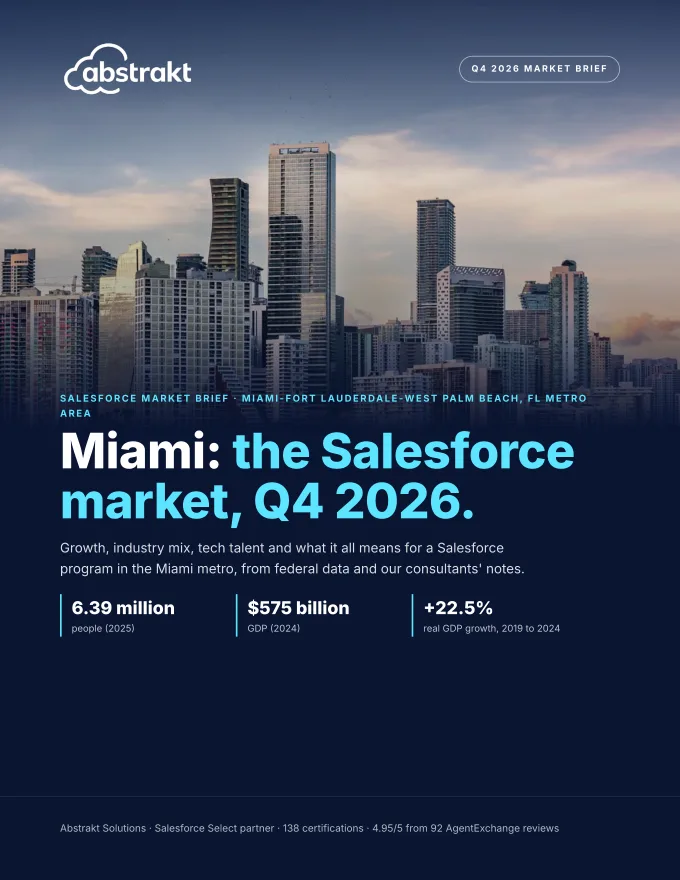
A free 23-page PDF with Miami's growth ranked against 100 metros, its industry mix, tech wages and nearby markets. It is offered on the public Miami page; send your customer there or get a copy for your own prep.
Get the Miami brief →Co-sell with Abstrakt in Miami
Working a Miami account? Bring in a named consultant for discovery, scoping or a health check. We reply within 4 business hours.