

How Salesforce work starts in Tulsa
Abstrakt Solutions is a Salesforce Consulting Partner that works with equipment makers, carriers, energy firms and health providers across the Tulsa region. Tulsa is one of our focus markets.
What buyers here usually run into
- 1
Field work that outgrew spreadsheets
Maintenance, installation and service teams in manufacturing and energy often schedule by email and spreadsheet, which hides costs and makes response times hard to measure.
- 2
Complex quotes for engineered equipment
Configurable products such as HVAC and aerospace components generate quotes with many options, and pricing errors are common until CPQ rules are set up carefully.
- 3
Salesforce disconnected from ERP
When orders, inventory and invoices live only in the ERP, sales and service teams work from stale data, so a planned integration usually pays off first.
Budget, team and partner questions
What drives cost
In Tulsa, scope swings on three things: how many configurable products need pricing rules, whether reps and distributors get a portal, and how many ERP or maintenance systems feed Salesforce. Energy firms add work untangling counterparty hierarchies that span many affiliated legal entities.
Admin or partner
Plants and carriers here often have a capable IT group but nobody who knows Salesforce deeply. A common pattern is an internal owner who sets priorities, with a partner handling configuration, integration monitoring and releases until the workload justifies a dedicated admin.
What buyers ask a partner
Ask for examples of quoting design for configurable equipment, Field Service work for installation or maintenance crews, and ERP integrations the partner still supports. For aerospace or defense work, ask how they keep controlled data out of the org.
The local economy and its biggest industries (4)
| Sector | Share of 2024 GDP | Where Salesforce fits |
|---|---|---|
| Manufacturing Salesforce for manufacturing → | 12.7% | HVAC, appliance and aerospace manufacturers in the Tulsa area sell through reps, distributors and OEM contracts, so quoting, dealer visibility and ERP integration are usually the priorities. |
| Transportation and warehousing Field Service → | at least 10.4% | With aircraft maintenance and large fulfillment operations in the region, Tulsa's logistics and MRO businesses need service scheduling, contract tracking and customer communication in one system. |
| Health care and social assistance Salesforce for health & life sciences → | at least 9.0% | Tulsa's third-largest private sector benefits from Salesforce designs for referrals, patient outreach and service that keep access tightly controlled. |
| Wholesale trade Sales Cloud → | 5.9% | Distributors serving Oklahoma's energy, industrial and building-products markets need account planning, pricing rules and order history that reps can reach from the road. |
Source: U.S. Bureau of Economic Analysis, GDP by county (CAGDP2), 2024, summed to the metro area; private sectors only, excluding real estate and government. “At least” marks sectors where BEA suppresses some county figures.
Regional target sectors named by local economic development groups: Advanced Manufacturing, Aerospace, Defense, Space, and UAS, Transportation & Logistics, Energy, Information Technology, Headquarters & Professional Services.
Salesforce products that fit Tulsa (6)
In the order we lead with them here, from the industries above.
Salesforce Sales Cloud
The CRM where sales pipeline lives, when it is built right.
Salesforce Field Service
Scheduling, dispatch, mobile work orders and parts for teams that work on site.
Salesforce Revenue Cloud / CPQ
Configure-price-quote, billing, subscription management, and quote-to-cash on Salesforce.
Salesforce Service Cloud
The operating system for modern customer service, case, knowledge, voice, and AI agent assist together.
MuleSoft
Enterprise API platform, for connecting Salesforce, ERP, data warehouses, and the rest of your stack.
Tableau
Executive analytics, embedded dashboards, and CRM Analytics built on Tableau.
Putting Agentforce to work in Tulsa aerospace and logistics
Tulsa's economy tilts toward making and moving things: manufacturing contributed 12.7% of metro GDP in 2024 according to BEA, and transportation and warehousing is the next largest private sector. Aerospace maintenance shops and energy equipment makers can give field technicians an assistant that answers from service manuals and past work orders, which shortens diagnosis when the documentation is current. Carriers and warehouse operators can use an agent to answer load and delivery status questions from Service Cloud records. Clinics and hospitals can try condensed intake notes that save front-desk staff from rereading long histories. Asset data, shipment records and manuals need cleanup before any of this, and someone should review early agent answers daily.
- Manual-grounded answers for field technicians
- Load and delivery status responses
- Summaries for patient-access teams
Services buyers here usually need (7)
Salesforce Implementation in Tulsa
In Tulsa, implementation work usually centers on equipment: what was quoted, what shipped, where it is installed and who services it. That makes the data model the first decision, since accounts, installed assets, dealers and ERP order numbers all have to line up before any screen matters. Discovery workshops come first, followed by a sandbox build, cleaned records and a phased go-live, often sales and quoting first and field service second.
By industry in Tulsa
- 1
Manufacturing
Tulsa's Future counts advanced manufacturing among its target sectors, and factories produced about 12.7% of the metro's 2024 GDP, more than any other private industry. For HVAC, appliance-component and industrial equipment makers, an implementation lives or dies on the product catalog. We decide early which configuration rules belong in Revenue Cloud and which stay in the ERP, how serial-numbered units become asset records, and how independent reps see only their own territories. Settling those three choices before build keeps quotes accurate from the first week of use.
- 2
Aerospace, Defense, Space, and UAS
Suppliers in this Tulsa's Future target sector tend to run commercial, government and repair work side by side. The implementation question is structure: separate record types or business units for each line, sharing rules that keep defense pursuits visible only to the staff who should see them, and pipeline stages that reflect bids and contract vehicles rather than a simple sales funnel. We also agree during design which technical data never enters Salesforce, so the org stays clear of controlled information from the start.
- 3
Energy
For energy-services companies around Tulsa, the first release often covers field crews and service tickets rather than sales. Jobs arrive by phone from operators, crews move between lease sites, and invoicing waits on paperwork. Implementation ties each work order to the customer and the site, puts a mobile checklist in the technician's hands, and passes completed tickets to billing without anyone typing them twice. Commercial pipeline and contract tracking follow in a later phase, once the operational data has proven reliable.
Raise before scoping
Settle the asset model early
Tulsa manufacturers and service firms often track installed equipment by serial number in the ERP, in warranty spreadsheets and in technicians' notes. Decide which system owns the asset record, and how Salesforce links to it, before building, because scheduling, warranty claims and service reporting all depend on that answer.
Decide rep visibility up front
Many equipment makers in northeast Oklahoma sell through independent reps who cover several states. Choose in phase one how much pipeline, pricing and order history each rep firm sees, since that drives the role hierarchy and sharing rules, and changing it after launch means reworking the security model.
Launch with the readiest team
Rather than switching everyone on at once, go live first with the group whose process is clearest, usually inside sales or quoting, and let field service follow once assets and work types are clean. Each release lands in weeks, and later teams inherit the lessons.
Salesforce Integration in Tulsa
For most Tulsa clients, integration means putting ERP data where sales and service teams already work. We map which system owns each record, such as customer, product, price, order, invoice or asset, then decide what moves, in which direction and how often. Some flows need to be close to real time, like order status for customer service; others, like invoice history, can sync overnight. We build with MuleSoft or Salesforce's native APIs depending on how many systems are involved, and add error handling so failures surface quickly.
By industry in Tulsa
- 1
Wholesale trade
Wholesale trade adds about 5.9% of Tulsa's 2024 GDP, and distributors serving oilfield, industrial and construction customers depend on current stock and pricing. Integration for them means an ERP connection that shows availability, customer-specific price and open orders on the account page, and sends accepted quotes back to the ERP as orders without re-keying. We pay particular attention to account matching, since one customer often exists under several ship-to and bill-to records that must roll up to a single Salesforce account.
- 2
Transportation & Logistics
Transportation and logistics is a Tulsa's Future target sector, and carriers, brokers and warehouse operators here run transportation or warehouse management systems that Salesforce should read from, not replace. Typical integrations bring shipment milestones, exceptions and proof of delivery onto the customer's record, so service agents answer questions without switching screens. Where event volume is high, we move updates through MuleSoft or platform events rather than polling, and define exactly which fields customers may see in a portal.
- 3
Aerospace, Defense, Space, and UAS
Aerospace and defense suppliers in the Tulsa region frequently connect Salesforce to ERP and quality systems that hold work orders, certifications and repair records. The design has to respect which data may leave those systems: part numbers, order status and customer contacts usually can, while controlled technical data should not. We document every field in each flow, restrict integration users to exactly what they need, and log each transfer, so a security review starts from a clear picture.
Raise before scoping
Name a system of record
Ownership comes first: for every object, one platform is the authority and the other follows. In many Tulsa companies both the ERP and Salesforce have been edited by different teams for years, and without one owner per object an integration simply moves disagreements back and forth faster.
Budget time for record matching
Customer and product records rarely line up one to one between systems. Expect a matching exercise, with rules for duplicates, inactive accounts and renamed parts, before the first sync runs. It is often the longest part of the project and the part that decides whether users trust the result.
Make failures visible
Integrations fail quietly: an expired credential, a new picklist value, a record locked by another process. We add logging, retry rules and alerts that reach a named person at your company, so a stalled order sync is caught within hours instead of at month-end.
Salesforce Optimization in Tulsa
Optimizing a Tulsa org starts with watching how it is used. We pull login and field-completion data, sit with a handful of reps, dispatchers and managers, and list the moments people leave Salesforce to get work done. The fixes are usually specific: fewer steps in quoting, mobile screens technicians can finish in the field, automation consolidated into a small set of documented Flows, and dashboards rebuilt so operations and sales count things the same way. It is a scoped project with a clear finish line.
By industry in Tulsa
- 1
Manufacturing
Plants and equipment makers across the Tulsa area often have quoting in Salesforce that sales engineers bypass because their own spreadsheet is faster. Optimization means timing the quote process, removing approval steps that no longer protect margin, and tightening product rules so the configurator stops offering invalid combinations. We then look past the order: whether service and warranty staff can see what was actually sold, or whether they are still phoning the plant to ask for serial numbers.
- 2
Health care and social assistance
Health and social-service organizations in Tulsa frequently adopt Salesforce for referrals, outreach or case management, then add programs one at a time. The result is often duplicate intake forms, reports that count clients differently for each grant or service line, and staff who keep private lists. We consolidate intake, align definitions so each client is counted once, and review who can open sensitive notes, since an optimization project should never loosen access to protected information while simplifying screens.
- 3
Information Technology
Information technology is on the Tulsa's Future target list, and software and IT service firms here tend to add sales tools faster than they retire them. We review which engagement, enrichment and forecasting tools actually write to Salesforce, remove automations that update the same fields from two directions, and settle on one pipeline definition. For firms selling subscriptions, we also confirm renewal opportunities are created consistently, because missed renewals usually trace back to automation that nobody owns anymore.
Raise before scoping
Start from frontline feedback
Usage reports show where screens go unused, not why. Short sessions with field technicians, inside sales and dispatchers in Tulsa uncover the extra clicks, missing lookups and offline gaps behind the numbers. We gather both kinds of evidence before redesigning anything, so changes answer real friction rather than guesses.
Retire old automation deliberately
Workflow rules, Process Builder and early Flows often coexist on quote, order and case objects in older orgs. Before consolidating, document what each one does and who relies on it, then migrate in small tested releases, so an approval or notification does not quietly stop firing.
Rebuild reports on shared definitions
Operations, finance and sales in Tulsa companies often define a booked order, an on-time job or an active account differently. Agree those definitions with each leader first, then rebuild dashboards once, instead of adding yet another report that disagrees with the ones already circulating.
Salesforce Implementation Rescue in Tulsa
Rescuing a Tulsa Salesforce project begins with an honest triage. We review the org, the backlog, the statement of work and the data, then interview sponsors and the users who have stopped logging in. That tells us whether the problem is design, data, scope, integration or ownership, and usually it is more than one. You get a short list of fixes to stabilize what exists, a decision on what to keep or rebuild, and a realistic plan for reaching a working go-live.
By industry in Tulsa
- 1
Manufacturing
Stalled manufacturing projects in the Tulsa region usually share a pattern: CPQ rules that never matched real pricing, an ERP integration that kept being deferred, and reps who drifted back to spreadsheets. Rescue starts by testing a sample of recent quotes against the configurator to find where it breaks, then deciding whether to repair the rules or simplify the product model. Once quotes calculate correctly, we reconnect order data so the system finally gives sales something back.
- 2
Transportation & Logistics
Logistics and maintenance operators here sometimes launch Salesforce with service processes designed for a generic help desk, not for shipments, work orders and customer contracts. Agents then track exceptions in email and the org fills with half-completed cases. In a rescue, we map how issues actually arrive and get resolved, rebuild case types and routing around that reality, and connect operational status so agents stop re-keying it. Existing case history can usually be salvaged, which helps win users back.
- 3
Aerospace, Defense, Space, and UAS
Aerospace and UAS companies in the Tulsa area occasionally inherit a Salesforce build that mixed commercial, government and research work in one undifferentiated pipeline, with sharing far too open for defense pursuits. Rescue here is partly a security exercise: separating record types, tightening visibility and confirming that no controlled technical data entered the org. Only after that do we rework stages and reports so leadership can rely on the pipeline again.
Raise before scoping
Pause new scope during triage
Adding requirements to a troubled project makes the diagnosis harder. Freeze new requests briefly while the org, backlog and data are assessed, so the team can see which problems are structural and which are simply unfinished work still waiting in the queue.
Separate keep, fix and rebuild
Not everything in a struggling org is wrong. We sort each component, from objects and automations to integrations and reports, into what works, what needs repair and what should be replaced, so budget goes toward rebuilding only the pieces that cannot be saved.
Win users back early
Returning skeptics want proof that something changed. Choose one or two visible fixes, such as a working quote template or a dispatch screen that saves time, and ship them early in the recovery while deeper repairs continue behind the scenes.
Salesforce Health Checks in Tulsa
Think of it as an inspection: we examine your Tulsa org exactly as configured and leave every setting untouched. We look at who can see and export what, how integration users are configured, how much automation and custom code has accumulated, and how clean the core records are. Findings come back ranked by risk and effort, with a short list of what to fix first. Companies with ERP and field-service connections often find their biggest exposures in integration accounts holding far more access than they need.
By industry in Tulsa
- 1
Health care and social assistance
Health care and social assistance is at least 9.0% of Tulsa's 2024 GDP, and organizations in it hold data where a permissions mistake can become a reportable event. The review tests which profiles and permission sets can view or export records with health details, whether field-level security matches your privacy policy, how portal and guest access is limited, and whether audit settings would let you reconstruct who opened a record. Each item states the exposure in plain language, so compliance staff can decide on it without an admin interpreting.
- 2
Energy
Energy firms in Tulsa often run Salesforce alongside commercial and operational systems through long-standing integrations. A health check inventories those connections, flags integration users with broad or administrator rights, and checks whether contract and counterparty data is shared more widely than commercial teams intend. It also counts custom objects and code built for earlier business models, which after mergers and divestitures frequently duplicate one another and slow down every future change.
- 3
Information Technology
With information technology among the Tulsa's Future targets and a university-based cyber research institute in the city, security posture is a familiar conversation here. For software firms and IT service providers, the check covers authentication settings, connected apps and their scopes, API usage, session policies, and sandbox refreshes that copy production data unmasked. We also examine technical debt in Apex and installed packages, because unsupported code is where security and release risk tend to hide together.
Raise before scoping
Tighten access before an AI pilot
An AI agent inherits the permissions of the user it runs as, so every loose sharing rule becomes its problem too. Outdated knowledge content and conflicting automation carry over the same way. Reviewing access, data quality and automation first keeps an Agentforce pilot from inheriting old mistakes.
Include integration accounts
Reviews that focus on human users miss the accounts that ERP, telematics or marketing tools use to connect. In many Tulsa orgs, those integration users were set up quickly with administrator rights and never revisited, so they belong at the top of the access review.
Decide who owns the findings
A findings list only helps if someone schedules the fixes. Agree before the review starts who receives the report, who may approve changes to security settings, and whether remediation goes to your admin, to a defined project, or to ongoing support.
Salesforce Managed Services in Tulsa
Managed services for a Tulsa company typically means one team covering the admin, developer and architect work that a single hire cannot. Requests from sales, service and operations go into one queue that your owner ranks with us each month. We test every seasonal Salesforce release in a sandbox, watch the integrations to your ERP and field apps for failures, and keep documentation current so the org can change hands safely. Each month you see what shipped, what is waiting and why.
By industry in Tulsa
- 1
Transportation and warehousing
Transportation and warehousing accounts for at least 10.4% of Tulsa's 2024 GDP, and carriers, 3PLs and maintenance operations change their Salesforce setup constantly as lanes, customers and contracts shift. Ongoing support covers the steady work: new rate and service fields, updated case routing when a customer's requirements change, and monitoring of the feeds that carry shipment or work-order status. We also keep automation from piling up, merging overlapping Flows before they start slowing record saves at peak volume.
- 2
Advanced Manufacturing
Producers in this Tulsa's Future target sector rarely stop changing their catalog. New models, discontinued options and revised dealer price lists all mean updates to products, price books and CPQ rules. Under a managed arrangement, those changes follow a tested path from sandbox to production, with someone confirming that approved quotes still calculate correctly afterward. Warranty and service queues get the same attention, so a new product line launches with support processes ready rather than improvised by the service desk.
- 3
Headquarters & Professional Services
Tulsa's Future lists headquarters and professional services as a target sector, and corporate teams in the region often run Salesforce for several divisions from one org. The managed work there is mostly governance: consistent naming and security across divisions, change requests tied to a named approver, and a release calendar that stays clear of quarter-close. We record each design decision so that divisional admins, auditors or a future internal hire can see why the org looks the way it does.
Raise before scoping
Reserve capacity for pricing updates
Manufacturers here tend to revise products and pricing in bursts, around model-year changes or dealer price updates. Agree how much monthly capacity is held for those windows, so catalog work does not crowd every other request out of the queue for weeks at a time.
Monitor integrations, not just users
Many Tulsa orgs depend on scheduled or real-time feeds from ERP, telematics or scheduling systems. A managed team should watch those jobs and alert your owner when records stop arriving, because a silent integration failure is otherwise discovered by an unhappy customer rather than by a ticket.
Write down what counts as urgent
Agree at kickoff which issues jump the queue, such as login failures, broken quoting or stalled case routing, and schedule everything else. A short list protects the backlog from being reshuffled whenever a department head calls, and gives the managed team a clear escalation rule to follow.
Salesforce Migration in Tulsa
Few Tulsa companies bring just one system across. Sales history may sit in a legacy CRM, service records in a dispatch or ticketing tool, and equipment lists in spreadsheets kept by each branch. We profile every source, agree what is worth moving, deduplicate and standardize accounts and contacts, and map everything to the target data model. Trial loads into a sandbox let your team check real records before the final cutover, which we time for a quiet period with a short freeze on the old system.
By industry in Tulsa
- 1
Transportation and warehousing
Trucking, warehousing and maintenance businesses in Tulsa often come to Salesforce from a mix of a transportation system's customer module, a shared inbox and rate spreadsheets. Migrating them means separating what belongs in Salesforce, such as customers, contacts, contracts, rates and service history, from shipment detail that should stay operational. We carry over enough history to give account managers context, keyed by customer ID so a later integration can pick up exactly where the migration stops.
- 2
Energy
Energy companies in the region commonly migrate from a commercial database built in-house years ago, or from a CRM bought for a single business unit. Those records carry decades of name changes, acquisitions and divestitures. Before moving anything, we build a crosswalk from old records to the new account hierarchy and confirm it with commercial staff, then migrate contacts, agreements and activity against that structure. Records nobody can place are archived for reference instead of guessed into the new org.
- 3
Health care and social assistance
Providers and community health organizations in Tulsa that migrate referral or outreach records into Salesforce work under stricter rules than most. Protected health information must land only in fields and objects with the right access controls, consent and communication preferences have to come across intact, and the transfer itself should run through secured, logged channels. We also agree which historical notes stay in the source system, because moving everything rarely helps care teams and enlarges the privacy footprint.
Raise before scoping
Inventory every source first
Spreadsheets kept by a branch manager or a dispatcher are easy to miss until go-live, when a team discovers its data never came across. List every source and its owner at the start, including personal files, and decide explicitly whether each one migrates, is archived or is retired.
Clean before loading, not after
It is tempting to load everything and tidy it inside Salesforce later. In practice, duplicates and inconsistent formatting make adoption harder from day one. Standardize addresses, phone numbers and account names during the migration, merge duplicates by agreed rules, and load only records that pass validation.
Plan the cutover weekend
Schedule the switch in a quiet stretch, lock the old tool, load whatever changed since the last rehearsal, and ask each manager to spot-check the accounts they know best. Leaving the retired application viewable for a while lets people settle doubts about a record by looking rather than by filing a ticket.
Industry plays in Tulsa (3)
Salesforce for Tulsa Manufacturers
Tulsa manufacturers often build engineered equipment for energy, commercial buildings and aerospace customers, selling through independent rep agencies as well as direct teams. Salesforce should show which rep is working which project, price engineered-to-order configurations accurately, and carry the order into startup, commissioning and warranty service. We set up Sales Cloud, Revenue Cloud or CPQ and Field Service, integrate the ERP for orders and inventory, and keep rep portals simple enough that agencies actually use them.
Plants and fabrication shops top Tulsa's private-sector ranking with a 12.7% share of 2024 metro GDP in Bureau of Economic Analysis figures, while transportation and warehousing, partly withheld in the data, shows at least 10.4%. On the regional partnership's target list, advanced manufacturing sits beside aerospace, defense, space and UAS, with energy and transportation and logistics named as well. Those overlapping targets describe a manufacturing base that often sells equipment to energy and aviation customers and ships through a strong regional logistics sector, so commercial teams handle both project bids and repeat orders.
Use cases to open with
- 1
Rep agency management
Independent manufacturers' representatives cover territories for many product lines. An Experience Cloud portal lets agencies register projects, request quotes and see order status, while commission-relevant data such as territory and project credit stays accurate in Salesforce, and sales managers can compare rep performance on quote volume, win rate and margin. Agencies also get current literature and pricing without emailing the factory.
- 2
Quoting engineered-to-order equipment
Equipment built to project requirements involves sizing, options, submittal drawings and approval cycles. CPQ rules for valid configurations, integrated with engineering tools for sizing, generate accurate quotes and submittal packages, and approvals catch low-margin deals, reducing the errors that appear when complex quotes are assembled from spreadsheets and old templates. Revised quotes keep their full history for the project team.
- 3
Startup and warranty service
After shipment, many manufacturers send technicians for startup, commissioning and warranty repairs. Field Service work orders tied to the serial number, with checklists for commissioning steps and parts used, create a complete service record, and warranty claims can be processed from that history instead of from paper forms. Engineering sees recurring field problems by model and component, and sales sees which sites are due for upgrades.
Raise before scoping
Rep channel conflict rules
When direct salespeople and rep agencies pursue the same projects, credit disputes follow. Define project registration rules, overlap handling and territory mapping before launch, and make them visible in Salesforce, so conflicts are resolved by policy rather than by whoever complains loudest.
Engineering tool integration
Sizing and selection software often holds the logic that determines what a customer needs. Decide whether CPQ calls that software, imports its results or replaces part of it, and involve application engineers early, since they will own many of the rules after launch.
Aerospace quality records
Aerospace and defense work requires traceability, certifications and sometimes export control. Keep controlled technical data in approved systems, link rather than copy it into Salesforce, and have quality and trade compliance staff confirm requirements before building any customer-facing workflows or portals.
Salesforce for Tulsa Construction Firms
Much of Tulsa's construction work is industrial: plant expansions, energy facilities, hangars, warehouses and the mechanical and electrical systems inside them. Contractors often hold master service agreements with the same owners for years, mixing project work with ongoing maintenance and small call-out jobs. A contractor in that position needs one record per owner that shows the agreement, every open ticket and the next expansion bid. We configure Sales Cloud for owner accounts and pursuits, Field Service for maintenance and call-out crews, CPQ for repeatable scopes, and integration with job cost and ERP systems.
Tulsa's builders get no line of their own in the top five of the BEA's 2024 private-sector ranking, and Tulsa's Future leaves construction off its target list. It shows up through the sectors that are targeted: advanced manufacturing, energy, aerospace, defense, space and UAS, and transportation and logistics, all of which depend on building and maintaining industrial facilities. Manufacturing, the metro's largest private sector at 12.7%, and transportation and warehousing, at no less than 10.4%, generate steady plant, hangar and warehouse work. Tulsa's Future covers a nine-county region, wider than the metro itself.
Use cases to open with
- 1
Master service agreement tracking
Industrial owners often hire contractors under master service agreements with rate sheets and many small work orders. Salesforce can store each agreement with its rates, insurance requirements and renewal date, link every work order and project to it, and show account leaders total spend by owner and site. Renewal conversations start with a clear record of volume, responsiveness and safety performance.
- 2
Call-out and maintenance crews
Plants and energy facilities call for urgent repairs and scheduled maintenance. Field Service dispatches crews by skill, certification and proximity to the plant gate, tracks time and materials against the right agreement, and captures photos, permits and sign-offs on a mobile device. Supervisors see open calls by site in real time, and invoicing starts from accurate field records rather than paper tickets.
- 3
Expansion project pursuits
When a manufacturer or aerospace operator plans an expansion, the contractors with existing site relationships often hear first. Sales Cloud can track each pursuit with its owner contacts, engineering firm, estimated scope and schedule, and link it to prior work at the same site. Preconstruction leaders see which pursuits deserve estimating time, which relationships need attention, and where the firm has never done work at a site it wants to win.
Raise before scoping
Safety and qualification records
Industrial owners require current safety programs, training certificates and insurance before crews arrive. Track these for your own staff and subcontractors, with expiration alerts, so dispatchers never send someone who cannot enter the site and account managers can answer owner audits quickly.
Rates must match the agreement
Time and materials billed under master agreements must use the rates in each contract. Store rate sheets in Salesforce or the ERP, apply them automatically to work orders, and review exceptions before invoicing to avoid disputes with owner accounts payable teams.
Spreadsheets to structured data
Many contractors run dispatch and job tracking on spreadsheets, whiteboards and text messages. Plan data cleanup and a firm cutover date, train dispatchers first, and keep the first release tightly focused so crews and office staff trust the new system before anything else is added.
Salesforce for Tulsa Professional Services Firms
Professional services firms in Tulsa often serve a concentrated set of large clients: energy companies, manufacturers, aerospace and logistics operators, and corporate headquarters. Engineering firms sell project and on-call work, IT and cybersecurity firms sell managed services and assessments, and advisory firms sell recurring engagements. Salesforce should show the full relationship with each client, from pursuits to renewals to staffing. In practice that means client hierarchies and renewals in Sales Cloud, CPQ for tiered managed-service bundles and engineering rate sheets, and Tableau views that set bench capacity against signed and likely work.
The BEA's 2024 ranking of Tulsa's private industries stops at five, and consulting, engineering and IT services are not on it. The work surfaces instead through Tulsa's Future, the Tulsa Regional Chamber's economic development partnership, which lists headquarters and professional services and information technology among its target sectors, next to energy, advanced manufacturing and aerospace. A university-based cyber innovation institute develops and tests cyber research, and Tulsa's Future describes active local venture investors supporting technology startups. Service firms here sell into manufacturing, the largest private sector at 12.7%.
Use cases to open with
- 1
Energy and industrial client accounts
Engineering and advisory firms often work with several business units, plants and pipelines inside one energy or industrial client. Account hierarchies show each unit and site, with contact roles for sponsors, procurement and technical leads. Account leaders see all active projects, proposals and master agreements for a client in one place before planning meetings, and can spot business units the firm has never served.
- 2
Managed services and renewals
IT and cybersecurity firms selling managed services, monitoring and annual assessments rely on renewals. Salesforce can track each contract with its services, term and renewal date, alert account managers ahead of expiration, and connect service performance data so renewal conversations start with evidence. CPQ keeps tiered pricing and bundled services consistent across the sales team, and approvals catch discounts that would erode margin.
- 3
Staffing from the pipeline
Project-based firms need to know when they will need engineers, analysts or consultants with specific skills. Opportunities can carry roles, estimated hours and start dates, and Tableau combines them with current assignments from the project system. Practice leaders see upcoming gaps by discipline and month and can plan hiring, training or subcontracting before commitments to a major client are made.
Raise before scoping
Protect client confidentiality
An engineering shop doing studies for two rival midstream operators cannot let one team read the other's files. Use restrictive sharing and private account teams, and review report and dashboard visibility so staff cannot browse confidential proposals, rates or engagement notes for clients they do not personally serve.
Security posture for cyber firms
Cybersecurity clients will judge your own practices, including your CRM. Use strong authentication, least-privilege access and event monitoring in your Salesforce org, and avoid storing client vulnerability details there, keeping findings in dedicated secure systems and referencing them only by ID.
Purchase order balances on accounts
Engineering firms that bill against purchase orders need to know how much of each PO remains before proposing more work. Pull PO balances, billed-to-date totals and write-offs from accounting into the client record nightly, and let partners judge margin by client and site without asking finance.
Case studies to send (3)
From the industries this market leans on. Client names are anonymized and these projects are not specific to Tulsa.
The Tulsa Salesforce market brief, Q4 2026
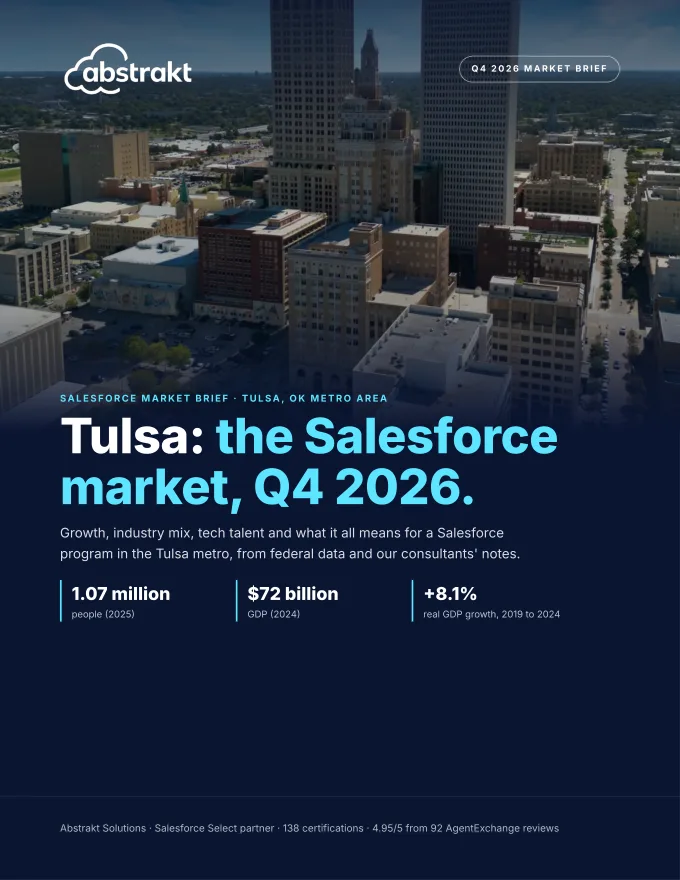
A free 21-page PDF with Tulsa's growth ranked against 100 metros, its industry mix, tech wages and nearby markets. It is offered on the public Tulsa page; send your customer there or get a copy for your own prep.
Get the Tulsa brief →Co-sell with Abstrakt in Tulsa
Working a Tulsa account? Bring in a named consultant for discovery, scoping or a health check. We reply within 4 business hours.