

How Salesforce work starts in Philadelphia
Throughout Greater Philadelphia, including its Pennsylvania, New Jersey and Delaware suburbs, Abstrakt Solutions brings Salesforce consulting to financial, professional services, health and life sciences organizations. Philadelphia is one of our focus markets.
What buyers here usually run into
- 1
Life-sciences commercial teams
Biotech and therapy companies moving toward commercialization need field teams, medical inquiries and patient support set up correctly the first time.
- 2
Healthcare privacy
Hospitals and health systems need access, consent and audit settled before patient-facing workflows go live.
- 3
Multi-state operations
A region spanning four states means territories, compliance rules and teams that do not always line up neatly, which the data model has to reflect.
Budget, team and partner questions
What drives cost
Philadelphia costs rise with privacy and consent design for health data, integration with claims, policy or orchestration systems, and the number of states whose rules the data model must reflect. Life sciences companies also need validation-minded testing that adds time.
Admin or partner
Health systems and insurers here often have Salesforce staff inside IT, but compliance reviews and integrations stretch them thin. A partner typically covers architecture, integration and release testing, while internal staff own user support and governance.
What buyers ask a partner
Ask for Health Cloud or Life Sciences Cloud references, Financial Services Cloud experience for insurers, and how the partner documents consent and access decisions. Ask how they test integrations with regulated systems.
The local economy and its biggest industries (4)
| Sector | Share of 2024 GDP | Where Salesforce fits |
|---|---|---|
| Finance and insurance Financial Services Cloud → | at least 10.8% | Insurers, asset managers and banks need relationship views, compliant marketing and service at scale, often across states with different rules. |
| Professional, scientific, and technical services Salesforce for professional services → | 10.2% | Consulting, legal and research services firms, many serving the life-sciences sector, need pursuit pipelines and client relationship history across partners and offices. |
| Health care and social assistance Salesforce for health & life sciences → | 9.8% | Academic medical centers, children’s hospitals and health systems use Salesforce for patient engagement, referrals, philanthropy and contact-center service, with privacy and consent designed in. |
| Manufacturing Salesforce for manufacturing → | at least 7.0% | Pharmaceutical, cell and gene therapy and medical-device manufacturers need field teams, key-account management and service processes that support regulated quality systems. |
Source: U.S. Bureau of Economic Analysis, GDP by county (CAGDP2), 2024, summed to the metro area; private sectors only, excluding real estate and government. “At least” marks sectors where BEA suppresses some county figures.
Regional target sectors named by local economic development groups: Life Sciences, Financial Services, Technology, Advanced Manufacturing.
Salesforce products that fit Philadelphia (6)
In the order we lead with them here, from the industries above.
Salesforce Service Cloud
The operating system for modern customer service, case, knowledge, voice, and AI agent assist together.
Salesforce Sales Cloud
The CRM where sales pipeline lives, when it is built right.
Salesforce Experience Cloud
Customer, partner, and employee portals built on Salesforce.
Salesforce Financial Services Cloud
Industry CRM for wealth management, banking, insurance, and lending, built for compliance from the start.
Salesforce Marketing Cloud
Cross-channel marketing, email, mobile, journey, and Data 360-powered personalization at scale.
Salesforce Agentforce
AI agents that handle real work inside Sales Cloud, Service Cloud, and Marketing Cloud.
Practical Agentforce uses for Philadelphia finance and health care
Philadelphia's economy leans on three sectors of similar weight: finance and insurance (at least 10.8 percent of 2024 metro GDP), professional and technical services (10.2 percent) and health care (9.8 percent). An insurer's service team might let Agentforce read an incoming claim letter and pull out the details a handler needs. A health system's patient access staff could get drafted replies to routine questions, grounded in approved policy articles. Advisory firms can use Data 360 (formerly Data Cloud) to unify engagement signals before AI flags which accounts need attention. Because regulated data is involved, permission sets and field-level access have to be settled first, and a reviewer should approve anything sent to a patient or client.
- Claim letter data extraction
- Patient access reply drafting
- Account attention flags for advisors
Services buyers here usually need (7)
Salesforce Implementation in Philadelphia
Implementing Salesforce in Greater Philadelphia usually means designing for regulated data from the first workshop. Finance and insurance, professional services and health care lead the regional economy, and organizations in all three handle information that needs careful access rules. We agree the data model, sharing and consent approach with compliance before anything is built, configure and test in a sandbox, migrate cleaned data and train each team by role.
By industry in Philadelphia
- 1
Finance and insurance
Finance and insurance is the region's largest private sector, at least 10.8% of 2024 GDP by the BEA's lower-bound figure, and Select Greater Philadelphia lists financial services as a key industry. Insurers, asset managers and banks implementing Salesforce face early choices about Financial Services Cloud, how producers, advisors and clients relate to one another, and how state licensing affects who may work which accounts. We resolve those in design so sharing and assignment rules reflect them from the first release.
- 2
Health care and social assistance
Health systems and physician practices implementing Salesforce for patient access, referrals or contact-center service need privacy rules settled before configuration begins. We determine which patient data belongs in Salesforce at all, how consent and communication preferences are stored, and which roles may view clinical context. Service Cloud queues and Experience Cloud patient pages are then built on that foundation, instead of being retrofitted after a compliance review raises objections. Access-center agents see what they need to help a caller and nothing more.
- 3
Life Sciences
Life sciences is a Select Greater Philadelphia key industry, and the organization ranks the region second in the U.S. for cell and gene therapy. Emerging biotech companies implementing Salesforce ahead of a launch need treatment-center accounts, field territories, medical inquiry handling and patient support designed together. We sequence the build so commercial and medical teams each get what they need without sharing data that regulations require keeping apart. Patient support intake is designed with the hub or specialty pharmacy handoffs in mind.
Raise before scoping
Capture state-by-state rules
An organization operating across Pennsylvania, New Jersey, Delaware and Maryland may face different licensing, privacy or communication rules in each state. Record those differences in discovery and express them in territories, record types and validation, instead of relying on users to remember which rule applies where.
Separate commercial and medical activity
Life-sciences companies must keep promotional activity apart from medical information and adverse event reporting. Define distinct processes, record types and permissions for each, with a clear handoff when a field conversation raises a medical question. Building that separation into phase one avoids rework just before launch.
Model consent before outreach
Any patient-facing workflow needs consent capture, communication preferences and audit history designed first. Decide where consent is mastered, how it syncs with clinical systems and how opt-outs are honored across every channel, then build outreach and service processes on top of that model.
Salesforce Integration in Philadelphia
Integration projects in Greater Philadelphia usually involve systems that were never designed to share data freely: electronic health records, policy administration and custodial platforms, ERP and regulated quality systems. The design question is less about moving everything and more about moving the right fields with the right controls. We define the system of record and permitted data for each flow, select MuleSoft, Workato or direct APIs, build with logging and error handling, and document controls for your compliance reviewers.
By industry in Philadelphia
- 1
Manufacturing
Manufacturing contributes at least 7.0% of the region's 2024 GDP, spanning pharmaceutical, medical-device and industrial producers. Integrating Salesforce with ERP and quality management systems gives sales and service teams order status, product information and complaint history without re-keying. For regulated manufacturers, we keep quality records mastered in the validated system and pass Salesforce only what customer-facing teams need, with an audit trail for each transfer. Complaint intake captured in Service Cloud can flow back to the quality system without anyone retyping it.
- 2
Health care and social assistance
Health systems integrate Salesforce with electronic health records, scheduling and patient engagement platforms to support access centers, referrals and outreach. We use healthcare interoperability standards where the EHR supports them, limit the data passed to the minimum each workflow needs, and log every exchange. Clinical documentation stays in the EHR, while Salesforce holds the relationship, communication and service context around it, which keeps compliance scope contained. Referral status updates can then flow back to referring practices automatically.
- 3
Financial Services
Financial services firms, a Select Greater Philadelphia key industry, connect Salesforce to policy administration, custodial, portfolio and document systems. Advisors and service staff need current holdings, policies and transactions in the client view, but those systems remain the official record. We sync what is needed on a schedule that matches how fresh the data must be, and restrict sensitive financial fields to the roles that genuinely require them. Document systems stay the home for statements and signed forms, linked rather than copied.
Raise before scoping
Carry only required fields
Each integration should move only the fields its workflow needs. Passing whole patient or client records for convenience enlarges the compliance scope of Salesforce and every system in between. Define permitted fields per flow in the design document and review them with privacy and security teams.
Plan validation for regulated interfaces
Integrations touching validated quality or clinical systems may need documented testing under your quality procedures. Build that effort into the plan from the start, since validation requirements affect how the interface can be changed later and who must approve each change.
Track vendor upgrade cycles
Health record, policy and ERP vendors release upgrades on their own schedules, which can change APIs or data formats. Keep interface specifications documented, test against vendor sandboxes before upgrades, and monitor closely afterward, so a vendor release does not quietly break a sync.
Salesforce Managed Services in Philadelphia
Managed services in Greater Philadelphia often supports organizations where each Salesforce change has compliance implications: insurers, asset managers, health systems, life-sciences companies and the professional firms that serve them. We handle day-to-day requests and a prioritized backlog, test each Salesforce release in a sandbox, review permission changes before they reach production, and keep a change record your auditors can follow. Developers and architects join when the work calls for them, within the same engagement.
By industry in Philadelphia
- 1
Professional, scientific, and technical services
In the region's 2024 BEA figures, legal, consulting, engineering and research services together produce about 10.2% of GDP, second only to finance. Law, consulting, engineering and research services firms rely on Salesforce for client relationships and pursuits but rarely employ a full Salesforce team. Managed services covers their steady flow of requests, such as new practice areas, conflict-check fields, pursuit reports and marketing lists, and looks after integrations with time, billing and document systems that break when either side upgrades.
- 2
Financial Services
Select Greater Philadelphia includes financial services among the industries it promotes. Firms running Financial Services Cloud need ongoing care for household and relationship structures, advisor workspaces, compliance fields and data feeds from custodians or policy systems. We maintain those, monitor the feeds for gaps, and adjust access as advisors, producers and teams change, keeping sharing aligned with who should see each client and documenting every adjustment for supervisory review. Feed failures are caught before advisors notice stale balances in a client meeting.
- 3
Life Sciences
Life-sciences companies change their Salesforce needs quickly as products move through trials and toward commercialization. A managed team adds territories and field users as they are hired, adjusts medical inquiry and patient support processes as programs evolve, and validates changes under the documented procedures regulated organizations follow. That lets a small commercial operations group move quickly without cutting corners on change control or losing track of what was approved. Launch-readiness changes are planned well ahead of commercial milestones.
Raise before scoping
Fit change control to risk
Regulated organizations often need documented requests, approvals and test evidence for each change. Agree that process at the start, keep it proportionate for low-risk updates such as report edits, and store the records where auditors can find them, so compliance supports delivery rather than stalling it.
Review access on a schedule
Staff join, move and leave across offices in several states, and permissions drift as they do. Review user access regularly, retire unused permission sets and confirm that departed users are deactivated promptly, since access creep is one of the easiest audit findings to prevent.
Script releases around real processes
Release testing is most useful when it follows actual business processes, such as a referral intake, a policy service request or an advisor onboarding. Maintain a short set of scenario scripts, run them in a preview sandbox before each release, and record the results for your change file.
Salesforce Optimization in Philadelphia
Optimization in Greater Philadelphia often addresses orgs shaped by several departments at once: a health system's access center, foundation and physician outreach teams, or an insurer's distribution, service and marketing groups. Each added fields, automation and reports for its own needs, and the result became hard for anyone to use. Usage data and department interviews come first; layout cleanup, Flow consolidation, record merging and dashboard rebuilds follow in staged releases, each tied to definitions every department has agreed.
By industry in Philadelphia
- 1
Health care and social assistance
Health systems and academic medical centers commonly run several Salesforce use cases in one org, from patient access to referrals and philanthropy. Optimization clarifies which records each team owns, removes duplicate patient and provider entries, and rebuilds reports so referral volume and access-center performance are measured consistently. Where departments have conflicting automation on shared objects, we consolidate it and document the rules each team relies on so later changes do not reopen the conflict.
- 2
Finance and insurance
Insurers and asset managers often find distribution teams tracking producer relationships outside Salesforce because the system shows too much of the wrong information. We simplify producer and advisor views, bring key activity and production data onto one page, and remove required fields that no longer serve a purpose. Leadership dashboards are rebuilt around agreed measures, such as submissions, placements or assets under management, so distribution and finance stop presenting different figures.
- 3
Advanced Manufacturing
Select Greater Philadelphia names advanced manufacturing as one of four key industries it promotes. Pharmaceutical, device and industrial manufacturers typically struggle with quoting, key-account planning and service cases spread across disconnected processes. Optimization aligns those on shared account and product data, removes duplicate distributor records, and gives account managers a clear picture of orders, open cases and opportunities in one view, which makes account reviews with large customers far easier to prepare. Service engineers also stop maintaining their own spreadsheets of installed equipment.
Raise before scoping
Map each department's dependencies
When several departments share one org, a change for one team can disrupt another. Map which objects and automation each group depends on before simplifying, and involve every owner in testing, so a cleanup for the access center does not break a process used by development or outreach.
Fix provider and producer data
Provider directories and producer rosters decay as people change roles, locations and affiliations. Establish a source of truth, often a credentialing or licensing system, refresh from it on a schedule and add duplicate rules, so referral routing and commission reporting depend on current information.
Make mobile updates quick
Field sales staff, liaisons and physician relations teams often update Salesforce between visits on a phone. Review the mobile experience specifically: compact layouts, quick actions and the few fields needed after a meeting. Faster mobile entry is frequently the quickest way to raise activity logging.
Salesforce Health Checks in Philadelphia
For Greater Philadelphia organizations, a health check is often driven by risk as much as performance. Health systems, insurers and life-sciences companies need confidence that protected data in Salesforce is visible only to the right people, that automation behaves predictably and that the org is ready for AI. The review spans access, data, automation, Apex, integrations and usage; interviews with key users fill in context, and every finding is ranked by risk and effort with the exact component named.
By industry in Philadelphia
- 1
Health care and social assistance
Health care and social assistance accounts for about 9.8% of the region's 2024 GDP, and its organizations carry some of the heaviest privacy obligations of any sector. Our review traces where patient information appears in Salesforce, including reports, list views, email templates and integration logs, checks who can see and export it, and verifies that event monitoring and field history are configured where your policies require them. We also check whether patient data appears in places nobody intended, such as free-text notes.
- 2
Life Sciences
Life-sciences companies need confidence that commercial users cannot see medical information requests, adverse event details or patient support data meant for other teams. We test sharing and permissions across those processes, check that required audit trails are enabled, and review how changes to regulated functionality were documented. Findings are organized so both quality and commercial operations leaders can see what applies to them. Gaps that could affect an inspection are placed at the top of the list.
- 3
Financial Services
For financial services firms, a Select Greater Philadelphia key industry, a health check concentrates on whether client data is shared according to the rules compliance approved. We compare sharing settings with the documented access model, check how departing advisors' accounts are reassigned, and review connections to custodial or policy systems for overly broad permissions. Each gap is paired with the specific configuration change that closes it, so your admin or partner can act without further interpretation.
Raise before scoping
Test guest and portal access
Experience Cloud sites for patients, members or partners can expose data through guest user settings or sharing mistakes. Include every site in the review, test what an unauthenticated visitor and each portal role can actually see, and fix any exposure before anything else on the list.
Gate Agentforce on data controls
In a hospital or insurer, a pilot agent that can open a restricted field will eventually quote it to someone. In regulated settings, confirm that agents cannot reach protected fields they do not need, that knowledge content is approved and current, and that interactions are logged, before any pilot touches patients, members or clients.
Inspect sandbox copies
Sandboxes refreshed from production often contain real patient or client data that developers and contractors can open. Review which sandboxes hold full copies, who has access and whether data masking is in place, since non-production environments are a common gap in otherwise careful programs.
Salesforce Migration in Philadelphia
Philadelphia migrations often consolidate several sources at once: a legacy CRM, departmental databases built over many years and spreadsheets held by individual teams, sometimes from organizations that merged. We inventory each source, agree what to keep, archive or discard, standardize and deduplicate records before loading, and run test migrations in a sandbox with reconciliation reports. Sensitive financial or health data is handled under agreed controls throughout, and cutover is timed around your reporting periods and busiest weeks.
By industry in Philadelphia
- 1
Wholesale trade
Distribution is smaller here than finance or health care, yet wholesale trade still accounts for no less than 5.7% of regional output in BEA data. Distributors moving to Salesforce from an older CRM or ERP customer lists usually find duplicate customers created by different branches, inconsistent ship-to addresses and contacts attached to the wrong accounts. Migration fixes those before loading, establishing one account per customer with its locations beneath it, so sales and service start from a single customer list instead of inheriting every branch's version.
- 2
Professional, scientific, and technical services
Law, consulting and research firms migrating to Salesforce often bring relationship data from legacy CRM systems, marketing databases and partners' personal contact lists. The migration has to merge those into shared records while respecting confidentiality, because some client relationships and matters must stay visible only to certain people. We map those restrictions into sharing rules before any data arrives, not afterward, and test them with sample records from each practice.
- 3
Life Sciences
Growing biotech and life-sciences companies often start with a lightweight CRM or spreadsheets tracking investigators, treatment centers and key opinion leaders. As they approach launch, that data moves into Salesforce with clearer structure: institutions as accounts, clinicians as contacts with specialties and affiliations, and past interactions categorized so commercial and medical activity remain separate once field teams begin using the system. Records of uncertain origin or consent status are flagged for review rather than loaded blindly.
Raise before scoping
Set survivorship rules after mergers
When organizations have merged, the same customer, patient or client may exist in several systems with different identifiers. Agree which source wins for each field before loading, and keep cross-reference IDs so every record can be traced back to its origin long after the migration.
Protect extracts in transit
Migration files containing health or financial data need the same protection as the systems they come from. Use encrypted transfer and storage, restrict who can open extracts, delete working files after reconciliation, and document the handling so compliance can confirm it was done properly.
Reconcile before sign-off
Compare record counts, key totals and sample records between the source and Salesforce after each trial load, with business users checking records they know well. Signing off only after reconciliation passes gives leaders confidence and catches mapping errors while they are still cheap to fix.
Salesforce Implementation Rescue in Philadelphia
Troubled Salesforce projects in Greater Philadelphia often stall at a compliance or security review that came too late, or at integrations with clinical, policy or quality systems that proved harder than planned. Recovery opens with a review of the configuration, data and original commitments; anything stopping clinicians, advisors or field staff from working is cleared, after which every part of the build is judged on its merits. Remaining scope is completed with the documentation reviewers need and a relaunch plan built around each department.
By industry in Philadelphia
- 1
Health care and social assistance
Academic medical centers and health systems sometimes launch Salesforce in one department, such as philanthropy or physician relations, and then find the design cannot extend to others without a rebuild. Rescue assesses whether the data model can be generalized, restructures shared objects like provider and organization records where needed, and resets governance so each department's changes stop colliding with everyone else's. The departments already live keep working while the shared foundation is repaired underneath them.
- 2
Life Sciences
Biotech companies approaching launch cannot afford a commercial system that is not ready. When a project slips, we prioritize the capabilities needed on launch day, such as treatment-center accounts, field territories, inquiry handling and patient support intake, stabilize those first, and schedule lower-priority features afterward. Decisions are documented so medical, commercial and quality leaders can all see what will be ready and in what order. Nothing that affects patient support is left to a last-minute scramble.
- 3
Finance and insurance
Insurers and financial firms sometimes find that a Financial Services Cloud project delivered objects and pages but not the processes advisors or producers were promised. Rescue maps the intended workflows against what exists, rebuilds automation around real service and onboarding steps, and repairs data feeds from policy or custodial systems, so the relationship view is complete enough for people to depend on during client conversations. Advisors see the changes first in a pilot group before wider rollout.
Raise before scoping
Bring compliance in early
If the first attempt stalled in review, involve privacy, security and compliance at the start of recovery. Share the assessment findings, agree the controls required and get sign-off on the revised design, so the second launch is not stopped by the same questions that halted the first.
Preserve what users already know
Even a troubled launch leaves some teams familiar with parts of the system. Keep objects, screens and terms users already understand wherever possible, and change only what is broken. Fewer unnecessary differences make the relaunch feel like an improvement rather than yet another new system.
Relaunch one department first
In large organizations, relaunching everyone at once repeats the risk of the first launch. Choose a department with a strong sponsor, stabilize and relaunch there, measure usage, then extend to others. Visible success in one group gives the next a reason to try the system again.
Industry plays in Philadelphia (4)
Salesforce for Philadelphia Health and Life Sciences
Life sciences in the Philadelphia region has an unusual concentration of advanced therapy developers, and in that field a single treatment can involve patient identification, insurance approval, cell collection at a qualified site, manufacturing and follow-up over years. Salesforce can coordinate that work: patient support cases in Service Cloud or Health Cloud, treatment center relationships and onboarding for field teams, and portals for sites and caregivers. For health systems, the same platform handles referrals, patient access and outreach, with privacy controls settled before launch.
Select Greater Philadelphia names life sciences as one of its four target industries and describes the region as the second-ranked U.S. hub for cell and gene therapy, with more than 60 companies doing research and development in that field and over 1,200 life sciences establishments. On the care delivery side, hospitals, clinics and social assistance providers generated 9.8% of Philadelphia metro output in 2024, per Bureau of Economic Analysis county figures. The combination of research-stage therapy companies and large clinical providers means many projects here connect developers, treatment sites and patients rather than serving one of them alone.
Use cases to open with
- 1
Patient support and hub services
Patients starting an advanced therapy need help with benefits verification, prior authorization, travel and scheduling. A patient support program built in Service Cloud or Health Cloud tracks each patient's journey as cases and milestones, assigns case managers, logs consent, and gives manufacturers aggregate reporting on time to treatment without exposing protected details to commercial teams who should not see them.
- 2
Treatment center onboarding
Before a site can administer a therapy, it usually needs contracts, training, certification and ordering setup. Salesforce can track each center through that onboarding pipeline, assign tasks to field and account teams, and store the documents required at each step, so commercial leaders know which centers are ready, which are stalled and where patient demand is waiting on site activation.
- 3
Referrals into specialty care
Health systems here receive referrals from community physicians across Pennsylvania, New Jersey and Delaware. Service Cloud or Health Cloud can capture referrals, check for missing information, route them to the right specialty and track time to appointment, while physician liaison teams see which practices send patients and where referrals are leaking to other providers. Referral volume by practice also guides where liaisons spend their visits.
Raise before scoping
HIPAA and consent design
Protected health information requires a signed business associate agreement with Salesforce, appropriate encryption and field-level access, and consent tracking that reflects what each patient agreed to. Settle who can see clinical details, especially commercial and field users, before configuration begins, and involve privacy and compliance officers from discovery onward.
Validation and quality expectations
Systems supporting regulated processes, such as adverse event intake or product complaints, may need documented requirements, testing and change control that meet your quality system. Decide which processes are in scope for validation early, since that affects release planning and how configuration changes are approved after launch.
Rules that vary by state
The region spans four states with different licensing, privacy and payer rules. Build territories, queues and consent logic that can vary by state, and involve teams from each state in design so the data model reflects how cross-border referrals and patient travel actually work.
Salesforce for Philadelphia Insurers and Agencies
For Philadelphia-area insurers and agencies, Salesforce is most useful around service moments: a claim, a renewal, an open enrollment period or a policy change. It gives service teams one view of the policyholder or employer group, keeps claimants informed as claims move, and lets customers handle routine requests themselves through a portal. We connect Salesforce to policy administration and claims systems, set up Financial Services Cloud for policies and relationships, and design processes that work across the four states the region covers.
At least 10.8% of the Philadelphia metro's 2024 GDP came from finance and insurance, the largest private sector in the Bureau of Economic Analysis's county data, ahead of professional services at 10.2%. Financial services is also one of just four industries Select Greater Philadelphia promotes to companies weighing the region. With a metro spanning parts of Pennsylvania, New Jersey, Delaware and Maryland, carriers and agencies here commonly work under several state regulators at once, and those writing group and benefits lines sell into a regional economy where health care alone produced 9.8% of output.
Use cases to open with
- 1
Claims communication and status
Claimants call most when they do not know what happens next. Service Cloud connected to the claims system can create a case at first notice of loss, send status updates at each milestone, and give adjusters and service reps the same timeline. Agentforce can answer routine status questions from that data, leaving adjusters time for investigation and complex conversations. Supervisors can also see which claim types generate the most follow-up calls.
- 2
Policyholder and member self-service
Policyholders want to download ID cards, request certificates of insurance, update beneficiaries or report changes without calling. An Experience Cloud portal connected to policy data handles those requests, logs each one as a case and escalates anything unusual to a person, which reduces call volume during peak periods and keeps an audit trail of every change. Portal usage data shows which requests to automate next.
- 3
Group and benefits renewals
Benefits brokers and group carriers manage employer clients with annual renewals, enrollment periods and many individual members. Financial Services Cloud can track employer groups, plans, renewal dates and decision makers, with tasks and templates for each renewal stage, so account teams start renewal work early and managers see which groups are at risk before open enrollment. Member service questions during enrollment become cases tied to the group.
Raise before scoping
Several state regulators
Pennsylvania, New Jersey, Delaware and Maryland each set their own expectations for licensing, privacy and how complaints are logged and answered. Design complaint tracking, producer licensing checks and document retention so they can vary by state, and have your compliance team confirm each rule rather than assuming one state's approach applies everywhere.
Claims and policy system boundaries
Claims and policy systems stay the record for coverage, reserves and payments. Decide which milestones and fields Salesforce needs for service and communication, how quickly they sync, and which system triggers notifications, so policyholders never receive conflicting messages from two places.
Health data in benefits lines
Group health and disability lines can bring protected health information into service processes. Decide whether that data belongs in Salesforce at all, and where it does, apply HIPAA safeguards, restricted access and consent tracking, keeping it separate from property and casualty records.
Salesforce for Philadelphia Professional Services Firms
Greater Philadelphia's services firms often sell expertise to scientific and regulated clients: contract research, laboratory and regulatory consulting, technology services and advisory work for health systems and financial institutions. Salesforce should manage the long, technical sales process behind those engagements, from first scientific conversation through proposal, budget, contract and change orders. We connect it to project and finance systems so milestone billing, amendments and resourcing stay consistent with what the client signed, and leaders can see pipeline by client segment.
Three sectors sit close together at the top of Greater Philadelphia's 2024 economy in Bureau of Economic Analysis data, and services firms are in the middle of them: 10.2% of metro GDP, just under finance and insurance and just over health care. Select Greater Philadelphia promotes life sciences, financial services, technology and advanced manufacturing, and the life sciences base it cites, including a leading position in cell and gene therapy, is a natural client market. Many local services firms, from research organizations to regulatory and technology consultancies, sell into exactly those clients, alongside banks, insurers and health systems.
Use cases to open with
- 1
Sponsor and client mapping
A biotech sponsor or health system buys through scientists, clinical operations, procurement and finance, each with different concerns. Salesforce can map those contacts and their roles, record scientific discussions and requests for information, and show every open proposal and active engagement with that client. Business development teams stop relying on memory, and new team members can understand a relationship's history before their first client meeting.
- 2
Proposals, budgets and change orders
Research and technical services proposals involve detailed task lists, unit costs, pass-through expenses and assumptions. Revenue Cloud or CPQ can build proposal budgets from approved rates and task libraries, track versions as the client negotiates, and route margins or unusual terms for approval. After award, change orders follow the same process, so scope growth is priced correctly and visible in pipeline reports instead of being absorbed quietly.
- 3
Milestone-based delivery handoff
Many engagements are billed on milestones rather than hours. When a contract is signed, Salesforce can pass milestones, budgets and staffing requirements to the project and finance systems, and receive milestone status back. Account managers see which deliverables are due and which invoices are pending, and can raise concerns with clients before a delay becomes a dispute over payment or scope.
Raise before scoping
Confidential scientific information
Clients share unpublished data, protocols and product plans under confidentiality agreements. Restrict access to proposals and client documents by team, store agreement terms in Salesforce, and keep sensitive files in the document systems your clients have approved, linked from the record rather than duplicated.
Quality and compliance expectations
Clients in regulated industries may audit their vendors' systems and processes. Document how Salesforce is configured, who can change it and how changes are tested, and keep an audit trail on key records. Ask your quality team which records fall under validated or controlled processes.
Four-state teams and clients
The region spans Pennsylvania, New Jersey, Delaware and Maryland, and many firms serve clients well beyond it. Plan territories, team structures and reporting around client segments rather than state lines alone, and make sure tax and contracting details carried on accounts match each entity.
Salesforce for Philadelphia Manufacturers
Many Philadelphia-area manufacturers sell engineered products to customers with exacting requirements, including pharmaceutical and biotech plants, laboratories and industrial facilities. Salesforce can manage configured quotes, service agreements on installed equipment, calibration and maintenance visits, and distributor relationships across the region. We integrate the ERP for parts, costs and orders, keep quality and validation documentation in the systems that control it, and give sales, service and engineering the same history for each customer site.
The Bureau of Economic Analysis estimates that manufacturing produced a minimum of 7% of Philadelphia metro GDP in 2024, behind finance and insurance, professional services and health care. Select Greater Philadelphia still names advanced manufacturing as one of its four target sectors alongside life sciences, and the region's standing in cell and gene therapy, with more than 60 therapy R&D companies, creates demand for specialized equipment and materials. The metro spans four states, so manufacturers typically manage distributors, sales territories and field service teams across several jurisdictions.
Use cases to open with
- 1
Configured equipment quoting
Process equipment and instruments are sold with options, accessories, documentation packages and service plans. Revenue Cloud or CPQ can guide sales engineers through valid configurations, apply pricing from the ERP, and include installation, qualification support and training where customers require them. Approvals route automatically for non-standard terms, and quotes carry the documentation requirements that production and quality teams need to plan.
- 2
Installed-base service and calibration
Customers in regulated industries expect equipment to be maintained and calibrated on schedule. Field Service can track each installed unit, its service agreement, preventive maintenance plan and calibration due dates, schedule technicians with the right skills and parts, and capture completed work with signatures. Service reports are available to customers promptly, and account managers can see upcoming renewals and upgrade opportunities.
- 3
Distributor and territory coverage
Manufacturers covering four states often combine direct representatives with distributors and agents. Salesforce can assign accounts by territory, register distributor opportunities, manage partner agreements and track shared pipeline. An Experience Cloud portal gives partners product information, pricing and deal registration, while sales leaders can see where direct and partner coverage overlap or leave gaps. Commission and rebate calculations can draw on the same registered deals.
Raise before scoping
Validation and quality records
Customers in life sciences may require documentation that equipment was built, installed and serviced under controlled processes. Keep controlled documents in the quality system, link them from Salesforce records, and confirm with your quality team whether any Salesforce processes need formal validation.
ERP and service parts
Parts availability and costs come from the ERP, and technicians need accurate inventory before a visit. Decide which inventory locations sync to Salesforce, how often, and how parts consumed in the field are posted back, so service margins and stock levels stay reliable.
Multi-state field operations
Technicians and representatives who cover Pennsylvania, New Jersey, Delaware and Maryland face different travel times, customer access rules and sometimes licensing requirements. Build territories and scheduling policies that reflect those realities, and test optimization results with dispatchers before relying on them.
Case studies to send (3)
From the industries this market leans on. Client names are anonymized and these projects are not specific to Philadelphia.
The Philadelphia Salesforce market brief, Q4 2026
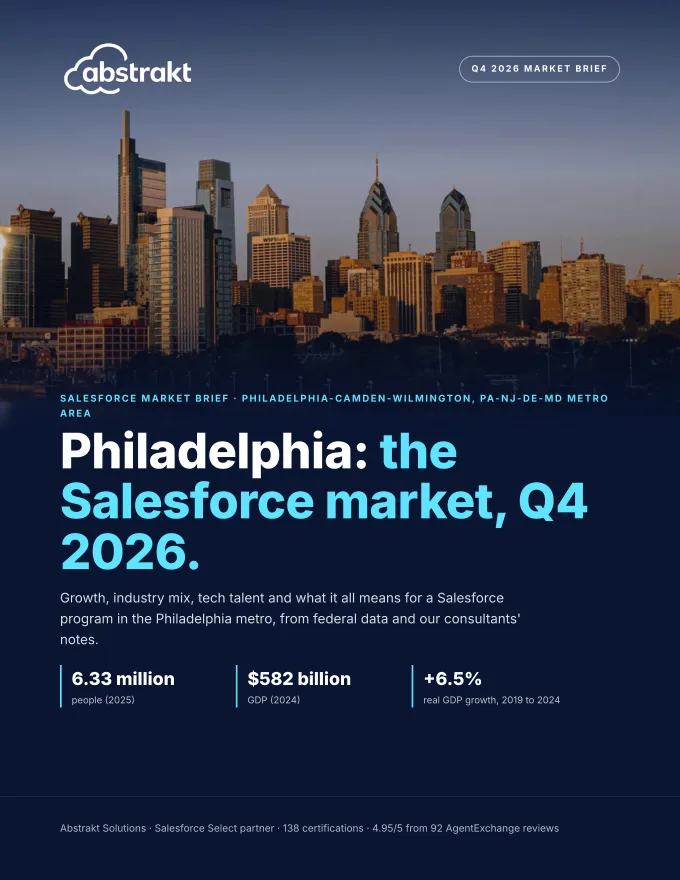
A free 26-page PDF with Philadelphia's growth ranked against 100 metros, its industry mix, tech wages and nearby markets. It is offered on the public Philadelphia page; send your customer there or get a copy for your own prep.
Get the Philadelphia brief →Co-sell with Abstrakt in Philadelphia
Working a Philadelphia account? Bring in a named consultant for discovery, scoping or a health check. We reply within 4 business hours.