

How Salesforce work starts in New York
Abstrakt Solutions is a Salesforce Consulting Partner focused on the financial, professional services and information businesses that anchor the New York economy. We implement, integrate, optimize and manage Salesforce for organizations across the New York metro. New York is one of our focus markets.
What buyers here usually run into
- 1
Regulated client data
Financial firms need record access, communications and marketing that stand up to compliance review, and a clear audit trail for who saw what.
- 2
Relationship knowledge in people’s heads
In partner-led firms, the most valuable relationship data lives in inboxes and calendars. Activity capture and simple layouts get it into the system.
- 3
Many systems, many business units
Large organizations often run several CRMs or orgs. Consolidation or clean integration is frequently the first project.
Budget, team and partner questions
What drives cost
In New York the cost swings come from sharing design and compliance review, the number of custodial, billing and archiving systems to connect, and how many business units must agree on one data model. Firms running several orgs should expect consolidation or integration work before new features.
Admin or partner
Large New York firms frequently employ Salesforce staff already, but spread across divisions with competing priorities. A partner usually takes the shared architecture, integrations and cross-org release testing, while internal admins keep ownership of requests inside their unit.
What buyers ask a partner
Ask for Financial Services Cloud and information-barrier references, and how the partner documents access decisions for your compliance team. Ask who on their team has led a multi-org consolidation, and get the names of the people doing the build.
The local economy and its biggest industries (4)
| Sector | Share of 2024 GDP | Where Salesforce fits |
|---|---|---|
| Finance and insurance Financial Services Cloud → | at least 19.3% | Asset managers, banks, insurers, brokerages and fintech firms need client and household views, onboarding, supervised communications and service. Financial Services Cloud and careful sharing and audit design are the usual foundations. |
| Professional, scientific, and technical services Salesforce for professional services → | 10.0% | Law, consulting, advertising and accounting firms manage relationships across partners and practices. Salesforce helps when client history, pursuits and referrals are shared rather than kept in individual inboxes. |
| Information Revenue Cloud / CPQ → | at least 8.8% | Media, publishing and software companies run advertising, subscription and enterprise sales motions that need quoting, renewals and customer data in one place. |
| Health care and social assistance Salesforce for health & life sciences → | 7.6% | Health systems and life-sciences companies use Salesforce for patient engagement, referral management, field teams and service, designed around privacy requirements. |
Source: U.S. Bureau of Economic Analysis, GDP by county (CAGDP2), 2024, summed to the metro area; private sectors only, excluding real estate and government. “At least” marks sectors where BEA suppresses some county figures.
Regional target sectors named by local economic development groups: Life sciences, Green economy, Technology, Creative sectors, Financial Services and Insurance (statewide target industry).
Salesforce products that fit New York (6)
In the order we lead with them here, from the industries above.
Salesforce Financial Services Cloud
Industry CRM for wealth management, banking, insurance, and lending, built for compliance from the start.
Salesforce Sales Cloud
The CRM where sales pipeline lives, when it is built right.
Salesforce Marketing Cloud
Cross-channel marketing, email, mobile, journey, and Data 360-powered personalization at scale.
Salesforce Data 360 (Data Cloud)
Unify customer data into a real-time profile that powers segmentation, analytics, and AI.
Salesforce Revenue Cloud / CPQ
Configure-price-quote, billing, subscription management, and quote-to-cash on Salesforce.
Salesforce Agentforce
AI agents that handle real work inside Sales Cloud, Service Cloud, and Marketing Cloud.
Putting Agentforce to work in New York finance
Finance and insurance produced at least 19.3% of New York metro GDP in 2024, per BEA county data, so the first AI question here is usually about regulated client service. An agent can summarize a long servicing case before an advisor picks it up, or draft a reply that a licensed employee edits and approves. Professional services firms and media businesses in the region tend to want lead triage and account research instead. Data hygiene decides whether it helps. Duplicate households, loose sharing rules, and outdated knowledge articles will surface straight into AI output, so we fix field-level permissions and content ownership first, then keep a person reviewing anything that touches money or advice.
- Advisor-ready case summaries
- Compliance-reviewed reply drafts
- Lead triage for professional services
Services buyers here usually need (7)
Salesforce Implementation in New York
For most New York organizations, a Salesforce implementation is shaped first by who is allowed to see which client. Practice groups, deal teams and regulated records decide the role hierarchy and sharing model, so we design those with your compliance and operations leads before building anything. Next comes the relationship model: households, companies and the people who connect them. We configure in a sandbox, load cleaned data and train each team on its own tasks before it goes live.
By industry in New York
- 1
Finance and insurance
With finance and insurance generating at least 19.3% of 2024 metro output, more than any other private sector in the region, asset managers, banks, insurers and brokerages make up much of the implementation work here. They face early choices about Financial Services Cloud objects, household and relationship modeling, and how advisors, bankers and service teams are separated. We make those decisions during design and document them for compliance, because the sharing model is the hardest part of an org to change once thousands of client records depend on it.
- 2
Life sciences
NYCEDC lists life sciences among its innovation industries. Implementations for these companies usually begin with business development: licensing discussions, research agreements and the contacts behind each one, modeled so that deal stages follow how scientific milestones actually progress. A later phase can add commercial and medical teams with their own processes. We design consent fields and restricted record types from the start, which keeps sensitive information out of the objects that sales users see every day.
- 3
Creative sectors
Creative sectors are another NYCEDC innovation priority. Agencies and studios in the city often implement Salesforce to replace a mix of pitch trackers and project spreadsheets. The data model has to link a client, a brief, the pitch and the engagement that follows, so new-business leaders can see win rates by service line and by the people pitching. We keep the first release small, focused on pipeline and client contacts, then add project and resourcing data once teams trust the basics.
Raise before scoping
Name a decision owner per group
Partner-led firms in New York often have several practices that each expect their own process. Implementation moves faster when each group names one person who can settle field definitions and stage names, and when a steering lead resolves conflicts between groups within the same week.
Build the relationship model first
Households, companies, contacts and the links between them underpin every later report. Build and test that structure with real sample records in the first phase, before adding marketing, service or quoting, because changing it afterwards means remapping every object that depends on it.
Keep review cycles short
Deal teams and compliance reviewers lose patience with long gaps between a request and a working demo. Show configured work in brief sandbox reviews every few days, so feedback arrives while the design questions are still fresh and small corrections never pile up into rework.
Salesforce Integration in New York
Integration projects in New York rarely involve just an ERP. Financial firms connect Salesforce to portfolio accounting, custodial feeds and communications archives, while media and software companies connect subscription billing, ad operations and product usage data. We map which system owns each field, pick the pattern that suits the volume, whether MuleSoft, another middleware tool or direct APIs, and build monitoring so failed records are caught and corrected before a client-facing report goes out.
By industry in New York
- 1
Information
The information sector, which includes media, publishing and software, produced at least 8.8% of 2024 metro GDP. These companies typically need Salesforce linked to subscription billing, ad operations and product usage systems, and the data arrives in large volumes. We design the integration so that account and subscription changes land on the right record, usage signals feed renewal risk, and Data 360 (formerly Data Cloud) handles high-volume profile data instead of loading it all into standard objects.
- 2
Finance and insurance
Advisors and relationship managers at the region's asset managers, banks and insurers want balances, positions and policies visible next to the client record, but the source systems belong to operations. We usually bring in summary data on a schedule, keep transactional detail in the system of record with links back to it, and log every sync so operations can reconcile what Salesforce shows against the books. Nothing is written back to a book of record without an agreed approval step.
- 3
Health care and social assistance
Hospitals and care organizations in the metro link Salesforce with electronic health records, scheduling and referral platforms, and each link raises questions about which data may leave the clinical system. We agree the minimum data set with privacy and IT leads, use event-driven updates for referral status, and keep clinical detail in the source application so Salesforce holds engagement information rather than a second copy of the chart. Access logging is designed in from the start.
Raise before scoping
Name an owner for every field
Before building, list the fields that more than one system can edit, such as client address or subscription status, and decide which system wins in a conflict. That single decision prevents most of the silent overwrites that make users stop trusting integrated data.
Plan around vendor feed limits
Market data, custodial and billing providers often cap how many API calls or file deliveries you receive, and some deliver only overnight. Design refresh schedules and user expectations around those limits instead of promising real-time data that the upstream vendor cannot actually supply.
Include the archive in scope
Regulated firms in New York often route email and messaging through a dedicated archiving system. If Salesforce sends client communications, confirm early how those messages reach the archive, since retrofitting that connection after launch can hold up compliance approval for the whole project.
Salesforce Managed Services in New York
Managed services in New York usually means running an org that changes weekly: new hires and departures, deal teams forming and dissolving, compliance asking for access reports and business units requesting fields. We take that request queue, triage it with you and deliver it using admins, developers and architects as each item needs. Every Salesforce release is tested in a sandbox before it reaches your users, and we meet on a regular cadence to agree what ships next.
By industry in New York
- 1
Professional, scientific, and technical services
Law, consulting, accounting and advertising firms, part of a professional services sector worth about 10% of 2024 metro GDP, add and remove users constantly as associates, laterals and contractors come and go, and each change touches permissions, territories and email sync. A managed services team handles that churn on a schedule, keeps client and matter data consistent, and builds the reports partners ask for without pulling an internal analyst away from billable work.
- 2
Finance and insurance
Banks, asset managers and insurers here tend to generate a steady stream of access requests, audit questions and small workflow changes. We keep a log of every permission change and who approved it, run periodic access reviews, and test each Salesforce release against your Financial Services Cloud configuration before it is promoted. That gives compliance a clear record while the business keeps receiving the enhancements it asked for, without waiting for a formal project.
- 3
Information
Media, publishing and software companies in New York change their packaging and pricing often, which means frequent updates to products, price books, quote templates and renewal automation. Under managed services, those changes move through a backlog with clear priorities and are tested in a sandbox first, so an update to a subscription bundle does not break the renewals or commission reports that finance relies on at month end. We also keep documentation current so the next change is quicker.
Raise before scoping
Agree one intake process
In a busy New York office, Salesforce asks tend to reach the admin through whichever channel is closest at hand. A single intake form or queue, with a named approver per department, lets us size and sequence the work, and gives leaders a record of what was asked for, what shipped and what is still waiting.
Keep releases away from close
New platform versions arrive on Salesforce's schedule, not yours. We time sandbox testing and any related adjustments so that nothing new reaches production during quarter-end close, audit fieldwork or other periods when finance and compliance teams have no capacity to absorb surprises of any kind.
Split duties with in-house staff
If you already employ an administrator, define which changes that person makes directly in production and which go through our sandbox and review process. Clear boundaries prevent two teams from editing the same flow at once and keep your deployment history readable during audits.
Salesforce Health Checks in New York
A health check for a New York organization usually begins with access. We review profiles, permission sets, sharing rules and admin rights against least-privilege, then look for automation overlaps, unused code and packages, integration users with excessive permissions and data-quality problems on key objects. The report ranks findings by risk and effort, so compliance, IT and the business can agree what to fix first, and it says plainly whether the org is ready to put Agentforce or other AI to work on your records.
By industry in New York
- 1
Finance and insurance
Financial services and insurance also appear on Empire State Development's statewide list of target industries. For firms in this sector, a health check focuses on whether Salesforce enforces the separation compliance believes it does: restriction rules, public groups, report folders and shared links that can expose client data sideways. We also confirm audit trail coverage on sensitive fields and look at how departed employees' access was removed, so each answer is backed by evidence from the org itself.
- 2
Health care and social assistance
Health care organizations in the New York area use a health check to confirm that protected information stays where it should. We look at which objects hold clinical or personal data, whether encryption and field-level security are applied, how integration users are scoped, and whether guest or community users can reach anything they should not. The output gives privacy officers a concrete list of settings to change rather than a general assurance.
- 3
Life sciences
Life sciences companies, one of NYCEDC's innovation industries, often build Salesforce quickly during a growth phase and later need to confirm it can support regulated commercial activity. A health check reviews how interactions with health care professionals are recorded, whether consent is tracked, where sensitive information has leaked into free-text fields and how much custom code a small team will need to maintain, ideally well before a product launch or an inspection puts the org under scrutiny.
Raise before scoping
Include integration and API users
Service accounts used by middleware and vendor tools often hold broad permissions that nobody reviews. Include them in scope, along with connected apps and stored credentials, since an integration user with access to every record is a larger exposure than most individual employees.
Rate data before an AI pilot
An AI pilot is only as trustworthy as the records it draws on. Ask the health check to rate completeness on the objects an agent would read, such as accounts, cases and knowledge articles, and fix the worst gaps before any pilot reaches clients or advisors.
Bring compliance into the readout
Findings about access and audit trails need decisions from compliance and legal, not only from IT. Invite them to the findings session, so remediation priorities reflect regulatory exposure and fixes that need their sign-off are identified early instead of waiting in a queue.
Salesforce Optimization in New York
Underused orgs in New York tend to fail in the same place: leadership meetings run on spreadsheets that someone rebuilds from Salesforce exports each week. Optimization removes the reason for that workaround. We measure logins and field completion, interview the teams who avoid the system, strip layouts back to what each role needs, consolidate overlapping automation into Flow, and rebuild dashboards on definitions your leaders agree, so the numbers in the meeting come straight from the org.
By industry in New York
- 1
Health care and social assistance
Health systems and community providers, part of a health care and social assistance sector that contributes about 7.6% of metro GDP, often run contact centers and referral tracking that grew one department at a time, leaving duplicate patient or referral records and queues nobody monitors. Optimization merges duplicates under agreed matching rules, simplifies case layouts for agents, and rebuilds referral dashboards so leaders can see volumes and conversion without exporting data that should stay inside a controlled system.
- 2
Professional, scientific, and technical services
For law, consulting and accounting firms, the adoption problem is usually partners who see data entry as someone else's job. We cut required fields to the few that feed reports partners actually read, add quick actions for logging a meeting or referral, and give each practice leader a dashboard of their own pursuits. When the system hands back something useful for a small amount of input, partner usage tends to follow.
- 3
Technology
Technology is one of NYCEDC's innovation industries, and the city's software companies often outgrow a Salesforce setup built by their first sales hire. Typical fixes include stage definitions that match the real buying process, lead routing that had been patched with several overlapping flows, and renewal and expansion reporting separated from new business. Cleaning that up gives a growing revenue team forecasts that its board and investors can rely on.
Raise before scoping
Benchmark usage before changing anything
Capture current logins, record updates and dashboard views per team before the first change. Those numbers show where the effort should go, and they give you an honest comparison afterwards, which matters when a skeptical managing partner or division head asks whether the work paid off.
Retire legacy automation carefully
When an object has workflow rules, Process Builder and Flows all firing on save, nobody can predict the outcome of an edit. Inventory every one, test the consolidated Flow in a sandbox against real records, and switch off the old automation only after the new version has run cleanly.
Check capture policies with compliance
Email and calendar capture helps adoption, but regulated firms in New York may have retention and supervision rules that limit what can be synced. Confirm with compliance which mailboxes and message types are permitted before enabling it, so the adoption gain does not create a records problem.
Salesforce Migration in New York
Migrations for New York companies often combine sources: a legacy CRM, a marketing tool, contact lists kept by individual partners and sometimes an acquired firm's system. The work starts with an inventory of each source and a decision about which history is worth keeping. We then map fields, merge duplicates, especially people who appear in several lists under different titles or emails, run trial loads into a sandbox, reconcile counts and schedule a cutover that avoids month-end and busy client periods.
By industry in New York
- 1
Professional, scientific, and technical services
Consulting, legal and accounting firms often arrive with a practice database, a marketing list tool and contact files that belong to individual partners. The hard part of the migration is merging those into one person record per contact without losing who owns which relationship. We match on email and company, flag conflicts for review by the partner concerned, and bring over key meetings and referrals so relationship history survives the move.
- 2
Technology
Startups in the city's technology sector, one of NYCEDC's innovation industries, frequently begin on a lightweight CRM and move to Salesforce once they add enterprise sales, partnerships or more product lines. Migration for them is mostly about reconciling deal stages that meant different things to different reps, carrying over product and subscription data correctly, and preserving the marketing attribution that growth teams use when planning spend. We also re-point signup forms and product-usage feeds at Salesforce during cutover.
- 3
Green economy
NYCEDC also names the green economy as an innovation industry. Energy-efficiency and clean-energy service companies often track sites, projects, incentives and installers in spreadsheets that grew as fast as the business did. Migrating them means turning those sheets into proper objects, such as properties, projects and program applications, and de-duplicating building and customer records so that each property appears once, with its full project history attached. Incentive deadlines are carried over as tasks so none are missed.
Raise before scoping
Freeze the old system deliberately
Pick a date after which nobody edits the legacy system, and tell every team what that means for open deals and cases. A short, announced freeze followed by a final delta load is far safer than letting people update both systems during a transition week.
Decide who owns each duplicate
When the same contact sits in several partners' lists, a merge needs someone to decide ownership and the correct details. Assign those decisions before trial loads begin, so migration is not held up by review queues that nobody feels responsible for clearing.
Keep archives reachable
Not all history is worth loading, but regulated firms may still need to produce it later. Export what stays behind to a searchable archive with a documented location, so records that do not move into Salesforce can still be retrieved when an auditor or client asks.
Salesforce Implementation Rescue in New York
When a New York Salesforce project goes wrong, it is usually because the design tried to satisfy every practice or business unit at once, or because a partner left before handover. Rescue begins with triage: what is live, what is half built, which data is trustworthy and what users actually need this quarter. We stabilize the parts the business depends on, decide for each component whether to keep, fix or rebuild, then finish the scope with documentation your team can maintain.
By industry in New York
- 1
Information
Media and software companies often stall on the quoting and subscription side of an implementation, where product catalogs, bundles and renewals get complicated fast. In a rescue, we separate the parts of Revenue Cloud or CPQ that work from pricing rules that conflict, simplify the catalog to what is actually sold, and get renewals generating correctly before adding anything new. Renewal accuracy is the first thing we verify, so finance can close a month without manual fixes.
- 2
Finance and insurance
Financial firms sometimes reach launch with a security model so restrictive that advisors cannot see their own households, or so open that compliance refuses to sign off. Recovery starts by mapping which users need to see which records and why, then rebuilding the sharing design with compliance in the room. In many cases most of the configured objects and data can be kept; it is the access layer that needs rework.
- 3
Professional, scientific, and technical services
At law, consulting and accounting firms, projects fail most often on adoption: the system went live, partners never used it and marketing kept its own lists. We interview the practice leaders who stopped using Salesforce, strip the build back to the few processes they will actually follow, and relaunch with training built around their weekly tasks rather than the original requirements document. Anything nobody uses is removed instead of being left to confuse new hires.
Raise before scoping
Secure the build artifacts
Before anything else, confirm you hold admin access, sandbox and production logins, any code repository and the design documents from the previous partner. Rescues slow down most when knowledge left with a contractor, so collect everything available while former contacts are still responsive.
Stop new scope during triage
Pause new feature requests until the assessment is finished. Adding requirements to a stalled project hides the original problems, and the recovery plan needs a fixed baseline to decide which parts of the org to keep, fix or rebuild. Park new ideas in a list for later.
Reset expectations with leadership
Senior sponsors in New York have often lost confidence after the first missed date. Share the triage findings openly, agree one realistic go-live for the stabilized scope and report progress against it regularly, so the second launch rebuilds trust instead of adding another slipped deadline.
Industry plays in New York (4)
Salesforce for New York Private Equity Firms
For a New York private equity firm, Salesforce is less a sales pipeline than a relationship map. Deal teams need to know which bankers, lenders and operating partners have shown them what, investor relations needs commitments and communications by LP, and partners want coverage reports they believe. We build around those three jobs, usually on Financial Services Cloud, capture email and calendar activity automatically, and keep sensitive deal data behind permissions that match how fund and deal teams are really staffed.
Finance and insurance accounts for at least 19.3% of the New York metro's 2024 GDP in Bureau of Economic Analysis county data, the largest private sector here, and professional, scientific and technical services adds another 10%. Empire State Development also names financial services and insurance on its roster of industries it recruits and supports across New York State. For sponsors, that density cuts both ways: the pool of intermediaries, co-investors, lenders and advisors is deep, and the same people turn up across many firms and processes. A CRM that cannot untangle overlapping relationships loses the investment team's confidence quickly.
Use cases to open with
- 1
Intermediary coverage and sourcing
Deal flow in a crowded market depends on which advisors think of you first. We model banks, boutique advisors and individual bankers as related records, log every teaser and CIM against its source, and give partners a coverage view showing who has sent opportunities, who has gone quiet and which relationships nobody on the team owns. Automated activity capture fills in most of it without extra typing.
- 2
LP relationships and fundraising
Fundraising teams juggle commitments, re-ups, due diligence questionnaires and data room access across many limited partners. Financial Services Cloud can hold investors, consultants and their ties to each fund, track the stage of every commitment, and log meetings and follow-ups, so the next close starts from a clean history rather than a spreadsheet that one person maintains. Placement agents and consultants get their own records, so the firm can see which introductions actually led to commitments.
- 3
Portfolio company oversight
Operating partners need a consistent read on each holding without logging into every company's systems. We define shared metrics, pull them from portfolio CRMs and finance tools through integration or Data 360 (formerly Data Cloud), and surface them on dashboards by fund and vintage, so board preparation and value creation reviews begin from the same numbers. Where a platform company absorbs add-ons, the same definitions keep pipeline and bookings comparable before and after each acquisition, and sponsors can see which holdings are ready for a shared revenue playbook.
Raise before scoping
Deal confidentiality and walls
Live processes, code names and information received under NDA should not be visible across the whole firm. Plan restriction rules, deal team membership and field-level security before build, and decide how records are handled when a process ends or the firm passes on a deal.
Overlapping contacts across processes
The same banker, lender or executive can be a source, a co-investor and a board candidate at once. Agree on duplicate rules and a single person record with roles before migrating old trackers, or coverage reports will double count relationships from the start.
Adoption among deal professionals
Associates and partners rarely type notes into a CRM between processes. Lean on email and calendar capture, mobile access and a short list of required fields, and run the weekly pipeline meeting from Salesforce so the system becomes the source instead of a copy.
Salesforce for New York Wealth Managers
Wealth management in New York tends to mean complicated households: family members with separate accounts, trusts, entities and outside advisors such as attorneys and accountants. Financial Services Cloud gives advisors a household view with financial accounts fed from custodians, while operations teams run onboarding and money movement requests as tracked workflows. We design the relationship model first, connect custodial and planning data, and set up communications so compliance can review them before they reach clients.
New York's finance and insurance sector is at least 19.3% of metro GDP in the Bureau of Economic Analysis's 2024 county figures, making it the region's largest private industry, and Empire State Development treats financial services and insurance as a statewide target. The Bureau does not break out wealth management, but advisory practices sit inside that sector alongside banks, broker-dealers and insurers. In practice, advisors here often arrive from larger institutions, clients hold assets at several firms, and a consolidated household picture is harder to assemble than in smaller markets.
Use cases to open with
- 1
Household and entity relationships
One client relationship may include grandparents, adult children, a family trust, an operating company and a foundation. We model each as a person or business account linked to the household, attach financial accounts from custodial feeds, and record roles such as trustee or grantor, so an advisor preparing for a review sees the whole family and every related entity on one screen.
- 2
Onboarding and service requests
New accounts, transfers and beneficiary changes involve forms, signatures and several handoffs between advisor, operations and custodian. Case-based processes in Financial Services Cloud track each request by stage and owner, remind staff about missing documents, and show advisors status without a call to operations, which matters most when a new relationship moves many accounts at once. Operations leaders also get reporting on aging requests and bottlenecks by custodian.
- 3
Supervised marketing and events
Seminars, market commentary and next-generation outreach are common growth tools for advisory firms here. Marketing Cloud can segment by household tier and interest, send approved content and record every touch against the client, while an approval step keeps compliance review inside the flow. Experience Cloud can add a secure portal where clients upload statements, sign documents and see upcoming meetings, which keeps sensitive files out of personal email threads.
Raise before scoping
Custodial and planning integrations
Advisors rarely work from a single custodian. Decide which feeds bring positions, balances and transactions into Salesforce, how often they refresh, and which system owns the household definition. Planning, portfolio management and document tools each need a defined role so advisors never see conflicting numbers.
Books, records and supervision
RIAs and broker-dealers operate under SEC and FINRA expectations for records and communications. Plan email archiving, field history, retention and approval steps with your compliance team before launch, and confirm how notes and client messages captured in Salesforce will be reviewed. We raise these points as design questions for your compliance staff; they are not legal advice.
Advisor migration and adoption
Advisors who joined from other firms bring their own habits and sometimes their own data. A clean migration, simple page layouts and a review-prep view that works on a phone earn more adoption than training alone. Pilot with a few teams, adjust, then roll out.
Salesforce for New York Law Firms
For a New York law firm, Salesforce is the layer where client relationships, pitches and new matter requests come together. It does not replace time entry, billing or the document management system; it sits beside them. We configure intake so a request moves through conflicts and engagement letters with a clear owner, give partners a view of who at the firm knows whom at each client, and add a client portal for matter updates where it saves associates from status emails.
The Bureau of Economic Analysis does not report law firms as a separate sector. They sit inside professional, scientific and technical services, which accounted for 10% of New York metro GDP in 2024, second only to finance and insurance, which reached at least 19.3%. Neither NYCEDC's innovation sectors nor the statewide target list names legal services, so the practice here is best understood through its clients: banks, insurers, asset managers and the information and creative businesses the city recruits. Corporate client teams, panel reviews and cross-office matters set the design requirements.
Use cases to open with
- 1
Intake through conflicts clearance
A new matter request often arrives by email to one partner and waits. A structured intake form in Salesforce captures parties, adverse parties and the matter description, sends the details to the conflicts system through an integration, and tracks clearance, engagement letter and matter opening as visible steps. Partners see where each request stands, and the business development team learns which referral sources and practices bring in the most new work.
- 2
Client team relationship coverage
Large institutional clients are served by several practice groups at once. Salesforce can record every lawyer with a meaningful relationship at each client, activity captured from email and calendars, and pitches won or lost by practice. Client team leaders prepare for annual reviews with one view of coverage, gaps and recent contact, instead of polling partners for updates before every meeting.
- 3
Client portals for matter status
In-house legal departments want predictable updates, budgets against actuals and a single place for requests. An Experience Cloud portal can publish matter status, key dates and shared documents drawn from firm systems, and let client counsel submit new requests that route into intake. Associates spend less time writing status emails, and relationship partners see which clients use the portal most.
Raise before scoping
Ethical walls in Salesforce
Screens set up in the conflicts or document systems must also apply to CRM records, activities and reports. Plan sharing rules and restricted record types so walled lawyers cannot see matter or client detail, and test the rules with your risk team before any partner logs in.
Leave billing where it lives
Time, billing and trust accounting stay in the practice management system. Salesforce should read summary figures such as fees billed by client or practice, not become a second source of financial truth, which keeps reconciliation simple and avoids arguments over whose number is right.
Adoption that suits partners
Lawyers will not fill in long forms between billable tasks. Rely on automatic activity capture, mobile access and assistants who update records on a partner's behalf, and give each practice leader a small dashboard they actually open. Adoption follows when the CRM answers questions partners already ask.
Salesforce for New York Professional Services Firms
New York professional services firms tend to sell into a handful of very large clients, each with separate divisions, budgets and procurement rules. Salesforce should map those buying centers, track pitches and proposals through to signed statements of work, and hand each win to delivery with scope, staffing and budget intact. We pair Sales Cloud with CPQ or a PSA tool so pricing, rate cards and project setup match what the proposal promised, and leaders can see pipeline against the bench.
One dollar in ten of New York's 2024 metro output came from consultants, agencies, engineers and other technical firms, by Bureau of Economic Analysis count, a share topped only by finance and insurance at 19.3% or more. Information, a large client base for agencies and consultancies, contributes at least 8.8%. NYCEDC's innovation industries include technology and the creative sectors, where many design, marketing and digital firms sit. The result is a services market where many firms compete for the same financial and media clients, so account intelligence and proposal speed matter more than raw lead volume.
Use cases to open with
- 1
Buying centers inside large clients
One global bank or media group can be a dozen separate buyers. We model the client as a parent account with divisions, sponsors, procurement contacts and existing agreements beneath it, so partners see where the firm already works, where contracts are up for renewal, and which divisions have never been approached. Cross-selling becomes a planned motion rather than a hallway conversation.
- 2
Pitch and proposal tracking
Agencies and consultancies spend heavily on pitches they may not win, and few measure that cost. Salesforce can record each pitch's team, hours invested, competitors, decision date and outcome, with proposal documents attached. Over time leadership sees win rates by practice, client type and pitch size, and can decide which invitations to decline before the team spends another weekend on a deck.
- 3
Statement of work to delivery
Revenue Cloud or CPQ builds statements of work from approved rate cards, roles and milestones, with discount approvals routed to the right partner and signed documents stored against the opportunity. When the deal closes, the project, budget and staffing request are created automatically in the PSA tool, so delivery starts with the same scope sales sold and finance can bill from day one.
Raise before scoping
Procurement and vendor onboarding
Large clients require supplier registration, security questionnaires and master agreements before work begins. Track those steps on the opportunity or account so a won pitch does not stall in vendor setup, and record agreement expiry dates so renewals start early.
Origination and credit rules
Partners care who gets credit for a win. Agree how origination, contribution and service credit are recorded before build, because compensation reporting depends on it. Changing the rules after launch means reworking opportunity splits, reports and every dashboard leadership has learned to trust.
CRM and PSA boundaries
Decide where the opportunity ends and the project begins. Most firms let Salesforce own pipeline, proposals and client relationships while the PSA tool owns staffing, time and project financials, synced through a defined integration. Blurred ownership produces duplicate records and utilization figures nobody believes.
Case studies to send (3)
From the industries this market leans on. Client names are anonymized and these projects are not specific to New York.
The New York Salesforce market brief, Q4 2026
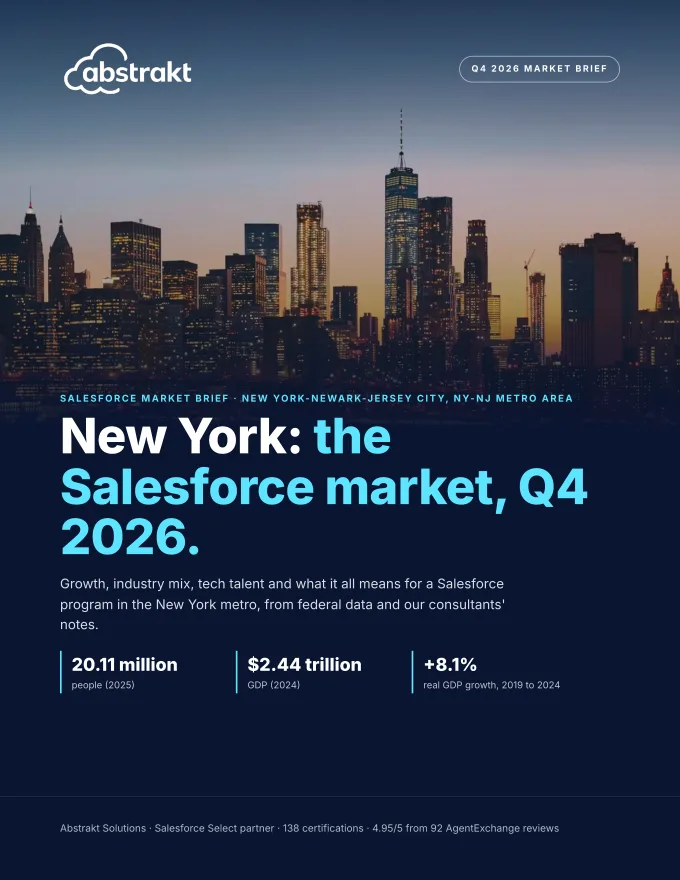
A free 23-page PDF with New York's growth ranked against 100 metros, its industry mix, tech wages and nearby markets. It is offered on the public New York page; send your customer there or get a copy for your own prep.
Get the New York brief →Co-sell with Abstrakt in New York
Working a New York account? Bring in a named consultant for discovery, scoping or a health check. We reply within 4 business hours.