

How Salesforce work starts in Allentown
In Allentown, Bethlehem, Easton and the surrounding Lehigh Valley, Abstrakt Solutions acts as Salesforce Consulting Partner to manufacturers, health networks and logistics firms. Allentown is one of our focus markets.
What buyers here usually run into
- 1
Dealer and distributor visibility
Equipment and consumer-goods makers that sell through partners often lack a clear view of what their channel is doing. Partner portals and shared pipeline data are a common first fix.
- 2
Regulated product service
Medical-device and life sciences manufacturers need complaint, service and field records that stay traceable, which shapes how Service Cloud is configured from day one.
- 3
Health-system outreach
Hospital networks competing for the same patients and physicians need referral and outreach tracking that respects consent and privacy requirements.
Budget, team and partner questions
What drives cost
Lehigh Valley cost drivers are mostly about integration and pricing: how many ERP, WMS or TMS connections are needed, whether dealer or fleet pricing calls for Revenue Cloud, and whether dealers or shippers need a portal. Health networks spend more on consent design and outreach setup, and companies leaving Dynamics or spreadsheets add migration and cleanup time.
Admin or partner
Larger manufacturers and health networks here often have an admin or small Salesforce team and bring in a partner for integration, quoting or a new business unit. Logistics firms, food producers and agencies more commonly use managed services until daily Salesforce work justifies a hire.
What buyers ask a partner
Ask for references involving ERP and dealer-channel work, logistics system integration, or health outreach with consent controls, depending on your business. Ask how the partner phases releases and what documentation your team owns at the end.
The local economy and its biggest industries (4)
| Sector | Share of 2024 GDP | Where Salesforce fits |
|---|---|---|
| Manufacturing Salesforce for manufacturing → | 14.4% | Truck, industrial gas, electrical-product and consumer-goods makers here sell through dealers, distributors and retailers, so quoting, account planning and service history need to connect to ERP and production data. |
| Health care and social assistance Salesforce for health & life sciences → | 12.9% | With health care and social assistance producing about 12.9% of 2024 metro GDP, second only to manufacturing, and life sciences on LVEDC’s target list, Salesforce work often centers on referrals, patient and provider outreach, and service designed around privacy rules. |
| Transportation and warehousing Sales Cloud → | 5.5% | Carriers, warehouses and third-party logistics providers need shipper accounts, quotes and service cases in one place, tied to the transportation and warehouse systems that run operations. |
| Professional, scientific, and technical services Salesforce for professional services → | at least 4.4% | LVEDC targets professional and creative services, and engineering, consulting and agency firms that serve the Valley’s manufacturers need pursuit pipelines, project handoffs and client reporting connected. |
Source: U.S. Bureau of Economic Analysis, GDP by county (CAGDP2), 2024, summed to the metro area; private sectors only, excluding real estate and government. “At least” marks sectors where BEA suppresses some county figures.
Regional target sectors named by local economic development groups: Life Sciences, Advanced Manufacturing, Professional/Creative Services, Food and Beverage Manufacturing.
Salesforce products that fit Allentown (6)
In the order we lead with them here, from the industries above.
Salesforce Sales Cloud
The CRM where sales pipeline lives, when it is built right.
Salesforce Service Cloud
The operating system for modern customer service, case, knowledge, voice, and AI agent assist together.
Salesforce Revenue Cloud / CPQ
Configure-price-quote, billing, subscription management, and quote-to-cash on Salesforce.
Salesforce Field Service
Scheduling, dispatch, mobile work orders and parts for teams that work on site.
Salesforce Marketing Cloud
Cross-channel marketing, email, mobile, journey, and Data 360-powered personalization at scale.
MuleSoft
Enterprise API platform, for connecting Salesforce, ERP, data warehouses, and the rest of your stack.
Lehigh Valley plants and health systems try AI
Manufacturing and health care together dominate the Allentown metro, at 14.4% and 12.9% of 2024 GDP. Food and beverage producers and other manufacturers can use agents to answer customer order questions, read incoming purchase documents, and log quality complaints with a structured summary. Hospital networks tend to open with a narrow patient access agent limited to vetted scheduling topics. Transportation and warehousing firms, also significant here, fit shipment inquiry handling. Across these, results depend on integration: if order status lives only in an ERP that Salesforce cannot see, the agent has nothing reliable to say. We connect the data first and pilot with a narrow scope.
- Quality complaint intake summaries
- Patient access question answers
- Shipment inquiry handling
Services buyers here usually need (7)
Salesforce Implementation in Allentown
In the Allentown metro, most first-time Salesforce buyers make or move physical things: trucks, industrial gases, medical devices, lighting controls, packaged food, freight. That makes the account structure the hardest design question, because a single customer may appear as a dealer, a fleet owner, a distributor branch and a service location. We resolve that hierarchy in workshops, build it in a sandbox, load reconciled ERP and spreadsheet data, and launch sales first, with quoting, service and portals following in later releases.
By industry in Allentown
- 1
Manufacturing
Heavy trucks, industrial gases, medical devices and electrical products all come out of Lehigh Valley plants, and together with other factories they give manufacturing about 14.4% of 2024 metro GDP, more than any other private sector. Implementations for these companies hinge on the product catalog and the channel: which items sell direct, which go through dealers or distributors, and how service contracts attach to equipment in the field. We lock those decisions into the data model before configuring pages, since a catalog designed around marketing names rarely survives contact with ERP part numbers.
- 2
Life Sciences
LVEDC names life sciences as a target sector. For device and pharmaceutical companies here, a first Salesforce implementation usually covers hospital accounts, buying committees and product complaints. Complaint intake must be traceable, so we design case fields and record types with the quality team present, and we keep regulated batch and device history records in the validated systems that already own them.
- 3
Transportation and warehousing
Carriers, warehouse operators and third-party logistics providers in the Lehigh Valley often come to Salesforce with shipper relationships scattered across rate spreadsheets and operations software. The implementation centers on a shipper account model that holds lanes, facilities, contract terms and service contacts in one place. Phase one gives sales a clean pipeline for new business and renewals; later phases add service cases tied to shipments and a view of volume pulled from the transportation management system.
Raise before scoping
Include the New Jersey side
The metro reaches into Warren County, New Jersey, as well as Carbon County in Pennsylvania. Put state and county on every account from the first data load. Territory assignment, tax treatment on quotes and email consent can all differ across the river, and adding those fields later means touching every record.
Settle part numbers early
Manufacturers here often carry the same product under an engineering number, an ERP item and a catalog name. Pick the identifier Salesforce will use, map the others to it, and agree who maintains the list. Quoting, service and reporting all inherit whatever choice is made in the opening weeks.
Go live with sales first
A phased rollout suits most Lehigh Valley companies: accounts, contacts and pipeline in the first release, then CPQ, service or field operations once reps trust the data. Each stage gets its own role-based training, and nothing in the first design has to be torn out to make room for the next.
Salesforce Integration in Allentown
For Allentown-area companies, integration mostly means connecting Salesforce to the systems that run the physical business: ERP for pricing and orders, transportation and warehouse platforms for shipments, and production or quality systems for product data. Reps and service agents need that information on the account page without re-keying it. We document each flow, assign an owning system to every shared field, build with MuleSoft or lighter tools depending on scale, and add monitoring so failures reach a named person quickly.
By industry in Allentown
- 1
Transportation and warehousing
In a metro where the BEA credits transportation and warehousing with about 5.5% of 2024 output, carriers, warehouse operators and logistics providers keep the real activity in transportation and warehouse management systems, while commercial teams sell and renew contracts elsewhere. Integration brings shipment volumes, on-time performance and open exceptions onto the shipper account in Salesforce, and pushes new customer and rate details back to operations, so account managers walk into renewal conversations knowing what the customer has experienced.
- 2
Advanced Manufacturing
Advanced manufacturing is an LVEDC target sector, and manufacturers pursuing it typically connect Salesforce to ERP for item masters, pricing, orders and inventory. For engineered or configurable products, CPQ quotes must translate cleanly into ERP orders with the right configuration codes. We design that handoff carefully, validate it with order-entry staff, and bring shipment and invoice status back so sales sees whether a won deal actually shipped and was billed.
- 3
Food and Beverage Manufacturing
Food and beverage producers, another LVEDC target sector, depend on data that arrives from outside: distributor depletion files, retailer portals and broker reports, each in its own format. Integration normalizes those feeds into Salesforce so account teams see sell-through by distributor and banner alongside promotions and plans. We also link ERP orders and lot information, which helps service teams answer retailer questions quickly when a shipment or product issue comes up.
Raise before scoping
Map every data owner
Draw up a table with customers, products, rates, orders and shipments down one side and your systems across the top, marking where each record is born, edited and merely read. Integration disputes in Lehigh Valley companies nearly always trace back to two systems that both think they own the same record.
Plan for partner file formats
Distributor, retailer and broker files change without warning. Build a staging step that validates each file before it touches Salesforce, flags rows that fail, and keeps the rest moving. Otherwise one malformed file can stall reporting for an entire sales team until someone notices.
Keep volumes in proportion
Carriers and warehouses produce enormous transaction volumes, and not all of it belongs in the CRM. Bring summaries and exceptions into Salesforce, such as weekly volume, late shipments and claims, and leave line-level detail in the operational system where it is already stored and reported.
Salesforce Health Checks in Allentown
A health check is how many Allentown organizations decide what to do next with Salesforce. Health networks want to know whether referral and outreach data is properly restricted; device and pharmaceutical makers want assurance that complaint records are complete and traceable; manufacturers planning CPQ, field service or Agentforce want to know whether their data will hold up. We review security, sharing, automation, code, integrations and data quality, then deliver a ranked list of findings with clear owners.
By industry in Allentown
- 1
Health care and social assistance
Hospital networks and care organizations in the region use Salesforce for physician relations, referrals and patient outreach, and those orgs tend to expand faster than their security model. The health check traces who can reach patient-related records through profiles, permission sets, sharing rules and portal access, checks field audit coverage, and identifies integrations pulling more data than they need. Findings are grouped for the privacy office, the Salesforce team and IT, so each knows its own list.
- 2
Life Sciences
For device and pharmaceutical companies, the health check pays special attention to complaint and inquiry handling. We confirm that case records capture the fields regulators and quality teams expect, that required steps cannot be skipped, and that edits are tracked in history. We also look for product or patient information stored in free-text fields, email attachments or notes, where it is hard to control and easy to overlook during an audit or inspection.
- 3
Advanced Manufacturing
Manufacturers pursuing LVEDC's advanced manufacturing agenda often want to add quoting, service or AI to an existing org. The health check measures whether the foundation can carry it: duplicate accounts, product records that disagree with ERP, orphaned assets, overlapping automation on opportunities and Apex without adequate tests. Each problem is rated by the risk it poses to the planned project, so leadership can decide what to fix beforehand and what can wait.
Raise before scoping
Decide who receives findings
Security findings, data quality problems and technical debt usually belong to different people. Agree in advance who owns each category, whether privacy, quality, sales operations or IT, so the report turns into assigned work rather than a document that circulates without anyone acting on it.
Review portals and guest access
Dealer portals, patient sites and customer communities expand who can reach your data. Include every Experience Cloud site in scope, test each as an anonymous visitor and a typical partner user, and confirm file and record visibility matches what you intended when the site launched.
Use findings to scope AI
If Agentforce is on the roadmap, have the health check identify where data is complete and permissions are tight. Start AI pilots in those areas, and treat the rest of the findings as the clean-up list that has to be finished before agents touch more sensitive records.
Salesforce Optimization in Allentown
Optimization in the Allentown metro usually follows growth: a manufacturer added product lines, a health organization added service areas, a retailer added locations, and the org absorbed each change without anyone stepping back. The symptoms follow: blank fields everywhere, automations undoing each other's work and forecasts that sales leaders quietly redo by hand. We start from usage data and user interviews, remove what nobody uses, merge overlapping automation into documented Flows, and rebuild dashboards around the handful of numbers each leader actually reviews.
By industry in Allentown
- 1
Retail trade
The BEA sizes retail at roughly 6.3% of the metro's 2024 economy, and regional retailers and consumer brands in it often run Salesforce beside commerce and marketing platforms, where the seams show: duplicate customer records, email preferences that disagree between systems, and service agents toggling between screens. Optimization here means one customer view on the case page, consent synchronized in one direction, and reports that connect service volume to store or channel so operations leaders can see where problems cluster.
- 2
Manufacturing
Truck, device and electrical-product manufacturers in the region frequently find their quoting and opportunity processes drifting apart. Reps build quotes outside Salesforce, discount approvals happen by email, and forecast categories mean different things in each division. We realign stages with the real sales cycle, bring approvals into the system with clear thresholds, and give sales leadership one forecast definition across business units, which tends to recover adoption faster than any new feature.
- 3
Health care and social assistance
Physician liaisons and outreach teams at the region's health networks rely on Salesforce to track referral sources and visits. Over time these orgs pick up redundant activity types, stale territories and reports that count the same visit twice. We simplify activity logging so a liaison can record a visit from a phone in a few taps, clean territory assignments, and rebuild referral trend reports so leaders can compare service lines on a consistent basis.
Raise before scoping
Interview the people who quit
Talk to users who stopped logging in, not only to power users. Their reasons, often a slow page, a pointless required field or a report they could not find, point directly at the fixes with the largest adoption payoff in a Lehigh Valley org.
Consolidate automation by object
Map every workflow rule, Process Builder, Flow and trigger that acts on accounts, opportunities and cases. Where several fire on the same event, fold them into one ordered Flow per object with clear entry criteria. Debugging becomes possible again and record saves get faster for everyone.
Retire fields with evidence
Run fill-rate reports before deleting anything. Fields below a threshold you agree on get hidden first, then removed after a quiet period if nobody objects. This avoids breaking an integration or a quarterly report that depends on a field no one remembered.
Salesforce Managed Services in Allentown
Allentown-area organizations tend to reach managed services the same way: one administrator, often shared with other IT duties, falls behind on requests while the org keeps growing. We take the backlog, rank it with your internal owner, and work through user changes, Flow fixes, report requests and integration errors on an agreed cadence. Each Salesforce release is tested in a preview sandbox before it lands, and every change is logged, so the org stays understandable to whoever administers it next.
By industry in Allentown
- 1
Health care and social assistance
By BEA's 2024 count, health care and social assistance produced about 12.9% of Allentown metro output, a close second to manufacturing. Health organizations using Salesforce for referrals, physician outreach or patient access generate constant small requests, each of which touches privacy settings. Our managed services process routes every change through a permission review and keeps a record of who approved it, so outreach teams get their updates without compliance losing track of what changed.
- 2
Food and Beverage Manufacturing
LVEDC counts food and beverage manufacturing among the four sectors it recruits, and the snack, candy and beverage producers selling to grocers and distributors in that group need Salesforce adjusted as promotions, retail banners and broker relationships change through the year. Managed services keeps trade promotion fields, account plans and retailer hierarchies current, loads distributor sell-through files when formats shift, and fixes the reports category managers rely on before their next buyer meeting rather than after it.
- 3
Professional/Creative Services
LVEDC also targets professional and creative services, a group that includes agencies, engineering practices and consultancies serving the region's manufacturers. These firms rarely employ a Salesforce specialist of their own, and whoever configured the org originally has usually moved on. Managed services gives them one on call for pipeline changes, project handoffs, time-to-invoice reporting and marketing list clean-up, with a monthly planning conversation that keeps partners focused on what the system should do next rather than on how to configure it.
Raise before scoping
Name a single request channel
Requests that arrive by hallway conversation, email and chat get lost or duplicated. Agree on one intake route, whether a Salesforce case queue or a shared form, so every request is visible, ranked and traceable. Health networks especially benefit, because each request then carries its own approval history.
Test releases before they land
Salesforce updates arrive three times a year and occasionally change how Flows, email templates or page components behave. We run your critical processes in a preview sandbox ahead of each release, so referral routing, quoting and order sync are checked before your users see any difference.
Protect integration credentials
Connections to ERP, EHR or marketing tools often run on a single integration user. Managed services should cover rotating its credentials, checking its permissions and watching for failed jobs, because a quiet sync failure can leave sales or care coordinators working from yesterday's information without knowing it.
Salesforce Migration in Allentown
Allentown migrations tend to involve years of accumulated records: a manufacturer's legacy CRM, a professional firm's contact database, a retailer's customer lists spread across point-of-sale and email platforms. We profile the data first, decide what history is worth moving, deduplicate and standardize before extraction where the source allows, and map every field to the new Salesforce model. The full load is rehearsed in a sandbox, and cutover is scheduled around your busiest weeks.
By industry in Allentown
- 1
Professional, scientific, and technical services
The BEA's professional, scientific and technical services category comes to about 4.4% of metro output for 2024, and the engineering, consulting and creative shops in it tend to scatter client history across an aging CRM, a project tool and each partner's own address book. Migration means reconciling those into one set of client accounts, attaching project history to the right organization, and preserving who introduced whom, since relationship history is what these firms value most and is the easiest thing to lose in a careless import.
- 2
Retail trade
Retailers and consumer brands moving customer data into Salesforce from several older platforms face a matching problem: the same shopper appears in loyalty, e-commerce and point-of-sale systems with slight variations in name, email and address. We agree matching rules with marketing, test them on samples, and carry over consent and unsubscribe status carefully, because importing a contact without their opt-out history can create real compliance exposure for email and text campaigns.
- 3
Life Sciences
Device and pharmaceutical companies migrating into Salesforce usually bring hospital and clinic accounts, key contacts and complaint or inquiry history from an older system. Complaint records need particular care: timestamps, original reporters and investigation links must survive intact so the trail stays auditable. We map these fields with the quality team, validate a sample line by line, and keep the legacy system available in read-only form for any record that cannot be moved cleanly.
Raise before scoping
Standardize two-state addresses
With customers in Pennsylvania and in Warren County, New Jersey, inconsistent state and county values are common in old systems. Clean them before migration, because territory rules, tax settings and consent logic in Salesforce will depend on those fields being right from the first day.
Freeze customizations during cutover
Stop configuration changes in both the old system and the new org during the final load window. Last-minute field additions are a common cause of failed migrations, since the mapping document and the import files no longer match what exists in either system.
Keep a read-only archive
Some history is worth keeping but not worth migrating, such as years of closed activities or retired product records. Archive it in a searchable store and link to it from Salesforce where useful. Users get a lean new org without losing the ability to look something up.
Salesforce Implementation Rescue in Allentown
Failed projects in the Allentown market usually share a root cause: the build started before hard questions about products, channels or operations data were answered. A manufacturer's quoting logic never matched ERP, a logistics firm's shipment data never arrived, or a firm's partners simply refused to use the result. Recovery begins with an assessment of the org, the contract and user experience, followed by fixes to whatever blocks daily work, then a smaller, sequenced plan to finish what the business needs.
By industry in Allentown
- 1
Manufacturing
Among Lehigh Valley manufacturers, the pieces that stall are nearly always the quote configurator and the ERP link behind it. Quotes come out with wrong prices, orders fail to transfer and reps revert to spreadsheets. In recovery, we freeze new features, reconcile the product catalog and pricing between systems, and fix the order handoff until it works on real deals. Only then do we revisit advanced configuration rules, bundling or guided selling, adding them back in small releases that reps test before rollout.
- 2
Transportation and warehousing
Logistics providers sometimes launch Salesforce expecting shipment visibility that depends on an integration nobody finished. Sales teams end up with an empty pipeline tool and operations keeps working in its own systems. Our rescue work separates what the CRM can deliver today, such as clean shipper accounts and renewal tracking, from what needs the integration, then completes that connection with realistic volume limits so account managers finally see operational data.
- 3
Professional/Creative Services
Agencies, engineering practices and consultancies, grouped by LVEDC as professional and creative services, often inherit an over-engineered org from an ambitious first project. Staff face long forms for simple tasks and give up. We cut the build back to what partners and project leads actually use, which is typically clients, pursuits, a delivery handoff and a small set of reports, then rebuild trust with quick, visible fixes before adding anything new.
Raise before scoping
Pause new feature work
When a project is failing, adding features spreads attention thinner. Stop new development, fix what stops people doing their jobs, and only restart the roadmap once the core is stable. Sponsors in the Lehigh Valley usually accept a pause far more readily than another missed date.
Reread the original contract
Compare the statement of work with what was delivered. Gaps between promised and built features, and change requests nobody documented, shape both the recovery plan and any conversation with the previous partner. Knowing exactly what was agreed keeps the discussion factual.
Measure trust, not just defects
A rescue succeeds when people choose to use the system again. Track logins, data completeness and user feedback alongside defect counts, and share them with sponsors after each release, so progress is visible in terms the business actually cares about.
Industry plays in Allentown (4)
Salesforce for Lehigh Valley Manufacturers
Lehigh Valley manufacturers range from heavy equipment and electrical products to medical devices and food and beverage, and many sell through dealers, distributors or long-term supply relationships rather than one-off deals. Salesforce is most valuable when it connects the manufacturer's own account teams with those channels and with operational data from the ERP. We commonly implement Sales Cloud with CPQ, Service Cloud and Field Service, integrated through MuleSoft, and tailor the data model to whether you sell direct, through partners or both.
Manufacturing produced 14.4% of the Allentown-Bethlehem-Easton metro's 2024 GDP in Bureau of Economic Analysis county data, the largest share of any private sector and ahead of health care. The Lehigh Valley Economic Development Corporation lists advanced manufacturing and food and beverage manufacturing among its four target sectors, alongside life sciences and professional and creative services. It also highlights a $3.5 billion pharmaceutical manufacturing project and a regional technology consortium assembled for a federal Tech Hub application. The corporation's work covers Lehigh and Northampton counties, while the metro also includes Carbon County and Warren County, New Jersey.
Use cases to open with
- 1
Fleet account planning with dealers
Vehicle and equipment manufacturers often sell to large fleets through independent dealers, with the factory's national account team setting terms. Sales Cloud can track each fleet opportunity with its dealer, specifications, pricing concessions and delivery schedule, while dealers see the deals assigned to them. Leadership gets one view of fleet demand across dealers, and account managers can see service history before renewal discussions.
- 2
Private-label and new product programs
Food and beverage manufacturers producing private-label or co-manufactured products manage customer specifications, samples, packaging approvals and launch dates. Salesforce can track each program from inquiry through approval and first production run, with tasks for quality, packaging and operations. Retail and brand customers get timely updates without chasing the plant, and commercial leaders can forecast line time and volume from programs still in development.
- 3
Replenishment driven by equipment data
Manufacturers that supply consumables for installed equipment can use telemetry or usage data to anticipate reorders. MuleSoft can bring readings from connected equipment into Salesforce, where rules create replenishment orders, service visits or sales tasks. Customers avoid running out, service teams catch equipment issues before they cause downtime, and account managers see usage trends that support contract renewals and pricing conversations.
Raise before scoping
Channel data sharing rules
Dealers and distributors need access to the customers and deals they handle, but not to other partners' information. Design partner roles, sharing rules and deal registration processes before launch, and test them with real partner accounts to avoid conflicts over ownership.
ERP and product data ownership
Pricing, product specifications and order status usually belong to the ERP. Decide which system is authoritative for each item, set synchronization frequency, and ensure quote and order data returns to the ERP without manual re-entry. Test the round trip with real orders, including changes and cancellations.
Regulated product lines
Some Lehigh Valley manufacturers make medical devices or food products subject to FDA requirements. Keep regulated complaint, quality and traceability records in validated systems, use Salesforce for customer interactions and intake, and involve quality and regulatory teams in integration design and test planning from the first workshop.
Salesforce for Lehigh Valley Health and Life Sciences
Health care in the Lehigh Valley is shaped by large hospital networks and a growing life sciences manufacturing base. For providers, Salesforce supports service line marketing, physician relationships and post-discharge follow-up with strict consent and privacy controls. Life sciences manufacturers use the same platform differently, handling customer inquiries, orders and partner accounts for products shipped far beyond the region. We usually build on Service Cloud and Marketing Cloud, add Experience Cloud or Agentforce where patient or customer self-service helps, and integrate with the EHR or manufacturing systems that remain authoritative.
The Lehigh Valley's hospitals, clinics and social service providers account for 12.9% of 2024 GDP in the Allentown-Bethlehem-Easton metro, a share the Bureau of Economic Analysis ranks behind only manufacturing. The Lehigh Valley Economic Development Corporation names life sciences as a target sector and points to a $3.5 billion pharmaceutical manufacturing investment as reinforcing that position. It also counts 11 colleges and universities serving the region, which together award more than 10,000 degrees each year. The combination creates both competition among providers for patients and clinicians and growing demand for skilled life sciences staff.
Use cases to open with
- 1
Service line growth campaigns
Hospital networks compete for patients in services such as orthopedics, cardiology and cancer care. Marketing Cloud can run consent-based campaigns for screenings, education events and new service locations, while Service Cloud captures inquiries and scheduling requests. Leaders can see which campaigns produce appointments, not just clicks, and adjust outreach by service line, community and channel before the next budget cycle.
- 2
Physician relations and referral patterns
Physician liaisons need to know which practices refer, where volume is changing and what issues affect referrals. Salesforce can record liaison visits, practice contacts and service concerns, while integrated referral data shows trends by practice and specialty. Leaders can direct outreach to practices at risk of moving referrals and track follow-through on concerns raised by physicians, which is often what keeps a referral relationship intact.
- 3
Follow-up after discharge
After discharge, patients may need follow-up calls, appointment reminders or help with medications and transportation. Service Cloud can create follow-up tasks from discharge data, prioritize patients by risk, and record outreach outcomes. Agentforce can handle routine reminders or questions, escalating clinical concerns to nurses. Care management teams get a clear view of patients who have not been reached and can direct nurses to them first.
Raise before scoping
Consent and marketing rules
Health care marketing must respect HIPAA, patient communication preferences and organizational policies. Separate marketing preferences from clinical data, obtain appropriate consents, and have privacy and compliance teams review campaign logic, audiences and message content before launching any automated outreach to patients.
EHR integration scope
Referral, appointment and discharge data typically comes from the EHR. Integrate only the fields needed for each workflow, define refresh timing and ownership, and test thoroughly so outreach teams do not act on outdated appointment or discharge information, which erodes patient trust quickly.
Clinical escalation paths
Automated reminders and AI assistants must know when to hand off to clinicians. Define escalation criteria with nursing and quality leaders, test scenarios before launch, and monitor interactions so patients with clinical concerns always reach the right person quickly. Review escalations regularly and refine the rules.
Salesforce for Allentown Professional and Creative Firms
Lehigh Valley professional and creative firms often live on retainers and repeat statements of work from a core group of regional manufacturers, health organizations and brands. Salesforce should make those relationships visible: retainer terms and renewal dates, statements of work in progress, creative or engineering requests coming in, and which people are assigned. Sales Cloud handles pipeline and renewals, Service Cloud or an Experience Cloud portal manages client requests, and Marketing Cloud supports the firm's own thought leadership.
Professional, scientific and technical services produce at least 4.4% of the Allentown-Bethlehem-Easton metro's 2024 GDP in Bureau of Economic Analysis data, the fifth-ranked private sector, and suppressed county figures mean the actual share is higher. The Lehigh Valley Economic Development Corporation lists professional and creative services as one of four target sectors, beside advanced manufacturing, life sciences and food and beverage manufacturing, all natural clients for those firms. The corporation counts 11 colleges and universities serving the region that award more than 10,000 degrees each year, a steady source of designers, engineers and analysts for firms that hire locally.
Use cases to open with
- 1
Retainers and renewal dates
Agencies and consultancies with monthly retainers need to see which agreements renew soon, which clients are using more hours than contracted, and where scope has quietly grown. Salesforce can hold each retainer with its term, fee and included services, pull actual hours from the time system, and alert account leads before renewal. Principals approach renewal conversations with facts instead of guesses about client satisfaction.
- 2
Client request intake
Creative and engineering firms receive a steady flow of small requests: a revised label, a new trade show graphic, a drawing update. An Experience Cloud portal or Service Cloud email-to-case can capture each request with deadlines and files, route it to the right team, and track turnaround. Account managers see volume by client, which supports pricing discussions when requests exceed the retainer.
- 3
Campus and talent pipeline
Firms that hire graduates from nearby colleges can manage campus relationships like any other pipeline. Salesforce can track faculty contacts, career fairs, internship applicants and hiring outcomes by school and program, and keep in touch with promising students before graduation. Leaders see which campus relationships actually produce hires, which helps decide where to spend recruiting time and sponsorship dollars each season.
Raise before scoping
Separate new business from growth
Winning a new client and expanding an existing retainer are different motions with different owners. Use distinct opportunity types, stages and reports for each, so leadership can see whether growth is coming from new logos or deeper relationships with the firm's existing client base.
Creative work stays in its tools
Design files, proofs and approvals belong in creative and project tools. Link Salesforce requests and projects to those systems instead of attaching files everywhere, so account managers see status while designers keep working in the tools they already use each day.
Keep it light for small teams
Many firms here are small, and every administrative hour counts. Start with the essentials: accounts, contacts, opportunities, renewals and a simple request process. Add automation and reporting once people use the basics, rather than launching a complex org nobody maintains.
Salesforce for Allentown Retailers and Consumer Brands
Many Lehigh Valley consumer companies are brand owners rather than store operators: they manufacture, sell to national retailers and distributors, and run their own online stores. Salesforce can connect both sides. Sales Cloud manages retail buyer relationships, line reviews and promotions; Service Cloud handles consumer questions and complaints; Marketing Cloud and Data 360 (formerly Data Cloud) build a direct relationship with the people who buy the products. Integration with ERP and fulfillment systems keeps order and shipping information current for every team.
Retail trade makes up 6.3% of the Allentown-Bethlehem-Easton metro's 2024 GDP by the Bureau of Economic Analysis count, third among private sectors, and transportation and warehousing adds 5.5%, so logistics carries real weight locally. The Lehigh Valley Economic Development Corporation targets food and beverage manufacturing, and its homepage highlights globally known consumer brands made or based in the region. For consumer companies here, customer relationships therefore run in several directions at once: to national retail buyers, to distributors, to consumers who contact the brand directly, and to the fulfillment operations moving product between them.
Use cases to open with
- 1
Retail buyer relationships
Brand owners selling to national retailers manage line reviews, planograms, promotions and chargebacks for each account. Sales Cloud can track every retail partner's buyers, category calendar, promotional commitments and deductions, and forecast shipments by customer. Account teams prepare for line reviews with sell-through, fill rate and service data in hand, and leadership sees which retail relationships are growing or at risk.
- 2
Consumer care for the brand
Consumers contact brands about product questions, allergens, quality concerns and online orders. Service Cloud routes each contact by topic and channel, gives agents order history from the commerce and ERP systems, and escalates potential safety issues to quality staff. An Agentforce agent can answer routine questions about ingredients or order status, and every complaint is recorded consistently for trend analysis.
- 3
Fulfillment status for everyone
With transportation and warehousing a sizable local sector, late or short shipments are often the first sign of trouble with a retail account. Integrating warehouse and transportation data into Salesforce lets account teams see open orders, shipment status and fill rates by customer, and lets service agents answer consumers without transfers. Recurring issues become visible before they turn into a retailer scorecard penalty.
Raise before scoping
Retail and consumer records differ
Retail buyers are business accounts; consumers are individuals with consent and privacy rights. Use separate record types and processes, keep consumer data in Data 360 (formerly Data Cloud) and Marketing Cloud where appropriate, and restrict who can see personal information, especially sales teams who never need it.
Food safety escalation paths
Food and beverage makers must escalate possible safety complaints quickly and consistently. Define which contacts trigger escalation, the information captured at intake, and the handoff to quality systems, then test with quality staff so nothing depends on an agent's judgment alone.
Deductions and trade spend
Retail deductions and promotional spend usually live in finance or trade promotion tools. Decide which figures account teams need in Salesforce, and at what level of detail, so they can discuss profitability and disputed deductions with buyers without exporting spreadsheets each month.
Case studies to send (3)
From the industries this market leans on. Client names are anonymized and these projects are not specific to Allentown.
The Allentown Salesforce market brief, Q4 2026
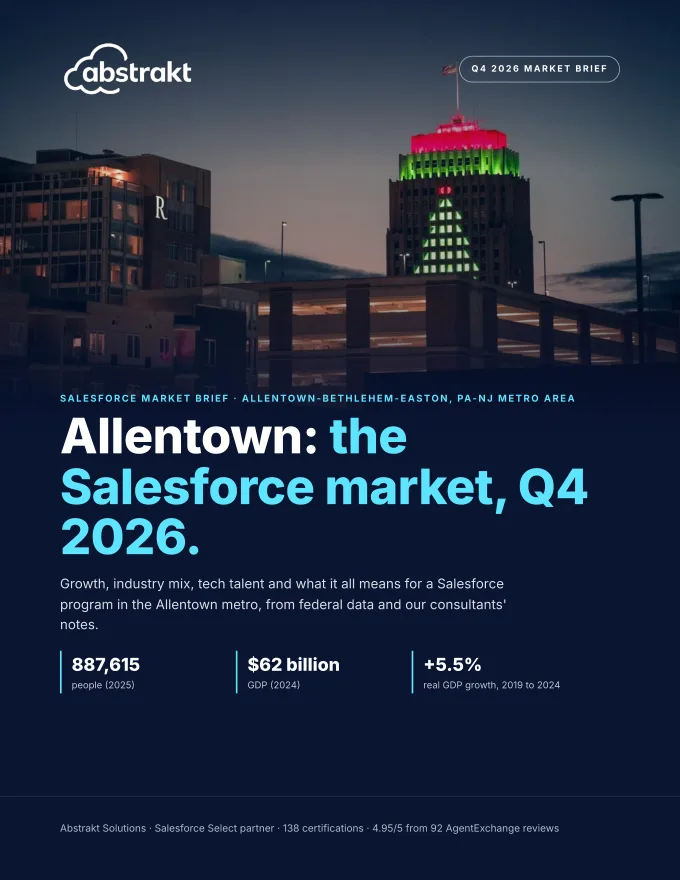
A free 22-page PDF with Allentown's growth ranked against 100 metros, its industry mix, tech wages and nearby markets. It is offered on the public Allentown page; send your customer there or get a copy for your own prep.
Get the Allentown brief →Co-sell with Abstrakt in Allentown
Working a Allentown account? Bring in a named consultant for discovery, scoping or a health check. We reply within 4 business hours.