

How Salesforce work starts in Harrisburg
Abstrakt Solutions is a Salesforce Consulting Partner working with organizations in Harrisburg, Hershey, Carlisle and Mechanicsburg across Dauphin, Cumberland and Perry counties. Harrisburg is one of our focus markets.
What buyers here usually run into
- 1
Patient and member data from many systems
Where hospital networks and insurers share a region, outreach and service teams draw on EHR, claims and billing data, so the first design decision is what Salesforce stores and what it only references.
- 2
Guest demand that rises and falls
Resort, attraction and event businesses see group sales and bookings swing through the year, and their pipelines and guest communications need to flex without a rebuild each season.
- 3
New warehouses, separate habits
Logistics operators that open facilities quickly often let each building track customers its own way, which makes a combined account view and service reporting slow to produce.
Budget, team and partner questions
What drives cost
Harrisburg costs depend on how many EHR, claims, core banking or warehouse systems Salesforce must reference, how much duplicate contact cleanup precedes AI work, and consent and access design for patient and member data. Resorts and attractions add booking-platform integration and seasonal campaign setup.
Admin or partner
Hospital networks and carriers here usually keep Salesforce ownership internal for compliance reasons and use a partner for architecture and integration. Community banks, distributors and hospitality operators more often rely on managed services with one internal owner.
What buyers ask a partner
Ask for health care or insurance references that involve service consoles and consent design, and how the partner decides what Salesforce stores versus references. Logistics operators should ask about warehouse system integration experience.
The local economy and its biggest industries (4)
| Sector | Share of 2024 GDP | Where Salesforce fits |
|---|---|---|
| Health care and social assistance Salesforce for health & life sciences → | 12.9% | An academic medical center in Hershey and two other hospital organizations give the region a deep clinical base, and both CAEDC and the regional strategy name health care as a target. Networks this size juggle referrals, physician outreach and patient messages that must stay behind strict access rules. |
| Finance and insurance Salesforce for insurance → | 8.6% | CAEDC files finance and insurance under its professional services banner. Community banks and carriers in the capital region generally want bankers, agents and service staff looking at a single client record, with permissions a compliance officer can sign off on. |
| Manufacturing Salesforce for manufacturing → | 6.9% | A chocolate and confectionery producer anchors local manufacturing, and the nine-county strategy also targets chemical, metal, wood, plastics and paper producers. Food and industrial makers selling through distributors and grocery chains get more from Salesforce when quotes, promotions and ERP order data live on the same account. |
| Transportation and warehousing Sales Cloud → | 6.6% | An online retailer holds the No. 2 spot among Cumberland County employers, a parcel delivery company appears in Dauphin County’s 2024 table, and CAEDC and the nine-county strategy both court the sector. Carriers and third-party warehouses use Salesforce to manage shipper accounts, rate requests, service tickets and site visits. |
Source: U.S. Bureau of Economic Analysis, GDP by county (CAGDP2), 2024, summed to the metro area; private sectors only, excluding real estate and government. “At least” marks sectors where BEA suppresses some county figures.
Regional target sectors named by local economic development groups: Business technology solutions, Life sciences, Light and advanced manufacturing, Professional Services (finance, insurance, architecture, accounting, consulting, engineering), Healthcare, Food Processing & Agribusiness, Transportation & Warehousing, Manufacturing (chemical, transportation equipment, metal, wood, plastics & rubber, paper products), Healthcare (hospitals, outpatient care, nursing & residential care).
Salesforce products that fit Harrisburg (6)
In the order we lead with them here, from the industries above.
Salesforce Service Cloud
The operating system for modern customer service, case, knowledge, voice, and AI agent assist together.
Salesforce Sales Cloud
The CRM where sales pipeline lives, when it is built right.
Salesforce Financial Services Cloud
Industry CRM for wealth management, banking, insurance, and lending, built for compliance from the start.
Salesforce Marketing Cloud
Cross-channel marketing, email, mobile, journey, and Data 360-powered personalization at scale.
Salesforce Revenue Cloud / CPQ
Configure-price-quote, billing, subscription management, and quote-to-cash on Salesforce.
MuleSoft
Enterprise API platform, for connecting Salesforce, ERP, data warehouses, and the rest of your stack.
Harrisburg health care, insurance, and logistics AI priorities
Health care and social assistance is the largest private sector around Harrisburg, at 12.9% of metro GDP in 2024, followed by finance and insurance at 8.6%. Many organizations here run member, patient, or policyholder service operations with heavy call volume, which makes case summaries and suggested replies a sensible first step. Distribution centers and carriers, part of the 6.6% transportation and warehousing share, often need shipment-exception handling more than chat. Professional firms can triage leads. A realistic plan starts by cleaning up duplicate contacts, confirming which records each role may see, and writing the knowledge articles agents will cite. Supervisors should review AI-assisted replies until quality is measured.
- Policyholder call case summaries
- Shipment exception handling
- Professional services lead triage
Services buyers here usually need (7)
Salesforce Implementation in Harrisburg
For most organizations around Harrisburg, implementation begins by deciding what Salesforce should hold and what it should only point to. Health systems keep clinical data in the EHR, banks keep balances in the core, and carriers keep loads in dispatch software. We design an account and contact model around those boundaries, settle sharing before any build starts, and release in phases so the first team is working in the org while the next piece is still in the sandbox.
By industry in Harrisburg
- 1
Health care and social assistance
Hospitals, clinics and social services make up about 12.9% of 2024 metro GDP, the largest private share in the Harrisburg-Carlisle area. A first implementation for a provider usually centers on physician relations, referral intake or patient access, and Health Cloud or Service Cloud is chosen according to how much care-team structure is needed. The design work that matters most is deciding which patient details are stored at all, which only appear through the EHR, and which roles can open them.
- 2
Finance and insurance
Community banks and carriers in the capital region tend to arrive with customer data in a core banking or policy system and relationship notes in email. We model households, businesses and their financial accounts in Financial Services Cloud when relationships run across products, and fall back to Sales Cloud when the work is mostly commercial lending pursuit. Compliance reviewers see the permission design on paper before configuration starts, which avoids reworking security late in the project.
- 3
Transportation and warehousing
Carriers, parcel operators and third-party warehouses in Cumberland and Dauphin counties sell to shippers whose needs differ by building and by lane. An implementation for them sets up shipper accounts with facility-level locations, a quote-request process sales can own, and a case queue for claims and appointment changes. We keep the first release small, cases and account visibility, and plan the connection to warehouse or transportation software for a later phase once the data model is stable.
Raise before scoping
Draw the system-of-record lines
Write down, field by field, which platform owns patient, policy, deposit or shipment data before anyone configures an object. Capital-region organizations usually run a regulated core system, and duplicating its data inside Salesforce creates reconciliation work and a larger audit surface than the project needs.
Train around early and late shifts
User acceptance testing and hypercare coverage follow your shift patterns, and hospital or warehouse teams working early or late hours get training sessions timed to their actual schedules.
Keep phase one narrow
Pick the one team with the clearest pain, such as referral intake or shipper service, and launch for them first. Early success gives the next department a working example to react to, which shortens their workshops and sharpens their requirements.
Salesforce Integration in Harrisburg
Harrisburg integrations often involve moving goods or money. Food and industrial manufacturers need ERP orders and pricing in front of reps; carriers and warehouses need shipment status for service agents; banks and insurers need core or policy data on the client record. We map which system owns each field, choose between real-time APIs, scheduled syncs or MuleSoft for each flow, and build error handling that alerts a named person when a record fails. Then we test with real transactions before go-live.
By industry in Harrisburg
- 1
Manufacturing
Manufacturing makes up about 6.9% of 2024 metro GDP, and the regional strategy names chemical, metal, plastics and paper producers among its targets. For these companies, integration usually means ERP pricing flowing into Revenue Cloud quotes, accepted quotes becoming ERP orders without re-keying, and invoice and shipment history appearing on the account. We agree the product and price-book structure first, because a mismatch there breaks every other flow built on top of it.
- 2
Transportation and warehousing
Transportation and warehousing accounts for about 6.6% of 2024 metro GDP. Warehouse operators and carriers need warehouse management or transportation data visible to customer-facing staff. We connect those systems so inventory, appointment and shipment status appear on the shipper's account and on each case, pulled on demand for fast-changing data and synced on a schedule for history, so agents answer questions without logging into a second platform.
- 3
Finance and insurance
For community banks and insurers, integration connects Salesforce to the core banking or policy administration platform that holds accounts, balances and coverage. We usually bring in a summary: products held, key dates and relationship totals, instead of copying every transaction. Integration users get only the permissions their feed requires, credentials are rotated on a schedule, and each flow is documented so an examiner can see exactly what data crosses from the core into the CRM.
Raise before scoping
Name one owner per field
Before building any connection, decide which system wins when values differ, whether it is price, address, credit status or shipment date. Writing this down field by field prevents two systems overwriting each other and gives support staff a clear answer when a customer spots a discrepancy.
Budget for failure alerts
Nobody notices a broken sync until a customer does, unless alerting is part of the build. Every flow we deliver logs errors, retries where safe, and notifies a named person when a record cannot be processed. Warehouse and banking feeds in particular need that, because stale data reaches customers quickly.
Decide when MuleSoft is warranted
For one plant talking to one ERP, platform tools or a modest connector may be all that is required. MuleSoft earns its cost when several systems share data, when APIs will be reused by other applications, or when the integration team needs monitoring across many flows.
Salesforce Optimization in Harrisburg
Around Harrisburg, the orgs we are asked to tune are rarely broken; they are avoided. Sales reps keep spreadsheets on the side, service staff re-key information from email, and the leadership dashboard disagrees with finance. We interview users by role, review login and record-update patterns, and inventory the flows, rules and triggers that fire on key objects. Then we simplify layouts, retire conflicting automation and rebuild the reports leadership depends on, releasing changes in small batches so each improvement is visible to users.
By industry in Harrisburg
- 1
Professional Services
Professional, scientific and technical firms contribute about 7.3% of 2024 metro GDP, and state labor data ranks management of companies fourth among Cumberland County industries by employment. Engineering, accounting and consulting practices often find their pipeline tracking drifted into partner-by-partner habits. We standardize opportunity stages and required fields, automate follow-up tasks after proposals go out, and build a win-rate view by service line that partners will open because it matches what they see in billing.
- 2
Food Processing & Agribusiness
Food processing and agribusiness appear on Cumberland County's key-industry list. Producers selling into grocery chains and food-service distribution frequently keep promotion calendars and deduction notes in workbooks that never touch the CRM. Optimization moves that work onto the account record: promotion calendars, deduction follow-ups and buyer visit notes become structured data, and a simple dashboard shows volume and spend by customer. Reps stop maintaining two versions of the same account plan, and sales leaders can compare promotion results across buyers in one report.
- 3
Healthcare
Health care sits on both the county and the nine-county regional target lists. Hospital outreach and access teams frequently have Salesforce orgs with duplicate referral sources, queues nobody monitors and reports built by staff who have since left. We merge duplicate provider records, rebuild routing so every inquiry has an owner, and replace orphaned reports with a small set agreed with department leaders. Automation is reviewed against privacy rules before anything is turned on or off.
Raise before scoping
Measure adoption before changing anything
Pull login frequency, record updates by role and report usage for a baseline. Without it, nobody can tell whether the changes helped. In organizations with several departments, the baseline also shows which team to start with, usually the one with licenses but little activity.
Count every automation on key objects
It is common to find a legacy workflow rule, a Process Builder process and a newer flow all updating the same opportunity field. Listing them side by side reveals duplicate updates and conflicting logic. Consolidating into fewer, documented flows reduces errors and makes future Salesforce releases less risky.
Agree the numbers with finance
A dashboard nobody trusts gets ignored. Reconcile pipeline, bookings or case volumes with the figures finance or operations already report, fix the definitions that differ, and label each metric clearly so leadership meetings argue about decisions, not data. Keep a short glossary of metric meanings inside Salesforce itself, linked from each dashboard.
Salesforce Managed Services in Harrisburg
Managed services around Harrisburg mostly serves organizations that run Salesforce with one admin or none: community banks, regional insurers, accounting and engineering firms, and hospital departments. We take over the request queue, rank it monthly with your owner, and ship changes through a sandbox with a record of who approved each one. When Salesforce announces a seasonal upgrade, we run your key processes in a preview sandbox first. Admin, Flow, reporting and integration skills sit on one team, so gaps are not left for a single person.
By industry in Harrisburg
- 1
Finance and insurance
Banks, insurers and agencies account for about 8.6% of the metro's 2024 GDP, second only to health care. Their Salesforce backlogs mix small requests, such as a new product field or a branch reassignment, with changes that examiners may ask about later. We log every request against a business owner, keep build and deployment steps separate, and retain approval evidence, so a routine picklist change and a sharing-rule change are both traceable when auditors review the quarter.
- 2
Professional Services
Cumberland County's development corporation groups accounting, engineering, architecture and consulting firms under professional services. These firms often bought Salesforce for business development and then outgrew the partner who configured it. Managed services gives them steady help with pipeline stages, proposal tracking, time-sensitive reports for partner meetings and the occasional integration fix, without adding a full-time Salesforce hire to a firm whose billable staff are the priority. Partners get the same reports each month, built the same way.
- 3
Healthcare
Hospitals, outpatient practices and residential care operators use Salesforce for referrals, admissions inquiries and community outreach, usually alongside larger clinical systems their IT teams manage. The Salesforce work falls between departments, so requests pile up. We act as that department's dedicated team, handle intake forms, queues and dashboards, and review every change for its effect on protected health information before it is deployed. Department heads see a short monthly summary of what shipped and what is next.
Raise before scoping
Fix the request intake path
Decide how users submit Salesforce requests, who ranks them, and what counts as urgent. Without that, managed-services hours go to whoever emails loudest. A simple intake form and a monthly prioritization meeting with your owner keep the backlog tied to business priorities.
Test releases against regulated processes
Seasonal Salesforce upgrades change screens and automation. For banks and providers, the processes to retest first are the ones with compliance exposure, such as consent capture, disclosures and restricted records, so a platform change never quietly alters how sensitive data is handled.
Keep documentation with you
Every change we make should leave behind a note your team can read: what changed, why and who approved it. If you later bring administration in-house or change partners, that record makes the handover a reading exercise rather than an investigation.
Salesforce Health Checks in Harrisburg
A Harrisburg health check usually answers one question: can this org stand up to a privacy review, a bank examination or an AI rollout? We examine user access and sharing, including integration users and connected apps; the automation, code and installed packages that form technical debt; duplicate and incomplete records on core objects; and whether key reports match reality. Every finding comes with evidence, a severity rating and a suggested fix, plus a one-page summary for leadership.
By industry in Harrisburg
- 1
Health care and social assistance
Provider organizations need to know whether Salesforce exposes more patient information than intended. We check who can view, export and report on records containing health details, whether field history and event monitoring cover sensitive fields, and whether community or portal users can reach anything beyond their own data. We also look for referral and intake flows that copy clinical details into free-text fields, a frequent source of unplanned exposure. Where we find it, we recommend structured fields or a link back to the source system instead.
- 2
Finance and insurance
Banks and insurers use a health check to prepare for examinations and vendor-risk reviews. The review traces how customer financial data is protected: profile and permission-set design, dormant accounts with elevated rights, multi-factor authentication and session settings, and integration credentials. Each finding is written so compliance staff can map it to a control, and remediation steps are sequenced so the riskiest gaps close first. We also note which fixes need a change-control ticket and which can be handled as routine administration.
- 3
Business technology solutions
Technology firms in the Harrisburg Market innovation zone's business technology group often built their orgs quickly while landing early customers. A health check finds the shortcuts: hard-coded values in flows, abandoned fields, unused managed packages and reports that no longer reflect the sales process. It also confirms whether the org is ready for Agentforce, since AI features depend on clean data and permissions that match who should see what. Founders get a plain list of what to fix before the next hiring push.
Raise before scoping
Review access before AI features
Agentforce and similar tools act on whatever records a user or agent can reach. If sharing is loose, AI can surface data that people never noticed they could see. Tightening access and cleaning duplicates beforehand makes AI answers more accurate and safer.
Include every connected app
Marketing tools, e-signature services and old integrations frequently hold broad, long-lived access. List each connected app, confirm it is still used and owned, and reduce its permissions to what it actually needs. Remove anything nobody can explain, and record an owner for every app that stays.
Plan remediation at the outset
Reviews that end in a document nobody owns change nothing. Before the review starts, decide who will own remediation: internal staff, a managed-services team or a follow-on project, so the critical items are addressed while the findings are still current.
Salesforce Migration in Harrisburg
Migrations in the capital region range from young technology companies graduating from spreadsheets to established financial firms retiring a legacy CRM. In each case the hard part is the data, not the import tool. We profile what exists, merge duplicates, standardize names and addresses, decide how much history to bring, and map every field to its new home. Trial loads go into a sandbox where your users check real records, and the final cutover is scheduled so nothing is entered in two places at once.
By industry in Harrisburg
- 1
Business technology solutions
Business technology solutions is one of three sectors eligible for Harrisburg Market Keystone Innovation Zone tax credits, which have totaled about $7.5 million since 2007. Start-ups in that group commonly track prospects, investors and pilot customers across spreadsheets and a free CRM tier. Migration for them is mostly consolidation: one account per company, contacts deduplicated, and deal history mapped to a clean Sales Cloud pipeline they can scale without restructuring later.
- 2
Life sciences
Life sciences companies in the area, including start-ups eligible for innovation-zone credits, keep relationships with clinical sites, research collaborators, distributors and investors. Those records often live in several tools owned by different teams. We merge them into one account structure, tag each relationship by type, and leave regulated study or patient data in the systems validated for it. The migration plan records which data moved and which intentionally stayed behind.
- 3
Finance and insurance
Banks and insurance agencies retiring an older CRM or a vendor-bundled contact manager need households, business relationships and policy or account references carried over correctly. We map legacy contact types to Financial Services Cloud's household and relationship structures, reconcile customer identifiers with the core system so integrations will match, and preserve activity history that compliance may need. Anything that fails validation is reported back for correction instead of being loaded silently.
Raise before scoping
Decide how much history
Carrying over every note and email since the old system went live makes records harder to read and adds storage cost. Agree on a cutoff by record type, such as open deals, recent activity and closed-won history, and archive the rest in a searchable export your team can still reach when needed.
Clean data before loading
Fixing a misspelled company or a departed owner takes seconds in a spreadsheet and far longer once the record has related contacts, deals and activities attached. We run cleanup and deduplication before the first trial load, so users validate clean records and do not lose confidence in the new system on day one.
Freeze the old system deliberately
Set a cutover date, stop edits in the legacy tool, run the final delta load and switch users over together. Leaving the old CRM open for convenience creates two versions of the truth within days and undermines the entire migration.
Salesforce Implementation Rescue in Harrisburg
Troubled Salesforce projects around Harrisburg usually fail at a boundary: the ERP connection that never worked, the warehouse feed that stopped, the privacy review that halted a hospital build. We start with triage, cataloging what was built, what works, and what blocks daily work. Next comes stabilization, fixing the failures users hit every day. Only after that do we sort each component into keep, repair or rebuild, and complete the outstanding scope with testing, documentation and training your team can maintain.
By industry in Harrisburg
- 1
Light and advanced manufacturing
Light and advanced manufacturing is one of the innovation zone's three eligible sectors, and these producers often stall at quoting. Configure-price-quote rules were half-built, product data was never reconciled with the ERP, and reps went back to spreadsheets. Recovery rebuilds the product catalog from the ERP's source of truth, repairs pricing and approval logic in Revenue Cloud, and tests each quote against real orders before reps are asked to trust it again.
- 2
Transportation & Warehousing
Both Cumberland County's list and the nine-county strategy target transportation and warehousing. Logistics projects commonly stall after the first facility goes live, when the design fails to fit the second building's workflow. We review the account and location model, repair the case routing that sends issues to the wrong site, and restore integration with warehouse software, then roll out to remaining facilities one at a time with local users involved.
- 3
Healthcare
Health care projects often pause when a privacy or security review finds problems late. By the time work resumes, the original project team has moved on. Recovery starts by answering the reviewers' findings: tightening sharing, removing clinical details stored where they should not be and documenting access. Then the unfinished intake, referral or outreach processes are completed and tested with the staff who will use them. Reviewers sign off on the revised design before users are trained.
Raise before scoping
Get the history on paper
Collect contracts, statements of work, design documents and change logs from the previous partner before triage begins. Knowing what was promised, what was paid for and what was changed along the way turns recovery decisions into facts rather than arguments about scope.
Stabilize before adding scope
Pressure to deliver the missing features is understandable, but broken integrations and faulty automation undermine everything added on top. Fix the failures users hit daily first, then restart feature delivery once people trust the system again. A short list of visible fixes in the first weeks rebuilds that trust faster than a long roadmap.
Reset expectations with users
Employees who sat through the first launch will judge the second one harshly. Tell them what is changing, when, and how their feedback will be used, and involve a few respected users in testing. Their endorsement at re-launch does more than any announcement from management or IT.
Industry plays in Harrisburg (3)
Salesforce for Harrisburg Health and Life Sciences
Health care in the Harrisburg-Carlisle area spans hospital systems, outpatient and imaging centers, nursing and residential care, and a young life sciences startup scene. Salesforce supports the parts of each that involve inquiries, scheduling, relationships and follow-up rather than clinical documentation. We build senior living inquiry pipelines, outpatient access and capacity tools, and investor and partner tracking for startups, keeping the EHR or resident systems as the clinical record and defining PHI access before any data moves.
In the three counties around Harrisburg and Carlisle, care providers and social assistance generate 12.9% of 2024 GDP, a larger slice than any other private industry in Bureau of Economic Analysis tables. The South Central Pennsylvania economic development strategy lists health care, covering hospitals, outpatient care and nursing and residential care, as a target industry, and the Cumberland Area Economic Development Corporation names healthcare among its key industries. The Harrisburg Market Keystone Innovation Zone offers tax credits to life sciences start-ups, with a college of medicine among its partners.
Use cases to open with
- 1
Senior living inquiry to move-in
Families researching senior living often contact several communities, tour, pause for a while and return months later when a health event forces a decision. Salesforce can track each inquiry with the prospective resident, family decision makers, care needs, tours and follow-ups. Marketing Cloud nurtures families with relevant content between conversations, and community leaders see occupancy pipeline by care level, which makes staffing and marketing plans far more grounded.
- 2
Outpatient scheduling and capacity
Outpatient, imaging and therapy centers juggle referrals, insurance authorizations and schedule availability across several locations. Service Cloud can manage referral intake, track authorization status and help schedulers offer the earliest suitable appointment at any site. Dashboards show backlog, no-show rates and referral sources by location, helping managers balance capacity across Dauphin, Cumberland and Perry counties and spot referral sources that are drifting away.
- 3
Life sciences startup relationships
Early-stage life sciences companies manage investors, grant programs, clinical collaborators and potential commercial partners with very small teams and little administrative help. Sales Cloud with simple stages and relationship tracking keeps those conversations organized and visible to founders and board members alike. Clean records also make fundraising diligence, board reporting and tax credit documentation easier to prepare when deadlines arrive at the same time.
Raise before scoping
Resident and family privacy
Senior living inquiries often involve health details shared by adult children or other family members. Limit what is recorded to what the sales process genuinely needs, secure sensitive fields, and move clinical information into resident care systems once a prospect becomes a resident.
Authorizations and payer data
Outpatient scheduling depends on insurance authorizations handled in other systems, often by a separate team. Integrate status summaries rather than full payer records, and design workflows so schedulers see immediately when an authorization is missing or expiring before they book the appointment.
Lean startup configuration
Startups should avoid heavy customization in their first Salesforce org. Use standard objects, simple automation and clear data entry habits so the system grows with the company and does not require a dedicated administrator before the team can afford to hire one.
Salesforce for Harrisburg Insurers and Agencies
Around Harrisburg and Carlisle, the insurance field covers health plans, property and casualty carriers and independent agencies, and each serves different customers with different service demands. Salesforce gives members, policyholders, producers and employer groups a consistent record, while the core administration platforms keep ownership of policies, claims and billing. We build onboarding and service processes for health plans, renewal and cross-sell tools for agencies, and submission intake for commercial lines, with privacy and audit controls suited to insurance.
Among private industries in Harrisburg-Carlisle, finance and insurance ranks just behind health care, with 8.6% of 2024 output reported by the Bureau of Economic Analysis. The Cumberland Area Economic Development Corporation lists professional services, including finance and insurance, among its key industries for Cumberland County. With care delivery and insurance the two largest private sectors, CRM needs here range from health plan member service to carrier and agency work for households and businesses across central Pennsylvania, and the same customer may touch both worlds.
Use cases to open with
- 1
Health plan member onboarding
New members need ID cards, provider information, benefit explanations and help choosing a primary care provider, and confusion early on drives calls for months. Service Cloud and Marketing Cloud can run onboarding journeys, track outreach attempts and log member questions in one place. Member services staff see onboarding status alongside prior contacts, and plans can measure how quickly new members engage with care, digital tools and self-service options.
- 2
Agency renewals and cross-sell
Independent agencies manage books of business across personal and commercial lines, with renewals arriving every single day. Salesforce can surface upcoming renewals, coverage gaps and cross-sell opportunities using data from the agency management system. Producers and account managers get task lists prioritized by premium and risk, which reduces lost renewals, uncovers additional coverage needs and gives principals a clearer view of book health.
- 3
Commercial submission intake
Carriers receiving commercial submissions from brokers need to triage, assign and track them quickly, because slow responses send business to competitors. Salesforce can capture submissions, pull out key details, route them to underwriters by line and appetite, and track quote status through binding. Broker relationship managers see submission counts and hit ratios by agency, helping carriers invest time in their most productive partnerships.
Raise before scoping
Member and policyholder privacy
Health plan data falls under HIPAA, and all insurance customer data is protected under GLBA and state insurance privacy rules. Design encryption, access controls, consent tracking and audit trails together with compliance staff, and complete that review before any data migration or integration testing with production records.
Agency management integration
Agencies rely on agency management systems for policy, carrier and commission data. Decide which of those details Salesforce needs, how often they sync and which system owns contact information, so producers do not face conflicting records or double entry after launch.
Underwriting workflow boundaries
Underwriting and rating tools make pricing decisions and should keep doing so. Salesforce should manage intake, assignment, broker communication and status tracking, connected to underwriting systems through integration, rather than replicating rating logic, referral rules or policy issuance inside the CRM.
Salesforce for Harrisburg Manufacturers
Manufacturing in the Harrisburg area is diverse and closely tied to logistics. Food processors, metal fabricators, plastics and packaging producers sell to distributors, retailers and other manufacturers, often shipping through nearby warehouses. Salesforce helps them manage those customers without losing sight of plant realities. Sales Cloud tracks accounts and pipeline, CPQ handles pricing and quotes, Service Cloud manages order and quality issues, and MuleSoft connects ERP and warehouse systems so sales sees inventory and shipment status.
Manufacturing contributes 6.9% of the Harrisburg-Carlisle metro's 2024 GDP in Bureau of Economic Analysis county data, fourth among private sectors, with transportation and warehousing close behind at 6.6%. The nine-county South Central PA regional strategy lists manufacturing as a target industry, naming chemical, transportation equipment, metal, wood, plastics and rubber, and paper products. The Cumberland Area Economic Development Corporation adds food processing and agribusiness, and the Harrisburg Market Keystone Innovation Zone supports light and advanced manufacturing startups with tax credits, about $7.5 million awarded since 2007.
Use cases to open with
- 1
Distributor and customer accounts
Manufacturers selling through distributors and directly to large customers need to see both channels. Sales Cloud tracks distributor performance, direct accounts, price agreements and open opportunities, with order history from the ERP. Sales managers can see which customers are buying less, which distributors are growing and where new product lines could be introduced, instead of waiting for monthly sales reports.
- 2
Quotes with cost-based pricing
Metal, plastics and paper products are often quoted from material costs, volumes and specifications that change frequently. CPQ, fed with ERP costs and pricing rules, keeps quotes consistent, routes exceptions for approval and tracks every revision. Sales can respond faster to requests, and leadership can analyze win rates and margins by product line and customer segment, spotting where resin, steel or pulp price moves are eroding margin faster than quotes are updated.
- 3
Order and quality issue resolution
Late shipments, damaged goods and quality complaints need quick, documented responses. Service Cloud logs each issue with order, lot and carrier details, routes it to the right team and tracks credits and corrective actions. Customer service sees shipment status from warehouse systems, and quality teams can spot recurring problems by product, plant or carrier, then share corrective action summaries with the customer from the same case record.
Raise before scoping
ERP and warehouse integration
Orders, inventory and shipments usually live in ERP and warehouse systems, sometimes at one of the third-party logistics providers along the region's interstate corridors. Decide which data Salesforce needs, how often it syncs and which system owns each field, so customer service can answer status questions confidently.
Food safety and traceability
Cumberland Valley processors answer to buyers' audit schedules and regulators' traceability rules. Put the lot number on the complaint case and a link to the quality file, but never let the CRM become a second, conflicting copy of the HACCP record or supplier certificates.
Plant and sales collaboration
Quotes and promises made in Salesforce affect scheduling and capacity at the plant. Give production planners visibility into large opportunities and forecast changes, and agree on how capacity constraints, maintenance shutdowns and material shortages are communicated back to sales before commitments are made.
Case studies to send (3)
From the industries this market leans on. Client names are anonymized and these projects are not specific to Harrisburg.
The Harrisburg Salesforce market brief, Q4 2026
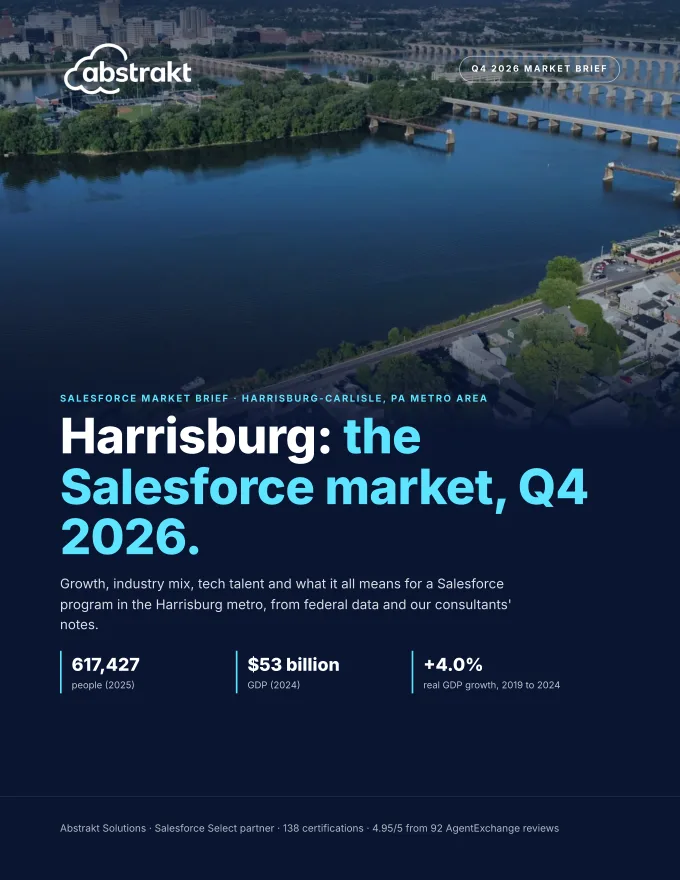
A free 22-page PDF with Harrisburg's growth ranked against 100 metros, its industry mix, tech wages and nearby markets. It is offered on the public Harrisburg page; send your customer there or get a copy for your own prep.
Get the Harrisburg brief →Co-sell with Abstrakt in Harrisburg
Working a Harrisburg account? Bring in a named consultant for discovery, scoping or a health check. We reply within 4 business hours.