

How Salesforce work starts in Las Vegas
Resorts, restaurant groups, contractors and healthcare organizations across Southern Nevada work with Abstrakt Solutions as their Salesforce Consulting Partner. Las Vegas is one of our focus markets.
What buyers here usually run into
- 1
Guest data in too many systems
Hospitality businesses commonly keep reservations, loyalty, events and service in separate tools. A Salesforce project usually starts with integration and an agreed definition of the guest record.
- 2
Group and event sales
Group bookings and events involve long lead times, many contacts and detailed proposals. Pipeline stages and quoting need to match how those deals actually close.
- 3
Crews and job costs
Contractors often schedule crews by phone and compare costs to estimates after the job is done. Field Service and CPQ can show both while work is still underway.
Budget, team and partner questions
What drives cost
In Las Vegas, scope usually grows with the number of guest-facing systems Salesforce has to read from: property management, loyalty, events, and sales and catering. Settling the guest record and consent rules adds design time up front. Contractors spend more on the link between bids, project management and accounting than on the CRM itself.
Admin or partner
Resort and restaurant groups with many properties often keep an internal owner for Salesforce and bring in a partner for integration and seasonal promotion work. Contractors and smaller hospitality operators more often hand day-to-day administration to a managed services team.
What buyers ask a partner
Ask a partner how they would define one guest across your property systems and how they handle consent before an agent or campaign touches the data. Contractors should ask to see how bids, prequalification records and job cost would connect.
The local economy and its biggest industries (4)
| Sector | Share of 2024 GDP | Where Salesforce fits |
|---|---|---|
| Accommodation and food services Service Cloud → | 16.2% | Casino resorts and restaurant groups on and off the Strip handle guest service, loyalty, group sales and events at very high volume. Salesforce can tie those teams to one guest record instead of separate systems for each. |
| Construction Salesforce for construction → | 7.7% | As the metro’s second-largest private sector, construction here spans resort, commercial and residential work. Contractors need estimates, crew schedules and job costs in one place rather than across spreadsheets. |
| Finance and insurance Financial Services Cloud → | 6.1% | With fintech on LVGEA’s target list, lenders, insurers and payments firms in Southern Nevada need compliant marketing, a full relationship view and portals for partners and agents. |
| Health care and social assistance Salesforce for health & life sciences → | 5.9% | The valley’s public hospital and other health systems, along with the healthcare and biotech companies LVGEA is recruiting, need patient and referral service built around privacy and integration with clinical systems. |
Source: U.S. Bureau of Economic Analysis, GDP by county (CAGDP2), 2024, summed to the metro area; private sectors only, excluding real estate and government. “At least” marks sectors where BEA suppresses some county figures.
Regional target sectors named by local economic development groups: Advanced Manufacturing & Battery, Clean Tech, Sports Tech & Entertainment, Fintech, Healthcare & Biotech.
Salesforce products that fit Las Vegas (6)
In the order we lead with them here, from the industries above.
Salesforce Service Cloud
The operating system for modern customer service, case, knowledge, voice, and AI agent assist together.
Salesforce Sales Cloud
The CRM where sales pipeline lives, when it is built right.
Salesforce Marketing Cloud
Cross-channel marketing, email, mobile, journey, and Data 360-powered personalization at scale.
Salesforce Field Service
Scheduling, dispatch, mobile work orders and parts for teams that work on site.
Salesforce Experience Cloud
Customer, partner, and employee portals built on Salesforce.
Salesforce Agentforce
AI agents that handle real work inside Sales Cloud, Service Cloud, and Marketing Cloud.
Hospitality-first AI in Las Vegas
Accommodation and food services made up 16.2% of the Las Vegas metro's GDP in 2024, far ahead of any other private sector. That makes guest communication the natural place to test AI. Agents can handle booking changes, loyalty questions, and group event inquiries using approved policy content, then pass anything involving refunds or complaints to staff with a clean summary. Contractors and home builders, the next-largest sector, can use lead triage and warranty request intake. Guest data spread across property systems is the main obstacle; a unified profile in Data 360 (formerly Data Cloud) helps, but consent flags and role-based access must be settled before an agent speaks to anyone.
- Booking change and loyalty answers
- Group event inquiry triage
- Builder warranty request intake
Services buyers here usually need (7)
Salesforce Implementation in Las Vegas
In Las Vegas, a Salesforce implementation usually begins by settling what one customer record means when reservations, loyalty, events and service each run in their own system. We make that call and plan the integrations it depends on in discovery, then design the data model, build in a sandbox and launch in phases, starting with the team whose process is most manual. Kickoff, go-live and role-based training are scheduled around your event calendar, so a launch never competes with a major convention.
By industry in Las Vegas
- 1
Accommodation and food services
Hotels, casino resorts and restaurants together produce about 16.2% of 2024 metro GDP, more than twice the share of any other private sector. For operators in this group, the implementation choices that matter most are how the guest record relates to loyalty, reservations and events data held elsewhere, which teams can see spending and preference information, and how group sales opportunities capture room blocks and function space. We decide those points before configuration, since they shape reporting across every property.
- 2
Construction
Builders and specialty contractors working on resort, commercial and residential projects across the valley usually implement Salesforce to track bids, general contractors, owners and repeat clients in one place. The design separates companies from projects so one firm can be client, partner and competitor on different jobs. We launch bid tracking and relationship management first, and add Field Service for service and maintenance divisions once office and estimating teams rely on the core records.
- 3
Healthcare & Biotech
Healthcare and biotech appear on the Las Vegas Global Economic Alliance's target list, and the valley's health systems, clinics and newer life science firms bring privacy requirements into every implementation. We design the security model, consent tracking and integration boundaries with compliance staff in discovery, then build patient or customer service processes on Service Cloud. Business-development teams at biotech firms typically start on Sales Cloud with a simpler model and add service capabilities later.
Raise before scoping
Settle who owns guest data
Marketing, hotel operations, casino hosts and event sales may each believe they own the guest. Before building, agree which system is authoritative for contact details, preferences and spend, and which teams may view or edit each part, or the implementation reproduces the conflict inside Salesforce.
Keep go-lives off event weeks
Major conventions, holiday weekends and big events stretch hospitality and event staff to their limit. Avoid go-lives and training during those periods, and plan user testing for quieter weeks so front-line teams can give the project real attention instead of squeezing it between shifts.
Review builds in short cycles
Hospitality teams give sharper feedback on working screens than on design documents. We prepare a sandbox build before each joint session, so reviewers react to something they can click and their comments shape the very next cycle.
Salesforce Integration in Las Vegas
Integration is often the core of a Las Vegas Salesforce project, because the operational systems in hospitality, gaming and entertainment are specialized and are not going away. We connect Salesforce to property management, loyalty, sales and catering, point-of-sale and ERP platforms, deciding for each data type which system owns it and how quickly changes must appear. Integrations are built with MuleSoft, native connectors or APIs, tested with realistic volume and monitored after launch so a failed sync triggers an alert, not a guest complaint.
By industry in Las Vegas
- 1
Accommodation and food services
Resorts and restaurant groups need a guest profile that draws on stays, dining, events and loyalty activity without asking staff to enter anything twice. We integrate Salesforce with property management, reservation, loyalty and point-of-sale systems, pulling in summaries and key events rather than every transaction. Access to spend and preference data is restricted by role, and the integrations are designed to handle the volume a large resort generates on a busy weekend without slowing staff screens.
- 2
Sports Tech & Entertainment
Sports tech and entertainment is on LVGEA's target list, and sports-betting platforms and gaming equipment makers are among the companies choosing Las Vegas for growth. Suppliers selling to casino operators typically connect Salesforce to ERP for orders and billing, to field service tools for installed equipment, and to product telemetry for usage. We design those links so account teams see each property's installed base, open issues and contract status in one view.
- 3
Advanced Manufacturing & Battery
LVGEA also courts advanced manufacturing and battery companies, a sector that ties Salesforce closely to plant systems. Manufacturers in this space connect Salesforce with ERP for pricing, orders and shipments, and with quality systems for returns and warranty claims. We define which system creates customers and products, sync order status back to sales and service, and route quality issues into service cases, so customer-facing teams can respond without chasing plant staff for updates by phone or email.
Raise before scoping
Summarize high-volume transactions
Point-of-sale and gaming systems produce far more records than a CRM should store. Bring in summaries, such as visit counts, spend bands or recent stays, and link to the source system for detail, so Salesforce stays fast and storage costs stay predictable.
Respect gaming and payment rules
Data from casino, sports-betting or payment systems may fall under regulatory and contractual restrictions. Review with your compliance team which fields may enter Salesforce, who may see them and how long they are kept, well before anyone designs the integration itself.
Plan alert routing before launch
Before go-live, name the person who gets integration alerts, agree how failed records are resubmitted and pick one place where errors are logged. Otherwise sync problems show up days later as confused staff or missing guest details, and tracing the original cause becomes far harder.
Salesforce Optimization in Las Vegas
Optimization suits Las Vegas companies that bought Salesforce for one purpose and kept adding to it. By the time help is requested, a group sales team, a service desk and marketing may share one org with overlapping fields, conflicting automation and a long tail of unused reports. We review usage, interview users on each team, then simplify layouts, consolidate automation into Flow, rebuild dashboards around real decisions and fix mobile screens for staff who work away from a desk. Changes arrive in small releases.
By industry in Las Vegas
- 1
Construction
Construction ranks second among the metro's private sectors, at about 7.7% of 2024 GDP. Contractors who already run Salesforce often find estimators tracking bids in spreadsheets anyway, because the pipeline stages do not match how bids are won. Optimization realigns stages with the bid process, adds prequalification and insurance expiration tracking, automates follow-up on submitted bids and builds win-rate reports by client and project type, so leadership can see where estimating time pays off.
- 2
Accommodation and food services
Resort and restaurant sales teams commonly work in Salesforce alongside dedicated catering and event systems, and the gap between them is where adoption drops. We streamline the group sales process, remove duplicate entry by surfacing event system data in Salesforce, and rebuild pace and conversion dashboards around the metrics directors review weekly. Service teams get routing and case templates that reflect real guest issues, from reservation changes to lost items and billing disputes.
- 3
Finance and insurance
Finance and insurance accounts for about 6.1% of the metro's 2024 GDP, spanning lenders, insurers and payment firms. Their orgs often carry compliance-driven fields and approval steps that no longer serve a purpose. Optimization reviews each one with compliance staff, keeps what regulation requires, and automates the rest where it can be done safely. We also simplify service consoles and rebuild pipeline reports so loan officers and agents spend more time with customers.
Raise before scoping
Design for staff on the floor
Many hospitality, field and sales employees rarely sit at a desk. Review mobile layouts, quick actions and notifications with them directly, because features that work on a laptop can be unusable on a phone in a busy venue or on a job site.
Remove before you add
Optimization gains often come from subtraction. Retire unused fields, deactivate obsolete automation and archive reports nobody opens before adding anything new. The remaining system becomes faster to use, easier to train new people on and simpler for admins to maintain.
Tie dashboards to meetings
Build each dashboard for a specific recurring meeting, such as weekly group sales pace or a monthly service review. When leaders open Salesforce in those meetings instead of a spreadsheet, the teams feeding the data keep it current without constant reminders.
Salesforce Managed Services in Las Vegas
Managed services for Las Vegas companies keeps Salesforce aligned with a business that changes quickly: new promotions, new outlets, new event calendars and frequent staffing changes in front-line roles. We handle the request backlog, user setup and permission changes, sandbox testing of Salesforce's three annual releases and monitoring of the integrations with reservation, loyalty and point-of-sale systems. Priorities are set with your business owner in a monthly review, and all work runs through a single shared queue your team can see.
By industry in Las Vegas
- 1
Accommodation and food services
Hospitality teams in the valley generate a steady flow of Salesforce requests: a new promotion to track, a changed loyalty tier, another restaurant outlet or a revised group sales proposal template. Under managed services we handle those changes quickly, keep integrations with reservation and loyalty systems running, and manage the user changes that come with seasonal and front-line staffing shifts. Monthly reviews let marketing, sales and operations leaders see what shipped and agree on what comes next.
- 2
Fintech
Fintech is an LVGEA target sector, and payment, lending and gaming-payments companies run Salesforce under close regulatory attention. Managed services for them includes documented change control, sandbox testing, access reviews whenever roles change and careful handling of any automation that touches customer financial information. We also maintain integrations with core platforms and onboarding tools, and keep a record of every configuration change that auditors or bank partners can review on request.
- 3
Retail trade
Retail trade represents about 7.3% of 2024 metro GDP, spanning resort shops, dealerships and chains that serve visitors and residents alike. Retailers using Salesforce for customer service, clienteling or marketing need regular updates to service processes, email journeys and store-level reports. Our team keeps those running, maintains consent and preference data in Marketing Cloud, and adjusts dashboards when stores open, close or change hours, without waiting for a busy internal team to find time.
Raise before scoping
Automate user provisioning
Where front-line roles change often, manual user setup becomes a daily chore and a security gap. Connect Salesforce to your identity provider for provisioning and single sign-on, so access is granted by role and removed promptly when someone leaves the business.
Share your event calendar
Marketing and event teams often need changes just before large conventions or holiday weekends. Give the managed services team your event and promotion calendar, so work is scheduled early and nothing risky is deployed during the days when your staff are busiest.
Keep a written change log
A change log listing what was altered, why and by whom helps with audits, troubleshooting and handovers. It also shows leadership exactly where the monthly hours are going, which makes prioritization conversations more concrete and less about whoever happened to ask last.
Salesforce Health Checks in Las Vegas
Before a Las Vegas organization spends more on Salesforce, it helps to know exactly what the current org contains and where it is exposed. Security settings are compared with Salesforce's published guidance, and we also test data quality, automation, code, integration behavior and real adoption. Hospitality groups with large guest databases, fintech firms under regulatory scrutiny and healthcare organizations holding patient information each get findings weighted toward their own risks. Every issue is ranked by risk and effort, and we walk your leaders through the results.
By industry in Las Vegas
- 1
Health care and social assistance
Health care and social assistance contributes about 5.9% of 2024 metro GDP, and the valley's public hospital and other providers hold sensitive patient information. When any of it reaches Salesforce, a health check verifies field-level security, sharing rules, audit coverage and export permissions, and reviews every integration user's access. The riskiest exposures are listed first with the exact setting to change. Healthcare and biotech companies that LVGEA is recruiting benefit from the same review.
- 2
Fintech
Fintech firms, one of LVGEA's target sectors, need evidence that customer financial data is protected. The review checks multi-factor authentication, login and session policies, connected apps, API access, encryption options and data retention, and highlights automation that moves financial information to other systems. It gives security and compliance leads documentation they can use with auditors, bank partners and regulators, along with a remediation plan ordered by risk for the admin team.
- 3
Accommodation and food services
Resorts and restaurant groups accumulate large guest databases, marketing consent records and many integration users. A health check for them looks at who can export guest lists, whether casino host or VIP data is visible beyond the teams that need it, how consent is stored and whether duplicate guest records undermine personalization. It also counts technical debt from years of promotions and seasonal campaigns that left fields and automation behind.
Raise before scoping
Limit bulk export rights
Guest, patient and customer lists are valuable to competitors and attackers alike. Review which profiles and permission sets can export reports or use data loaders, and restrict that right to the few people who genuinely need it, with export events monitored where possible.
Clean up departed users
In workforces with frequent role changes, inactive accounts pile up. Confirm that departed staff are deactivated, their records reassigned and any personal API tokens or connected apps revoked. Linking Salesforce to your identity provider makes most of this automatic going forward.
Score data for AI readiness
Before deploying Agentforce, measure duplicate rates, field completeness and knowledge article freshness. An agent answering guests or customers will repeat whatever inaccuracies it finds, so the health check shows what to clean first and roughly how much effort that requires.
Salesforce Migration in Las Vegas
A migration for a Las Vegas company usually brings together data from more places than expected: an older CRM, spreadsheets kept by sales or event staff, email marketing lists and exports from operational systems. We inventory those sources, profile each one for duplicates and gaps, and agree on retention rules before mapping anything. Trial loads run in a sandbox and are checked by the people who know the records. Cutover is planned for a quiet period, away from major conventions and event weekends.
By industry in Las Vegas
- 1
Finance and insurance
Lenders, insurers and payments companies in the valley often migrate from a loan origination add-on, an agency management system or a basic CRM. Moving them to Salesforce means mapping borrowers, policyholders and households into Financial Services Cloud or a well-structured Sales Cloud model, carrying over consent and communication history, and deciding which transactional records stay in core systems with links from Salesforce. Regulatory retention rules shape what is archived versus migrated.
- 2
Construction
Contractors tend to migrate from spreadsheets, a bid-management tool or a lightweight CRM an office manager set up years ago. Cleaning that data means reconciling general contractors and owners that appear under several names, attaching historical bids to the right projects and preserving prequalification details. With bid history migrated accurately, estimators can compare win rates by client from the start rather than rebuilding that memory one job at a time.
- 3
Clean Tech
Clean tech is one of LVGEA's target sectors, and younger companies in it frequently manage investors, pilot customers, installers and suppliers in a patchwork of spreadsheets and startup tools. Migration organizes those relationships into accounts and contacts with clear types, carries over pilot and project history as structured records, and sets up the fields a growing sales team will need to forecast. Doing that early avoids a harder migration later, once the patchwork has doubled.
Raise before scoping
Inventory every data source
Before mapping, list every place customer information lives, including personal spreadsheets, event registration exports and email lists. Sources discovered late in a migration cause rework, so ask each department directly rather than relying only on what IT already knows about.
Set rules for inactive records
Decide how far back to migrate accounts, leads and activities, and what happens to everything older. Archived data should remain searchable for compliance or reference, but loading it all into Salesforce slows users down and inflates storage for little benefit.
Validate with record owners
Automated checks catch format errors, but only the people who work with the data notice when a key account has the wrong owner or a merged record lost history. Ask each team to spot-check its most important records after every trial load.
Salesforce Implementation Rescue in Las Vegas
In hospitality and entertainment, stalled Salesforce projects often trace back to integration: the guest profile, event data or equipment records were supposed to arrive from other systems, but the connections were deferred or never stabilized, so users saw empty screens and returned to old tools. Our work for a Las Vegas organization in that situation opens with a short diagnosis of the org, its defect list and the promised scope, plus conversations with frustrated users. Then we stabilize the most disruptive problems, decide what to keep or rebuild and finish in short, user-tested releases.
By industry in Las Vegas
- 1
Accommodation and food services
Resort and restaurant groups that need a rescue commonly launched Salesforce for group sales or guest service without the property management or event system feeds the design assumed. Sales managers then maintained two systems and gave up on one. Recovery restores or rebuilds those feeds, trims the group sales process to the steps managers actually follow and relaunches property by property, so each team gets focused support before the next one goes live.
- 2
Construction
Contractors' stalled projects usually tried to do too much at once: CRM, estimating, scheduling and job costing in a single launch. Triage identifies which part delivers value soonest, typically bid tracking and client relationships, stabilizes it and defers the rest. We then reintroduce Field Service or quoting in later phases, with superintendents and estimators testing each piece on real jobs before it replaces their current spreadsheet, whiteboard or phone-call routine.
- 3
Sports Tech & Entertainment
Sports tech and entertainment companies, a target sector for LVGEA, often grow faster than their Salesforce design. A rescue for them untangles account structures that mix casino operators, individual properties and partners, repairs service processes for installed equipment and rebuilds reporting that leadership stopped trusting. We document each decision as we go, so the recovered org can keep pace with the next product launch or new jurisdiction without another emergency.
Raise before scoping
Separate symptoms from causes
What users describe are symptoms, such as sluggish screens, blank guest fields or records assigned to the wrong person. Triage traces each symptom to a cause such as an integration fault, a design gap or missing training, because fixing symptoms one at a time rarely ends the frustration that stalled the project.
Relaunch outside peak periods
Avoid relaunching during a major convention, holiday or big event week. Hospitality and event staff have no spare attention then, and a rough relaunch at the wrong moment can undo the goodwill a recovery depends on. Choose a quieter window and staff it well.
Document as you recover
Many rescues begin with no reliable documentation. Record the data model, automation, integrations and decisions as the recovery proceeds, so the organization ends with an org it understands and can hand to an admin, a managed services team or future partners.
Industry plays in Las Vegas (3)
Salesforce for Las Vegas Construction Firms
For Las Vegas contractors, Salesforce earns its keep when it follows a job from invitation to bid through closeout. Resort renovations, commercial buildings and residential work each move differently, so we set up bid pipelines by project type, connect estimates to the accounting or job-cost system, and give superintendents and dispatchers a shared schedule. Owners get win rates and backlog by market segment without waiting for someone to rebuild a spreadsheet.
Construction is the second-largest private sector in the Las Vegas metro, at 7.7% of 2024 GDP according to the Bureau of Economic Analysis's county data, trailing only accommodation and food services. Much of that work follows the resort economy through renovations, expansions and tenant improvements, while population growth keeps residential and infrastructure crews busy. The Las Vegas Global Economic Alliance is also recruiting advanced manufacturing and battery and clean tech companies, which brings industrial and plant construction into the mix for local builders and trades.
Use cases to open with
- 1
Bid and backlog visibility
Estimators juggle invitations to bid from owners, developers and general contractors at once. Sales Cloud tracks each bid with due dates, scope, estimated value and bonding needs, and rolls awarded work into a backlog view by segment, so leadership can see whether resort, commercial or residential work is carrying the year and decide where to bid next. Lost bids keep their reasons, which sharpens pricing on the following round.
- 2
Estimates that match job costs
Revenue Cloud or CPQ can hold labor rates, material assemblies and markup rules so specialty trades produce consistent proposals quickly. When the estimate is tied to the job-cost system, project managers can compare budget to actuals during the job instead of discovering a margin problem at closeout, and change orders follow the same approval path as the original bid, with the customer's signature captured on the record.
- 3
Crew scheduling and service work
Mechanical, electrical and plumbing contractors often carry maintenance agreements on the buildings they install. Field Service schedules crews by skill, certification and location, captures photos and signatures on a mobile app, and links each visit to the original project. That turns warranty and service calls into a steady revenue line rather than an afterthought, and it gives estimators real history when the owner plans the next renovation.
Raise before scoping
Keep accounting as master
Most contractors already run job costing and payroll in a construction accounting system. Let that system own costs and invoices, let Salesforce own bids, customers and schedules, and agree on which fields sync each way before any integration is designed.
Plan for the field
Superintendents and foremen will not update records from a desk. Design mobile layouts with only the fields they need, allow offline use on job sites with weak signal, and test the app on the phones and tablets crews actually carry.
Model subcontractor relationships
In a busy market the same firm can be your customer on one job and your subcontractor on the next. Decide early how accounts, contacts and project roles are structured, so reports on relationships and win rates stay accurate as volume grows.
Salesforce for Las Vegas Insurers and Agencies
In Las Vegas, many agencies earn a large share of their commissions from commercial clients tied to tourism and building: resorts, restaurant operators, subcontractors and the suppliers around them. Salesforce gives producers and account managers one record per insured business, with policies, renewals, open service requests and certificate activity pulled from the agency management system. Personal lines teams work in the same org with their own queues. We set it up so renewals start early, cross-sell gaps are visible and no request waits in someone's inbox.
In the Bureau of Economic Analysis's 2024 county figures for the Las Vegas metro, banks, insurers and other financial firms produced 6.1% of output, ranking fourth on the private-sector list. Two of the sectors ahead of it are major buyers of coverage: accommodation and food services, the largest at 16.2%, and construction at 7.7%. The Las Vegas Global Economic Alliance does not list insurance as a separate target, but it does name fintech, which covers the payments and digital-finance side of the same sector. For agencies, that mix means commercial property, liability and workers' compensation for hospitality and building clients sit at the center of the book.
Use cases to open with
- 1
Hospitality account rounding
A restaurant group or resort vendor may carry property, liability, liquor, workers' compensation and auto policies, often placed with different carriers. Financial Services Cloud can show every line on one account with renewal dates, premium and carrier, so producers see which coverages are placed elsewhere. Account managers get tasks well ahead of each renewal and a checklist of the exposure data to collect before marketing the account.
- 2
Certificates for contractors
General contractors and subcontractors request certificates of insurance constantly, frequently on short notice before a job starts. An Experience Cloud portal lets clients submit requests with the certificate holder and project details, while Service Cloud routes each request to the right account manager and tracks turnaround. Recurring requests for the same holder can be reused, and the agency keeps a history of every certificate issued.
- 3
Personal lines service desk
Household customers call about ID cards, payment dates, vehicle changes and billing questions that rarely need a licensed agent. Service Cloud gathers phone, email and web requests into queues, and an Agentforce agent can answer routine policy questions from synced data and hand off anything involving coverage advice. Licensed staff spend their time on quotes, reviews and claims support instead of paperwork lookups.
Raise before scoping
Agency system as source
Your agency platform, not Salesforce, holds the authoritative copy of each policy, premium and carrier assignment. Agree on the handful of fields Salesforce pulls in, the sync interval and the person who resolves conflicts between the two systems, so producers can work renewal lists without second-guessing them.
Advice stays with licensed staff
Automated replies and AI agents can explain billing or send documents, but questions about coverage belong with licensed producers. Build clear handoff rules, log each conversation on the account, and have your compliance lead confirm what unlicensed staff and automation may say.
Protect customer financial data
Applications and billing records carry nonpublic personal information that federal privacy rules such as GLBA cover. Limit who sees driver, payment and loss-history fields, encrypt what needs it, and document retention choices before migrating years of files from the old system.
Salesforce for Las Vegas Health Care and Life Sciences
Health organizations in Las Vegas range from a public hospital and private systems to specialty clinics and early-stage biotech and health-tech companies. For providers, Salesforce usually centers on patient access, referrals and outreach, connected to the electronic health record rather than duplicating it. For younger life sciences firms, it tracks investors, research partners, pilot sites and early customers. We design the data model and permissions for protected health information from the first sprint, so growth does not require a rebuild.
At 5.9% of metro output in 2024, per the Bureau of Economic Analysis, health care and social assistance trails hospitality, construction, retail and finance in the Las Vegas economy. The Las Vegas Global Economic Alliance names healthcare and biotech among its target industries and lists startups as a separate focus. The research base is growing too: the local research university reached Carnegie R1 status in 2018 and runs a 122-acre research and technology park that it describes as its incubator for research and business development. The result is a health sector with both established care delivery and newer ventures.
Use cases to open with
- 1
Central patient access line
Scheduling, referral questions and follow-up calls often arrive at separate clinic desks. Service Cloud can route them into one patient access queue, with appointment and referral status pulled from the EHR. An Agentforce agent can handle directions, preparation instructions and rescheduling requests, while staff focus on complex cases. Managers see wait times and abandoned calls by location and service line, not just totals.
- 2
Physician referral development
Specialty groups and hospitals depend on referring physicians across a fast-changing valley. Liaisons log each visit against the practice, and Salesforce compares referral counts month over month so a quiet practice gets a call before the relationship fades. Liaisons plan outreach with real data, and leadership can see which service lines are gaining or losing referral share. Referral records stay separate from clinical detail, which keeps access simple.
- 3
Venture partner and pilot tracking
Biotech and health-tech startups juggle investors, research collaborators, pilot hospitals and grant deadlines with a small team. Sales Cloud keeps each investor, collaborator and pilot hospital on its own record with milestones and next steps, while an Experience Cloud space lets pilot partners pick up protocols and status reports without long email chains. When the company moves from pilots to paying customers, the same org carries the history forward instead of starting over.
Raise before scoping
HIPAA and signed agreements
Any org that stores protected health information needs a business associate agreement with Salesforce and a documented access model. Decide which roles see clinical fields, restrict exports and field history as needed, and confirm the design with your privacy officer before loading patient data.
Leave clinical data in EHR
Salesforce works best as the engagement layer, not a second medical record. Bring in appointments, referral status and care team contacts through integration, and leave notes, orders and results in the EHR. That keeps the project smaller and the clinical system the source of truth.
Short sessions around shifts
Clinical and front-desk staff have little time away from patients. Schedule training in short blocks around shift changes, offer recorded refreshers, and plan at-the-elbow support for go-live week, since adoption at clinic desks decides whether the system actually replaces phone notes.
Case studies to send (3)
From the industries this market leans on. Client names are anonymized and these projects are not specific to Las Vegas.
The Las Vegas Salesforce market brief, Q4 2026
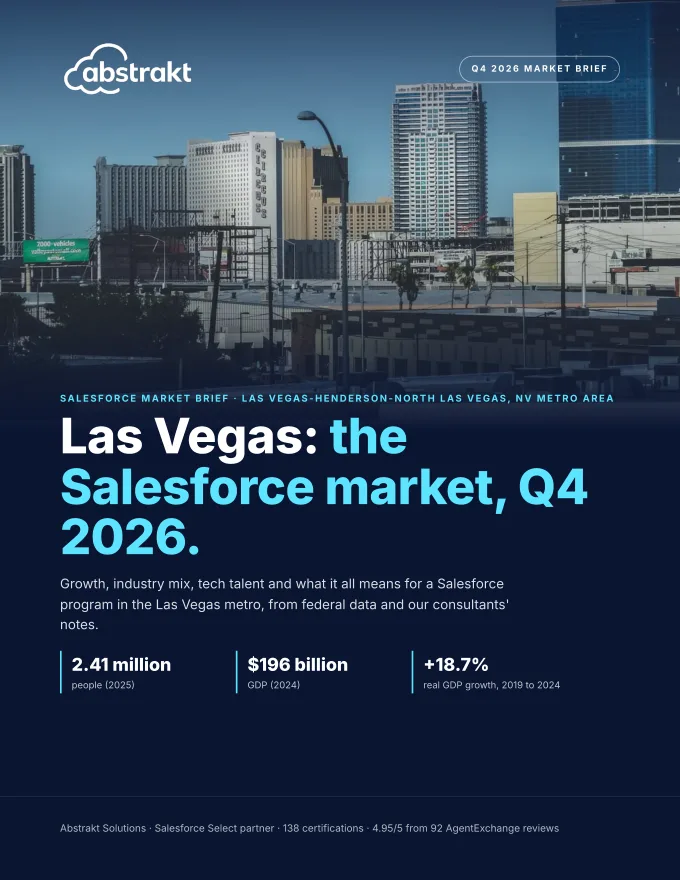
A free 21-page PDF with Las Vegas's growth ranked against 100 metros, its industry mix, tech wages and nearby markets. It is offered on the public Las Vegas page; send your customer there or get a copy for your own prep.
Get the Las Vegas brief →Co-sell with Abstrakt in Las Vegas
Working a Las Vegas account? Bring in a named consultant for discovery, scoping or a health check. We reply within 4 business hours.