

How Salesforce work starts in Portland, Maine
Abstrakt Solutions is a Salesforce Consulting Partner for companies in Greater Portland, Maine, from Portland, South Portland and Westbrook through Cumberland, York and Sagadahoc counties. Portland, Maine is one of our focus markets.
What buyers here usually run into
- 1
Demand that swings with the seasons
Tourism and hospitality businesses, and the suppliers that sell to them, see sharp seasonal peaks, so forecasts, staffing plans and marketing calendars in Salesforce need to reflect the calendar rather than a flat year.
- 2
Brokers and partners as users
Insurers and payments firms often sell through brokers or partner companies, and the access rules for those outside users must be right before a portal opens.
- 3
Grants and research collaborations
Organizations tied to ocean science and climate programs manage funders, collaborators and deliverables that do not fit standard opportunity stages without some thoughtful modeling.
Budget, team and partner questions
What drives cost
In Greater Portland, privacy and partner access drive scope. Health organizations need BAA-covered design and EHR integration; insurers and payments firms need broker or partner portals with sharing that scales. Grant tracking for research-linked firms adds modeling time.
Admin or partner
Many organizations here are too small for a dedicated Salesforce team, so managed services with one internal owner is common. Larger insurers and health organizations often keep an admin in-house and use a partner for integration and portal work.
What buyers ask a partner
Ask how the partner handles protected health information and which features they would hold back until a BAA is signed. For insurers, ask how they model agent licensing and appointments and test partner access before launch.
The local economy and its biggest industries (4)
| Sector | Share of 2024 GDP | Where Salesforce fits |
|---|---|---|
| Health care and social assistance Salesforce for health & life sciences → | 10.2% | The health system that tops Maine's list of private employers sets the scale here. Practices, home care agencies and behavioral health providers use Salesforce for referral tracking, patient outreach and service, with privacy settled at design time. |
| Finance and insurance Salesforce for insurance → | at least 8.4% | With a life insurer's operations and a payments processor both listed in Portland, the sector leans toward large books of policyholders, brokers and business partners. That calls for sharing models, partner portals and service consoles built to scale. |
| Professional, scientific, and technical services Salesforce for professional services → | 8.2% | Engineering, consulting, marine science and software firms connected to the Roux Institute and the Gulf of Maine Research Institute juggle grants, research partners and client projects that outgrow a basic sales pipeline. |
| Manufacturing Salesforce for manufacturing → | at least 6.5% | Veterinary diagnostics in Westbrook and ship building and repair in Bath show how varied the sector is. Smaller manufacturers in the metro need distributor management, quoting and service records tied to ERP. |
Source: U.S. Bureau of Economic Analysis, GDP by county (CAGDP2), 2024, summed to the metro area; private sectors only, excluding real estate and government. “At least” marks sectors where BEA suppresses some county figures.
Regional target sectors named by local economic development groups: Ocean-based economy, Climate action economy, Technology and computer sciences (commercialized innovation), Hospitality / restaurant and tourism economy (named regional strength).
Salesforce products that fit Portland, Maine (6)
In the order we lead with them here, from the industries above.
Salesforce Service Cloud
The operating system for modern customer service, case, knowledge, voice, and AI agent assist together.
Salesforce Financial Services Cloud
Industry CRM for wealth management, banking, insurance, and lending, built for compliance from the start.
Salesforce Sales Cloud
The CRM where sales pipeline lives, when it is built right.
Salesforce Experience Cloud
Customer, partner, and employee portals built on Salesforce.
Salesforce Marketing Cloud
Cross-channel marketing, email, mobile, journey, and Data 360-powered personalization at scale.
Salesforce Agentforce
AI agents that handle real work inside Sales Cloud, Service Cloud, and Marketing Cloud.
Portland, Maine: practical AI for care, finance and services
Health care leads the Portland, Maine metro economy at 10.2% of GDP in 2024, and finance and insurance contributes at least 8.4%. For clinics and care organizations, the dependable early wins are internal: summarizing a patient's service history, drafting responses to billing questions, and surfacing the right procedure for staff. Insurers and banks can hand document reading to an agent while underwriters and officers make decisions. Professional services firms, 8.2%, may use AI to rank incoming leads. Smaller organizations often underestimate preparation. Clear roles and permissions, one reliable customer record, and reviewed articles matter more than which AI feature is switched on first.
- Patient service history summaries
- Billing question reply drafts
- Ranking incoming professional services leads
Services buyers here usually need (7)
Salesforce Implementation in Portland, Maine
A Portland, Maine implementation often begins with a question of visibility: which patients, policyholders, brokers or clients each user may see. That answer shapes the data model, so we settle it in discovery before configuring anything. From there we build in a sandbox, stage the release so service or intake goes live ahead of marketing and portals, move cleaned data across and train each role.
By industry in Portland, Maine
- 1
Health care and social assistance
As the metro's largest private sector, at about 10.2% of 2024 GDP, health care and social assistance produces many of the region's Salesforce projects. Practices, home care agencies and behavioral health providers typically begin with referral intake and patient outreach, and the design has to keep clinical detail out of broad view. We decide which data stays in the clinical system, which summary fields Salesforce holds and how consent is captured, then launch intake first so staff feel relief from phone and fax work.
- 2
Ocean-based economy
GPCOG's regional plan names the ocean-based economy as a growth area, taking in seafood, marine science, boatbuilding and port-related businesses. Implementations for these companies need a data model that handles seasonal supply, buyers who are also suppliers, and licenses or certifications tied to vessels or harvest areas. We usually start with Sales Cloud for buyer relationships and availability, then add a wholesale ordering portal once account data is reliable enough to expose outside the company.
- 3
Finance and insurance
Insurers, payments firms and smaller financial companies in Greater Portland often sell through brokers or business partners, which makes the sharing model the heart of the implementation. We design account relationships, partner roles and Financial Services Cloud structures together, test them against real broker scenarios, and only then build screens. Service consoles and case handling usually launch first, with partner portals following once internal users trust the data they will be sharing.
Raise before scoping
Settle privacy boundaries early
Health, insurance and payments organizations in Southern Maine hold data that cannot be reopened casually after launch. Write down which roles see which records and fields before build begins, and test those rules with real users in a sandbox, since loosening or tightening access later means rework across the whole org.
Stage the rollout by team
A large first release overwhelms smaller teams. Launch the process with the clearest payoff, often service intake or pipeline management, then bring in marketing, portals and automation in later phases once the first group has settled into daily use and its feedback has been folded back into the design.
Plan for seasonal staffing
Hospitality, seafood and tourism-linked businesses bring in seasonal workers each year. Design plain layouts, permission sets that can be assigned in minutes and short training modules, so new staff are productive in Salesforce during the busy season without constant administrator help.
Salesforce Optimization in Portland, Maine
Many Portland, Maine orgs were set up by a small team in a hurry and then extended piece by piece. By the time we see them, required fields have multiplied, automation overlaps and every manager keeps a private report. We begin with usage and field-completion data plus interviews, fix the quick wins, then fold automation into maintainable Flows, clean duplicates and rebuild dashboards around agreed definitions. Each round ends with brief training for the affected roles, so the improvements are noticed rather than stumbled upon.
By industry in Portland, Maine
- 1
Professional, scientific, and technical services
Engineering, consulting and research firms, which together account for about 8.2% of 2024 metro GDP under professional, scientific and technical services, often built Salesforce around pursuits and then bolted on project delivery, grants and partner tracking. Optimization separates those processes with clean record types, trims duplicate fields each practice added and rebuilds capacity and pipeline reports so principals can see which work is won, which is at risk and who is overcommitted.
- 2
Retail trade
Retailers in Southern Maine, from specialty shops to outdoor and apparel brands, frequently use Salesforce for customer service and marketing while sales happen in a separate commerce or point-of-sale system. Optimization focuses on the customer record: merging duplicate shoppers, fixing consent fields and making sure service agents see recent orders. We also review Marketing Cloud segments and journeys, retiring those nobody has opened in a long time and rebuilding the ones that drive repeat purchases.
- 3
Finance and insurance
Service teams at insurers and payments companies in the metro depend on consoles that grew by accretion: extra tabs, overlapping case types and macros that no longer match procedures. We measure handling steps for the most common requests, simplify the console, merge overlapping assignment rules and tidy case categories so reporting reflects real work. Broker-facing Experience Cloud pages get the same review, since confusing partner screens generate avoidable calls to your service center.
Raise before scoping
Interview the people who avoid it
Login reports reveal the gaps; only conversations explain them. Talk with reps, agents and coordinators across the metro who have quietly returned to spreadsheets, since their reasons usually point straight to the layouts, fields and reports that need to change first.
Fix quick wins visibly
Early, visible improvements build goodwill for the harder work that follows. Remove unused required fields, repair a broken dashboard or add a shortcut agents have asked for in the first weeks, and tell users plainly what changed and why it changed.
Protect consent during cleanup
Merging duplicate contacts in health, insurance or retail orgs can overwrite communication preferences. Define which record's consent values survive a merge before deduplication starts, and check a sample afterward, so optimization never results in messages to people who opted out.
Salesforce Integration in Portland, Maine
In Portland, Maine, integration work usually connects Salesforce to the system that runs the business: policy administration or payment processing for financial firms, ERP for manufacturers and inventory for seafood and marine companies. We agree which system owns each record, pick an approach that fits your volumes, often Workato or a direct API rather than a large middleware platform, and build error handling, alerts and reconciliation in from the start. Staff then see core data in Salesforce without retyping it.
By industry in Portland, Maine
- 1
Manufacturing
Manufacturing, at no less than 6.5% of 2024 metro GDP, ranges here from diagnostics to ship building and repair. Smaller manufacturers in the metro usually need a small set of connections: products and prices flowing from ERP into Salesforce, orders flowing back once quotes are accepted, and shipment and invoice status visible to account managers. We design those flows around what your ERP can reliably expose and document which system wins whenever the two disagree.
- 2
Finance and insurance
Insurers and payments companies in Greater Portland keep policy, claims or transaction data in core platforms that Salesforce should display but never own. We integrate them so service agents see policy status, recent transactions and open claims on the customer record, and so broker or partner updates made in Salesforce reach the core system with validation. Sensitive values stay in the source where possible, and every call is logged for audit.
- 3
Ocean-based economy
Seafood dealers, aquaculture operators and marine suppliers, grouped under the ocean-based economy in GPCOG's plan, often track catch, inventory and orders in operational systems or spreadsheets. Integrating those with Salesforce lets sales promise only what is available, shows buyers' order history on the account and feeds a wholesale reorder portal. We keep the integration simple, usually scheduled updates, because seasonal volume swings matter more than real-time precision for most of these businesses.
Raise before scoping
Size the tooling to the problem
Many Southern Maine companies need a handful of connections, not an enterprise integration platform. Compare Workato, direct APIs and MuleSoft against your actual systems, volumes and future plans, and choose the lightest option your team can support comfortably once the project team has gone.
Test at peak-season volume
Order and transaction counts can swing sharply between peak and off-peak months. Test integrations with busy-season volumes, check API limits against the heaviest days and make sure retries cannot create duplicate orders when a system is briefly unavailable or slow to respond.
Keep sensitive data at the source
Payment details, health information and policy specifics rarely need to be copied into Salesforce. Display them through lookups or summary fields where possible, which shrinks the security review and keeps the core system as the single place auditors need to examine.
Salesforce Managed Services in Portland, Maine
In Greater Portland, managed services often supports organizations whose Salesforce use has spread beyond its original team: a service console that marketing now depends on, or a broker portal that operations maintains by hand. We keep one ranked backlog with your owner, handle user and permission requests, maintain automation and reports, and try each Salesforce release in a sandbox first. When a request needs development or integration work, the right specialist picks it up without a new contract.
By industry in Portland, Maine
- 1
Finance and insurance
BEA puts finance and insurance at no less than 8.4% of 2024 metro GDP, and for the insurers and payments companies behind that figure, day-to-day Salesforce work is dominated by access changes for brokers and partners, service process tweaks and reporting for regulators and leadership. We handle those with documented approvals, review partner user access on a schedule and keep the change log internal audit teams ask for, so compliance never relies on memory.
- 2
Hospitality / restaurant and tourism economy
GPCOG's plan names hospitality, restaurants and tourism as a regional strength, and these businesses run Salesforce on a seasonal rhythm. Ahead of each peak, managed services means onboarding seasonal staff, refreshing marketing journeys and booking or event processes, and making sure service queues can absorb volume. In the quieter months we use capacity for cleanup and enhancements, so the org enters the next season leaner than it left the last one.
- 3
Health care and social assistance
Clinics, home care agencies and social service providers in Southern Maine often use Salesforce for referrals, outreach and program tracking without a dedicated administrator. We take on the steady flow of changes, such as new referral partners, intake questions and grant-reporting dashboards, while protecting the permission model that keeps client information restricted. Connections to scheduling or records systems get a check after every release, since a sync that fails without warning can leave referrals waiting.
Raise before scoping
Flex capacity with the season
Hospitality, retail and tourism-linked organizations in the metro need more help before the busy season than after it. Agree how monthly capacity flexes across the year, and schedule larger enhancements for quieter months so seasonal onboarding and campaign work never compete with project work.
Keep partner access under review
Broker and partner users come and go faster than employees. Set a regular review of external accounts in Experience Cloud, deactivate anyone who has left a partner firm, and confirm that sharing still follows account relationships rather than manual exceptions added under deadline pressure.
Track requests by department
Knowing which teams generate requests reveals where training or design is falling short. We tag every ticket by department and type, so Southern Maine leaders can see whether repeated questions point to a confusing process that deserves a fix rather than another round of individual answers.
Salesforce Health Checks in Portland, Maine
Greater Portland organizations tend to ask for a health check when they inherit an org, change partners, face an audit or plan to use Agentforce. We look first at external access, then at internal permissions, sharing and field security; we measure data quality on the objects that matter, list automation, code and packages, test integrations and see how people use the system day to day. The written result orders every issue by how much harm it could do and how hard it is to correct, so privacy exposures surface ahead of cosmetic clutter.
By industry in Portland, Maine
- 1
Health care and social assistance
Health and social service organizations in Southern Maine often use Salesforce next to clinical systems, and over time the boundary between them blurs. A health check looks at whether diagnosis or treatment details have crept into notes and free-text fields, whether reports can be exported by roles that should not have that ability, and whether integration users hold more access than their job requires. Each issue is cross-referenced to the privacy safeguards already on your compliance officer's list.
- 2
Finance and insurance
For insurers and payments firms, the review concentrates on external access and audit readiness. We check broker and partner users in Experience Cloud, guest user settings, sharing rules built on account relationships and any manual shares added as exceptions. We also look at field history tracking, encryption settings and access left behind by departed employees, then flag which findings an examiner or internal auditor would most likely question first, with evidence attached for each.
- 3
Climate action economy
The climate action economy is one of the growth areas in GPCOG's regional plan, and organizations in it often combine grants, public programs, customers and installers in one Salesforce org. A health check untangles that mix: whether funder data and customer data are properly separated, whether program reporting draws on reliable fields and whether automation built for an earlier program still fires. The findings show what to fix before adding more programs.
Raise before scoping
Start with external users
Portals for brokers, partners, customers or program participants carry the highest exposure. Review guest and external user settings first, confirm each profile sees only the intended records and check whether any public pages or forms reveal more than they should to anonymous visitors.
Measure knowledge before a pilot
Agentforce answers from your records and knowledge articles. Count duplicates, missing fields and outdated articles on the objects an agent will use, and fix the worst gaps before any pilot reaches Southern Maine customers or staff, so early results reflect the tool.
Count what you pay for
Renewal is a good trigger for a review. Compare active users, license types and add-on products with actual use, and identify inactive accounts or unused features, so the renewal conversation with Salesforce starts from evidence rather than last year's order form.
Salesforce Migration in Portland, Maine
Migrations in Portland, Maine often involve companies that started on a lighter CRM or marketing tool and outgrew it as they added service, partners or more sellers. We inventory the source systems, agree field and object mappings with each team, decide what history to keep, then deduplicate and standardize records before any load. Trial migrations run in a sandbox with record-count reconciliation, and the final cutover follows a dated plan with a short data freeze and go-live support.
By industry in Portland, Maine
- 1
Retail trade
Retail trade produces about 8.0% of 2024 metro GDP, and retailers moving to Salesforce often bring customer lists from an e-commerce platform, a loyalty program and an email tool, each with its own identifiers and consent flags. We match shoppers across those sources, carry forward opt-in and opt-out status precisely and bring order summaries rather than every transaction line, so service and marketing work from one customer record on day one.
- 2
Technology and computer sciences
GPCOG's plan lists technology and computer sciences, framed as commercialized innovation, among the region's growth areas. Startups and software firms here commonly begin on a free or low-cost CRM and migrate once investors, partners and a service team need more structure. We map deals, subscriptions and support tickets into Salesforce objects, preserve the email and meeting history founders rely on and set up the reporting that board and investor updates will draw from.
- 3
Professional, scientific, and technical services
Engineering, consulting and research organizations in Southern Maine often keep client relationships in one tool and project or grant records in spreadsheets. A migration brings them together: clients and funders as accounts, pursuits and awards as distinct opportunity types, and deliverables linked to both. We agree with each practice leader what history matters, since a firm's reputation often rests on relationships recorded years ago that newer staff need to see.
Raise before scoping
Carry consent over exactly
Marketing permissions are easy to lose when email, commerce and CRM data merge. Map every opt-in, opt-out and preference field explicitly, reconcile totals after each test load and have your marketing lead confirm a sample before cutover, since a single lost suppression can reach the wrong inbox.
Publish an old-to-new glossary
Teams attach meaning to the labels they already use. When stages, statuses or fields change names in Salesforce, publish a translation table from old to new and walk each department through it before go-live, so reports and conversations stay understandable.
Choose a quiet cutover window
Seasonal retailers, tourism-linked businesses and firms with fiscal year-end peaks all have periods when a migration would hurt. Pick a cutover date in a slower stretch, and keep the old system read-only for a while after launch so staff can check records if something seems missing.
Salesforce Implementation Rescue in Portland, Maine
Stalled projects in Portland, Maine frequently come from scope that grew faster than a small team could test, or a partner change halfway through. Triage comes first: secure access, list what users need working now, check whether sensitive data is exposed and compare the build against what was promised. Urgent defects are fixed before anything else. Then every component is assessed on its merits and the remaining work is re-planned in releases your team can absorb.
By industry in Portland, Maine
- 1
Professional, scientific, and technical services
Consulting, engineering and research firms sometimes commission Salesforce to cover pursuits, projects and time tracking in one leap, and the project stalls when delivery staff reject the time and project screens. Rescue usually narrows the scope: stabilize the pipeline and account side that leaders already use, set project tracking aside and rebuild it later with input from the people who will enter the data. Momentum returns once partners see reliable pipeline reports again.
- 2
Health care and social assistance
Health and social service organizations that stall mid-project often face an awkward mix: a partial intake process in Salesforce, the old process on paper and staff unsure which is official. We first confirm that client information in the partial build is properly restricted, then pick one program or site to complete end to end. Once that group works entirely in Salesforce, the same design is extended to the remaining programs.
- 3
Hospitality / restaurant and tourism economy
Hotels, restaurant groups and tourism operators work to a hard calendar, and a Salesforce project that misses its window before the busy season can sit unfinished until the next one. Triage focuses on what must work before peak demand, typically bookings or event inquiries, guest communications and group sales pipeline. Features that can wait, such as loyalty programs or detailed analytics, move to the quieter months, when staff have time to test and learn them.
Raise before scoping
Check exposure before fixing features
Half-built orgs often have overly broad sharing, open guest access or test data containing real customer details. Review those risks in the first days of a Southern Maine rescue, before any feature work, because a data exposure is far harder to recover from than a missed deadline.
Narrow the scope to recover
Projects that stall have usually bitten off several clouds, portals and integrations in a single release. Agree on the smallest set of processes that would make the org useful, deliver that set well, and schedule everything else as later releases once users have regained confidence in the system.
Judge inherited work on evidence
Replacing everything a previous partner built feels satisfying but wastes money. Test each component against real scenarios, keep what works and write down the reasons behind each repair or replacement, so leadership can see the recovery plan is grounded in facts.
Industry plays in Portland, Maine (4)
Salesforce for Portland, Maine Health Care
In Greater Portland, health care is the largest private industry, and much of the hard work happens between settings: hospital to home, clinic to community program, bill to payment plan. Salesforce fits around the EHR as a coordination and engagement layer. We build care transition workflows, patient financial service for billing questions, and philanthropy tools for health foundations, each with PHI boundaries and access rules defined before any data moves. The result is fewer dropped handoffs and more consistent communication.
Health care and social assistance produces 10.2% of the Portland-South Portland metro's 2024 GDP in Bureau of Economic Analysis county data, the largest private share, just ahead of finance and insurance at 8.4% or more. The region's economic development plan from the Greater Portland Council of Governments focuses on ocean, climate and technology growth sectors rather than naming health care, even though care delivery produces more output than any other private industry. The metro covers Cumberland, York and Sagadahoc counties, so organizations often serve both dense city neighborhoods and small towns with limited local services.
Use cases to open with
- 1
Care transitions to home and community
Patients leaving the hospital often need home health, rehabilitation or community services, and the handoff is where things slip. Service Cloud care coordination records can track discharge plans, referrals to home and community partners, follow-up calls and barriers such as transportation. Coordinators see which patients have not connected with the next service and act before a readmission rather than after it.
- 2
Patient financial service
Billing questions, payment plans and financial assistance applications generate a large share of patient calls, and they often arrive after the clinical visit is long over. Service Cloud with billing system summaries lets agents see balances, statements and prior contacts in one place, set up payment plans and route assistance applications for review. Agentforce can answer routine balance and payment questions once data access and response limits are well defined.
- 3
Philanthropy from grateful patients
Health foundations raise funds from patients and families who want to support the care they or a relative received. Salesforce can manage donor relationships, gifts, pledges and campaigns, with carefully limited use of patient information as permitted under HIPAA fundraising rules and your opt-out process. Development officers see giving history and event engagement without any access to diagnoses, treatment details or other clinical information.
Raise before scoping
Sharing with community partners
Home health agencies and community organizations should receive what they need to deliver the next service and nothing beyond it. Define partner access through Experience Cloud with narrow sharing, confirm patient consent where required, and document what each partner type can see before any agency is invited.
Fundraising and PHI limits
HIPAA permits limited use of patient information for fundraising, with opt-out requirements attached. Keep development data separate from clinical data, restrict which fields flow to the foundation, and record every opt-out centrally so it is honored across all future campaigns and mailings.
Rural reach and staffing
Serving small towns across three counties means staff often work remotely, in patients' homes or on the road. Mobile access, clear task queues and simple layouts help small teams manage large territories without adding administrative work to clinical roles that are already stretched.
Salesforce for Portland, Maine Insurers and Agencies
Insurance organizations around Portland include carriers, independent agencies and firms that administer benefits for employers. Salesforce brings producers, policyholders, employer groups and service requests into one view while policy administration, claims and billing systems remain the records of truth. We build on Financial Services Cloud where it fits, integrate the core systems that matter most to service staff, and design security and consent controls that match insurance privacy obligations from the outset.
Bureau of Economic Analysis data, with some county figures withheld, credit finance and insurance with no less than 8.4% of Portland-South Portland output in 2024; only health care is larger. Insurance is not separated from banking and investment in that figure, and the Greater Portland Council of Governments' regional plan emphasizes ocean, climate and technology sectors instead. Even so, a share that large in a metro of this size means insurance and financial firms are a meaningful presence, and their CRM needs center on producers, employer groups and policyholder service.
Use cases to open with
- 1
Producer onboarding and performance
Carriers working with independent agents need to track licensing, appointments, contracts, production and service quality for each producer. Financial Services Cloud or Sales Cloud can hold those records, with dashboards showing premium, retention and submission trends by agency. Distribution managers spot which relationships need support, and onboarding checklists make sure licensing and appointment steps are complete before business is written.
- 2
Policyholder service center
Policy changes, billing questions and claim status calls need fast, accurate answers, and callers rarely know which department owns their issue. Service Cloud connected to policy administration, billing and claims systems gives agents a single view of each policyholder, with knowledge articles for common requests. Agentforce can handle routine questions such as payment status or document requests, handing complex or coverage-related issues to licensed staff.
- 3
Employer group enrollment
Benefits carriers and administrators serve employers who need help with enrollment periods, eligibility changes and a steady stream of employee questions. Salesforce can track each group's plans, renewal dates, contacts and service cases, while Experience Cloud gives HR contacts a portal for requests and documents. Account managers see open issues well before renewal and can plan outreach around each group's calendar.
Raise before scoping
Insurance data privacy
Policyholder information is protected under GLBA and state insurance privacy and data security rules, and health-related benefits data may also bring HIPAA into scope. Design encryption, field access, retention periods and audit trails together with compliance staff before any production data is loaded.
Core system integration
Older core platforms for policy, billing and claims frequently differ from one line of business to the next. Prioritize the few data points service staff need most, integrate those reliably with monitoring, and resist the temptation to copy entire policy histories into Salesforce.
Licensed versus unlicensed staff
Some conversations and transactions legally require licensed staff. Reflect those rules in case routing, permissions and Agentforce topic limits so each request reaches someone qualified to handle it, and record who handled what so audits and complaint reviews have a clear trail.
Salesforce for Portland, Maine Professional Services
Professional services in the Portland, Maine area carry a regional flavor: engineering and environmental consultancies working on waterfronts and climate resilience, design and marketing agencies serving tourism and consumer brands, and technology firms growing out of the region's research institutions. Salesforce helps them manage proposals, public and private clients, and project capacity in one place. Sales Cloud tracks pursuits, CPQ standardizes fee proposals, and dashboards connect pipeline to staffing so partners can see next quarter's workload before committing.
Southern Maine's consultants, engineers, designers and technical specialists contribute 8.2% of metro output in the BEA's 2024 series, a close third to hospitals and to banks and insurers at 8.4% or more. The Greater Portland Council of Governments' 2023-2028 prosperity plan, a draft regional strategy, names the ocean-based economy, the climate action economy and technology and computer sciences as growth areas. It points to a graduate research institute, a marine research institute and the region's colleges as catalysts, all of which generate consulting, engineering and software work.
Use cases to open with
- 1
Public and grant-funded pursuits
Engineering and environmental firms chase municipal, state and federally funded projects with formal qualifications packages, interviews and funding timelines. Sales Cloud can track each pursuit from early intelligence to award, with funding source, client, teaming partners and submission deadlines. Leaders see which clients and funding programs produce wins, and business development staff stop maintaining a separate spreadsheet of upcoming requests for qualifications and proposals.
- 2
Fee proposals with consistent rates
Design, engineering and technology firms price work from labor categories, hours and expenses that vary by project type. Revenue Cloud or CPQ builds fee proposals from standard rate tables and templates, applies approval rules when margins drop, and keeps every version tied to the opportunity. Partners spend less time reconciling numbers, and the firm can analyze which proposal assumptions held once projects are delivered.
- 3
Client relationships across seasons
Agencies and consultancies serving tourism, hospitality and ocean-economy businesses see demand swing through the year. Salesforce can track retainers, seasonal campaigns and repeat project cycles by client, and prompt account leads to start planning conversations months ahead of peak season. Marketing Cloud sends thought leadership to the right segments, and engagement data shows which clients are ready for new work.
Raise before scoping
Project system integration
Timesheets, invoices and budget burn belong to whatever delivery or accounting tool the firm already trusts. Decide what Salesforce needs, such as backlog, burn and billing status, and connect won opportunities to project setup so delivery managers do not retype contract details.
Public-sector records and terms
Public clients may subject proposals and correspondence to records requests, and grant-funded work carries specific reporting terms. Tag records by funding source and client type, and confirm with contracts staff what may be stored where, so compliance obligations are visible to the project team.
Small firms, lean administration
Many Greater Portland firms are small enough that nobody manages Salesforce full time. Keep the design simple, rely on standard objects and declarative automation, and document the setup. Managed support can cover releases and new requests without adding a dedicated administrator.
Salesforce for Portland, Maine Manufacturers
Manufacturing around Portland, Maine is smaller in scale than in industrial metros, but it is varied: marine and boat builders, food and beverage producers, and specialty makers selling to national and international customers. Sales and customer care are often handled by a few people who also do other jobs. Salesforce gives them structure without heavy overhead. Sales Cloud manages dealers, distributors and direct buyers; CPQ handles configured or custom orders; Service Cloud tracks warranty and after-sale support. Order and stock figures come across from the ERP, so nobody keeps a second copy by hand.
Manufacturing produced at least 6.5% of the Portland-South Portland metro's 2024 GDP in BEA county data, where some figures are withheld, ranking fifth among private sectors. It is not a named growth sector in the Greater Portland Council of Governments' draft prosperity plan, but two of that plan's priorities, the ocean-based economy and the climate action economy, overlap with local production. The market page notes that the metro reaches Bath, and that seasonal tourism peaks affect suppliers. Many producers therefore sell into marine, food and outdoor markets with strongly seasonal demand.
Use cases to open with
- 1
Configured boat and equipment orders
Boat builders and marine equipment makers sell products with options, custom features and long lead times. CPQ with product rules keeps quotes buildable, captures deposits and change orders, and hands a clean specification to production. Sales and dealers can see build status pulled from the ERP, so buyers get accurate delivery estimates instead of optimistic guesses that damage the relationship later.
- 2
Dealer and distributor management
Marine, outdoor and food producers often sell through dealers or distributors spread across New England and beyond. Sales Cloud tracks each partner's orders, inventory commitments, promotions and territory, and flags partners whose orders are slowing before the season starts, so reps can call while there is still time to adjust stocking levels or programs. An Experience Cloud portal can let dealers check orders, register sales and submit warranty claims without calling the factory.
- 3
Seasonal planning and forecasting
Demand for marine, outdoor and tourism-linked products peaks in warmer months, while production has to start much earlier. Salesforce can combine dealer pre-season orders, historical sell-through and open opportunities into a forecast by product and month. Operations then plans materials and labor from a shared view, and sales can see when capacity is already committed before promising new orders, which matters when a late-spring rush arrives all at once.
Raise before scoping
Seasonal staffing and access
Seasonal sales and service staff join and leave through the year. Plan permission sets, onboarding guides and license management so temporary users get productive quickly and lose access cleanly when the season ends, without leaving orphaned records or open cases behind.
Serial and hull records
Boats and equipment carry hull or serial numbers, warranty registrations and service histories that owners expect a builder to track for years. Model assets in Salesforce linked to owners and dealers, and keep regulatory or certification records in the quality system with references.
Integration on a small budget
Smaller manufacturers often run accounting-grade ERP systems with limited APIs. Start with the integrations that save the most re-keying, such as orders and inventory, use prebuilt connectors where possible, and add more once the core flow is stable and staff trust the numbers.
Case studies to send (3)
From the industries this market leans on. Client names are anonymized and these projects are not specific to Portland, Maine.
The Portland, Maine Salesforce market brief, Q4 2026
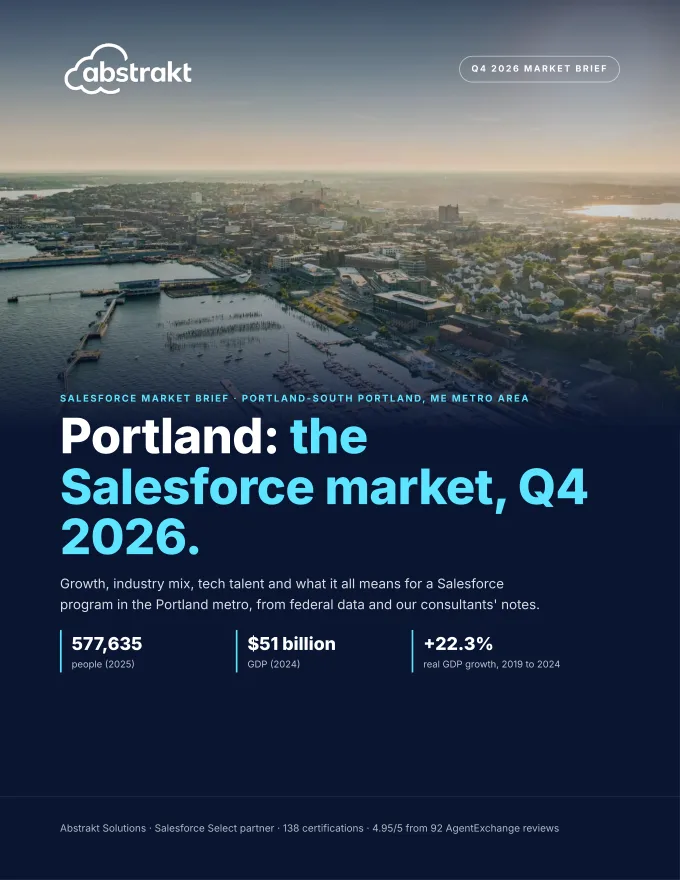
A free 23-page PDF with Portland, Maine's growth ranked against 100 metros, its industry mix, tech wages and nearby markets. It is offered on the public Portland, Maine page; send your customer there or get a copy for your own prep.
Get the Portland, Maine brief →Co-sell with Abstrakt in Portland, Maine
Working a Portland, Maine account? Bring in a named consultant for discovery, scoping or a health check. We reply within 4 business hours.