

How Salesforce work starts in Boston
In Greater Boston, Abstrakt Solutions concentrates its Salesforce Consulting Partner work on professional services firms, financial companies and health and life sciences organizations. We implement, integrate, optimize and manage Salesforce across eastern Massachusetts and southern New Hampshire. Boston is one of our focus markets.
What buyers here usually run into
- 1
Scaling from startup tools
Fast-growing biotech and software companies outgrow spreadsheets and starter CRMs. The right time to set up Salesforce properly is before the commercial team triples.
- 2
Scientific sales
Selling instruments, research services or therapies involves technical buyers and long cycles, which standard sales stages do not capture well.
- 3
Data that has to be right
Research, healthcare and financial organizations need clean, auditable data, which makes data quality and governance part of every project.
Budget, team and partner questions
What drives cost
Boston costs depend on how technical the sales process is, the governance needed for research, clinical or financial data, and whether a starter CRM must be migrated. Integration with ERP, project or clinical systems is often a separate phase worth scoping on its own.
Admin or partner
Fast-growing biotech, robotics and software companies here often have operations staff who learned Salesforce on the job. A partner usually adds architecture, data governance and release testing, while internal operations owns requests.
What buyers ask a partner
Ask for life sciences or scientific-selling references, Financial Services Cloud experience if you are an asset manager or insurer, and how the partner documents data governance decisions. Ask which named consultants will do the build.
The local economy and its biggest industries (4)
| Sector | Share of 2024 GDP | Where Salesforce fits |
|---|---|---|
| Professional, scientific, and technical services Salesforce for professional services → | 16.7% | Research organizations, software companies and consultancies need pipeline, account management and delivery tracking, and many are scaling from startup tools to Salesforce. |
| Finance and insurance Financial Services Cloud → | 9.1% | Asset managers, custody banks and insurers need relationship views, compliant communications and service across large client bases. |
| Health care and social assistance Salesforce for health & life sciences → | 8.5% | Academic medical centers and health systems use Salesforce for patient engagement, referral management, research recruitment and service, with privacy designed in. |
| Manufacturing Salesforce for manufacturing → | 7.6% | Biotech, medical-device and robotics manufacturers need key-account, field and service processes that fit regulated or highly technical products. |
Source: U.S. Bureau of Economic Analysis, GDP by county (CAGDP2), 2024, summed to the metro area; private sectors only, excluding real estate and government. “At least” marks sectors where BEA suppresses some county figures.
Regional target sectors named by local economic development groups: Life Sciences, Information Technologies, Financial Services, Aerospace, Defense, Robotics, Advanced Manufacturing, Clean, Green & Blue Technologies.
Salesforce products that fit Boston (6)
In the order we lead with them here, from the industries above.
Salesforce Sales Cloud
The CRM where sales pipeline lives, when it is built right.
Salesforce Service Cloud
The operating system for modern customer service, case, knowledge, voice, and AI agent assist together.
Salesforce Financial Services Cloud
Industry CRM for wealth management, banking, insurance, and lending, built for compliance from the start.
Salesforce Data 360 (Data Cloud)
Unify customer data into a real-time profile that powers segmentation, analytics, and AI.
Salesforce Agentforce
AI agents that handle real work inside Sales Cloud, Service Cloud, and Marketing Cloud.
Tableau
Executive analytics, embedded dashboards, and CRM Analytics built on Tableau.
Boston use cases where Agentforce fits today
Which Boston teams get value from AI first? Usually the ones buried in text. Life sciences and research-heavy professional services firms handle long inquiries, protocols, and contracts, and an agent can read those documents and hand staff a short summary with the relevant fields filled in. Financial services teams, a sector worth 9.1% of metro GDP in 2024, get more from drafted client replies and cleaner forecast rollups. Health care providers focus on patient questions answered from approved content. The honest caveat is that grounding matters more than the model. If the knowledge base is stale or medical and financial records are overshared, we pause the rollout and fix access before any agent goes live.
- Protocol and contract summarization
- Drafted replies for advisors
- Patient answers from approved content
Services buyers here usually need (7)
Salesforce Implementation in Boston
A Salesforce implementation for a Greater Boston company is usually shaped by who has to approve it. Life-sciences, financial and healthcare organizations bring compliance, privacy and audit requirements into the first workshop, and those requirements drive the data model more than sales stages do. We design objects, record types and sharing with those reviewers involved, build in a sandbox, then phase the rollout so the first team goes live while later phases, such as service or portals, are still in design.
By industry in Boston
- 1
Life Sciences
Life sciences leads MassEcon's list of target sectors. Biotech and research-tools companies preparing their first commercial team need an implementation that keeps medical engagement apart from promotion, models institutions, labs and investigators correctly, and holds up under validation. We define those boundaries in the design phase, put sharing rules in place before any contact data is loaded and document configuration decisions so quality teams can review them line by line.
- 2
Finance and insurance
Asset managers, custody banks and insurers, part of a finance and insurance sector worth about 9.1% of Greater Boston's 2024 GDP, have to decide early in an implementation how institutional relationships, funds or policies, and intermediaries fit together. Financial Services Cloud supplies much of that structure, and our design work concentrates on the pieces it leaves open: consultant and intermediary relationships, communications retention and access limited by client, region or business line. Those choices are made before any data is loaded.
- 3
Professional, scientific, and technical services
Research, engineering, software and consulting firms make professional services the region's largest private sector. When these firms implement Salesforce, the central design question is how opportunities connect to engagements and people. We model proposals, statements of work and project records so that pipeline becomes a staffing forecast, and we leave time and billing in the systems that already handle them unless there is a clear reason to move them. Practice leaders review the model before build starts.
Raise before scoping
Bring compliance in at discovery
Legal, privacy and quality reviewers in regulated industries slow a project most when they see the design late. Invite them to the data model and security workshops, agree on what Salesforce will and will not hold, and record each decision they approve.
Model technical buying committees
Instruments, research services and enterprise software sold here can take many months and involve scientists, procurement and finance on the buying side. Build opportunity stages and contact roles that reflect those buyers, rather than forcing a generic funnel that reps will quietly ignore.
Phase by team, not by feature
Launching one complete team at a time, such as commercial sales before medical affairs or client service, gives each group a working system sooner and lets later phases learn from the first. Every go-live includes role-based training for that team alone.
Salesforce Migration in Boston
Boston migrations split between growing companies and long-established ones. Software and robotics startups leaving a starter CRM need deals, contacts and marketing history moved before the team expands. Older consulting and engineering firms often migrate from homegrown databases or aging CRMs with years of inconsistent entries. In both cases we inventory the source, agree what to keep, clean and deduplicate before loading, run test migrations into a sandbox and plan a short cutover so nobody works in two systems.
By industry in Boston
- 1
Information Technologies
Software and IT companies, a MassEcon target sector, typically migrate from HubSpot or another starter CRM once they add sales territories, partners or enterprise contracts. Beyond accounts and deals, they need lifecycle stages, lead sources and marketing attribution carried over without breaking the reports their investors review. We map those fields carefully and decide early whether marketing stays in its current tool or moves as well. Investors and boards see continuity, not a reset.
- 2
Professional, scientific, and technical services
Older consulting, engineering and research firms often migrate from a homegrown client database or an aging CRM that only a few people understand. Their data mixes current clients, alumni contacts and prospects under inconsistent names. We standardize organizations and people, preserve the engagement history partners rely on and retire contact lists nobody has touched in years, so the new org starts cleaner than the old one ended. Retired lists are archived, not destroyed.
- 3
Clean, Green & Blue Technologies
MassEcon also targets clean, green and blue technologies, a group spanning energy, climate and ocean-related companies. Their pre-Salesforce records often live in spreadsheets covering sites, grants, pilots and utility or municipal partners. Migration turns those into structured records with real relationships, such as pilots linked to partners and sites, so business development teams can track projects and funding deadlines in one place. Grant reporting then draws on the same records instead of a separate tracker that someone must keep current.
Raise before scoping
Decide where marketing lives
Many companies move sales to Salesforce but keep their marketing platform for a while. Settle which system owns leads and consent before migrating, and plan the sync between them, or contact records will drift apart within weeks of go-live and nobody will know which copy is right.
Standardize institution names
Hospitals, universities and research institutes appear under many variations in Boston-area data. Build a standard naming list and hierarchy before loading, so parent organizations, departments and labs roll up correctly in reports and territory assignments. Getting the hierarchy right also makes later territory changes far simpler.
Carry consent across intact
Email opt-outs and consent records are easy to lose in a migration and costly to get wrong. We move them with their timestamps and sources, verify counts after every test load and switch marketing sends back on only after reconciliation is complete.
Salesforce Integration in Boston
Around Boston, the systems Salesforce must connect to usually come with firm rules about who owns what. A manufacturer's ERP owns pricing and orders, a life-sciences company's quality and research systems own regulated data, and a financial firm's portfolio or policy platforms own positions and contracts. We document which system owns each shared field, choose MuleSoft, another middleware tool or direct APIs based on how many systems meet and how fresh the data must be, and build monitoring so failures are caught the same day.
By industry in Boston
- 1
Manufacturing
Manufacturing contributes about 7.6% of 2024 metro GDP, and the region's makers of robotics, medical devices and precision components usually need Salesforce linked to ERP for products, pricing, orders and invoices. We integrate those objects so sales sees order and payment status without leaving the account, and so service teams can pull serial numbers and warranty dates while a customer is still on the phone. Pricing stays owned by the ERP, so reps never quote from stale numbers.
- 2
Life Sciences
Biotech and research-tools companies connect Salesforce to systems that hold data the CRM should reference but not own: sample and order platforms, clinical and quality systems, and reference data for healthcare professionals. We design those integrations to pass identifiers and status rather than full records, apply field-level security to whatever does arrive, and log each exchange so validation and audit teams can follow the data path end to end. Nothing regulated is copied without a documented reason.
- 3
Finance and insurance
Asset managers and insurers here usually need Salesforce to show holdings, policies or claims that live in dedicated platforms. We sync summaries and status, such as assets by account or open claims by policyholder, rather than every transaction. That keeps the CRM responsive and limits the sensitive data it holds, while giving relationship managers the context they need before a client meeting or a renewal discussion. Advisors get the full picture without a second login.
Raise before scoping
Pass references, not copies
When regulated data must stay in its source system, a link or identifier in Salesforce is often enough. Decide object by object whether the CRM needs the data itself or only a pointer to it, and design each integration around that answer.
Match middleware to your landscape
Organizations with many systems and a platform team benefit from reusable APIs on MuleSoft. Smaller companies with a few connections are usually better served by a lighter tool or direct integration. Volume, latency and who maintains the result decide the choice.
Test with realistic volumes
Month-end order loads, quarterly statements and claims surges stress integrations far more than daily traffic does. We test with production-sized data in a full sandbox before go-live, so API limits and timeouts surface in testing rather than during a financial close.
Salesforce Managed Services in Boston
Managed services for Boston organizations usually means supporting an org that several regulated teams depend on. Health systems, financial firms and technology companies need configuration changes, new automation and user requests handled promptly, but each change also needs testing and a record of who approved it. We run a prioritized backlog, deliver changes through a sandbox with documented tests, review every Salesforce release before it reaches users and bring in developers or architects when a request goes beyond administration.
By industry in Boston
- 1
Health care and social assistance
Health systems and care organizations belong to a sector that produced about 8.5% of Greater Boston's 2024 GDP, and those using Salesforce for patient engagement, referrals or research recruitment need small changes constantly, from new referral sources to updated consent language. Every one of those changes touches protected information. Our managed services team applies them through a controlled process, retests access rules after each release and keeps a change log compliance staff can review.
- 2
Information Technologies
Information technologies is one of MassEcon's target sectors, and software companies here adjust their go-to-market often: new products, pricing tiers, partner programs and territories. Each shift creates a stack of Salesforce requests that competes with the in-house admin's daily work. We take the specialist items, such as Apex, integrations and quoting changes, and deliver them on a steady schedule aligned with your planning cycles. Your admin stays focused on users, and the roadmap keeps moving instead of stalling behind daily tickets.
- 3
Financial Services
Financial services firms here, another MassEcon target sector, often run Salesforce under change-control policies set by risk and compliance teams. Managed services has to fit inside that: requests logged with a business owner, peer review of configuration, testing evidence retained, and deployments scheduled away from critical trading or reporting windows. We work within your existing controls instead of asking you to adapt them to ours. Where your policy calls for segregation of duties, the person who builds a change is not the person who approves it.
Raise before scoping
Keep evidence for every change
Regulated teams need to show what changed, who approved it and how it was tested. We attach that record to each backlog item as part of delivery, so audit preparation becomes a report you pull rather than a scramble through old email threads.
Review releases against regulated processes
Each Salesforce release can alter behavior in sharing, Flow or interface components. We check release notes against the processes that carry privacy or compliance weight first, test them in a preview sandbox and brief your team before production is upgraded.
Plan around academic and fiscal calendars
Many Boston organizations run on academic or fiscal-year rhythms, with enrollment, budgeting or year-end reporting driving request peaks. We plan capacity and freeze windows around those dates so significant changes land in quieter periods instead of colliding with the busiest weeks of your year.
Salesforce Health Checks in Boston
For Boston organizations, a health check usually answers a governance question before a technical one: who can see what, and can we prove it. Financial firms, health systems and defense-related manufacturers need that answer for audits, and increasingly before introducing AI. We review access and sharing, data quality, automation, custom code, integrations and adoption, then rank findings by risk and effort, so the fix list starts with whatever an auditor or an AI agent would expose first.
By industry in Boston
- 1
Financial Services
Financial services firms, one of MassEcon's target sectors, face regular examinations of who can access client data and how changes are controlled. A health check for them tests profiles, permission sets, sharing rules and admin access against least privilege, checks field history and retention settings, and reviews connected apps with broad access. The findings map to the control questions examiners and internal audit teams typically raise. Each finding notes which control it relates to.
- 2
Health care and social assistance
Health systems and care organizations using Salesforce hold information that privacy law protects. Our review checks field-level security on sensitive fields, sharing between departments, audit trail coverage, guest and portal access, and whether integrations pull more data than they need. We also measure duplicate patient and referrer records, which cause both privacy mistakes and poorly targeted outreach. Portal users and integration accounts get the same scrutiny as staff, since they are often where unexpected access hides. Each finding is paired with a practical fix.
- 3
Aerospace, Defense, Robotics
Aerospace, defense and robotics companies are on MassEcon's target list, and their orgs often hold program, pricing and technical information with contractual access limits. A health check confirms that sensitive programs are restricted to the right people, that controlled technical data is not stored in the CRM and that integrations with engineering and ERP systems respect the same limits. Where customers audit their suppliers, the report gives your team a ready answer about how CRM access is controlled and reviewed.
Raise before scoping
Scope the review to your obligations
A bank, a hospital and a defense supplier care about different risks. We agree at kickoff which regulations, contracts and policies apply and weight the findings accordingly, so the report reflects your obligations rather than a generic checklist. Findings that do not apply to you are noted but not ranked.
Gate AI on the findings
Before an AI agent reads your cases, contacts or knowledge, the permissions and data beneath it need to be sound. The review tests the objects a planned agent would use and tells you which fixes are prerequisites and which can safely follow a pilot.
Put a number on technical debt
Over many years an org collects fields nobody fills in, automation that no longer fires and packages whose purpose is forgotten. We list each item with the effort to remove it, so technical debt becomes a budgeted cleanup plan instead of a vague complaint that never reaches a roadmap.
Salesforce Optimization in Boston
Optimization for Greater Boston organizations usually targets an org that is not broken, just heavy. Consulting firms, manufacturers and health organizations add fields, approvals and reports as needs arise and rarely remove anything. We start with usage data and conversations with the teams involved, remove what no one uses, move legacy automation into Flow, fix the duplicate and incomplete records that weaken reporting and rebuild the dashboards leadership reviews. Changes ship in short releases with training on what moved.
By industry in Boston
- 1
Professional, scientific, and technical services
Consulting, engineering and research firms belong to the region's largest private sector, professional, scientific and technical services, which accounts for about 16.7% of 2024 metro GDP. In many of these firms, partners run real opportunities out of their inboxes while Salesforce holds a partial, outdated version. Optimization trims opportunity entry to the few fields partners will maintain, automates follow-up and handoffs to delivery, and rebuilds pipeline and utilization reports so practice leaders can plan hiring from them.
- 2
Advanced Manufacturing
Advanced manufacturing is on MassEcon's target-sector list, and precision equipment and component makers here often have orgs where quoting, service and distributor data grew up separately. Optimization links those pieces around a clean account and asset structure, retires parallel custom objects built by different teams and gives sales managers a single view of quotes, open service issues and upcoming renewals for each customer. Service and sales finally see the same customer history, which makes renewal conversations far less awkward.
- 3
Health care and social assistance
Health care organizations frequently use Salesforce for outreach, referrals or contact centers, and adoption suffers when staff have to click through many screens during a call. We shorten those paths with guided screens and dynamic forms, merge duplicate patient or referrer records that confuse routing, and rebuild operational dashboards around the measures managers already report upward, such as referral conversion and response time. Staff notice shorter calls first; managers notice reports they no longer have to rebuild by hand each month.
Raise before scoping
Design for senior staff
Partners and principal investigators will not fill out long forms. Capture the minimum from email, calendar or a mobile screen, fill the rest through automation, and let operations staff enrich records afterward, so the people with the relationships stay in the system.
Clean data with its owners
The same hospital, university or lab often appears under several names in Boston-area orgs. Automated matching finds candidate duplicates, but final merges need someone who knows the accounts, so we schedule short review sessions with each team before anything is combined.
Retire reports, not just fields
Orgs with a long history often carry far more reports and dashboards than anyone opens. We archive the unused ones, consolidate near-duplicates and label the official versions, so leaders stop comparing numbers pulled from competing reports in the same meeting.
Salesforce Implementation Rescue in Boston
Rescues in the Boston area often involve projects that were technically sound but never finished. Validation requirements, compliance reviews or a change of leadership stopped work partway, and teams have lived with a half-built org ever since. We review what exists against the original scope, fix what stops daily work, and decide for each component whether to keep, fix or rebuild. Then we complete the remaining scope with documentation, testing evidence and training so the org can pass the reviews that stalled it.
By industry in Boston
- 1
Aerospace, Defense, Robotics
Robotics and defense-related companies often stall on installed-base and service processes. The sales side works, but assets, service contracts and field visits were never modeled properly, so support still runs in spreadsheets. We rebuild the asset structure around real units in the field, connect cases and work orders to it and restore the service reporting leadership expected from the original project. Service leaders get fleet-level reporting they can take to customers at renewal time.
- 2
Life Sciences
Life-sciences companies sometimes start a Salesforce build ahead of a commercial launch and then pause when the product timeline shifts. When the timeline resumes, the org has aged: requirements changed, validation documentation lapsed and key users have left. Recovery reassesses the design against the current launch plan, updates configuration and documentation and completes validation before the field team is trained. Users who joined after the pause are trained on the finished system, not the abandoned draft, so the field team starts with one consistent way of working.
- 3
Manufacturing
Manufacturers here commonly stall at the ERP boundary. Quotes do not reflect current pricing, orders are keyed twice and the integration fails without anyone noticing. We stabilize the connection first, reconcile products and accounts between the two systems and then finish the quoting and order processes the project was meant to deliver, testing each against real orders before release. Reps regain trust in quotes once they match what finance invoices every time.
Raise before scoping
Restart validation deliberately
In regulated environments a stalled project may have incomplete or outdated validation records. Confirm what was tested and approved, what has changed since and what must be retested before resuming delivery. Skipping this step can force a second round of rework later.
Name a decision owner
Recovery moves only as fast as decisions do. Before work restarts, agree on one person on your side who can settle process questions quickly, and on how disagreements between departments such as sales, service and finance will be resolved without weeks of escalation.
Protect what already works
Even a troubled build tends to contain things worth saving, such as data already loaded, a sound account model or a working integration. Identifying and protecting them keeps recovery shorter and preserves the credibility of the internal teams who built them.
Industry plays in Boston (4)
Salesforce for Boston Health and Life Sciences
Around Boston and Cambridge, many life sciences companies sell to other scientists: instruments, reagents, software, contract research and manufacturing services. Their buyers are principal investigators, lab managers and procurement teams at research institutions and biotech companies, and their sales cycles depend on technical evaluations, grants and project timelines. Salesforce can map those lab-level relationships, track evaluations and scientific support, and connect service history on installed instruments, with Agentforce helping application scientists answer routine technical questions faster.
MassEcon lists life sciences first among Massachusetts's target industries, and Kendall Square in Cambridge is described as the heart of the state's innovation economy. Boston itself is home to roughly 30 colleges and universities, and academic labs are a natural customer base for scientific products and services. In the Bureau of Economic Analysis's 2024 county data, professional, scientific and technical services, which includes research and development, is the metro's largest private sector at 16.7%, with health care and social assistance at 8.5%. That density of labs and researchers shapes how commercial teams here sell and support customers.
Use cases to open with
- 1
Lab-level account mapping
A single research institution can contain a great many labs, cores and departments, each with its own budget and decision makers. Modeling institutions, departments and labs as a hierarchy, with principal investigators, lab managers and core directors as contacts, lets sales teams see where products are already used and where the next evaluation should start, instead of treating a whole university as one account.
- 2
Technical evaluations and demos
Scientific buyers test before they buy. Tracking evaluations, demo units, samples and application scientist involvement on each opportunity shows which evaluations convert, how long they take and where technical support is stretched thin. Grant timing and funding sources can be captured too, helping sales forecast when purchases will actually clear procurement and when a lab's budget is likely to open up again.
- 3
Instrument service and scientific support
Installed instruments need preventive maintenance, repairs and application support. Service Cloud can manage cases and entitlements for each serial number, route technical questions to the right specialists, and give customers a portal for documentation and requests. Agentforce, grounded in approved protocols and manuals, can answer common how-to questions and hand harder ones to application scientists with context attached. Recurring issues by model feed product engineering.
Raise before scoping
Scaling beyond startup tools
A young company in Kendall Square may run its first commercial year on a shared spreadsheet and a free CRM. Move before the commercial team grows sharply, define the institution and lab model carefully, and migrate only clean data, because fixing hierarchy and duplicates after rollout is far harder.
Quality and complaint handling
Companies making regulated products need complaint intake, investigation and reporting that fit their quality management system. Decide whether Salesforce captures complaints and hands off to the quality system, or links to it, and validate that process as your quality team requires.
Research and patient data
Most scientific selling involves no patient data, but clinical services and diagnostics can. Define early which lines of business may touch protected health information, keep that data out of commercial records, and apply HIPAA safeguards where it truly belongs in Salesforce.
Salesforce for Boston Professional Services Firms
Boston's professional services firms often sell deep specialist knowledge: scientific consulting, engineering, strategy, regulatory and financial advisory work. Their challenge is matching the right expert to each opportunity, pricing work that runs in milestones, and planning accounts across clients in life sciences, finance and technology. Salesforce can hold expertise profiles alongside pipeline, build proposals with milestone pricing through Revenue Cloud, and give practice leaders account plans and analytics, with Tableau showing which industries and services drive profitable growth.
Professional, scientific and technical services is the largest private sector in the Boston metro at 16.7% of GDP in the Bureau of Economic Analysis's 2024 county data, well ahead of finance and insurance at 9.1% and health care at 8.5%. MassEcon's target industries include life sciences, information technologies, financial services and aerospace, defense and robotics, all natural buyers of specialist consulting and engineering work. With roughly 30 colleges and universities in the city, firms here also compete and collaborate with academic experts, which affects how they position their own staff.
Use cases to open with
- 1
Matching experts to opportunities
Winning specialist work often depends on naming the right expert in the proposal. Storing consultant profiles in Salesforce with skills, therapeutic or industry areas, certifications and past engagements lets partners find qualified people quickly, add them to opportunity teams and see their availability, so proposals are staffed with credible names instead of whoever happens to be free that week. Win rates by named expert show whose involvement matters most.
- 2
Proposals priced by milestone
Research, engineering and regulatory projects are frequently priced by phase or milestone. Revenue Cloud can assemble proposals from standard phases, rates and assumptions, route unusual terms for approval and produce consistent documents. When the client signs, milestones and budgets pass to delivery and billing systems, so the plan the client approved becomes the plan the team works to. Change requests are tracked against the original scope.
- 3
Industry account planning
Firms serving large life sciences, financial and technology clients need structured account plans: relationship maps, open opportunities, delivery health and growth targets. Salesforce account plans and Tableau dashboards bring those together, so practice leaders can review key accounts consistently and spot where one practice's relationship could open doors for another within the same client. Plans are reviewed on a regular cadence with the client team.
Raise before scoping
Keep expertise data current
Skills profiles lose value quickly if nobody maintains them. Pull what you can from HR and project systems automatically, ask consultants to confirm rather than type their profiles, and review the data at regular intervals so partners trust search results when staffing a proposal.
Data quality and governance
Clients in research, health and finance expect accurate, auditable information from advisors. Set clear ownership for account, contact and engagement data, define validation rules and duplicate checks, and give an administrator responsibility for governance so reporting stays reliable as the firm grows.
Integrating delivery systems
Project accounting, time tracking and document management usually remain separate. Decide which summaries return to Salesforce, such as budget consumed and milestone status, and avoid duplicating detailed delivery data that belongs in those systems. A nightly sync is usually enough for account reviews.
Salesforce for Boston Insurers and Agencies
Boston insurance organizations often arrive at Salesforce with years of history in older CRMs, spreadsheets and agency systems, and with data governance expectations set by audit and risk teams. The work usually starts with consolidation: one customer and producer model, clean household and business relationships, and documented data ownership. On that foundation we build distribution management, policyholder service and specialty underwriting pipelines, typically on Financial Services Cloud with integrations to policy, billing and claims platforms.
Insurers belong to the metro's second-largest private sector: finance and insurance together equal 9.1% of Boston's 2024 GDP in federal BEA data, which trails only professional services. MassEcon, the statewide economic development organization, lists financial services among its target sectors along with life sciences, information technologies, and aerospace, defense and robotics. Research, healthcare and financial organizations in the area are known for demanding clean, auditable data. The region's technology and life sciences companies also form a distinctive commercial customer base, with intellectual property, clinical and product liability exposures that specialty underwriters must understand.
Use cases to open with
- 1
Consolidating legacy CRM data
Carriers and agencies that grew through acquisitions often run several CRMs and spreadsheets for different lines. We map each source to a single model of customers, households, businesses, producers and policies, resolve duplicates, and migrate history with clear rules for what is kept. Users then work from one record per customer, and reports finally reconcile with finance and underwriting figures.
- 2
Specialty underwriting pipeline
Underwriters writing technology, life sciences or professional liability risks work through submissions that need careful triage. Salesforce can capture submissions from brokers, record risk characteristics, required information and referral decisions, and track quotes, binds and declinations. Leaders see hit ratios by broker, class and underwriter, and can adjust appetite or broker relationships using real data. Loss information from claims can later be joined to the same records to show which segments perform.
- 3
Policyholder service with governance
Service Cloud gives representatives a single view of policies, billing and claims pulled from core systems, with requests routed by type and line. Every change to contact information, beneficiaries or preferences is logged with who made it and why. Audit and risk teams can review service activity without extra reports, and managers monitor resolution times and complaints across lines. Knowledge articles keep answers consistent between representatives.
Raise before scoping
Data governance before migration
Define owners, quality rules and retention for each data domain before moving records. Decide which system is authoritative for customers, producers and policies, and document matching rules. Audit teams will ask how migrated data was validated, so keep reconciliation reports as evidence.
Massachusetts and New Hampshire rules
The metro crosses two states with different insurance departments, licensing and privacy requirements. Record the state for each policy and producer, route work to properly licensed staff, and ask compliance to confirm communication and data-handling requirements for each state. Configurable templates make later rule changes simple.
Core system integration strategy
Older policy and claims platforms may lack modern APIs. Choose between real-time integration, scheduled batches or middleware such as MuleSoft based on how current the data must be for each use. Plan for integration testing with realistic volumes and error scenarios.
Salesforce for Boston Manufacturers
Boston-area manufacturers often sell sophisticated systems to technical buyers who test before they commit: robots piloted in a warehouse, instruments evaluated in a lab, components qualified by a defense prime. Salesforce should track those evaluations, the technical stakeholders involved and the success criteria agreed, then carry the relationship into installation, service contracts and upgrades. We connect it to ERP and product data, and design it so application engineers and service teams use it as much as sales does.
Bureau of Economic Analysis figures for 2024 put manufacturing at 7.6% of Boston metro GDP, fourth among private sectors behind professional services, finance and insurance, and health care. MassEcon's target sectors include advanced manufacturing and a combined aerospace, defense and robotics category, and the region's incubators include a robotics innovation hub in the Seaport. Boston.gov also names manufacturing among the city's key industries. Buyers of robots and engineered systems here are usually engineers with test plans of their own, so deals move on proof rather than on a sales calendar.
Use cases to open with
- 1
Evaluation and pilot management
Customers often trial a robot, instrument or system before purchasing. Salesforce can track each evaluation unit, its location, dates, success criteria, technical contacts and results, with tasks for application engineers. Sales leaders see which pilots are on track to convert and which are drifting, and operations knows where every demonstration unit is and when it should return. Results from past pilots help set realistic criteria for the next prospect.
- 2
Technical stakeholder mapping
Purchases involve engineers, scientists, safety officers, procurement and executives. Salesforce can record each stakeholder's role, concerns and engagement, and connect technical questions, application notes and demos to the opportunity. Account teams prepare for committee decisions with a clear picture of support and objections, rather than relying on one champion's view of the buying process. Safety and integration reviews can be tracked as formal milestones on the deal.
- 3
Service contracts on installed systems
Robotic cells and defense systems in the field need firmware releases, periodic inspections and quick remote diagnosis. Service Cloud and Field Service can track each system, its configuration, warranty and service contract, schedule preventive visits and log remote support cases. Account managers see contract renewals, utilization issues and upgrade opportunities, and product teams receive structured feedback on recurring failures. Customers can open cases and download manuals through a portal instead of calling.
Raise before scoping
Adoption by application engineers
Application and field engineers hold critical technical knowledge but resist duplicate data entry. Integrate with the tools they already use, keep required fields minimal, and give them views that help plan evaluations and service, so the CRM becomes useful to them rather than a reporting chore.
Configuration and product data
Systems are often configured with options, software versions and serial numbers. Decide which product and configuration data comes from ERP or product lifecycle systems, how installed configurations are recorded, and who updates them after upgrades, so service always sees what is actually installed.
Defense and export requirements
Robotics and aerospace products may involve export-controlled technology or customer security requirements. Work with compliance to decide what technical data may be stored, restrict access where required, and keep controlled documents in approved repositories linked from Salesforce. Document the access model so customer security audits can be answered quickly.
Case studies to send (3)
From the industries this market leans on. Client names are anonymized and these projects are not specific to Boston.
The Boston Salesforce market brief, Q4 2026
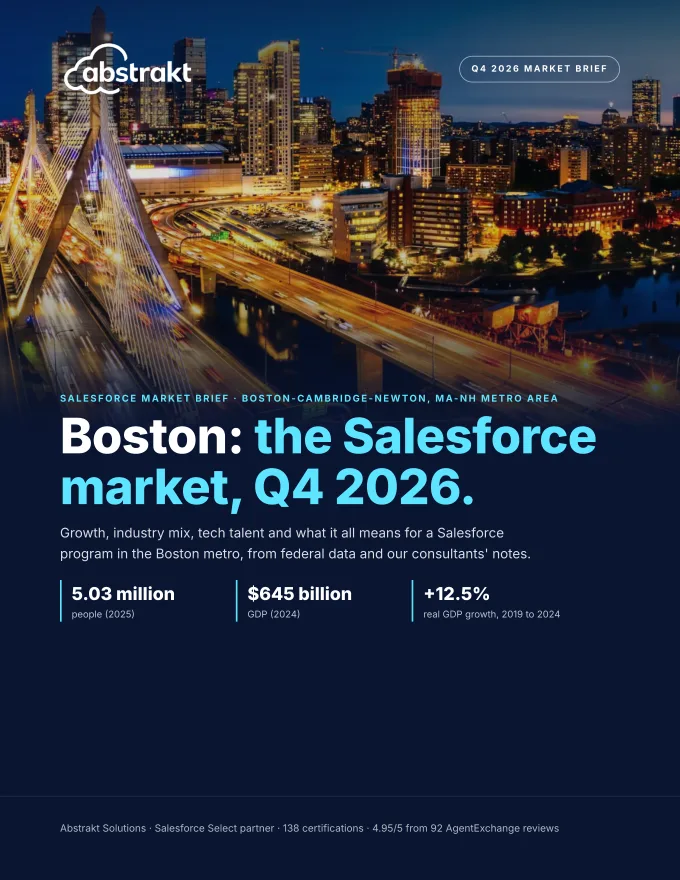
A free 24-page PDF with Boston's growth ranked against 100 metros, its industry mix, tech wages and nearby markets. It is offered on the public Boston page; send your customer there or get a copy for your own prep.
Get the Boston brief →Co-sell with Abstrakt in Boston
Working a Boston account? Bring in a named consultant for discovery, scoping or a health check. We reply within 4 business hours.