

How Salesforce work starts in Providence
Across Providence, Warwick, the rest of Rhode Island and the Massachusetts communities in the same metro, Abstrakt Solutions brings Salesforce consulting to health, financial, manufacturing and insurance organizations. Providence is one of our focus markets.
What buyers here usually run into
- 1
Clinical and research records side by side
Where hospital systems and a research university overlap, one Salesforce org can end up holding patient outreach, grant partnerships and donor relationships, each with different privacy obligations that must be separated by design.
- 2
Defense work with export controls
Suppliers to naval and defense programs commonly handle controlled technical data, so deciding what may live in the CRM, and in which Salesforce environment, has to happen before the build starts.
- 3
Advisors and service desks on different systems
Banks, asset managers and insurers often run relationship management and customer service in separate tools, which leaves no single view of a household and makes suitability reviews slower.
Budget, team and partner questions
What drives cost
Providence scope often grows with separation requirements: patient, research and donor records with different privacy rules, or controlled defense data that must stay out of the CRM. Manufacturers add drawing and revision links, and distributors add customer-specific pricing across two states.
Admin or partner
Small and midsize organizations here often have no dedicated Salesforce staff, so managed services covers administration and releases. Hospital networks and larger financial firms usually keep internal owners and bring in a partner for integration and design.
What buyers ask a partner
Ask how the partner separates records with different privacy obligations in one org, and how they handle controlled technical data. Ask whether they build the knowledge base an agent will need.
The local economy and its biggest industries (4)
| Sector | Share of 2024 GDP | Where Salesforce fits |
|---|---|---|
| Health care and social assistance Salesforce for health & life sciences → | 10.5% | Two hospital networks hold the first and third spots on Rhode Island’s 2024 statewide list of private employers. Systems on that scale need referral tracking, patient outreach and service records locked down by role, while the life sciences startups near Brown’s labs track investors, research partners and trial sites. |
| Manufacturing Salesforce for manufacturing → | at least 7.6% | Manufacturing contributes at least 7.6% of 2024 GDP, and RI Commerce recruits design and custom manufacturers alongside ocean economy businesses in shipbuilding and defense. Shops that build to specification need quotes tied to drawings and revisions, then a clean handoff from the sales team to production planning. |
| Finance and insurance Salesforce for wealth management → | 7.2% | Finance and insurance accounts for 7.2% of the metro’s 2024 GDP, and RI Commerce files financial services and insurance under advanced business services. Advisors, bankers and service teams here need one household view with permissions that satisfy compliance reviewers. |
| Wholesale trade Salesforce for retail & consumer goods → | 6.6% | Wholesale trade is one of the metro’s five largest private sectors, and RI Commerce promotes transportation, distribution and logistics across the state. Distributors usually want ERP order history, customer-specific price lists and sales territories that cross the Rhode Island and Massachusetts line in front of every rep. |
Source: U.S. Bureau of Economic Analysis, GDP by county (CAGDP2), 2024, summed to the metro area; private sectors only, excluding real estate and government. “At least” marks sectors where BEA suppresses some county figures.
Regional target sectors named by local economic development groups: Information Technology, Cyber Physical Systems, Data Analysis, Advanced Business Services (financial services, insurance, IT services, consulting, data processing/BI), Life Sciences, Ocean Economy (incl. defense, offshore wind, shipbuilding), Design and Custom Manufacturing, Transportation, Distribution and Logistics.
Salesforce products that fit Providence (6)
In the order we lead with them here, from the industries above.
Salesforce Service Cloud
The operating system for modern customer service, case, knowledge, voice, and AI agent assist together.
Salesforce Financial Services Cloud
Industry CRM for wealth management, banking, insurance, and lending, built for compliance from the start.
Salesforce Sales Cloud
The CRM where sales pipeline lives, when it is built right.
Salesforce Experience Cloud
Customer, partner, and employee portals built on Salesforce.
Salesforce Revenue Cloud / CPQ
Configure-price-quote, billing, subscription management, and quote-to-cash on Salesforce.
MuleSoft
Enterprise API platform, for connecting Salesforce, ERP, data warehouses, and the rest of your stack.
Where Providence organizations can start with Agentforce
Health care is the Providence metro's largest private sector, followed by manufacturing and finance and insurance. For hospitals and community providers, the practical starting point is a patient-facing agent limited to approved topics such as appointments, links to forms, and billing basics, with nurses and staff reviewing anything clinical. Manufacturers, including marine and defense suppliers, can use AI to read purchase orders and technical requests and route them correctly. Insurers and credit unions get value from summaries of long member interactions. Small and midsize organizations often lack a maintained knowledge base, so we build one first. An agent that guesses is worse than no agent.
- Appointment and billing basics
- Purchase order reading and routing
- Member interaction summaries
Services buyers here usually need (7)
Salesforce Implementation in Providence
Sensitive records shape almost every Providence Salesforce implementation from the first workshop. Health systems, lenders and defense suppliers make up much of the local economy, and each brings rules about who sees what. We start with discovery workshops, then agree the objects, record types and sharing model before configuration starts in a sandbox. Go-live comes in phases, usually the core sales or service process first, with data migration and role-based training for each group.
By industry in Providence
- 1
Health care and social assistance
BEA's 2024 county figures credit health care and social assistance with about 10.5% of Providence-area output, more than any other private sector. When a provider, community health organization or social-service agency implements Service Cloud or Health Cloud here, the build hinges on how referrals, intake and consent are modeled, and on which staff roles may open which records. We design those structures with privacy and compliance staff in the workshops, and we keep clinical detail in the EHR, bringing into Salesforce only what coordinators need.
- 2
Ocean Economy
Rhode Island Commerce lists the ocean economy, spanning defense, offshore wind and shipbuilding, among the state's target sectors. Suppliers in that chain tend to sell into a handful of prime contractors over multi-year programs, so an implementation for them models prime contracts as account hierarchies and programs as parent records for bids. Before any build we classify data, because controlled technical drawings usually belong in an approved repository, with Salesforce holding the commercial side: contacts, bid dates, quotes and delivery commitments.
- 3
Wholesale trade
Wholesalers working both sides of the Rhode Island–Massachusetts line need sales territories that follow customers rather than state borders. Implementing Sales Cloud for a distributor here centers on the account hierarchy, territory assignment rules and a read-only view of ERP order history, so reps see reorder patterns without keying anything twice. The same foundation suits logistics providers, which RI Commerce counts among its statewide target sectors, since their customers also expect shipment and order history on every account.
Raise before scoping
Classify data before design
Organizations serving hospitals or naval programs should decide early which records Salesforce may hold at all. A short classification exercise with security and compliance staff sets the edition, the sharing model and the fields that need encryption, and it avoids rework after the first audit question arrives.
Design for two states
The metro spans Rhode Island and part of Massachusetts, so sales territories, service regions and any state-specific licensing or disclosure details should be modeled as attributes from the start. Retrofitting a second state into page layouts, assignment rules and reports after launch costs far more than designing for it.
Phase by user group
Rather than one launch for everyone, go live with the group whose process is clearest, often a sales or service team, then add partner portals, CPQ or marketing in later releases. Each release brings its own training and a few weeks of stabilization support before the next begins.
Salesforce Integration in Providence
Integration work for Providence companies is mostly about linking Salesforce to systems that must stay authoritative: EHRs at care organizations, core banking and portfolio platforms at financial firms, and ERPs at manufacturers and distributors. Our work settles data ownership field by field, picks MuleSoft, Workato or direct APIs according to volume and who will support them, adds error handling and reconciliation, and leaves monitoring in place so a failed sync raises an alert instead of a wrong report.
By industry in Providence
- 1
Manufacturing
Manufacturing contributed at least 7.6% of metro GDP in 2024, according to BEA's county data. For fabricators and component makers here, integration usually means pulling ERP pricing, inventory and order status into Salesforce and pushing won quotes back as sales orders. We decide early whether product and price data flow one way or both, because two-way pricing sync is where manufacturing integrations most often go wrong. Revenue Cloud quotes then draw on the same numbers production planning uses.
- 2
Health care and social assistance
Care organizations connecting Salesforce to an EHR should move as little clinical data as possible. We usually sync demographics, appointment or referral status and care-team assignments, leaving diagnoses and notes in the clinical system, and log every transfer for privacy review. For providers exchanging referrals with the large hospital networks that anchor Rhode Island's health economy, an Experience Cloud portal connected to Salesforce can replace fax and phone updates with tracked status changes.
- 3
Transportation, Distribution and Logistics
Transportation, distribution and logistics is another RI Commerce target sector. Carriers, third-party logistics firms and distributors depend on shipment and order events that live in transportation or warehouse systems, not the CRM. Integration puts those events inside Salesforce cases and account pages for account managers and service agents, typically through MuleSoft or an event-based API, so a customer calling about a late delivery gets an answer without a second screen or a callback.
Raise before scoping
Name a system of record
Customer, product, price, order and patient records each need a written answer to one question: which system may change them, and which may only read. That single decision prevents circular updates, settles disputes between departments, and makes troubleshooting far quicker when two systems disagree about a value.
Trace regulated data paths
Data moving between Salesforce and clinical, banking or defense-program systems may fall under privacy, examination or export-control rules. Trace each field's route, including middleware logs and error queues, because sensitive values often end up stored in places no one reviewed.
Assign monitoring owners
Decide before launch who receives alerts when a sync fails and who fixes the underlying record. Without a named owner, errors pile up quietly in a queue, and teams in Rhode Island and Massachusetts end up trusting different numbers from what should be the same source.
Salesforce Optimization in Providence
Optimizing Salesforce for a Providence organization typically starts with how people actually use it. We look at login and field-completion data, interview staff in each department, and inventory the workflow rules, Process Builder and Flows that have piled up over the years. Then we simplify layouts, move old automation into maintainable Flows, clean duplicates and rebuild the dashboards leadership relies on, finishing with short, role-based training so the changes stick in hospitals, banks and distributors alike.
By industry in Providence
- 1
Health care and social assistance
Care organizations often find that clinicians and coordinators avoid Salesforce because a simple referral takes too many clicks and required fields. Optimization for them trims layouts to what each role needs, uses dynamic forms to show fields only when relevant, and rebuilds referral turnaround reports so managers see where patients wait. We test every change with frontline staff before release, since a slower screen during a busy shift is enough to send people back to paper.
- 2
Advanced Business Services
RI Commerce groups financial services, insurance, IT services, consulting and data processing under advanced business services. Firms in this category tend to run a Salesforce org that several consultants have extended, leaving overlapping triggers and dashboards built on inconsistent stage definitions. We consolidate the automation, agree one set of pipeline and utilization definitions with leadership, and rebuild reports on top of them. A dashboard that matches what partners and account managers see in their own records gets used.
- 3
Wholesale trade
In 2024, wholesalers generated roughly 6.6% of the Providence metro economy by BEA's measure. Distributors frequently bought Salesforce for account management and then found reps logging activity in spreadsheets anyway. The usual culprits are duplicate accounts from ERP imports and territory reports that disagree with commission statements. We merge duplicates, add matching rules that stop new ones, and rebuild territory and product-mix reports so sales managers can coach from the system rather than from exports.
Raise before scoping
Measure before you trim
Pull login history, record-update frequency and field-completion rates before touching layouts. Numbers show which teams avoid the system and which fields are ignored, so simplification targets real friction instead of the loudest complaint in the room. Share the baseline with each department head before work begins.
Retire automation in order
Orgs set up years ago frequently fire legacy workflow rules, Process Builder and newer Flows on a single object at once. Map what fires on each object, move logic into one Flow per trigger point and switch off the old versions only after tests confirm identical results.
Agree on definitions first
Reports lose their audience once departments disagree on what makes a customer active or a case closed. Settle those definitions with each leader in writing before any report is rebuilt, then document them inside Salesforce where users can find them. Revisit them when the business changes.
Salesforce Health Checks in Providence
For Providence organizations, a Salesforce health check is often prompted by an outside question: a privacy officer, examiner, defense customer or board wants to know how the org is secured. Our consultants examine login policies, connected apps and every layer of record access, count duplicate and incomplete records, catalog automation and custom code, and follow how integrations move data. You get a prioritized list of risks and fixes, along with an assessment of whether the data is ready for Agentforce.
By industry in Providence
- 1
Health care and social assistance
Hospitals, clinics and social-service agencies need to know exactly who can view referral, intake and outreach records. Our health check traces access through profiles, permission sets, sharing rules and guest-user settings on any Experience Cloud sites, checks field history and encryption on sensitive fields, and lists integrations that copy personal data elsewhere. Privacy exposure ranks first in the findings, followed by data quality issues that could mislead care coordinators. We also note which fixes need sign-off from the privacy officer.
- 2
Manufacturing
Defense and marine suppliers, which sit within the metro's manufacturing base, often face customer security questionnaires that ask about their CRM. A health check gives them documented answers: multi-factor enforcement, session and IP policies, who can export data, which files are stored in Salesforce, and whether any controlled technical data has crept into attachments or notes. Where it has, we recommend moving it to an approved repository and tightening access before the next customer audit.
- 3
Finance and insurance
Financial firms here often run orgs extended by several partners over the years. We inventory Apex code without adequate tests, overlapping Flows and triggers, unused managed packages, and consent or retention settings that no longer match policy. For firms planning Agentforce, we also check whether household and account data is clean and permissions tight enough that an AI agent answering advisors or clients would not surface the wrong records. Findings go to technology and compliance leaders as one shared list.
Raise before scoping
Match the review to obligations
Obligations differ sharply between a care provider, a lender and a naval subcontractor. Tell us which frameworks, audits or customer requirements apply, and the health check weighs findings against them instead of a generic checklist, so the report answers the questions your reviewers will actually ask.
Look at portals and guests
Experience Cloud sites for patients, partners or brokers widen your exposure. Review guest-user permissions, sharing sets and file visibility on every site, since a portal misconfiguration can reveal records to people outside the organization without anyone inside noticing. Test each site as an anonymous visitor.
Sequence fixes before Agentforce
An AI agent works within the access and data it inherits. Close permission gaps and deduplicate key records before a pilot starts, and choose the pilot's scope based on where the health check found the cleanest data rather than where demand is loudest.
Salesforce Managed Services in Providence
Managed services in the Providence market usually means taking over a busy queue in an org that already works. Hospitals, banks and manufacturers here often run Salesforce with one admin who also looks after other systems, so requests from service, sales and compliance wait for weeks. We work that backlog in monthly cycles, test every Salesforce release in a sandbox before it reaches your users, watch integrations for failures, and keep a written change log so compliance reviewers can see what changed and why.
By industry in Providence
- 1
Finance and insurance
Finance and insurance accounted for roughly 7.2% of Providence metro GDP in 2024. Banks, asset managers and insurers here run orgs where a single field change can touch a compliance process, from suitability notes to complaint handling. Our managed services team routes those changes through a documented approval step, tests them against Financial Services Cloud behavior in each release, and keeps permission sets tidy as advisors and service staff join, move or leave. Audit questions get answered from the change log rather than from memory.
- 2
Life Sciences
Life sciences is one of Rhode Island Commerce's target sectors, and young companies in the downtown innovation district expand their Salesforce use quickly: investor contacts one quarter, research partners and trial sites the next. Without a steady owner, each addition arrives as a hurried custom object. Managed services gives them an architect's review of every request, so new processes reuse existing structures and the org stays usable as headcount multiplies and funding stages change.
- 3
Design and Custom Manufacturing
RI Commerce also pursues design and custom manufacturing. Shops building to specification revise quote templates, product options and approval thresholds often, and each revision ripples into CPQ rules and the ERP sync. A managed services arrangement lets them submit those updates to one queue, have them built and tested in a sandbox, and see them deployed on a schedule that avoids month-end order pushes. Integration errors are flagged to the team before sales notices a wrong price.
Raise before scoping
Budget hours for release months
Salesforce's three yearly releases each change Flow, security and interface behavior in small ways. Set aside part of the monthly hours for sandbox regression testing ahead of each release, especially if your org has custom code or packages supporting clinical, lending or defense work.
Separate urgent from important
Agree on what counts as urgent before the first ticket arrives. A locked-out user or failed integration needs prompt attention; a new report can wait for the monthly cycle. Clear categories stop small requests from crowding out the roadmap work leadership actually funded.
Keep compliance in the loop
In regulated Rhode Island industries, managed changes to sharing rules, field history or consent settings should reach the compliance team before deployment. Build that review into the monthly cadence so approvals happen routinely rather than as a scramble after an examiner's question.
Salesforce Migration in Providence
In the Providence area, Salesforce migrations often combine consolidation with cleanup. A bank may run advisor contacts in one tool and service cases in another; a distributor may keep customers in its ERP and in reps' spreadsheets. We inventory every source, decide what history is worth keeping, deduplicate before loading, rehearse the migration in a sandbox with reconciled record counts, and schedule the cutover so teams stop working in the old system on a known date.
By industry in Providence
- 1
Finance and insurance
Advisory firms, banks and insurers moving to Financial Services Cloud need their data reshaped as much as moved. Individual contacts become household members, accounts become financial accounts, and years of notes must be sorted into what compliance requires to keep and what can be archived. We map those structures with operations and compliance staff, test the load in a sandbox, and reconcile balances and relationship counts before any advisor sees the new system.
- 2
Information Technology, Cyber Physical Systems, Data Analysis
RI Commerce targets information technology, cyber-physical systems and data analysis. Software and data firms in this group often start on HubSpot or a startup CRM and move to Salesforce once enterprise deals, partner channels or multi-product subscriptions appear. Their migration hinges on converting deal stages, subscription records and marketing history without losing attribution, and on switching website forms and integrations at the same moment as the data, so no lead falls between the two systems.
- 3
Wholesale trade
Distributors migrating to Salesforce often have customer records scattered across an ERP, an old contact manager and rep spreadsheets, with the same buyer appearing under several spellings. Cleanup matters more than the load itself. We standardize names and addresses, match records on account numbers where they exist, pick a surviving record for each customer, and keep ERP account IDs on every Salesforce account so later integration has a reliable key.
Raise before scoping
Decide how much history
Moving every email and note since the old system went live is rarely worth it. Agree with each department which activity history supports current work, which must be retained for regulators or contracts, and which can stay in a searchable archive outside Salesforce.
Protect records during transfer
Health, financial and defense-related data should travel through encrypted, access-logged channels, and test loads should use masked or minimal data where possible. Delete extract files once reconciliation is signed off, so copies of sensitive records do not linger on laptops or shared drives.
Pick a clean cutover date
Avoid migrating during month-end, open enrollment or a fiscal close. Announce a brief freeze on the legacy system, load and reconcile the last changes, then move every user across on the same morning. Running both systems in parallel usually creates more duplicates than it prevents.
Salesforce Implementation Rescue in Providence
Rescue work in Providence tends to follow a familiar pattern: a project scoped for a hospital, bank or manufacturer ran into privacy or integration questions nobody answered during design, the deadline held anyway, and users now work around a half-finished org. We begin with an assessment of the build, the original requirements and user feedback, stabilize whatever is blocking daily work, then decide component by component what to keep, fix or rebuild before finishing in phases.
By industry in Providence
- 1
Health care and social assistance
Rescues for care organizations usually start with security. Projects launched under deadline pressure often left sharing rules too open or consent tracking unfinished, and privacy officers then limited what staff could do in the system. We close the access gaps first, restore confidence with compliance, and then rebuild intake, referral or outreach workflows with the coordinators who use them. Relaunch happens unit by unit, with hands-on training for each group of staff.
- 2
Life Sciences
Life sciences companies in Rhode Island, a sector the state's commerce agency targets, sometimes commission a Salesforce build during a funding round and lose momentum when priorities shift. The org is left with half-built objects for investors, partners and trial sites, and no one who remembers the design. We document what exists, remove unused pieces, settle a data model that fits the company's current stage and finish the parts people need now.
- 3
Manufacturing
Manufacturing rescues in the region often involve CPQ or an ERP sync that never quite worked. Reps stop quoting in Salesforce when prices are wrong or approvals stall. We separate integration defects from design problems, fix the data feeds first, and simplify product rules until quotes match what production can build. Only then do we reintroduce advanced features, one release at a time, tested with the estimators and reps who rely on them.
Raise before scoping
Secure access and knowledge
Partner exits mid-build tend to strand admin logins, integration accounts and design notes. Before changing anything, confirm who holds system administrator rights, rotate passwords held by departed vendors, and collect whatever specifications, test scripts and statements of work still exist.
Reopen the compliance questions
Many stalled projects in regulated industries never settled what sensitive data belongs in Salesforce. Revisit that with privacy, security and compliance staff early in the recovery, because the answer can change the data model, and building further on a wrong assumption only deepens the problem.
Relaunch smaller than planned
A rescue is not the moment for the full original scope. Get one team working reliably in Salesforce, show measurable improvement, and then extend. A smaller, credible relaunch rebuilds trust with users and sponsors faster than another large release that arrives late.
Industry plays in Providence (4)
Salesforce for Providence Health and Life Sciences
In the Providence metro, health care is the largest private sector by output, and much of it involves coordination across a compact, two-state region: hospital systems, community health centers, behavioral health providers and academic research programs. Salesforce helps those organizations manage patient navigation, referrals and outreach from one secure platform. For young life sciences companies, it supports investor, partner and clinical site relationships. Privacy is settled at the start: which staff see which patient details, how consent is logged and what gets audited are written down with your privacy officer before configuration begins.
Care delivery is the biggest private slice of the Providence economy; the Bureau of Economic Analysis's 2024 county series credits health care and social assistance with 10.5% of metro GDP, ahead of manufacturing at no less than 7.6%. Life sciences also appears on the state commerce agency's list of statewide targets, a list not specific to the Providence metro. Downtown, the I-195 redevelopment district is building an innovation district on former highway land that houses the state's first life sciences incubator and a startup accelerator, and state innovation vouchers fund research partnerships with local knowledge providers, giving small biotech and health technology companies a foothold near the hospitals.
Use cases to open with
- 1
Care navigation across programs
Patients moving between hospital, primary care, behavioral health and community services often lose track of appointments and next steps. Service Cloud gives navigators a single case with the patient's programs, referrals, social needs and scheduled follow-ups, and Experience Cloud offers patients a secure place to check next steps. Leaders see where patients drop out of care and which handoffs between organizations need attention.
- 2
Community partner referrals
Health systems and community organizations exchange referrals for housing, food, transportation and behavioral support. Salesforce can track each referral from submission through acceptance and outcome, with partner organizations updating status through a portal. Care teams stop chasing faxes and calls, and population health managers can report on closed-loop referral rates by program and partner. Those reports also support grant and payer reporting that many community programs owe.
- 3
Life sciences startup relationships
Early-stage biotech and health technology companies manage investors, grant programs, pharmaceutical partners, clinical sites and first customers at the same time. Sales Cloud with a simple data model tracks each relationship, milestone and document, so founders and business development leads share one view. As trials and commercial activity grow, the same org can add service and partner portals without a rebuild.
Raise before scoping
Sign the BAA first
Before any protected health information enters Salesforce, confirm the business associate agreement is in place and decide which clinical data truly needs to live there. Keep the electronic health record as the legal record and bring across only what navigators and outreach staff require.
Handle sensitive care categories
Addiction treatment programs and behavioral health services often operate under confidentiality rules tighter than those covering a routine clinic visit. Work with privacy officers to define which record types and fields need extra restrictions, consent tracking or segmentation before configuring sharing, reports and any partner portal access.
Work across two states
The metro spans Rhode Island and part of Massachusetts, with different Medicaid programs, community partners and reporting requirements. Model state and payer as core attributes on patients and programs, so referrals, eligibility checks and reports reflect where each patient is covered.
Salesforce for Providence Wealth Managers
Providence wealth managers typically run relationship-driven practices where a few advisors know every family personally, and growth depends on referrals and the next generation. Salesforce helps preserve that personal touch while adding structure: complete household records, service calendars that do not rely on memory, and compliant marketing to prospects and centers of influence. We implement Financial Services Cloud, connect custodial and planning tools, and account for clients and advisors who span Rhode Island and Massachusetts.
Advisory firms in Providence fall under finance and insurance, 7.2% of the metro's 2024 GDP according to the Bureau of Economic Analysis, which does not report wealth management separately. Rhode Island Commerce targets advanced business services statewide, a category that explicitly includes financial services, insurance and consulting. Health care, the metro's largest private sector at 10.5% of GDP, and a manufacturing base of at least 7.6% produce physicians, executives and owners of closely held firms, the kinds of clients whose planning spans investments, practices, businesses and estates.
Use cases to open with
- 1
Physician and professional households
Doctors, dentists and other professionals juggle practice ownership, retirement plans, student debt and insurance alongside investments. Financial Services Cloud can link each household to its practice entity, plans and outside advisors, and track planning projects such as practice buy-ins or retirement transitions. Advisors see the whole situation before each meeting, and the firm can build a repeatable service model for a valuable niche.
- 2
Centers of influence tracking
Referrals from attorneys, accountants and bankers drive much of the growth in a small market. Salesforce tracks each professional contact, the introductions they make, the clients that result and the reciprocal referrals you send. Marketing Cloud can deliver approved updates and event invitations to those partners, and leaders see which relationships are productive and which have quietly lapsed. In a market this size, a few strong referral sources can shape a firm's entire growth rate.
- 3
Engaging the next generation
Keeping assets in the firm after a transfer depends on relationships with heirs. Salesforce maps family members across generations, records their goals and interactions, and triggers outreach such as introductory meetings or education sessions. Experience Cloud can give younger clients a digital way to share documents and schedule time, which many of them expect. Advisors can see which heirs have never met the firm and plan introductions while parents are still actively involved.
Raise before scoping
Account for two-state clients
Clients and advisors may live and work in both Rhode Island and Massachusetts. Track registrations, residency and state-specific planning considerations on each household, and confirm that marketing and advisory activity align with where your firm and each representative are registered to do business.
Supervise communications properly
Advisers and broker-dealers must retain and supervise business communications. Connect email and messaging archiving, define approval steps for marketing content, and test retention before launch. Your compliance officer decides the policies, and Salesforce should enforce them consistently for every advisor.
Keep small-team adoption realistic
Smaller firms rarely have a dedicated administrator. Keep automation simple, document how things work, and plan who will maintain the system after launch, whether an operations lead, a part-time admin or a managed services arrangement, so small fixes do not pile up for months.
Salesforce for Providence Manufacturers
The custom and design-driven makers Rhode Island recruits build to specification, usually after a long design or engineering conversation that starts well before the first order. Salesforce can follow a job from inquiry through samples, prototypes and first production run, track subcontract bids for shipbuilding and offshore projects, and keep a record of research partnerships with universities and labs. We connect it to ERP and engineering tools so estimators, designers and account managers work from the same revision and price.
Only hospitals and other care providers outproduce the metro's factories, which contributed no less than 7.6% of 2024 output in BEA's county numbers for Rhode Island and neighboring Bristol County, Massachusetts. Rhode Island Commerce, whose industry pages are statewide rather than metro-specific, recruits design and custom manufacturing and promotes an ocean economy covering defense, offshore wind and shipbuilding. Submarine building and naval undersea research give the state a deep defense manufacturing base, and the state offers innovation vouchers of up to $75k for research partnerships with local knowledge providers. That mix favors engineering-heavy, relationship-driven selling.
Use cases to open with
- 1
From prototype to production runs
Design-led makers often move a customer through concept, samples, prototypes and pilot runs before any volume order. Sales Cloud can model those stages explicitly, attach drawings, sample approvals and cost estimates at each step, and record who approved what. Account managers see which prototypes are waiting on customer feedback, and leadership can finally measure how many design projects turn into repeat production business.
- 2
Subcontract bids for marine programs
Suppliers to shipbuilding, undersea systems and offshore wind projects answer requests from prime contractors and developers with detailed technical and compliance requirements. Salesforce can track each bid, the prime's buying team, required certifications and submission deadlines, and store past bid packages for reuse. Winning bids flow into program records with delivery schedules pulled from ERP, so sales and operations see the same commitments.
- 3
Research partnership tracking
Small manufacturers increasingly co-develop materials and products with universities, labs and incubators, sometimes funded through state innovation vouchers or federal research grants. Salesforce can record each partnership, its funding source, milestones, deliverables and intellectual property terms. Engineering leaders see every active collaboration in one place, business development knows which partner relationships could open new markets, and finance can track grant reporting deadlines without a separate spreadsheet.
Raise before scoping
Revision control across systems
Custom work depends on quoting the right drawing revision. Link Salesforce opportunities and quotes to revisions held in engineering or PLM tools rather than copying files, and require estimators to confirm the revision before a quote is sent, so production never builds from an outdated drawing.
Controlled data placement
Defense and naval subcontract work can involve export-controlled or otherwise restricted technical information. Decide with your security and compliance leads what may be stored in Salesforce at all, which environment is appropriate, and how controlled drawings stay in approved systems.
Right-size for a small team
Custom shops often run lean, with one person covering sales operations, IT and sometimes purchasing. Favor standard features, clear page layouts and a small number of reports people actually use, and plan who will administer the org once the implementation team steps back.
Salesforce for Providence Insurers and Agencies
Insurance in the Providence area spans independent agencies, regional carriers and membership organizations that combine insurance with other services, all selling across the Rhode Island and Massachusetts line. Salesforce can give producers and service staff one view of each household or business, track cross-sell opportunities between memberships and policies, and route claims and service requests efficiently. We connect it to policy administration and agency systems, and design licensing records for a market that routinely crosses state borders.
Banks, carriers, agencies and investment firms produced 7.2% of the Providence area's 2024 output by BEA's county count, ranking finance and insurance third, after care providers and factories. Rhode Island Commerce groups insurance and financial services under advanced business services, a statewide target that also includes IT services and consulting. Banking, investment management and membership-based organizations such as auto clubs all have a real presence in the state's economy. The metro also extends into southeastern Massachusetts, so many agencies serve clients in both states.
Use cases to open with
- 1
Membership and policy cross-sell
Organizations that offer roadside assistance, travel or other memberships alongside insurance hold valuable relationship data. Financial Services Cloud can show members' services, policies and interactions in one household view, and identify members without auto or home coverage. Marketing Cloud can send consented, relevant offers, while licensed agents follow up on interested members. Leaders see which offers convert across the membership base.
- 2
Two-state agency operations
Agencies serving Rhode Island and Massachusetts clients handle different carriers, forms and regulations for each state. Salesforce can record state on every account and policy, route service requests to staff licensed in the right state, and report production by state and carrier. Producers see which clients have exposures across the border, such as a Rhode Island business with a Massachusetts location.
- 3
Claims service and follow-through
After a loss, policyholders want quick answers and regular updates. Service Cloud can capture first notice of loss, attach the right policy, create tasks for adjusters or carrier contacts, and send status updates automatically. Agentforce can handle routine status questions, while staff focus on complex claims and customers who need reassurance. Managers track open claims by age, carrier and adjuster, and step in when a file goes quiet for too long.
Raise before scoping
Licensing across state lines
Producers and service staff may hold licenses in Rhode Island, Massachusetts or both. Track each license, line of authority and expiration, use them in assignment and routing rules, and confirm with compliance which activities unlicensed staff may perform in each state.
Consent for membership marketing
Cross-selling insurance to members of a broader organization raises consent and privacy questions. Document what members agreed to and when, store preferences by channel and product, and have compliance review offers before launch, especially where GLBA or state privacy rules apply to the shared data.
Policy and claims integration
Service quality depends on current policy and claim data. Identify the systems of record, integrate the data agents actually use through MuleSoft or carrier connections, and show on screen when data was last refreshed, so staff never promise a customer outdated information.
Case studies to send (3)
From the industries this market leans on. Client names are anonymized and these projects are not specific to Providence.
The Providence Salesforce market brief, Q4 2026
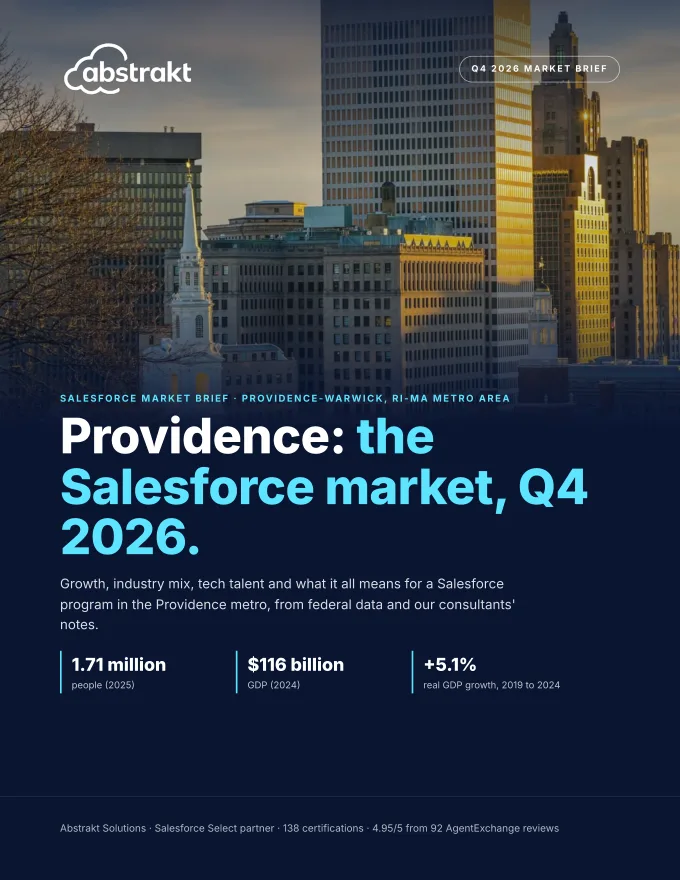
A free 22-page PDF with Providence's growth ranked against 100 metros, its industry mix, tech wages and nearby markets. It is offered on the public Providence page; send your customer there or get a copy for your own prep.
Get the Providence brief →Co-sell with Abstrakt in Providence
Working a Providence account? Bring in a named consultant for discovery, scoping or a health check. We reply within 4 business hours.