

How Salesforce work starts in Portland
Abstrakt Solutions is a Salesforce Consulting Partner to manufacturers, consumer brands and care providers throughout the Portland region, in Oregon and southwest Washington. Portland is one of our focus markets.
What buyers here usually run into
- 1
Wholesale and direct channels in one view
Consumer brands that sell through retail partners and direct to consumers often split those customers across systems. Unifying accounts and customer data takes planned integration.
- 2
Complex products, long sales cycles
Semiconductor and equipment suppliers manage multi-year design-ins and configured quotes, which spreadsheets and generic pipeline stages handle poorly.
- 3
Service after the sale
Manufacturers with installed equipment need warranty, parts and field service history tied to the account so service can drive the next sale.
Budget, team and partner questions
What drives cost
In Portland, product complexity drives cost. Configured and engineered-to-order quoting, installed-base modeling and Field Service add design work for manufacturers, and brands selling wholesale and direct need integration between ERP, product and commerce systems. Health care adds privacy design and clinical system integration.
Admin or partner
Larger manufacturers often have internal admins and use a partner for quoting, Field Service and integration. Mid-sized brands and machinery companies commonly outsource administration and keep a business owner internally.
What buyers ask a partner
Ask for references with configured quoting, installed-base service or wholesale and direct channel integration. Ask how the partner organizes knowledge content for service and AI, since scattered spec sheets are a common blocker here.
The local economy and its biggest industries (4)
| Sector | Share of 2024 GDP | Where Salesforce fits |
|---|---|---|
| Manufacturing Salesforce for manufacturing → | 12.1% | Semiconductor suppliers, truck makers and metals and machinery companies need quoting, distributor and dealer management, and installed-base service connected to ERP. |
| Health care and social assistance Salesforce for health & life sciences → | at least 8.2% | Academic medicine and large regional health systems need patient engagement, referral management and service built around privacy and integration with clinical systems. |
| Professional, scientific, and technical services Salesforce for professional services → | 7.9% | Software, design and engineering firms serving the region's manufacturers and brands need pipeline, project and client reporting in one place. |
| Wholesale trade Salesforce for retail & consumer goods → | 7.0% | Apparel, outdoor and equipment brands selling through wholesale accounts need account planning, order visibility and B2B portals for retail partners. |
Source: U.S. Bureau of Economic Analysis, GDP by county (CAGDP2), 2024, summed to the metro area; private sectors only, excluding real estate and government. “At least” marks sectors where BEA suppresses some county figures.
Regional target sectors named by local economic development groups: Computers & Electronics, Software, Apparel & Outdoors, Bioscience, Clean Tech, Metals & Machinery.
Salesforce products that fit Portland (6)
In the order we lead with them here, from the industries above.
Salesforce Sales Cloud
The CRM where sales pipeline lives, when it is built right.
Salesforce Service Cloud
The operating system for modern customer service, case, knowledge, voice, and AI agent assist together.
Salesforce Revenue Cloud / CPQ
Configure-price-quote, billing, subscription management, and quote-to-cash on Salesforce.
Salesforce Field Service
Scheduling, dispatch, mobile work orders and parts for teams that work on site.
Salesforce Experience Cloud
Customer, partner, and employee portals built on Salesforce.
Salesforce Data 360 (Data Cloud)
Unify customer data into a real-time profile that powers segmentation, analytics, and AI.
Portland manufacturers and the practical case for AI
Manufacturing contributed 12.1% of Portland-area GDP in 2024, the largest share of any private sector. Semiconductor, metals, and outdoor products companies generate a steady stream of technical questions from distributors and customers, and an agent grounded in product documentation and warranty terms can answer many of them while escalating the rest with context attached. Field service teams maintaining equipment benefit from AI that suggests likely fixes from past work orders. Health care organizations look at reply drafting for patient messages. The limiting factor is usually content: spec sheets scattered across drives, inconsistent part numbers, and no owner for knowledge articles. Solving that is part of the project, not a side task.
- Warranty and spec question answers
- Work-order-based repair suggestions
- Patient message reply drafts
Services buyers here usually need (7)
Salesforce Implementation in Portland
Products and sales channels shape a Portland Salesforce implementation more than any screen layout does. A chip-equipment supplier needs its installed base and configured quotes; an outdoor brand needs wholesale accounts, seasonal lines and a view of direct customers. We begin with discovery workshops, agree one data model covering accounts, products and assets, build in a sandbox and release in phases, so sales goes live first and service, portals and quoting follow once that foundation holds.
By industry in Portland
- 1
Manufacturing
Manufacturing is the largest private sector in the Portland metro, about 12.1% of 2024 GDP, and much of it sells engineered or configured products with long buying cycles. Implementation for these companies hinges on the product catalog and pricing rules, because Revenue Cloud quoting and the ERP order handoff both depend on them. We model design-in opportunities, distributor relationships and customer sites up front, then add Field Service for installed equipment in a later phase rather than squeezing it into the first release.
- 2
Apparel & Outdoors
Apparel and outdoors is one of Greater Portland Inc's target sectors, and brands in this group usually sell in two directions at once. An implementation for them separates wholesale account planning from consumer service while keeping both on shared customer and product records. Seasonal line sheets, pre-book windows and retail partner hierarchies need a place in the data model from day one, or reps drift back to the spreadsheets they used before the project started.
- 3
Health care and social assistance
Care providers account for at least 8.2% of Portland-area GDP in 2024, and Greater Portland Inc counts bioscience among its key sectors. For care providers, an implementation starts by deciding what Salesforce should not hold: clinical records stay in the EHR, while referrals, patient outreach and contact-center cases move into Service Cloud. We define consent handling, field-level security and integration boundaries during design, which keeps privacy review from turning into a late blocker before launch.
Raise before scoping
Plan for two states
The Portland metro spans Oregon and southwest Washington, so territories and sales ownership often split at the Columbia River. Build territory assignment and reporting to handle both states from the start, instead of patching Washington accounts in after launch, when ownership disputes have already begun.
Settle the product catalog early
Configured equipment, apparel sizes and seasonal styles all push complexity into product data. Decide which system owns products and prices, how variants are represented and what reps actually need to quote before configuration starts. Rebuilding the catalog after go-live disrupts every open quote and forecast.
Keep design decisions moving
Design questions pile up between workshops when nobody owns them. We keep an open-decisions list that is reviewed in every build session, so a question about product structure or territories never sits unanswered long enough to stall configuration.
Salesforce Integration in Portland
In Portland, integration work usually centers on product-heavy businesses: electronics suppliers with ERP-managed configurations, apparel brands whose styles live in a product lifecycle system, and manufacturers tracking assets across customer sites. Our process names an owning system for every record, weighs MuleSoft against Workato or direct APIs by volume and by who will support the result, builds against realistic data in a sandbox and adds monitoring, so a failed sync raises an alert instead of producing a wrong report weeks later.
By industry in Portland
- 1
Computers & Electronics
Computers and electronics is a Greater Portland Inc target sector, and Oregon's semiconductor cluster, the Silicon Forest, is regarded as one of the most mature in the country. Suppliers to that cluster need Salesforce to show ERP order status, shipment data and the configuration of tools installed in customer facilities. Integration design here focuses on asset and serial-number data, timely order updates for account teams, and access rules that keep customer-specific engineering details limited to the right people.
- 2
Apparel & Outdoors
Outdoor and apparel brands juggle styles, colorways and sizes across seasons, and that product data usually originates in a product lifecycle system and an ERP. Integrating Salesforce for them means feeding a clean, current catalog to wholesale reps and B2B portals, returning orders to the ERP without re-keying, and linking consumer service cases to the same product records. Order volume spikes around seasonal pre-book deadlines, so we load-test the integrations at those levels.
- 3
Manufacturing
Industrial manufacturers in the metro often run an ERP that predates their CRM, plus a separate system for field service or warranty. Integration connects quotes to ERP pricing, accepted orders to production, and warranty claims to installed assets, so service engineers and account managers share one history. We start with a written system-of-record map and error-handling rules, because unclear ownership breaks more integrations here than any choice of tool does.
Raise before scoping
Write the system-of-record map
Before choosing middleware, list every shared entity, such as accounts, products, prices, orders and assets, and name the system that owns each field. That document settles disputes when records conflict and becomes the reference for anyone maintaining the integration after the original builders move on.
Give every flow an owner
Integrations fail quietly when nobody is responsible for them. Assign a business owner to each flow, set up alerts and logs for rejected records, and agree who reconciles mismatches. A short runbook means a Friday sync failure is fixed by Monday instead of discovered at month-end close.
Keep engineering data scoped
Suppliers to semiconductor and equipment customers often handle customer-confidential specifications. Decide which technical data Salesforce actually needs, keep drawings and detailed specs in the engineering system with links rather than copies, and restrict access by account team so integrations do not widen who can see sensitive files.
Salesforce Optimization in Portland
Many Portland companies adopted Salesforce years ago, then added products, territories and admins until the org no longer matched how teams sell. Optimization starts by measuring where people avoid the system: login data, empty fields and pipeline kept in spreadsheets. We then simplify layouts, consolidate automation into maintainable Flows, clean the account and product data underneath the dashboards and retrain each team on what changed. The org stays in place; it simply becomes easier to use and to trust.
By industry in Portland
- 1
Wholesale trade
Wholesale trade accounts for about 7.0% of the metro's 2024 GDP, much of it distributors and brands selling to retailers and contractors. Their orgs typically suffer from duplicate accounts created by individual reps and order data that never reached Salesforce. Optimization for them means one clean account hierarchy, territory rules that reflect current coverage, and dashboards built around reorder rates and account growth instead of opportunity counts that do not fit repeat business.
- 2
Professional, scientific, and technical services
Engineering, design and software services firms serving Portland's manufacturers and brands often use Salesforce for pipeline but track projects and utilization somewhere else. That gap makes forecasts unreliable. Optimization aligns opportunity stages with how proposals really move, removes fields nobody fills in, and connects won work to project or resource data so leaders see backlog and capacity together. Brief training for principals and project managers keeps the revised process in use.
- 3
Metals & Machinery
Metals and machinery is among Greater Portland Inc's target sectors, and these companies frequently quote custom work that goes through many revisions. When the org was never designed for that, reps email quotes outside Salesforce and the history disappears. We streamline the quote and approval path, retire overlapping workflow rules and Process Builder automation, and rebuild win-rate and margin reporting so sales managers can see which job types actually make money.
Raise before scoping
Measure before you simplify
Collect login history, field-completion rates and a list of the reports people actually open before removing anything. The data shows which features are ignored and which are quietly essential, and it gives you a baseline for showing leadership that adoption improved after the changes.
Retire legacy automation deliberately
Workflow rules and Process Builder are being phased out in favor of Flow. Inventory every automation on key objects, merge the ones firing on the same events and test the consolidated Flows in a sandbox, so a cleanup does not silently break order or lead routing.
Agree metric definitions first
A dashboard is only as credible as the definitions underneath it. Write down shared meanings for pipeline, bookings and active accounts with each department head, store them inside Salesforce, and only then rebuild the reports, so new managers inherit one set of numbers.
Salesforce Health Checks in Portland
A health check gives Portland companies an honest baseline before they spend more on Salesforce. The review compares profiles, permission sets and sharing with least-privilege, measures duplicate and incomplete records on key objects, inventories automation and custom code, and shows which reports people actually open. Findings come back sorted by how risky they are and how hard they are to fix. That matters most for teams inheriting an org from a departed admin, planning Agentforce or Data 360 (formerly Data Cloud), or approaching renewal and asking what their licenses are delivering.
By industry in Portland
- 1
Health care and social assistance
With at least 8.2% of the metro's 2024 GDP coming from health care and social assistance, care organizations here carry some of the highest stakes for access control. A health check for them looks closely at who can see patient-related records, whether consent and communication preferences are stored consistently, and which integrations bring clinical data into Salesforce. We flag over-broad permissions and unused admin accounts first, because those are the findings privacy and compliance officers ask about.
- 2
Software
Software companies in Portland tend to build fast, and their Salesforce orgs show it: custom objects from earlier business models, managed packages nobody uses and automation competing on the same records. The review inventories that technical debt, estimates what it costs in admin time and performance, and identifies which items block new work such as usage-based billing or product-led sales tracking. The result is a cleanup list you can schedule between product launches.
- 3
Computers & Electronics
Electronics and semiconductor suppliers often store customer-specific configurations, pricing and service history in Salesforce, which makes data protection a priority. A health check reviews sharing rules between account teams, external access through portals, and API users created for integrations that may hold broader rights than necessary. We also test data quality on asset and installed-base records, since AI agents and predictive service tools are only as reliable as that underlying data.
Raise before scoping
Check AI readiness honestly
Agentforce and other AI features act on your records with whatever permissions you grant them. Duplicate accounts, stale contacts and loosely scoped integration users become bigger risks once an agent can read or update data. Review those areas before any pilot, and close the high-risk gaps first.
Include integration and API users
Service accounts created for ERP, marketing or support integrations often hold administrator-level rights nobody revisited. List every integration user, confirm what it needs to read and write, and reduce its profile accordingly. These accounts are easy to overlook and frequently carry the widest access in the org.
Interview users, not just metadata
The org's configuration tells only half the story. Short interviews with sales, service and operations staff reveal the fields they ignore, the reports they rebuild in spreadsheets and the steps they skip. Combining both views keeps the fix list focused on real friction.
Salesforce Managed Services in Portland
Managed services in Portland usually replaces a single overloaded admin with a bench: an administrator for daily requests, a developer for Flow and Apex work, and an architect when integrations or new clouds come up. Growth in software, distribution and health care keeps adding users, products and territories, and the backlog grows with them. We triage that backlog with you, check each Salesforce release in a sandbox first and review what shipped on a regular cadence.
By industry in Portland
- 1
Software
Pricing, packaging and sales motions change often at the software companies that Greater Portland Inc counts among its target sectors. Each change lands on Salesforce as new fields, product records, approval paths and dashboard requests. A managed services team absorbs that churn: we keep the product catalog consistent, update renewal and expansion reporting when packaging shifts, and retire old fields so the org does not gain a layer of debt with every pricing experiment.
- 2
Wholesale trade
Distributors and brand wholesalers in the metro run on account hierarchies, price agreements and order history that drift quickly without care. Ongoing support for them is largely data stewardship: merging duplicate accounts after acquisitions, keeping territory assignments current as reps change, and monitoring the ERP sync so order data in Salesforce matches what finance sees. We also field the steady stream of report and list-view requests that sales managers send each week.
- 3
Health care and social assistance
Care organizations rarely have Salesforce specialists to spare, yet their orgs need careful handling: a permission change can affect patient privacy, and a broken referral flow shows up as missed appointments. Our team reviews every access request against least-privilege, tests releases against intake and outreach processes before they reach staff, and documents changes for compliance review. Your people keep ownership of priorities while we handle the configuration and development work.
Raise before scoping
Set one intake channel
Requests that arrive by email, chat and hallway conversation never get prioritized properly. Agree on one intake channel, a simple priority scale and a named business owner who ranks the backlog. That turns managed services from a help desk into a roadmap leadership can see and steer.
Treat each release as an event
Every seasonal Salesforce release can change screens, retire features or alter how automation behaves. Review the release notes against your org, test key processes in a sandbox and brief users before changes land, rather than learning about them from a support ticket the morning after.
Divide work with your admin
Many Portland teams keep an in-house admin for quick fixes and user questions. A simple split works well: your admin answers user questions and trains new hires, and our bench picks up development, integrations, release reviews and bigger enhancements. A shared backlog and documentation prevent the two groups from duplicating effort.
Salesforce Migration in Portland
Portland migrations often come from growing companies that began on a starter CRM, a marketing tool and shared spreadsheets, then outgrew all three. Others are replacing an on-premise system nobody wants to maintain. Whatever the source, the work begins with a written inventory of systems and fields, then choices about which history earns a place, cleanup and deduplication before loading, and sandbox trial loads with reconciled record counts. Cutover is set for a date that avoids your busiest selling period, so the team leaves the old system in one clean step.
By industry in Portland
- 1
Clean Tech
Clean tech is a Greater Portland Inc target sector, and many of the region's energy and sustainability companies grew quickly from project-based work tracked in spreadsheets. Migrating them means turning project lists into accounts, sites and opportunities with consistent stages, and preserving incentive or permitting details that sales still references. We map each spreadsheet column to a field or decide to archive it, so the new org does not inherit dozens of half-used attributes.
- 2
Professional, scientific, and technical services
At about 7.9% of the metro's 2024 GDP, the professional and technical services sector is full of consulting, engineering and design firms that keep client relationships in a lightweight CRM and proposals in shared drives. When moving them to Salesforce we preserve client history and key contacts, map old deal stages to a cleaner pipeline and link proposal documents rather than importing every file. Partners get their relationship history on day one, which is what persuades them to abandon the old system.
- 3
Bioscience
Bioscience is a Greater Portland Inc target sector, and the region's companies, many with roots in its university and research district, often hold contact data from grants, research partnerships and early commercial sales in separate places. Migration for them means distinguishing collaborators from customers, consolidating duplicate researchers and institutions, and keeping consent and communication preferences with each record. Regulated documentation stays out of the CRM unless there is a clear reason to store it there.
Raise before scoping
Decide what history to keep
Years of closed deals and logged tasks rarely help anyone sell today. Agree with each team which records and date ranges matter for selling and service today, move those, and archive the rest where it can still be searched. Smaller, cleaner loads mean a faster cutover and more trust in the new data.
Clean in staging, not production
Duplicate companies, mixed spellings of Oregon and Washington addresses, and contacts with no email are cheaper to fix in a staging file than inside Salesforce. Run deduplication and standardization rules on the extracts, review the exceptions with record owners, and only then begin trial loads.
Pick a quiet cutover window
Choose a cutover date away from quarter-end, trade show season or seasonal pre-book deadlines. Lock the old system, load the final delta, check the counts and move every user on the same day. Running both systems in parallel for weeks almost always produces conflicting records.
Salesforce Implementation Rescue in Portland
Rescue projects in Portland typically come from over-scoped first implementations, where quoting, service and portals were all promised at once and none quite worked, or from partners that left mid-build. Our first step is triage, which means reading the build against the original scope, listening to users and fixing whatever blocks daily work. Next comes a verdict for each component, keep, fix or rebuild, and the outstanding scope ships in smaller releases with documentation your team can maintain.
By industry in Portland
- 1
Metals & Machinery
Machinery and metals companies often reach us after a quoting build that tried to replicate every engineering rule and became too slow for reps to use. Triage separates the pricing logic that truly belongs in Salesforce from calculations that should stay with estimators or the ERP. We stabilize the quote-to-order flow first, so orders stop being re-keyed, then rebuild approvals and product options in a simpler form tested with the people who quote every day.
- 2
Wholesale trade
For distributors, stalled projects usually trace back to data: a migration that loaded duplicate accounts, or an ERP sync that never matched customers correctly. Reps lose trust within weeks and go back to their own lists. Recovery begins with fixing the account master and integration keys, then reloading clean order history. Only after the data is right do we reintroduce territory rules and dashboards, followed by a short relaunch with each sales team.
- 3
Bioscience
Bioscience organizations sometimes launch Salesforce for partnership, sales or patient-support work without a clear security design, and compliance teams halt use until it is fixed. A rescue for them starts with access: who can see which records, how consent is captured and whether regulated documents belong in the org at all. With those corrected and documented, we complete the intended processes and retrain users so the system can return to service.
Raise before scoping
Stabilize before adding scope
Resist new requests during recovery, even valuable ones. Fix what blocks daily work, confirm the fixes hold, and only then reopen the backlog. Mixing new features into stabilization is one of the most common reasons a second attempt repeats the problems of the first.
Reset expectations with sponsors
Leadership may have been promised a date and a feature list that no longer fit. Share the assessment findings openly, agree on a revised scope with realistic phases and name one executive who approves changes. A credible plan rebuilds confidence faster than an optimistic one.
Plan a real relaunch
People who abandoned the first launch will not return on their own. Treat the relaunch like a new go-live: role-based training, updated reference guides, visible fixes for the complaints they raised and close support in the first days.
Industry plays in Portland (4)
Salesforce for Portland Manufacturers
Portland manufacturers range from electronics suppliers in the Silicon Forest to metal fabricators and machinery builders producing custom and engineered orders. Their common need is quoting accuracy and visibility after the sale. Salesforce can manage requests for quote with drawings and specifications, turn engineering estimates into consistent quotes, track orders through ERP, and support installed equipment through service and field teams. We design around how your shop floor, engineering and sales actually work together, and keep the ERP as the source of cost and production truth.
Making things still anchors the Portland-Vancouver-Hillsboro economy: the Bureau of Economic Analysis attributes 12.1% of 2024 metro output to manufacturers, a clear lead over professional services (7.9%) and wholesale trade (7.0%). Greater Portland Inc names computers and electronics, metals and machinery, clean tech and apparel and outdoors among its key sectors, and describes the region as the Silicon Forest for its role in the tech industry. Business Oregon calls the state's semiconductor ecosystem one of the most mature in the country. Manufacturing here mixes high-volume electronics with smaller engineered-to-order and job shop producers.
Use cases to open with
- 1
RFQ intake and estimating
Fabricators and machine shops receive requests for quote with drawings, materials and quantities, often by email. Salesforce can capture each RFQ with its attachments, route it to the right estimator, track turnaround time and record win or loss reasons. Revenue Cloud or CPQ can then apply material, labor and margin rules consistently, so quotes reflect current costs and estimators spend time on engineering questions rather than formatting documents.
- 2
Custom and engineered orders
Machinery and equipment builders sell configured or custom systems with engineering milestones, factory acceptance tests and installation. Salesforce opportunities can carry configuration details, drawings and milestone schedules, and hand off to project and ERP records on award. Sales and customers then see progress without repeated status meetings, and change orders are captured with pricing approval before the work proceeds. Lead times are quoted from real capacity.
- 3
Service on installed systems
Equipment and clean tech systems need maintenance, warranty support and parts. Service Cloud with asset hierarchies records every installed unit and its components; Field Service schedules technicians by skill and location, including customer sites across Oregon and Washington. Service data flows back to sales as upgrade and replacement opportunities, and to engineering as reliability feedback on specific models. Parts sales follow the same records.
Raise before scoping
Respect estimator knowledge
Estimating logic often lives in experienced people's heads and spreadsheets. Capture the rules that are truly standard in CPQ, leave room for estimator judgment on unusual work, and involve estimators in testing, so the tool supports them instead of forcing oversimplified pricing.
Map ERP and job costing
Quotes, orders and actual job costs must connect to show real margin. Decide which data flows between Salesforce and ERP, such as routings, material costs and order status, and whether completed job costs return to Salesforce for win-loss and margin analysis.
Plan for multi-state operations
The metro spans Oregon and Washington, with different tax, labor and regulatory details. Account for state differences in territories, pricing and service scheduling, and make sure field teams have the right mobile access and documentation for sites in both states.
Salesforce for Portland Retailers and Consumer Brands
Portland's consumer brands often run two businesses side by side: wholesale to specialty and national retailers, and direct sales through their own stores and ecommerce. Salesforce can join them. Sales Cloud manages retailer accounts, seasonal orders and account plans; Service Cloud handles consumer questions, warranty claims and repairs; Data 360 (formerly Data Cloud) unites shopper data from every channel. We design the model so wholesale and direct teams share product and customer data without stepping on each other, and connect it to ERP, order management and commerce systems.
Greater Portland Inc describes the region as home to the largest cluster of outdoor and apparel companies in the U.S., and lists apparel and outdoors among its key sectors. In Bureau of Economic Analysis 2024 county data, wholesale trade accounts for 7.0% of Portland-Vancouver-Hillsboro GDP and retail trade 5.4%, while manufacturing leads at 12.1%. Many consumer brands here design products locally, produce elsewhere, and sell through wholesale and direct channels at once. That makes seasonal selling, retailer relationships and consumer service as important as ecommerce itself.
Use cases to open with
- 1
Wholesale account management
Brand sales teams manage specialty retailers and larger accounts through seasonal line reviews, prebooks and reorders. Sales Cloud can track each account's assortment, order history and sell-through data, schedule line review meetings and forecast seasonal bookings. An Experience Cloud or B2B commerce portal lets smaller retailers reorder in-stock items directly, freeing reps to focus on planning with larger partners. Reps prepare line reviews from one screen.
- 2
Warranty and repair service
Outdoor and apparel brands often stand behind products with warranties and repair programs. Service Cloud can manage claims with photos, product and purchase details, route them to repair or replacement decisions, and track shipping and repair status. Customers get consistent updates, and product teams receive defect data by style and season, which informs design and sourcing choices for future lines.
- 3
One view of direct shoppers
Direct-to-consumer brands collect shopper data in ecommerce, retail stores, events and loyalty programs. Data 360 (formerly Data Cloud) can merge those sources into unified profiles, and Marketing Cloud can then send journeys based on activities, products owned and repair history. Brands can invite customers to relevant events, recommend compatible gear and avoid promoting products a customer has just returned or already owns. Consent is respected across every channel.
Raise before scoping
Manage channel conflict
Wholesale partners may worry when brands market directly to consumers in their area. Decide how account ownership, pricing and promotions work across channels, and give wholesale reps visibility into direct activity where appropriate, so partners trust the brand's strategy. Put the rules in writing.
Plan product data carefully
Seasonal styles, colors, sizes and regional assortments create large product catalogs. Decide whether ERP, product information management or commerce systems own product data, and how often it syncs to Salesforce, so reps and service agents always see current styles and availability.
Respect consumer privacy
Unified profiles depend on consent and preferences across channels. Oregon, Washington and other state privacy laws shape how brands collect and use consumer data. Build consent and data-rights processes into the design, and confirm requirements with privacy counsel. Honor deletion requests everywhere.
Salesforce for Portland Health and Life Sciences
Portland health organizations use Salesforce around, not instead of, clinical systems. Health systems and clinics apply it to patient access, referral coordination and community outreach across a two-state metro. Academic and research groups manage industry partners, sponsors and grants. Bioscience companies track investors, collaborators and early customers. Each group needs strict privacy controls and careful integration. We design access, consent and data boundaries first, then build workflows that save staff time without moving clinical records out of the systems built for them.
Hospitals, clinics and social services sit behind only the factories of the Silicon Forest in Portland-area output: Bureau of Economic Analysis figures for 2024 credit care with 8.2% or more of GDP, the exact share masked by withheld detail, against 12.1% for manufacturing. Bioscience appears on Greater Portland Inc's roster of key regional sectors. The research record describes the Portland Innovation Quadrant, a partnership of a health sciences university, a state university, a community college and a science museum spanning the Central Eastside, South Waterfront and University District, including a shared life sciences building. Care, teaching and research together yield a large provider base plus a startup pipeline.
Use cases to open with
- 1
Two-state patient access
The metro spans Oregon and Washington, and patients may cross the Columbia River for care. Service Cloud can route calls, messages and web requests by location, specialty and insurance, show agents only the patient context they need, and capture state-specific consent. Integration with the electronic health record keeps appointment data current, and reporting shows where access delays are growing by clinic, specialty and payer.
- 2
Research and industry partnerships
Academic medical centers and research groups work with industry sponsors, foundations and startup collaborators. Salesforce can track each partner, agreements, sponsored projects, contacts and milestones, giving technology transfer and partnership offices a shared pipeline. Leaders see which relationships generate funding, investigators can find prior collaborations before approaching a company, and staff avoid two departments pitching the same sponsor in the same month.
- 3
Commercial launch for bioscience firms
Bioscience startups moving toward revenue need structured sales and support before the first product ships. A focused Sales Cloud setup can track target accounts, key opinion leaders, evaluations and contracts, and later add Service Cloud for customer support and complaint intake. Starting clean avoids migrating from spreadsheets during the most stressful months of a launch, and investors see pipeline numbers they can trust in board updates.
Raise before scoping
Handle state privacy differences
Oregon and Washington have their own health data and consumer privacy rules in addition to HIPAA. Map which data enters Salesforce, where patients reside, and which consents apply, and have counsel confirm obligations in both states before designing outreach and data sharing.
Separate research and clinical data
Partnership and sponsorship records rarely need patient information, while patient access does. Use separate record types, permission sets and sometimes separate orgs, so research staff cannot see clinical details and clinical teams are not burdened with partnership data they never use.
Size to the organization
A health system with many clinics and a startup incubated in a university building need very different builds. Buy for the team you have this year, leave room in the object model for growth, and skip automation that only a full-time admin could keep running.
Salesforce for Portland Professional Services Firms
Portland professional services firms often serve the region's signature industries: engineering and technical consultancies working with electronics and semiconductor manufacturers, creative and digital agencies working with apparel and outdoor brands, and software consultancies supporting technology companies. Salesforce helps when pursuits, statements of work and renewals are managed in one place, when opportunities forecast staffing needs by skill, and when client relationships are visible across practices. We integrate with time, project and billing tools so leaders see margin and utilization alongside the pipeline.
Engineers, designers, lawyers, accountants and consultants together generate 7.9% of Portland-area output in the Bureau of Economic Analysis's 2024 county figures, placing their sector third, after factories at 12.1% and care providers at a minimum of 8.2%. Greater Portland Inc's key sectors include software and computers and electronics, and it describes the region as the largest U.S. cluster of outdoor and apparel companies and as the Silicon Forest. Its full list also includes design and media. Many local firms therefore sell engineering, creative, software and advisory services to manufacturers and brands, rather than to a large financial sector.
Use cases to open with
- 1
Pursuits and statements of work
Firms respond to requests for proposals, extend existing contracts and propose new phases of work. Salesforce opportunities can track scope, budget, decision makers and competing firms, and Revenue Cloud or CPQ can generate statements of work from approved roles and rates. Leaders see win rates by client industry and service line, which helps decide where to invest business development time.
- 2
Skill-based staffing forecasts
Engineering and creative firms depend on scarce skills, such as process engineers, UX designers or data specialists. Tag each proposal with the disciplines it needs, and Salesforce can show next quarter's shortage of, say, firmware engineers before anyone signs. Resource managers and practice leads can then plan hiring, subcontracting or schedule changes before utilization, delivery quality or client satisfaction suffers on active engagements.
- 3
Client relationships across practices
A consumer brand might hire a firm for digital strategy, then for commerce implementation and analytics. Salesforce account plans show all engagements, sponsors, satisfaction and whitespace across practices, and Marketing Cloud can share relevant case studies and events with each contact. Partners preparing for executive meetings see the full relationship rather than their own project alone, including open invoices and recent feedback scores.
Raise before scoping
Choose a PSA approach
Decide whether resource management, time entry and project accounting will run in a professional services automation tool built on Salesforce or in a separate system integrated with it. The choice affects licensing, data model and user experience, so settle it before configuring opportunities and projects.
Protect client intellectual property
Engineering and product firms often handle confidential designs, unreleased roadmaps and detailed specifications from clients. Keep deliverables in document systems approved for them, store only metadata in Salesforce, restrict access by engagement team, and align retention with client contracts and nondisclosure agreements.
Keep creative teams engaged
Designers, engineers and developers dislike administrative work. Collect only the data that improves staffing and client decisions, automate activity capture, and deliver staffing requests and approvals in the tools they already use so the system supports their work rather than interrupting it.
Case studies to send (3)
From the industries this market leans on. Client names are anonymized and these projects are not specific to Portland.
The Portland Salesforce market brief, Q4 2026
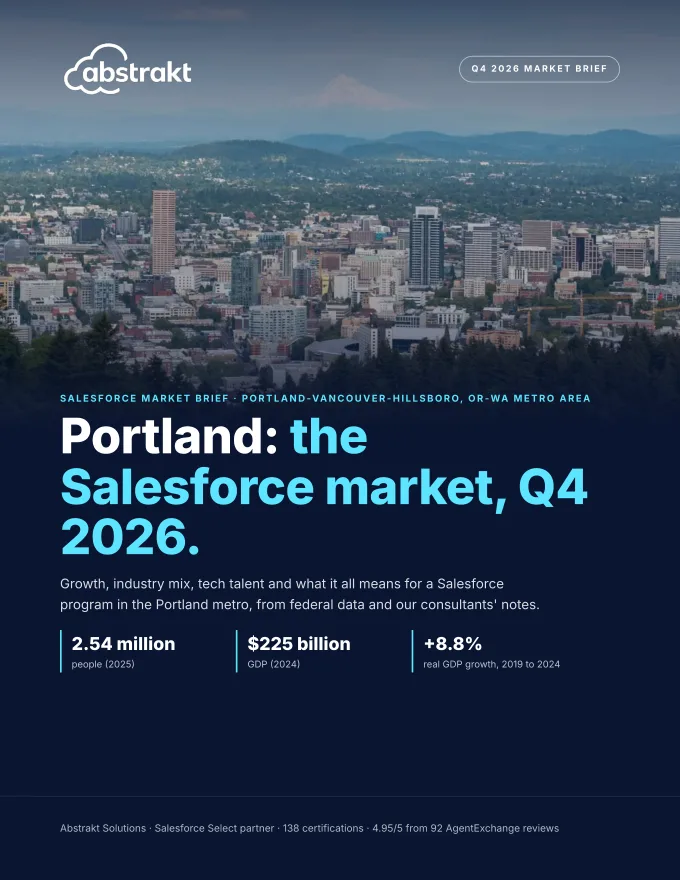
A free 24-page PDF with Portland's growth ranked against 100 metros, its industry mix, tech wages and nearby markets. It is offered on the public Portland page; send your customer there or get a copy for your own prep.
Get the Portland brief →Co-sell with Abstrakt in Portland
Working a Portland account? Bring in a named consultant for discovery, scoping or a health check. We reply within 4 business hours.