

How Salesforce work starts in Spokane
Abstrakt Solutions is a Salesforce Consulting Partner for health organizations, credit unions and manufacturers throughout Spokane and Stevens counties, from downtown Spokane to Spokane Valley. Spokane is one of our focus markets.
What buyers here usually run into
- 1
Quality paperwork outside the CRM
Aerospace and metals suppliers frequently keep certifications, first-article inspections and customer approvals in shared drives, so sales cannot tell whether a part is ready to quote for a new program.
- 2
Member data spread across banking systems
Credit unions typically hold deposits, loans and card data in separate cores and portals, leaving member service staff to piece together a relationship while the member waits.
- 3
Health partnerships without a system of record
Academic health programs, hospitals and life sciences startups often coordinate clinical placements, research agreements and grants by email, which makes shared progress hard to report.
Budget, team and partner questions
What drives cost
Spokane costs are driven by banking core and loan system integration for credit unions, ERP and qualification tracking for manufacturers, and privacy design for health systems and University District partnerships. Retailers add loyalty data unification and campaign setup.
Admin or partner
Many Spokane organizations are mid-sized, with IT staff but no dedicated Salesforce team. Managed services often covers admin, integration and releases while an internal owner sets priorities; larger health systems tend to staff internally and add partner capacity.
What buyers ask a partner
Credit unions should ask for Financial Services Cloud and core integration references. Manufacturers should ask how the partner handles qualification records and ERP-linked quoting, and health organizations how they restrict access to patient and research data.
The local economy and its biggest industries (4)
| Sector | Share of 2024 GDP | Where Salesforce fits |
|---|---|---|
| Health care and social assistance Salesforce for health & life sciences → | 11.8% | Both of the area’s large hospital networks rank in the county’s 2022 top ten, and the University District trains physicians, nurses and pharmacists. Health systems and the life sciences firms GSI recruits need patient outreach, referral handling and research partner records with strict access rules. |
| Retail trade Salesforce for retail & consumer goods → | 8.2% | Retail is the Spokane metro’s second-largest private sector. Regional retailers and grocers competing for the same shoppers use Salesforce to unify loyalty data, promotions and customer service. |
| Finance and insurance Salesforce for mortgage & lending → | 6.4% | Finance and insurance generates about 6.4% of Spokane’s 2024 metro output. Credit unions and community lenders here need member households, loan pipelines and branch service requests organized so staff can see the full relationship during a single conversation. |
| Manufacturing Salesforce for manufacturing → | 6.1% | Manufacturing contributes 6.1% of 2024 metro GDP, and aerospace is one of GSI’s six target groups. Metals, electronics and aerospace suppliers need engineered quotes, customer part numbers and ERP order status visible to account managers. |
Source: U.S. Bureau of Economic Analysis, GDP by county (CAGDP2), 2024, summed to the metro area; private sectors only, excluding real estate and government. “At least” marks sectors where BEA suppresses some county figures.
Regional target sectors named by local economic development groups: Manufacturing, Logistics, Aerospace, Health and Life Sciences, Agribusiness, IT and Energy.
Salesforce products that fit Spokane (6)
In the order we lead with them here, from the industries above.
Salesforce Sales Cloud
The CRM where sales pipeline lives, when it is built right.
Salesforce Service Cloud
The operating system for modern customer service, case, knowledge, voice, and AI agent assist together.
Salesforce Financial Services Cloud
Industry CRM for wealth management, banking, insurance, and lending, built for compliance from the start.
Salesforce Revenue Cloud / CPQ
Configure-price-quote, billing, subscription management, and quote-to-cash on Salesforce.
Salesforce Marketing Cloud
Cross-channel marketing, email, mobile, journey, and Data 360-powered personalization at scale.
MuleSoft
Enterprise API platform, for connecting Salesforce, ERP, data warehouses, and the rest of your stack.
Spokane's health care and trade sectors meet Agentforce
Among Spokane's private sectors, health care ranks first with 11.8 percent of 2024 metro GDP; retail trade (8.2 percent) and wholesale trade (6.9 percent or more) come next. Medical groups and care networks can use Agentforce to draft responses to routine patient messages and to condense long case threads for the next staff member. Wholesalers and agribusiness suppliers can give dealers a self-service agent for order status and product questions, backed by Service Cloud records. Retail teams can sort incoming customer messages so urgent complaints reach people first. None of it is plug-and-play: patient data needs careful permissions, product and order records need to be accurate, and a person should approve anything sensitive before it is sent.
- Routine patient message drafts
- Dealer order status self-service
- Inbound inquiry triage by urgency
Services buyers here usually need (7)
Salesforce Implementation in Spokane
Spokane implementations usually fall into one of two shapes. Health organizations need patient, referral and research-partner records under tight access rules; Spokane Valley manufacturers need part approvals, quotes and ERP orders in one view. Credit unions sit between the two, with the member household at the center. We settle the data model for your shape in design sessions with each team, configure in a sandbox, and release in phases, so the first team is live and giving feedback while the next is still being built.
By industry in Spokane
- 1
Health care and social assistance
Health care and social assistance led all private industries in the Spokane metro with about 11.8% of 2024 GDP, and GSI names health and life sciences as a target industry. For providers implementing Salesforce, the early decisions are how patients, referring physicians and locations relate, which Health Cloud or Service Cloud structures to adopt, and which roles can see clinical context. Settling those before build keeps a privacy review from forcing a redesign late in the project.
- 2
Aerospace
Aerospace is one of the six groups Advantage Spokane courts, and a supplier in that chain cannot quote a part its customer has not yet qualified. Implementation therefore adds structures the standard opportunity lacks: approvals, certifications and first-article status held against each part and customer. We phase the work so account managers see qualification status first, quoting in Revenue Cloud arrives second, and ERP order data follows once the part master has been cleaned.
- 3
Finance and insurance
Credit unions and community lenders in Spokane and Spokane Valley usually implement Financial Services Cloud around the member household rather than the individual account. That choice drives everything after it: how joint members and businesses are linked, how referrals move between branches and lending, and which staff see balances fed from the core. We design the household model and the core data feed together in phase one, then add service queues and marketing consent in later releases.
Raise before scoping
Separate build time from design time
Build time and design time are kept separate. Configuration and testing run in focused blocks, and design calls are reserved for decisions only your team can make, so build time is never spent waiting.
Map academic and research partners
Health organizations near the University District often work with an academic health sciences campus, clinical placements and research partners. Decide early whether those relationships live in Salesforce and how they connect to patient-facing data, because mixing academic and clinical records later complicates access rules.
Keep controlled data elsewhere
Aerospace suppliers may handle export-controlled drawings and specifications. Agree in design which technical files stay in engineering systems, with only references stored in Salesforce, so the implementation does not create a compliance problem that the security team discovers after launch.
Salesforce Integration in Spokane
For Spokane companies, integration usually means getting plant and warehouse facts in front of the people who talk to customers. We map which system owns accounts, items, prices and orders, then build the connections with MuleSoft, a lighter integration service or direct APIs, depending on how many systems are involved and how fast data changes. Each flow gets logging, retry rules and an owner on your side who is alerted when something fails, so problems surface before a customer notices them.
By industry in Spokane
- 1
Manufacturing
Manufacturing accounts for about 6.1% of 2024 metro GDP, and Greater Spokane Inc. counts both manufacturing and aerospace among its target industries. For these firms, integration pays off when a quote can be priced from the ERP's current cost and lead time and becomes an ERP order without anyone retyping it. Service cases then carry lot and order references, so a quality complaint traces straight to the production run behind it.
- 2
Logistics
Logistics is one of Advantage Spokane's target industries, and wholesale trade adds at least 6.9% of 2024 metro GDP. Distribution businesses here integrate Salesforce with warehouse and transportation systems so customer service can see shipment status on a case, sales can see order volume by account, and pricing agreements maintained in the CRM reach the systems that invoice each customer.
- 3
Aerospace
Aerospace suppliers exchange forecasts and purchase orders with prime contractors, often through EDI or customer portals, and track quality records in dedicated systems. Integration brings order status, on-time delivery and nonconformance counts into the account view for customer reviews, while controlled technical data stays in engineering systems with only references in Salesforce. We design those boundaries with your quality and compliance staff before building any connector, since mistakes there are expensive to unwind.
Raise before scoping
Set sync speed per object
Real-time sync is expensive to build and run, so reserve it for data a rep acts on during a call. Prices and inventory availability often do; invoice history and closed orders can move nightly. Setting the speed per object keeps API usage and middleware costs reasonable and avoids complex real-time designs where a batch would serve users just as well.
Assign an integration owner
Someone at your company should receive alerts, understand the runbook and decide when to replay a failed message. Without that owner, errors pile up unnoticed. We train that person during build and hand over documentation written for them, not for developers.
Test with real orders
Sample data hides edge cases such as split shipments, backorders and credit holds. We test integrations using copies of recent real orders from your ERP, reviewed by the people who process them every day, before switching any production flow on.
Salesforce Optimization in Spokane
Most Spokane orgs we are asked to optimize are several years old and still running, just not well. Credit union staff click through too many screens during a member call, retail marketers export data to build audiences, and managers keep private spreadsheets because dashboards disagree. We review usage data and interview each role, then streamline layouts, replace overlapping automation with a small set of Flows and rebuild reporting on definitions everyone signs off. Changes ship in small releases so work never stops.
By industry in Spokane
- 1
Finance and insurance
Finance and insurance contributes about 6.4% of 2024 metro GDP, a share that includes the region's credit unions. Optimization for member-owned lenders focuses on the service conversation: one console showing household, products and open requests, fewer required fields during a call, and loan follow-up tasks created by automation instead of memory. We then rebuild pipeline reports by branch so managers can compare like with like.
- 2
Retail trade
Regional retailers and grocers here often run Salesforce for loyalty and service but pull campaign lists by hand because segment data is unreliable. We clean up the fields that define a shopper, consolidate the automation that tags customers, and connect service history to marketing preferences. The result is audiences marketing can build without an export, and a service view that shows an agent a shopper's recent purchases and complaints in one place during a busy season.
- 3
Agribusiness
Agribusiness is one of the six industry groups Advantage Spokane courts, and ag suppliers and processors sell through seasons, co-ops and dealer networks. Their orgs frequently carry leftover fields from each season's campaign and automation built for programs that ended. We archive what no longer applies, restructure accounts so growers, co-ops and dealers relate correctly, and build seasonal pipeline and volume reports that sales and operations can use to plan the next harvest.
Raise before scoping
Start with the busiest screen
Find the page your staff use most, often the member or customer console, and fix it first. Reducing clicks where people spend hours each day wins goodwill quickly and builds support for the less visible work on automation and data that follows.
Agree metric definitions first
A branch manager and a lending director can look at the same Spokane dashboard and see different totals, simply because each counts an active member or a funded loan in a different way. We document one definition per metric with its owners before rebuilding any report, which removes most of the arguments about whose numbers are right.
Retire seasonal leftovers
Fields, picklist values and automation added for one campaign or season rarely get removed. We identify those with usage data and owner input, archive the data they hold, and delete the clutter so new staff face a simpler org from their first day.
Salesforce Managed Services in Spokane
Managed services for a Spokane organization means one team looking after an org that is already in daily use. We keep a single intake list, sit down with your owners monthly to rank it, and deliver admin work, Flow automation, small development and integration fixes. Before each Salesforce upgrade we rehearse it in a sandbox. Owners receive a plain summary after every monthly cycle describing what shipped, what slipped and why, and what comes next.
By industry in Spokane
- 1
Retail trade
Retail trade is the metro's second-largest private sector, at about 8.2% of 2024 GDP, and regional grocers and retailers compete here with national e-commerce fulfillment. Their Salesforce requests come in bursts around promotions and holidays: new loyalty tiers, campaign audiences, service macros for seasonal returns. Managed services plans those peaks in the monthly backlog, freezes risky changes during the busiest weeks and has promotional setups tested well before shoppers arrive.
- 2
Health and Life Sciences
Health and life sciences is one of Advantage Spokane's target groups, and the organizations in it, from clinics to research-stage companies near the University District, keep revising who can see what. Each new grant, research agreement or clinical partner can require a record type, a sharing rule or a consent field. We handle those as documented changes, tested in a sandbox and approved by an owner, and review access every quarter so permissions do not drift.
- 3
Manufacturing
Metals, casting-equipment and electronics makers in Spokane Valley tend to run lean commercial teams, so no one has time to maintain quoting rules, customer part numbers and the ERP connector. Under managed services those become recurring work: price updates loaded on schedule, obsolete parts retired from the catalog, and integration errors reviewed weekly. Plant managers and sales leaders share one request list, which keeps a quoting fix from waiting behind a report tweak.
Raise before scoping
Protect retail peak weeks
Mark the weeks around back-to-school, holidays and your own promotions as no-change periods on the shared calendar. Deployments to loyalty, promotion or service setups during those weeks carry more risk than benefit, so we front-load that work and reserve the peak itself for monitoring and small corrective fixes only.
Use the time-zone head start
Our consultants start two hours before your Spokane staff. We use that window for deployments, data loads and release checks, so changes are in place and verified before most users log in, and questions raised in your afternoon are picked up at the start of our next day.
Track grant and research changes
Health and life sciences groups often add programs mid-year when funding arrives. Keep a running list of expected grants and partnerships in the backlog, so data model and access changes for a new program are designed ahead of time instead of rushed after the award.
Salesforce Health Checks in Spokane
A Spokane health check is a bounded review of a working org. Our consultants work through who can see what, how automation and code behave, which outside apps hold access, how clean the data is and whether licenses match actual use, then interview daily users. Spokane clients tend to ask for one when a regulator, a new AI project or a change of consulting partner is on the horizon. You receive findings ranked by risk and effort, with fixes your admin can make now separated from work that needs a project.
By industry in Spokane
- 1
Health care and social assistance
Health care and social assistance is Spokane's largest private sector, and hospitals, clinics, home health agencies and social service providers all contribute to it. Their health checks weigh access above everything else: who can view patient-related records, whether reports and list views expose more than intended, how portal guest users are configured, and whether field history covers consent changes. Findings are written so privacy and compliance officers can follow each one to a specific setting.
- 2
Aerospace
Aerospace suppliers that answer to demanding customers and export rules need confidence about what their CRM holds. The health check searches for technical attachments stored where they should not be, reviews file-sharing links and connected apps, and checks that users outside the United States, if any, cannot reach restricted records. We also assess whether qualification and approval data is structured well enough to support customer audits and later automation such as agents that draft customer updates.
- 3
Finance and insurance
Credit unions and lenders in the metro face exams that probe how member data is secured and how changes are controlled. We review multi-factor authentication, session and login settings, sharing between branches and lending, field-level security on income and account data, and audit trail coverage. Where automation pushes member data to marketing or outside services, we document the path. The report maps each finding to a remediation step compliance staff can track.
Raise before scoping
Review before adding Agentforce
Agentforce answers from your records and acts within your permissions, so gaps in either show up in what it tells customers. Assess data completeness and access for the specific use case first, whether that is summarizing cases or answering member questions, so a pilot does not surface problems in front of customers.
Find forgotten connected apps
Orgs accumulate connected apps, managed packages and API users from past projects and trials. Several usually belong to vendors or trials nobody at the company remembers approving. We list them with their permissions and last use, and recommend removing or restricting any that no longer serve a purpose.
Measure technical debt concretely
Rather than a general verdict, we count what matters: automation on each object, Apex without meaningful tests, fields with no data, reports untouched for a year. Those counts turn technical debt into a list your team can plan against and remeasure later.
Salesforce Migration in Spokane
Spokane migrations often involve organizations that grew on whatever tool was at hand: a grant or donor database, a contact manager bought years ago, spreadsheets on a shared drive. We profile each source, agree which one wins when records conflict, map fields to the new Salesforce design and clean the data in a staging area. Trial loads go into a sandbox for owners to review. On cutover night the old tool is locked to read-only, and it stays available for lookups until the agreed retirement date.
By industry in Spokane
- 1
Health and Life Sciences
Research-stage companies and health programs connected to the University District frequently track partners, grants and clinical placements in spreadsheets and email. Migration for them means turning those lists into structured records: organizations, agreements, funding sources and contacts, with dates and owners attached. We separate anything touching patient information before loading and set access rules first, so the new system does not expose data the old spreadsheets kept in a single person's folder.
- 2
IT and Energy
IT and energy is one of Advantage Spokane's six target groups, and the region also hosts a smart-city technology proving ground. Young software, cybersecurity and energy firms often start on a lightweight CRM and outgrow it when sales teams and partner channels expand. We move their contacts, deals and activity history into Sales Cloud, rebuild pipeline stages to fit longer enterprise or utility sales, and map partner relationships the earlier tool could not represent.
- 3
Finance and insurance
Credit unions and insurance agencies leaving a legacy CRM carry years of member notes, referrals and campaign responses. We decide with compliance staff which history must come across and which can stay in an archive, classify sensitive fields before loading, and merge duplicate members created by different branches. Households are built during migration rather than afterward, so staff see a correct relationship view the first time they search for a member in Salesforce.
Raise before scoping
Pick a winner for conflicts
When the same customer appears in two sources with different addresses or owners, someone must decide which source wins. We set those survivorship rules with business owners before cleanup begins, so large numbers of conflicts are resolved by rule rather than debated record by record.
Plan the parallel period
Most teams want the old system available briefly after cutover. Keep it read-only, set and publish an end date, and make Salesforce the only place new work is entered; otherwise records drift apart and parts of the migration end up being repeated.
Include attachments and files
Legacy systems often hold documents alongside records: agreements, scans, signed forms. Decide early which files migrate, where they will live in Salesforce or a linked repository, and how storage limits affect cost, because files are frequently the slowest and largest part of the load.
Salesforce Implementation Rescue in Spokane
Rescue work in Spokane typically follows one of three stories: an implementation partner that disappeared partway through, a go-live that users rejected, or a scope that kept growing until nothing shipped. We begin with triage, reviewing the org's configuration, code, integrations and backlog and interviewing both sponsors and end users. The output is a clear account of what to keep, fix or rebuild, plus a phased recovery plan. Our consultants can carry that plan through if you choose.
By industry in Spokane
- 1
Manufacturing
Metals and electronics manufacturers in Spokane Valley sometimes stall after a quoting project that tried to encode every pricing exception at once. Rescue narrows the scope: we find the product families behind most quotes, rebuild pricing for those against recent real orders, and let reps use Salesforce for them while the edge cases stay manual. Once that works, the remaining families are added in planned releases instead of one oversized launch.
- 2
Health care and social assistance
Health organizations occasionally halt a Salesforce launch after compliance raises concerns about what staff can see or what a portal exposes. We treat access as the first repair: auditing profiles, sharing rules, reports and guest access, then correcting and documenting each change. With privacy officers satisfied, the rollout resumes with one department, usually referral intake or scheduling support whose processes are best documented, before expanding to outreach and service teams across the region.
- 3
Retail trade
A retailer's Salesforce rescue often starts with a loyalty or service rollout that launched on bad customer data: duplicate shoppers, broken purchase history, consent flags that did not migrate. Agents lose trust in what they see and marketing goes back to exports. We repair the customer record first, deduplicating and reconciling consent, then relaunch service and campaign features on top of data both teams can rely on through the next peak season.
Raise before scoping
Collect the handover package
Before a departing partner's access ends, request sandboxes, deployment history, design notes, integration credentials and the backlog. Gaps in that package are a frequent reason recovery slows. If the partner is already gone, we reconstruct what we can from the org's metadata and setup audit trail.
Pause new requests briefly
During triage, hold every new feature request, however small. A frozen scope lets the rescue team see what is actually broken, and it forces the conversation stakeholders avoided the first time: which outcomes matter most for the relaunch and which can wait.
Win back a small group
Choose a handful of respected users from one site, relaunch to them, and fix what they report before expanding to other Spokane teams. Their endorsement carries more weight with colleagues than any announcement from leadership after a failed first launch.
Industry plays in Spokane (4)
Salesforce for Spokane Manufacturers
Spokane-area manufacturers in metals, equipment and electronics sell engineered products with a lot of technical detail, so Salesforce has to capture more than contacts and deals. Metals producers need pricing that reflects alloy, dimensions and market surcharges; equipment builders need long capital sales cycles followed by installation and service; electronics manufacturers need new-product introductions and volume quotes managed carefully. We pair Sales Cloud and CPQ with Field Service where equipment is installed at customer sites, and use MuleSoft to keep ERP and quality data in step.
Spokane is not a factory town by the numbers: manufacturing's 6.1% of 2024 metro GDP, as the Bureau of Economic Analysis tallies it, trails health care, retail, wholesale and finance. Greater Spokane Inc. still puts manufacturing first on its target list, along with logistics, aerospace, health and life sciences, agribusiness, and IT and energy. On the ground that means aluminum rolling, casting equipment and electronics production, much of it in Spokane Valley. Each sells technical products where pricing, engineering and service knowledge have to travel together.
Use cases to open with
- 1
Alloy and surcharge pricing
Metals pricing combines base price, alloy or temper, dimensions and market-driven surcharges that change regularly. CPQ can apply current surcharge tables from the ERP, enforce minimum order quantities and route custom widths or tolerances for approval. Reps quote consistently, customers receive prices that match what finance will invoice, and managers can see margin by product family and customer. When surcharges move, open quotes can be flagged for review.
- 2
Capital equipment installation
Builders of casting and processing equipment sell machines that ship, install and run for years at customer plants. Opportunities can carry configuration and site requirements into installation projects, and Field Service schedules commissioning, operator training and preventive maintenance. Asset histories give sales early signals about upgrade opportunities and spare-parts demand before a competitor gets the call. Service revenue becomes visible alongside new equipment sales.
- 3
New product introduction tracking
Electronics manufacturers taking on a customer's new product move through quoting, design review, prototype builds and ramp to volume. Tracking each introduction as a staged project linked to the opportunity lets program managers, engineering and sales see risks early. Reports show how many introductions convert to production revenue and how long each stage really takes, which improves the next estimate of ramp timing for a customer.
Raise before scoping
Keep the ERP as pricing authority
Surcharges, costs and inventory change often, so Salesforce should read them from the ERP rather than store its own copies. Define integration frequency by data type, and warn users when pricing data is stale instead of letting quotes go out with outdated numbers.
Model installed equipment carefully
Capital equipment involves serial numbers, configurations, software versions and service contracts. Define an asset hierarchy that captures the components technicians actually replace, and link warranty and contract entitlements so service teams know what is covered before they travel. Keep software versions current on each asset.
Clarify ownership across technical roles
Application engineers, estimators and program managers all touch the same opportunities. Define who owns each stage, provide role-specific page layouts and train using your own recent quotes, so users see their real work reflected rather than generic examples. Name a process owner who approves changes.
Salesforce for Spokane Health and Life Sciences
Spokane's health sector supports two major hospital networks and an organized life sciences effort. Salesforce helps in three places: giving patients easier ways to reach care through Service Cloud and Experience Cloud, helping employers recruit graduates of local nursing, pharmacy and medical programs, and giving young life sciences companies a structured pipeline for partners and customers. Marketing Cloud adds consent-aware communication. Every design treats protected health information carefully, separating clinical data from recruiting and commercial records.
No private industry in the Spokane metro outproduces health care, which the Bureau of Economic Analysis measured at 11.8% of 2024 GDP. Greater Spokane Inc. lists health and life sciences among its target industries and leads a life sciences initiative that grew out of the VISION 2030 health care strategy centered on the downtown University District. That district hosts a state university's health sciences campus with colleges of medicine, nursing and pharmacy, so education, research and care delivery sit close together.
Use cases to open with
- 1
Online front door for patients
Patients want to book appointments, ask questions and check referral status without waiting on hold. An Experience Cloud portal connected to Service Cloud and scheduling systems lets them request appointments, message the right department and follow referrals, while staff handle every request from one console, routed by location and specialty rather than landing in separate inboxes. Managers can see request volumes by service line and respond to demand.
- 2
Clinical talent pipeline
Hospitals and clinics compete for nurses, pharmacists and physicians trained nearby. Salesforce can track students met at career events, residents approaching graduation and candidates in process, with Marketing Cloud journeys that keep them informed about openings. Recruiters see which programs produce hires who stay, and hiring managers get fewer unscreened applications to sort through. Rural clinics in the region can use the same tools to reach candidates.
- 3
Commercial pipeline for life sciences startups
Young diagnostics, device and research-services companies coming out of the University District need to track investors, pilot sites, distributors and first customers. A lean Sales Cloud setup with custom stages for evaluations and contracting keeps founders and early sales hires aligned and produces the pipeline evidence that investors and board members expect to see. Customer support can be added once products are in use.
Raise before scoping
Separate PHI from recruiting data
Patient portals and referral workflows handle protected health information, while recruiting and startup pipelines do not. Keep those processes in separate record types or even separate orgs, apply HIPAA-aligned security to clinical data and confirm access models with your privacy officer.
Respect candidate and student privacy
Recruiting data about students and applicants carries its own expectations. Collect only what recruiters need, honor communication preferences and retention policies, and coordinate with academic partners on what information they are able to share about students. Purge stale candidate records on a defined schedule.
Integrate scheduling and HR systems
Portals are only useful if appointment availability is real, and recruiting pipelines must hand off cleanly to HR. Plan integrations with scheduling, EHR and applicant tracking systems early, and define which system owns each record before building anything. Test with real schedules, not sample data.
Salesforce for Spokane Lenders
Mortgage lending around Spokane is often one product among many at credit unions and community banks, alongside deposits, auto loans and cards, as well as the core business of independent mortgage companies. Salesforce helps lenders capture and nurture borrower leads, give loan officers a pipeline that mirrors the loan origination system, and use the whole member relationship to spot purchase and refinance opportunities. Financial Services Cloud supplies the relationship model, integrations reach the LOS and the core, and Marketing Cloud carries nurture campaigns that compliance has approved.
Mortgage lending is not reported on its own by the Bureau of Economic Analysis; it sits within finance and insurance, which accounted for 6.4% of Spokane's 2024 metro GDP, fourth among private sectors. Financial services is not among the industry groups that Greater Spokane Inc., through Advantage Spokane, sets out to recruit. Local lenders range from credit unions and community banks that originate mortgages alongside deposits, auto loans and cards to independent mortgage companies focused on purchase and refinance volume. Health care, at 11.8% of GDP the metro's largest private sector, sits beside that financial base.
Use cases to open with
- 1
Member mortgage opportunity signals
A member saving steadily, paying off an auto loan or browsing rate pages may be preparing to buy a home. Data 360 (formerly Data Cloud) can combine core banking, digital banking and marketing data to flag those signals, and Salesforce routes the lead to a mortgage loan officer with context. Marketing Cloud follows up with education content, and results show which signals actually turn into applications.
- 2
Loan officer pipeline from the LOS
Loan officers should not track applications twice. Integration brings milestones from the loan origination system, such as application, disclosure, approval and closing, into Salesforce, where officers see their pipeline, due tasks and borrower communications together. Managers compare pull-through by officer and lead source, and referral partners receive automatic updates at the milestones they care about most, while processors see the same view without asking for status.
- 3
Builder and agent referral tracking
In a purchase market, loan officers live on referrals from real estate agents and new-home builders. Each partner becomes an account showing referred borrowers, funded loans and joint events, and officers get prompts when a once-steady agent goes quiet. Partner-facing updates from Marketing Cloud stay inside what the rules on referral arrangements allow, and sales leaders judge partnerships by funded volume, not by the number of lunches.
Raise before scoping
Plan for RESPA and fair lending
Referral partner programs must avoid anything that could be treated as a kickback under RESPA, and marketing segments should be reviewed for fair lending risk. Involve compliance in designing partner tracking, co-marketing workflows and targeting rules, and keep an audit trail of what was sent to whom.
Sync with the LOS carefully
Every loan-level fact originates in the LOS and stays governed there. Decide which milestones and fields flow into Salesforce, how often, and what happens when a loan is withdrawn or reassigned, so dashboards match the LOS and loan officers trust the numbers in front of them.
Respect GLBA and member privacy
Borrower financial information is protected under GLBA, and credit unions also answer to examiners on vendor oversight. Limit who can view income and credit data, encrypt sensitive fields where appropriate, and document the controls so your compliance and risk teams can review them.
Salesforce for Spokane Retailers and Grocers
Spokane retailers, especially grocers and regional chains, compete with national e-commerce on convenience and with each other on loyalty. Salesforce helps by unifying loyalty, point-of-sale and online order data into one customer profile, running personalized offers and service from it, and giving store and service teams the history they need. We typically pair Data 360 (formerly Data Cloud) and Marketing Cloud for segmentation and journeys with Service Cloud for customer care, and connect POS and e-commerce platforms through MuleSoft.
After health care, retail trade is the largest private contributor to Spokane's economy; Bureau of Economic Analysis county data put it at 8.2% of 2024 metro GDP. Wholesale trade adds at least 6.9%, a lower bound because some county figures are withheld. Retail is not a Greater Spokane Inc. target, but the agribusiness and logistics sectors it recruits feed the same supply chain that stocks regional shelves. Local retailers therefore compete with national e-commerce while depending on repeat regional customers.
Use cases to open with
- 1
Grocery loyalty personalization
Grocers collect rich purchase data through loyalty programs but often send the same weekly ad to everyone. Data 360 (formerly Data Cloud) can group shoppers by basket patterns, such as families, organic buyers or deal seekers, and Marketing Cloud sends offers matched to each group through email, app and text. Results are measured by incremental spend per segment, so merchandising and marketing can see which offers change behavior.
- 2
Online order and delivery service
Pickup and delivery orders create questions about substitutions, timing and refunds. Service Cloud cases linked to the order show what was picked, substituted or missing, so agents resolve issues quickly and issue credits within policy. Reports reveal which stores or products cause the most substitutions, and those findings go back to store operations and buyers to fix at the source.
- 3
Local supplier and vendor programs
Regional retailers often feature products from nearby farms and producers, part of the agribusiness sector GSI promotes. Salesforce can track vendor onboarding, certifications, promotions and co-op funding, and give suppliers a portal to submit documents and view sell-through reports. Category managers see which local products perform and plan promotions with suppliers from shared data instead of emailed spreadsheets, and new vendors get onboarded faster.
Raise before scoping
Secure payment and personal data
Payment card data should stay in payment systems, not in Salesforce. Limit the personal information flowing into Data 360 (formerly Data Cloud) to what segmentation needs, handle any health-related purchase data such as pharmacy items under Washington's consumer health data law, and document retention policies.
Plan store-level adoption
Store managers and associates are busy, and turnover can be high. Give them simple mobile views for customer lookups and service handoffs, train in short sessions, and measure use by store, so the tools support the counter instead of adding another login nobody opens.
Resolve identities before personalizing
Loyalty numbers, emails, phone numbers and online accounts often point to the same household in different ways. Set matching rules, decide whether to personalize by individual or household, and test merge results on real data before building journeys, so offers never reach the wrong person.
Case studies to send (3)
From the industries this market leans on. Client names are anonymized and these projects are not specific to Spokane.
The Spokane Salesforce market brief, Q4 2026
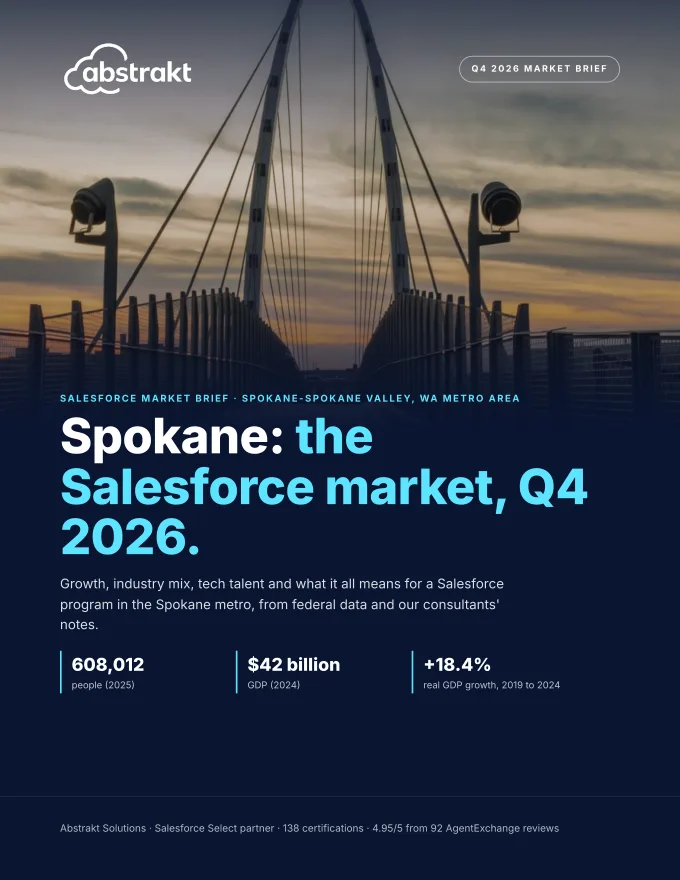
A free 23-page PDF with Spokane's growth ranked against 100 metros, its industry mix, tech wages and nearby markets. It is offered on the public Spokane page; send your customer there or get a copy for your own prep.
Get the Spokane brief →Co-sell with Abstrakt in Spokane
Working a Spokane account? Bring in a named consultant for discovery, scoping or a health check. We reply within 4 business hours.