

How Salesforce work starts in Boise
Abstrakt Solutions is a Salesforce Consulting Partner working with health, construction, wholesale and technology companies across Boise, Meridian and Nampa. Boise is one of our focus markets.
What buyers here usually run into
- 1
Growth outpacing the CRM
Fast-growing regional companies often outgrow a first Salesforce build, ending up with duplicate data and workarounds that a health check and cleanup can resolve.
- 2
Project-based field work
Construction and service contractors commonly schedule crews by text and spreadsheet, which hides job costs until work is finished.
- 3
Agribusiness sales cycles
Food and agriculture suppliers tend to sell on seasonal cycles through growers and distributors, and generic CRM setups rarely match that rhythm.
Budget, team and partner questions
What drives cost
In Boise the biggest cost driver is often data: moving jobs, accounts and contacts out of spreadsheets and cleaning duplicates from an outgrown first build. Integration with ERP for distributors, billing systems for health care and accounting for contractors adds scope, as do Field Service and Revenue Cloud.
Admin or partner
Larger health systems here often keep internal Salesforce staff and use partners for integration and new programs. Contractors, distributors and growing technology firms usually start with managed services and hire once daily Salesforce work is steady.
What buyers ask a partner
Ask for experience cleaning up and extending orgs that grew quickly, plus ERP, billing or construction integration relevant to you. Ask how the partner plans for growth so the build doesn't need replacing in two years.
The local economy and its biggest industries (4)
| Sector | Share of 2024 GDP | Where Salesforce fits |
|---|---|---|
| Health care and social assistance Salesforce for health & life sciences → | at least 9.1% | Two large not-for-profit health systems shape care in the Treasure Valley, and providers here need patient access, referral and service workflows designed with privacy controls from the start. |
| Construction Salesforce for construction → | 7.9% | Contractors building homes, commercial space and industrial projects, including work tied to semiconductor expansion, need bids, crews and job costs tracked in one place. |
| Wholesale trade Sales Cloud → | at least 7.9% | Food, agricultural and industrial distributors across southern Idaho sell through repeat accounts and field reps, which suits Sales Cloud connected to inventory and ERP. |
| Professional, scientific, and technical services Salesforce for professional services → | at least 7.4% | Engineering, software and back-office service firms serving the chip, fintech and utility sectors run on client relationships and project pipelines that Salesforce can make visible. |
Source: U.S. Bureau of Economic Analysis, GDP by county (CAGDP2), 2024, summed to the metro area; private sectors only, excluding real estate and government. “At least” marks sectors where BEA suppresses some county figures.
Regional target sectors named by local economic development groups: Food Processing & Agri-Business, Technology, Manufacturing, Professional Services: Back-Office & Shared Services, Semiconductor.
Salesforce products that fit Boise (6)
In the order we lead with them here, from the industries above.
Salesforce Sales Cloud
The CRM where sales pipeline lives, when it is built right.
Salesforce Service Cloud
The operating system for modern customer service, case, knowledge, voice, and AI agent assist together.
Salesforce Field Service
Scheduling, dispatch, mobile work orders and parts for teams that work on site.
Salesforce Revenue Cloud / CPQ
Configure-price-quote, billing, subscription management, and quote-to-cash on Salesforce.
Salesforce Agentforce
AI agents that handle real work inside Sales Cloud, Service Cloud, and Marketing Cloud.
MuleSoft
Enterprise API platform, for connecting Salesforce, ERP, data warehouses, and the rest of your stack.
Boise builders, distributors and the right AI jobs
Boise does not fit the usual pattern. Health care leads its BEA sector ranking, and construction, wholesale trade and retail trade sit roughly level behind it, with construction measured at 7.9% of metro GDP in 2024. Contractors can use an agent to turn site-visit notes and change requests into clean case summaries for project managers. Distributors serving food processing and agribusiness customers get value from lead triage and reorder forecasting inside Sales Cloud. Clinics can pilot reply drafting for scheduling messages. The catch is that many growing Boise firms still track jobs in spreadsheets, so moving that data into Salesforce accurately is the first project, not an afterthought.
- Summarizing change requests for PMs
- Reorder forecasting for distributors
- Scheduling message drafts for clinics
Services buyers here usually need (7)
Salesforce Implementation in Boise
In the Boise metro, implementation often means giving a fast-growing company its first real system of record. Health care is the largest private sector, at least 9.1% of 2024 GDP, with construction, wholesale and retail close behind, so the data model has to fit patients and referrals, bids and crews, or accounts and reorders. We settle that model in working sessions with each department, build in a sandbox, bring over clean data and launch in phases, training each team shortly before its own go-live.
By industry in Boise
- 1
Health care and social assistance
Treasure Valley providers implementing Salesforce usually begin with patient access, referral management or community outreach rather than anything clinical. We define early what stays in the electronic health record, design Service Cloud queues and case types around how requests really arrive, and switch on privacy controls in the very first release. Later phases can add patient communications, or an Agentforce agent for routine questions, once knowledge content and access rules have proven themselves in daily use.
- 2
Construction
Construction contributes 7.9% of 2024 metro GDP, spanning residential, commercial and industrial work, including projects tied to semiconductor expansion. Implementations for builders and specialty contractors connect bids, estimates and change orders to crews and job sites. We model projects and phases explicitly, configure Revenue Cloud for repeatable estimates where it fits, and add Field Service once scheduling rules are understood, so the first launch gives owners and estimators bid visibility within weeks.
- 3
Food Processing & Agri-Business
The Boise Valley Economic Partnership names food processing and agri-business among its target sectors, and processors and agricultural suppliers here sell through distributors, retailers and foodservice buyers on seasonal cycles. Implementation for them starts with the account hierarchy and product catalog: buying groups, ship-to locations, approved items and customer specifications. With that structure in place, seasonal forecasting and quality complaint handling can follow in later phases without redesigning records that sales already uses.
Raise before scoping
Design for the next growth stage
Many Boise companies are adding locations, product lines or staff at speed. Build the data model and role hierarchy for the organization you expect to become, not only today's, so new teams and territories can be added through configuration rather than structural rework.
Decide ERP ownership during design
Distributors and manufacturers in the valley often run an ERP that already holds customers, items and pricing. Decide which system creates and owns each record while the design is still on paper, because that choice shapes the Salesforce data model far more than any page layout.
Train by role, not by feature
Give schedulers, estimators, service agents and sales reps separate sessions built around their daily tasks, using sandbox records that look like their real work. Role-based training held shortly before go-live sticks far better than a general platform tour delivered weeks earlier.
Salesforce Health Checks in Boise
Boise-area companies often request a health check after a growth spurt, when nobody is quite sure how the org is built anymore. The review walks through who can reach which records, what every integration account is allowed to do, the state of data, flows and Apex, installed packages, license use and adoption, with each finding scored for risk and effort. The report separates quick fixes from project work and notes what must be resolved before AI features such as Agentforce, so leadership can plan spending with evidence instead of guesswork.
By industry in Boise
- 1
Semiconductor
Semiconductor suppliers and service firms handle customer data under confidentiality agreements, and those terms usually extend to their CRM. A health check confirms that access follows those commitments: which users can see which customer accounts, whether files and notes stay within the right teams, how data can be exported and whether contractor logins remain active after work ends. Findings map directly to the controls customers ask about during supplier audits.
- 2
Construction
Contractors frequently add Field Service, estimating tools and document packages as they grow, and each addition brings its own automation and permissions. The review checks whether scheduling and job automation conflict, whether mobile users hold broader access than their work requires, and whether integrations to accounting or estimating software still behave as originally designed. The result is a clear list of fixes that keeps crews productive and job data accurate.
- 3
Professional Services: Back-Office & Shared Services
Shared services centers often hold employee and customer information from several business units in one Service Cloud org. A health check reviews how queues, sharing and case visibility keep those units apart, whether knowledge articles are accurate enough to support self-service or AI, and how requests are measured against service levels. That tells the center's leadership what to fix before taking on new functions, business units or an AI assistant for employees.
Raise before scoping
Count unused licenses too
Health checks focus on risk, but license waste is a finding worth real money. Include a review of inactive users, unused feature licenses and permission set licenses assigned to people who do not need them, so any savings can help fund the fixes.
Hunt for unclaimed connections
Fast-growing firms often let teams connect tools on their own. List every connected app, OAuth grant and integration user, identify an owner for each and remove whatever nobody claims, since forgotten connections can keep wide access long after their purpose has ended.
Test automation at future volume
Automation that worked for a small team can slow down or hit limits as record volumes climb. Review flows and triggers on high-volume objects, and run bulk updates in a sandbox to confirm they will hold up as the business keeps expanding.
Salesforce Optimization in Boise
Rapid growth leaves many Boise orgs with the same problems: duplicate accounts, fields added for one manager and never used, automation that conflicts, and dashboards that disagree. Optimization starts with evidence, including usage data, user interviews and a review of automation on key objects. We then merge duplicates, strip out clutter, consolidate automation into Flow and rebuild reports around agreed definitions. Changes ship in small releases, so contractors, distributors and health teams keep working while the org improves.
By industry in Boise
- 1
Retail trade
Stores and consumer brands generate 7.9% of 2024 metro GDP through retail trade, and as they open locations they tend to lean harder on Service Cloud and marketing lists. Optimization for them cuts case handling time through better routing, macros and knowledge articles, cleans the customer records that loyalty or email programs depend on, and replaces manual exports with dashboards that store and service managers open directly. With that groundwork in place, an Agentforce pilot on order and return questions becomes realistic.
- 2
Construction
Contractors that adopted Salesforce during a busy stretch often skipped job costing fields, win-loss reasons and clean project stages. Optimization brings those back: bid stages aligned to real estimating steps, required loss reasons, and Field Service scheduling rules that match crew skills and drive times between job sites. Leaders gain a reliable view of which project types and customers are profitable, which in turn guides where estimators spend their limited time.
- 3
Technology
Technology is a BVEP target sector, and software and services firms in the valley tend to layer on automation quickly as they scale. Their orgs commonly have triggers, flows and third-party tools all writing to the same opportunity fields. Optimization maps that automation, removes overlap and documents the rules, then aligns pipeline stages with how deals actually progress, so forecasts stop surprising leadership at the end of each quarter and board updates rest on numbers everyone accepts.
Raise before scoping
Merge duplicates before dashboards
Duplicate accounts and contacts distort every report and frustrate users. Set matching and duplicate rules, merge existing duplicates with input from record owners and block new ones at entry, before redesigning dashboards that would otherwise be built on inflated counts.
Slim page layouts by role
Long pages with dozens of fields slow users down. Use Dynamic Forms and role-specific layouts so estimators, service agents and sales reps see only what they need, and tuck rarely used fields into collapsed sections rather than deleting information someone may still depend on.
Prune reports with their users
Ask managers which reports they open each week and which they ignore. Retire the unused ones, merge near-duplicates into one trusted version and place key dashboards on home pages, so people find the numbers they need without asking an admin for yet another report.
Salesforce Integration in Boise
Integration in the Boise metro most often ties Salesforce to ERP at distributors, food processors and manufacturers, and to scheduling or patient systems at health providers. We start by mapping data ownership and volumes, then choose native APIs, scheduled syncs or MuleSoft depending on how many systems are involved and how current the data must be. Each connection gets error handling, alerting, documentation and an integration user with only the access it needs, so problems stay visible and security reviewers have answers.
By industry in Boise
- 1
Manufacturing
Manufacturing is a BVEP target sector, and plants in the valley need their CRM and ERP to agree. Integrating the two lets sales see order status, shipments and open invoices beside each opportunity, while service agents see warranty and serial details on every case. We decide which system owns customers, products and pricing, then sync only the fields users actually need, which keeps the integration fast and far easier to maintain as the plant adds product lines.
- 2
Semiconductor
Idaho Commerce lists semiconductors among the state's key industries, and suppliers of equipment, materials and services support fab operations across the Treasure Valley. Those suppliers often need Salesforce linked to ERP, quality and service systems so account teams can track consumables contracts, installed tools and service events at customer sites. Event-driven integration suits them, because only meaningful changes, such as a tool fault or an approaching contract renewal, need to reach sales and service.
- 3
Health care and social assistance
Treasure Valley providers commonly want access center staff to see appointment and referral status without opening several applications. We bring summary fields from scheduling and the health record into Service Cloud, keep full clinical documentation where it already lives, and log each exchange through an integration layer. Contact preferences and consent come across with every patient record, which lets outreach and scheduling teams avoid calling anyone who has asked not to be contacted.
Raise before scoping
Estimate API use at peak
Every org has a daily ceiling on API traffic tied to its edition and license count, and busy seasons push against it. Estimate how many calls each integration will make at its busiest, including seasonal order spikes, and design batching or events accordingly, so a heavy harvest or building season does not exhaust limits and halt syncs.
Give each data type one owner
Customer, product and pricing records drift apart when two systems can both edit them. Choose one owner per data type, make the other system read-only for those fields, and route corrections through the owner, so reports match across sales, finance and operations.
Insulate Salesforce from system swaps
Growing companies often replace accounting, ERP or scheduling tools as they scale. Middleware or a clear API layer between Salesforce and those systems means a future replacement changes one connection rather than every integration and automation built on top of it.
Salesforce Managed Services in Boise
Boise-area companies often reach a point where Salesforce requests outpace the one person who knows the org. Managed services gives them a consistent team for administration, enhancements, release testing, integration monitoring and user support, all working from a single prioritized backlog. We plan work monthly with your product owner, report what changed and why, and flag recurring problems that deserve a proper project. Requests are triaged by business impact, so a broken integration moves ahead of a new report or page layout.
By industry in Boise
- 1
Wholesale trade
Wholesale trade adds at least 7.9% of 2024 metro GDP, and distributors in southern Idaho move food, agricultural and industrial products. Their Salesforce needs shift constantly: new price books, reassigned territories, updated reorder alerts and reports for supplier reviews. A managed service handles those changes quickly and watches the ERP integration that keeps orders and inventory visible, so a failed sync is fixed before reps quote from stale numbers or promise stock that has already shipped.
- 2
Health care and social assistance
Health providers need Salesforce changes made carefully, since patient-related processes carry privacy obligations. For them a managed service covers access reviews when staff join or leave, updates to case routing and templates for access centers, and regression testing before each Salesforce release. Every change is documented with its approval, which gives compliance staff a dependable record of how the system is maintained, what changed in each release and who authorized every adjustment along the way.
- 3
Professional Services: Back-Office & Shared Services
BVEP targets back-office and shared services operations, and centers of that kind often run Service Cloud for internal HR, finance and IT requests. Their needs never stop: new request types, queue changes when teams reorganize, knowledge articles that drift out of date and dashboards for service levels. A managed service keeps that configuration current and tunes routing as volumes shift, freeing the center's own staff to focus on the work itself.
Raise before scoping
Protect time for improvements
Support tickets can swallow an entire monthly allocation and leave no room for enhancements. Reserve a fixed share of each month for planned improvements from the backlog, so the org gets better over time instead of simply being kept running.
Run key processes on preview
Salesforce makes each seasonal release available in sandboxes before production. Refresh a sandbox onto the preview, run quoting, case routing and mobile scheduling end to end, and fix what breaks before the upgrade reaches users. Put that routine on the managed service calendar.
Make integration health visible
Integrations with ERP, scheduling or billing systems fail quietly unless someone watches them. Ask for a simple dashboard or alert showing failed syncs and error counts, reviewed as part of the service, so problems surface within hours rather than when a customer complains.
Salesforce Implementation Rescue in Boise
Rescue work in the Boise metro often follows a project that could not keep pace with the business: requirements shifted as the company grew, the partner or internal lead left, and the org went live half built. We start with triage, securing access and stabilizing anything blocking daily work, then assess the design, the backlog and how people really use the system. The recovery plan sequences fixes in short releases, ending with a relaunch and retraining for each affected team.
By industry in Boise
- 1
Health care and social assistance
A clinic network's Salesforce project can grind to a halt when compliance first sees the design after records are already loaded. Recovery begins by pausing the riskiest features, reviewing what patient-related data the org actually holds and correcting access. With a sound privacy foundation confirmed by compliance staff, we complete the access center or referral workflows that were promised, then retrain front desk, referral and outreach staff on a system they can use with confidence.
- 2
Food Processing & Agri-Business
Food processors and agricultural suppliers sometimes try to configure every customer's specification, pricing agreement and quality process in the first release. When that stalls, sales and quality teams are stuck together. Recovery trims the first release to accounts, approved items and complaint cases, stabilizes the ERP connection that feeds orders, and phases in pricing agreements and forecasting once that core has proven dependable in daily use by sales and plant quality staff.
- 3
Retail trade
Retailers growing across the region sometimes launch Service Cloud with complex routing, chat and loyalty integrations all at once, and agents quickly drift back to email. Rescue pares routing down to queues that mirror actual teams, steadies the loyalty and order integrations customers notice when they break, and restores a clean agent console before chat, social and other channels are added back one at a time as agents regain confidence.
Raise before scoping
Deliver a quick visible win
Users who gave up on a failed rollout need evidence that things are improving. Pick one painful problem, such as a broken report or a slow screen, and fix it early in the recovery, so teams see change while the larger plan is still being prepared.
Park new requests separately
Requests from expanding teams keep arriving during a rescue. Log them in their own backlog and review them after stabilization, so the recovery team is not pulled back into the scope creep that often caused the original stall in the first place.
Budget real time for retraining
Retraining is not optional after a rescue. Set aside time for every affected team, including managers who approve and report, and schedule refresher sessions a few weeks after relaunch, since habits formed during the failed rollout take time to change.
Salesforce Migration in Boise
Many Boise companies migrate because a starter CRM or a set of shared spreadsheets can no longer keep up with growth. Others are folding acquired businesses into one org. Either way, we inventory every source, profile data quality and agree with each team what to move, archive or discard. Records are cleaned and deduplicated before loading, trial loads run in a sandbox until totals reconcile, and cutover is timed to avoid month-end and seasonal peaks.
By industry in Boise
- 1
Professional, scientific, and technical services
Engineering, software and consulting firms, part of a professional services sector worth at least 7.4% of 2024 metro GDP, often arrive from project tools, shared drives or starter CRMs. Their most important data is client history, proposals and active engagements. We map those into accounts, opportunities and related project records, carry enough history to support renewals and references, and archive the remainder in a searchable form that staff can still reach.
- 2
Food Processing & Agri-Business
Processors and agricultural suppliers often migrate from spreadsheets organized by season, crop or plant, with the same buyer recorded differently across files kept by different sales and plant staff. We standardize customer names and locations, rebuild the relationships between parent buyers and their ship-to sites, and bring specification and complaint history across, so sales and quality teams keep the context they rely on during annual contract reviews with major retail and foodservice customers.
- 3
Wholesale trade
Distributors often pair a CRM migration with an ERP cleanup, since customer lists in the two systems have drifted apart over time. We match accounts between them, agree which identifiers link them, and migrate contacts, activities and open opportunities against the cleaned ERP customer list. Order history usually stays in ERP and appears in Salesforce through integration, which keeps the new org lean and fast for reps who need account context, not every invoice line.
Raise before scoping
Standardize acquired companies' definitions
Growth by acquisition brings separate CRMs where the same field means different things. Agree on one set of definitions for accounts, stages and statuses first, then map each acquired system to it, instead of creating parallel record types that preserve every old convention.
Avoid peak-season cutovers
Food, agriculture, construction and retail businesses in the valley all have busy seasons. Schedule cutover during a quieter stretch, so staff have time for training and questions, and avoid launching when crews, buyers or service teams are already stretched thin.
Let experienced users spot-check
Totals that reconcile perfectly can still hide wrong phone numbers, owners or addresses. Ask experienced users to spot-check their own accounts, projects and cases after each trial load, since they notice missing contacts or odd values that automated reconciliation scripts routinely miss.
Industry plays in Boise (3)
Salesforce for Boise Health Care Organizations
Health care is the largest private sector in the Boise metro, and organizations here often run many clinics, urgent care sites and specialty practices under one brand. Salesforce helps them present one front door: a consistent patient access and billing service experience, a recruitment pipeline for physicians and advanced practice clinicians, and reporting across locations. We typically build on Service Cloud with Experience Cloud and Agentforce, integrate the EHR and revenue cycle systems, and keep clinical data in those systems of record.
No private industry in the Boise City metro outweighs health care and social assistance, which the Bureau of Economic Analysis credits with at least 9.1% of 2024 GDP; the real figure is higher, since some county values are not disclosed. The Boise Valley Economic Partnership does not target health care directly; its list centers on food processing and agribusiness, technology, manufacturing and back-office and shared services, while Idaho Commerce adds semiconductors. For health organizations, the shared-services emphasis is the most relevant, since billing, scheduling and contact center operations are large employers in their own right.
Use cases to open with
- 1
Patient financial services center
Billing questions are among the most common and frustrating patient contacts. Service Cloud can give patient financial services agents one view of statements, payment plans, insurance status and prior contacts pulled from the revenue cycle system. Agentforce can answer routine questions such as balances or payment options through chat, handing off to an agent for disputes or financial assistance applications, which shortens queues without removing people from sensitive conversations.
- 2
Physician and clinician recruitment
Health organizations adding clinics or specialties compete to recruit physicians, nurse practitioners and physician assistants. Sales Cloud can manage the recruitment pipeline: candidate sourcing, site visits, offers, credentialing and start dates. Recruiters and medical group leaders see where each candidate stands, which locations remain understaffed, and how long each stage takes, making planning for new services, clinic openings and call coverage far more realistic than a recruiter's spreadsheet.
- 3
One front door across locations
Patients contact many clinics, urgent care centers and specialists, and each site may answer differently. A central access team on Service Cloud can manage scheduling requests, messages and follow-ups for all locations, with routing by specialty and geography. An Experience Cloud site or patient portal integration lets patients complete common tasks online, and leadership can compare service levels by site.
Raise before scoping
Revenue cycle integration
Patient financial conversations depend on accurate balances, payments and insurance data. Integrate the revenue cycle system through MuleSoft or vendor APIs, define refresh timing, and restrict what agents can change so Salesforce never becomes a second, conflicting billing record that agents and patients have to reconcile later.
HIPAA and minimum necessary access
Access-center and billing agents need some protected health information, recruiters need none. Separate those data sets with profiles, permission sets and sharing rules, sign a business associate agreement, and let your privacy team confirm the minimum necessary standard is applied to each role.
Standardize before centralizing
Clinics often handle the same request differently. Before routing everything to a central team, agree on standard scheduling rules, message templates and escalation paths with site leaders. Centralizing inconsistent processes only moves the confusion to a new place, and patients notice when two agents give different answers.
Salesforce for Boise Construction Firms
Construction firms in the Boise metro may bid on semiconductor and industrial projects one week and residential or commercial work the next. Salesforce gives them one system for bids and customer relationships, crew scheduling and credentials, and warranty service after handover. We connect it to estimating and construction accounting so project managers can compare estimates with actual costs while work is underway, and configure Field Service so foremen can update jobs from a phone without a long training course.
Construction contributed 7.9% of the Boise City metro's 2024 GDP in Bureau of Economic Analysis figures, level with wholesale and retail trade and just behind health care. Construction is not on the Boise Valley Economic Partnership's target list, but several targets depend on it: manufacturing, food processing and semiconductors all need plants and facilities. Idaho Commerce names semiconductors a statewide key industry, and industrial construction for that sector sits alongside the region's residential and commercial building work.
Use cases to open with
- 1
Industrial bid and subcontract pipeline
Large industrial projects create many bid packages for electrical, mechanical, process piping and specialty trades. Sales Cloud can track each package with scope, general contractor, bid date, estimator and result. Leaders can see capacity, backlog and win rates by customer and trade, and decide which large packages the firm can staff without damaging service to existing residential and commercial clients.
- 2
Crew credentials and site requirements
Industrial and semiconductor sites often require specific safety training, badging and cleanroom protocols before workers arrive. Field Service can store credentials on each worker, match them against site requirements when scheduling, and alert supervisors before certifications expire. That prevents a crew from being turned away at the gate after a long drive, and gives safety managers an up-to-date record they can hand to an owner or general contractor on request.
- 3
Warranty service for builders
Homebuilders and residential contractors face warranty requests after closing, often with photos, deadlines and subcontractor involvement. Service Cloud can take requests through a homeowner portal, group them by home and trade, and assign work to employees or subcontractors. Reporting shows recurring defects by trade, community or product, which feeds back into purchasing decisions, subcontractor reviews and construction standards for the next phase.
Raise before scoping
Different pipelines, same platform
Industrial bids, commercial projects and home sales follow different stages and timelines. Use separate record types and processes for each, with shared accounts and reporting, so estimators and sales teams are not forced into one generic funnel that fits none of them.
Integrate job costing early
Estimates and actual costs live in estimating and accounting systems. Integrate committed costs, actual costs and billing status into Salesforce on a regular schedule, and agree which figures project managers may edit, so weekly margin discussions use one set of numbers everyone accepts.
Mobile adoption for crews
Field staff will only use Salesforce if the mobile screens are fast and simple. Limit required fields, support offline work on remote or secured sites, and train foremen on real jobs. Subcontractors can use a portal instead of full licenses where appropriate.
Salesforce for Boise Manufacturers
Boise-area manufacturers range from food and building products to the parts, equipment and services that semiconductor plants consume. For suppliers to fabs, Salesforce should reflect a small number of very large accounts with many buying centers, long qualification steps and service commitments measured in uptime. Sales Cloud organizes account plans and qualification, Revenue Cloud or CPQ handles complex quotes, and Field Service tracks service on installed tools. We connect it to the ERP so orders and parts stay accurate.
Look for manufacturing in the Bureau of Economic Analysis top five for the Boise City metro and you will not find it; health care heads that 2024 list with a floor of 9.1% of GDP. It appears instead through targets. The Boise Valley Economic Partnership lists manufacturing among its four sectors, and Idaho Commerce names semiconductors as a statewide key industry. Suppliers here increasingly organize around semiconductor customers.
Use cases to open with
- 1
Strategic account plans
A supplier to a semiconductor plant may deal with procurement, process engineering, facilities and quality groups inside one customer. Sales Cloud can map each buying center, its decision makers, open qualifications and spending, and hold an account plan the whole team updates. Leadership sees where revenue concentrates and which relationships depend on a single contact, a real risk when one customer is most of the business.
- 2
Quotes for capital equipment
Tools, subsystems and facility equipment involve configuration options, installation, service contracts and spare parts packages. Revenue Cloud or CPQ can bundle these into consistent quotes, apply customer-specific pricing and route non-standard terms for approval. Each accepted quote becomes an order in the ERP without anyone re-keying line items, and service contracts are created alongside the equipment sale instead of being forgotten.
- 3
Service on installed tools
When equipment in a clean room goes down, the customer measures the cost in lost production. Field Service can track every installed unit, its service contract and uptime commitments, dispatch qualified technicians with the right parts and gowning or site-access requirements, and log each intervention with parts, time and root cause. Account teams review service history and contract renewals together, and spare parts planning improves.
Raise before scoping
Guard customer secrets closely
A fab customer may treat its tool counts, recipes and expansion plans as closely held secrets. Decide which customer information belongs in Salesforce, who can see it, and whether some data should stay in engineering systems, and reflect those rules in permission sets and sharing settings.
Qualification as a process
Getting a product qualified at a fab can take many steps and stakeholders. Model qualification as its own process with milestones, owners, test results and documents rather than as a single opportunity stage, so forecasts reflect where each product actually stands with each customer.
Growing fast without rework
Suppliers expanding to serve new capacity often add people and products quickly. Build a clean data model, naming standards and governance early, so rapid growth does not produce duplicate accounts and custom fields that a later health check has to untangle.
Case studies to send (3)
From the industries this market leans on. Client names are anonymized and these projects are not specific to Boise.
The Boise Salesforce market brief, Q4 2026
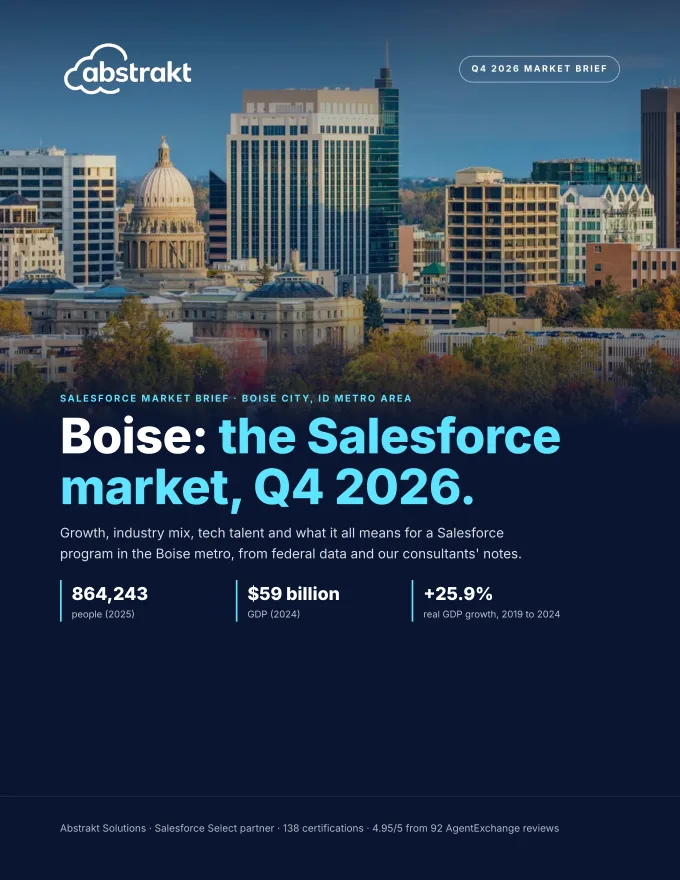
A free 21-page PDF with Boise's growth ranked against 100 metros, its industry mix, tech wages and nearby markets. It is offered on the public Boise page; send your customer there or get a copy for your own prep.
Get the Boise brief →Co-sell with Abstrakt in Boise
Working a Boise account? Bring in a named consultant for discovery, scoping or a health check. We reply within 4 business hours.