

How Salesforce work starts in Seattle
Puget Sound software, retail and manufacturing teams from Seattle to Tacoma and Bellevue turn to Abstrakt Solutions, a Salesforce Consulting Partner, for builds their engineers can respect. Seattle is one of our focus markets.
What buyers here usually run into
- 1
Technical buyers, high expectations
Engineering-led companies expect Salesforce to be as well built as their own products: clean data models, tested automation and documented integrations.
- 2
Consumer-scale service
Retail and consumer companies handle large volumes of customer contacts, where routing, knowledge and AI assistance make the biggest difference.
- 3
Aftermarket and dealer service
Manufacturers selling through dealers need warranty, parts and service history connected to the account.
Budget, team and partner questions
What drives cost
Seattle costs depend on integration depth with product, commerce and ERP systems, contact volume and routing design for retailers, and the testing and documentation standards an engineering-led team expects. Dealer portals and warranty processes add scope for manufacturers.
Admin or partner
Software and retail companies here often have engineers who can own integrations but few people versed in Salesforce architecture. A partner usually covers data model design, automation and release practice, while internal engineering owns the APIs and pipelines on their side.
What buyers ask a partner
Ask how the partner versions and tests changes, documents integrations and handles deployments through source control. Ask for consumer-scale Service Cloud or dealer portal references, and who reviews code before it ships.
The local economy and its biggest industries (4)
| Sector | Share of 2024 GDP | Where Salesforce fits |
|---|---|---|
| Information Data 360 → | 23.0% | Software, cloud and internet companies need Salesforce connected to product usage and billing data, with territories and renewals that keep up with fast growth. |
| Retail trade Salesforce for retail & consumer goods → | 11.6% | Retailers and consumer brands use Salesforce for customer service, loyalty and marketing across channels, where unified customer data drives everything else. |
| Professional, scientific, and technical services Salesforce for professional services → | 8.5% | Consultancies, engineering firms and technology services companies need pipeline, resourcing and client history in one place. |
| Manufacturing Salesforce for manufacturing → | 6.5% | Aerospace suppliers, truck makers and maritime manufacturers manage long programs, dealer networks and aftermarket service. |
Source: U.S. Bureau of Economic Analysis, GDP by county (CAGDP2), 2024, summed to the metro area; private sectors only, excluding real estate and government. “At least” marks sectors where BEA suppresses some county figures.
Regional target sectors named by local economic development groups: Aerospace, Artificial Intelligence, Information Technology, Life Sciences, Clean Technology, Maritime.
Salesforce products that fit Seattle (6)
In the order we lead with them here, from the industries above.
Salesforce Data 360 (Data Cloud)
Unify customer data into a real-time profile that powers segmentation, analytics, and AI.
Salesforce Service Cloud
The operating system for modern customer service, case, knowledge, voice, and AI agent assist together.
Salesforce Sales Cloud
The CRM where sales pipeline lives, when it is built right.
Salesforce Marketing Cloud
Cross-channel marketing, email, mobile, journey, and Data 360-powered personalization at scale.
Salesforce Agentforce
AI agents that handle real work inside Sales Cloud, Service Cloud, and Marketing Cloud.
MuleSoft
Enterprise API platform, for connecting Salesforce, ERP, data warehouses, and the rest of your stack.
Grounding Agentforce in Seattle's software and retail economy
Information is the largest private sector in the Seattle metro, at 23.0% of GDP in 2024, followed by retail trade at 11.6%. Software and platform companies here usually have mature support queues, which makes case summarization and suggested replies the natural pilot: agents read the history, Agentforce proposes a response, and an engineer or support lead approves it. Retail brands can put an agent in front of order, return and loyalty questions, provided product and policy content is kept current. Technical services firms, 8.5% of output, often want help reading contracts and statements of work. Across all three, weak permission models are the usual blocker, so audit who can see what before connecting any agent.
- Summarizing software support case history
- Order, return and loyalty self-service
- Reading contracts and statements of work
Services buyers here usually need (7)
Salesforce Integration in Seattle
Seattle integration work spans several patterns. Manufacturers need ERP pricing, orders and parts connected to Salesforce; retailers need commerce, loyalty and service data brought together; maritime and logistics firms need operational schedules reflected on customer records. We map each system and data owner, select MuleSoft, other middleware or direct APIs based on volume and latency, and build error handling and alerts so a failed sync is noticed the same day rather than at month-end.
By industry in Seattle
- 1
Manufacturing
Manufacturing contributed about 6.5% of the metro's 2024 GDP, including aerospace suppliers, truck and equipment makers and marine manufacturers. Their integrations typically connect Salesforce to ERP for parts, pricing and orders, and to dealer or distributor systems for warranty and service history. We design those flows so a dealer's warranty claim, a part order and a service visit can all be traced to the same customer and unit. Dealers get faster answers as a result.
- 2
Retail trade
Retailers and consumer brands connect Salesforce to commerce platforms, point-of-sale, loyalty programs and ERP. Once ownership of the customer profile is settled, Data 360 (formerly Data Cloud) can match identities across those feeds, and order and return data can flow into Service Cloud so agents see the full purchase history during a contact. Marketing Cloud then draws on the same unified profile instead of its own copy. Returns and exchanges show up in context instead of in a separate lookup.
- 3
Maritime
Maritime companies, a Greater Seattle Partners target sector, run operations in scheduling, dispatch and vessel-tracking systems that rarely talk to the CRM. We integrate voyage, berth or job schedules onto customer and vessel records and send completed work back for invoicing, so sales and service teams can answer customer questions without calling operations every time. Invoices then go out sooner because completed work no longer waits to be keyed. We also map vessel and customer identifiers between systems once, carefully, so every later sync can rely on them.
Raise before scoping
Choose one customer owner
When commerce, loyalty and service tools each keep a customer record, profiles drift apart. Choose one owner for identity and consent, and have every other system reference it through the integration rather than editing a private copy of its own.
Standardize dealer and partner data
Manufacturers selling through dealers receive warranty claims, service records and sales reports in varied formats. Standardize an intake format or portal, validate data at the boundary and map it to assets and accounts before it reaches any report. Bad data stopped at the door costs far less to fix.
Build retries and alerts
Network hiccups and API limits are normal. Integrations should retry automatically, record failures in a log someone reviews and alert an owner when a threshold is crossed, so problems surface within hours rather than when a customer complains. A short runbook tells that owner what to do next.
Salesforce Implementation in Seattle
Seattle-area companies often judge a Salesforce implementation the way their engineers judge software: clear design, tested changes and documentation. We start with discovery workshops to map the real process, design the data model and security before configuration, build in sandboxes with scenario tests and phase go-lives so each team works in Salesforce as soon as its part is ready. For maritime, research and services companies, most of the design effort goes into objects that a standard sales setup does not include.
By industry in Seattle
- 1
Maritime
Greater Seattle Partners includes maritime among the sectors it targets, and shipyards, vessel operators, port service firms and marine suppliers need an implementation that starts with the customer structure, since owners, operators and management companies overlap on the same vessels. The first phase settles those relationships; later phases add quoting for repair or supply work and service tracking, so every phase builds on a customer model that is already right.
- 2
Professional, scientific, and technical services
Engineering, architecture and consulting firms, part of a professional services sector that produced about 8.5% of the metro's 2024 GDP, need pursuit tracking for proposals and public bids, relationships with teaming partners and a clean handoff into project delivery when Salesforce arrives. We model pursuits, bid deadlines and partner roles in the first phase, because those structures drive the forecasting and win-rate reports principals depend on. Delivery tools stay where they are unless there is a reason to move them.
- 3
Life Sciences
Life sciences is on Greater Seattle Partners' target list, and the region's biotech and research-services companies often implement Salesforce with close ties to academic research. They need institution and investigator models, collaboration or grant tracking and access controls that keep scientific and commercial activity separate. We lay those foundations before the first users arrive, so clouds added later fit without a redesign. Grant and collaboration records also feed the reporting that research leaders already owe their funders.
Raise before scoping
Treat configuration like code
Engineering-led teams expect version control, peer review and repeatable deployments. We use source-tracked sandboxes and deployment pipelines where the scope justifies them, which also makes future changes easier for whoever maintains the org after launch. Nothing reaches production without a reviewed, repeatable deployment.
Model assets, not just accounts
Maritime, aerospace and equipment firms sell around physical things with long service lives. Decide early how vessels, aircraft components or machines are represented, because asset records will shape service, renewal and reporting design for years afterward. Retrofitting assets later means reworking cases, contracts and reports.
Shorten the feedback loop
Engineering-minded teams expect to see changes quickly, not at the end of a long build phase. Short build cycles with a standing test session let reviewers try each change in a sandbox and see their feedback reflected in the next cycle.
Salesforce Health Checks in Seattle
A common trigger for a Seattle health check is an AI initiative that has just moved from idea to budget line. Before an agent works on customer data, leadership wants to know whether permissions, data quality and automation will hold up. Our consultants examine sharing and security, record quality, automation overlap, Apex and its test coverage, integrations and usage patterns, and they sort what they find by risk and by the effort to fix it. Engineering-minded teams get detail they can act on, and business leaders get a short list of what to fix first.
By industry in Seattle
- 1
Artificial Intelligence
Artificial intelligence is a Greater Seattle Partners target sector, and AI companies are often the most eager to put agents to work on their own Salesforce data. A health check tests whether that data is ready: duplicate rates on accounts and contacts, completeness of the fields an agent would draw on, how current the knowledge base is and whether integration users and agents would receive only the access they need.
- 2
Information
Software and cloud companies make up much of the region's large information sector, and their orgs often carry significant technical debt from rapid growth. We inventory unused fields and objects, inactive or overlapping automation, packages installed for trials and Apex with weak test coverage, then estimate the effort to address each item, so cleanup can be planned alongside product work instead of competing with it. Findings are phrased like engineering tickets, ready for a sprint.
- 3
Life Sciences
Life-sciences companies need confidence that research, clinical or patient-related information in Salesforce is protected. The review tests whether sensitive objects are locked down at field level, whether scientists and sales staff see only their own side of the house, whether audit settings capture changes and which connected systems can read protected records. Findings are ranked so privacy risks are addressed before any expansion of the org or its use of AI.
Raise before scoping
Review agent permissions separately
AI agents and integration users need their own access review. Confirm each can read only what its tasks require, because an agent with broad access can surface records that a human user asking the same question would never be shown.
Inspect code as well as configuration
Engineering-heavy companies often have more Apex, triggers and custom components than typical orgs. Test coverage, error handling and hard-coded values deserve the same scrutiny as permissions, since fragile code tends to break during Salesforce releases. Brittle triggers are a frequent source of surprise.
Talk to users, not just metadata
Metadata shows what exists; interviews show what people rely on and what they avoid. A few conversations with sales, service and operations users turn a technical inventory into a priority list the business actually agrees with. It also builds support for the fixes.
Salesforce Managed Services in Seattle
For Seattle-area companies, managed services usually covers an org that changes as fast as the business around it. Retail calendars, product releases and program milestones all generate Salesforce requests, and a single admin rarely has time for development, integration fixes and release testing as well. Instead of one person juggling everything, you get a shared queue, sandbox testing on every change, a preview of each Salesforce release against your org and developers or architects who join when a task calls for them.
By industry in Seattle
- 1
Retail trade
Retail trade represents about 11.6% of metro GDP in 2024, the second-largest private sector here. Retailers and consumer brands depend on Salesforce for service, loyalty and marketing, and their requests cluster around promotions and the holiday season. Managed services lets them schedule changes ahead of those peaks, hold a change freeze during them and clear the backlog afterward, with the same team that already knows their service processes. Promotions get the attention they need without derailing everything else.
- 2
Information Technology
Information technology companies, one of Greater Seattle Partners' target sectors, often have strong internal engineering but little Salesforce depth. Managed services fills that gap: Apex and Lightning components built to the standards their engineers expect, integration fixes, permission redesign when teams reorganize and release reviews. Their product and operations leads set priorities, and we deliver and document against them. Engineers can read our change notes and tests the same way they read each other's, which builds trust quickly and keeps Salesforce from feeling like a black box.
- 3
Aerospace
Aerospace suppliers in the region manage long programs and quote revisions that call for careful change control. Under managed services we maintain program and quote objects, adjust approval rules as contracts evolve and keep access restrictions current as people move between programs. Every change is tested in a sandbox and logged, which supports the traceability these suppliers' customers often require. When a customer asks who could see a program's pricing at a given point, the answer is in the log rather than in someone's memory.
Raise before scoping
Plan around peak seasons
Consumer companies here see service volume and marketing activity spike around holidays and major promotions. Agree on a freeze window before each peak and front-load the changes that support it, such as new case routing or campaign fields, so nothing risky ships mid-rush.
Match engineering standards
Technical stakeholders will read what we build. We follow naming conventions, write tests for code and Flows and keep deployment notes in a form engineers recognize, so Salesforce does not become the one undocumented system in the company. Handovers between people then stay painless.
Keep permissions current
Frequent reorganizations leave users with access that no longer matches their role. A recurring permission review under managed services removes access people no longer need and gradually consolidates profiles into permission set groups that are easier to audit. Fewer profiles also make audits quicker.
Salesforce Optimization in Seattle
Optimization for Seattle companies usually starts where speed left its mark. Software, retail and services firms added fields, flows and dashboards as they scaled, often built by different people for different leaders. We measure what is used, interview the teams who depend on it, then simplify layouts, consolidate automation into Flow, clean duplicate customer and account records and rebuild core dashboards on agreed definitions. Changes go out in small batches with short training, so users feel the improvement without a disruptive relaunch.
By industry in Seattle
- 1
Information
Information accounts for about 23% of the metro's 2024 GDP. For software and cloud companies, optimization typically targets territory and account ownership rules that no longer match the sales organization, renewal processes spread across several objects and forecast dashboards that disagree with finance. We rationalize ownership and territories, bring renewals into one process and reconcile pipeline definitions with the finance team before rebuilding the forecast. Reps see a book of business that finally matches the accounts they actually call.
- 2
Retail trade
Retailers and consumer brands often find the same customer duplicated across service, loyalty and e-commerce sources, which weakens both service and marketing. Optimization merges duplicates using agreed matching rules, cleans case categories so contact reasons can be trusted and rebuilds service dashboards around handle time, resolution and repeat contacts, the measures service leaders actually manage to. Marketing benefits too, because segments built on merged profiles stop sending the same offer twice to one household. We then set matching rules so new duplicates are caught at entry rather than cleaned up each quarter.
- 3
Professional, scientific, and technical services
Engineering and consulting firms in the region often have a Salesforce org their principals rarely open. We simplify pursuit entry, connect proposals to the delivery team and rebuild pipeline and backlog reports around the numbers principals already discuss in leadership meetings. Once those reports match what leaders use, principals have a reason to work in the system directly instead of asking staff for summaries. Adoption among principals follows usefulness, not mandates, so the reports come first.
Raise before scoping
Rationalize territories after reorganizations
Sales reorganizations leave territory and assignment rules that no one fully understands. Map current ownership, confirm the intended model with sales leadership and rebuild assignment logic before touching the dashboards that depend on it. Skipping that order usually means fixing the same reports twice.
Clean case categories first
Service reporting and any future AI routing depend on consistent case reasons and categories. Collapsing overlapping values and retraining agents on a shorter list is one of the most useful early steps a consumer-facing service team can take. It also shortens training for new agents.
Ship improvements in small batches
Large one-time relaunches disrupt busy teams. Grouping improvements into small, tested releases, each with a brief note on what changed, keeps momentum and makes it easier to measure the effect of each change on adoption and data quality. Teams also stay willing to test.
Salesforce Migration in Seattle
Seattle-area migrations often involve technical teams who have already exported their data and want to know what else there is to do. The answer is mostly judgment: which records and history are worth moving, how legacy fields map to a better data model, how duplicates are resolved and when the old system stops accepting changes. We handle the inventory, mapping, cleanup, sandbox test loads and reconciliation, and we plan a short cutover so sales and service teams switch together.
By industry in Seattle
- 1
Clean Technology
Clean technology is a Greater Seattle Partners target sector, and energy, climate and efficiency companies often track projects, sites, incentives and utility partners in spreadsheets before moving to Salesforce. Migration turns those into related records, so each project carries its site, partners, funding and milestones, and reports can show pipeline and delivery side by side instead of in separate workbooks. Utility and municipal partners appear once, with every project they touch linked beneath them, which makes partner reviews far quicker to prepare.
- 2
Professional, scientific, and technical services
Engineering and consulting firms migrating to Salesforce frequently bring a legacy CRM plus a proposal archive and contact lists kept by individual principals. We consolidate those sources, deduplicate firms and people, preserve pursuit history on each client and set ownership rules so relationships held by retiring or departing staff stay with the firm rather than leaving with them. Proposal archives are linked to the matching clients, so a principal preparing a new pursuit can see every past submission, outcome and teaming partner in one place.
- 3
Information Technology
IT and software companies usually migrate from HubSpot, another starter CRM or a Salesforce org they want to rebuild. Beyond records, they need lifecycle stages, attribution, subscription details and integration keys carried across so billing and product systems still match after cutover. We rebuild those links in a sandbox and test them end to end before the final load. Finance signs off on reconciled subscription data before anyone switches over, which prevents a surprise at the next renewal or invoice run.
Raise before scoping
Keep integration keys intact
Billing, support and product systems often reference CRM IDs. Map old identifiers to new Salesforce IDs and update every connected system as part of cutover, or integrations will fail silently the day after launch. Keep a crosswalk table for any later audit.
Retire personal spreadsheets deliberately
Principals and account managers often keep their own client lists. Collect them early, merge them into the main data set and make it clear that the old copies stop being maintained once cutover is complete. A named deadline for final submissions helps.
Redesign instead of replicating
A migration is a chance to fix the old data model. Map legacy fields to a better design rather than copying every custom field across, and archive whatever no longer serves a current process so it does not clutter the new org.
Salesforce Implementation Rescue in Seattle
Seattle-area rescues usually involve ambitious scope that outran the design. A manufacturer tried to include dealers, warranty and field service in one launch, or a retailer connected every channel before the customer model was settled. We triage first: what works, what is broken and what data can be trusted. Once sales and service are running again, we sort each component into keep, fix or rebuild and deliver the rest in phases, each tested and documented before release.
By industry in Seattle
- 1
Aerospace
Aerospace is a Greater Seattle Partners target sector, and suppliers here often stall on program and quote structures that do not reflect how multi-year programs actually run. Recovery rebuilds the program object and quote revision history on a sound model, restores access controls where customers require them and reconnects forecasting so leadership sees program revenue realistically again. Quote history is preserved during the rebuild, since customers and auditors may ask how a price changed over the life of a program.
- 2
Manufacturing
Equipment, truck and marine manufacturers commonly stall at dealer and service processes. Warranty claims arrive in inconsistent formats, assets are missing or duplicated and field technicians work outside the system. We stabilize asset and account data first, then finish dealer intake, warranty and service workflows in stages, so each one is usable before the next begins. Technicians get mobile screens with the asset details they need at the job site, and dealers see claim status without phoning the factory.
- 3
Retail trade
Retailers sometimes launch Service Cloud or Marketing Cloud before customer data is unified, leaving agents with duplicate profiles and campaigns that reach the wrong people. Recovery settles which system owns the customer, merges duplicates, repairs the integrations feeding Salesforce and then rebuilds service routing and marketing segments on the corrected data. Agents are retrained on the corrected profiles, and we track repeat contacts and unsubscribe rates to confirm that the fixes are working. Only then do we revisit features that were deferred during recovery.
Raise before scoping
Cut scope to recover momentum
Overambitious projects recover faster when the next release is small. Choose the process that matters most to revenue or customers, finish it properly and defer the rest, rather than restarting the entire original scope at once. Early wins also rebuild confidence among sponsors.
Audit data before rebuilding features
Many failed launches rest on bad data: duplicates, missing assets or mismatched IDs from a hurried migration. Fixing the data first prevents rebuilt features from inheriting the same problems and failing for the same reasons. We check data quality before any rebuild.
Write down every decision
Stalled projects often lack any record of why things were built as they were. We document each keep, fix or rebuild decision with its reasoning, which gives your team and any future partner a clear history to work from. Nothing is left to memory.
Industry plays in Seattle (4)
Salesforce for Seattle Retailers and Consumer Brands
For Seattle retailers, service at scale is usually the first problem to solve, because contact volumes are high and customers expect quick, digital-first answers. Salesforce supports that with Service Cloud for high-volume contact centers, Agentforce agents that resolve routine orders and returns end to end, Data 360 (formerly Data Cloud) for a single customer profile across stores, apps and memberships, and clienteling tools for store associates. We design the data model and integrations to the standard an engineering-minded organization expects, with tests and documentation.
Retail trade is the second-largest private sector in the Seattle metro's 2024 Bureau of Economic Analysis county data at 11.6% of GDP, surpassed only by information at 23%. Among the largest U.S. metros covered on this site, no other shows a retail share that high. Greater Seattle Partners names artificial intelligence and information technology among its target sectors, a sign of how much AI and software expertise surrounds retailers here. That combination, big consumer businesses sitting inside a deep technology workforce, sets a high bar for automation, data quality and self-service.
Use cases to open with
- 1
AI agents for routine contacts
Order status, returns, exchanges and account changes make up most consumer contacts. An Agentforce agent connected to order and inventory systems can resolve many of them in chat or messaging, following your policies and escalating to a person with the full conversation attached when needed. Supervisors see resolution rates and escalation reasons, and adjust instructions and knowledge without writing code.
- 2
Membership and loyalty programs
Paid memberships and loyalty tiers depend on knowing each member's value and engagement. Data 360 (formerly Data Cloud) can unify purchases, app activity, program status and service history into one profile, while Marketing Cloud journeys handle onboarding, renewal and win-back messages. Service agents see member status instantly, so benefits are honored consistently whether a member calls, chats or walks into a store. Churn risk scores can flag members to save.
- 3
Clienteling for store associates
For higher-consideration purchases, associates build relationships with repeat customers. A mobile clienteling app on Salesforce shows purchase history, preferences and notes, lets associates send approved messages and book appointments, and records outcomes. Store managers then see which associates drive repeat visits, and marketing learns which products and styles customers ask about most. Customer consent governs every outreach. Appointment no-shows are tracked as well.
Raise before scoping
Engineering standards for the org
Technical teams expect source control, automated tests and documented integrations. Set up a development pipeline, sandbox strategy and code review process from the first release, so Salesforce changes follow the same discipline as the rest of your stack and do not become a separate, fragile system.
Guardrails for AI agents
Before an agent handles refunds or account changes, define what it may do, what limits apply and when it must hand off. Test with real conversation samples, monitor outcomes after launch, and keep a person accountable for agent instructions, just as you would for a new team member.
Washington privacy requirements
Washington's privacy laws, including its law on consumer health data, can apply to retailers collecting certain information. Map what personal data you hold, where consent is captured and how deletion requests are handled, and confirm requirements with counsel before building segments or AI features.
Salesforce for Seattle Professional Services Firms
Professional services firms in Seattle frequently serve very large clients through master service agreements, supplier programs and purchase orders rather than one-off deals. Engineering and design firms also pursue projects in aerospace, maritime and clean technology. Salesforce can track master agreements and the statements of work issued under them, manage pursuits with go or no-go decisions, and collect client feedback during delivery. Integrations with project accounting and resourcing systems keep partners from juggling separate spreadsheets for each client program.
The Bureau of Economic Analysis's 2024 county figures show professional, scientific and technical services at 8.5% of Seattle metro GDP, third behind information at 23% and retail trade at 11.6%. Greater Seattle Partners targets aerospace, maritime, clean technology, life sciences, information technology and artificial intelligence, a list that describes many of the clients engineering and consulting firms here serve. Because the region's economy is anchored by very large technology and retail employers, services firms often sell through formal supplier programs with rate cards, compliance requirements and purchase order processes.
Use cases to open with
- 1
Master agreements and work orders
Large clients issue statements of work and purchase orders under master agreements, each with its own budget, rate card and end date. Modeling agreements, statements of work and POs in Salesforce shows remaining budget, upcoming expirations and renewal opportunities, and helps account teams see total spend by client program instead of scattered individual orders in email and finance systems. Alerts fire when a PO nears exhaustion.
- 2
Pursuits with go or no-go gates
Engineering and design firms pursue projects that require proposals, qualifications and sometimes interviews. Salesforce can track pursuits through qualification, go or no-go, proposal and award, with the proposal team and costs attached. Leadership sees pursuit spend against win rates by market, such as aerospace or maritime, and decides where to focus proposal effort. Loss reasons feed the next go or no-go.
- 3
Client feedback during delivery
Waiting for the end of a project to hear from the client is too late. Surveys sent at milestones, with results recorded on the account and project, alert partners to problems while there is still time to fix them. Over time, feedback trends by service line and client help firms improve delivery and give sales credible evidence for proposals. Low scores open a follow-up task.
Raise before scoping
Supplier program compliance
Large clients require insurance, security attestations, diversity reporting and approved rate cards from suppliers. Track those requirements and their expiration dates in Salesforce, and alert account owners before anything lapses, since a lapsed requirement can stop new work orders from being issued.
Integration with finance and PSA
Purchase orders, invoices and project budgets live in finance and PSA systems. Integrate the fields account teams need, such as PO balance and invoiced amounts, through MuleSoft or native connectors, and keep Salesforce focused on relationships and pipeline rather than duplicating accounting.
Build to engineering standards
Clients and staff with technical backgrounds notice poor data and brittle automation. Use a clear data model, documented integrations, testing and version control from the start, so the system is maintainable and earns trust from people who build software for a living.
Salesforce for Seattle Manufacturers
Seattle-area manufacturers often support what they build for decades: aircraft parts and interiors, marine engines and vessel systems, and newer clean technology equipment. Salesforce should connect the sale to everything after it, including dealer and distributor relationships, warranty claims, parts orders and service history for each aircraft, vessel or installation. We integrate the ERP and product data, model assets in hierarchies that reflect real equipment, and build dealer portals and service processes that engineering-minded teams will trust.
Manufacturing ranks fourth among Seattle's private sectors in the Bureau of Economic Analysis's 2024 data, at 6.5% of metro GDP, well behind information at 23% and retail trade at 11.6%. Greater Seattle Partners nevertheless names aerospace, maritime and clean technology among its target sectors and also lists advanced manufacturing, and its startup map tracks aerospace and clean tech ventures. Local buyers and teams tend to be engineering-led and expect Salesforce to be built with the same rigor as their own products, while manufacturers that sell through dealers need warranty, parts and service history tied to each account.
Use cases to open with
- 1
Dealer and distributor network
Marine and industrial equipment makers often sell and service through independent dealers. An Experience Cloud portal can give dealers product information, pricing, deal registration, warranty submission and parts ordering, while Salesforce tracks each dealer's agreements, certifications, sales and service performance. Channel managers can compare dealers by region and product line, support those falling behind, and plan territory changes with actual data.
- 2
Warranty claims and returns
Warranty claims arrive from dealers and end customers with varying documentation. Service Cloud can capture each claim with serial number, failure description, photos and parts, validate coverage against the warranty terms on the asset, and route claims for approval. Finance sees claim costs by product and supplier, and engineering receives structured data on failure patterns to feed design changes and supplier recovery.
- 3
Asset history for vessels and aircraft
A vessel or aircraft can carry many systems supplied by one manufacturer. Salesforce asset hierarchies record each installed unit under its parent vessel, aircraft or site, with configuration, software versions, service events and parts replaced. Technicians and support engineers see full history before responding, and account managers can spot upgrade and retrofit opportunities across a customer's fleet. Planned haul-outs or maintenance checks become natural moments to propose that work.
Raise before scoping
Engineering-grade build quality
Technical teams will judge Salesforce by its data model, automation and documentation. Use version control, sandboxes and automated tests, document integrations, and review designs with engineering stakeholders. A disciplined build earns trust and reduces surprises when the org grows, and it lets your own engineers extend the platform safely later.
Serial and configuration data
Warranty and service depend on knowing exactly what was shipped and installed. Agree which system holds serial numbers, bills of material and configuration, how updates after retrofits are captured, and how that data reaches Salesforce, so warranty decisions rely on accurate records.
Aerospace quality and export rules
Aerospace suppliers operate under customer quality requirements and sometimes export controls. Keep controlled technical data in approved systems, restrict access in Salesforce where compliance requires it, and ensure traceability records remain in the quality system of record. Salesforce should reference lot and certificate data rather than copy it.
Salesforce for Seattle Health and Life Sciences
Seattle's health and life sciences organizations frequently blend biology and software: biotech companies with data platforms, digital health products sold to health plans and employers, and providers adopting new technology. Salesforce can support business-to-business sales to payers and employers, manage patient or member programs, and bring product usage data into account records. We design around HIPAA from the start, integrate carefully with engineering-built systems, and apply the same testing and documentation discipline local technical teams expect.
Health care and social assistance accounted for 5.1% of the Seattle metro economy in 2024, per the Bureau of Economic Analysis, a smaller share than information at 23%, retail trade, professional services or manufacturing. Greater Seattle Partners includes life sciences and artificial intelligence among its target sectors, and its startup map covers biotech alongside AI and clean tech ventures. A major public research university is a founding partner of the organization. The outcome is a sector where research and software are closely linked, and where many companies sell technology into healthcare rather than deliver care themselves.
Use cases to open with
- 1
Selling to health plans and employers
Digital health companies sell through long enterprise processes with clinical, security, procurement and benefits stakeholders. Salesforce can map those buying groups, track security questionnaires and pilot terms, and manage contract renewals with performance metrics attached. Sales leaders see which deals are waiting on clinical evidence or security review, and customer success teams inherit a complete picture at launch. Win and loss reasons by buyer type show whether evidence, price or integration effort decides deals.
- 2
Patient and member programs
Programs that enroll patients or plan members need eligibility checks, outreach, onboarding and support. Health Cloud and Service Cloud can manage enrollment status, consent and case history, while Marketing Cloud sends approved outreach through the channels members prefer. Program managers track engagement and outcomes by client, supporting the reporting that health plans and employers require at renewal. Support cases from members show which parts of the program cause friction.
- 3
Usage data for customer success
For software-based health products, usage predicts renewal. Data 360 (formerly Data Cloud) can bring aggregated engagement metrics from the product into Salesforce without importing unnecessary PHI, so customer success managers see which clients are adopting, which are at risk and which are ready to expand. Automated alerts create tasks when usage falls, prompting timely outreach. Expansion conversations can start from evidence of strong adoption in one client population.
Raise before scoping
PHI scope and business associate terms
Decide early whether Salesforce will hold PHI at all. If it will, sign the business associate agreement, limit PHI to the fields and users that need it, and configure encryption and audit. If not, design integrations that pass only de-identified or aggregate data.
Engineering integration standards
Product and data teams will expect integrations to be versioned, monitored and documented like their own services. Agree on API contracts, error handling and ownership up front, and include engineering in design reviews so Salesforce fits the company's architecture rather than sitting outside it.
Evidence and claims review
Marketing and sales materials for health products may make clinical or outcome claims that require review. Route content through medical, regulatory and legal approval in Salesforce or Marketing Cloud, keep approval records, and prevent unapproved materials from reaching customers. Expired approvals should withdraw content automatically.
Case studies to send (3)
From the industries this market leans on. Client names are anonymized and these projects are not specific to Seattle.
The Seattle Salesforce market brief, Q4 2026
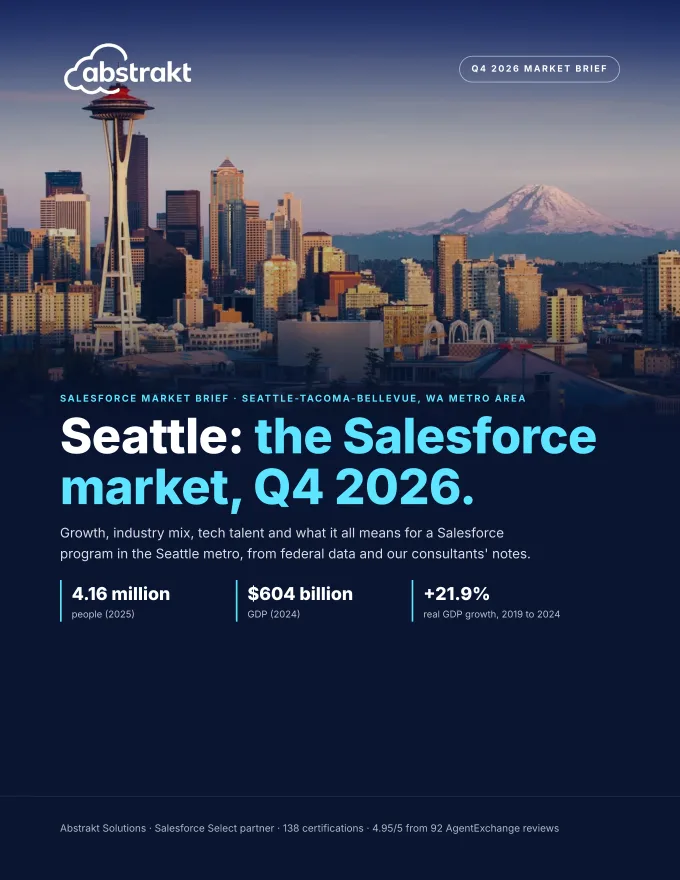
A free 23-page PDF with Seattle's growth ranked against 100 metros, its industry mix, tech wages and nearby markets. It is offered on the public Seattle page; send your customer there or get a copy for your own prep.
Get the Seattle brief →Co-sell with Abstrakt in Seattle
Working a Seattle account? Bring in a named consultant for discovery, scoping or a health check. We reply within 4 business hours.