

How Salesforce work starts in Albany
Capital Region semiconductor suppliers, insurers and research organizations in Albany, Schenectady and Troy turn to Abstrakt Solutions, a Salesforce Consulting Partner, to build and run their orgs. Albany is one of our focus markets.
What buyers here usually run into
- 1
Engineered products, long sales cycles
Manufacturers of high-spec components often quote in spreadsheets and track opportunities that run for many months, which makes forecasting and CPQ design worth getting right.
- 2
Research partnerships outside the usual pipeline
Organizations tied to university and public-private research programs manage partners, grants and consortia, and standard Salesforce objects need thoughtful adaptation to fit.
- 3
Regulated member and patient data
Insurers and health organizations need permission models, audit trails and integrations that satisfy compliance reviews before Salesforce can be widely used.
Budget, team and partner questions
What drives cost
Albany scope depends on qualification and service complexity for manufacturers, compliance requirements such as New York cybersecurity controls for insurers, and how many research partners, grants and consortia must be modeled. Territory design across eight counties adds some address cleanup.
Admin or partner
Insurers and health plans here often keep Salesforce ownership internal for compliance reasons and add a partner for architecture and integration. Equipment suppliers and research-driven firms typically outsource administration while their sales processes are still forming.
What buyers ask a partner
Ask for long-cycle quoting and service contract examples, Financial Services Cloud work for insurers, and how the partner documents access controls for compliance reviews. Research organizations should ask how the partner has modeled grants and consortia.
The local economy and its biggest industries (4)
| Sector | Share of 2024 GDP | Where Salesforce fits |
|---|---|---|
| Manufacturing Salesforce for manufacturing → | 13.7% | Semiconductor, energy-equipment and advanced-materials manufacturers here sell long-cycle, engineered products. Salesforce helps them manage complex quotes, distributor and OEM accounts, and service tied back to ERP. |
| Finance and insurance Salesforce for insurance → | 10.8% | The metro's second-largest private sector includes insurers and financial firms that need a single view of members or clients, compliant communications and reliable service handoffs. |
| Professional, scientific, and technical services Salesforce for professional services → | 7.4% | R&D labs, engineering firms and software and game studios around the Capital Region's research institutions track partners, grants and projects that rarely fit an off-the-shelf pipeline. |
| Health care and social assistance Salesforce for health & life sciences → | 6.9% | With an academic medical center and biopharmaceutical production in the region, Salesforce work often covers patient or provider outreach and service built around privacy rules. |
Source: U.S. Bureau of Economic Analysis, GDP by county (CAGDP2), 2024, summed to the metro area; private sectors only, excluding real estate and government. “At least” marks sectors where BEA suppresses some county figures.
Regional target sectors named by local economic development groups: Advanced Electronics / Semiconductors R&D and Manufacturing, Life Sciences, Clean Energy R&D and Manufacturing, Digital Gaming / Software, Artificial Intelligence / Quantum Computing.
Salesforce products that fit Albany (6)
In the order we lead with them here, from the industries above.
Salesforce Sales Cloud
The CRM where sales pipeline lives, when it is built right.
Salesforce Revenue Cloud / CPQ
Configure-price-quote, billing, subscription management, and quote-to-cash on Salesforce.
Salesforce Service Cloud
The operating system for modern customer service, case, knowledge, voice, and AI agent assist together.
Salesforce Financial Services Cloud
Industry CRM for wealth management, banking, insurance, and lending, built for compliance from the start.
MuleSoft
Enterprise API platform, for connecting Salesforce, ERP, data warehouses, and the rest of your stack.
Salesforce Field Service
Scheduling, dispatch, mobile work orders and parts for teams that work on site.
Albany's semiconductor and insurance sectors meet Agentforce
Manufacturing tops the Albany metro economy at 13.7% of 2024 GDP, and the region targets semiconductors and advanced electronics for growth. Equipment and component makers there can use AI to help service engineers: an agent reads tool logs, parts history and procedures attached to a case and proposes next steps. Finance and insurance, at 10.8%, fits document reading and reply drafting for policy servicing. Professional and scientific firms, 7.4%, can generate account briefs before client meetings. Be realistic about readiness. If service history lives in spreadsheets or procedures are out of date, the first project is data and knowledge cleanup, with an engineer reviewing every AI suggestion.
- Next-step suggestions for equipment cases
- Policy servicing reply drafts
- Client meeting account briefs
Services buyers here usually need (7)
Salesforce Implementation in Albany
Implementing Salesforce for an Albany-area company usually means modeling complexity a basic pipeline ignores: qualification stages for engineered parts, member and policy relationships at insurers, research partners and grants at life sciences firms. Data model and security come first, then a sandbox build, cleaned records and training by role. Delivery is phased, starting with discovery workshops and closing each phase with go-live support and training for the teams that will use it.
By industry in Albany
- 1
Manufacturing
Manufacturing contributes about 13.7% of 2024 metro GDP, the largest share of any private sector, and CEG lists semiconductors and clean energy among the region's strengths. For manufacturers implementing Salesforce, the defining decisions are how customer sites and programs nest in the account hierarchy, where qualification or sampling stages live and how product data lines up with ERP. We settle those before configuration starts, because they decide whether forecasts will be credible a year later.
- 2
Life Sciences
Life sciences is one of CEG's key regional clusters, spanning drug development, production and research services. Implementations for these companies keep commercial relationships apart from research collaborations, track partners, samples and agreements alongside opportunities, and restrict who can see sensitive project details. We model those relationships early and phase the rollout so business development goes live first, with service, complaint handling and quality processes added once the core data has settled.
- 3
Finance and insurance
Insurers, banks and financial firms around Albany weigh Financial Services Cloud against a Sales or Service Cloud design early in implementation. The deciding factors are whether you manage households or members, how policies and accounts relate to people and what your compliance team needs to see. We make that call with your data in front of us, then build security and audit settings into the first phase rather than retrofitting them after users arrive.
Raise before scoping
Model qualification, not just deals
Engineered components often go through months of qualification before a purchase order exists. Track those stages on their own record, linked to the customer site and part, so the sales pipeline reflects commercial reality and engineering can see where each qualification stands.
Put compliance sign-off in the plan
Insurers and health-related firms need security and data handling approved before users arrive. Write compliance reviews into the project plan as explicit milestones for each phase, with test evidence ready, rather than asking for approval a few days before go-live.
Start where revenue is visible
A first phase built around accounts, contacts and the pipeline leadership reviews each week creates quick value and clean data. Quoting, service, partner portals and integrations then build on that foundation in later phases, each going live on its own schedule.
Salesforce Integration in Albany
Integration for Albany-area companies often involves systems with strict owners: ERP for pricing and orders, product lifecycle or quality systems for engineering data, and policy administration or core platforms at insurers. Ownership of every record is agreed in writing, and the tooling, MuleSoft, a lighter platform or direct APIs, is chosen for volume and long-term support, with error queues, alerts and reconciliation reports included. Account teams get what they need in Salesforce, while the source systems keep authority.
By industry in Albany
- 1
Advanced Electronics / Semiconductors R&D and Manufacturing
CEG names advanced electronics and semiconductor R&D and manufacturing as a leading cluster. Suppliers to chip fabs need Salesforce to reflect engineering reality: sample shipments, qualification results, change notices and part revisions that originate in quality and product lifecycle systems. We bring summaries of those records into account and opportunity views while engineering systems stay authoritative, so account teams know where each qualification stands without chasing engineers for updates.
- 2
Clean Energy R&D and Manufacturing
Clean energy companies in CEG's cluster often combine equipment manufacturing with project and service work. Integration connects ERP orders and serial numbers with installed assets in Salesforce, feeds service history from Field Service back to engineering and links project milestones to billing. Deciding who owns asset and serial number data up front prevents the drift that appears when field teams and the factory each keep their own list of what is installed where.
- 3
Finance and insurance
Insurers and financial firms connect Salesforce to policy administration, claims, core banking or portfolio systems that must remain the record of truth. The practical pattern brings policy, claim or account summaries into Financial Services Cloud for service teams, with updates flowing through controlled APIs rather than direct edits. We log every integration transaction and restrict integration users to the objects they need, which keeps auditors, examiners and internal security teams comfortable.
Raise before scoping
Keep sensitive engineering data out
Detailed specifications, process data and customer roadmaps often belong only in engineering systems. Decide which summaries Salesforce needs and exclude everything else from integrations, which limits exposure and keeps the CRM focused on what account teams actually use each day.
Reconcile, don't just sync
Moving data is half the job; knowing it arrived correctly is the other half. Build reconciliation reports that compare record counts and totals between Salesforce and ERP or policy systems, and review them with finance or operations until trust is established.
Choose tooling for the long term
MuleSoft suits companies expecting to connect many systems and reuse APIs across projects; a lighter platform or direct integration can serve one or two connections well. Decide based on your roadmap and on who will maintain the integrations once the project team moves on.
Salesforce Optimization in Albany
Optimization for Capital Region companies usually starts with a forecast nobody believes. Long manufacturing sales cycles, project-based professional work and policy renewals all strain a pipeline designed for simple deals, so reps drift back to spreadsheets. The work opens with hard numbers on who uses what, followed by team interviews; then layouts get trimmed, old workflow rules fold into Flow, duplicate accounts merge and forecasts are rebuilt on stage definitions everyone has signed off. Releases arrive in small batches on your existing org, each with brief role-based training.
By industry in Albany
- 1
Professional, scientific, and technical services
Professional, scientific and technical firms, about 7.4% of metro GDP, include engineering practices, testing labs and consultancies clustered around the region's research universities and institutes. Their orgs often accumulate practice-specific fields and pipelines that no longer match how work is won. Optimization aligns stages with proposal and award steps, removes redundant fields and rebuilds utilization and backlog views so principals can plan staffing and hiring from Salesforce instead of separate trackers.
- 2
Manufacturing
Manufacturers selling engineered products here frequently stretch opportunity stages to cover qualification, sampling and production ramp, which makes pipeline reports meaningless. We move qualification into its own tracked process, pare opportunity stages back to the commercial steps, clean distributor and OEM accounts and rebuild forecasts that separate qualified run-rate business from new wins. Sales leaders then see clearly which numbers are committed and which remain uncertain when they present the quarter.
- 3
Finance and insurance
Insurers and financial firms often run orgs where service, sales and marketing teams each added automation over time, with overlapping rules that fire on the same record. We map all automation on policies, accounts and cases, consolidate it into maintainable Flows and remove the conflicts. Service agents get faster screens, and the audit trail becomes easier to follow because each change now comes from one documented process instead of several.
Raise before scoping
Agree definitions before dashboards
Rebuilding reports without agreeing what a qualified opportunity, an active client or a closed case means only reproduces the argument. Settle those definitions with the leaders who use the numbers, write them down and build every report from the same fields.
Consolidate automation object by object
Move workflow rules and Process Builder into Flow one object at a time, starting with the records that cause the most complaints or data errors. Test each consolidated Flow against real scenarios in a sandbox, since older automation often carries undocumented behavior teams depend on.
Measure adoption after each release
Track logins, field completion and dashboard views for a period after each optimization release. The data shows whether the changes worked for every team or only some, and it guides where short follow-up training in Albany or by video would help.
Salesforce Health Checks in Albany
Capital Region organizations commission a health check to replace assumptions about their Salesforce org with evidence. The review walks through profiles and sharing, scores the key objects for duplicates and blanks, catalogs automation and Apex, checks every integration account and connected app, and sets license assignments against real usage. Each issue is placed in a priority order that weighs exposure against effort. Insurers and health organizations often schedule one ahead of an audit, and technology firms before introducing Agentforce.
By industry in Albany
- 1
Health care and social assistance
Hospitals, clinics and care organizations in the Albany metro produce about 6.9% of 2024 GDP between them. Their orgs hold referral, outreach and sometimes clinical details that require tight controls. In this sector the review focuses on export rights to health information, whether encryption and field history cover the fields that need them, what marketing users can reach and how quickly access is removed when clinical or administrative staff leave.
- 2
Finance and insurance
Insurers and financial firms usually want to know whether their Salesforce controls would survive an examiner's questions. We sample recent configuration changes to see whether each had an approval, look for dormant users with active licenses, test whether customer lists can be exported by roles that should not have that power, and review how long records and files are retained. The output separates quick policy fixes from structural problems that need a project.
- 3
Artificial Intelligence / Quantum Computing
CEG lists AI and quantum computing as an emerging regional strength, and companies in that space are often early to try Agentforce and other AI features on their own customer data. A health check tells them whether that data is ready: duplicate and stale records, gaps in key fields, sharing broader than an agent should inherit and automation that could conflict with agent actions. Fixing those first makes pilot results meaningful.
Raise before scoping
Time the review before audits
If an audit, examination or major contract review is coming, schedule the health check early enough to fix what it finds. Findings delivered close to the review date can only be disclosed, not resolved, which is a weaker position for your compliance team.
Look beyond the core org
Include connected apps, integration users, MuleSoft credentials and any portals in scope. External access paths often carry broader permissions than internal profiles, and they are the most likely to have been set up quickly by someone who has since moved on.
Turn findings into owners
A ranked list only helps if each item has someone accountable. Assign every finding to your team, a project or managed services during the results session, and set a date to revisit progress, so the report does not sit unread in a shared drive.
Salesforce Managed Services in Albany
For Albany-area organizations, managed services typically fills the gap left by a stretched or departed admin. After documenting the org, we take over the request queue, make configuration and Flow changes, handle Apex and integration work and put every Salesforce release through a sandbox before it reaches users. Once a month, the executive who owns Salesforce on your side decides what gets done next. Every request is logged and prioritized, and you get a written record of what changed in the org and why.
By industry in Albany
- 1
Finance and insurance
Insurance carriers, banks and other financial firms produce roughly 10.8% of the Albany metro's 2024 GDP, behind only manufacturing. Insurers and financial firms here cannot let configuration changes reach production informally, and staff moving between roles require regular access reviews. Managed services makes that routine: each change carries a ticket, a sandbox test and an approver, release testing covers Financial Services Cloud customizations and the history is ready whenever examiners or auditors ask to see it.
- 2
Digital Gaming / Software
CEG counts digital gaming and software among the region's clusters, and studios and software firms here change how they sell and support customers often. Managed services keeps Salesforce in step: new partner and licensing deal types, support queues for launches, knowledge articles for player or customer questions and dashboards that reflect subscription or milestone revenue. Developers are on hand for integrations with telemetry, billing or storefront systems when configuration alone is not enough.
- 3
Health care and social assistance
Hospitals, clinics and care organizations in the Capital Region use Salesforce for referrals, outreach and patient or member service, and their needs change with each program. A managed team handles new queues, routing and templates, keeps consent and privacy settings intact through every release and reviews who can see sensitive fields as staff turn over. Small requests move quickly, and larger projects are scoped with the operational lead before work begins.
Raise before scoping
Keep one visible backlog
When insurers, studios or health teams route requests through email and hallway conversations, priorities blur. A single intake form and a backlog every department can see make trade-offs explicit, and the monthly review becomes a decision meeting rather than a status report.
Protect integrations during releases
Platform updates arriving each season can change API behavior and automation. Include MuleSoft flows, policy or claims connections and ERP syncs in sandbox regression testing each release, and alert users to visible changes in advance so nothing reaches customers unannounced.
Keep knowledge beyond one person
Much Salesforce knowledge in smaller Capital Region teams lives with a single person. Managed services should produce living documentation of automations, integrations and scheduled jobs, so the org stays supportable whoever is on staff next year and the next audit is easier to prepare.
Salesforce Migration in Albany
Migrations for Capital Region companies often merge records that grew up in parallel: a legacy CRM from an earlier owner, partner or grant tracking in spreadsheets, a marketing platform and data exported from a research or project system. Every source is profiled for gaps and repeats, mappings are signed off by the people who own the data and the load is rehearsed in a sandbox until counts reconcile. Cutover follows during a short freeze at a time you choose, with support through the first live days.
By industry in Albany
- 1
Professional, scientific, and technical services
Engineering, testing and consulting firms around the region's research institutions often hold client history in a project management tool, proposal spreadsheets and email. Migration links those into accounts, contacts and opportunities, connecting each proposal to the eventual project and invoice where possible. We standardize client names, retire obsolete service categories and keep the proposal history that informs future pricing, archiving older material so it remains searchable when a past client returns.
- 2
Digital Gaming / Software
CEG notes the region's long history in digital games, and studios and software companies here often start with a lightweight CRM or support tool and outgrow it as publishing deals, licensing and customer support expand. Migration moves partners, deals, support history and knowledge articles into Salesforce, mapping each to standard objects where possible. We test that support history links to the right player or customer before cutover, since broken links frustrate agents immediately.
- 3
Life Sciences
Life sciences companies migrating to Salesforce must handle research collaborators, commercial customers and sometimes patient-adjacent data from separate systems. We classify each source by sensitivity before mapping, keep regulated information out of the migration unless there is a clear need, and preserve the agreement and communication history that business development teams rely on. Validation after each trial load confirms that record counts, relationships and access all match the approved design.
Raise before scoping
Classify sensitive data first
Research, health and financial records may carry obligations the old system handled informally. Classify each source field by sensitivity before mapping, decide what belongs in Salesforce at all and apply the security model before the first trial load, not after go-live.
Have real users check samples
Record counts can match while relationships are wrong. Ask a few experienced users to check their own accounts, opportunities and cases after each trial load, since they will spot missing history or misattributed records faster than any automated check or record count.
Keep the old system readable
Plan read-only access to the old CRM or an archive for a period after cutover. Staff will occasionally need to confirm an older interaction, and knowing it remains available reduces pressure to migrate every historical record and argue over what to keep.
Salesforce Implementation Rescue in Albany
Rescues in the Capital Region often involve ambitious designs that met complex realities: CPQ rules that could not handle engineered configurations, Field Service rollouts for equipment makers that misassigned technicians, or a care organization's intake build staff avoided. Recovery starts by comparing the org against the contract and talking to the people it failed, then clearing whatever blocks daily work, and only then judging each component on its merits. What is left of the original scope then ships in stages, each written up for your admin and introduced to users with fresh training.
By industry in Albany
- 1
Advanced Electronics / Semiconductors R&D and Manufacturing
Suppliers in CEG's semiconductor cluster sometimes end up with quoting configurations that cannot express their product options, so reps build quotes in spreadsheets and paste totals into Salesforce. We reproduce the failing quotes, identify which product and price rules are wrong or missing and decide whether the existing CPQ design can be repaired. Often it can, once qualification data and part revisions are modeled separately from pricing and the rules are simplified.
- 2
Clean Energy R&D and Manufacturing
Clean energy manufacturers that also install and service equipment may have a Field Service rollout that schedules the wrong technicians or loses track of installed assets. Recovery starts with scheduling policies, skills and territories tested against real jobs, then asset and serial number data reconciled with ERP. Once dispatchers trust the recommendations, the mobile app is relaunched to technicians with only the steps they actually need on a job site.
- 3
Health care and social assistance
A care organization's outreach or referral build can stall when privacy requirements surface late and half the design is paused for review. Rescue starts with a compliance-led look at what data the build holds and who can see it, then fixes the security model before resuming features. Deferred functionality is re-prioritized with operations leads, and delivery resumes in small releases that each clear privacy review before frontline staff use them.
Raise before scoping
Establish the real baseline
Before planning recovery, compare what was contracted, what was configured and what is actually in use. The three rarely match after a troubled project, and the gaps show where the budget went and which commitments still matter to the business.
Decide who owns each fix
If the original partner remains engaged, agree in writing which party is responsible for each component during recovery. Split ownership without clear boundaries is a common reason rescued projects stall a second time, so define handoffs and acceptance criteria as well.
Relaunch with evidence
After one disappointing launch, skeptical staff want evidence, not promises. Share which reported problems were fixed, let respected users test the recovered build first and relaunch team by team, measuring usage after each step to confirm the change actually held.
Industry plays in Albany (4)
Salesforce for Albany Manufacturers
Albany-area manufacturing leans toward semiconductors, advanced electronics and clean energy, often close to research and development activity. Suppliers of equipment, materials and components sell to fabs and research programs, then support tools under service contracts with strict uptime expectations. Salesforce should manage installed tools, service agreements and spares alongside new sales, and track research partners separately from customers. We combine Sales Cloud, Service Cloud and Field Service, integrated with ERP and service parts systems.
Manufacturing tops the Albany-Schenectady-Troy economy at 13.7% of 2024 metro GDP in Bureau of Economic Analysis county data, ahead of finance and insurance at 10.8%. The Center for Economic Growth lists semiconductors and advanced electronics R&D and manufacturing, and clean energy R&D and manufacturing, as target industries. It describes a regional semiconductor R&D complex it calls North America's largest, now anchoring a $10B public-private partnership. With 22 higher education institutions in the region, many manufacturers here operate close to research programs as well as production customers.
Use cases to open with
- 1
Tool service contracts and uptime
Equipment suppliers commit to response times, preventive maintenance and uptime targets for tools inside fabs and labs. Service Cloud entitlements and Field Service work orders track each contract's obligations, schedule qualified engineers with site access, and report performance by tool and customer, which supports renewal discussions with evidence instead of anecdotes and highlights tools that need redesign. Engineers see contract terms before they arrive on site.
- 2
Spares and consumables sales
Installed tools generate steady demand for spare parts, consumables and upgrades. Linking assets to parts catalogs and usage history lets account managers forecast replenishment, offer consignment or stocking programs, and quote upgrades through CPQ, turning the installed base into predictable recurring revenue and warning customers before a critical spare runs out on site. Upgrade campaigns can target every tool still running an older module revision.
- 3
Research consortium engagement
Manufacturers participating in research programs manage memberships, joint projects, equipment loans and publication reviews. Custom records for programs, agreements and deliverables keep those commitments visible to leadership and separate from commercial pipelines, while contacts link across both, so account teams know when a research partner is about to become a buyer. Leadership can report total engagement with each consortium across commercial and research work.
Raise before scoping
Site access and credentials
Engineers entering fabs and clean rooms need site badges, safety training and sometimes citizenship verification. Track those credentials with expiration dates on resource records so scheduling assigns only cleared engineers, and decide which system remains the record for training compliance.
Protect proprietary process data
Customers in semiconductor manufacturing guard process recipes and yield data closely. Store only what service needs, restrict case attachments by customer and role, and review data handling terms in customer contracts before integrating tool logs or diagnostics with Salesforce, since contracts often restrict where that data may live.
Export controls on advanced technology
Semiconductor tools, materials and related technical data can be subject to export controls that change as policy shifts. Add classification and screening steps to accounts, quotes and shipments, and have trade compliance confirm requirements for each product and destination before sales commits.
Salesforce for Albany Insurers and Agencies
Insurance in the Albany area includes health plans, property-casualty and life carriers, and independent agencies. Salesforce commonly supports member and policyholder service, broker and employer relationships, and agency growth. New York's cybersecurity regulation for financial services companies makes security design a first step: access controls, multifactor authentication, logging and vendor oversight. We build on Service Cloud or Financial Services Cloud, integrate core platforms carefully and document controls so compliance reviews move smoothly.
Insurers and other financial firms account for 10.8% of 2024 Albany-Schenectady-Troy metro GDP in Bureau of Economic Analysis county figures, second only to manufacturing. The Center for Economic Growth's target list focuses on semiconductors, life sciences, clean energy, digital gaming and AI and quantum computing, so insurers are not a named target sector. They show up instead as part of the broader finance and insurance sector, where health plans, carriers and agencies serve the region's employers, including the technology and research organizations the Center for Economic Growth is working to attract.
Use cases to open with
- 1
Employer group service for health plans
Health plans serving employer groups handle enrollment changes, billing questions and renewal quotes through account managers and brokers. Salesforce employer accounts with group details, broker relationships, renewal opportunities and service cases give account teams a full picture, and an Experience Cloud portal lets brokers and HR staff submit requests and follow their progress without phone calls. Renewal quotes are prepared from the same record.
- 2
Complaint and inquiry tracking
Regulators expect timely, documented responses to consumer complaints. Service Cloud case types for complaints, with intake from every channel, due-date tracking, response templates and escalation rules, give compliance staff a reliable log, and trend reports show which products or processes generate repeat issues, so the root cause gets fixed rather than just the individual case. Regulator inquiries get their own tracked deadlines.
- 3
Broker and producer support
Carriers and plans relying on brokers need a responsive way to answer commission, quote and appointment questions. Service Cloud queues dedicated to brokers, a searchable knowledge base and portal self-service reduce phone volume, while sales leaders see which brokers are growing, which need attention, and which questions keep coming back because documentation is unclear. Those questions become new knowledge articles.
Raise before scoping
New York cybersecurity requirements
Financial services companies licensed in New York are subject to the state's cybersecurity regulation, covering access privileges, multifactor authentication, monitoring and third-party oversight. Map Salesforce settings, Shield options and integration controls to your program, and have your compliance team confirm how the requirements apply.
Separate clinical and service data
Health plan service teams may need eligibility and claims information but rarely full clinical detail. Define which roles see protected health information, apply field-level security and encryption, and keep marketing data apart, with HIPAA obligations confirmed by your privacy officer.
Core system integration sequence
Policy, claims, enrollment and billing systems cannot all be integrated at once. Prioritize the data service teams need most often, start with read-only summaries, and add transactional integrations only after the first phase is stable and users trust what they see.
Salesforce for Albany Professional Services Firms
Professional services firms around Albany often have two very different client bases: public agencies in the state capital, which buy through formal procurements and contract vehicles, and technology companies in semiconductors, clean energy and software, which buy engineering, IT and advisory work on commercial terms. Salesforce should handle both without forcing either into the other's process. Our usual design gives agency solicitations and commercial pursuits their own lanes in Sales Cloud, prices labor categories through CPQ or Revenue Cloud, and uses Tableau to watch ceilings, backlog and bench time.
In the Capital Region's 2024 BEA accounts, only factories (13.7%) and financial firms (10.8%) out-earned the professional, scientific and technical category, which held 7.4% of metro output. The Center for Economic Growth, the Capital Region's economic development organization, targets advanced electronics and semiconductors, life sciences, clean energy, digital gaming and software, and AI and quantum computing, all fields that lean heavily on engineering and research services. CEG describes the region's nanotech complex as the flagship EUV Accelerator for the National Semiconductor Technology Center, a $10B public-private partnership, and counts 22 higher education institutions nearby.
Use cases to open with
- 1
Public procurement pipeline
Selling to state agencies means tracking solicitations, question periods, proposal deadlines, protests and awards, often under contract vehicles with task orders and ceilings. Sales Cloud can model each procurement with its agency, vehicle, due dates and evaluation status, and roll task orders up under their master contract. Leaders see remaining ceiling, upcoming recompetes and proposal workload by month, and can decline bids the team cannot staff well.
- 2
Semiconductor and clean energy clients
Engineering and IT firms supporting fabs, equipment suppliers and energy developers work with engineering managers, procurement and facilities teams inside large organizations. Mapping those buyers by site and business unit shows which manager funds each engagement, and opportunities list the disciplines and start dates each one will need. As expansion projects move forward, account teams can anticipate staffing needs, line up subcontractors and plan site access and safety training rather than scrambling after award.
- 3
Research partnership tracking
Firms that collaborate with universities and research consortia manage grants, sponsored research agreements, subcontracts and joint proposals that do not fit a normal sales stage. A custom partnership object in Salesforce can track each agreement, its sponsors, deliverables and reporting dates, alongside commercial opportunities that may grow out of the research. Leadership can then see which collaborations lead to paid work and which mostly build capability or reputation.
Raise before scoping
Separate public and commercial processes
Public procurements have fixed deadlines, formal question periods and strict rules on who may communicate with the agency. Give them their own record type, stages and approvals, and keep commercial opportunities on a simpler path, so reporting, win rates and forecasting stay meaningful for both kinds of work.
Lobbying and ethics rules
Firms interacting with state officials in the capital may face registration, gift and contact-reporting rules. Work with counsel to decide what activity must be logged, then configure Salesforce so the required records are captured consistently and reportable on demand, without turning every ordinary client contact into a compliance event.
Track contract ceilings closely
Task-order contracts can run out of funding before their term ends. Roll up invoiced and committed amounts from your project accounting system against each ceiling, and alert account leads well before the limit so modifications can be requested in time.
Salesforce for Albany Health and Life Sciences
Health and life sciences in the Albany region combine clinical care with research and biopharmaceutical production. Provider organizations need Salesforce for patient access, referral coordination and outreach across a largely rural eight-county area, while life sciences companies need it for customer relationships, contract manufacturing inquiries and scientific partnerships. For a hospital or physician group, that means Service Cloud and an Experience Cloud patient site; for a biomanufacturer, Sales Cloud and Service Cloud built around client programs, with EHR or quality data brought in only where the use case truly calls for it.
Hospitals, practices and social service agencies rank fourth in the Albany metro's private economy, at 6.9% of 2024 output in BEA county data. Life sciences is one of four key regional clusters named by the Center for Economic Growth, alongside semiconductors, digital gaming and clean energy. CEG defines the Capital Region as eight counties, from Albany and Rensselaer to Warren and Washington, and counts 22 higher education institutions, which gives providers and life sciences firms a steady source of research partners and trained staff.
Use cases to open with
- 1
Rural referral coordination
Patients across the Capital Region's more rural counties are often referred into Albany-area specialists. Service Cloud can track referrals from receipt to scheduled appointment, show liaisons which practices send patients and where referrals stall, and prompt follow-up when an appointment has not been booked. Coordinators in Salesforce see appointment status pulled from the EHR, while clinicians keep charting where they always have, and leaders can compare referral completion by county.
- 2
Biomanufacturing customer management
Biopharmaceutical and contract manufacturers handle inquiries, technical evaluations, quality agreements and long production programs with each client. Sales Cloud can track each program from first inquiry through technology transfer and commercial supply, while Service Cloud manages client questions, change requests and complaints. Account teams see project status, open quality items and upcoming contract renewals in one place before every client call.
- 3
Research and scientific outreach
Life sciences companies build relationships with investigators, clinicians and research institutions. Salesforce can track collaborations, sponsored studies, speaker programs and scientific meetings with the region's many colleges and research centers, with Marketing Cloud handling compliant communications. Medical and commercial teams keep separate records and notes where company policy requires it, and leadership sees how scientific engagement relates to commercial interest over time.
Raise before scoping
Keep medical and commercial apart
Life sciences companies often need clear separation between medical affairs and sales activity. Design record types, sharing rules and page layouts so each team sees only what it should, and document those rules in plain language so they hold up to internal review and audits.
Quality records need governance
Complaints and deviations that touch regulated products may require validated systems and controlled changes. Decide early whether they will live in Salesforce or a dedicated quality system, and integrate rather than duplicate if they stay elsewhere, so there is never a question about which record is official.
Privacy across providers and partners
Hospitals and practices must have Salesforce's business associate addendum in place and limit each role to the minimum patient detail it needs. Life sciences firms working with academic partners should check what their data sharing agreements allow before loading any participant-level information into the org.
Case studies to send (3)
From the industries this market leans on. Client names are anonymized and these projects are not specific to Albany.
The Albany Salesforce market brief, Q4 2026
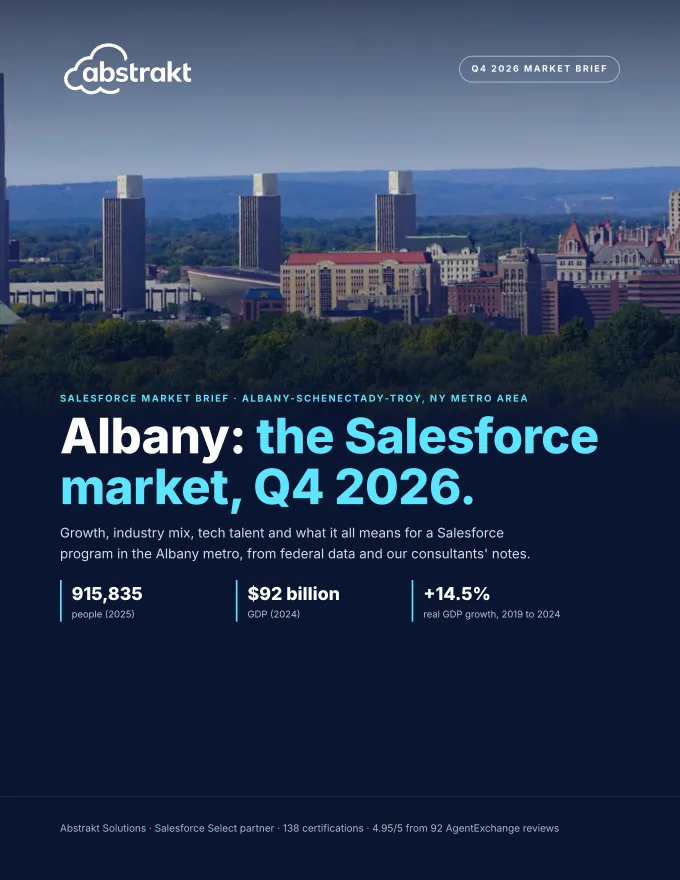
A free 23-page PDF with Albany's growth ranked against 100 metros, its industry mix, tech wages and nearby markets. It is offered on the public Albany page; send your customer there or get a copy for your own prep.
Get the Albany brief →Co-sell with Abstrakt in Albany
Working a Albany account? Bring in a named consultant for discovery, scoping or a health check. We reply within 4 business hours.