

How Salesforce work starts in Columbus
Central Ohio companies in insurance, banking, manufacturing and health care work with Abstrakt Solutions, a Salesforce Consulting Partner. Columbus is one of our focus markets.
What buyers here usually run into
- 1
Agent and member experience
Insurers and banks often run policy, account and service data in core systems that CRM can’t see. Integration decides whether agents get a full picture or another screen to check.
- 2
Supplier sales in long programs
Automotive and semiconductor suppliers sell into multi-year programs with many stakeholders. Opportunity and forecast design has to reflect program timelines, not simple deal stages.
- 3
Startups outgrowing spreadsheets
Young software firms tend to start with spreadsheets or a light CRM. A focused first implementation sets data habits before the team scales.
Budget, team and partner questions
What drives cost
Columbus scope usually turns on how deeply Salesforce must connect to policy, claims or loan systems, and whether service write-back is in scope or read-only views are enough. Consumer brands add cost through customer identity and consent design. Suppliers add program forecasting and ERP-based quoting.
Admin or partner
Insurers and banks headquartered here often have internal Salesforce teams and bring in a partner for integration, Agentforce or a new line of business. Startups and mid-sized suppliers more often rely on managed services until they can keep a specialist busy.
What buyers ask a partner
Ask how the partner handles policy administration integration and write-back, and how they keep one customer identity across service and marketing. Suppliers should ask to see an opportunity design built for multi-year programs.
The local economy and its biggest industries (4)
| Sector | Share of 2024 GDP | Where Salesforce fits |
|---|---|---|
| Finance and insurance Salesforce for insurance → | 11.4% | With insurance and banking headquarters in the city and One Columbus targeting insurtech and fintech, insurers, banks and lenders need agent and advisor workflows, member service and compliant marketing. |
| Manufacturing Salesforce for manufacturing → | 7.8% | With automotive, mobility and semiconductors on One Columbus’s target list and manufacturing producing about 7.8% of 2024 metro GDP, manufacturers and suppliers here need quoting, account planning and service tied to ERP. |
| Health care and social assistance Salesforce for health & life sciences → | at least 7.6% | One Columbus’s life sciences focus means health organizations here need provider and patient engagement, case management and service built around privacy. |
| Professional, scientific, and technical services Salesforce for professional services → | at least 6.8% | Software and technology startups around the new downtown hub and Ohio State, along with consulting and engineering firms, need a clean pipeline, renewals and project handoffs in one system. |
Source: U.S. Bureau of Economic Analysis, GDP by county (CAGDP2), 2024, summed to the metro area; private sectors only, excluding real estate and government. “At least” marks sectors where BEA suppresses some county figures.
Regional target sectors named by local economic development groups: Automotive + Mobility, Finance + Fintech, Insurance + Insurtech, Life Sciences, Semiconductors, Fashion + Retail.
Salesforce products that fit Columbus (6)
In the order we lead with them here, from the industries above.
Salesforce Financial Services Cloud
Industry CRM for wealth management, banking, insurance, and lending, built for compliance from the start.
Salesforce Sales Cloud
The CRM where sales pipeline lives, when it is built right.
Salesforce Service Cloud
The operating system for modern customer service, case, knowledge, voice, and AI agent assist together.
Salesforce Marketing Cloud
Cross-channel marketing, email, mobile, journey, and Data 360-powered personalization at scale.
Salesforce Experience Cloud
Customer, partner, and employee portals built on Salesforce.
Salesforce Revenue Cloud / CPQ
Configure-price-quote, billing, subscription management, and quote-to-cash on Salesforce.
AI for Columbus insurers, lenders, and retail brands
With finance and insurance at 11.4% of the Columbus metro's 2024 GDP, the region's service centers handle a steady stream of policy changes, payment questions, and claim updates. Many of those are routine enough for an agent to resolve against documented procedures, and the rest benefit from a case summary so the next person does not start cold. Retail and consumer brands, another Columbus strength, can pair Marketing Cloud segments with AI-written variations that a marketer approves before sending. Manufacturers tied to automotive supply chains tend to need forecasting support more than chat. What decides success is whether procedures are written down, customer identities are unified, and someone owns reviewing outputs each week.
- Policy change request resolution
- Approved AI campaign variations
- Supplier demand forecasting support
Services buyers here usually need (7)
Salesforce Implementation in Columbus
Central Ohio projects often pair a heavily regulated core, such as insurance or banking, with fast-moving startups and suppliers at the edges. Carriers, banks and health organizations need producer, household or patient structures settled before anything is configured, while younger software and supplier firms need a lean org that will not have to be rebuilt later. We run discovery workshops with each team that will use the system, agree the data model and security in writing, build in a sandbox, and phase releases so each team goes live on something it can use immediately.
By industry in Columbus
- 1
Insurance + Insurtech
One Columbus lists insurance and insurtech as a target sector, and finance and insurance is the Columbus metro's largest private sector by output. For carriers and insurtech startups, the first implementation decision is how producers, agencies, policies and policyholders relate to each other in Salesforce. We decide early whether Financial Services Cloud's insurance objects fit or a lighter Sales Cloud design will do, and we keep policy administration as the system of record so the CRM holds only the summaries agents actually read.
- 2
Automotive + Mobility
Automotive and mobility is another One Columbus target, and semiconductors sit on the same list. Tier suppliers selling into vehicle programs need opportunities that follow a program from sourcing through launch and annual volume, not a single close date. In implementation we model programs, platforms and part families as their own records, connect quotes to them and give account managers a forecast view that reflects award timing rather than the calendar quarter.
- 3
Life Sciences
Life sciences rounds out this list of One Columbus priorities, and the region's university research and innovation districts keep producing young companies in the field. A first Salesforce build for a device, diagnostics or research-services firm should separate commercial contacts from any clinical or patient information from day one. We set field-level security, consent tracking and record types for customer types before users are loaded, which is far easier than retrofitting privacy controls once a sales team has filled the org with data.
Raise before scoping
Write down the producer model
Insurance and banking implementations in Central Ohio often stall over whether an independent agent is an account, a contact or a partner user. Settle that definition with distribution and compliance leaders during discovery, because sharing rules, commissions reporting and any future portal all depend on the answer.
Keep the first release small
Startups in the region's new innovation hubs tend to buy more licenses than processes they have defined. Launch the core pipeline and account structure first, measure how people use it and add service, marketing or quoting once real habits exist to automate.
Book key stakeholders early
Discovery days are planned around your office calendar and the people who own each decision. Reserve full sessions with those stakeholders early; design choices made with everyone together rarely need to be reopened later.
Salesforce Integration in Columbus
Integration is often the deciding factor for Columbus Salesforce projects, because the region's largest businesses keep their real records elsewhere. Carriers rely on policy administration systems, banks on core platforms, and manufacturers on ERP for pricing and orders. We map which system owns each piece of data, choose MuleSoft, a packaged connector or custom Apex based on volume and change frequency, build error handling into every flow and hand over monitoring and a runbook, so a failed sync is caught by your team before anyone notices it on the phone.
By industry in Columbus
- 1
Insurance + Insurtech
Carriers and insurtech firms, a sector One Columbus actively recruits, depend on integrations to give agents and service staff a single view. Policy details, billing status and claims usually live in separate administration systems. We decide which fields agents truly need in Salesforce, sync summaries on a schedule or on demand, and keep write-back to the policy system limited and logged. That keeps the CRM fast and avoids turning it into a second, disagreeing copy of the policy record.
- 2
Semiconductors
Semiconductors are a One Columbus target, and a large chip fabrication project is under construction in New Albany with a start date that has moved more than once. Regional suppliers preparing for that work need Salesforce tied to ERP for certifications, quality documents, quotes and orders. We design those integrations so account and product data stays consistent across systems, and so supplier-qualification status is visible to sales without anyone copying spreadsheets between tools.
- 3
Health care and social assistance
Health care and social assistance contributed at least 7.6% of metro GDP in 2024, and integration is where health projects carry the most risk. Scheduling, EHR, billing and referral systems each hold part of the picture. We limit protected information to what staff need, use secure middleware with audit logging, and document exactly which system is authoritative for demographics, appointments and referral status, so privacy reviews can approve the design before build begins.
Raise before scoping
Name a system of record
For every shared entity, such as account, policy, product or order, agree in writing which Columbus system wins when data conflicts. Without that decision, integrations overwrite good data with stale values and teams stop trusting both systems at once. Revisit the decision whenever a new system joins the landscape.
Plan for core-system change windows
Banks and carriers schedule upgrades and freezes on their core platforms. Align integration testing and go-live with those windows, and confirm with the core-system owners that test environments hold realistic data before integration testing starts. A missed freeze can push a launch back by weeks.
Budget for monitoring after launch
An integration is not finished when the first sync succeeds. Alerts, logs and a named owner for failures must be in place, and someone should review error trends monthly, or small mapping problems quietly grow into missing orders and duplicate records.
Salesforce Migration in Columbus
Migration work in Columbus often comes from companies that grew past their first tools: software startups on spreadsheets or a starter CRM, retailers with customer data in several marketing platforms, and financial firms replacing an older CRM. The hard part is deciding what to bring. We inventory each source, agree field mappings with the people who use the data, deduplicate and standardize before loading, run trial loads in a sandbox with reconciliation, and plan a short freeze and cutover so teams move to Salesforce on a known date.
By industry in Columbus
- 1
Professional, scientific, and technical services
The professional, scientific and technical sector is a sizable one here, with a 2024 GDP share of at least 6.8%. Consulting, engineering and software firms often run client relationships from a mix of spreadsheets, email folders and a starter CRM chosen when the company was small. Migrating them means reconciling client names across sources, deciding how much historical activity is worth importing and preserving the link between past projects and current accounts, so partners see the whole relationship on the day they switch over.
- 2
Fashion + Retail
Fashion and retail companies, a One Columbus focus, rarely keep customer data in one place: storefront, loyalty and email platforms each hold a version. The key migration question is which profile wins when two disagree, and that rule has to be written down, along with how consent carries across, before loading. We treat consent as the first field to validate, because a migration that loses opt-outs creates a compliance problem immediately.
- 3
Finance + Fintech
Fintech startups and established lenders, both part of the finance and fintech sector One Columbus promotes, sometimes move from an older CRM or a homegrown database into Financial Services Cloud. Their data needs remodeling as well as moving: households, financial accounts and relationships replace flat contact lists. We map legacy records into those structures, keep sensitive identifiers out of the migration where they are not needed and reconcile counts by product type before go-live.
Raise before scoping
Decide what stays behind
Inactive accounts and years-old call notes rarely earn a spot in the new org. Set rules for inactive accounts, bounced contacts and years-old activity before mapping starts, and archive the rest somewhere searchable, so Columbus users begin with a clean system instead of an imported mess.
Clean data before loading
Deduplication and standardization are far cheaper in a staging file than inside Salesforce. Fix state codes, company names and phone formats first, then load, so duplicate rules and reports work correctly on the first day users log in. Keep the staging file as a record of every correction made.
Plan a real freeze window
During the final cutover, the old system must stop taking changes, or recent updates will be lost. Agree a short freeze with each team, communicate it in advance and have a delta load ready for anything entered during the transition.
Salesforce Optimization in Columbus
Most Columbus orgs we are asked to optimize were implemented competently and then changed by many hands. Banks added compliance fields, manufacturers bolted on quoting steps, and consulting firms created reports for every partner who asked. Optimization starts with usage data and interviews to find where people work around the system. We then remove clutter, consolidate automation into maintainable Flows, rebuild the dashboards leaders use and retrain each role on what changed, so the org feels lighter without losing the controls the business relies on.
By industry in Columbus
- 1
Finance + Fintech
Finance and fintech is a One Columbus target, and finance and insurance leads the metro's private sectors at about 11.4% of 2024 GDP. Banking orgs accumulate required fields and approval steps with each audit, until relationship managers log activity elsewhere and enter it later. Optimization here means asking which controls are truly required, moving the rest to background automation and giving bankers a streamlined record page, so compliance holds while the time spent in Salesforce drops noticeably.
- 2
Manufacturing
Factories and suppliers generated 7.8% of Columbus metro GDP in 2024, ranking just behind finance and insurance. Plant and supplier sales teams often have Salesforce quoting built years ago, layered with workflow rules and Process Builder automations that now fire in unpredictable order. We inventory that automation, rebuild it as a small set of documented Flows and simplify the quote path so reps and inside sales can price a part without calling an admin for help.
- 3
Professional, scientific, and technical services
Consulting, engineering and software firms around Columbus usually adopt Salesforce for pipeline and then stretch it to cover projects, resourcing and renewals. The result is dashboards that disagree with the finance system and partners who stop trusting forecasts. Optimization rebuilds reporting around the few numbers leaders actually use, cleans up opportunity stages so they mean one thing, and cuts fields nobody fills in, which is usually enough to bring partners back into the system.
Raise before scoping
Start with usage data
Columbus teams vote with their clicks: which pages they skip, which fields stay blank and which reports nobody opens, often long before anyone complains aloud. Pull that data before the first interview, so conversations focus on real behavior rather than complaints about whichever screen annoyed someone that week.
Retire legacy automation deliberately
Salesforce no longer supports legacy workflow rules or Process Builder, and new automation belongs in Flow. Plan the move of any that remain to Flow as part of optimization, testing each rewritten automation against real records, rather than waiting until a failure turns cleanup into an emergency. Document what each new Flow replaces as you go.
Agree metric definitions first
If bookings mean one thing to finance and another to sales, no rebuilt dashboard will settle arguments in the Monday meeting. Get those definitions signed off by each function before reports are rebuilt, otherwise the new dashboards will be questioned just like the old ones. Publish the agreed definitions where every report user can find them.
Salesforce Managed Services in Columbus
Managed services in Columbus tends to serve two kinds of client: financial and health organizations with mature, heavily governed orgs, and retail or technology companies whose Salesforce grew faster than their admin capacity. In both cases the work is steady rather than dramatic. We run a shared request queue, test every Salesforce release in a sandbox against your customizations, watch integrations for failures, and deliver a monthly set of improvements agreed with the business owner, so the org keeps up with how the company is changing.
By industry in Columbus
- 1
Finance and insurance
BEA's 2024 figures put banking, lending and insurance at 11.4% of Columbus metro output, the top private sector. Banks, lenders and carriers here change products, rates and disclosure language often, and every change touches validation rules, email templates and permissions. A managed services team handles those updates through a documented change process, keeps an audit trail compliance staff can review and tests each change in a sandbox, so a new product launch does not wait behind an admin's other priorities.
- 2
Fashion + Retail
One Columbus counts fashion and retail among the sectors it recruits and supports. Retail teams live on the marketing calendar: seasonal campaigns, loyalty changes and store openings all create Salesforce work with fixed dates. Under managed services we plan that backlog around the calendar, build journeys and segments ahead of each season and monitor the order and customer-data feeds that personalization depends on, instead of scrambling the week a campaign launches.
- 3
Health care and social assistance
Health organizations give Columbus a large health sector with constant process change. Referral rules, intake forms and consent handling are updated regularly, and each update can expose data to the wrong users if made carelessly. Our managed services work routes those changes through permission review and sandbox testing, keeps a record of who approved what and checks each seasonal Salesforce release for effects on case and patient-related data.
Raise before scoping
Separate run work from roadmap
Columbus teams often let small requests consume every hour while larger projects slip. Agree a split up front, such as a fixed share for tickets and the rest for planned improvements, and review it monthly so neither side of the work is starved.
Map approvals for regulated changes
Banks, insurers and health organizations usually need compliance or privacy sign-off on certain changes. List which types of change need approval and from whom, so the managed services team can move routine work quickly and route sensitive items correctly. Revisit the list whenever regulators or internal policy add a requirement.
Hand over integration credentials cleanly
Policy, core banking and order systems often connect through accounts set up by people who have since left. Inventory those connections and the service users behind them when managed services begins, so monitoring and fixes are not blocked by unknown passwords or expired certificates.
Salesforce Health Checks in Columbus
Before Columbus companies spend more on Salesforce, a health check tells them plainly what they already own. Financial and insurance firms here usually want assurance on access and data exposure, while manufacturers and life-sciences companies want to know whether years of customization will support new features. Our reviewers go through permission sets, sharing, Flows and Apex, integrations and data quality, then speak with several users and hand over a ranked list of findings, each with an effort estimate. You can act on it yourselves, with us or with another partner.
By industry in Columbus
- 1
Finance and insurance
Banks, carriers and lenders across Central Ohio face regular audits, and Salesforce is increasingly in scope. A health check for them concentrates on who can see and export client data: profiles with broad permissions, users who changed roles years ago, integration accounts with admin rights and reports shared too widely. We document each exposure with a suggested fix, so risk and compliance teams can close issues before an examiner or internal auditor finds them first.
- 2
Life Sciences
Life-sciences companies, a One Columbus target, often run Salesforce for commercial teams while clinical and quality processes sit elsewhere. Over time, fields and objects creep in that hold information those systems should own. A health check traces where sensitive data has landed, confirms consent and field-level security work as intended and flags customizations that would complicate adding Health Cloud or AI features later on. Findings are written so quality and regulatory staff can follow them.
- 3
Manufacturing
Manufacturers in the Columbus region tend to have orgs shaped by a decade of quoting, distributor and service changes. The health check inventories automation for overlap, finds Apex code without tests or owners and measures how many fields go unused. That technical-debt picture tells leaders whether the next investment should be a new capability or a cleanup phase, which is especially useful before committing to Agentforce or Data 360 (formerly Data Cloud). Integration users tied to ERP are reviewed too.
Raise before scoping
Audit before adding AI
AI features act on whatever data and permissions already exist. If a Columbus org has duplicates, stale records or overly broad access, AI will surface those problems to more people. A health check establishes whether the foundation is ready before licenses are signed.
Include integration accounts
Service users created for policy, banking or ERP connections are easy to forget and often hold far more access than they need. Make sure the review covers every integration user, its permissions and whether its credentials are still managed by anyone in the company.
Plan who acts on findings
Findings that belong to nobody tend to sit untouched in a shared folder. Before the review starts, decide who will triage the findings, which fixes internal staff can handle and what budget exists for the rest, so high-risk items are closed within weeks rather than left in a document.
Salesforce Implementation Rescue in Columbus
Rescue projects in Columbus often trace back to the region's growth: companies scaling quickly, program deadlines that would not move, and partners who staffed the first phase well and the later ones thinly. Step one is reading the org, the signed scope and user complaints side by side. Defects that block orders, cases or quotes get patched ahead of any redesign conversation. From there, every piece of the build receives a verdict of keep, repair or replace, and the unfinished scope is delivered in phases, documented for your own staff.
By industry in Columbus
- 1
Automotive + Mobility
Automotive and mobility suppliers, a One Columbus target, sometimes buy Salesforce to manage program pursuits and end up with a generic opportunity pipeline that ignores awards, volumes and launch timing. Sales teams return to spreadsheets within months. Our rescue work reshapes the data model around programs, keeps whatever account and contact data is sound and reconnects quoting so the forecast reflects what engineering and purchasing actually commit to. Reps test each rebuilt step before it replaces their spreadsheets.
- 2
Health care and social assistance
Health organizations in Columbus call us when a Service Cloud or intake project has launched with gaps, such as missing referral steps, confusing queues or sharing rules that expose too much. Staff lose confidence quickly when patient-related information appears in the wrong place. Recovery starts with access fixes and a privacy review, then rebuilds the intake and case flow with frontline staff testing each step before it returns to production.
- 3
Insurance + Insurtech
Carrier and insurtech projects stall most often at the integration with policy administration or at a producer portal that never reached launch. We test what the integration really does, stabilize the feeds agents rely on and decide whether the portal can be finished or should be rescoped. The aim is a working agent experience first, with policyholder features added once the foundation behaves reliably. Agents and underwriting staff help test every fix before it is released.
Raise before scoping
Stabilize before you extend
When a Columbus project is behind, the temptation is to add the missing features quickly. Fix the defects blocking daily work first, then extend, because new features built on a broken base create the next round of problems and erode what trust users have left.
Separate scope from quality issues
Some complaints come from features that were never in scope; others come from features built badly. Sort them against the original statement of work early, so budget conversations with sponsors and the previous partner rest on facts rather than frustration.
Plan a proper relaunch
Users who struggled with the first launch will not simply return. Treat the relaunch like a go-live, with role-based training, visible fixes to their top complaints and a named person to take feedback, so the second attempt earns back their time.
Industry plays in Columbus (4)
Salesforce for Columbus Insurers and Insurtechs
Columbus insurers tend to run large service and distribution operations alongside a growing layer of digital products. Salesforce ties those together: agents and call center reps work from one policyholder record, online quote journeys hand off cleanly to a licensed person when a customer stalls, and claims updates reach customers without a phone call. We build on Financial Services Cloud, connect policy, billing and claims platforms, and help carriers and insurtechs launch new products without bolting another standalone system onto the stack.
Central Ohio leans on money and risk more than on any other private activity, with finance and insurance producing 11.4% of Columbus-area output in the Bureau of Economic Analysis's 2024 county tables. One Columbus lists insurance and insurtech as its own target sector, separate from finance and fintech, which signals how central carriers and their technology partners are to the regional economy. A downtown innovation hub for software and advanced-technology startups opened in 2026, adding to a pipeline of young firms that sell into or compete with established insurers.
Use cases to open with
- 1
Digital quote with human handoff
Customers increasingly start a quote online and abandon it halfway. Salesforce can capture each partial quote as a lead with the answers already given, route it to a licensed agent by state and line of business, and trigger a follow-up email or text through Marketing Cloud. Agents pick up the conversation with full context, and product teams learn exactly which questions cause people to drop out.
- 2
Enablement for captive agents
Carriers with exclusive agents need to push leads, campaigns and product updates to many small offices spread across the state. Experience Cloud gives each agency a portal with its leads, policies up for renewal, marketing materials and commission statements. Field managers track agency performance and coaching in Financial Services Cloud, and home office sees which campaigns turn into written premium by territory.
- 3
Claims communication at scale
After a hailstorm or a large loss event, claim volume can multiply overnight. Service Cloud routes first notice of loss, status inquiries and document uploads into prioritized queues with policy details attached, while automated updates tell policyholders what happens next. Adjusters spend less time returning status calls, and supervisors see backlog by adjuster, severity and region in one dashboard, which helps them decide quickly when to bring in outside adjusting help.
Raise before scoping
Coordinate with core modernization
Many carriers are replacing policy or claims platforms at the same time they adopt Salesforce. Sequence the work so Salesforce integrates with stable interfaces, avoid building to a system that is about to be retired, and keep an integration layer that can swap back ends later.
Govern marketing consent carefully
Insurance marketing is subject to state rules, telemarketing limits and privacy expectations. Capture consent by channel and purpose, keep suppression lists in sync with source systems, and have compliance approve journey templates. Our role is building the settings, while interpreting the rules stays with your attorneys.
Keep insurtech builds flexible
Startups change products and pricing quickly. Favor configuration over custom code, keep the data model close to Financial Services Cloud standards, and document decisions so new hires can extend the org as the company grows instead of rebuilding it after the next funding round.
Salesforce for Columbus Lenders
For Columbus lenders, Salesforce is most valuable before and after the loan origination system does its work. It captures leads from realtors, builders and digital channels, keeps loan officers on top of each borrower until application, and brings closed borrowers back for refinance, home equity or other products later. We integrate it with the origination system so milestones appear automatically, and we design consent, disclosure and marketing controls around consumer lending rules.
Mortgage and consumer lending in Columbus sit within finance and insurance, the metro's largest private industry at 11.4% of 2024 GDP in Bureau of Economic Analysis county figures; the data does not break lending out on its own. One Columbus targets finance and fintech as a named sector, and a downtown startup hub for software companies opened in 2026. Retail trade adds 6.5% of GDP and fashion and retail is another regional target, a consumer-heavy mix in which purchase mortgages and personal credit matter to local and national lenders alike.
Use cases to open with
- 1
Referral partner management
Purchase business depends on realtors, builders and financial advisors who send borrowers your way. Financial Services Cloud tracks each partner, the referrals they send, the loans that close and the co-marketing you do together. Loan officers see which relationships need attention, and managers can compare partner productivity across branches and loan officers without asking for weekly spreadsheets from each team.
- 2
Pipeline from lead to close
Borrowers often talk to a loan officer weeks before applying. Salesforce captures those early conversations and pre-qualification details, then pulls application, lock, underwriting and closing milestones from the origination system. Leaders see the whole funnel, from first contact to funded loan, and can spot where applications stall, whether in documentation, appraisal or conditions clearing. Loan officers also get reminders when a pre-qualified borrower goes quiet for too long.
- 3
Lifetime borrower marketing
A closed loan is the start of a long relationship. Data 360 (formerly Data Cloud) can combine loan, servicing and deposit data to flag borrowers who may benefit from a refinance, home equity line or new product, and Marketing Cloud sends compliant, consent-aware outreach. Loan officers get alerts when a past client re-engages, so repeat business stays with your institution rather than going elsewhere.
Raise before scoping
Integrate the origination system
The loan origination system remains the source of truth for applications and disclosures. Decide which milestones and fields sync to Salesforce, how often, and whether updates ever flow back. Test with real loan files so status timing matches what loan officers expect.
Build compliance into outreach
Consumer lending brings GLBA privacy obligations, fair lending expectations and telemarketing rules. Record consent by channel, keep marketing lists free of protected-class targeting, and have compliance review every journey and template before it goes live. We implement controls; your compliance team owns the interpretation.
Separate retail and partner views
Banks and credit unions often run mortgage, consumer lending and deposits on different teams. Design sharing and record types so loan officers see what they need without exposing unrelated account data, and so referral partners in a portal see only their own referrals.
Salesforce for Columbus Manufacturers
For Columbus manufacturers, winning business often depends on getting qualified by a large customer and staying ready while that customer's schedule shifts. Salesforce can track qualification steps, audits and sample approvals alongside the commercial pipeline, then manage program volumes and quotes once parts are awarded. We link it to ERP for costs, orders and shipments, and set up service for customers who need corrective actions or field support, so sales, quality and engineering share one account history.
Manufacturing contributed 7.8% of 2024 Columbus metro GDP in BEA county figures, the second-largest private sector behind finance and insurance at 11.4%. One Columbus targets automotive and mobility and, newer to the list, semiconductors. Vehicle production has deep roots in the region, while the semiconductor industry is newer here. For local suppliers that means two very different customers: established vehicle programs with steady volumes, and a semiconductor supply chain that is forming slowly and requires long qualification before any purchase order.
Use cases to open with
- 1
Supplier qualification pipeline
Before a large customer buys, suppliers pass capability reviews, site audits, first-article inspections and paperwork checks. Salesforce can track each qualification as a staged project tied to the opportunity, with documents, owners and customer contacts attached. Leaders see which prospects are close to approval and which have stalled, and engineering knows what evidence to prepare next instead of rebuilding it from old email threads.
- 2
Automotive program forecasting
Parts awarded for a vehicle platform ship for years, but volumes rise and fall with customer schedules. Sales Cloud or Manufacturing Cloud can store program awards with annual volumes and pricing, compare forecasts with ERP shipments, and flag gaps early. Account managers bring accurate numbers to quarterly customer reviews, and planners see demand changes before they hit the plant floor.
- 3
Corrective action and field support
When a customer reports a defect or requests on-site help, the response involves quality, engineering and sometimes technicians. Service Cloud can open a case tied to the part, lot and customer program, track containment and corrective action steps, and schedule field visits through Field Service. The account team sees every open quality issue and its status before the next pricing or program conversation with that customer.
Raise before scoping
Plan for shifting timelines
Semiconductor and vehicle programs move, sometimes by years. Design opportunity stages, close dates and forecast categories so delayed programs stay visible without distorting this year's numbers, and review aging opportunities in a regular cadence rather than letting stale dates pile up.
Quality records stay governed
Inspection results, PPAP packages and corrective actions often belong in a quality management system with controlled documents. Link to those records from Salesforce, surface status and due dates on the account, and avoid storing controlled documents twice where versions can drift apart.
ERP drives cost and orders
A supplier quote built on last quarter's resin or steel price can lose money on every part shipped. Pull standard costs, material surcharges and order history from ERP, decide how often they refresh, and require approvals when a quote departs from margin rules, so sales and finance argue less about numbers.
Salesforce for Columbus Health Care and Life Sciences
In Columbus, health care includes both bedside care and a large business-to-business side: distributors, pharmacy services and technology firms selling to hospitals and pharmacies. Salesforce fits each differently. Hospital and clinic groups lean on it for scheduling queues, referral follow-up and reminder campaigns fed by the EHR. Distribution and services companies use it to manage pharmacy and hospital accounts, order questions and service requests. Life sciences ventures track partners, trials and investors. We design each org around who the customer is and what data must stay protected.
Care providers and social service agencies generated no less than 7.6% of Columbus-area output in 2024 by BEA's count, ranking third among private industries, with banks and insurers first and factories second. One Columbus names life sciences among its target industries, and health care distribution is part of the region's corporate headquarters base. The state university's west-campus innovation district is planned to cover more than 270 acres and deliberately mixes entrepreneurial, corporate, academic and health care communities. Together these point to a health economy where supply chain, research and care delivery sit close together.
Use cases to open with
- 1
Pharmacy and hospital accounts
Distributors and pharmacy services companies manage very large numbers of customer locations, each with its own contracts, ordering patterns and recurring service issues. Salesforce can model health systems, their hospitals and pharmacies as account hierarchies, give account managers order and contract data from ERP, and track business reviews. Service Cloud handles order discrepancies, returns and product questions with routing by customer segment.
- 2
Patient scheduling and outreach
Providers run preventive reminders, post-discharge calls and specialty scheduling across many sites. Service Cloud can consolidate those contacts into queues with EHR appointment data, Marketing Cloud can send consented reminders, and Agentforce can handle simple rescheduling within approved rules. Care teams spend less time on phone tag and can see outreach results, such as completed screenings or missed follow-ups, by clinic and service line.
- 3
Venture and research partnerships
Life sciences startups and research groups around the innovation district juggle sponsors, collaborators, investors and pilot sites. Sales Cloud can track those relationships and milestones, and an Experience Cloud space can share documents with outside partners securely. As a venture moves from grants and pilots toward commercial sales, the same org carries forward every earlier conversation, agreement and contact, so nothing depends on a founder's inbox.
Raise before scoping
Account hierarchies at scale
Health systems buy through parent organizations, group purchasing arrangements and individual sites. Model those levels before data migration, decide which one owns pricing and contracts, and test reporting at full volume so managers can roll results up without slow dashboards.
Controlled products and privacy
Distribution and pharmacy data can include regulated products and, sometimes, patient details. Identify what is subject to HIPAA or product-tracing rules, keep it in restricted objects or source systems, and review the design with compliance before connecting order or dispensing feeds.
EHR remains clinical record
For providers, Salesforce should hold engagement data such as outreach, preferences and referral status, while diagnoses and notes stay in the EHR. Define that boundary in writing, integrate only what staff need for their work, and revisit it before adding any AI features.
Case studies to send (3)
From the industries this market leans on. Client names are anonymized and these projects are not specific to Columbus.
The Columbus Salesforce market brief, Q4 2026
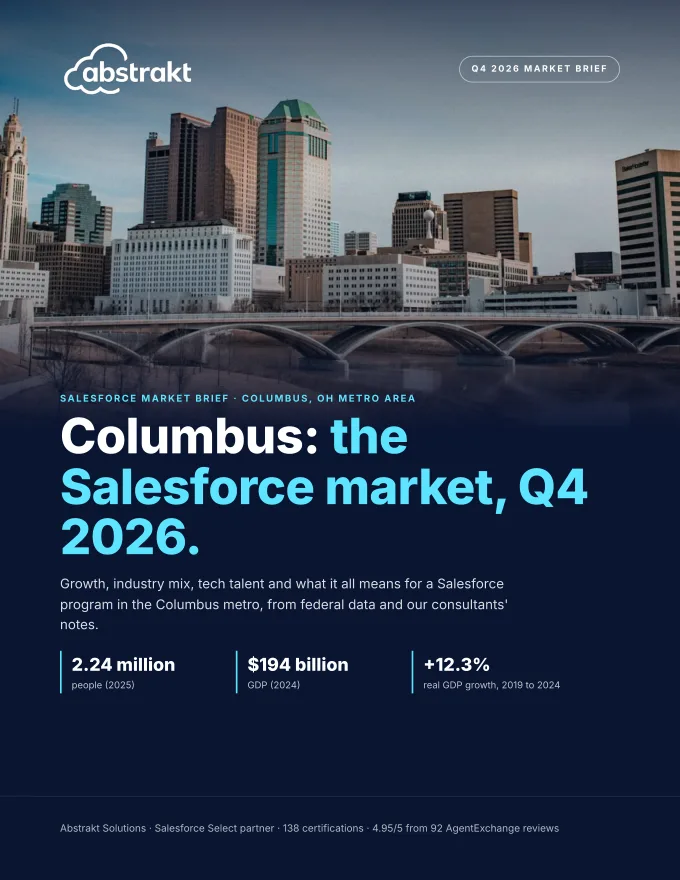
A free 24-page PDF with Columbus's growth ranked against 100 metros, its industry mix, tech wages and nearby markets. It is offered on the public Columbus page; send your customer there or get a copy for your own prep.
Get the Columbus brief →Co-sell with Abstrakt in Columbus
Working a Columbus account? Bring in a named consultant for discovery, scoping or a health check. We reply within 4 business hours.