

How Salesforce work starts in Washington, DC
Abstrakt Solutions is a Salesforce Consulting Partner for government contractors, associations and professional services firms across the Washington, DC metro, in the District, Northern Virginia and suburban Maryland. Washington, DC is one of our focus markets.
What buyers here usually run into
- 1
Capture and pursuit management
Contract pursuits run for months or years with teaming partners and formal gates. Standard opportunity stages usually need adapting.
- 2
Security expectations
Organizations near government work expect tight permissions, audit and careful integration design, which suits a health check before any expansion.
- 3
Member and stakeholder engagement
Associations, nonprofits and advocacy groups need Salesforce for members, donors and campaigns rather than a classic sales pipeline.
Budget, team and partner questions
What drives cost
Washington costs rise with sharing and audit design, the effort to model contract vehicles, task orders and teaming relationships, and whether sensitive data pushes the project toward Government Cloud. Integration with project accounting is a common second phase and should be scoped on its own.
Admin or partner
Contractors and associations here often have one admin or a small business systems group. A partner usually handles capture or membership model design, security review and integrations, while internal staff own user support and the release calendar.
What buyers ask a partner
Ask for capture management and association references, how the partner documents permissions for a security review, and whether they have worked in Government Cloud. Ask to meet the assigned people before signing.
The local economy and its biggest industries (4)
| Sector | Share of 2024 GDP | Where Salesforce fits |
|---|---|---|
| Professional, scientific, and technical services Salesforce for professional services → | at least 17.8% | Consulting firms, IT services companies and government contractors track long pursuits, teaming partners and contract vehicles. Salesforce works well here when opportunities, capture plans and relationships sit in one place. |
| Information Revenue Cloud / CPQ → | 6.4% | Software, telecom, media and data companies need subscription sales, renewals and service tied together. |
| Health care and social assistance Salesforce for health & life sciences → | at least 5.1% | Health systems and healthcare services organizations use Salesforce for patient engagement, referral management and service, designed around privacy requirements. |
| Finance and insurance Financial Services Cloud → | 4.9% | Lenders, banks and financial services firms need relationship views, onboarding and compliant marketing at scale. |
Source: U.S. Bureau of Economic Analysis, GDP by county (CAGDP2), 2024, summed to the metro area; private sectors only, excluding real estate and government. “At least” marks sectors where BEA suppresses some county figures.
Regional target sectors named by local economic development groups: Technology, Education & Research, Consulting & Business Services, Communications & Design, Life Sciences, Retail.
Salesforce products that fit Washington, DC (6)
In the order we lead with them here, from the industries above.
Salesforce Sales Cloud
The CRM where sales pipeline lives, when it is built right.
Salesforce Service Cloud
The operating system for modern customer service, case, knowledge, voice, and AI agent assist together.
Salesforce Experience Cloud
Customer, partner, and employee portals built on Salesforce.
Salesforce Marketing Cloud
Cross-channel marketing, email, mobile, journey, and Data 360-powered personalization at scale.
Salesforce Agentforce
AI agents that handle real work inside Sales Cloud, Service Cloud, and Marketing Cloud.
Tableau
Executive analytics, embedded dashboards, and CRM Analytics built on Tableau.
Realistic AI for Washington's services economy
In the Washington region, BEA puts consulting, engineering, research, and similar technical firms at no less than 17.8% of 2024 output. For consulting, research, and contracting firms, the practical AI wins sit in the pipeline: scoring inbound opportunities, pulling key terms out of solicitation documents, and preparing account briefs before a capture meeting. Information and health care organizations lean more toward knowledge-grounded self-service for members and subscribers. Each depends on groundwork that is easy to skip. Opportunity stages have to mean the same thing to every team, sensitive records need tight access controls, and a reviewer should read anything an agent drafts before it goes to a client or agency contact.
- Solicitation document reading
- Opportunity scoring and triage
- Member self-service from knowledge
Services buyers here usually need (7)
Salesforce Implementation in Washington, DC
Implementation in the Washington, DC metro is shaped by professional services and the government market. Pursuits last months or years, involve teaming partners and contract vehicles, and pass through formal gates, so standard opportunity stages rarely fit unchanged. Security expectations are also higher than in most markets. We design the pursuit model, the sharing model and any controlled-data boundaries first, build in a sandbox, and roll out in phases, with capture, contracts and security leads signing off each one.
By industry in Washington, DC
- 1
Professional, scientific, and technical services
Professional, scientific and technical services contribute at least 17.8% of metro GDP, the largest private sector by a wide margin. For consulting, engineering and IT services firms, implementation starts with the pursuit record: capture stages, bid decisions, teaming partners and the contract vehicle each opportunity sits under. We then connect wins to delivery planning, so leaders see pipeline and staffing together. Getting these objects right in design saves a costly remodel once the firm's reporting depends on them.
- 2
Information
Software, telecom, media and data companies make up the information sector, about 6.4% of 2024 metro GDP. Implementing Salesforce for them usually means one model for subscriptions, renewals and service, so account teams see contract terms, usage signals and open cases together. We plan the handoff from sales to onboarding and support during design, and decide early whether quoting and billing need Revenue Cloud or whether Sales Cloud with an integration to the existing billing platform is enough.
- 3
Education & Research
The Washington DC Economic Partnership lists education and research among the District's target sectors. Universities, research institutes and policy organizations implementing Salesforce must represent people in several roles at once: student, graduate, donor, research collaborator, event speaker. We design one person model with a clear owner for each field, then phase the rollout department by department, because each school or center usually has its own processes and its own reasons for resisting a shared system.
Raise before scoping
Design for teaming partners
Washington-area pursuits often include primes, subcontractors and joint ventures that change from bid to bid. Model teaming relationships as their own records linked to opportunities, and decide which partners, if any, get portal access, before the security model is locked.
Set controlled-data boundaries early
If controlled unclassified information or other sensitive government data might enter Salesforce, decide during design whether it belongs in a separate environment such as Government Cloud. Moving it later means migrating data and rebuilding security, which is far harder than choosing the right home initially.
Assign approvers for every pursuit gate
Pursuit reviews stall when nobody is sure who approves a bid decision in Salesforce. Assign an owner to each gate, record approvals on the opportunity, and test the approval path with capture leads before launch, so decisions are never held up waiting for the right signature.
Salesforce Health Checks in Washington, DC
Health checks in the Washington, DC area are often requested by security or compliance staff as much as by sales leaders. We review profiles, permission sets, sharing, login policies, integration users, encryption, event monitoring, automation, custom code, unused customization and data quality, then interview users to find the workarounds metadata cannot show. Each item gets a risk rating and a rough effort level. For organizations considering Agentforce, the review also tests whether the data and permissions an agent would use are ready.
By industry in Washington, DC
- 1
Professional, scientific, and technical services
Consulting and contracting firms often accumulate access exceptions: capture staff granted broad visibility for one bid, partners given portal access that never expired, and administrators sharing a single powerful login. A health check lists every one, compares access with each role's actual need, and reviews how pursuit and contract data is protected. The ranked findings give security officers and practice leaders a remediation plan they can present to clients who ask how their information is handled.
- 2
Health care and social assistance
Health and social service organizations need assurance that protected information in Salesforce is limited and controlled. We identify which objects and fields carry such information, check encryption and field history settings, review who can export or report on it and confirm that consent is captured consistently. Findings are framed so privacy officers can compare them with their policies and decide on fixes, since a configuration review supports compliance but does not certify it.
- 3
Technology
Technology firms in the District, where the Washington DC Economic Partnership highlights a strong cybersecurity cluster, are often held to the standards they sell. A health check reviews their own org against least-privilege access, multifactor login, session policies and monitoring of unusual activity. We also look for unused packages and code with weak test coverage, then rank findings so the security team can close the gaps a customer due-diligence questionnaire would expose.
Raise before scoping
Review access after reorganizations
Washington-area firms reorganize around new contracts, vehicles and practices regularly, and permission sets rarely shrink afterward. Compare each user's access with their current role, remove leftovers from old teams and move from profile-based to permission-set-based access where that simplifies future reviews.
Check portal and partner exposure
Experience Cloud sites for members, teaming partners or clients can expose more than intended through guest user settings or sharing sets. Test each site as an outside user would see it, and confirm that records, files and reports are visible only to the right audiences.
Measure data readiness for AI
An agent answering member questions or summarizing pursuits depends on complete, current records. Measure duplicates, empty key fields and stale data on the objects it will use, and fix the worst gaps before any pilot, so early results are not undermined by poor inputs.
Salesforce Managed Services in Washington, DC
Washington-area clients ask a managed team for governance first and extra hands second. Contractors, associations and financial firms need a record of who approved each change, predictable release testing and permissions that do not drift as staff turn over. We run one prioritized backlog, handle administration and Flow work, bring in developers and architects when a request calls for them, and document every change. Salesforce releases are tested in a sandbox first.
By industry in Washington, DC
- 1
Consulting & Business Services
Consulting and business services is among the target sectors the Washington DC Economic Partnership names for the District. Firms in it reorganize practices, add contract vehicles and reshuffle capture teams often, and each change becomes a Salesforce request. Managed services keeps those changes consistent: new vehicles added using the established model, pursuit stage changes tested against win-rate reports, and access updated promptly when staff join or leave a capture team.
- 2
Health care and social assistance
At least 5.1% of metro GDP comes from health care and social assistance. Health systems, home care providers and social service organizations running Salesforce need ongoing changes that respect patient privacy. Our managed service documents approvals for access changes, keeps encryption and field history settings intact through releases, and tests referral and intake flows before each update. Requests from clinical and outreach teams are prioritized alongside compliance work rather than in a separate queue.
- 3
Communications & Design
Communications and design firms, another District target sector, usually run Salesforce alongside marketing automation and project tools. Ongoing support for them covers campaign and client reporting, integration upkeep between Marketing Cloud and the CRM, and new fields or dashboards as client work and reporting needs evolve. We keep data definitions consistent so account teams and leadership read client profitability and pipeline the same way, even as the services the firm offers change.
Raise before scoping
Document every approval
Washington-area clients near government work are regularly asked to show who changed what. Require ticket approvals, change descriptions and deployment records as a standard part of the service, so the evidence exists before an auditor or contracting officer asks for it.
Offboard users promptly
High staff turnover in consulting and advocacy organizations leaves active accounts behind. Build user deactivation, license reassignment and record ownership transfer into the managed service routine, tied to your HR process, so former staff lose access the day they leave.
Align releases with busy seasons
Associations have conference and renewal peaks; contractors face proposal surges near the federal fiscal year-end. Share those calendars with the managed services team so major deployments avoid those windows and release testing finishes well before the busiest weeks of the year begin.
Salesforce Integration in Washington, DC
Integration in the Washington, DC area most often links Salesforce to project accounting or ERP for contractors and consultancies, to membership and event platforms for associations, and to billing and product systems for information companies. The goal is usually funded backlog, invoices, memberships or usage beside the pipeline. We map systems and owners, choose a pattern and tool, give each integration user the narrowest access that works, and set up alerting and logs, which security teams near government work generally expect to review.
By industry in Washington, DC
- 1
Professional, scientific, and technical services
Government contractors and consulting firms need Salesforce connected to project accounting so capture leaders see what happens after a win: contract value, funding, burn and remaining ceiling. Integration typically sends awarded opportunities to the accounting system as projects and returns financial status to Salesforce on a schedule. Because contract data can be sensitive, we limit what is replicated, keep an audit trail on synchronized fields and document the flow for internal security review.
- 2
Life Sciences
Life sciences is one of the District's target sectors named by the Washington DC Economic Partnership. Companies in it connect Salesforce to research, grant, regulatory and quality systems, and each connection raises questions about sensitive data. We design integrations that move only what commercial, partnership or medical affairs teams need, keep identifiable health information out unless the privacy design supports it, and log every transfer so quality and compliance teams can trace records.
- 3
Retail
Retail appears among the Washington DC Economic Partnership's target sectors. Retailers and consumer brands in the District typically want commerce, loyalty and point-of-sale data to meet customer service in one place. Integration brings order and loyalty history into Service Cloud, synchronizes consent and preferences with Marketing Cloud, and keeps high-volume transaction data summarized rather than copied line by line. That keeps service agents informed without overloading Salesforce storage or API limits.
Raise before scoping
Scope integration users narrowly
Security reviewers in the Washington area will ask what each integration account can reach. Give every connection its own user with only the objects and fields it needs, rotate credentials on a schedule and record the owner of each account.
Keep controlled data in place
When contract or program data may be sensitive, decide which system is authorized to hold it before building flows. Often the right answer is to show a summary in Salesforce and leave the detail in the accounting or program system of record.
Document flows for reviewers
Clients, auditors and internal security staff near government work often request diagrams of how data moves. Produce a current data flow diagram, field mapping and error-handling description as part of the integration, and update all three whenever a flow changes.
Salesforce Optimization in Washington, DC
Optimization in the Washington, DC metro often starts with a pipeline that does not reflect how work is won. Capture managers track pursuits in spreadsheets because stages, gates and teaming records do not match the process, so leadership forecasts from side documents. We measure usage, interview capture, business development and delivery staff, then simplify layouts, rebuild stages around your gate reviews, consolidate automation and rebuild dashboards, in Tableau where that fits. Short, role-based training closes each round of changes.
By industry in Washington, DC
- 1
Information
Software, data and media companies in the region often find that renewals and expansion live outside Salesforce because the org was built for new-logo sales. Optimization brings renewal opportunities, usage signals and support history onto the account, trims fields that only mattered to an older sales motion, and rebuilds retention dashboards. Customer success and sales then work from the same account view instead of reconciling separate spreadsheets before every quarterly business review.
- 2
Technology
The Washington DC Economic Partnership counts technology among the District's target sectors and points to its cybersecurity strength. Technology firms here tend to accumulate sales tools faster than they retire them. We map which tools write to Salesforce, remove duplicate activity logging, consolidate lead routing and fix the conversion and attribution reports that marketing and sales argue over. Pipeline reviews then begin from one agreed set of numbers rather than several competing exports.
- 3
Finance and insurance
Finance and insurance contributes about 4.9% of metro GDP, with lenders, banks and financial services firms concentrated in Northern Virginia. Their orgs often carry duplicate client records from several origination channels and marketing lists, which undermines relationship views and compliant outreach. Optimization merges duplicates with agreed matching rules, standardizes consent fields, tightens layouts for relationship managers and rebuilds the referral and pipeline reports that leaders use in their weekly meetings with branch teams.
Raise before scoping
Rebuild stages around gate reviews
Capture processes in Washington often use formal gates such as bid/no-bid and color-team reviews. Align opportunity stages with those gates and record each decision on the record, so win-rate and pipeline reports reflect real progress and reviews can be audited later.
Separate members from customers
Associations that use Salesforce for both sponsorship sales and membership often blend the two in one account model. Clarify how members, sponsors and exhibitors are represented before cleanup, or reports on renewals and revenue will keep double-counting the same organizations.
Choose one reporting home
Some Washington organizations report from Salesforce dashboards, Tableau and spreadsheets all at the same time. Decide which metrics live where, retire duplicate reports and document each definition, so board and leadership packages stop presenting slightly different numbers for the same measure each month.
Salesforce Migration in Washington, DC
Migrations in the Washington, DC metro frequently involve records with rules attached: consent for members and donors, privacy for patients, and handling restrictions for government-related data. We inventory each source, classify data by sensitivity, agree mappings and what should stay behind, deduplicate people who appear in several roles, then run trial loads in a sandbox with reconciliation. The cutover is scheduled around your busy seasons, and legacy systems move to read-only access before they are archived.
By industry in Washington, DC
- 1
Health care and social assistance
Health systems, clinics and social service organizations moving onto Salesforce must decide carefully what patient and client information migrates. We classify each source field, bring over only what care coordination or outreach needs, encrypt sensitive fields before loading and confirm that the necessary agreements are signed before any protected data enters Salesforce. Referral and program histories are rebuilt with their relationships intact, so staff can see a person's journey across services after the move.
- 2
Education & Research
Universities, research institutes and policy organizations tend to hold relationship data in many places: an alumni database, a grants system, event tools and faculty spreadsheets. Migration consolidates those into Salesforce, matching people who appear as graduates, donors, speakers and research partners into one record. We agree survivorship rules with each department, keep source identifiers for traceability, and preserve the giving and engagement history that advancement and alumni relations staff depend on.
- 3
Finance and insurance
Lenders and financial services firms migrating from an older CRM or marketing tool must carry over consent, communication preferences and relationship links without error. We map borrowers, co-borrowers, referral partners and business relationships explicitly, verify that opt-out records survive the move, and restrict sensitive fields from the very first day in Salesforce. History needed for servicing and regulatory questions moves; the rest is archived with a documented, tested retrieval path.
Raise before scoping
Classify data before mapping
Washington organizations often hold sensitive records they would not choose to migrate. Classify each source field as public, internal, confidential or restricted before mapping, and decide which classes Salesforce may hold, rather than discovering sensitive content after it has been loaded.
Resolve people with many roles
In associations and research institutions, one individual may be a member, donor, speaker and committee chair at once. Define how those roles are represented and which record survives when duplicates are merged, before the first test load, so no relationship is lost.
Carry consent with every contact
Unsubscribe flags, communication preferences and consent dates travel with each contact. Compare suppression totals between the old and new systems after every test load, and send a controlled test campaign before go-live to prove nobody who opted out will be contacted.
Salesforce Implementation Rescue in Washington, DC
Across the Washington, DC area, the reasons projects stall repeat themselves: a capture or membership process that was never fully agreed, a security review that arrived late and forced redesign, or a partner that left after the first phase. We triage first, fixing what blocks daily work and reporting, then assess the build and data against the original scope. From that assessment comes a verdict on each piece, and we finish the outstanding scope, leaving your staff with training and written guides.
By industry in Washington, DC
- 1
Consulting & Business Services
Consulting firms that rushed a Salesforce launch often end up with opportunity stages nobody uses, teaming data scattered in notes and a pipeline report that leadership has stopped opening. Recovery focuses on the pursuit model: we restructure stages around the firm's actual gates, move teaming and vehicle data into proper records, and migrate what capture managers have been tracking elsewhere. Once the weekly pipeline meeting runs from Salesforce again, the rest of the rescue gets much easier.
- 2
Information
Software, media and data companies sometimes stall on quoting and subscription projects where product catalogs, pricing rules and billing integration were never finished. Sales teams revert to spreadsheets for quotes, and renewals slip. We stabilize the quoting path first, even if that means simplifying pricing rules temporarily, then complete the catalog and billing integration in stages, testing each against real deals before handing it back to the sales and finance teams.
- 3
Life Sciences
For life sciences companies, projects often stall when privacy and compliance requirements surface late, after data has already been loaded. Recovery starts by locating any sensitive health information, restricting access and applying encryption where needed. We then rework the design so consent, audit and access controls are built in, and relaunch to commercial or partnership teams once compliance staff have reviewed the corrected configuration and signed off on how data is handled.
Raise before scoping
Bring security in early
Many Washington-area rescues trace back to a security review that happened after the build. Involve security and compliance staff in the recovery assessment, agree their requirements in writing and design to them, so the relaunch is not blocked a second time.
Recover the audit trail
Projects abandoned midstream often leave undocumented changes in production. Reconstruct what was deployed, when and by whom from setup audit history and deployment records, so your organization can explain the current configuration to auditors or clients before new work begins.
Relaunch with a visible win
Staff who watched a launch fail need proof the next attempt is different. Pick a process that matters, such as the weekly pipeline review or member renewals, fix it completely, and relaunch it first before tackling the rest of the backlog.
Industry plays in Washington, DC (4)
Salesforce for DC Professional Services Firms
Professional services firms in the Washington region often sell to government agencies and the organizations around them, which means pursuits instead of simple deals. Salesforce can track opportunities from early shaping through proposal and award, record teaming partners and their roles, and connect wins to contract vehicles, task orders and recompete dates. For commercial and association clients, the same org handles conventional pipeline. We tailor stages, approvals and permissions to how your capture, proposal and delivery teams actually hand work to one another.
Few metros lean on professional services as heavily: in the Bureau of Economic Analysis's 2024 county figures, professional, scientific and technical services account for at least 17.8% of Washington metro GDP, nearly three times information, the next sector at 6.4%. The Washington DC Economic Partnership, which covers the District itself, lists consulting and business services, technology, and education and research among its target industries, and cites a strong cybersecurity cluster. A great deal of that work is sold to public-sector buyers through structured procurements, which shapes the CRM design more than firm size does.
Use cases to open with
- 1
Capture and pursuit management
Government pursuits move through qualification, capture, bid decision, proposal and award over long periods. We configure opportunity stages and gate reviews that mirror your capture process, attach competitive assessments, win themes and call plans, and keep bid and no-bid decisions on record, so leaders can compare pursuit investment with probability of award and see which capture managers carry too much at once.
- 2
Teaming partner tracking
Most larger pursuits involve primes, subcontractors and teaming agreements. Recording partners as accounts with their capabilities, certifications, past teaming history and workshare on each opportunity helps capture teams assemble credible teams quickly, while an Experience Cloud portal can let approved partners exchange documents and data calls without long email chains that are hard to audit later. Workshare percentages and small business participation can be reported per pursuit for compliance with subcontracting plans.
- 3
Contract vehicles and recompetes
Awards often run through multiple-award contracts and task orders with defined periods of performance. Linking each contract, its vehicle, option periods and end date to the account lets the business development team see recompetes well ahead of time, forecast follow-on revenue and start positioning early instead of discovering an expiring contract when the solicitation appears. Contract end dates can also trigger tasks for past performance write-ups while the team still remembers the details.
Raise before scoping
Security and data handling
Firms working with federal agencies may handle controlled unclassified information or defense-related data subject to CMMC and agency requirements. Decide what data belongs in Salesforce at all, whether a government-specific Salesforce environment is warranted, and how access is logged, with your security and contracts staff making the final call.
Pipeline data from outside sources
Capture teams track forecasts and solicitations from public procurement sources and paid market intelligence services. Plan how that data arrives, whether through integration or manual import, and how duplicates are handled, so opportunities are not created twice when a forecast becomes an actual solicitation.
Commercial and public sides
Many firms serve agencies, associations and commercial clients at once. A single org can support all three if record types, stages and reports are designed deliberately; otherwise commercial sellers inherit capture fields they never use and adoption drops across both groups.
Salesforce for Washington, DC Nonprofits
Nonprofits in the Washington region often combine roles that other organizations keep separate: a trade association may also lobby, run a foundation and host conferences, and an advocacy group may raise money while mobilizing supporters. Salesforce, with Nonprofit Cloud where it fits, brings members, donors, advocates and grantees into one constituent record. We design programs, memberships, gifts and campaigns around that combined picture, then add portals and reporting so boards, funders and staff see the same numbers.
The Bureau of Economic Analysis does not report nonprofits as a sector, so their weight in the Washington metro is spread across its 2024 county figures: health care and social assistance accounts for at least 5.1% of GDP, and professional, scientific and technical services, where many research and consulting organizations sit, for at least 17.8%. Two of the District's economic development priorities, as set by the Washington DC Economic Partnership, map closely onto the nonprofit world: education and research, and communications and design. For mission-driven organizations here, that usually means close ties to policy work, research output and national membership rather than a purely local donor base.
Use cases to open with
- 1
Membership and dues
Associations need join, renew and lapse processes, member tiers, chapter structures and company memberships with many individual contacts. Salesforce can manage the full membership lifecycle, automate renewal reminders and invoices, and give staff a view of each member's engagement, from committee service to event attendance, so retention efforts target the members most likely to leave before their dues lapse. Chapter leaders can get limited access to their own rosters.
- 2
Advocacy and action campaigns
Advocacy groups mobilize supporters around legislation and regulation with tight timing. Marketing Cloud can segment supporters by district, issue and past actions, send action alerts, and record each response against the constituent, so staff know who called, wrote or attended a hill day. Reports then show engagement by district, which helps plan the next campaign and brief coalition partners. Consent and communication preferences stay attached to each supporter across channels.
- 3
Grants and program outcomes
Foundations and service organizations track grant applications, awards, reporting deadlines and outcomes across many funders and programs. Salesforce can hold grants with their requirements and payment schedules, collect program data from staff or partners through Experience Cloud, and feed Tableau dashboards that show outcomes by program and funder, turning quarterly reports into a regular export. Funder deadlines surface on each grant manager's home page as they approach.
Raise before scoping
Separating c3 and c4 activity
Organizations running both a charitable arm and an advocacy or lobbying arm must keep money and certain activities apart. Plan record types, fund designations, permissions and reporting so gifts, dues and campaign activity are attributed to the right entity, and have counsel confirm the rules.
Migrating from association systems
Many associations run an association management system with years of member, event and billing history. Decide what moves to Salesforce, what stays in finance or event tools, and how historical records will be cleaned, deduplicated and tested before cutover, so renewal notices do not go to the wrong contacts.
Adoption with small staff
Many nonprofits have lean operations teams and no full-time Salesforce administrator. Keep the design close to standard features, document it plainly, and plan for managed support after launch so small changes do not pile up until the system stops matching how staff work.
Salesforce for Washington, DC Lenders
A lender in the Washington region is rarely working one market. Loan officers originate in the District, Virginia and Maryland, sometimes West Virginia, and each jurisdiction brings its own licensing and disclosure requirements. Salesforce can route leads only to officers licensed where the property sits, manage relationships with real estate agents and builders who send referrals, and keep borrowers informed from application through closing. We integrate the loan origination system so milestones appear in Salesforce automatically and marketing respects each borrower's consent.
Finance and insurance is a moderate sector here, 4.9% of Washington metro GDP in 2024 according to the Bureau of Economic Analysis, far behind professional services at a minimum of 17.8%. Lending is not among the District's target industries either; the Washington DC Economic Partnership focuses on technology, consulting, life sciences and related fields. Lending is simply part of that finance share, serving households spread across four jurisdictions. For lenders, the practical consequence is operational: licensing, compliance review and referral relationships must be managed jurisdiction by jurisdiction, even inside one sales team.
Use cases to open with
- 1
Jurisdiction-aware lead routing
A purchase lead in Montgomery County and a refinance in Arlington may need different loan officers. Salesforce can read the property location, check each officer's licenses by state and district, and assign leads only to those eligible, balancing volume across the team. Unlicensed assignments are blocked automatically, and managers can see response times by jurisdiction and lead source. When an officer adds a license, new territory opens to them without an administrator editing rules.
- 2
Real estate referral partners
Purchase business depends on agents and builders. Salesforce can track each partner's referrals, closed loans and co-marketing activity, schedule regular touchpoints for loan officers, and flag partners whose referrals have slowed. Marketing Cloud can send partner-branded market updates where permitted, and leaders can see which relationships produce closed loans rather than just introductions. New agents met at open houses or closings can be added from a phone in moments, so relationships are captured while they are fresh.
- 3
Borrower milestone communication
Silence during underwriting is what generates most borrower anxiety. With milestones from the loan origination system flowing into Salesforce, automated messages can confirm receipt of documents, appraisal scheduling and clear-to-close, and an Experience Cloud portal can show outstanding conditions. Loan officers spend less time answering status calls and more time on new applications, while processors keep working in the LOS.
Raise before scoping
Licensing data kept current
Stale license records undermine every routing rule built on them. Decide where license status is maintained, how often it syncs, and who updates it when officers add or lose a license. Ask compliance to confirm the rules for each jurisdiction; we build the checks they specify.
Consent and marketing rules
Calls, texts and emails to borrowers are subject to consent and marketing regulations, and borrower financial data is covered by GLBA. Record consent by channel, honor opt-outs across systems, and have compliance review templates before campaigns go live. Keep an audit trail of consent changes in case a complaint or exam asks for it.
Retail, credit union and partner channels
A lender may run credit union partnerships or employer programs alongside retail origination. Record types, lead sources and reporting should separate those channels clearly, so each program's volume and profitability can be measured without manual adjustments. Partner-specific pricing or disclosures should be driven by that channel field too.
Salesforce for Washington, DC Health and Life Sciences
Health organizations in the Washington region plan around patients, clinicians and research participants who cross state and District lines every day. Salesforce can give access centers one view of a patient's requests, manage research participant recruitment with proper consent, and support life sciences companies engaging providers and investigators. Security review is usually the first hurdle here, so we design permissions, encryption and audit logging early, document them for your security teams, and keep clinical records in the electronic health record.
The Bureau of Economic Analysis puts health care and social assistance at a minimum of 5.1% of Washington metro GDP in 2024, third among private sectors after professional services and information. Within the District, the economic partnership's target list includes life sciences as well as education and research, and its materials point to a security-focused tech cluster. A university computing institute is also an anchor of National Landing in Arlington, where an innovation district is planned. Health and research organizations here therefore sit in an environment where security expectations are high and research work is closely intertwined with care delivery.
Use cases to open with
- 1
Access center across jurisdictions
Patients may live in Maryland, work in the District and see specialists in Virginia. A Service Cloud access center with Health Cloud can hold each patient's requests, referrals and communication preferences, route calls by service line and location, and show agents which clinics accept the patient's coverage. Managers can monitor access times by jurisdiction and address bottlenecks before they affect referrers.
- 2
Research participant recruitment
Studies struggle when recruitment relies on flyers and manual lists. Salesforce can manage interest forms, eligibility screening questions, consent status and scheduling for research participants, with Marketing Cloud sending approved outreach only to people who opted in. Study teams see where each candidate stands, and investigators can report enrollment progress against targets to sponsors and review boards. Reminders reduce missed screening visits, and staff time shifts from chasing candidates to enrolling them.
- 3
Investigator and provider engagement
Life sciences companies working with academic investigators and specialist physicians need to track collaborations, advisory activities, medical inquiries and sponsored studies. Salesforce can keep these relationships in one place with proper separation between medical and commercial activity, so medical affairs teams see a complete picture and compliance can review interactions when needed. Commercial teams, where they exist, see only what policy permits, and field-based medical science liaisons log visits from mobile devices.
Raise before scoping
Security review from the start
Expect security teams to ask about encryption, identity, logging, data residency and third-party access before any PHI is loaded. Prepare the architecture and control documentation early, include your security office in design sessions, and plan time for review in the schedule.
Research consent and oversight
Research participant data carries consent terms and review board requirements in addition to HIPAA. Model each consent, the studies it covers and its expiration, restrict access to study staff, and confirm requirements with your research compliance office before recruitment campaigns begin.
Rules that vary by jurisdiction
Operating across the District, Maryland, Virginia and West Virginia can mean different state privacy and communication requirements. Record the patient's jurisdiction, keep templates configurable by location, and have your privacy counsel confirm which rules apply. Our role is to make those rules configurable, not to interpret them.
Case studies to send (3)
From the industries this market leans on. Client names are anonymized and these projects are not specific to Washington, DC.
The Washington, DC Salesforce market brief, Q4 2026
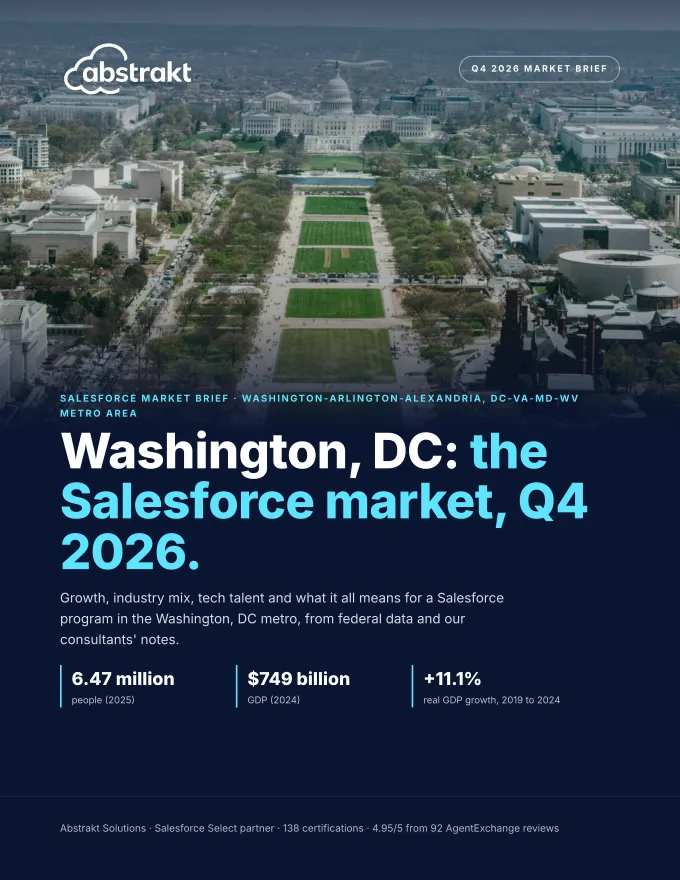
A free 24-page PDF with Washington, DC's growth ranked against 100 metros, its industry mix, tech wages and nearby markets. It is offered on the public Washington, DC page; send your customer there or get a copy for your own prep.
Get the Washington, DC brief →Co-sell with Abstrakt in Washington, DC
Working a Washington, DC account? Bring in a named consultant for discovery, scoping or a health check. We reply within 4 business hours.