

How Salesforce work starts in Baltimore
Baltimore's health systems, research groups, professional services firms and contractors are the organizations Abstrakt Solutions, a Salesforce Consulting Partner, works with most across the region. We implement, integrate, optimize and manage Salesforce across central Maryland. Baltimore is one of our focus markets.
What buyers here usually run into
- 1
Health data and research
Health systems and research organizations need consent, access and integration with clinical systems designed carefully before anything goes live.
- 2
Asset managers and client reporting
Investment and wealth firms need relationship views and compliant communications across large client bases.
- 3
Estimates versus actuals
Construction and services firms often quote in one tool and track work in another, hiding real margins until the job is done.
Budget, team and partner questions
What drives cost
In Baltimore, privacy and federal requirements drive scope. Health systems and research organizations add consent, access and EHR integration work, and firms selling to federal agencies may need Government Cloud evaluation and Shield. Distributors and contractors are driven mostly by ERP and job-cost integration.
Admin or partner
Health systems and larger consultancies often keep Salesforce ownership internal and use a partner for architecture and integration. Startups commercializing university research and mid-sized contractors more often outsource administration.
What buyers ask a partner
Ask for health care references involving consent and EHR integration, experience with federal capture processes, and how the partner documents access controls for audits. Construction firms should ask how estimates and job costs are connected.
The local economy and its biggest industries (4)
| Sector | Share of 2024 GDP | Where Salesforce fits |
|---|---|---|
| Professional, scientific, and technical services Salesforce for professional services → | 10.5% | Engineering, cybersecurity, research and consulting firms, many serving federal and healthcare clients, need pursuit pipelines, account planning and delivery visibility. |
| Health care and social assistance Salesforce for health & life sciences → | 8.5% | Academic medical centers, health systems and insurers use Salesforce for patient and member engagement, referrals, research recruitment and contact centers, with privacy built in. |
| Wholesale trade Integration → | 5.6% | The Port of Baltimore and the I-95 corridor support distributors whose sales teams depend on order and inventory data being visible in Salesforce. |
| Construction Salesforce for construction → | 5.5% | Contractors and building-services firms need estimating, project tracking and field crews connected, from bid to closeout. |
Source: U.S. Bureau of Economic Analysis, GDP by county (CAGDP2), 2024, summed to the metro area; private sectors only, excluding real estate and government. “At least” marks sectors where BEA suppresses some county figures.
Regional target sectors named by local economic development groups: Life Sciences / Biotechnology, Cybersecurity, Artificial Intelligence, Advanced Manufacturing, Supply Chain & Logistics.
Salesforce products that fit Baltimore (6)
In the order we lead with them here, from the industries above.
Salesforce Service Cloud
The operating system for modern customer service, case, knowledge, voice, and AI agent assist together.
Salesforce Sales Cloud
The CRM where sales pipeline lives, when it is built right.
Salesforce Financial Services Cloud
Industry CRM for wealth management, banking, insurance, and lending, built for compliance from the start.
Salesforce Field Service
Scheduling, dispatch, mobile work orders and parts for teams that work on site.
Salesforce Experience Cloud
Customer, partner, and employee portals built on Salesforce.
Salesforce Agentforce
AI agents that handle real work inside Sales Cloud, Service Cloud, and Marketing Cloud.
How Baltimore health and services firms apply AI
Baltimore's two largest private sectors are professional services and health care, so AI projects here tend to split along those lines. Health systems, payers, and life sciences groups want agents that answer patient or member questions from vetted knowledge and summarize case history for nurses and coordinators. Consulting, engineering, and cybersecurity firms usually start with sales work: triaging inbound leads, reading RFP attachments, and drafting follow-ups. Distributors add order and pricing inquiries to the list. Protected health information changes the scope, though. We map which fields an agent may read, keep audit trails on, and require human sign-off for clinical or contractual answers before expanding beyond a pilot.
- Care coordinator case summaries
- RFP attachment review
- Distributor order inquiry answers
Services buyers here usually need (7)
Salesforce Implementation in Baltimore
Baltimore implementations tend to start from constraints rather than features. Health and research organizations need consent and data-use rules settled before any patient, participant or member record arrives; firms serving federal agencies must decide which data may live in commercial Salesforce at all; contractors need estimates and field work linked from bid to closeout. We resolve those questions in discovery, design the data model and security around them, and then build and launch in phases, with design workshops for every group whose rules the system has to honor.
By industry in Baltimore
- 1
Professional, scientific, and technical services
Technical, engineering and consulting firms lead Baltimore's private economy, generating about 10.5% of all 2024 regional output. Many of these engineering, research and consulting firms pursue federal and healthcare contracts, so their implementation needs a capture process alongside the standard pipeline: pursuit decisions, teaming partners, contract vehicles and task orders. We model those as related objects so business development and delivery leaders work from the same record through award and beyond.
- 2
Health care and social assistance
Hospital networks, teaching hospitals and health plans across central Maryland apply Salesforce to scheduling access, referral follow-up, study enrollment and member inquiries. Implementation for them starts with a data inventory: which clinical fields Salesforce truly needs, which consents govern outreach, and which roles may see what. Service Cloud or Health Cloud is then configured around those answers, with encryption, audit trails and a signed business associate agreement in place before real data loads.
- 3
Construction
Construction contributes about 5.5% of metro GDP, and contractors and building-services firms here often estimate in one tool, schedule in another and invoice from a third. A Salesforce implementation for them links opportunity, estimate, project and service work in one data model, so the bid that won the job becomes the baseline for tracking it. Field Service is added in a later phase once the project structure is stable and crews have a clear reason to use it.
Raise before scoping
Classify data before configuring
Health, research and federal work in Baltimore often involves data with legal handling rules. List every data type you plan to store, note which rules apply to each, and confirm that commercial Salesforce, Shield or Government Cloud fits before the build begins.
Link estimates to actuals
Contractors lose margin visibility when estimates and job costs sit in unconnected systems. Design the implementation so each project inherits its estimate from the winning opportunity, and plan an integration to job-cost data even if it arrives in a later phase.
Bring every corridor office into design
Organizations with teams in Baltimore, Columbia, Towson and further along the corridor often run the same process a little differently at each office. Surfacing those differences in early workshops keeps discovery moving and gives each group a say in the design before it is fixed.
Salesforce Integration in Baltimore
Baltimore integration projects often involve systems with strict owners: EHRs and research databases in health and life sciences, ERPs at distributors, job-cost and project accounting platforms at contractors, and warehouse systems in logistics. We agree field by field which system owns the data and what may be copied into Salesforce, then choose MuleSoft, Workato or direct APIs to fit the volume and the team that will maintain it. Every connection includes error handling, alerting and a runbook.
By industry in Baltimore
- 1
Life Sciences / Biotechnology
The Greater Baltimore Committee lists life sciences and biotechnology as a target sector, and the region was selected as a federal EDA Tech Hub focused on commercializing predictive healthcare technologies. Life sciences companies here often need Salesforce connected to research systems, grant or sponsor records, and product usage data from pilots. We design those integrations so only aggregate or de-identified results flow into Salesforce unless there is a documented reason and approval to do more.
- 2
Supply Chain & Logistics
Supply chain and logistics also appears on the Greater Baltimore Committee's target-sector list. Distributors and logistics providers need order status, shipment tracking and inventory visible to sales and service teams without logging into operational systems. We connect warehouse and transportation platforms through APIs so a delay can open a case automatically and agents see the shipment history on screen. Customer portals built on Experience Cloud reuse the same data services, so there is one integration to maintain instead of two.
- 3
Construction
Contractors need Salesforce connected to estimating, scheduling and job-cost accounting so the full life of a project is visible in one place. We typically send won opportunities to project accounting to create jobs, bring actual costs and billing back on a schedule, and link field service work orders to the project. The integration design names the system of record for each figure, so project managers and finance stop reconciling spreadsheets.
Raise before scoping
Limit clinical data in transit
Health and research integrations should move the minimum data Salesforce needs. Filter at the middleware layer, log what passes through, encrypt sensitive fields at rest, and get privacy office approval for each data element before production traffic begins. Revisit the approvals whenever a new field is added to the flow.
Assign an owner for errors
Every integration fails occasionally. Decide who receives alerts, how quickly they respond and how failed records are reprocessed. Without a named owner, sync errors in Baltimore organizations often go unnoticed until a customer or auditor finds the gap, by which point the cleanup is much larger.
Choose tooling you can support
MuleSoft suits organizations with many systems and an API strategy; lighter tools suit a handful of connections. Pick based on who will maintain the integrations after launch, whether that is your IT team, a managed-services partner or both. A capable tool nobody can support becomes the next problem.
Salesforce Managed Services in Baltimore
For Baltimore organizations, managed services is usually a mix of routine work and careful work. Routine requests, such as new users, report changes and page tweaks, move quickly through a shared backlog. Changes touching patient, member, participant or client data follow a review path agreed with your privacy or security lead. We test every Salesforce release in a sandbox against your key processes, maintain documentation as the org evolves, and bring in developers or architects when a request needs more than configuration.
By industry in Baltimore
- 1
Health care and social assistance
Health care and social assistance produced about 8.5% of the metro's 2024 GDP, and health organizations here rarely have enough Salesforce staff for the volume of change they face. Our managed-services work for them covers contact-center queue changes, referral workflow updates, consent field maintenance and release testing. Every change that alters who can see protected information gets logged with the approver's name, so privacy audits have a clear trail to follow months later.
- 2
Cybersecurity
The Greater Baltimore Committee names cybersecurity as a target sector, and cybersecurity firms apply their own standards to their CRM. Managed services for them includes quarterly access reviews, monitoring of login and permission changes, prompt removal of departed users, and careful vetting of any new connected app. Enhancements to their pipeline and partner processes run alongside, delivered in sprints so product and sales changes land on a predictable schedule the whole company can plan around.
- 3
Wholesale trade
Wholesale trade contributes about 5.6% of metro GDP, and distributors near the port and along the I-95 corridor depend on Salesforce data staying aligned with ERP changes. A managed-services team watches the integration for failures, updates product and pricing references when catalogs change, adjusts territory assignments as reps come and go, and keeps duplicate accounts in check. That steady upkeep prevents the slow decline that makes sales teams stop trusting their CRM.
Raise before scoping
Write a data-access change policy
Decide which kinds of Salesforce changes need sign-off from privacy, security or compliance, and which do not. A short written policy lets routine requests move quickly while ensuring every change that widens access to sensitive data has an approver on record.
Keep documentation with the org
Organizations that change managed-services partners or admins often lose the reasons behind past decisions. Keep design notes, field definitions and change history in a shared location your team owns, so knowledge stays with the organization rather than with any vendor.
Review licenses at each renewal
Health and research organizations here often add users for projects that end. Before every renewal, review inactive users, permission set licenses and add-ons, so you are paying for what people use and access for departed staff is closed promptly rather than lingering until someone notices.
Salesforce Health Checks in Baltimore
In Baltimore, health checks often start from a security or privacy question: can we show who sees patient, member or client data, and would our org pass a customer's security review? We examine profiles, permission sets, sharing, guest access and connected apps against least privilege; inventory automation, code and packages for technical debt; measure data quality on key objects; and assess readiness for AI features. The report ranks each finding by risk and effort, with specific fixes rather than general advice.
By industry in Baltimore
- 1
Cybersecurity
Cybersecurity companies face customers who expect their CRM to be as well defended as their products. A health check gives them proof: multi-factor enforcement, session and IP policies, least-privilege access, controlled connected apps and monitored admin activity. It also checks the parts sales teams feel, such as automation conflicts and technical debt, so the org stays both secure and fast enough for a growing sales team. Findings come with the evidence customers typically request.
- 2
Artificial Intelligence
With artificial intelligence named among the Greater Baltimore Committee's target sectors, AI adoption is a live topic for organizations of every kind here. Before turning on Agentforce or similar features, a health check confirms that the records an agent reads are clean, that its permissions are narrow and that knowledge content is current. Those checks are much cheaper to run beforehand than to perform after an agent gives a customer a wrong answer.
- 3
Health care and social assistance
Health systems and insurers need a health check that puts privacy first. We review who can view protected information, whether encryption and event monitoring cover the right fields, how portal guest access is restricted, and whether audit history is retained long enough. Each gap is tied to the setting involved and ranked by exposure, so your privacy and security teams can address the most serious issues first and schedule the rest with confidence.
Raise before scoping
Include every connected system
Integration users, connected apps and managed packages often carry broader access than people. Review them with the same rigor as human users, confirm each is still needed and owned, and remove or tighten those that are not before they become an audit finding.
Test portal and guest settings
Patient, member and customer portals can expose data through guest user permissions configured years ago. Test what an unauthenticated visitor can reach, and confirm portal sharing still matches your intentions after successive Salesforce security changes. Older portals deserve particular attention, because defaults have tightened since many were first built.
Match findings to your frameworks
Security and compliance teams in Baltimore often map controls to frameworks their customers or regulators use. Ask for findings labeled so they can be mapped to those controls, which shortens the path from report to remediation evidence and avoids a second round of translation work.
Salesforce Optimization in Baltimore
Optimization in Baltimore usually targets one of three gaps: contractors who cannot see estimate-versus-actual margin in Salesforce, health and service teams whose case handling has grown cluttered, and professional services firms whose pipeline data lags reality. We measure usage and data quality first, then simplify layouts, consolidate old automation into Flows, fix the reports leaders depend on, and retrain users on what changed. The aim is a lighter, more trusted org, not a new one.
By industry in Baltimore
- 1
Construction
Contractors and building-services firms often have Salesforce for bids but track job progress elsewhere, so leaders learn the real margin only at closeout. Optimization links each won opportunity to a project record carrying the original estimate, adds the few progress and cost fields project managers will actually maintain, and rebuilds dashboards to compare estimated and actual figures while jobs are still running. Field users get simplified mobile layouts that make updates quick.
- 2
Health care and social assistance
Health organizations that launched Service Cloud years ago often have queues, case types and automation layered by different teams. Agents juggle too many picklist values and supervisors distrust handle-time reports. We consolidate case types, clean up routing rules, retire overlapping automation and rebuild service dashboards on agreed definitions. Privacy settings are rechecked along the way, since past quick fixes sometimes widened access more than anyone intended. The result is a service console agents can move through without hunting for fields.
- 3
Artificial Intelligence
Artificial intelligence is one of the Greater Baltimore Committee's target sectors, and AI and data companies here often have fast-changing sales motions: pilots, usage-based pricing and research partnerships. Their orgs accumulate fields and stages from each experiment. Optimization trims those back to the ones still in use, standardizes pilot and conversion tracking, and rebuilds forecasts so leadership can see which pilots are turning into revenue and which partnerships deserve more attention from the sales team.
Raise before scoping
Fix data before dashboards
Rebuilding dashboards on top of duplicate accounts and inconsistent stages only produces better-looking wrong numbers. Clean the underlying records, agree definitions for key metrics, and add validation rules, then rebuild reporting on that foundation for Baltimore leadership. Numbers people trust get used; the rest get exported and argued over.
Design for field and mobile
Project managers, estimators and technicians update Salesforce from job sites, not desks. Test every simplified layout on a phone, cut fields that are hard to fill in the field, and make the most common update reachable from the first screen.
Recheck access while optimizing
Optimization work touches layouts, profiles and automation, which is a good moment to confirm access still matches policy. Health and research organizations should have privacy staff review any permission changes before release, rather than treating access as out of scope.
Salesforce Migration in Baltimore
Baltimore migrations commonly involve data that needs more care than a typical CRM move: patient or participant records, federal pursuit history, or years of project and estimating data at contractors. We start by classifying what each source holds and what rules apply, then map it to Salesforce, cleanse and deduplicate before loading, and run sandbox trial loads with reconciled counts. Cutover lands outside your busy periods: the old system is frozen briefly, the final load runs, and users get close help during their opening days in Salesforce.
By industry in Baltimore
- 1
Professional, scientific, and technical services
Engineering, research and consulting firms that serve federal and healthcare clients often track pursuits in spreadsheets, an older CRM and a separate bid-tracking tool. Migrating them means merging those into one opportunity and capture structure, keeping teaming partners, contract vehicles and past-performance references intact. We also confirm with the security lead which records, if any, must stay out of commercial Salesforce before the first trial load runs, since that answer can change the whole migration plan.
- 2
Life Sciences / Biotechnology
Biotech and life sciences companies often start with a simple CRM or spreadsheets and move to Salesforce as pilots and partnerships grow. The migration needs to separate customer pipeline from research partners, sponsors and licensing relationships, and to handle any clinical or participant data with care. We classify fields first, bring over only what has a clear business purpose, and document where excluded data remains so retention and access rules still apply to it.
- 3
Retail trade
Retailers, whose sector produced about 5.3% of the region's 2024 output, usually hit duplicate customers spread across stores, e-commerce and call-center systems when they move service or loyalty data into Salesforce. We match and merge customer identities before loading, migrate consent and preferences with their dates, and bring over recent service history so agents can see past issues from the first day on the new platform, without switching between old and new systems.
Raise before scoping
Classify sensitive data first
Before mapping fields, identify which sources contain protected health information, controlled federal data or financial details. Decide for each whether it moves, stays behind or needs encryption, and record the decision so auditors can follow the reasoning later, even after the project team has moved on.
Keep source identifiers
Store the original system's record ID on every migrated record. It makes reconciliation, troubleshooting and later integrations far easier, and lets you trace any questioned value back to where it came from long after the old system is retired and its administrators have moved to other work.
Schedule around fiscal deadlines
Federal fiscal year-end, grant deadlines and construction season peaks are poor times for a cutover in Baltimore. Choose a window when teams can spare attention for training and the first days of support, even if that means waiting a little longer than the project plan first assumed.
Salesforce Implementation Rescue in Baltimore
Failed or stalled Salesforce projects in Baltimore often trace back to decisions deferred too long: consent and privacy rules for health data, capture processes for federal work, or how field crews would actually use the system. Triage comes first, comparing what exists with what was promised; blockers to daily operations get cleared; and every component then earns a verdict of keep, repair or replace. The remaining scope is completed with documentation your team can maintain, followed by relaunch training focused on what changed and why.
By industry in Baltimore
- 1
Construction
Construction and building-services rescues frequently involve Field Service builds that cannot schedule multi-day or multi-crew jobs correctly, or that charge licenses for workers who only need to clock in. We review the scheduling model, work order structure and license assignments, fix the configuration that causes errors, and simplify the mobile experience so crews and supervisors can rely on it. Estimate and job-cost links are repaired at the same time where they exist.
- 2
Life Sciences / Biotechnology
Life sciences projects sometimes stall when reviewers raise concerns late about how research participants, sponsors or clinical data are handled. Recovery starts by pausing the disputed processes, agreeing requirements with quality, compliance and privacy teams, and redesigning only those pieces. The rest of the org continues to operate. Documentation of each decision helps the next review proceed without repeating the same discussions. We also leave a short guide so internal owners can keep that record current.
- 3
Advanced Manufacturing
Advanced manufacturing is a Greater Baltimore Committee target sector, and manufacturers' Salesforce projects often falter on quoting or ERP integration. When quotes cannot reproduce ERP pricing or orders fail to sync, sellers go back to spreadsheets. We stabilize the integration, simplify pricing rules to those actually used, and relaunch quoting with a pilot group of sellers, expanding to the full team once quotes and orders match reliably. Integration monitoring stays in place so any regression is caught early.
Raise before scoping
Collect everything from the previous partner
Request admin access, source code, deployment history, design documents and open defect lists before the previous partner disengages. Missing documentation adds weeks of rediscovery, and it is much easier to obtain while the relationship is still formally active and contacts still answer.
Revisit the original business case
Projects drift from their purpose over time. Before finishing a stalled build, confirm with leadership which outcomes still matter, so the rescue delivers what the organization needs today rather than completing a specification written for different priorities. Some features may no longer be worth building at all.
Win back field users first
Field crews and technicians abandon tools quickly when mobile apps fail them. Fix their experience early, train them on the devices they actually carry, and gather feedback within days, because their confidence influences how office staff view the relaunch. A good week in the field does more for adoption than any announcement.
Industry plays in Baltimore (4)
Salesforce for Baltimore Health and Life Sciences
Baltimore's health sector combines large care delivery with academic research and a growing set of companies commercializing health technology. Salesforce fits each piece differently: referral and patient access work for providers, study and sponsor relationships for research groups, and pilot-to-contract sales for startups selling predictive tools to hospitals. We design around the part of that chain you occupy, keep clinical data in the systems built for it, and set up privacy and access controls that stand up to institutional review.
Baltimore-Columbia-Towson hospitals, clinics and social service providers generated 8.5% of 2024 metro GDP in Bureau of Economic Analysis figures, a share topped only by professional services at 10.5%. The Greater Baltimore Committee names life sciences and biotechnology first on its target list, along with AI and cybersecurity. The region was chosen as one of 31 federal EDA Tech Hubs, with a focus on commercializing predictive healthcare technologies, through a GBC-led consortium that includes 8 universities. That puts care delivery, research and early-stage health technology companies in close contact, often working with the same clinicians and data.
Use cases to open with
- 1
Referral and access management
Cardiology, oncology and other specialty lines live or die by who sends them patients. Salesforce can track referral sources, route incoming referrals to the right service line, follow up on missing information and show which practices send patients and where they drop out. Physician liaison teams get territory views and visit planning, and leaders can finally see referral leakage by service line and region.
- 2
Study recruitment and sponsor relations
Research groups juggle sponsors, collaborating sites and participant recruitment. Salesforce can manage sponsor and site relationships, track feasibility requests and contracts, and support recruitment outreach with consent-aware lists and screening workflows. Identifiable participant data and clinical results stay in research systems, with Salesforce holding only what coordinators need to manage contacts and next steps. Coordinators also see which sites are behind on enrollment.
- 3
Health tech pilots to contracts
Companies selling predictive or analytics tools to health systems often run pilots with clinical champions before a purchasing decision. Sales Cloud can track each pilot's sponsor, success measures, IT and security reviews and procurement steps as a structured opportunity, so founders know where each deal stands and can forecast conversions honestly for investors and boards. Implementation handoffs after signature become cleaner too.
Raise before scoping
Minimize protected health information
HIPAA obligations follow PHI into Salesforce, along with a business associate agreement and careful access design. Store only the clinical details a workflow truly needs, reference the EHR or research system for the rest, and apply encryption, field-level security and event monitoring to sensitive records.
Plan for institutional review
Academic medical and research organizations review new systems through privacy, security and sometimes research compliance offices. Engage those groups in discovery, prepare data flow diagrams and access matrices early, and allow time for review so approvals do not become the last-minute bottleneck.
Integrate with clinical systems carefully
Referral, scheduling and research workflows depend on EHR and research platform data. Use standards such as FHIR-based interfaces where available, agree on refresh timing and ownership of each field, and test integrations with de-identified data before connecting production systems. Retire any manual spreadsheet workarounds at cutover.
Salesforce for Baltimore Construction Firms
A Baltimore contractor gets the most from Salesforce at the edges of a job: deciding which invitations to bid are worth chasing, nurturing the owners and design firms who send work, and dispatching service calls once tenants move in. Project execution usually stays in construction management and accounting software. We connect the two so estimates, awarded contracts and actual costs line up, giving leaders a clear view of win rates, backlog and margin by customer and project type, and giving service teams scheduling and mobile tools that fit field work.
Builders and trade contractors produced 5.5% of Baltimore-Columbia-Towson output in 2024, a hair under wholesale trade's 5.6%, based on Bureau of Economic Analysis county estimates. Its customers include the region's larger sectors: professional services at 10.5% and health care at 8.5%. The Greater Baltimore Committee targets life sciences and biotechnology, advanced manufacturing, and supply chain and logistics, all industries that need labs, plants and distribution buildings. For contractors that means a mix of institutional owners, private developers and industrial clients, each with its own bid process, standards and relationship dynamics.
Use cases to open with
- 1
Bid and pursuit management
Contractors respond to many invitations to bid and must choose which to pursue. Salesforce can log each invitation with owner, architect, project type, value range and due date, support go or no-go decisions with win-rate history, and track bid results by competitor type and customer. Estimators see their workload, and leadership sees backlog projections by quarter rather than a whiteboard.
- 2
Estimates tied to job costs
Estimates that never get compared with actual costs repeat the same mistakes. Integrating Salesforce with job costing and accounting systems lets firms compare estimated and actual labor, materials and subcontract costs by project type and customer, then feed lessons into future bids. CPQ or Revenue Cloud can standardize proposals for repeatable scopes, such as service agreements or tenant improvements. Estimators get feedback from finished jobs.
- 3
Service and maintenance contracts
Mechanical, electrical and building service contractors earn recurring revenue after construction ends. Field Service can schedule preventive maintenance, dispatch technicians for repairs, track assets in each building and capture work on mobile devices, including photos and customer signatures. Service history then informs renewal pricing and gives account managers a clearer picture of each building they support. Customers can also request work through a portal.
Raise before scoping
Keep project systems authoritative
Leave schedules, change orders and job costs where they already live. Define exactly which data flows into Salesforce, such as contract value, percent complete and final cost, and how often, so CRM reports never contradict finance. Finance should sign off on the mapping.
Model owners, designers and partners
Construction relationships span owners, architects, engineers, general contractors and subcontractors, often on the same project. Use account and contact relationships that reflect multiple roles, so you can see which architects bring work, which owners return and which partners you win with.
Equip field crews realistically
Technicians and supervisors work on job sites with gloves, limited time and uneven connectivity. Keep mobile screens short, support offline use where signal is weak, and test with real crews before rollout, because field adoption decides whether service data is reliable.
Salesforce for Baltimore Wealth Managers
Baltimore wealth firms tend to serve clients whose finances are complicated rather than flashy: dual-career households in medicine and research, owners of professional practices, and families passing assets between generations. Salesforce supports that work when it organizes households and related entities, pulls balances and activity from custodians, and turns onboarding and annual reviews into repeatable workflows. Communication runs through supervised channels. We configure Financial Services Cloud so advisors spend meetings on planning rather than on paperwork they could have prepared automatically.
Wealth management is not measured separately in the data we use. Finance and insurance does not rank among the Baltimore-Columbia-Towson metro's five largest private sectors in the Bureau of Economic Analysis's 2024 figures, and the Greater Baltimore Committee's target list centers on life sciences, cybersecurity, AI, advanced manufacturing and logistics, so we state no share for it. The client base is what stands out. Professional, scientific and technical services lead the economy at 10.5% of GDP and health care follows at 8.5%, while a federally designated tech hub focused on predictive healthcare technology links eight universities. Those sectors produce many high-earning professionals with equity, retirement and practice-ownership questions.
Use cases to open with
- 1
Household and entity mapping
A single client relationship may include spouses, children, trusts, a medical practice and a family foundation. Financial Services Cloud models households, legal entities and the relationships between them, with each account's custodian balances attached. Advisors preparing for a review see the whole picture, including beneficiaries and outside professionals such as attorneys and accountants, without assembling it from several screens and spreadsheets the night before.
- 2
Onboarding with fewer resubmissions
New accounts stall when forms are incomplete or signatures are missing. Guided onboarding in Salesforce collects client information once, pre-fills custodian paperwork, routes documents for electronic signature and tracks each item until the account opens. Operations staff see a queue of what is waiting on whom, and clients can upload documents through a secure Experience Cloud portal instead of emailing sensitive files.
- 3
Review cadence and supervised outreach
Firms promise annual or semiannual reviews, then struggle to prove they happened. Salesforce can schedule reviews by service tier, prepare meeting packets from account data and log outcomes. Marketing Cloud sends newsletters, event invitations and educational series from approved templates, while archiving integrations capture messages for supervision. Principals can see which households are overdue, which advisors need support and which service tiers are slipping.
Raise before scoping
Plan custodian and planning integrations
Holdings arrive from custodial feeds and the portfolio accounting platform, and goals and projections sit in the planning tool. List every field advisors expect to see, name its source, and rehearse the sync with a family whose trust account and IRAs are held in different places.
Build supervision into the design
RIAs answer to the SEC or state regulators, and broker-dealer representatives face FINRA supervision. Capture communications, approvals and complaints in ways your chief compliance officer can review, and configure retention accordingly. Interpretation stays with your compliance staff, and we configure what they specify.
Migrate with relationships intact
Leaving another CRM often exposes duplicate clients, broken household links and years of notes in inconsistent formats. Clean and map these before migration, keep a verified archive of historical notes, and give advisors a short validation window to confirm their top households look right.
Salesforce for Baltimore Professional Services Firms
Baltimore professional services firms often sell specialized expertise, such as cybersecurity assessments, engineering studies, data science or research support, to clients who buy through formal proposals. Salesforce helps when pursuits, bid decisions and proposal deadlines are managed in one place, when opportunities forecast demand for specific skills, and when multi-year client programs are tracked as accounts with many engagements. We integrate time and billing data so partners see margin by client, and we keep the interface light for the specialists who deliver the work.
Expert firms carry more economic weight than any other private industry around Baltimore: the Bureau of Economic Analysis credits professional, scientific and technical services with 10.5% of 2024 metro output, with care providers next at 8.5%. Three of the Greater Baltimore Committee's priority fields, biotech, cyber and AI, lean heavily on outside consultants, testers and engineers. The region's federal tech hub designation centers on commercializing predictive healthcare technologies, with a consortium of eight universities, and the committee also runs a startup initiative and a regional innovation office. That points to firms whose work blends research, technology and regulated clients.
Use cases to open with
- 1
Bid decisions and proposal calendars
Firms responding to requests for proposals need to decide quickly which to pursue. Salesforce opportunities can hold the solicitation, due dates, evaluation criteria, teaming partners and a structured bid or no-bid review. Proposal managers see every deadline on one calendar, and leadership reviews win rates by client type, service line and proposal lead to decide where to invest pursuit effort next year.
- 2
Specialist capacity forecasting
A cybersecurity assessment or a clinical data project may depend on a handful of certified people. Opportunities can list required roles, clearances or certifications and expected hours, so delivery leaders see which specialists are overcommitted months ahead. That view supports decisions on hiring, subcontracting or rescheduling, and it gives sales an honest answer when a client asks how soon the work can start.
- 3
Client programs across many engagements
Large clients such as health systems or research organizations may buy dozens of separate engagements over several years. Salesforce can group them under a client program with master agreements, rate schedules, key contacts and satisfaction feedback. Account leaders see total relationship value, renewal dates and where other practices could help, and they prepare for executive reviews without assembling data by hand.
Raise before scoping
Protect client and research data
Cybersecurity and health research engagements can involve sensitive client findings or protected health information. Keep deliverables in systems approved for them, store only engagement metadata in Salesforce, and restrict record access by team. Clients may impose their own security requirements, which your contracts staff should review against the design.
Connect time and billing
Utilization and margin data usually come from a time, project accounting or ERP system. Agree which figures appear in Salesforce, at what level of detail and how often they refresh, so account leaders can discuss profitability with confidence instead of debating whose report is right.
Keep specialists' effort minimal
Engineers, analysts and researchers bill their time and resent administrative work. Automate activity capture, ask them only for inputs that change decisions, such as skills and availability, and give them simple mobile or email-based ways to respond to staffing requests.
Case studies to send (3)
From the industries this market leans on. Client names are anonymized and these projects are not specific to Baltimore.
The Baltimore Salesforce market brief, Q4 2026
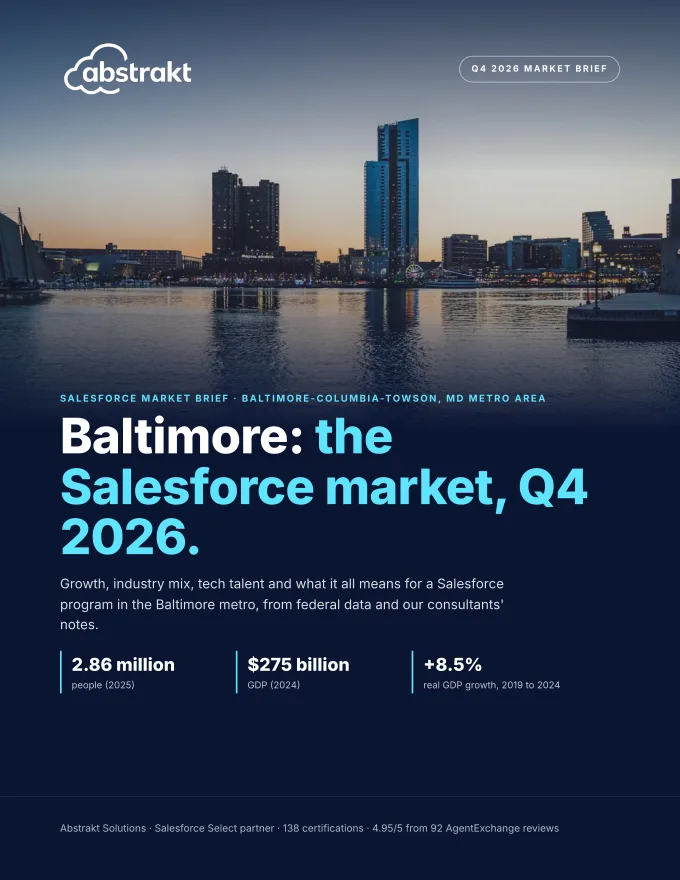
A free 24-page PDF with Baltimore's growth ranked against 100 metros, its industry mix, tech wages and nearby markets. It is offered on the public Baltimore page; send your customer there or get a copy for your own prep.
Get the Baltimore brief →Co-sell with Abstrakt in Baltimore
Working a Baltimore account? Bring in a named consultant for discovery, scoping or a health check. We reply within 4 business hours.