

How Salesforce work starts in Richmond
As a Salesforce Consulting Partner, Abstrakt Solutions works with companies in the City of Richmond and in Henrico, Chesterfield and Hanover counties, as well as the rest of the metro. Richmond is one of our focus markets.
What buyers here usually run into
- 1
Headquarters orgs with many business units
Corporate headquarters often run one Salesforce org for several divisions, and without clear governance each unit adds fields and automation that slow everyone else down.
- 2
Underwriting and servicing on separate tracks
Insurers and lenders typically keep submissions, policies or loans in core systems, so producers and service teams in Salesforce see only part of each relationship.
- 3
Security reviews before any build starts
Firms with cyber security operations and regulated data usually require access models, encryption choices and audit logging to be approved before configuration begins.
Budget, team and partner questions
What drives cost
Richmond budgets swing on governance and security: how many business units share the org, how many core systems feed it, and how much access design and audit logging must be approved before configuration begins. Professional services firms spend more on the handoff to project and billing systems than on sales setup.
Admin or partner
Headquarters companies in Richmond often keep a central Salesforce team and bring in a partner for architecture, integration and security-sensitive releases. Smaller insurers, manufacturers and consultancies more often hand day-to-day administration to a partner until volume supports a hire.
What buyers ask a partner
Ask how the partner governs one org shared by several divisions, what they deliver for a security review before building, and for Financial Services Cloud references with core-system integration. Ask who approves changes when two business units want conflicting things.
The local economy and its biggest industries (4)
| Sector | Share of 2024 GDP | Where Salesforce fits |
|---|---|---|
| Manufacturing Salesforce for manufacturing → | 8.8% | GRP hopes to widen Greater Richmond’s manufacturing base through its advanced manufacturing target. Consumer-products and industrial makers need trade and distributor relationships, quotes and service history tied back to the ERP that runs production. |
| Finance and insurance Salesforce for insurance → | at least 7.9% | GRP names finance and insurance as a target sector for the Richmond region. Carriers, brokers, lenders and advisory firms use Salesforce for producer and client relationships, servicing and compliant marketing. |
| Health care and social assistance Salesforce for health & life sciences → | at least 7.7% | Life sciences is one of GRP’s six target industries, and providers and research-driven companies both depend on privacy-aware records. Salesforce supports patient and referral management for care organizations and account management for device and pharmaceutical sellers. |
| Professional, scientific, and technical services Salesforce for professional services → | at least 7.5% | GRP’s IT and corporate services targets cover much of the consulting, cyber security and shared-services work counted in this sector. Such firms sell expertise engagement by engagement, so pipeline, resourcing and renewals matter more than transaction volume. |
Source: U.S. Bureau of Economic Analysis, GDP by county (CAGDP2), 2024, summed to the metro area; private sectors only, excluding real estate and government. “At least” marks sectors where BEA suppresses some county figures.
Regional target sectors named by local economic development groups: Finance + Insurance, IT, Corporate Services, Data Centers, Life Sciences.
Salesforce products that fit Richmond (6)
In the order we lead with them here, from the industries above.
Salesforce Financial Services Cloud
Industry CRM for wealth management, banking, insurance, and lending, built for compliance from the start.
Salesforce Sales Cloud
The CRM where sales pipeline lives, when it is built right.
Salesforce Service Cloud
The operating system for modern customer service, case, knowledge, voice, and AI agent assist together.
Salesforce Marketing Cloud
Cross-channel marketing, email, mobile, journey, and Data 360-powered personalization at scale.
MuleSoft
Enterprise API platform, for connecting Salesforce, ERP, data warehouses, and the rest of your stack.
Tableau
Executive analytics, embedded dashboards, and CRM Analytics built on Tableau.
Richmond's banks and manufacturers: where AI actually helps
Start with the unglamorous part: an agent in a Richmond finance or insurance operation is only as reliable as the customer data and approved content behind it. Once those are in order, the region's leading sectors offer clear targets. Finance and insurance, one of Richmond's three largest private sectors, can use Data 360 (formerly Data Cloud) to unify account history so an agent summarizes a customer's situation before a banker calls. Manufacturing, which BEA measured at 8.8% of metro GDP in 2024, gains from case summaries on distributor complaints and returns. Health systems can trial drafted billing replies. Keep human approval on anything touching credit decisions, claims outcomes or medical advice.
- Pre-call customer situation summaries
- Distributor complaint and return summaries
- Drafted billing replies for review
Services buyers here usually need (7)
Salesforce Implementation in Richmond
Implementing Salesforce in Richmond often means working inside a large organization's governance. Headquarters companies, insurers and banks here usually put the security design through formal review before anything is built, and several business units want a say in the design. We run discovery with each unit, agree a shared data model and sharing rules with security, build in a sandbox, connect the policy, loan or ERP systems that remain authoritative, and roll out one unit at a time.
By industry in Richmond
- 1
Finance and insurance
Finance and insurance contributed at least 7.9% of 2024 metro GDP in BEA's county data, and the Greater Richmond Partnership lists it as a target industry. Carriers, brokers and lenders implementing Financial Services Cloud decide early how producers, insureds, policies or loans and households relate. We keep policy issuance and loan servicing in their core systems, bring status and summary data into Salesforce, and design producer and client views that respect underwriting confidentiality.
- 2
Corporate Services
Corporate services is one of GRP's six target industries, reflecting the headquarters and shared-services operations in the region. Implementing Salesforce for a corporate service center means designing one org that several divisions share without tripping over each other: record types and page layouts per unit, a common account model, and a change process that stops each division from adding fields independently. We settle that governance model before the first object is built.
- 3
Manufacturing
For a consumer-products or industrial manufacturer, the first design question is how distributor, retailer and direct accounts sit in one hierarchy, and how quotes and service history link to the production ERP. We design the product catalog and price book around the ERP's item master, choose the integration pattern during design and plan Service Cloud for warranty and complaint handling as a second phase once sales is live. Engineered products from advanced manufacturers add configuration rules that quoting must enforce.
Raise before scoping
Win security approval early
Richmond's banks, insurers and firms with cyber security operations usually run a formal architecture review. Bring the proposed sharing model, encryption approach, integration users and logging plan to that review during design, so approval does not become the item holding up the build.
Set governance for business units
When several divisions share one org, agree who approves new fields, automation and apps, and how conflicts are resolved. A small design authority with representatives from each unit keeps the org coherent as later phases add teams with their own priorities.
Keep core systems authoritative
Policy administration, loan servicing and ERP platforms should remain the source for their own data. Design Salesforce to display and act on that information, with integrations carrying updates both ways only where a process genuinely requires it, rather than building a second copy of core records.
Salesforce Optimization in Richmond
Richmond optimization projects often begin in a shared org where each business unit added its own fields, automation and reports. Adoption drops as screens fill up, and leadership sees different numbers from different divisions. We measure usage by team, consolidate conflicting Flows and legacy workflow rules, trim layouts by role, align metric definitions across units and rebuild dashboards in Salesforce or Tableau, then retrain each group on what changed and track whether usage improves.
By industry in Richmond
- 1
Professional, scientific, and technical services
BEA's 2024 figures give professional, scientific and technical services a floor of 7.5% of Richmond-area GDP. Many, including cyber security specialists, sell engagements, so they care about pipeline accuracy, utilization and renewals. Optimization makes engagement data quick to log, automates renewal and follow-up tasks, and rebuilds dashboards showing backlog and forecast by practice. When partners can trust those numbers, the weekly pipeline meeting runs from Salesforce instead of slides. Practice leads get their own views.
- 2
Finance and insurance
Producers and relationship managers at Richmond insurers and banks often avoid Salesforce because it shows only part of each client. Optimization brings policy or loan status onto the record through existing integrations, removes fields nobody uses, and gives service staff consoles arranged around their most common requests. Marketing Cloud audiences are rebuilt on cleaned data so outreach reaches the right clients and respects consent. Adoption is then tracked by role after each change.
- 3
Advanced Manufacturing
The Greater Richmond Partnership recruits advanced manufacturers. Makers of engineered products tend to find their Salesforce quoting slower than the spreadsheets it replaced, and forecasts that ignore what distributors report. We simplify the quote process, remove approval steps that add delay without adding control, and rebuild forecast and distributor sell-through reports, often in Tableau, so sales and operations plan from the same view of demand. Quote templates are cut back to the options customers actually order.
Raise before scoping
Compare adoption by business unit
In multi-division orgs, low adoption is rarely uniform. Break login and field-completion data out by unit and role, because the fix for a service team's overloaded console differs from the fix for a sales team that never trusted its forecast.
Decide where reporting lives
Some metrics belong in Salesforce dashboards; others, combining CRM data with finance or operations, fit Tableau better. Decide which audience uses which tool, so the same measure is not calculated twice with slightly different logic and then argued over in meetings.
Clean up before AI or campaigns
Deduplicate accounts and contacts and standardize key picklists before adding Marketing Cloud journeys or Agentforce. Both multiply the effect of bad data, sending the wrong message or giving the wrong answer, and both are easier to launch on an org that has just been simplified.
Salesforce Integration in Richmond
Richmond integration work frequently links Salesforce to large, established systems: policy administration and claims platforms at insurers, loan and deposit systems at banks, ERPs at manufacturers and distributors, and data warehouses feeding Tableau. We document ownership for each shared field, take the design through your security architecture review, build with MuleSoft or direct APIs depending on scale, and deliver monitoring and a runbook so the internal team can keep integrations healthy.
By industry in Richmond
- 1
Manufacturing
Factories and plants in the Richmond metro produced roughly 8.8% of its 2024 GDP, per BEA county data. Integrating Salesforce for a manufacturer here usually starts with the ERP: item master and prices flowing into Salesforce, orders and shipment status flowing back to accounts, and invoice history visible to sales. We plan how customer records match between the two, since distributor and retailer accounts often exist in the ERP under billing names that differ from how sales knows them.
- 2
Data Centers
GRP lists data centers as a target industry. Contractors and suppliers pursuing that work run estimating, project management and accounting systems that each hold part of a bid's story. Integrating them with Salesforce lets leadership see pursuits, awarded packages and billed work together, typically through MuleSoft or scheduled API syncs. We key every record to a shared project identifier so data from different systems lines up without manual matching. Dashboards then show pipeline by site.
- 3
Life Sciences
Life sciences, another GRP target, includes device and pharmaceutical firms whose sales and medical teams work from different systems. Integration connects Salesforce accounts with order management, sample tracking or complaint handling systems, while keeping regulated records in their validated homes. We design the flows so product complaints raised in Service Cloud reach quality systems with a traceable handoff, and nothing required for regulatory reporting is lost between them. Validation documentation is kept current.
Raise before scoping
Budget for security review
Integration users, connected apps, IP restrictions and encryption of data in transit are exactly what Richmond security teams scrutinize. Include the review in the plan from the start, with documentation ready, so approval proceeds alongside the build instead of delaying go-live.
Decide real-time versus batch
Latency should match the use case. Policy status for a service call may need real time, while nightly batches suit invoice history or sales reporting. Choosing per flow keeps API usage, middleware licensing and failure handling proportionate to the business need.
Reuse APIs across divisions
Headquarters companies often integrate the same ERP or customer master for several business units. Build shared APIs for customers, products and orders once, through MuleSoft or a similar layer, rather than a separate point-to-point link for each division's project. Later projects reuse them.
Salesforce Health Checks in Richmond
Richmond organizations often request a health check because someone with authority wants proof: an internal auditor, a chief information security officer, or an executive weighing Agentforce. The review covers who can reach what, through profiles, permission sets, sharing, connected apps and integration users, along with data quality on core objects, an inventory of automation, Apex and packages, and adoption by business unit. Findings are ranked by risk and effort, with specific settings named, so security, IT and business owners can act on the same list.
By industry in Richmond
- 1
Corporate Services
Corporate service centers and headquarters teams run orgs shared by several divisions, where each unit's additions pile up. A health check shows which fields, automation and reports belong to which unit, what nobody uses, where Flows from different units conflict on the same objects, and whether users see records beyond their division's needs. It also measures the storage and limits each unit consumes, giving the org owner evidence for governance decisions otherwise argued from opinion.
- 2
IT
Firms in GRP's IT target industry, including those with cyber security operations, hold Salesforce to the same standard as other systems. Our review checks multi-factor enforcement, login and session policies, admin rights, API access, event monitoring coverage and data export permissions, and maps findings to the controls your security team already tracks. That lets the CRM appear in security reporting with specific remediation items rather than as an unexamined gap.
- 3
Health care and social assistance
Providers and health-related organizations need to know where protected information sits in Salesforce and who can reach it. We trace access through sharing rules, portal settings and integrations, check encryption and field history on sensitive fields, and flag records where clinical detail has slipped into free-text notes. The recommendations put privacy fixes ahead of everything else, then address data quality issues that affect care coordination or outreach accuracy. Owners are named for every item.
Raise before scoping
Align with your control framework
Richmond's banks and insurers typically measure systems against a formal control framework. Share it before the review, so each finding maps to a control your auditors already test, and remediation can be tracked in the same risk register rather than a separate document.
Review Marketing Cloud too
Consent, data extensions and connector users in Marketing Cloud often escape the core org's review. Include them, because an outreach platform with broad access to client data carries the same exposure as the CRM itself, sometimes with fewer controls in place.
Size technical debt per unit
In multi-division orgs, attribute unused fields, untested code and redundant automation to the unit that added them. Cleanup can then be funded and scheduled by each business owner, which is far more likely to happen than a central project nobody owns.
Salesforce Managed Services in Richmond
For Richmond organizations, managed services is often about governance as much as capacity. Headquarters companies share one org across divisions, and insurers and banks need every change traceable. We run a single intake queue with agreed priorities per business unit, deliver enhancements on a regular cadence, test each Salesforce release in a sandbox, monitor integrations with policy, loan and ERP systems, and document every change so security and audit teams can follow what happened and why.
By industry in Richmond
- 1
Health care and social assistance
BEA puts Richmond-area health care and social assistance at no less than 7.7% of 2024 GDP. Providers and care organizations using Service Cloud keep changing referral steps, intake forms and staff access as programs open and close. Managed services handles those changes through a documented, sandbox-tested process, reviews each Salesforce release for effects on patient-related records, and keeps permission sets aligned as staff move between programs, so privacy officers are never surprised by what changed.
- 2
IT
IT is a GRP target industry, and GRP reports 24,000 people employed in computer occupations across the metro. Many technology firms, and the corporate IT departments around them, run Salesforce with a lean admin team. Managed services supplements that team with developers, integration specialists and architects when the backlog needs skills it lacks, while routine user support stays in-house. Both groups share one tracker, so every request's status is visible to everyone involved.
- 3
Finance and insurance
Carriers, brokers and lenders change producer hierarchies, commission-related fields and service workflows regularly, and each change needs an audit trail. Our managed services team logs every request with its approver, tests Financial Services Cloud processes before each release, and keeps integration monitoring in place for policy and loan data. Marketing Cloud consent settings are reviewed whenever outreach rules change, and monthly reviews show compliance and business leaders what was delivered and what is queued.
Raise before scoping
Give each unit a voice
In a shared headquarters org, agree how business units submit and rank requests. A monthly prioritization meeting with a representative from each unit, chaired by the org owner, keeps the backlog fair and stops the loudest division from absorbing most of the hours.
Keep change records audit-ready
Regulated Richmond firms should expect auditors to ask who approved a change to sharing rules, encryption or field history. Record the requester, approver, test evidence and deployment date for every managed change, stored where internal audit can retrieve it without chasing people.
Schedule around fiscal calendars
Insurers, banks and manufacturers have periods when no one wants system changes, such as quarter-end closes, renewal seasons or annual enrollment. Build those freeze windows into the managed services calendar at the start of each year, alongside Salesforce's release dates.
Salesforce Migration in Richmond
Richmond migrations are often consolidations. A headquarters company may retire a different CRM in each division, an insurer may bring producer data out of an aging agency system, and a manufacturer may move distributor contacts out of spreadsheets. Each source is profiled, mapping and history rules are signed off by the business, duplicates across sources are resolved before loading, sandbox trial runs are reconciled, and the cutover date respects your fiscal calendar.
By industry in Richmond
- 1
Finance + Insurance
The Greater Richmond Partnership targets finance and insurance, and carriers and banks in the region often keep producer and client data in older agency or banking systems. Moving that into Financial Services Cloud means restructuring agencies, producers, households and policies or accounts, and settling which historical notes must be retained. We reconcile policy and account counts against source systems and give compliance a migration record showing what moved, what was archived and why.
- 2
Professional, scientific, and technical services
Consulting and engineering firms moving to Salesforce typically bring client lists from an older CRM, engagement records from a project system and contacts from partners' own address books. We merge those into one account and contact set, link past engagements as closed opportunities so relationship history is visible, and map active proposals into the new pipeline, so nobody has to re-key live pursuits when cutover arrives. Alumni and referral sources come across as contacts too.
- 3
Health care and social assistance
Care organizations migrating to Service Cloud usually move referral logs, intake forms and program enrollments from spreadsheets or case-management tools. We minimize the protected data brought across, encrypt it in transit, load it under restricted permissions, and verify each program's records with the staff who own them. Extract files are destroyed after sign-off, and the old system is set to read-only so nothing new lands there by mistake. Each program manager signs off on counts.
Raise before scoping
Consolidate divisions in waves
Migrating every business unit at once multiplies risk. Move one division, stabilize, then bring the next, reusing the mapping and cleanup rules each time. Shared customers found in later waves merge into existing accounts instead of creating duplicates. Communicate each wave's date early.
Clean producer and account hierarchies
Insurers and banks often carry agencies, producers or relationship managers recorded inconsistently across systems. Standardize those hierarchies before loading, since commission reporting, territory assignment and sharing rules in Salesforce all depend on them. Fixing them after launch means recalculating sharing across the whole org.
Plan the cutover around closes
Keep the go-live well clear of closes, renewal peaks and budgeting season. Announce a short freeze in the old system, run the final load and reconciliation, then switch users over together, with trainers on hand to answer questions through the first days after launch.
Salesforce Implementation Rescue in Richmond
Richmond Salesforce projects that stall usually do so for organizational reasons as much as technical ones. Several divisions pulled scope in different directions, security approval came late, or integrations with core systems proved harder than planned. Our first step is reading the org against the agreed scope and listening to users. We then stabilize what blocks daily work, reset governance with the sponsors, and complete the program in smaller phases each unit can see and test.
By industry in Richmond
- 1
Finance and insurance
Insurers and banks often reach rescue after a Financial Services Cloud build launched with the servicing or policy integration unfinished, forcing staff to re-key data and eroding trust. We stabilize that integration first, add monitoring, and correct producer or household structures that were rushed. Changes go through your security and compliance review in small batches, so each release restores a working capability without reopening approval for the whole design. Service leads confirm each fix with real accounts.
- 2
Manufacturing
Richmond manufacturers sometimes find their Salesforce project stuck between sales and operations: quoting that ignores ERP rules, distributor data nobody trusts, and forecasts that operations will not use. Our triage separates data problems from process design, repairs ERP feeds, and simplifies quoting until it produces orders operations can accept. Each fix is tested against real orders, and forecasting and distributor reporting return in later releases reviewed by both sets of leaders.
- 3
Corporate Services
Shared-service and headquarters programs stall when every division expects its own features in the first release. Recovery for them resets scope around a common core, sets up a design authority that can say no, and sequences division-specific work into later releases. We document decisions openly, so units waiting their turn can see why and when their needs will be addressed. The first relaunch usually serves the unit with the clearest process and most patient users.
Raise before scoping
Reset the sponsor structure
Stalled multi-division programs often have too many sponsors and no final decision-maker. Name one executive owner for the recovery, backed by a small group of unit representatives, and agree that design disputes reach that owner within days rather than circulating for weeks.
Get security sign-off on fixes
Rescue changes still need your security review, and a stalled project may never have finished it. Confirm which parts of the design were approved, submit the remaining items early, and batch fixes so approvals keep pace with the work instead of trailing it.
Recover integration knowledge
Integrations with policy, loan or ERP systems are the hardest pieces to understand after a partner leaves. Collect mappings, middleware configurations, integration user credentials and error logs at the start, and trace each flow end to end before changing any of them.
Industry plays in Richmond (4)
Salesforce for Richmond Insurers and Agencies
Richmond insurers, whether carriers with wide distribution, specialty writers or independent agencies, operate in a metro where financial firms treat security as a first-order concern. Salesforce helps them manage agents and brokers, give service teams a complete policyholder view and track underwriting submissions through to bind. We build on Financial Services Cloud with Service Cloud, integrate policy and claims platforms through MuleSoft, and design sharing, encryption and monitoring settings that will satisfy internal security reviews.
Money management, banking and risk together give Greater Richmond a financial core worth no less than 7.9% of its 2024 output, per the Bureau of Economic Analysis, with only manufacturing larger. The Greater Richmond Partnership names finance and insurance as a target industry together with IT, corporate services and data centers. Several of the region's financial institutions run cybersecurity operations here, and data center operators keep reinvesting in local sites. For insurers, that means a deep pool of technology and security talent, and executives who expect CRM projects to pass rigorous security review.
Use cases to open with
- 1
Underwriting submission intake
Specialty and commercial carriers receive submissions from brokers by email, portal and phone, and underwriters lose time sorting them. Salesforce can capture each submission with broker, line, class and requested limits, route it to the right underwriter by appetite and authority, and track quote, bind or decline outcomes. Leaders see hit ratios by broker and line, and brokers get faster answers on which risks you want to write.
- 2
Broker and agent performance
Carriers that rely on independent distribution need to know which brokers and agencies produce profitable business. Financial Services Cloud can track appointments, submissions, written premium and loss ratios by producer, pulled from policy and claims systems through MuleSoft. Distribution managers plan visits and incentives from that data, and underwriters see relationship context before responding to a difficult submission. Producers who send volume but poor loss experience become visible early, before renewal terms are set.
- 3
Title and closing coordination
Title insurers and agencies coordinate lenders, real estate agents, attorneys and buyers on tight closing timelines. Service Cloud and Experience Cloud can track each order's status, outstanding requirements and communications, while partners check progress in a portal rather than calling. Managers see which files are at risk of delay, and marketing can identify the agents and lenders sending the most orders.
Raise before scoping
Pass security review early
Richmond financial firms often have demanding information security teams. Involve them from discovery, document data flows, encryption and access controls, and plan for Shield, event monitoring or single sign-on requirements, so the project is not stalled by a late-stage security assessment before go-live.
Integrate through a governed layer
Policy, billing, claims and rating systems each expose different interfaces. Using MuleSoft or another integration layer keeps connections reusable and monitored, and it limits how many direct system-to-system links your security team must approve and maintain over time. Monitoring in one place also makes failed transactions easier to catch.
Define underwriting authority rules
Routing submissions correctly depends on accurate appetite, authority limits and territory data. Agree on who maintains those rules, how exceptions are escalated and how changes are audited, so routing stays trustworthy as underwriters join, leave or change lines, and brokers are not left waiting on a submission sitting in the wrong queue.
Salesforce for Richmond Manufacturers
Manufacturing is the Richmond metro's largest private sector, and many producers here sell to a limited number of large customers under negotiated supply agreements, often through global account teams. Salesforce helps them plan key accounts, track contract terms and volumes, and keep technical service and customer service aligned. We connect it to the ERP and, where needed, to data platforms such as Tableau for margin and volume analytics, so account teams can walk into every business review with the same numbers finance uses.
Richmond's economy is unusually balanced, and factories hold a narrow lead: the Bureau of Economic Analysis's 2024 county data assigns manufacturing 8.8% of metro GDP, with finance and health care each within a point. The Greater Richmond Partnership lists advanced manufacturing and life sciences among its target industries, and its broader list also covers food and beverage and logistics and e-commerce. Many plants in the Richmond region report to corporate teams that set global CRM and data standards.
Use cases to open with
- 1
Key account planning
When a handful of customers account for much of a plant's revenue, account plans matter. Sales Cloud can hold account plans with objectives, stakeholders, open opportunities and risks, and link them to volumes and margins from the ERP. Account teams prepare quarterly business reviews from the same data, and leadership sees which strategic accounts are growing, flat or at risk across the portfolio.
- 2
Supply agreement tracking
Negotiated agreements carry price escalators, volume commitments, rebates and renewal dates. Salesforce can store agreement terms, compare committed volumes to actual shipments and alert account managers ahead of renewals or when a customer is falling short. Finance and sales share one record of terms, reducing disputes over pricing and rebate calculations at year end. Renegotiations start from facts rather than each side's memory of the original deal.
- 3
Margin and volume analytics
Tableau connected to Salesforce and ERP data can show margin by customer, product and plant, highlight price leakage and model the effect of raw material changes. Sales leaders see where discounts are eroding profitability, and plant managers understand which customers and products drive capacity. That shared picture supports better pricing decisions and more grounded negotiations with key accounts, and it shows which product lines deserve investment.
Raise before scoping
Align with corporate standards
Plants and divisions owned by larger companies may need to follow corporate CRM, security and data standards. Confirm what is already licensed, which integrations are approved and who governs the org, so a local project does not conflict with a global rollout.
Keep ERP as pricing master
Contract prices, rebates and cost data usually belong in the ERP. Let Salesforce display and track them, but avoid maintaining a second price list, and set clear sync schedules so account managers always quote from current numbers, even right after a price increase takes effect.
Integrate analytics deliberately
Margin reporting needs clean joins between customer, product and plant data from several systems. Plan the data model and ownership with finance and IT, test reconciliation against financial reports, and resist launching dashboards before the numbers match, because trust lost in the first month is hard to win back.
Salesforce for Richmond Professional Services Firms
Richmond's professional services firms sell largely to a concentrated set of regional headquarters in insurance, banking, energy, retail and consumer products, plus the data center operators expanding around the city. Salesforce helps them manage multi-year relationships with those clients, answer security reviews before work can start, and track managed services contracts alongside project work. We connect Salesforce to time, billing and resourcing tools so practice leaders see pipeline, backlog and renewals for each headquarters client without assembling spreadsheets.
The consultants, engineers, lawyers and technologists in BEA's professional services category generated no less than 7.5% of Richmond's 2024 output, a close fourth among closely bunched private sectors. The Greater Richmond Partnership targets IT and corporate services, and its IT page counts 24,000 people employed in computer occupations out of 660,000 total metro employment, with colleges within 150 miles producing more than 33,800 computer and IT graduates each year. It also points to cyber security operations in the region's financial sector, which shapes what local clients expect from their service providers.
Use cases to open with
- 1
Headquarters client programs
For many Greater Richmond services firms, a few large corporate clients generate most of the revenue. Salesforce can map every business unit, sponsor and active engagement at those clients, track master service agreements and rate cards, and show where the firm has no relationship yet. Client leads run quarterly account reviews from the same data, keeping partners in different practices from colliding with one another.
- 2
Security questionnaires and approvals
Banks, insurers and utilities rarely let a vendor start work before security, privacy and insurance reviews are complete. Salesforce can track each client's onboarding requirements, questionnaire status, certificates and approval dates, and store reusable answers. Delivery leaders know which engagements are cleared to start, and renewals prompt the team when annual reassessments are due, so projects are not delayed by expired paperwork.
- 3
Managed services renewals
Many IT and cyber firms now earn steady revenue from monitoring, managed detection and help desk contracts. Each agreement can live in Salesforce with its term, service-level commitments, seat counts and monthly ticket volume, and a renewal opportunity opens automatically well before the end date. Account managers enter renewal talks knowing which services clients lean on most, and leadership reports recurring revenue apart from one-time projects.
Raise before scoping
Your own security posture
Clients in regulated industries will ask how you protect their information, including in your CRM. Apply least-privilege permissions, multi-factor authentication, field encryption where warranted and event monitoring, and document those controls so answering questionnaires about your own systems is straightforward.
Resourcing and billing integration
Utilization, backlog and billing typically live outside Salesforce, in PSA or accounting tools. Integrate only the few measures partners use in account reviews, keep definitions consistent with finance, and resist copying detailed time entries into the CRM, which adds cost and noise without improving decisions.
Clear data ownership by practice
Multi-practice firms often have partners who each believe they own the client. Agree on account ownership, team roles and visibility rules before build, so cross-practice opportunities are shared rather than hidden, and client contacts are not flooded with uncoordinated outreach.
Salesforce for Richmond Health Care and Life Sciences
Richmond health organizations tend to meet a new platform with a security review before anyone discusses features, a habit reinforced by the region's banks, insurers and cyber security operations. We plan for that. Hospitals get referral development and outreach work built on EHR data, research offices get a single record of sponsors and licensees, and life sciences companies get customer service with product and lot tracking. Access models, encryption choices and audit logging are documented first, so approval is a step, not a stall.
By BEA's 2024 county tally, hospitals, clinics and social service agencies generated at least 7.7% of Richmond's output, third among private sectors in a metro whose leading sectors, headed by manufacturing at 8.8%, are tightly bunched. The Greater Richmond Partnership, which covers the city plus Chesterfield, Hanover and Henrico counties, names life sciences among its six target industries. The same partnership highlights cyber security operations at financial institutions and continued data center investment, and that security-minded culture carries into how local health organizations evaluate any cloud platform.
Use cases to open with
- 1
Referral development beyond the suburbs
Richmond hospital programs draw patients from the three suburban counties and from rural areas well beyond them, where a handful of practices can drive a service line's volume. Salesforce gives liaisons a map of those practices with referral trends by specialty, visit notes and open concerns, and prompts a call when a practice goes quiet. Directors compare referral share by county, and coordinators confirm that each referring office received the consult note.
- 2
One record of research partners
Sponsors, foundations, device companies and prospective licensees often deal with several departments at once, and nobody sees the whole relationship. Salesforce can hold each partner organization with its agreements, milestones, funding status and contacts across departments. An investigator preparing to approach a company can see who else has talked to it and what was promised, and leadership can report the full industry portfolio to the board.
- 3
Customer care for life sciences sellers
Device, diagnostics and pharmaceutical services companies answer hospitals, labs and pharmacies about orders, product use, suspected defects and technical problems. Service Cloud gives agents guided forms that capture product and lot details, routes possible complaints to quality staff within set timelines, and records every follow-up. Sales teams see open cases before visiting a customer, so they never walk into an unresolved problem unaware.
Raise before scoping
Security artifacts before configuration
Expect reviewers to ask for data classification, an access matrix, encryption and key management options, an integration inventory and a logging plan. Prepare these during discovery, consider Shield where sensitive fields justify it, and schedule the review so approval lands before build begins rather than after.
Keep study data apart
Participant information, sponsor negotiations and patient engagement fall under different rules and different approvers. Put them in distinct objects with their own permission sets, bring the IRB or research compliance office in before any study system connects, and write down who may see across the line.
Narrow the EHR feed
Liaisons and schedulers need appointments, referral status and care team names, not full charts. Agree on that short list with clinical leaders, pull it through standard interfaces such as HL7 or FHIR, and have privacy and security staff sign off on the data flow diagram before go-live.
Case studies to send (3)
From the industries this market leans on. Client names are anonymized and these projects are not specific to Richmond.
The Richmond Salesforce market brief, Q4 2026
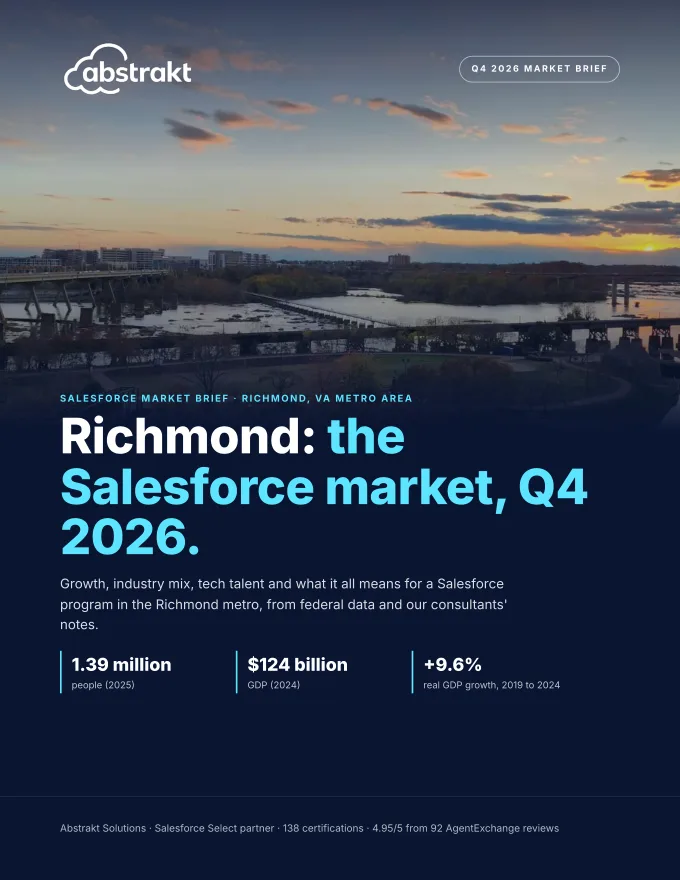
A free 23-page PDF with Richmond's growth ranked against 100 metros, its industry mix, tech wages and nearby markets. It is offered on the public Richmond page; send your customer there or get a copy for your own prep.
Get the Richmond brief →Co-sell with Abstrakt in Richmond
Working a Richmond account? Bring in a named consultant for discovery, scoping or a health check. We reply within 4 business hours.