
Salesforce consulting for Cincinnati companies
Insurers, banks, manufacturers and distributors throughout the Cincinnati region in Ohio, Kentucky and Indiana turn to Abstrakt Solutions, a Salesforce Consulting Partner, for implementation, integration and ongoing support. Cincinnati is one of our focus markets.
The Cincinnati business landscape
Finance and insurance is the largest private sector in the Cincinnati metro by output, and manufacturing is second. REDI Cincinnati, the economic development organization for a 15-county region across Ohio, Kentucky and Indiana, targets advanced manufacturing, life sciences, business and professional services, and technology.
REDI organizes its work around four core industries: advanced manufacturing, including aerospace, automotive, food and flavoring, and chemicals; life sciences; business and professional services such as back-office support, consumer insights and financial services; and technology, from cybersecurity to supply chain management. The Cincinnati Innovation District, announced in March 2020, is a partnership of JobsOhio, the city’s public research university and its pediatric research hospital, with JobsOhio committing up to $100 million over ten years. REDI says those two institutions together contribute over $450 million a year in research, and the university’s 1819 Innovation Hub runs the Venture Lab accelerator.
Figures cover the Cincinnati, OH-KY-IN Metro Area (OH–KY–IN).
- Finance and insuranceat least 14.8%Share of 2024 metro GDP Financial Services Cloud →
- Manufacturingat least 13.4%Share of 2024 metro GDP Salesforce for manufacturing →
- Wholesale tradeat least 9.1%Share of 2024 metro GDP Sales Cloud →
- Health care and social assistanceat least 7.5%Share of 2024 metro GDP Salesforce for health & life sciences →
- Retail tradeat least 6.0%Share of 2024 metro GDP
Regional target sectorsAdvanced Manufacturing (Aerospace & Aviation; Automotive; Food, Flavoring & Beverage; Chemicals & Materials), Life Sciences (Biomedical Research; Pharmaceuticals Manufacturing; Medical Device Manufacturing), Business & Professional Services (Back Office Support; Consumer Insights; Financial Services), Technology (Cybersecurity; Data Analysis; Supply Chain Management; Smart Transportation Technologies)REDI Cincinnati
Where Salesforce fits in Cincinnati’s economy (4)
The largest private sectors by share of 2024 metro GDP, and what Salesforce work usually looks like in each.
| Sector | Share of 2024 GDP | Where Salesforce fits |
|---|---|---|
| Finance and insuranceFinancial Services Cloud → | at least 14.8% | Finance and insurance is the Cincinnati metro’s largest sector, and banks and insurers here need relationship views, agent and advisor workflows, and marketing that passes compliance review. |
| ManufacturingSalesforce for manufacturing → | at least 13.4% | From aerospace suppliers feeding local jet engine production to food, flavoring and chemical producers, Cincinnati manufacturers need quoting, dealer and distributor management, and service tied to ERP. |
| Wholesale tradeSales Cloud → | at least 9.1% | Wholesale trade ranks third in the Cincinnati economy, and distributors serving the region’s manufacturers and retailers need account plans, order and inventory visibility from ERP, and reorder prompts in front of reps. |
| Health care and social assistanceSalesforce for health & life sciences → | at least 7.5% | With a children’s hospital and a university anchoring a large research base, health and life-sciences organizations need patient, donor and partner engagement designed around privacy. |
Source: U.S. Bureau of Economic Analysis, GDP by county (CAGDP2), 2024, summed to the metro area; private sectors only, excluding real estate and government. “At least” marks sectors where BEA suppresses some county figures.
Cincinnati by the numbers: the trend, not just the size (3)
Cincinnati's economy has grown modestly since 2019, with new business formation close to the national pace.
Business applications rose 65.7%, slightly ahead of the national 62.2%. New firms add to steady demand from the region's consumer goods, financial and health companies.
Census Business Formation Statistics, county data summed to the metro, 2019–2025Real output grew 6.3%, about half the national rate. Slower growth usually puts Salesforce budgets toward optimization and integration with existing systems.
BEA real GDP by county (CAGDP9), summed to the metro, 2019–2024Private employment grew 2.5%, behind the national 4.9%. Productivity improvements carry most Salesforce business cases here.
BLS Quarterly Census of Employment and Wages, 2019 and 2024Leading private sectors in Cincinnati, 2024: concentration, growth and pay
| Sector | Concentration vs U.S. | Job growth 2019–2024 | U.S. job growth | Average annual pay |
|---|---|---|---|---|
| Retail trade | 0.92 | -5.8% | -0.8% | $38,842 |
Retail trade is a little below the national share (0.92); BLS withholds Cincinnati's larger sector figures, including finance, manufacturing and computer systems design. The GDP shares above give the fuller picture of the region's industry mix.
BLS Quarterly Census of Employment and Wages for Cincinnati, 2019 and 2024 · How these measures work
Across the Cincinnati metro (16)
We work with companies throughout the metro area as the Census Bureau defines it, which spans 3 states.
Principal cities (1)
- Cincinnati, OH
Counties (15)
- Dearborn County, IN
- Franklin County, IN
- Ohio County, IN
- Boone County, KY
- Bracken County, KY
- Campbell County, KY
- Gallatin County, KY
- Grant County, KY
- Kenton County, KY
- Pendleton County, KY
- Brown County, OH
- Butler County, OH
- Clermont County, OH
- Hamilton County, OH
- Warren County, OH
Salesforce in Cincinnati, service by service (7)
Each service has its own page for Cincinnati: what the work involves here, the industries it applies to and the questions local teams ask.
Implementation
Salesforce implementation for Cincinnati insurers, banks, manufacturers and distributors in Ohio, Kentucky and Indiana, phased around your data model.
See Cincinnati implementation →Integration
Salesforce integration for Cincinnati manufacturers and distributors: ERP orders, pricing and inventory in Salesforce, with monitoring built in.
See Cincinnati integration →Optimization
Cincinnati distributors, insurers and manufacturers get simpler Salesforce layouts, consolidated automation and reports leaders will actually use.
See Cincinnati optimization →Managed Services
Ongoing Salesforce admin, release testing and backlog delivery for Cincinnati health, insurance and back-office teams that share one org.
See Cincinnati managed services →Health Check
A Salesforce health check for Cincinnati insurers, banks and health organizations: security, technical debt and data quality reviewed before AI.
See Cincinnati health check →Migration
Cincinnati sales, agent and service teams moved off legacy CRMs and spreadsheets into Salesforce, with data cleaned, mapped and reconciled first.
See Cincinnati migration →Implementation Rescue
When a Cincinnati Salesforce project has stalled or failed, we run triage, write a realistic recovery plan and can deliver it with a U.S. team.
See Cincinnati implementation rescue →Salesforce products we implement for Cincinnati teams
Realistic AI roles across Cincinnati finance and industry
BEA figures for 2024 put finance and insurance at no less than 14.8% of Cincinnati metro GDP, manufacturing at no less than 13.4% and wholesale trade at no less than 9.1%. Those three sectors share a common trait: lots of structured paperwork. Insurance and banking teams can use an agent to extract fields from applications and correspondence, then queue exceptions for an underwriter. Consumer-goods and chemical manufacturers can equip service reps with summaries of distributor cases. Wholesalers benefit from lead triage that sorts reorder requests from new-account inquiries. The results depend on inputs. Stale product data, overlapping account records and unclear approval rules will surface in AI output quickly, so clean those up first.
- Extracting fields from insurance applications
- Distributor case summaries for reps
- Separating reorders from new-account leads
Salesforce for Cincinnati’s leading industries (4)
Insurance
Salesforce for Cincinnati-area carriers and agencies: tri-state producer management, policyholder service, and a single view of every household.
See Salesforce for insurance in Cincinnati →Manufacturing
Salesforce for Greater Cincinnati makers in aerospace, flavors, chemicals and materials: specification selling, quoting and aftermarket support.
See Salesforce for manufacturing in Cincinnati →Retail & Consumer Goods
Salesforce for Cincinnati consumer brands, food and flavor makers and retailers: retailer account plans, consumer care lines and first-party data.
See Salesforce for retail & consumer goods in Cincinnati →Health & Life Sciences
Salesforce for Cincinnati pediatric and adult care, research partnerships and device and drug makers: family access, sponsor tracking, complaints.
See Salesforce for health & life sciences in Cincinnati →Common Salesforce challenges in these industries (3)
- 01
Selling through distributors
Manufacturers and wholesalers often sell through dealers and distributors they can’t see into. Salesforce works best here when partner data, pricing and ERP orders are connected.
- 02
Compliance in financial marketing
Banks and insurers need marketing automation that respects consent, record privacy and review steps, which has to be designed in rather than added later.
- 03
Adoption across large field teams
Organizations with many reps or agents can end up with a system few people use. Rollouts need simple layouts, training and a clear reason for each field.
What Salesforce should look like for Cincinnati companies (2)
Starting points for the industries that lead this market, not templates. Every org differs; these show the systems and the order they usually connect in.
A Cincinnati-area carrier with producers in Ohio, Kentucky and Indiana
- Policy administration and billing systems as the record of policies
- MuleSoft syncing policy summaries and producer data
- Financial Services Cloud household and policyholder view
- Producer records with state licensing and appointments
- Experience Cloud portal for agents
- Marketing Cloud with consent and review steps
- Agentforce extracting application fields for underwriters
Carriers in this region license producers in three states, so licensing and appointment data should sit on the producer record and drive what each agent can quote. Compliance review for marketing has to be part of the journey design, not a step added after launch.
A Greater Cincinnati flavor, chemical or materials producer
- ERP for orders, formulas, pricing and inventory
- MuleSoft or direct APIs to the ERP
- Sales Cloud with sample and formulation requests tracked as records
- Revenue Cloud or standard quotes based on pricing complexity
- Service Cloud for distributor cases
- Tableau for run-rate volume by customer
The slow point for specification sellers is usually the handoff between R&D and sales, where sample requests disappear into email. Tracking each request with status and lab notes gives account teams something concrete to tell the customer.
How Cincinnati revenue teams connect Salesforce to the rest of the stack (4)
Finance and insurance (at least 14.8% of metro GDP), manufacturing (at least 13.4%) and wholesale trade (at least 9.1%) make Cincinnati stacks heavy on core systems and ERP. Most RevOps work here is about getting policy, order and inventory data in front of reps and agents who sell across a three-state region.
- 1
Marketing → Agents and reps
Account Engagement or Marketing Cloud campaigns pass leads to Sales Cloud by county-based territory, with consent status carried along.
- 2
Sales → Underwriting
Applications and supporting documents go to an underwriting queue, with Agentforce pulling key fields and flagging exceptions for review.
- 3
Wholesale reps → Warehouse and ERP
MuleSoft brings order history and inventory into Sales Cloud so reps can prompt reorders and answer availability questions.
- 4
All teams → Leadership
Snowflake or Tableau reporting on shared definitions of household, account and product across insurance, manufacturing and distribution lines.
Our work in these industries (3)
Client names are anonymized and these projects are not specific to Cincinnati.
Salesforce guides from our team (3)
Written by the consultants delivering the work.
Insurance producer management software and Salesforce: an RFP checklist
What to put in an RFP for insurance producer management software when Salesforce is your CRM: licensing and appointment data, NIPR connections, commissions, onboarding, compliance evidence, and how the integration should work.
Salesforce for insurance agencies: policies, renewals and producers
How insurance agencies and brokers use Salesforce for households, policies, renewals, producer routing, consent and agency system integration, and what belongs in phase one.
Sales CloudSalesforce mobile app for field sales: setup that reps will use
How to set up the Salesforce mobile app so outside reps log visits and deals: phone pages, compact layouts, quick actions, sync, offline, maps, security, piloting and adoption.
Industry guides for Cincinnati companies (3)
- Manufacturing Salesforce Manufacturing Cloud: when it fits and how to implement it
- Retail & Consumer Goods Salesforce for retail and consumer goods: shoppers, orders, trade
- Health & Life Sciences Health Cloud implementation: patient data, care teams and compliance
Cost, staffing and partner choice in Cincinnati (3)
What drives the cost
Cincinnati projects grow with the number of core and ERP systems involved and with compliance work: consent, record privacy and review steps for financial marketing. Selling across Ohio, Kentucky and Indiana adds territory and licensing design. Manufacturers that track samples and formulations add custom objects and an R&D handoff.
How Salesforce consulting is priced →Hire, outsource or both
Larger insurers and banks in the region often run internal Salesforce teams and need a partner for integration, architecture or a new cloud. Mid-sized manufacturers and wholesalers more often rely on managed services until the volume of changes justifies a full-time hire.
Managed services vs. an in-house admin →Choosing a partner
Ask for experience with insurance data models, tri-state territory design and ERP integration for distributors. Ask how the partner plans adoption for large agent or rep teams, since a system few people use fails quietly.
Compare partners with the free scorecard →What Salesforce-related talent costs in Cincinnati (5)
These are the related occupations the Bureau of Labor Statistics measures in the Cincinnati metro, alongside national averages.
Annual wages for related occupations, Cincinnati and United States, May 2025
| Occupation (SOC code) | Cincinnati mean | Cincinnati median | U.S. mean | Cincinnati jobs |
|---|---|---|---|---|
| Computer systems analysts(15-1211) | $114,290 | $103,450 | $114,610 | 4,240 |
| Network and computer systems administrators(15-1244) | $105,650 | $101,530 | $103,680 | 2,960 |
| Database administrators(15-1242) | $103,910 | $102,360 | $110,090 | 400 |
| Software developers(15-1252) | $122,700 | $121,420 | $148,100 | 9,900 |
| Computer and information systems managers(11-3021) | $178,290 | $169,530 | $192,160 | 3,920 |
BLS Occupational Employment and Wage Statistics, May 2025: Cincinnati metro and U.S. estimates · About these figures
Analysts and administrators earn close to the national mean here, while developers earn about 17% less and database administrators about 6% less. National salary guides are a reasonable guide for an in-house administrator.
Planner: in-house admin or outside support?
Compare the yearly cost of employing Salesforce staff in Cincinnati with a quote you have for outside support · How the planner works
In-house cost per year:$150,974
Enter an outside quote to compare.
Managed services vs an in-house admin → · Managed services in Cincinnati →
The Cincinnati Salesforce market brief, Q4 2026.
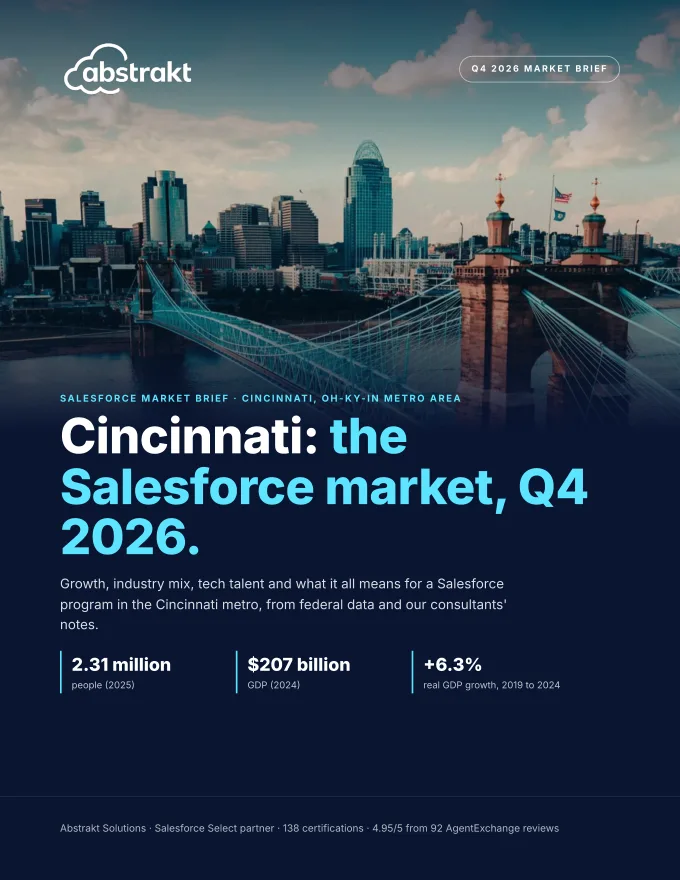
Everything on this page and more in one 25-page download for your planning: Cincinnati's growth since 2019 ranked against 100 metros, its industry mix, what related tech roles pay here compared with the U.S., the Cincinnati industry and service guides, and how Cincinnati compares with nearby metros.
A new edition of the Cincinnati brief is posted here each quarter, after the federal data refresh.
Salesforce consulting in Cincinnati: questions (10)
How should a Cincinnati food and flavoring manufacturer track sample and formulation requests from brand customers in Salesforce?
Treat each sample or formulation request as a tracked record rather than an email thread. Sales Cloud opportunities can link to a custom request object that captures the target profile, regulatory notes and lab status, so account teams see where every project sits. Once a flavor is commercialized, Manufacturing Cloud sales agreements carry the expected run-rate volumes. Abstrakt usually starts by mapping the handoff between R&D and sales, because that is where requests stall and customers lose visibility.
We sell across Northern Kentucky and Southeast Indiana as well as Ohio. How should Salesforce territories work for the three-state Cincinnati region?
Build territories on county or ZIP code rather than state, since customers and reps in this region cross the Ohio River constantly. Enterprise Territory Management lets you assign accounts with county-based rules and keep overlay roles for specialists. Fields that genuinely differ by state, such as licensing or tax treatment, belong on the account, not the territory. We typically prototype the rules in a sandbox against a full account export before any reassignment reaches production.
How can a company licensing research from a Cincinnati university or hospital research program manage those partnerships in Salesforce?
Model the relationship explicitly. A custom object for each agreement, linked to the institution's account and the inventors or tech transfer contacts, can hold milestones, sponsored research terms and renewal dates. Sales Cloud then covers commercial pipeline once the product reaches market. Keep any patient or study data out of the CRM unless compliance has approved it and Shield encryption is in place. Abstrakt can set this up as a focused first release and extend it as the company grows.
Which factors set the budget for a Cincinnati Salesforce project?
The main ones are the number of policy, banking or ERP systems to integrate, the compliance steps marketing must pass, and how territories and licensing work across three states. Data cleanup on overlapping accounts adds time. A paid discovery phase converts those unknowns into a firm plan.
Our Cincinnati firm has one Salesforce admin. Should we add another or use managed services?
Add a second person when the backlog is daily user requests that need someone who knows the business well. Use managed services when the backlog includes integrations, releases and development that one or two admins cannot cover. Keeping your admin as the internal owner while a partner adds depth works well here.
Do we need your team working inside our Cincinnati office?
No. The build happens in your Salesforce org, and we meet your team in scheduled working sessions, so a daily presence in your office is not part of the plan.
How should a Cincinnati wholesaler get ERP order and inventory data in front of reps?
Show the last orders, open orders and stock positions on the account in Sales Cloud, and keep the ERP as the system that owns them. MuleSoft or direct APIs can sync on a schedule or on demand depending on how fresh the data must be. Reorder prompts built on purchase history give reps a reason to call.
Can an AI agent read insurance applications for a Cincinnati carrier?
Yes. An agent can extract fields from applications and correspondence into Salesforce and send exceptions to an underwriter, who makes the decision. It works only when product rules are documented and account records are deduplicated. Measure accuracy on a sample before widening it.
How should a Cincinnati insurer track producer licenses across Ohio, Kentucky and Indiana?
Store each license and appointment as a related record on the producer with state, line of authority and expiration date. Use those records to control which products an agent can quote and to send reminders before renewals. Reporting by state shows gaps before they block business.
Our agents and reps barely use Salesforce. How do we fix adoption?
Start by asking which fields people actually need and removing the rest from their layouts. Then rebuild the daily views around what each role does first thing in the morning, and train on those. A short list of reports leadership reviews every week gives people a reason to keep data current.
Planning a Salesforce project? Read how Salesforce consulting is priced, the questions to ask a Salesforce consulting partner, or compare partners with our free scorecard.
Salesforce community groups in Cincinnati (1)
Salesforce's Trailblazer Community lists these local groups, where admins, developers and Salesforce owners meet to compare notes.
Upcoming community events
- Holiday Happy Hour: Celebrate with Trailblazers December 7, 2026 · Salesforce Women in Tech Group, Cincinnati
- Salesforce Women in Tech Group, Cincinnati, United States · last meetup September 23, 2026
Events and meetup dates checked on the official group pages on October 15, 2026.
Working across the Midwest? (3)
The same team works with companies in these nearby metros. All 100 markets →
Dayton
826,554 people · Health care and social assistance, 10.7% of GDP
Salesforce consulting in Dayton →Columbus
2.24M people · Finance and insurance, 11.4% of GDP
Salesforce consulting in Columbus →Louisville
1.40M people · Manufacturing, at least 16.3% of GDP
Salesforce consulting in Louisville →Sources and review (13)
Sources for the figures on this page
- U.S. Census Bureau, Population Estimates Program, Vintage 2025 (cbsa-est2025-alldata), July 1, 2025 estimate (accessed 2026-09-25)
- U.S. Bureau of Economic Analysis, CAGDP2 GDP by county (line 1, All industry total, current dollars), 2024; summed over the CBSA's component counties per Census Vintage 2025 delineation (accessed 2026-09-25; metro total summed from county figures)
- U.S. Census Bureau, County Business Patterns 2023, MSA file (NAICS total '------', ESTAB) (accessed 2026-09-25)
- REDI Cincinnati
- REDI Cincinnati
- University of Cincinnati 1819 Innovation Hub
- U.S. Census Bureau, Core Based Statistical Areas delineation files (July 2023), lists 1 and 2
- U.S. Census Bureau, Business Formation Statistics, county-level annual business applications (2019-2025; retrieved 2026-10-20; Sum of component-county applications; growth computed as latest/base - 1. Published only when every component county matches.)
- U.S. Bureau of Economic Analysis, CAGDP9 Real GDP by county, chained 2017 dollars, all industry total (2019-2024; retrieved 2026-10-15; Sum of component-county real GDP; growth computed as latest/base - 1. Published only when every county matches (independent cities and combined areas need manual mapping).)
- U.S. Bureau of Labor Statistics, Quarterly Census of Employment and Wages, annual averages, private ownership (2019 and 2024 annual averages; retrieved 2026-10-15; Employment growth computed as latest/base - 1. Location quotients and pay as published by BLS. Suppressed values stored as null.)
- U.S. Bureau of Labor Statistics, Occupational Employment and Wage Statistics, May 2025 (May 2025; retrieved 2026-10-20; Related occupations only. BLS publishes no Salesforce Administrator occupation; these figures are not Salesforce salaries.)
- U.S. Bureau of Labor Statistics, Employer Costs for Employee Compensation, private industry workers (2026 2nd Quarter; retrieved 2026-10-15; benefitsOnWages = benefits cost per hour / wages and salaries cost per hour (national average, all private industry).)
- Salesforce Trailblazer Community Groups, Official group pages (public, robots.txt-permitted paths only) (verified 2026-10-15)
Last reviewed October 5, 2026. See how Cincinnati compares with the other 99 markets in the U.S. Salesforce market report.