
Salesforce consulting for Columbia companies
Abstrakt Solutions is a Salesforce Consulting Partner for organizations in Columbia, West Columbia, Lexington and Irmo and out through Richland, Lexington and Kershaw counties. Columbia is one of our focus markets.
The Columbia business landscape
Manufacturing edges out finance and insurance as the Columbia metro’s biggest private sector in BEA’s 2024 figures, and retail trade follows in third. Inside city limits, Columbia’s FY2025 financial report, which credits the Central SC Alliance for its numbers, lists the state’s largest hospital system first, then a health insurer serving all of South Carolina and the state’s flagship public university.
The Central SC Alliance’s 2025–2028 strategic plan, covering Calhoun, Clarendon, Fairfield, Kershaw, Lexington, Newberry, Orangeburg and Richland counties, treats machinery, chemicals and plastics, and energy technologies as anchor industries, and marks food and beverage manufacturing, automotive, and life sciences and medical supplies as emerging ones. Its regional assessment singles out financial services, chemicals and plastics, logistics and energy technologies as high-performing clusters. SCRA, chartered by the state in 1983, backs innovation from Columbia, and its affiliate SC Launch lends to and invests in South Carolina companies.
Figures cover the Columbia, SC Metro Area (SC).
- Manufacturing9.3%Share of 2024 metro GDP Salesforce for manufacturing →
- Finance and insuranceat least 8.2%Share of 2024 metro GDP Salesforce for insurance →
- Retail trade8.1%Share of 2024 metro GDP Salesforce for retail & consumer goods →
- Health care and social assistanceat least 7.4%Share of 2024 metro GDP Salesforce for health & life sciences →
- Professional, scientific, and technical services6.9%Share of 2024 metro GDP
Regional target sectorsMachinery (anchor industry), Chemicals & Plastics (anchor industry), Energy Technologies (anchor industry), Food & Beverage Manufacturing (emerging industry), Automotive (emerging industry), Life Sciences & Medical Supplies (emerging industry)Central SC Alliance Strategic Plan 2025-2028 (June 2025), Target Industry Identification p. 8; region = Calhoun, Clarendon, Fairfield, Kershaw, Lexington, Newberry, Orangeburg and Richland counties
Where Salesforce fits in Columbia’s economy (4)
The largest private sectors by share of 2024 metro GDP, and what Salesforce work usually looks like in each.
| Sector | Share of 2024 GDP | Where Salesforce fits |
|---|---|---|
| ManufacturingSalesforce for manufacturing → | 9.3% | Manufacturing is the metro’s largest private sector at 9.3% of 2024 GDP, and the Alliance’s anchor list centers on machinery and chemicals. Industrial producers in the Midlands need dealer and distributor accounts, spec-based quote approvals and ERP order status visible to sales. |
| Finance and insuranceSalesforce for insurance → | at least 8.2% | A health plan, a life and accident carrier and a farm credit bank give Columbia an uncommon blend of health coverage, life and accident insurance and agricultural lending. Carriers and lenders here rely on member or broker service consoles, case routing and role-based access to regulated records. |
| Retail tradeSalesforce for retail & consumer goods → | 8.1% | Retail trade is the metro’s third-largest private sector, at 8.1% of 2024 GDP, and the Alliance’s regional assessment names logistics among its high-performing clusters, so goods reach buyers through stores and online channels alike. Regional retailers and consumer brands selling through those channels use Salesforce for loyalty programs, customer service and buyer relationships. |
| Health care and social assistanceSalesforce for health & life sciences → | at least 7.4% | Health care and social assistance contributes at least 7.4% of 2024 metro GDP, while the Alliance counts life sciences and medical supplies among its emerging industries. Hospitals track referrals and physician relations; medical suppliers manage hospital contracts and reorders. |
Source: U.S. Bureau of Economic Analysis, GDP by county (CAGDP2), 2024, summed to the metro area; private sectors only, excluding real estate and government. “At least” marks sectors where BEA suppresses some county figures.
Columbia by the numbers: the trend, not just the size (3)
Columbia has grown slightly ahead of the country since 2019, with professional services expanding fastest.
Business applications rose 62.3%, in line with the 62.2% national figure. New firms add steady first-implementation work.
Census Business Formation Statistics, county data summed to the metro, 2019–2025Real GDP grew 16.2%, above the U.S. 12.8%. Growing companies often need their Salesforce setup extended to new teams and services.
BEA real GDP by county (CAGDP9), summed to the metro, 2019–2024Private employment rose 5.4%, about the national 4.9%. Hiring keeps onboarding and access design on the agenda.
BLS Quarterly Census of Employment and Wages, 2019 and 2024Leading private sectors in Columbia, 2024: concentration, growth and pay
| Sector | Concentration vs U.S. | Job growth 2019–2024 | U.S. job growth | Average annual pay |
|---|---|---|---|---|
| Manufacturing | 0.97 | +0.7% | -0.3% | $73,055 |
| Retail trade | 1.11 | +5.4% | -0.8% | $37,443 |
| Professional, scientific, and technical services | 0.73 | +25.4% | +13.0% | $95,181 |
Professional services added 25.4% more jobs since 2019 though it remains below the national share (0.73); retail is 1.11 and manufacturing 0.97. BLS withholds the metro's finance, health care and computer systems design figures.
BLS Quarterly Census of Employment and Wages for Columbia, 2019 and 2024 · How these measures work
Across the Columbia metro (7)
We work with companies throughout the metro area as the Census Bureau defines it.
Principal cities (1)
- Columbia
Counties (6)
- Calhoun County
- Fairfield County
- Kershaw County
- Lexington County
- Richland County
- Saluda County
Salesforce in Columbia, service by service (7)
Each service has its own page for Columbia: what the work involves here, the industries it applies to and the questions local teams ask.
Implementation
Salesforce rollouts for Midlands carriers, farm lenders, hospitals and equipment makers, with sharing rules and catalogs settled before build.
See Columbia implementation →Integration
Policy admin, loan servicing, ERP and quality systems tied to Salesforce for Midlands carriers, farm lenders and plants, via MuleSoft or native APIs.
See Columbia integration →Migration
Columbia Salesforce migration for insurers, lenders and plants leaving older CRMs, spreadsheets or Classic, with records profiled and reconciled.
See Columbia migration →Optimization
Columbia Salesforce optimization for carriers, lenders and manufacturers: faster service consoles, consolidated automation and reliable dashboards.
See Columbia optimization →Managed Services
Columbia managed Salesforce services for carriers, lenders, retailers and chemical makers: admin, release testing, backlog work and change control.
See Columbia managed services →Health Check
Columbia Salesforce health checks for insurers, lenders and hospitals: access, sharing, technical debt and AI readiness, each finding ranked by risk.
See Columbia health check →Implementation Rescue
When a Midlands carrier, lender or equipment maker's Salesforce project stalls, we triage, stabilize and finish it in short releases.
See Columbia implementation rescue →Salesforce products we implement for Columbia teams
Columbia's manufacturers and insurers: where AI helps first
Columbia's leading private sectors are closely matched: in 2024 manufacturing produced 9.3 percent of metro GDP, finance and insurance at least 8.2 percent, and retail trade 8.1 percent. Machinery and chemicals producers can use AI to triage distributor leads and draft technical answers from approved product literature. Insurers and financial service operations handle high volumes of routine service requests, which suits case summaries and suggested replies that a representative reviews before sending. Store operators can let an assistant resolve common purchase and pickup inquiries. Before switching anything on, map which teams own which data, retire duplicate records, and write the knowledge articles the AI will rely on.
- Distributor lead triage for manufacturers
- Suggested replies for insurance requests
- Store and order self-service
Salesforce for Columbia’s leading industries (3)
Insurance
Salesforce for Columbia health, life and benefits insurers: worksite enrollment support, member service at volume and broker service desks.
See Salesforce for insurance in Columbia →Manufacturing
Salesforce for Columbia-area machinery, chemical and plastics manufacturers: engineered quotes, customer trials and aftermarket parts sales.
See Salesforce for manufacturing in Columbia →Health & Life Sciences
Salesforce for Columbia providers and medical supply makers: hospital and clinic accounts, product complaints, patient outreach and research ties.
See Salesforce for health & life sciences in Columbia →Common Salesforce challenges in these industries (3)
- 01
Member service at carrier volume
Health and life insurers field a steady stream of member, broker and employer questions, and routing each one to the right team with full policy context is where many service desks lose time.
- 02
Engineered quotes kept in spreadsheets
Machinery and chemical producers frequently price by specification and volume, so approval chains stall when discount rules and cost sheets sit in files outside the CRM.
- 03
Loan relationships hidden in core systems
Agricultural and farm-credit lenders follow borrowers through seasonal cycles and field visits, yet those details often stay in loan platforms that relationship and service staff cannot open.
What Salesforce should look like for Columbia companies (2)
Starting points for the industries that lead this market, not templates. Every org differs; these show the systems and the order they usually connect in.
A Columbia health, life or accident carrier serving members, brokers and employers
- Policy administration and claims systems as the record
- MuleSoft for policy, enrollment and claim status
- Financial Services Cloud insurance objects for policies, producers and groups
- Service Cloud queues by case type: broker, member, employer
- Experience Cloud broker and employer portal
- Agentforce case summaries and suggested replies for representatives
Protected health information limits who can see each field, so field-level security has to be designed before the service console. Adjudication stays in the policy system; Salesforce shows status and handles the conversation.
A Midlands machinery or chemicals producer selling through distributors
- ERP: orders, cost sheets, inventory
- Integration for order status and pricing
- Sales Cloud distributor accounts and customer trials
- Revenue Cloud for spec-based quotes and discount approvals
- Service Cloud for technical questions and aftermarket parts
- Agentforce drafts of technical answers from approved product literature
Approval chains stall when cost sheets and discount rules sit in separate files instead of Salesforce. Move the pricing rules into the quote process first; the AI and portal work depend on that data being right.
How Columbia revenue teams connect Salesforce to the rest of the stack (4)
Columbia's private economy is split almost evenly between manufacturing, finance and insurance, and retail, with hospitals and medical suppliers close behind. That mix means stacks here pair Salesforce with policy, loan, ERP and clinical systems, and the work is mostly about routing and access to regulated data.
- 1
Brokers and employers → Member service
Enrollment changes and member questions logged as Service Cloud cases with policy context pulled from the administration system.
- 2
Loan platform → Relationship managers
Borrower, loan and renewal details summarized in Financial Services Cloud so field staff prepare for visits without opening the core system.
- 3
Sales → Plants
Approved Revenue Cloud quotes sent to the ERP through MuleSoft, with ship dates and order status returned to the distributor account.
- 4
All teams → Leadership
Tableau dashboards built on shared definitions of member, borrower and customer, combining Salesforce service data with figures from core systems.
Our work in these industries (3)
Client names are anonymized and these projects are not specific to Columbia.
Salesforce guides from our team (3)
Written by the consultants delivering the work.

Salesforce for insurance agencies: policies, renewals and producers
How insurance agencies and brokers use Salesforce for households, policies, renewals, producer routing, consent and agency system integration, and what belongs in phase one.
Salesforce Service Cloud vs. ServiceNow: which fits your service team?
How Salesforce Service Cloud and ServiceNow Customer Service Management differ in design, where each fits, how AI agents compare, how to run both together, and the questions that decide it for your company.
Service CloudSalesforce surveys and CSAT: measuring satisfaction in Service Cloud
How to run CSAT, NPS and CES surveys in Salesforce: native survey licensing, sending after case close with Flow, linking responses to cases and agents, closing the loop and reporting.
Industry guides for Columbia companies (2)
- Manufacturing Salesforce Manufacturing Cloud: when it fits and how to implement it
- Health & Life Sciences Health Cloud implementation: patient data, care teams and compliance
Cost, staffing and partner choice in Columbia (3)
What drives the cost
Columbia cost drivers depend on the sector: carriers and lenders spend on field-level security, policy or loan system integration and service console design, while machinery and chemical producers spend on Revenue Cloud pricing rules and ERP connections. Duplicate records and older Classic orgs add cleanup before new work begins.
How Salesforce consulting is priced →Hire, outsource or both
Carriers here commonly run an internal Salesforce team with strict change control and bring in a partner for integration, new lines of business or Financial Services Cloud work. Manufacturers, medical suppliers and retailers more often outsource administration until the workload supports a hire.
Managed services vs. an in-house admin →Choosing a partner
Ask for experience with insurance or lending data models and protected data access if you are a carrier or lender, or Revenue Cloud and ERP integration if you manufacture. Ask how the partner handles release approvals and audit documentation.
Compare partners with the free scorecard →What Salesforce-related talent costs in Columbia (5)
Salesforce roles have no federal occupation code; the table lists related occupations measured in the Columbia metro and nationwide.
Annual wages for related occupations, Columbia and United States, May 2025
| Occupation (SOC code) | Columbia mean | Columbia median | U.S. mean | Columbia jobs |
|---|---|---|---|---|
| Computer systems analysts(15-1211) | $93,850 | $90,760 | $114,610 | 2,110 |
| Network and computer systems administrators(15-1244) | $97,090 | $86,650 | $103,680 | 810 |
| Database administrators(15-1242) | $92,670 | $83,330 | $110,090 | 250 |
| Software developers(15-1252) | $122,260 | $123,380 | $148,100 | 2,070 |
| Computer and information systems managers(11-3021) | $153,010 | $141,570 | $192,160 | 990 |
BLS Occupational Employment and Wage Statistics, May 2025: Columbia metro and U.S. estimates · About these figures
Columbia pays 16% to 20% under the national mean for analysts, developers, database administrators and IT managers, and about 6% under for network administrators. In-house staff are relatively inexpensive here.
Planner: in-house admin or outside support?
Compare the yearly cost of employing Salesforce staff in Columbia with a quote you have for outside support · How the planner works
In-house cost per year:$138,742
Enter an outside quote to compare.
Managed services vs an in-house admin → · Managed services in Columbia →
The Columbia Salesforce market brief, Q4 2026.
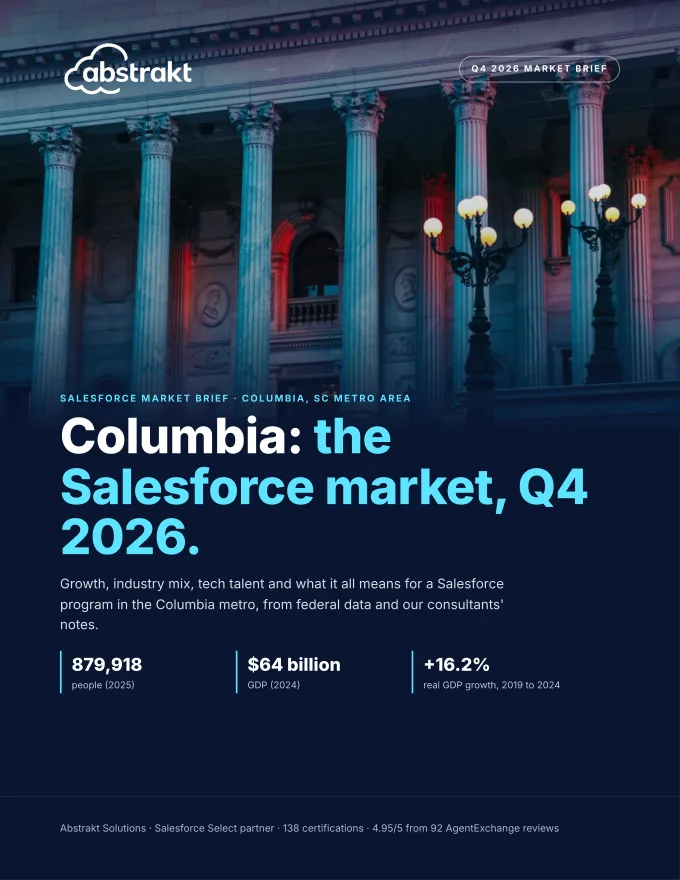
Everything on this page and more in one 23-page download for your planning: Columbia's growth since 2019 ranked against 100 metros, its industry mix, what related tech roles pay here compared with the U.S., the Columbia industry and service guides, and how Columbia compares with nearby metros.
A new edition of the Columbia brief is posted here each quarter, after the federal data refresh.
Salesforce consulting in Columbia: questions (10)
Our machinery plant is in one of the Central SC Alliance counties outside Columbia, such as Orangeburg or Newberry. Can Salesforce handle quoting for custom equipment configurations?
Yes. Revenue Cloud (CPQ) applies product rules, option dependencies and discount approvals, so reps cannot quote a combination engineering will reject. Store the chosen configuration on the quote and pass it to ERP when the order books. For aftermarket parts and service, pair it with Service Cloud or Field Service so installed equipment records drive later quotes. We usually begin by cleaning up the product catalog, because pricing logic is only as dependable as the data underneath it.
Columbia has a heavy concentration of health, life and accident insurance carriers. What should an insurer settle before moving broker and member service onto Service Cloud?
Map channels and case types first: broker questions, member inquiries, claim status and enrollment changes behave differently and deserve their own queues and entitlements. Financial Services Cloud adds insurance objects for policies, producers and group benefits, which saves custom build. Keep adjudication in the policy administration system and surface status through integration. Settle field-level security early, since protected health information limits who may see what, and retrofitting sharing rules later is expensive.
Energy technologies is one of the Central SC Alliance’s anchor industries. How do energy equipment and services firms in the Midlands typically use Salesforce?
Most start with Sales Cloud for utility and industrial accounts, where long buying cycles, many stakeholders and bid deadlines call for disciplined opportunity stages. Field Service suits companies that install or maintain equipment at customer sites, dispatching technicians by skill and certification. Linking asset records to service history lets renewals and upgrade offers surface on their own. An ERP and project accounting integration keeps margin visible from the first quote through closeout.
What shapes the cost of Salesforce consulting for a Columbia insurer or lender?
The number of case types and channels, how much policy or loan data must be surfaced through integration, and how tightly access has to be controlled. Migrating from an older CRM or Classic org adds profiling and reconciliation. Those answers come out of discovery and set the estimate.
Should a Midlands manufacturer hire a Salesforce admin or rely on managed services?
A hire makes sense when sales and service use Salesforce all day and need quick changes and user help. Managed services fits when the work includes quoting rules, ERP integration and release testing that need more than one skill set. Many plants start with a partner and hire once the work is steady.
Is it necessary for our Salesforce consultant to be in our Columbia office?
No. We do the build in your Salesforce org and meet your team in scheduled working sessions, so a daily presence in your office isn't needed. Compliance and operations staff join the sessions where their approval matters.
How can a farm credit lender give relationship staff loan details in Salesforce?
Keep the loan platform as the record and bring in a summary for each borrower: balances, maturities, renewal dates and open requests. Financial Services Cloud handles households, operations and related parties. Field visit notes then live beside the loan context instead of in separate files.
Can Agentforce help a Columbia chemicals or plastics producer answer technical questions?
Yes, if it drafts answers only from approved product literature and safety data, and a technical specialist reviews anything about specifications or handling. Start with distributor and customer questions that repeat often. Keep the source documents current, since the agent can only be as accurate as they are.
How should a Columbia medical supply maker manage hospital contracts and reorders in Salesforce?
Model health systems with parent and facility accounts, and track contract terms and pricing tiers on each. Reorder data from the ERP shows which facilities are buying less than expected. Product complaints belong in Service Cloud with the traceability your quality team needs.
How should a Columbia benefits carrier prepare Salesforce for worksite enrollment season?
Set up queues, knowledge articles and case types for enrollment questions before the season starts, and give brokers and employers a portal for status. Test routing at expected volume in a sandbox. Afterward, review case reasons to see which questions better materials could have prevented.
Planning a Salesforce project? Read how Salesforce consulting is priced, the questions to ask a Salesforce consulting partner, or compare partners with our free scorecard.
Working across the South? (3)
The same team works with companies in these nearby metros. All 100 markets →
Sources and review (12)
Sources for the figures on this page
- U.S. Census Bureau, Population Estimates Program, Vintage 2025 (cbsa-est2025-alldata), July 1, 2025 estimate (accessed 2026-09-25)
- U.S. Bureau of Economic Analysis, CAGDP2 GDP by county (line 1, All industry total, current dollars), 2024; summed over the CBSA's component counties per Census Vintage 2025 delineation (accessed 2026-09-25; metro total summed from county figures)
- U.S. Census Bureau, County Business Patterns 2023, MSA file (NAICS total '------', ESTAB) (accessed 2026-09-25)
- Central SC Alliance Strategic Plan 2025-2028 (June 2025), Target Industry Identification p. 8; region = Calhoun, Clarendon, Fairfield, Kershaw, Lexington, Newberry, Orangeburg and Richland counties
- University of South Carolina
- SCRA
- U.S. Census Bureau, Core Based Statistical Areas delineation files (July 2023), lists 1 and 2
- U.S. Census Bureau, Business Formation Statistics, county-level annual business applications (2019-2025; retrieved 2026-10-20; Sum of component-county applications; growth computed as latest/base - 1. Published only when every component county matches.)
- U.S. Bureau of Economic Analysis, CAGDP9 Real GDP by county, chained 2017 dollars, all industry total (2019-2024; retrieved 2026-10-15; Sum of component-county real GDP; growth computed as latest/base - 1. Published only when every county matches (independent cities and combined areas need manual mapping).)
- U.S. Bureau of Labor Statistics, Quarterly Census of Employment and Wages, annual averages, private ownership (2019 and 2024 annual averages; retrieved 2026-10-15; Employment growth computed as latest/base - 1. Location quotients and pay as published by BLS. Suppressed values stored as null.)
- U.S. Bureau of Labor Statistics, Occupational Employment and Wage Statistics, May 2025 (May 2025; retrieved 2026-10-20; Related occupations only. BLS publishes no Salesforce Administrator occupation; these figures are not Salesforce salaries.)
- U.S. Bureau of Labor Statistics, Employer Costs for Employee Compensation, private industry workers (2026 2nd Quarter; retrieved 2026-10-15; benefitsOnWages = benefits cost per hour / wages and salaries cost per hour (national average, all private industry).)
Last reviewed October 5, 2026. See how Columbia compares with the other 99 markets in the U.S. Salesforce market report.