
Salesforce consulting for Seattle companies
Puget Sound software, retail and manufacturing teams from Seattle to Tacoma and Bellevue turn to Abstrakt Solutions, a Salesforce Consulting Partner, for builds their engineers can respect. Seattle is one of our focus markets.
The Seattle business landscape
The information sector makes up almost a quarter of greater Seattle’s output, the highest share of any market we cover, and retail trade is second. Both shape how Seattle companies sell, serve customers and report on revenue.
Greater Seattle Partners, the regional economic development organization, targets aerospace, artificial intelligence, information technology, life sciences, clean technology and maritime. The University of Washington anchors the region’s research base, and the partnership tracks a startup community spanning AI, biotech, clean tech and aerospace.
Figures cover the Seattle-Tacoma-Bellevue, WA Metro Area (WA).
- Information23.0%Share of 2024 metro GDP Data 360 →
- Retail trade11.6%Share of 2024 metro GDP Salesforce for retail & consumer goods →
- Professional, scientific, and technical services8.5%Share of 2024 metro GDP Salesforce for professional services →
- Manufacturing6.5%Share of 2024 metro GDP Salesforce for manufacturing →
- Health care and social assistance5.1%Share of 2024 metro GDP
Regional target sectorsAerospace, Artificial Intelligence, Information Technology, Life Sciences, Clean Technology, MaritimeGreater Seattle Partners
Where Salesforce fits in Seattle’s economy (4)
The largest private sectors by share of 2024 metro GDP, and what Salesforce work usually looks like in each.
| Sector | Share of 2024 GDP | Where Salesforce fits |
|---|---|---|
| InformationData 360 → | 23.0% | Software, cloud and internet companies need Salesforce connected to product usage and billing data, with territories and renewals that keep up with fast growth. |
| Retail tradeSalesforce for retail & consumer goods → | 11.6% | Retailers and consumer brands use Salesforce for customer service, loyalty and marketing across channels, where unified customer data drives everything else. |
| Professional, scientific, and technical servicesSalesforce for professional services → | 8.5% | Consultancies, engineering firms and technology services companies need pipeline, resourcing and client history in one place. |
| ManufacturingSalesforce for manufacturing → | 6.5% | Aerospace suppliers, truck makers and maritime manufacturers manage long programs, dealer networks and aftermarket service. |
Source: U.S. Bureau of Economic Analysis, GDP by county (CAGDP2), 2024, summed to the metro area; private sectors only, excluding real estate and government. “At least” marks sectors where BEA suppresses some county figures.
Seattle by the numbers: the trend, not just the size (4)
Seattle combines one of the fastest rates of new business formation in the country with a technology sector that keeps growing, which makes for a demanding Salesforce market.
Business applications rose 90.5% since 2019, far ahead of the national 62.2%. Many of them will reach the point of needing a real CRM within a few years, often with product and billing data to connect.
Census Business Formation Statistics, county data summed to the metro, 2019–2025Real output grew 21.9%, well above the national 12.8%. Growth concentrated in high-value technology work means Salesforce programs here are judged on data quality and integration, not just user adoption.
BEA real GDP by county (CAGDP9), summed to the metro, 2019–2024Private employment grew only 1.7%, much slower than output. Companies are producing more per person, so Salesforce is expected to automate work rather than support a growing headcount.
BLS Quarterly Census of Employment and Wages, 2019 and 2024Computer systems design is 1.71 times as concentrated as nationally and grew 15.2%, with average pay above $223,000. Skilled integration people are plentiful and expensive.
BLS QCEW, NAICS 5415, 2019 and 2024Leading private sectors in Seattle, 2024: concentration, growth and pay
| Sector | Concentration vs U.S. | Job growth 2019–2024 | U.S. job growth | Average annual pay |
|---|---|---|---|---|
| Information | 3.44 | +4.9% | +2.0% | $340,978 |
| Retail trade | 0.84 | -24.7% | -0.8% | $53,888 |
| Professional, scientific, and technical services | 1.24 | +16.6% | +13.0% | $164,183 |
| Manufacturing | 0.96 | -10.4% | -0.3% | $111,824 |
| Health care and social assistance | 0.86 | +6.9% | +10.1% | $75,088 |
| Computer systems design and related services | 1.71 | +15.2% | +11.1% | $223,488 |
Information is 3.44 times as concentrated as nationally and professional services grew 16.6%, while retail employment fell by a quarter. Software, cloud and services firms drive most of the region's Salesforce work.
BLS Quarterly Census of Employment and Wages for Seattle, 2019 and 2024 · How these measures work
Across the Seattle metro (12)
We work with companies throughout the metro area as the Census Bureau defines it.
Principal cities (9)
- Auburn
- Bellevue
- Everett
- Kent
- Lakewood
- Redmond
- Renton
- Seattle
- Tacoma
Counties (3)
- Snohomish County
- King County
- Pierce County
Salesforce in Seattle, service by service (7)
Each service has its own page for Seattle: what the work involves here, the industries it applies to and the questions local teams ask.
Integration
Connecting Seattle manufacturers, retailers and maritime firms to Salesforce: ERP, commerce, dealer and operational data, monitored end to end.
See Seattle integration →Implementation
Salesforce implementation for Puget Sound maritime, professional services and life-sciences companies, with data models built around how they operate.
See Seattle implementation →Health Check
Seattle AI, software and life-sciences orgs reviewed for security, technical debt and data readiness before the next AI project begins.
See Seattle health check →Managed Services
Ongoing Salesforce admin, releases and backlog delivery for Seattle-area retailers, IT companies and aerospace suppliers.
See Seattle managed services →Optimization
Seattle tech, retail and services orgs made easier to use: cleaner records, consolidated automation and forecasts sales and finance both accept.
See Seattle optimization →Migration
Moving Seattle clean-tech, services and IT companies to Salesforce from spreadsheets, HubSpot or legacy CRMs, with cleanup and a short cutover.
See Seattle migration →Implementation Rescue
Seattle aerospace, manufacturing and retail teams with a stalled Salesforce project get triage, stabilization and a clear path to finishing the work.
See Seattle implementation rescue →Salesforce products we implement for Seattle teams
Grounding Agentforce in Seattle's software and retail economy
Information is the largest private sector in the Seattle metro, at 23.0% of GDP in 2024, followed by retail trade at 11.6%. Software and platform companies here usually have mature support queues, which makes case summarization and suggested replies the natural pilot: agents read the history, Agentforce proposes a response, and an engineer or support lead approves it. Retail brands can put an agent in front of order, return and loyalty questions, provided product and policy content is kept current. Technical services firms, 8.5% of output, often want help reading contracts and statements of work. Across all three, weak permission models are the usual blocker, so audit who can see what before connecting any agent.
- Summarizing software support case history
- Order, return and loyalty self-service
- Reading contracts and statements of work
Salesforce for Seattle’s leading industries (4)
Retail & Consumer Goods
Salesforce for Seattle retailers and consumer brands: service at consumer scale, AI agents for routine contacts, membership programs and clienteling.
See Salesforce for retail & consumer goods in Seattle →Professional Services
Salesforce for Seattle engineering, design and technical consulting firms: master agreements with large buyers, pursuits and delivery feedback.
See Salesforce for professional services in Seattle →Manufacturing
Salesforce for Seattle aerospace, maritime and clean technology manufacturers: dealer networks, warranty claims and service history by asset.
See Salesforce for manufacturing in Seattle →Health & Life Sciences
Salesforce for Seattle life sciences and digital health companies: selling to health plans and employers, patient programs and product data.
See Salesforce for health & life sciences in Seattle →Common Salesforce challenges in these industries (3)
- 01
Technical buyers, high expectations
Engineering-led companies expect Salesforce to be as well built as their own products: clean data models, tested automation and documented integrations.
- 02
Consumer-scale service
Retail and consumer companies handle large volumes of customer contacts, where routing, knowledge and AI assistance make the biggest difference.
- 03
Aftermarket and dealer service
Manufacturers selling through dealers need warranty, parts and service history connected to the account.
What Salesforce should look like for Seattle companies (2)
Starting points for the industries that lead this market, not templates. Every org differs; these show the systems and the order they usually connect in.
A Seattle retailer or consumer brand with a membership program
- Commerce, point-of-sale and loyalty platforms
- MuleSoft for orders, returns and member events
- Data 360 unified customer and member profiles
- Service Cloud with routing for consumer-scale contact volume
- Marketing Cloud journeys by membership tier
- Agentforce order, return and loyalty answers
Contact volume is the pressure point, so routing and current policy content come before any new campaign. Decide which platform owns the member record before unifying profiles, or loyalty balances will disagree across channels.
A Puget Sound equipment manufacturer selling through dealers
- ERP and PLM: parts, configurations, engineering changes
- Direct APIs or MuleSoft with documented contracts
- Sales Cloud with dealer accounts and programs
- Experience Cloud dealer portal for warranty claims and parts
- Service Cloud with service history by asset
- Tableau aftermarket revenue by dealer
Aftermarket revenue depends on knowing which asset a dealer is servicing and what is under warranty. Make the serialized asset the anchor for claims and parts orders, and keep engineering data in PLM with a link from Salesforce.
How Seattle revenue teams connect Salesforce to the rest of the stack (4)
Seattle stacks are often owned by engineering-led teams who expect Salesforce to meet the same standards as their own systems: versioned changes, tested automation and documented integrations. Between software companies feeding usage data and retailers handling consumer-scale service, RevOps work here is about clean contracts between systems more than adding tools.
- 1
Product → Sales
Usage and billing data from Snowflake reaches account records through Data 360, so renewals and expansions start from real numbers.
- 2
Marketing → Service
Marketing Cloud journeys share the unified profile with Service Cloud, so an agent sees recent orders and campaigns on every contact.
- 3
Dealers → Service
Warranty claims and parts requests enter through Experience Cloud and land as cases tied to the serialized asset.
- 4
All teams → Leadership
Integration monitoring through MuleSoft and Tableau reporting from documented, tested data definitions.
Our work in these industries (3)
Client names are anonymized and these projects are not specific to Seattle.
Salesforce guides from our team (3)
Written by the consultants delivering the work.

Salesforce for retail and consumer goods: shoppers, orders, trade
How retailers and consumer-goods brands use Service Cloud, Data 360 and Marketing Cloud for unified shoppers, order service, consent, wholesale accounts and loyalty, plus what to build first.
Data 360 (Data Cloud) implementation: phases, timeline and cost drivers
The phases of a Salesforce Data 360 (Data Cloud) implementation, what makes it take longer or cost more, how consumption pricing works, and how to scope a first phase.
Data 360Data 360 (Data Cloud) readiness checklist: data, identity, consent and ownership
A practical checklist to use before starting Salesforce Data 360 (Data Cloud): use case, sources, data quality, identity, consent, CRM health, definitions, activation, consumption, team and governance.
Industry guides for Seattle companies (3)
- Professional Services Salesforce for professional services firms: pipeline to delivery
- Manufacturing Salesforce Manufacturing Cloud: when it fits and how to implement it
- Health & Life Sciences Health Cloud implementation: patient data, care teams and compliance
Cost, staffing and partner choice in Seattle (3)
What drives the cost
Seattle costs depend on integration depth with product, commerce and ERP systems, contact volume and routing design for retailers, and the testing and documentation standards an engineering-led team expects. Dealer portals and warranty processes add scope for manufacturers.
How Salesforce consulting is priced →Hire, outsource or both
Software and retail companies here often have engineers who can own integrations but few people versed in Salesforce architecture. A partner usually covers data model design, automation and release practice, while internal engineering owns the APIs and pipelines on their side.
Managed services vs. an in-house admin →Choosing a partner
Ask how the partner versions and tests changes, documents integrations and handles deployments through source control. Ask for consumer-scale Service Cloud or dealer portal references, and who reviews code before it ships.
Compare partners with the free scorecard →What Salesforce-related talent costs in Seattle (5)
Here are the Seattle-metro wages for the federal occupations closest to Salesforce work, beside the national averages; Salesforce roles have no code of their own.
Annual wages for related occupations, Seattle and United States, May 2025
| Occupation (SOC code) | Seattle mean | Seattle median | U.S. mean | Seattle jobs |
|---|---|---|---|---|
| Computer systems analysts(15-1211) | $134,400 | $133,690 | $114,610 | 19,050 |
| Network and computer systems administrators(15-1244) | $112,580 | $104,440 | $103,680 | 5,530 |
| Database administrators(15-1242) | $131,460 | $133,180 | $110,090 | 1,010 |
| Software developers(15-1252) | $174,920 | $167,280 | $148,100 | 92,770 |
| Computer and information systems managers(11-3021) | $231,400 | $214,680 | $192,160 | 13,170 |
BLS Occupational Employment and Wage Statistics, May 2025: Seattle metro and U.S. estimates · About these figures
Every occupation pays well above the national mean, from about 9% more for network and systems administrators to about 20% more for IT managers. In-house Salesforce staff in Seattle are among the most expensive in the country to employ.
Planner: in-house admin or outside support?
Compare the yearly cost of employing Salesforce staff in Seattle with a quote you have for outside support · How the planner works
In-house cost per year:$160,877
Enter an outside quote to compare.
Managed services vs an in-house admin → · Managed services in Seattle →
The Seattle Salesforce market brief, Q4 2026.
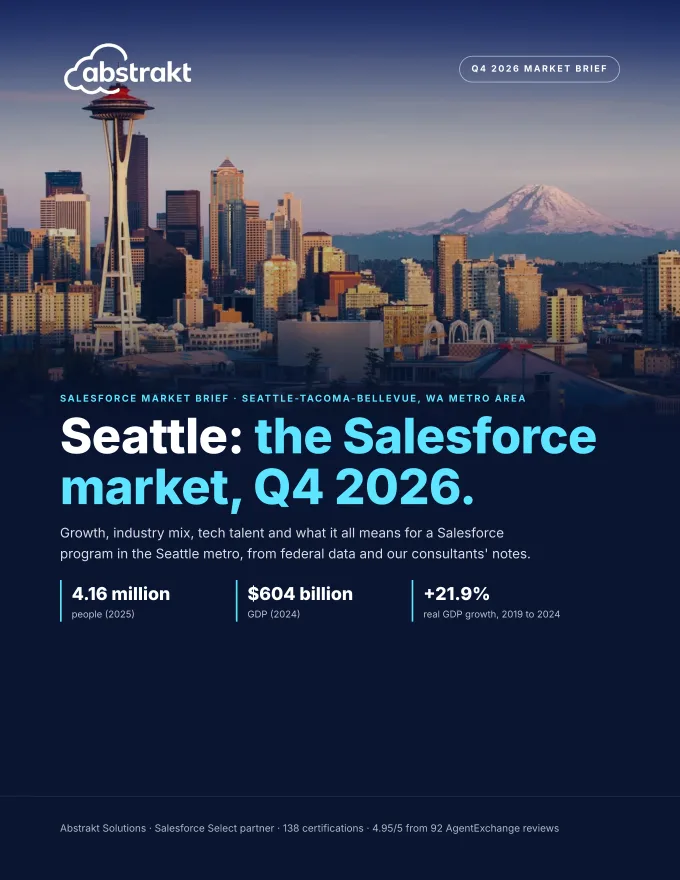
Everything on this page and more in one 23-page download for your planning: Seattle's growth since 2019 ranked against 100 metros, its industry mix, what related tech roles pay here compared with the U.S., the Seattle industry and service guides, and how Seattle compares with nearby metros.
A new edition of the Seattle brief is posted here each quarter, after the federal data refresh.
Salesforce consulting in Seattle: questions (10)
We are a Puget Sound maritime or port services company. Can Salesforce handle vessel customers and service contracts?
It can, with a data model built around vessels and voyages. Maritime firms usually need accounts for owners and operators, asset records for each vessel, and service contracts that renew by season or charter. Service Cloud tracks repair and inspection requests against the vessel, and Field Service can schedule crews at yards or berths. Pull scheduling or AIS data in through an integration rather than typing it in. We typically start by consolidating owner, operator and management company records, which are often tangled.
How should a Seattle-area aerospace supplier feeding the region’s commercial jet programs use Salesforce?
Use it to manage long programs, not just deals. Aerospace suppliers quote against multi-year programs, track RFQs by part number and manage engineering changes that affect cost and delivery. Sales Cloud with a program object linked to quotes and forecasted production rates gives leadership a realistic revenue view. Keep export-controlled drawings and technical data out of the CRM and link to your PLM system instead. Permission sets should limit program visibility where customers require it, and audit trails should cover quote revisions.
Our Seattle consumer brand sells through retail and direct to customers. How do we unify that in Salesforce?
Decide first which system owns the customer. Brands that sell through big retail partners and their own e-commerce site often have wholesale data in ERP, orders in Commerce or Shopify and loyalty data elsewhere. Data 360 (formerly Data Cloud) can resolve identities across those sources, while Sales Cloud manages retail accounts and Marketing Cloud handles direct campaigns. If you already keep analytics in Snowflake, zero-copy connections avoid duplicating data. Abstrakt usually starts with a customer data map so each integration has one clear owner.
What moves the cost of a Seattle Salesforce engagement?
How many product, commerce or ERP systems connect, the volume and channels of customer contacts, and the testing and documentation standard you expect. Engineering-led teams often want source control and automated tests, which adds setup but saves rework. Dealer portals and warranty flows add scope for manufacturers.
Our Seattle engineers could maintain Salesforce. Do we still need an admin or managed services?
Engineers handle integrations and code well, but day-to-day configuration, user requests and Salesforce-specific design take different skills and time. Managed services can own platform administration and architecture while engineering keeps the integration layer. Some teams later hire an admin once request volume is steady.
Does your team need to work from our Seattle office?
No. Configuration and development happen in your Salesforce org and source repository, and we meet your engineers and business owners in scheduled working sessions, so regular presence at your office isn't needed.
How should a Seattle aerospace or maritime manufacturer connect dealers to Salesforce?
Give dealers an Experience Cloud portal for warranty claims, parts orders and service history, with each claim tied to the serialized asset. The ERP keeps parts pricing and inventory; Salesforce shows it to dealers through MuleSoft or direct APIs. Track claims by dealer so quality issues surface early.
Where should a Seattle retailer start with Agentforce?
With order, return and loyalty questions answered from current policy and product content. Route anything involving refunds above policy or account changes to a person. Audit permissions and keep articles owned and dated before the agent goes live, since outdated content is the most common failure.
Can a Seattle software company keep Salesforce changes in source control?
Yes. Metadata can be managed in a Git repository with scratch orgs or sandboxes, pull requests and automated tests before deployment. It adds discipline to releases and gives engineers the review process they expect. Admins can still make declarative changes, as long as those changes flow through the same pipeline.
How should a Seattle engineering or design firm manage master agreements with large buyers in Salesforce?
Record the master agreement on the account with its terms and dates, and track each work order or project as an opportunity under it. That shows remaining room on each agreement and win rates by buyer. Delivery feedback logged on the account helps the next pursuit.
Planning a Salesforce project? Read how Salesforce consulting is priced, the questions to ask a Salesforce consulting partner, or compare partners with our free scorecard.
Salesforce community groups in Seattle (2)
Salesforce's Trailblazer Community lists these local groups, where admins, developers and Salesforce owners meet to compare notes.
- Salesforce Admin Group, Seattle, United States · last meetup August 13, 2026
- Salesforce Women in Tech Group, Seattle, United States · last meetup August 13, 2026
Events and meetup dates checked on the official group pages on October 15, 2026.
Working across the West? (3)
The same team works with companies in these nearby metros. All 100 markets →
Spokane
608,012 people · Health care and social assistance, 11.8% of GDP
Salesforce consulting in Spokane →Portland
2.54M people · Manufacturing, 12.1% of GDP
Salesforce consulting in Portland →Boise
864,243 people · Health care and social assistance, at least 9.1% of GDP
Salesforce consulting in Boise →Sources and review (12)
Sources for the figures on this page
- U.S. Census Bureau, Population Estimates Program, Vintage 2025 (cbsa-est2025-alldata), July 1, 2025 estimate (accessed 2026-09-25)
- U.S. Bureau of Economic Analysis, CAGDP2 GDP by county (line 1, All industry total, current dollars), 2024; summed over the CBSA's component counties per Census Vintage 2025 delineation (accessed 2026-09-25; metro total summed from county figures)
- U.S. Census Bureau, County Business Patterns 2023, MSA file (NAICS total '------', ESTAB) (accessed 2026-09-25)
- Greater Seattle Partners
- Greater Seattle Partners - 2025 Greater Seattle Economic Overview
- U.S. Census Bureau, Core Based Statistical Areas delineation files (July 2023), lists 1 and 2
- U.S. Census Bureau, Business Formation Statistics, county-level annual business applications (2019-2025; retrieved 2026-10-20; Sum of component-county applications; growth computed as latest/base - 1. Published only when every component county matches.)
- U.S. Bureau of Economic Analysis, CAGDP9 Real GDP by county, chained 2017 dollars, all industry total (2019-2024; retrieved 2026-10-15; Sum of component-county real GDP; growth computed as latest/base - 1. Published only when every county matches (independent cities and combined areas need manual mapping).)
- U.S. Bureau of Labor Statistics, Quarterly Census of Employment and Wages, annual averages, private ownership (2019 and 2024 annual averages; retrieved 2026-10-15; Employment growth computed as latest/base - 1. Location quotients and pay as published by BLS. Suppressed values stored as null.)
- U.S. Bureau of Labor Statistics, Occupational Employment and Wage Statistics, May 2025 (May 2025; retrieved 2026-10-20; Related occupations only. BLS publishes no Salesforce Administrator occupation; these figures are not Salesforce salaries.)
- U.S. Bureau of Labor Statistics, Employer Costs for Employee Compensation, private industry workers (2026 2nd Quarter; retrieved 2026-10-15; benefitsOnWages = benefits cost per hour / wages and salaries cost per hour (national average, all private industry).)
- Salesforce Trailblazer Community Groups, Official group pages (public, robots.txt-permitted paths only) (verified 2026-10-15)
Last reviewed October 5, 2026. See how Seattle compares with the other 99 markets in the U.S. Salesforce market report.