

How Salesforce work starts in Akron
Abstrakt Solutions works as a Salesforce Consulting Partner with polymer producers, health organizations and insurers in Akron, Cuyahoga Falls, Green and Kent throughout Summit and Portage counties. Akron is one of our focus markets.
What buyers here usually run into
- 1
Qualification cycles longer than sales cycles
Materials and polymer companies often run customer trials and qualification testing for months before an order, and tracking samples, lab results and decision makers over that span strains a standard pipeline.
- 2
Several health systems, overlapping referrers
With multiple hospital networks in one county, physician liaisons and outreach teams need clean referral source data, or duplicate provider records distort every report.
- 3
Headquarters serving many regions
Companies that run national or global headquarters from Summit County often have divisional sales teams on separate CRMs, and bringing them into one org means reconciling account hierarchies, territories and currencies.
Budget, team and partner questions
What drives cost
Akron projects vary most with how qualification and sample tracking are modeled, how many ERPs and lab systems connect, and whether divisional CRMs are being consolidated. Insurers and health systems add access reviews and privacy testing. Consolidations cost the most when duplicate customer cleanup is left until migration week.
Admin or partner
Summit County headquarters often have internal Salesforce staff and bring in a partner for consolidation or integration. Mid-sized polymer firms and distributors more often outsource administration and keep one internal owner who sets priorities.
What buyers ask a partner
Ask for manufacturing references that involve trials, samples or specification-driven quoting, not just standard opportunity pipelines. Insurers and health systems should ask how the partner audits permissions and documents changes for compliance review.
The local economy and its biggest industries (4)
| Sector | Share of 2024 GDP | Where Salesforce fits |
|---|---|---|
| Manufacturing Salesforce for manufacturing → | 12.2% | Tire companies and the polymer firms the chamber counts give Akron a manufacturing base rooted in rubber, plastics and materials science. Materials producers selling to OEMs need specification-driven quotes, sample and trial tracking, and ERP order visibility for account teams. |
| Health care and social assistance Salesforce for health & life sciences → | 9.7% | Health care and social assistance trails only manufacturing in Akron, at 9.7% of 2024 GDP, and the chamber builds patient care training pathways. Health systems here depend on referral management, physician relations and family or donor outreach with protected data locked down. |
| Finance and insurance Salesforce for insurance → | 9.1% | Finance and insurance is the Akron metro’s third-largest private sector in BEA’s 2024 figures, and Team NEO targets financial services across its region. Carriers and banks need agent or banker views of each client and service consoles with audit-ready permissions. |
| Wholesale trade Sales Cloud → | 7.5% | Wholesale trade rounds out the metro’s five largest private sectors, and Summit County names logistics and distribution among the fields driving its economy. Distribution businesses tend to need reorder reminders, contract pricing by account and a shared view of open orders for inside and outside sales. |
Source: U.S. Bureau of Economic Analysis, GDP by county (CAGDP2), 2024, summed to the metro area; private sectors only, excluding real estate and government. “At least” marks sectors where BEA suppresses some county figures.
Regional target sectors named by local economic development groups: Polymers & advanced materials (Polymer Industry Cluster; Sustainable Polymers Tech Hub), Advanced Manufacturing, Construction Technology, Patient Care (healthcare), Health care & biomedicine, Logistics & distribution, Technology, financial & professional services, Information Technology, Financial Services, Headquarters & Professional Services, Healthcare & Biotechnology.
Salesforce products that fit Akron (6)
In the order we lead with them here, from the industries above.
Salesforce Sales Cloud
The CRM where sales pipeline lives, when it is built right.
Salesforce Revenue Cloud / CPQ
Configure-price-quote, billing, subscription management, and quote-to-cash on Salesforce.
Salesforce Service Cloud
The operating system for modern customer service, case, knowledge, voice, and AI agent assist together.
Salesforce Financial Services Cloud
Industry CRM for wealth management, banking, insurance, and lending, built for compliance from the start.
Salesforce Marketing Cloud
Cross-channel marketing, email, mobile, journey, and Data 360-powered personalization at scale.
MuleSoft
Enterprise API platform, for connecting Salesforce, ERP, data warehouses, and the rest of your stack.
Polymers, patients, and policies: AI in Akron
Manufacturing contributes 12.2% of Akron's metro GDP (2024), with polymers and advanced materials at the center of regional strategy, while health care follows at 9.7% and finance and insurance at 9.1%. Materials producers get practical help from agents that parse technical data requests and route them to the right application engineer with context attached. Sales teams can use AI-assisted forecasting to spot which accounts are slowing reorders. Hospitals can deploy knowledge-based answers for common patient questions. Carriers and credit unions can have calls condensed into notes an agent drafts. The foundation is the same everywhere: tidy account hierarchies, reliable order history, curated knowledge articles, and a reviewer who checks outputs before customers see them.
- Technical data request routing
- Reorder slowdown forecasting support
- Common patient question answers
Services buyers here usually need (7)
Salesforce Implementation in Akron
In Akron, implementation usually has to serve a technical sale. Polymer compounders, rubber and plastics producers and industrial suppliers sell grades and specifications that customers test for months before ordering, and many run divisions that report to a Summit County headquarters. We design the account hierarchy, product and specification model and trial tracking before configuring screens, connect pricing to the ERP where it lives, and release in phases so sales and technical service adopt one shared record of each customer.
By industry in Akron
- 1
Manufacturing
Factories generate about 12.2% of Akron's 2024 output, more than any other private industry, with rubber, plastics and engineered materials at the core. Implementations for these companies turn on the product model: grades, formulations, pack sizes and customer-specific specifications that standard price books cannot express alone. We decide early whether Revenue Cloud handles configuration and pricing or the ERP stays the pricing master, then build opportunity stages that reflect how industrial buyers approve a new supplier.
- 2
Polymers & advanced materials
Greater Akron's federal Tech Hub designation for sustainable polymers makes materials development a regional priority, and the chamber counts more than 500 polymer-related companies across Northeast Ohio. Firms commercializing new materials need Salesforce to track sample shipments, lab and line trials, test results and the decision makers at each customer plant. We model trials as their own records linked to opportunities, so technical and commercial teams share one timeline and forecasts reflect qualification progress.
- 3
Headquarters & Professional Services
Team NEO names headquarters and professional services among Northeast Ohio's key industries, and several national and global headquarters operate in Summit County. Headquarters implementations often mean bringing divisions with different sales motions into one org. We start with a shared account and customer identifier standard, use record types and territories for real process differences, and give leadership consolidated reporting without forcing every division into an identical pipeline that fits none of them well.
Raise before scoping
Model specifications, not just products
Materials customers buy to a specification, and the same grade can carry different approved specs by customer or plant. Decide how specifications, approvals and certificates relate to products and accounts before building quotes, or reps will keep this knowledge in email and personal files.
Track trials as real work
Qualification can outlast the sales cycle by a wide margin. Give sample requests and trials their own records, owners and statuses, so technical service effort is visible, stalled trials are caught early, and forecasts stop treating a lab test as a nearly closed deal.
Agree on divisional boundaries
Summit County headquarters with several business units should decide up front what is shared, such as accounts and contacts, and what stays divisional, such as pipelines and pricing. Written rules prevent the first division to go live from setting defaults the others must later undo.
Salesforce Integration in Akron
Integration work in Akron commonly connects Salesforce to ERPs that have run manufacturing and distribution businesses for many years, plus lab, warehouse and billing systems added along the way. We identify what sales and service teams need from each, decide which system owns customers, products and pricing, and choose between MuleSoft, native connectors and scheduled jobs based on volume and complexity. Error handling and monitoring are part of the design, so failures reach a person before they reach a customer.
By industry in Akron
- 1
Wholesale trade
Distributors and other wholesalers produce roughly 7.5% of what the Akron economy generated in 2024. A rep at a Summit County distributor should be able to answer where an order is, what the customer's contract price is and whether an invoice is overdue, all from the account record, and a closed quote should become an ERP order without retyping. We reconcile customer numbers first, since duplicate or mismatched accounts are the main reason distribution integrations lose credibility, and then add order history in summarized form so pages stay fast.
- 2
Polymers & advanced materials
Materials companies connected to the region's polymer cluster, which includes a planned shared Polymer Pilot Plant funded by about $25 million of a state innovation award, often run lab systems alongside their ERP. Integration can link trial results, certificates of analysis and lot information to customer records, so technical service answers questions without searching several systems. We bring across summaries and documents, not raw instrument data, and keep regulated or confidential formulation details in the systems designed to protect them.
- 3
Logistics & distribution
Summit County names logistics and distribution among the fields driving its economy, and wholesale trade adds another 7.5% of 2024 metro GDP. Logistics providers here need shipment exceptions, claims and volume trends in Salesforce, not every scan event. Daily rollups from yard, dock and freight software are enough for most account conversations, and only exceptions that someone must answer turn into cases, which customers can follow in a portal.
Raise before scoping
Respect the ERP's history
Long-running ERPs in Akron manufacturers carry customizations and conventions that are not always documented. Interview the people who maintain them before designing the integration, because unwritten rules about pricing, credit and order edits are where connections most often break once real orders start flowing.
Keep confidential data contained
Formulations, test methods and customer-specific specifications may be commercially sensitive or under nondisclosure terms. Decide explicitly which fields may flow into Salesforce, restrict who can see them there, and keep the detailed records in the lab or engineering systems built to protect them.
Plan monitoring with IT
Agree with your IT team who watches integration alerts, how failures are logged and how quickly they must be resolved. A shared dashboard showing sync status and recent errors helps both IT and business users trust that the data in Salesforce is current.
Salesforce Optimization in Akron
Optimization in Akron often follows years of layered change: divisions merged, products added, several admins each leaving their mark. Retail trade alone is about 8.2% of metro GDP, and consumer and distribution businesses here feel that clutter in every order and case. We measure what people actually use, remove fields and automation that no longer serve a purpose, consolidate logic into well-documented Flows, fix duplicates and rebuild reporting around a short list of agreed metrics.
By industry in Akron
- 1
Wholesale trade
Distributors in Summit and Portage counties commonly run Salesforce alongside an ERP that owns orders and pricing. Over time, reps start editing synced fields, duplicate accounts appear from imports, and reorder reminders fire for customers who already bought. Optimization locks integration-owned fields, merges duplicates with history intact, rebuilds reminder automation around actual order data and redesigns account pages so inside and outside sales see the same current picture of every customer they share.
- 2
Health care & biomedicine
Summit County's 2025 disclosure statement names health care and biomedicine among the fields driving its economy, and organizations in that space often use Salesforce for physician relations, referrals and donor or family outreach. Typical problems are duplicate provider records, campaign lists nobody trusts and dashboards built on inconsistent referral sources. We standardize sources, merge providers carefully, and rebuild the few dashboards leadership uses to decide where liaisons should spend their time.
- 3
Construction Technology
Construction technology appears among the regional target sectors for Greater Akron, and firms selling software or equipment into construction often adopted Salesforce fast during growth. Their orgs show it: opportunity stages that no longer match the sales process, trial and pilot tracking built three different ways, and forecasts that miss renewals. We rebuild stages around real buying steps, unify pilot tracking into one object and add renewal visibility, so revenue reporting reflects both new and recurring business.
Raise before scoping
Baseline before changing anything
Capture current login rates, record completeness, report usage and time spent on common tasks before optimization starts. Those numbers show where the effort should go and let you demonstrate improvement afterward to leadership and to the users who were promised a simpler system.
Standardize across divisions carefully
Headquarters companies often want one way of working after years of divisional variation. Standardize shared data such as accounts, contacts and products, but keep process differences where they reflect genuinely different customers, or the optimized org will simply trade one frustration for another.
Consolidate old automation safely
Akron orgs that changed hands between admins tend to stack three generations of automation on a single record type. Map every automation per object, rebuild the logic in a single documented Flow where practical, test it against real scenarios and switch off the older versions only once results match.
Salesforce Migration in Akron
Consolidation drives much of the CRM switching we see in Summit County. A headquarters absorbs an acquired company running a different CRM, a manufacturer retires a homegrown database, or a professional firm leaves a tool it outgrew. Each legacy source gets catalogued, mapped onto a single agreed design and scrubbed in a holding area, and account owners check trial loads before anything is final. Cutover is planned around month-end and busy periods, with a read-only fallback for the old system.
By industry in Akron
- 1
Technology, financial & professional services
Summit County groups technology, financial and professional services together among the fields driving its economy. Firms in that group often move to Salesforce from another vendor's CRM, a marketing-first platform or an industry-specific tool as they grow or merge. Migration means preserving client relationships, engagement history and billing contacts, mapping custom fields to a cleaner design and retiring the ones nobody used. We rehearse the cutover with partners and account leads, who know which client records matter most.
- 2
Advanced Manufacturing
Some Portage and Summit county producers keep a customer's story split three ways: billing in the ERP, contacts in an aging CRM, drawings and approvals in engineering folders. Migration consolidates those into one account structure, attaches specifications and approvals to the right customers, and brings over enough quote and order history for reps to see buying patterns. We keep detailed transaction records in the ERP and link to them, rather than copying years of line items into Salesforce.
- 3
Healthcare & Biotechnology
Team NEO lists healthcare and biotechnology as a Northeast Ohio key industry, and organizations in it often migrate referral, donor or partner data from older databases. Those migrations need privacy controls from the first load: sensitive fields classified in advance, access restricted before users arrive, and test loads run with masked data. We reconcile record counts with compliance staff and document exactly what moved, what was archived and who approved each decision along the way.
Raise before scoping
Plan for acquired companies
Headquarters in Summit County often inherit CRMs through acquisitions. Decide whether each acquired business moves into the main org, keeps its own for a period or merges in phases, and set customer matching rules before the first load, since shared customers are almost guaranteed.
Mask data in test loads
Health, financial and employee information should not sit unprotected in sandboxes during trial migrations. Use masked or synthetic values for sensitive fields in test runs, and restrict sandbox access to the named migration team until the final load is complete and verified.
Avoid month-end cutovers
Finance, manufacturing and distribution teams in Summit County are busiest at month and quarter end. Schedule the final migration for a quieter period, so users have time to learn Salesforce, raise questions and reconcile their data before the next reporting deadline arrives.
Salesforce Health Checks in Akron
A health check for an Akron organization answers three questions: who can see what, what is fragile, and what should be fixed first. Our consultants read, never edit: they trace who reaches which records, what partners and families see, how connected systems authenticate, how tangled Flow and Apex have become, and which paid seats sit unused. Insurers and banks usually focus on access and audit trails, health systems on protected information, and manufacturers on integrations and confidential specifications. Everything lands in one prioritized list with a size attached to each fix.
By industry in Akron
- 1
Finance and insurance
At about 9.1% of 2024 GDP, finance and insurance ranks third in Akron after factories and care providers. Carriers and banks here face examinations where Salesforce configuration can become evidence. The review tests who can view and export customer financial data, how agents or bankers are limited to their own books, whether field history and event monitoring capture what auditors expect, and whether integration users hold broader rights than their function needs. Each gap is tied to a named control so it slots into existing remediation tracking.
- 2
Health care and social assistance
With care providers producing close to a tenth of 2024 metro output, Akron has many organizations running outreach, referral and physician relations in Salesforce. We look for diagnoses or treatment details that crept into free-text notes, check which roles can pull them into reports, probe the public forms families fill in, and confirm that access logging would hold up if an incident were ever investigated. Each item includes the risk and a recommended fix written for privacy officers rather than for administrators.
- 3
Manufacturing
Manufacturers often store customer specifications, pricing agreements and trial results in Salesforce, some of it confidential. The review checks sharing on those records and files, external collaboration settings and integration accounts connected to ERP or lab systems. It also measures technical debt from years of customization, such as untested Apex, overlapping automation and unused packages, which slows every future change, makes deployments riskier and complicates any move to AI features.
Raise before scoping
Align findings with audit controls
Regulated organizations already track controls for access, change management and data protection. Map health check findings to those controls, so remediation fits existing compliance work instead of creating a parallel list that competes for the same people, budget and attention.
Review external collaboration
Manufacturers and health organizations often share records with distributors, partners or families through portals or external users. Review exactly what each external audience can reach, because sharing opened for one project is easily forgotten and stays open far longer than intended.
Plan AI readiness separately
An Agentforce pilot raises specific questions: which records it can read, which actions it can trigger and how accurate its knowledge sources are. Ask the health check to address those directly, so AI planning starts from documented facts about your org.
Salesforce Managed Services in Akron
Summit County employers tend to buy managed services once the launch team has moved on and the org still has to keep pace. Health systems add programs and referral sources, insurers and banks adjust products and disclosures, and software firms change pricing. Named consultants who stay on your account field day-to-day asks, look after automation and connected systems, trial every platform upgrade in a sandbox, and sit down monthly with your designated owner to reorder what comes next.
By industry in Akron
- 1
Health care and social assistance
Akron's care sector generates roughly 9.7% of metro GDP, and its larger providers operate across many sites and service lines. Organizations of that size run steady streams of Salesforce changes for outreach, referrals and physician relations. What they need from a support partner is restraint as much as speed: a privacy screen on every request, access trimmed when nurses and liaisons change facilities, and referral flows retested ahead of each platform upgrade.
- 2
Financial Services
Financial services is a Team NEO key industry, and finance and insurance ranks third among the Akron metro's private sectors. Carriers and banks need Salesforce changes that hold up under audit. Our consultants document each request, test it in a sandbox, record who approved it and deploy on a set schedule. That rhythm lets business teams keep adding products, campaigns and service processes without creating configuration drift that examiners or internal auditors would question.
- 3
Information Technology
Team NEO reports 31,000 people working in technology across Northeast Ohio, and software firms in Summit County, including those serving the auto industry, often run Salesforce with heavy customization. Their engineers can handle code but rarely want to spend time on permission design, release testing or admin requests. Managed services takes that platform work off their plate, while leaving room for internal developers to own integrations or Apex under a shared deployment process.
Raise before scoping
Set one intake channel
When requests arrive by email, hallway conversation and chat, priorities blur and small items disappear. Route every Salesforce request through one channel with a short form, so each item is logged, sized and ranked, and nothing depends on who remembers what.
Regression-test regulated processes
Referral intake, consent capture, disclosures and claims routing should be retested before each Salesforce release and after any related change. Keep a written test script for each one, so testing is consistent regardless of which consultant runs it and results can be shown to auditors.
Review licenses every renewal
Large Akron employers often accumulate inactive users and unused add-ons as staff and programs change. Managed services should include a license review ahead of each renewal, comparing logins and feature use with contract terms, so spending tracks actual need rather than last year's headcount.
Salesforce Implementation Rescue in Akron
A Salesforce rescue in Akron starts with understanding why the project stalled before anyone writes more configuration. Common causes here include quoting built without the product and specification complexity materials companies need, divisional requirements that were never reconciled, and integrations with long-running ERPs that proved harder than planned. Our first weeks go to reading the org and the paperwork and listening to the people who funded and used it; what follows is a repair list, a verdict on each component and a finish plan you can defend.
By industry in Akron
- 1
Polymers & advanced materials
Materials projects often stall because the original design treated grades and specifications as simple products. Quotes come out wrong, trials are tracked outside the system, and technical staff never log in. In a rescue we rebuild the product and specification model with sales and technical leads, create a proper trial record, and restore accurate quoting for the most common grades first, then extend to the rest once users trust the results.
- 2
Finance and insurance
Financial and insurance projects stall when compliance requirements surface late. Sharing designed for convenience fails review, disclosures are not captured, and the launch is blocked. We start by documenting the controls the org must meet, audit the current build against them and correct permissions, field access and approval steps. Only then do we resume feature work, so the project clears compliance review instead of stalling again at the same gate.
- 3
Logistics & distribution
Logistics and distribution projects commonly fail at adoption. Cases lack shipment context, order data never arrived from the ERP, and service teams return to email and spreadsheets. We prioritize a minimal reliable data feed, redesign case types around real exceptions, and fix the queues supervisors use daily. Once agents see accurate information in Salesforce, broader improvements like customer portals, proactive alerts or more automation become realistic next steps for the team.
Raise before scoping
Find the real decision-maker
Stalled projects often lack a sponsor with authority to settle disputes between divisions or departments. Confirm who can make binding scope and design decisions before recovery begins, or the same disagreements that stopped the original project will stop the rescue too.
Recover the knowledge trail
Design decisions, workarounds and integration details often left with the previous partner. Gather documentation, code repositories and credentials, and interview anyone involved while memories are fresh, so the recovery team does not rediscover old problems by breaking things in production.
Narrow the next milestone
Replace the original big-bang launch with a smaller, achievable milestone that delivers visible value to one team. Success there rebuilds sponsor confidence and user trust, and justifies funding for the following phases on the strength of evidence rather than promises from the original plan.
Industry plays in Akron (3)
Salesforce for Akron Manufacturers
What an Akron producer ships is frequently a compound or grade built to one customer's requirements, not an off-the-shelf item. Salesforce has to reflect that: each customer may buy custom compounds, require documentation for every change and ask detailed sustainability questions. We model products by grade and customer specification, connect quoting to raw material costs in the ERP, and give technical service, sales and quality teams one shared history for each customer application so nothing depends on memory or email threads.
Across Summit and Portage counties, factories generate 12.2% of 2024 GDP by the Bureau of Economic Analysis's reckoning, more than health care or finance. The Greater Akron Chamber puts polymers and advanced materials at the center of its economic development work and cites more than 150 polymer-related companies in Akron and over 500 across Northeast Ohio. The region's Sustainable Polymers Tech Hub received a $51 million federal Phase 2 award in February 2024, one of 12 nationwide, which signals where investment and new product development are heading.
Use cases to open with
- 1
Grade and specification management
Compounders and materials producers often maintain customer-specific grades with their own specifications, approvals and price terms. Salesforce can link each customer application to the approved grade, specification documents and change history held in quality systems. Sales and technical service staff see what each customer is qualified to receive, which prevents quoting an unapproved material and speeds responses when customers request formulation changes or new samples.
- 2
Raw material cost pass-through
Polymer prices move with feedstock costs, and many contracts include index-based adjustments. Revenue Cloud or CPQ, fed by raw material costs and index values from ERP, can recalculate prices on schedule and document every change. Account managers explain increases with clear data, and finance sees whether adjustments were applied consistently across the customer base instead of discovering gaps at year end.
- 3
Sustainability data requests
Customers increasingly ask about recycled content, carbon footprint and material composition before approving a supplier or renewing a supply contract. Service Cloud can route these requests to the right technical or sustainability specialist, track due dates and store each response by product and customer. Over time, the answers become reusable knowledge articles, which shortens turnaround on the next questionnaire and keeps statements consistent across every sales team and region.
Raise before scoping
Formulation data security
Formulations are core intellectual property. Salesforce should hold grade identifiers, the specifications customers are allowed to see and commercial terms, never the recipes themselves. Restrict access to technical documents by role, and keep formulation details in the laboratory and product systems designed to protect them.
Distributor and direct channels
Many materials companies sell large accounts directly and smaller customers through distributors. Define how distributor-served accounts appear in Salesforce, how pricing is protected between channels and whether distributors get portal access, before those channels start competing for the same end customer.
Linking lab and quality systems
Certificates of analysis, test results and change notices come from laboratory and quality systems. Decide which of these customers need to see through sales staff or a portal, then integrate summaries and document links rather than copying full lab data into the CRM where it can drift out of date.
Salesforce for Akron Health and Life Sciences
In Summit and Portage counties, health organizations compete for patients, employer contracts and clinical staff at the same time. Salesforce can support all three: patient engagement and access alongside the EHR, sales and service for occupational and employer health programs, and recruiting pipelines for nurses and allied health workers. Biomedical and health technology companies can use it to manage clinical customers and partners. We define PHI boundaries first, then build the processes that matter most to your organization.
Only manufacturing outweighs health care and social assistance in Akron's economy; the Bureau of Economic Analysis attributes 9.7% of the metro's 2024 GDP to the sector. Summit County's 2025 informational statement lists health care and biomedicine among the fields driving its economic diversity, and Team NEO names healthcare and biotechnology as a key industry across 14 Northeast Ohio counties. The Greater Akron Chamber also builds workforce pathways in patient care, and a local nonprofit innovation hub runs a healthcare innovation program for startups, showing investment in both care delivery and health technology.
Use cases to open with
- 1
Clinical workforce recruiting
Nursing and allied health roles are hard to fill, and candidates often compare several employers. Salesforce can track candidates from school partnerships and career events through applications and offers, with Marketing Cloud nurturing students and early-career clinicians. Recruiters see which programs produce hires, and leaders can measure pipeline for each role and unit instead of reacting only after vacancies open.
- 2
Employer health program sales
Occupational health, on-site employee clinics and wellness programs are sold to local employers, and in a county where manufacturing leads the economy, plants are natural prospects. Each employer becomes an account with its program mix, contract dates and plant locations, and HR contacts open requests for injury visits or drug screens through Service Cloud. Account managers see utilization summaries without patient-level details, which keeps renewal conversations focused on outcomes and inside privacy rules.
- 3
Biomedical startup customer management
Health technology and biomedical startups need a disciplined way to track pilots, clinical champions and purchasing decisions inside hospitals, where approvals involve many people. Sales Cloud with simple stages for pilot, evaluation and contract, plus a clear record of the evidence shared at each step, helps founders and small sales teams manage long cycles and answer investor questions about pipeline and traction with real data rather than estimates.
Raise before scoping
HIPAA across different programs
Patient care, employer programs and recruiting each involve different data types. Keep PHI restricted to the users and processes that need it, sign a business associate agreement where required, and design reports so employer and recruiting teams never see protected patient details.
Candidate data and applicant tracking
Most health organizations already run an applicant tracking system for hiring. Salesforce should manage relationship building before someone applies and hand off to that system for the formal process, with an integration that avoids duplicate candidate records and conflicting status between the two tools.
Scaling from startup to growth
Biomedical startups should begin with a lean configuration and clean data habits, then add features as the team and customer base grow. Overbuilding early wastes scarce budget, while skipping basic data standards creates cleanup work that slows fundraising diligence and later expansion into new markets.
Salesforce for Akron Insurers and Agencies
Insurance in the Akron area sits close to industry. Agencies and carriers here write coverage for materials companies, manufacturers, distributors and the households that work for them, and many operations support customers well beyond Ohio. Salesforce helps in three places: commercial account management with complex exposures, service operations that must be fast and documented, and consolidation of divisional CRMs into one org. Financial Services Cloud provides the insurance data model, with policy systems remaining the record for coverage.
Summit and Portage counties form the Akron metro, where finance and insurance generated 9.1% of 2024 GDP in BEA county numbers, placing it third behind manufacturing at 12.2% and health care. Team NEO, which covers a 14-county Northeast Ohio region, lists financial services and headquarters and professional services among its key industries, and Summit County's 2025 informational statement names technology, financial and professional services as a driver of the county's economic diversity. The Greater Akron Chamber cites 150+ polymer-related companies in Akron, a commercial client base with specialized property, product and environmental exposures.
Use cases to open with
- 1
Commercial accounts with complex exposures
Polymer compounders, tire and rubber suppliers and manufacturers carry property, product liability, environmental and cargo exposures that change as plants add lines or products. Financial Services Cloud can hold each business with its locations, policies, loss history and exposure notes, and schedule pre-renewal meetings. Account managers see what changed since last year before asking the client, and underwriting submissions start from organized information instead of a scramble.
- 2
Consolidating divisional CRMs
Insurance operations that grew through acquisitions often run personal lines, commercial lines and benefits on separate CRMs or spreadsheets. Bringing them into one Salesforce org means reconciling account hierarchies, territories and producer codes, but it gives leadership a single view of each client relationship. Cross-sell opportunities appear when a commercial client's owners turn out to be personal-lines prospects the agency never approached.
- 3
Documented service for policyholders
Policy changes, billing questions, certificate requests and claims inquiries need quick answers and a clear record. Service Cloud routes each request to the right team with deadlines, gives representatives the policy summary and prior interactions, and captures resolutions. Managers track response times by line and team, and the audit trail helps with complaints and regulatory inquiries that ask what was said and when.
Raise before scoping
Hierarchies before migration
When merging CRMs or agencies, decide how parent companies, subsidiaries, locations and households relate before loading data. Duplicate clients across divisions are common, so plan matching rules, a master record strategy and a review step with producers, who know which duplicates are truly the same client.
Policy and claims integration
Coverage, premium and claim details belong in policy administration and claims systems. Pull the summaries producers and service staff actually need, refresh them on a known schedule, and avoid building parallel policy records in Salesforce that drift out of date after the first endorsement.
Ohio privacy and security duties
Ohio's insurance data security law and GLBA shape how licensees protect consumer information. Configure access controls, multi-factor authentication and monitoring to support your written security program, and let your compliance lead confirm how Salesforce fits it. We support the program without providing legal advice.
Case studies to send (3)
From the industries this market leans on. Client names are anonymized and these projects are not specific to Akron.
The Akron Salesforce market brief, Q4 2026
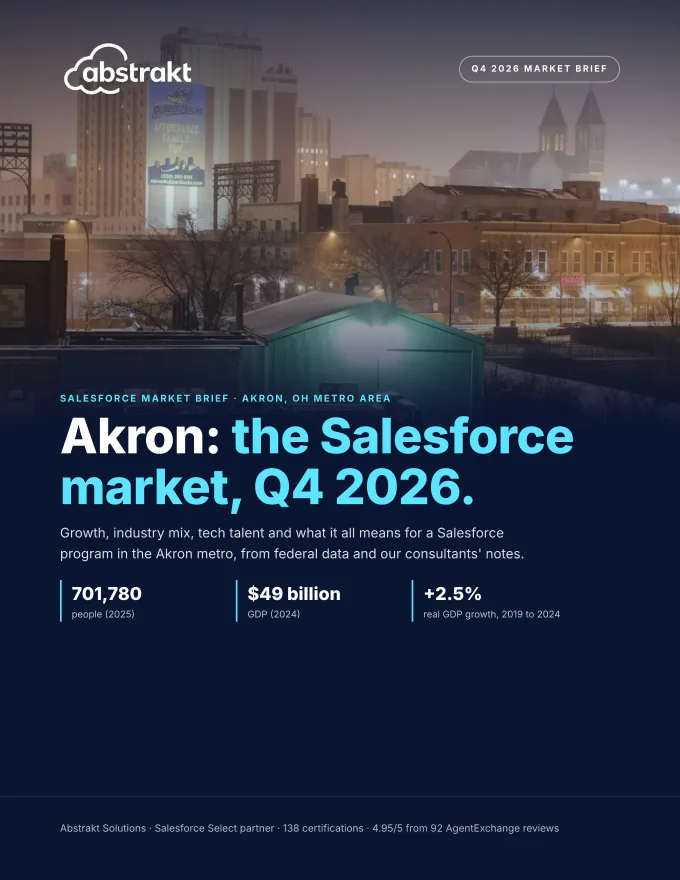
A free 22-page PDF with Akron's growth ranked against 100 metros, its industry mix, tech wages and nearby markets. It is offered on the public Akron page; send your customer there or get a copy for your own prep.
Get the Akron brief →Co-sell with Abstrakt in Akron
Working a Akron account? Bring in a named consultant for discovery, scoping or a health check. We reply within 4 business hours.