

How Salesforce work starts in Pittsburgh
Abstrakt Solutions is a Salesforce Consulting Partner whose Pittsburgh-area clients range from health systems and banks to robotics and technology companies. We implement, integrate, optimize and manage Salesforce across southwestern Pennsylvania. Pittsburgh is one of our focus markets.
What buyers here usually run into
- 1
From research to revenue
Robotics and AI companies spun out of research often have strong technology and thin sales operations. A lean, well-designed Salesforce org helps them scale without rework.
- 2
Serving equipment in the field
Companies whose products run on customer sites need service history, parts and technician scheduling connected to the account.
- 3
Commercial banking relationships
Banks need a view of each commercial relationship across lending, treasury and wealth products, which rarely lives in one system today.
Budget, team and partner questions
What drives cost
In Pittsburgh, cost tracks privacy and exam requirements at health systems and banks, and integration with core banking, EHR or billing systems. Robotics and AI companies spend more on quoting hardware with recurring revenue and on installed-base service. Energy companies add billing, asset and GIS integration.
Admin or partner
Hospitals and banks typically keep internal Salesforce ownership and use partners for architecture, integration and compliance-sensitive builds. University spinouts and smaller tech companies usually start with a partner and hire as sales grows.
What buyers ask a partner
Ask for Financial Services Cloud or health care references, how the partner prepares documentation for examiners or privacy reviews, and for tech companies, how they model pilots and recurring revenue. Ask how agent actions will be logged.
The local economy and its biggest industries (4)
| Sector | Share of 2024 GDP | Where Salesforce fits |
|---|---|---|
| Health care and social assistance Salesforce for health & life sciences → | 9.7% | Health systems and insurers use Salesforce for patient and member engagement, referral management and contact-center service, with privacy and consent designed in. |
| Finance and insurance Financial Services Cloud → | 8.4% | Banks and financial services firms need relationship views across commercial and retail lines, onboarding workflows and compliant marketing. |
| Professional, scientific, and technical services Salesforce for professional services → | 8.2% | Engineering, research and technology services firms, including robotics and AI companies moving from research to commercial sales, need pipeline and account management that fits technical buyers. |
| Manufacturing Salesforce for manufacturing → | 7.3% | Industrial and robotics manufacturers need quoting, installed-base tracking and field service for equipment on customer sites. |
Source: U.S. Bureau of Economic Analysis, GDP by county (CAGDP2), 2024, summed to the metro area; private sectors only, excluding real estate and government. “At least” marks sectors where BEA suppresses some county figures.
Regional target sectors named by local economic development groups: AI, Robotics, Life Sciences & Healthcare, Energy, Financial Services & Fintech, Advanced Manufacturing.
Salesforce products that fit Pittsburgh (6)
In the order we lead with them here, from the industries above.
Salesforce Sales Cloud
The CRM where sales pipeline lives, when it is built right.
Salesforce Service Cloud
The operating system for modern customer service, case, knowledge, voice, and AI agent assist together.
Salesforce Field Service
Scheduling, dispatch, mobile work orders and parts for teams that work on site.
Salesforce Financial Services Cloud
Industry CRM for wealth management, banking, insurance, and lending, built for compliance from the start.
Salesforce Agentforce
AI agents that handle real work inside Sales Cloud, Service Cloud, and Marketing Cloud.
Salesforce Data 360 (Data Cloud)
Unify customer data into a real-time profile that powers segmentation, analytics, and AI.
Careful first AI steps for Pittsburgh hospitals and lenders
Pittsburgh leans on hospitals and banks: BEA's 2024 series puts health care near 9.7% of metro output and finance and insurance near 8.4%. Both work under strict privacy rules, so the realistic entry point is narrow. A health network can have an agent summarize patient-access cases for staff rather than for patients, and clinical content stays out of scope until governance is agreed. Banks and insurers can test reply drafting on servicing emails where a rep approves every message. The region's robotics and research firms, often comfortable with AI, still need the same groundwork: field-level security, a reviewed knowledge base and logs that show what the agent did.
- Patient-access case summaries for staff
- Rep-approved servicing email drafts
- Audit logs of agent actions
Services buyers here usually need (7)
Salesforce Implementation in Pittsburgh
Pittsburgh implementations span very different starting points. A health system wants patient outreach and referrals without touching the EHR; a bank needs commercial and retail relationships in one view; a robotics company moving from research to sales needs its first real pipeline and installed-base records. The sequence is discovery with each department, then data model and security design, sandbox build, clean data migration and training organized by role. No group starts until the one before it is live and stable.
By industry in Pittsburgh
- 1
Health care and social assistance
Health care is Pittsburgh's largest private sector, about 9.7% of 2024 metro GDP, led by large health systems and insurers. Implementing Health Cloud or Service Cloud for them depends on early decisions about patient and member identity, consent, and which clinical data may appear in the CRM at all. We settle those with privacy and IT leaders during design, and phase the rollout by department so each contact center or care team gets focused training.
- 2
Robotics
Robotics is a Pittsburgh Regional Alliance target sector, and the region counted more than 130 robotics companies in 2024. Many are moving from research contracts and pilots to repeat commercial sales. Implementation for them treats pilots, deployments and the robots themselves as records, so sales, customer success and field support share one history. We keep the first release lean, then add Field Service and service contracts as the installed fleet grows.
- 3
Financial Services & Fintech
Financial services and fintech is another of the alliance's target sectors, ranging from large banks to younger payments and lending firms. For them, implementation choices center on Financial Services Cloud's relationship and household model, referral paths between retail, commercial and wealth teams, and a sharing model that keeps client data within the right lines of business. We design those before building, because changing the sharing model after launch disrupts every team at once.
Raise before scoping
Separate research and commercial contacts
Companies with university or lab roots carry contacts from grants, collaborations and pilot customers. Decide early which belong in the sales process and which remain partner or research relationships, so pipeline reports reflect genuine buyers rather than every scientist the founders have met.
Put compliance in design sign-off
Health and financial organizations should include privacy and compliance staff in design approval, not only in final testing. Their questions about retention, consent and access shape objects and sharing rules, and answering them before the build avoids rework late in the project.
Release in focused phases
Start with one line of business or one team, go live, stabilize and learn. Add the next group once adoption measures look healthy. Phasing lets organizations with several divisions prove the design at a manageable scale before extending it across the enterprise.
Salesforce Integration in Pittsburgh
Pittsburgh integration work covers some of the most varied systems we see: industrial ERPs, utility billing and asset platforms, core banking, and clinical and scheduling systems at health organizations. We map every shared entity and name its owner, pick MuleSoft, Workato or direct APIs according to volume and support capacity, build with realistic data and set up alerts for failures. The goal is that each team sees current information in Salesforce without re-keying it or calling another department.
By industry in Pittsburgh
- 1
Manufacturing
Manufacturing accounts for about 7.3% of the metro's 2024 GDP, and many of the region's industrial firms run long-established ERPs. With the connection in place, quoting draws on current ERP prices, accepted orders enter production without re-entry, and the account page shows shipments and invoices. For equipment makers, serial numbers and warranties connect to Field Service, so technicians and account managers see the same installed-base history. Integration errors route to a named owner on the ERP side as well as in Salesforce.
- 2
Energy
Energy is a Pittsburgh Regional Alliance target sector, and energy companies typically hold customer, premise and asset data in separate billing, GIS and work management platforms. Integrations bring the relevant slices into Salesforce: commercial account and contract status for sales, open work orders and service cases for customer teams. Each of those platforms keys customers differently, so reconciling identifiers is usually the largest single design task. Field crews then see account context before they arrive at a commercial site.
- 3
Health care and social assistance
Health systems and insurers need Salesforce to reflect appointments, referrals, claims or eligibility quickly enough that contact-center staff can resolve calls without switching screens. The hardest part is patient and member matching, since several systems hold the same person under different identifiers. We design a matching and merge approach first, then build interfaces that move the minimum data each workflow requires and record where every value came from. Privacy staff approve each interface before it carries live data.
Raise before scoping
Match latency to the need
Latency requirements differ sharply by team. Service agents may need live appointment or outage status, while revenue and invoice history can refresh nightly. Choosing the slowest refresh each team can live with keeps the design simpler and failures easier to trace.
Write the operating runbook
Every integration needs a short operating guide: what it moves, when it runs, who is alerted and how failed records are resent. Without one, knowledge sits with whoever built the connection, and the first failure after they move on turns into a long investigation.
Bring source vendors in early
ERP, billing and clinical system vendors often control the APIs and access you will use. Involve them early in design to confirm available endpoints, limits and any added costs, so the integration plan reflects what those systems actually support rather than assumptions drawn from documentation.
Salesforce Managed Services in Pittsburgh
For Pittsburgh companies, managed services usually starts when the Salesforce admin role has become a bottleneck: requests wait for weeks, releases arrive untested and integrations fail without anyone noticing. We take over or support that role with a bench of administrators, developers and architects working from one prioritized backlog. Each Salesforce release is checked in a sandbox against your key processes, and a regular review with your business owner covers what shipped, what is next and what the org still needs.
By industry in Pittsburgh
- 1
Finance and insurance
Finance and insurance contributes about 8.4% of 2024 metro GDP, and banks and insurers here run orgs that change constantly as products, branches and regulations shift. Managed services keeps those changes controlled: every request is logged and tested, sharing and permission changes get a second reviewer, and deployments are documented for examiners. We also maintain Financial Services Cloud configuration, such as relationship groups and referral routing, as teams reorganize. Every deployment carries the name of the person who approved it.
- 2
Life Sciences & Healthcare
Life sciences and healthcare is a Pittsburgh Regional Alliance target sector, and device, diagnostics and research companies often run Salesforce with a very small internal team. Ongoing support for them covers user and access administration, service case processes for customer inquiries, and careful handling of any fields tied to quality or regulatory requirements. We test each release against those processes before it reaches users, and keep a change history their quality staff can reference.
- 3
Professional, scientific, and technical services
Engineering, research and consulting firms rely on Salesforce for pipeline and client reporting but rarely employ a full-time admin. Managed services gives them that capability without the hire, handling new user setups, report changes and enhancements such as proposal tracking or project handoffs. When a principal wants a new dashboard before a board meeting, the request enters the same backlog and is delivered on an agreed timeline. Regular reviews show principals what the backlog actually produced.
Raise before scoping
Agree response expectations upfront
Decide together which requests count as urgent, which are routine and which are project work, and how quickly each should be acknowledged. Written expectations prevent frustration on both sides and give your business owner a clear basis for reviewing performance.
Keep a living org document
Managed services should leave your org better documented than it found it. Expect an up-to-date record of objects, automation, integrations and key decisions, so that if you change providers or hire internally, the knowledge stays with you rather than with a vendor.
Budget time for technical debt
If every hour goes to new requests, old automation and unused fields keep piling up. Reserve a regular share of capacity for retiring legacy workflow rules, consolidating flows and removing clutter, which keeps releases safer and new work cheaper over time.
Salesforce Optimization in Pittsburgh
Many Pittsburgh orgs were built by several admins or partners over the years, each solving a problem without revisiting the whole. The result is crowded layouts, automation that conflicts and dashboards that disagree with finance. Optimization begins with usage data and interviews to find where people avoid Salesforce, then simplifies screens, moves legacy workflow and Process Builder logic into Flow, cleans duplicate accounts and rebuilds reports around shared definitions. We finish with short training for each role on what changed.
By industry in Pittsburgh
- 1
Professional, scientific, and technical services
Engineering, research and consulting firms sit within a professional services sector worth about 8.2% of 2024 metro GDP. Their orgs often track opportunities well but lose sight of work after the sale, when projects move to another tool. Optimization aligns stages with how proposals are really decided, removes fields partners never complete, and links closed work to delivery data so leadership sees backlog, win rates and client concentration in one set of dashboards.
- 2
Finance and insurance
Banks and insurers here often layer campaign, referral and service processes onto an org built for a single line of business. Adoption drops when bankers must search several tabs to understand one client. We consolidate the relationship view, streamline referral entry so it takes seconds, retire automation that duplicates core-system logic and rebuild pipeline and referral reports that commercial, retail and wealth leaders can all use. Training focuses on the few screens bankers open every day.
- 3
Advanced Manufacturing
Advanced manufacturing is a Pittsburgh Regional Alliance target sector spanning industrial equipment, materials and automation. These companies frequently use Salesforce for quoting and distributor management, and struggle with outdated price books, duplicate distributor accounts and forecasts that ignore ERP orders. Optimization cleans the account and product data, simplifies quote approvals and brings order history into view so managers forecast from actual demand rather than rep optimism. Distributor performance reports follow once the account data is trustworthy.
Raise before scoping
Start where adoption is weakest
Usage reports show which teams rarely log in and which fields stay empty. Begin with the group that struggles most, since fixing their experience delivers visible improvement and builds support for the broader cleanup across other departments. Record the before-and-after numbers.
Consolidate automation object by object
Rather than rewriting all automation at once, take one object at a time: list every workflow rule, Process Builder, flow and trigger acting on it, merge them into a clear design, test in a sandbox and deploy. Risk stays contained and regressions are easy to trace.
Make one dashboard authoritative
Competing dashboards invite competing numbers. Agree with leadership which report is authoritative for pipeline, bookings and service metrics, retire the duplicates and label the official versions clearly. It removes a surprising amount of meeting time spent debating figures. New requests then extend those reports instead of spawning copies.
Salesforce Health Checks in Pittsburgh
A health check gives Pittsburgh organizations a clear picture of the org they actually have, which often differs from the one on paper. Our consultants examine profiles, permission sets, sharing and admin rights, count duplicates and incomplete records, catalog automation, code and installed packages, and check which reports people use and trust. We grade each finding on two scales: exposure and effort. Many teams here request one before an Agentforce or Data 360 (formerly Data Cloud) project, after an acquisition or when a new leader inherits the system.
By industry in Pittsburgh
- 1
Finance and insurance
Banks and insurers in the region answer to examiners, so the access review is where their health checks begin. We examine who can view and export client data, whether sharing between commercial, retail and wealth teams matches policy, and how field history and audit settings are configured. Technical debt matters too: layered automation on accounts and opportunities is a frequent source of errors that masquerade as data problems. Examiner-sensitive items lead the report.
- 2
Life Sciences & Healthcare
Life sciences and healthcare organizations frequently extend Salesforce into service, patient programs or field teams without revisiting the original security design. A health check tests field-level security on sensitive attributes, reviews consent storage, flags integrations that copy more data than required and checks whether validated processes were changed outside their documented controls. The ranked findings help quality and privacy teams decide what to fix before the next expansion. Each finding names the process owner responsible for the fix.
- 3
AI
AI companies in Pittsburgh often build their Salesforce org quickly while their product changes underneath it. By the time they sell to enterprises, the org holds retired product fields, experimental automation and loosely controlled links to product analytics tools. The health check separates what still matters from what can go, and verifies that customer data, including material shared during security reviews and pilots, is restricted to the people who need it.
Raise before scoping
Set a baseline you can track
Record the key measures from the health check, such as duplicate rates, inactive users, high-risk permissions and failing automation, and repeat them later. A baseline turns cleanup into measurable progress and helps justify further investment to leadership. Share the trend with sponsors after each round.
Review code and packages
Apex classes, triggers and managed packages installed for past projects often outlive their purpose. They slow deployments, consume limits and complicate upgrades. Identify which are still called, which lack test coverage and which can be removed, and include the results in the prioritized list.
Include marketing and portals
Health checks sometimes stop at the core CRM. If you run Marketing Cloud, Experience Cloud sites or other connected products, include them, since guest-user access, synced consent and external sharing settings are common sources of exposure that a CRM-only review misses.
Salesforce Migration in Pittsburgh
Pittsburgh migrations often involve companies at a turning point: an AI or robotics startup outgrowing a starter CRM as enterprise customers arrive, a fintech consolidating tools after rapid growth, or a consulting firm retiring an on-premise system. Our team catalogs each source, settles with you how much history comes along, fixes and merges records in a staging area, then loads a sandbox copy for your people to inspect. A dated cutover plan moves everyone together, so the old system stops being updated the same day.
By industry in Pittsburgh
- 1
AI
AI is a Pittsburgh Regional Alliance target sector, and the region's AI companies often start with a lightweight CRM and a founder's contact list. As they sell to larger enterprises, they need procurement stages, security review tracking and multi-contact buying groups that starter tools handle poorly. Migration moves accounts and deal history into Salesforce with a cleaner stage model, merges duplicate companies and preserves the relationship notes founders rely on.
- 2
Financial Services & Fintech
Fintech and financial services firms moving onto Salesforce frequently bring data from a spreadsheet pipeline, a marketing tool and sometimes an older CRM inherited through acquisition. We reconcile those sources into Financial Services Cloud structures, standardize client identifiers and carry over consent and communication preferences with care, since mistakes there create regulatory exposure. Compliance staff review the trial loads before cutover is approved. Duplicate clients found during that review are merged before loading, not after.
- 3
Professional, scientific, and technical services
Engineering and consulting firms often keep client history split between a legacy CRM, proposal folders and each partner's own contact list. Migrating them means agreeing on one account list, consolidating contacts who appear under several partners and mapping historical proposals to opportunities where they still inform pursuits. Older records are archived with a searchable reference, keeping the new org focused on active relationships. Mapping mistakes surface early when partners inspect their own client lists in a sandbox.
Raise before scoping
Find the shadow systems
Beyond the official CRM, teams often keep critical data in spreadsheets, shared inboxes and personal contact lists. Find them during discovery, decide which to migrate and which to retire, and tell their owners the date after which Salesforce becomes the only place to record customer activity.
Load in dependency order
Accounts must exist before contacts, contacts before opportunities, and products before quote lines. Plan the load sequence around those parent-child relationships, test it end to end in a sandbox and reconcile counts at each stage, so the final migration runs without broken links.
Train before the switch
Users should practice in a sandbox loaded with their own migrated data before cutover. Seeing familiar accounts in a new system builds confidence, surfaces mapping mistakes early and makes go-live day about working rather than learning. Short sessions by role work better than one long demo.
Salesforce Implementation Rescue in Pittsburgh
Failed Salesforce projects in Pittsburgh tend to fall into two groups: ambitious multi-cloud programs at larger organizations that collapsed under unclear ownership, and fast-moving builds at technology companies that were never documented. In both cases, triage comes first: we compare the build with the agreed scope, gather user complaints and stabilize whatever blocks daily operations. Components are then sorted into keep, fix and rebuild, and the rest of the work arrives in phases, documented for the team that will own it.
By industry in Pittsburgh
- 1
Robotics
Robotics companies sometimes rush a Field Service or service contract build to support their first large deployments, and it breaks as the fleet grows: work orders without assets, entitlements that do not match contracts, technicians working from email. Recovery links every deployed robot to an asset record, reconciles contracts with what customers actually bought and rebuilds scheduling around real service patterns, then relaunches with the support team. Customer-facing uptime reporting follows once asset data is complete.
- 2
Energy
Energy company projects that stall usually run aground on integration: billing or GIS data that never matched Salesforce records, leaving service and sales staff with incomplete customer views. Triage isolates which connections are failing and why, stabilizes the most important data flows and suspends any that corrupt records. With reliable data in place, we complete the planned field, service or commercial processes in manageable releases. Monitoring is added so the same failures are caught quickly rather than weeks later.
- 3
Health care and social assistance
Health organizations sometimes launch a contact center or referral project that technically works but slows staff down, so calls take longer and referrals get lost. A rescue observes how staff actually handle calls and referrals, removes unnecessary steps, fixes routing and closes any access gaps flagged by privacy staff. We relaunch unit by unit with training, and compare call handling and referral completion before and after. Frontline supervisors sign off on each change before it reaches their unit.
Raise before scoping
Freeze the org during assessment
While the assessment runs, pause unreviewed changes by admins, previous partners or eager power users. A stable baseline keeps the diagnosis accurate and stops well-meant fixes from creating new problems that later look like part of the original failure. Log any exception that must go ahead.
Rebuild trust with quick wins
Users who abandoned the system need visible proof that things are improving. Choose a few fixes that address their most frequent complaints, deliver them early and announce them clearly. Early credibility makes the later, larger changes easier to introduce and adopt.
Document as you recover
Rescued orgs usually lack documentation, which is partly why they failed. Record design decisions, automation logic and integration settings as each is fixed, not at the end. Your team inherits a system it understands, and future partners or hires can pick it up without guesswork.
Industry plays in Pittsburgh (4)
Salesforce for Pittsburgh Health and Life Sciences
Health care is Pittsburgh's largest private industry, and it increasingly overlaps with the region's AI and robotics strengths. Providers use Salesforce for patient engagement, access and outreach; health technology companies use it to sell to cautious clinical buyers and support installed products. Both benefit from AI features, provided they are grounded in trustworthy data and governed carefully. We design Salesforce for your side of that market, integrate it with EHR or product systems, and put guardrails around Agentforce before it touches patient or clinician conversations.
Hospitals, physician groups and other care providers make up Pittsburgh's biggest private industry, with 9.7% of 2024 metro output in the Bureau of Economic Analysis series. The Pittsburgh Regional Alliance lists life sciences and healthcare as a key industry, alongside AI and robotics. It counts more than 130 robotics companies in the region and points to a $62.7M EDA Build Back Better award for the robotics and autonomy cluster, anchored by a university robotics institute and a top-ranked AI graduate program. The overlap between medicine, AI and automation gives local health technology companies unusual depth.
Use cases to open with
- 1
Patient engagement across service lines
Patients moving between primary care, specialists, imaging and rehabilitation often receive disconnected messages. Service Cloud and Marketing Cloud, working from a patient profile integrated with the EHR, can coordinate reminders, preparation instructions and follow-up by service line, while respecting communication preferences. Contact center agents see recent interactions and open issues, so patients do not have to explain their history on every call.
- 2
Selling clinical technology
Companies commercializing health AI or robotics sell to clinical leaders, IT, security and value analysis committees. Sales Cloud can track each hospital's evaluation stages, pilot results, security questionnaires and contract terms, and forecast adoption across a health system's facilities. Clinical success managers can log training and utilization, which supports expansion conversations after the first installation proves itself. Reference sites can be tracked and requested too.
- 3
Governed AI for service teams
Agentforce can summarize cases, draft replies and answer routine questions for patients or clinicians using approved knowledge. In health care, that requires careful grounding, masking of sensitive data and clear escalation to qualified staff. We start with internal uses, such as summarizing service histories, then expand to external conversations once accuracy, privacy and oversight are demonstrated. Every automated answer is logged for review.
Raise before scoping
Govern AI with clinical input
AI features in patient or clinician workflows need oversight from clinical, privacy and compliance leaders. Define approved uses, knowledge sources, escalation rules and monitoring before launch, and review results regularly, so automation supports care rather than creating new risk. Retire use cases that underperform.
Keep PHI in its place
HIPAA obligations apply to protected health information stored in Salesforce, which needs a business associate agreement and strong controls. Store only what engagement workflows require, reference the EHR for clinical detail, and apply encryption, access controls and monitoring throughout. Log access to sensitive records.
Plan for long hospital sales
Health technology sales involve pilots, security reviews and committee approvals that stretch over months. Model those stages explicitly, forecast conservatively and track pilot success criteria, so investors and leadership see realistic timing rather than optimistic close dates. Separate pilot revenue from full deployments.
Salesforce for Pittsburgh Lenders
In Pittsburgh, much lending happens inside institutions that already hold the customer's deposits, whether a bank, a credit union or a commercial lender serving local businesses. Salesforce helps those lenders act on that relationship: spotting customers ready for a mortgage, home equity line or business loan, routing digital applications to the right officer, and keeping commercial relationship managers coordinated. We implement Financial Services Cloud with integrations to the core banking system and loan platforms, and design reporting that shows which relationships generate lending growth.
Banking, insurance and investment firms together contributed 8.4% of Pittsburgh's 2024 output, per the Bureau of Economic Analysis; of private industries, only health care produced more. The Pittsburgh Regional Alliance names financial services and fintech among its key industries, next to AI, robotics and energy. The research record does not separate lending from other financial activity, so no lending share is claimed here, but the region's financial base combines established banking institutions with a growing fintech scene drawing on local AI talent.
Use cases to open with
- 1
Growing loans from deposit customers
Banks and credit unions know when customers' balances, life events or payment patterns suggest they may need a loan. Data 360 (formerly Data Cloud) can combine core banking, digital banking and CRM data to identify customers likely to need a mortgage, auto loan or home equity line, and route those opportunities to lenders or trigger personalized offers. Results tie back to originations so the program can be tuned over time.
- 2
Digital application follow-up
Online applications often stall when documents are missing or questions arise. Salesforce can receive application events from the digital lending platform, assign follow-up to the right officer, send reminders and status updates to applicants, and flag abandoned applications for outreach. Applicants who just want to know where things stand can get that answer from Agentforce even outside business hours, drawn from live milestone data.
- 3
Commercial lending relationships
Commercial relationship managers handle lines of credit, term loans, treasury services and deposits for business clients. Financial Services Cloud can track each relationship's exposure, renewals, covenants and pipeline, and coordinate specialists across lending and treasury. Credit reviews become easier to prepare, and leadership sees relationship profitability rather than isolated loan balances. Renewal dates trigger tasks well ahead of maturity. Treasury specialists are looped in automatically.
Raise before scoping
Integrate core and loan systems
Core banking, digital banking and loan origination platforms each hold part of the picture. Plan which data Salesforce receives from each, the refresh frequency and the system of record for customer identity, so cross-sell signals and pipeline data are reliable enough for lenders to trust.
Keep offers fair and compliant
Targeted lending offers must comply with fair lending, UDAAP, advertising and GLBA privacy rules. Review models and segmentation criteria with compliance, document the logic, monitor outcomes for disparate impact and keep campaign records, rather than relying on marketing judgment alone.
Align retail and commercial teams
Retail lenders, commercial bankers and treasury specialists often serve the same business owner. Define ownership rules, referral paths and shared visibility so the customer receives coordinated attention, and credit is assigned fairly, avoiding internal competition over relationships. Report shared wins openly.
Salesforce for Pittsburgh Manufacturers
Pittsburgh manufacturing mixes long-established industrial producers with robotics and automation companies that grew out of university research. Both sell equipment that must prove itself on a customer's site. Salesforce helps when it tracks pilots and proofs of concept as they grow into fleet or plant-wide orders, quotes configured systems accurately, and supports installed equipment with service history and field technicians. We connect it to the ERP and to product telemetry where available, so sales and service see how each installation is performing.
Mills and plants still matter here, though less than their history suggests: the Bureau of Economic Analysis puts manufacturing at 7.3% of Pittsburgh's 2024 metro output, rounding out a top five led by health care, finance, professional services and retail. The Pittsburgh Regional Alliance, part of the Allegheny Conference, targets advanced manufacturing alongside robotics, AI and energy. Robotics gives the sector a second identity: the research record lists 130-plus robotics firms as of 2024, a national institute devoted to robots in manufacturing, and a $62.7M federal regional-challenge award aimed at autonomy. Local manufacturers are therefore both customers of automation and, increasingly, its makers.
Use cases to open with
- 1
Pilot to fleet expansion
Robotics and automation sales often begin with a paid pilot at one site before a customer commits more broadly. Salesforce can track each pilot's success criteria, milestones, stakeholders and results, then link expansion opportunities to the original evaluation. Leaders see which pilots are on track to convert and where technical issues or champion changes put a larger deal at risk.
- 2
Configured automation quotes
Automation systems combine hardware, software licenses, integration services and support plans. Revenue Cloud or CPQ can enforce compatible configurations, price subscriptions alongside equipment and route engineering-heavy exceptions for approval. Quote history stays with the opportunity, so when a customer returns to add another line or site, the team starts from the proven configuration and knows which integration work was already done.
- 3
Installed-base service and uptime
Equipment on customer floors needs preventive maintenance, software updates and quick repair. Field Service tracks each installed asset, schedules technicians by skill and location, and records parts and work performed, while connected telemetry can open cases automatically when performance drops. Service history and uptime data become part of the account conversation at renewal and expansion, and product teams see which components fail most often in the field.
Raise before scoping
Connect telemetry thoughtfully
Robots and connected equipment generate large volumes of data. Bring only meaningful events, such as faults, utilization thresholds and software versions, into Salesforce, and keep raw data in analytics platforms built for it, so service teams get useful alerts rather than noise they learn to ignore.
Blend subscription and equipment revenue
Many automation vendors sell hardware once and software or support as recurring subscriptions. Design products, contracts and renewal processes to handle both, and agree with finance how revenue, bookings and renewals are reported before configuring quotes and forecasts, since changing definitions later distorts every trend line.
Support research-born sales teams
Spinouts from university labs often have brilliant engineers and almost no sales operations. Build a simple, well-documented org that supports early pilots and investor reporting, and plan the data model so it can scale into channels, regions and field service without a rebuild when the company grows.
Salesforce for Pittsburgh Professional Services Firms
Pittsburgh professional services firms tend to serve large institutional clients: health systems, financial institutions, energy producers and manufacturers. Many engagements run for years and span several practices. Salesforce helps when it maps those relationships across the firm, tracks pursuits and renewals, forecasts demand for specific skills, and gives partners a clear view of client value. Firms building AI and data practices use it to manage a fast-growing pipeline. We integrate time, billing and project data so partners discuss margin with facts.
Pittsburgh's two largest private sectors are natural buyers of outside expertise: health care produced 9.7% and finance 8.4% of 2024 metro output in Bureau of Economic Analysis county data, with professional and technical firms close behind at 8.2%. The Pittsburgh Regional Alliance targets AI, robotics, life sciences and healthcare, energy, financial services and fintech, and advanced manufacturing. The research record highlights a top-ranked AI graduate program and a robotics institute anchoring the cluster. For consultancies, law firms, engineering practices and technology firms, those target industries are major clients, and AI capabilities are increasingly part of what clients expect to buy.
Use cases to open with
- 1
Institutional client relationship maps
A health system or bank may engage a firm through legal, IT, finance and operations teams at once. Salesforce account plans can map each buying center, sponsor and engagement, record which partner holds each relationship and show whitespace where the firm could help. Partners prepare for executive meetings with the full picture instead of relying on memory, and newer staff learn who to call inside each client.
- 2
Growing an AI practice pipeline
Data and AI engagements often start as small assessments or proofs of concept and expand into larger programs. Salesforce can track each initial engagement, its outcomes and expansion opportunities, and report conversion rates by industry. Practice leaders see which offers lead to follow-on work, and marketing can tailor content and events to the industries most likely to buy, such as health care or financial services.
- 3
Demand forecasting by skill
Specialized engagements depend on scarce skills such as data scientists, engineers or regulatory specialists. Opportunities can record required roles and expected hours, feeding a skills-based demand forecast. Delivery leaders see future shortages early enough to hire, subcontract or reschedule, and sales can set realistic start dates with clients. The same data supports pricing decisions, since scarce skills can command higher rates when demand runs ahead of capacity.
Raise before scoping
Respect client confidentiality
Law, accounting and consulting firms handle confidential client matters and conflict checks. Restrict access by practice or engagement where required, keep privileged documents in systems built for them, and align retention and record ownership with professional obligations and client agreements.
Define the PSA boundary
Decide whether time, resourcing and project accounting stay in existing systems or move to a professional services automation tool on Salesforce. That choice drives licensing, integration and user experience, so settle it early, document which system owns each figure, and share the decision with finance and delivery leaders.
Win partner participation
A rainmaker with twenty years of client history will not retype it into a new tool. Automate email and calendar capture, give partners concise dashboards that answer their own questions, and recruit respected partners as sponsors so adoption is led by peers rather than mandated by operations staff.
Case studies to send (3)
From the industries this market leans on. Client names are anonymized and these projects are not specific to Pittsburgh.
The Pittsburgh Salesforce market brief, Q4 2026
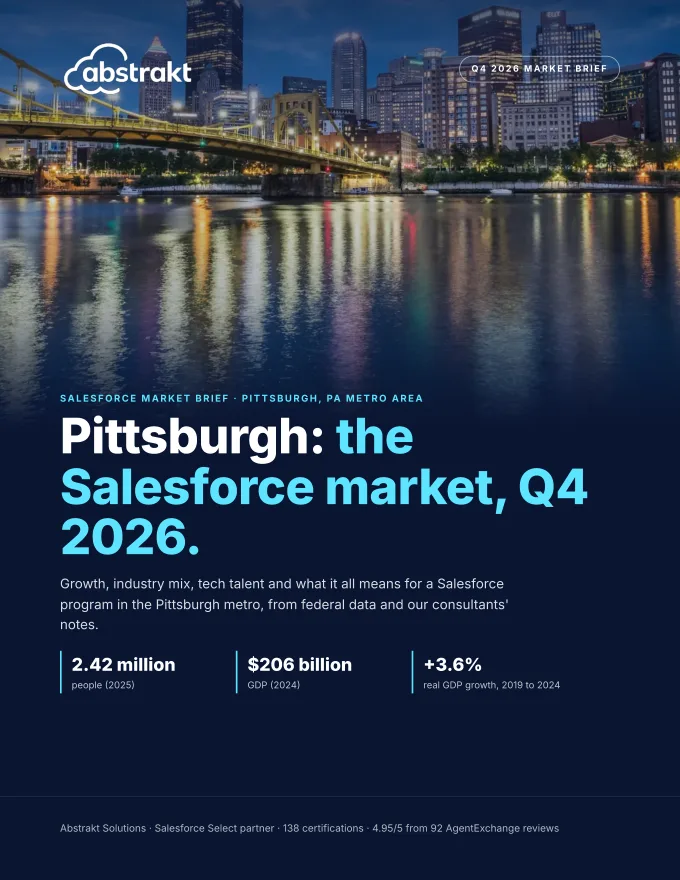
A free 25-page PDF with Pittsburgh's growth ranked against 100 metros, its industry mix, tech wages and nearby markets. It is offered on the public Pittsburgh page; send your customer there or get a copy for your own prep.
Get the Pittsburgh brief →Co-sell with Abstrakt in Pittsburgh
Working a Pittsburgh account? Bring in a named consultant for discovery, scoping or a health check. We reply within 4 business hours.