

How Salesforce work starts in Poughkeepsie
Abstrakt Solutions is a Salesforce Consulting Partner for health care, retail, finance and manufacturing organizations in Poughkeepsie, Newburgh and the wider Hudson Valley. Poughkeepsie is one of our focus markets.
What buyers here usually run into
- 1
Multi-site patient service
Health systems with several hospitals and clinics often keep patient and referral contacts in separate tools, so no one sees the full history.
- 2
Distribution at scale
Distribution and retail operations handle large volumes of orders and inquiries. Case routing and integration with warehouse systems keep service responsive.
- 3
Aging marketing platforms
Smaller financial and consumer businesses often outgrow basic email tools and need marketing tied to their CRM data.
Budget, team and partner questions
What drives cost
Poughkeepsie-Newburgh projects are sized by the number of systems and sites involved. Multi-site health organizations add EHR integration and privacy design; retailers and distributors add order and warehouse integration; community banks and agencies replacing older marketing tools add data cleanup and consent migration.
Admin or partner
Health systems here often have internal IT that can own Salesforce once it is built. Community banks, agencies and smaller retailers rarely have the volume for a full-time admin and tend to use managed services.
What buyers ask a partner
Ask how the partner would consolidate referral contacts kept in separate tools at different facilities. For financial and consumer businesses, ask how they migrate consent and opt-out history from an older email platform.
The local economy and its biggest industries (4)
| Sector | Share of 2024 GDP | Where Salesforce fits |
|---|---|---|
| Health care and social assistance Salesforce for health & life sciences → | 9.8% | Health care is the metro's largest private sector, and Orange County's economic development partnership counts healthcare and pharmaceuticals among the industries it pursues. Salesforce supports patient access, referral management and community outreach across sites. |
| Retail trade Salesforce for retail & consumer goods → | 8.8% | Retail and e-commerce operations in the Hudson Valley, including regional distribution and warehouse sites, rely on customer service, loyalty and marketing that connect to order systems. |
| Finance and insurance Financial Services Cloud → | 6.6% | Community banks, lenders, insurance agencies and advisors serving Dutchess and Orange counties need relationship views, compliant marketing and simple service workflows. |
| Manufacturing Salesforce for manufacturing → | 5.7% | Semiconductor and advanced manufacturing are targets in both counties, and producers from chipmakers to large manufacturing and supply operations need quoting, service and dealer data tied to ERP. |
Source: U.S. Bureau of Economic Analysis, GDP by county (CAGDP2), 2024, summed to the metro area; private sectors only, excluding real estate and government. “At least” marks sectors where BEA suppresses some county figures.
Regional target sectors named by local economic development groups: Advanced Manufacturing, Semiconductor, IT & Office / Software Development, Transportation, Logistics & Distribution, Healthcare/Pharmaceuticals, Food & Beverage / Agribusiness.
Salesforce products that fit Poughkeepsie (6)
In the order we lead with them here, from the industries above.
Salesforce Service Cloud
The operating system for modern customer service, case, knowledge, voice, and AI agent assist together.
Salesforce Sales Cloud
The CRM where sales pipeline lives, when it is built right.
Salesforce Marketing Cloud
Cross-channel marketing, email, mobile, journey, and Data 360-powered personalization at scale.
Salesforce Field Service
Scheduling, dispatch, mobile work orders and parts for teams that work on site.
Salesforce Financial Services Cloud
Industry CRM for wealth management, banking, insurance, and lending, built for compliance from the start.
Salesforce Experience Cloud
Customer, partner, and employee portals built on Salesforce.
Hudson Valley health and retail teams using AI sensibly
In Poughkeepsie-Newburgh, health care and social assistance made up 9.8% of metro GDP in 2024 and retail trade 8.8%. Provider networks and social service agencies spend heavy staff time on intake, referrals and follow-up, and Agentforce can summarize those cases and draft next-step messages for a coordinator. Retailers can serve customers through self-service built on product and policy articles. Community banks and insurers, 6.6% of output, can use AI to read applications and flag gaps. Start small. Consolidate duplicate contacts, set consent and privacy rules, assign owners to knowledge content, and require human sign-off until results prove consistent over several months.
- Intake and referral case summaries
- Coordinator next-step message drafts
- Flagging gaps in bank applications
Services buyers here usually need (7)
Salesforce Implementation in Poughkeepsie
For most Poughkeepsie-area companies, implementing Salesforce means designing one system for operations that straddle the Hudson. A health system, distributor or manufacturer may run sites in both Dutchess and Orange counties, each with its own habits and contact lists. We start by agreeing which records Salesforce owns, how locations and accounts relate, and which teams go first. Then we build in a sandbox, load reconciled data, train by role and go live in phases, bringing one site or team onto the system at a time.
By industry in Poughkeepsie
- 1
Health care and social assistance
With about 9.8% of 2024 metro GDP, health care leads every other private industry in this two-county market, ahead of retail at 8.8%. For providers here, the first implementation decision is scope: Salesforce should hold referrals, patient access requests and outreach, while clinical records stay in the EHR. We design the patient and provider model, consent fields and permission sets together, and usually launch referral intake first because it shows value quickly without moving much protected information.
- 2
Semiconductor
Chipmaking sits on the Think Dutchess target list, backed by the more than $120 billion the state has drawn in semiconductor commitments. Suppliers to chip fabrication run long qualification programs and sell against detailed customer specifications, so their implementation hinges on how opportunities, sites and technical documents connect. We model customer fabs as account hierarchies, tie qualification milestones to opportunity stages and store certifications against each account, leaving quoting automation for a later phase once volume justifies the extra configuration.
- 3
Finance and insurance
Lenders, insurance agencies and advisory practices in the valley often come to Salesforce from a core banking screen and a shared inbox. Implementation for them starts with the household and relationship model in Financial Services Cloud, because how you represent a family or a small business owner shapes every report after it. We set field-level security and approval steps with the compliance officer during design, then launch the relationship view before adding referral tracking between branches and lines of business.
Raise before scoping
Map sites across both counties
Many organizations here operate on both sides of the river, with a facility in Dutchess and another in Orange. Decide early whether a location is an account, a territory or a field, because that choice drives sharing, reporting and assignment rules for every team that follows.
Launch one team first
A phased plan suits mid-sized Hudson Valley employers better than a single cutover. Put the group with the clearest process and cleanest data live first, learn from its adoption, and bring the next department on once its requirements are written down and its data reconciled.
Name an internal owner
Smaller companies in the metro rarely employ a dedicated Salesforce administrator. Choose an internal owner during the project, include them in design sessions and testing, and decide how admin work will be covered after launch, whether by that person, a new hire or outside support.
Salesforce Integration in Poughkeepsie
Integration work in the Poughkeepsie metro usually starts with an ERP or warehouse system holding orders, inventory and invoices that sales and service teams cannot see. Ownership comes first: which platform is the master for customers, items, prices and invoices. Then we pick an API call, a nightly batch or a middleware route for each flow, and set alerts so a stuck order reaches a person before it reaches your customer. The aim is fewer logins and less re-keying, with Salesforce showing the operational facts people need.
By industry in Poughkeepsie
- 1
Manufacturing
Factories produce about 5.7% of the metro's 2024 output, and both counties court advanced manufacturers. Manufacturers here commonly need Salesforce to show order status, shipment dates and open invoices from an ERP, and to send approved quotes back without re-entry. We design the product and price sync first, because catalog mismatches break every later step, then add order and service history so reps and technicians can answer customers without calling the plant.
- 2
Transportation, Logistics & Distribution
Large distribution centers in Fishkill and the Town of Montgomery show how much logistics work runs through this metro. For distributors and carriers, the integration question is what belongs in Salesforce at all. Account managers need shipment exceptions, volume trends and billing disputes; they do not need every scan event. We pull summarized data from warehouse and transportation systems on a schedule, open cases automatically for exceptions, and keep detailed tracking in the operational system where it belongs.
- 3
Health care and social assistance
Hospital systems and clinic groups in Dutchess and Orange counties rarely want Salesforce to duplicate the EHR. Integration for them means passing a limited set of fields, such as referral status, appointment dates or program enrollment, under a business associate agreement and with an audit trail. We document every field that crosses the boundary, restrict the integration user's access, and design retries so a failed message is noticed and resent instead of silently dropped.
Raise before scoping
Name a system of record
Write down, per object, whether Salesforce or the ERP holds the master copy. Integrations fail slowly when two systems both believe they are authoritative, and the fix is a written ownership table rather than more synchronization logic layered on top.
Plan for integration errors
Every connection eventually meets a record it cannot process. Define who receives alerts, how failed messages are retried, and what users see when data is late, so a broken sync becomes a ticket someone owns rather than a gap discovered weeks later.
Size middleware to volume
Middleware is not automatically required. A mid-sized manufacturer with one ERP and modest order volume may be well served by native connectors or scheduled jobs, while several systems or high transaction counts justify an integration platform. We size the approach to your data, not to a favorite tool.
Salesforce Migration in Poughkeepsie
Migration projects around Poughkeepsie often involve smaller systems than people expect but messier data. A distributor may keep customer lists in an old desktop CRM, pricing in spreadsheets and history in a shared mailbox; a lender may hold a marketing list that has not been cleaned in years. Every file and database gets listed and matched to one target design; duplicates are merged, sandbox trial loads prove the mapping, and the final switch happens over a weekend so staff open Salesforce on Monday.
By industry in Poughkeepsie
- 1
Transportation, Logistics & Distribution
Wholesale trade contributes at least 4.5% of metro GDP, and distribution is a target for both county organizations. Distributors migrating to Salesforce typically carry years of ship-to addresses, bill-to accounts and rep assignments that never matched. Migration is the moment to settle on one account hierarchy, merge duplicates and preserve the order history reps rely on. We load historical summaries rather than every line item, keeping the new org fast while detailed records stay in the ERP.
- 2
Finance and insurance
Agencies and community lenders often move to Salesforce from an industry-specific CRM or a contact manager bundled with another system. The migration must carry relationships, not just names: spouses, business owners, beneficiaries and the accounts that tie them together. We map those to Financial Services Cloud structures, keep the activity history examiners might ask about, and reconcile record counts with your compliance lead before cutover so nothing required disappears in the move.
- 3
Food & Beverage / Agribusiness
Food, beverage and agribusiness appears on both county target lists, and producers here are often small firms that grew on spreadsheets and email. Their migration is mostly a cleanup exercise: consistent names for buyers and distributors, one contact per person, and product lists that match what is actually sold. We also move marketing lists into a consented, segmented structure, which matters once a craft beverage maker or specialty producer starts sending campaigns from Salesforce.
Raise before scoping
Clean data before moving
Loading duplicates into a new system only relocates the problem. Deduplicate, standardize addresses and retire inactive records in the source or a staging area first, and agree which fields are genuinely needed, so the new org starts with data people trust from day one.
Decide how much history
Decades of logged calls and dead deals rarely earn a place in the new org. Agree on a cutoff by record type, archive the rest somewhere searchable, and tell users where older history lives, so the new org stays fast and the migration schedule stays reasonable.
Rehearse the cutover
Do a dress rehearsal: load everything into a sandbox and have the account owners check their biggest customers there. A rehearsal surfaces mapping mistakes while there is still time to fix them, and it shows how long the real load will take.
Salesforce Health Checks in Poughkeepsie
A Salesforce health check for a Poughkeepsie-area organization is a structured, read-only review that ends with a ranked list of findings. It covers who holds which permissions, what outsiders can see through portals and forms, how integration logins are set up, how much Apex and Flow has built up, and whether core records are complete. For health care and financial organizations, access findings usually matter most; for manufacturers and distributors, integration and data issues tend to top the list. You get the risks, the effort to fix each one and a suggested order.
By industry in Poughkeepsie
- 1
Health care and social assistance
Providers and community health organizations in the metro handle information where a sharing mistake has regulatory consequences. The health check tests which users can view, report on or export records containing health details, whether field-level security matches your privacy policies, and how guest access is restricted on any public forms. We also check whether field history and event monitoring would let you reconstruct who saw a record, which compliance teams ask about after any incident.
- 2
Semiconductor
Semiconductor suppliers here often store customer specifications, qualification results and pricing agreements in Salesforce, some of it under nondisclosure terms. A health check looks at who can reach those files and records, whether external sharing settings expose them, and whether integration accounts carry broader access than their job requires. We also review custom code written for earlier business models, since unsupported Apex is a common source of both security gaps and failed deployments.
- 3
IT & Office / Software Development
Software and IT firms in the region often built their Salesforce orgs quickly and with more custom code than a typical company. The review counts that technical debt: triggers without tests, installed packages nobody uses, and API connections running under personal logins that belonged to former employees. It checks connected apps, OAuth scopes and session settings too, and assesses whether data quality and permissions are ready for Agentforce or other AI features to run against.
Raise before scoping
Review before adding AI
AI features act with the access of the user or agent configuration behind them. If sharing is loose, duplicates are common or knowledge content is outdated, an AI pilot will expose that quickly. Auditing access and data first gives any Agentforce project a sound foundation.
Trace what departed users own
Deactivated users often still own scheduled reports, flows or integration connections. A review should trace those dependencies, move ownership to active people or service accounts, and remove stale credentials, which matters most at smaller employers where one departure can orphan much of an org.
Time the review before renewal
Ahead of a renewal, the audit compares what you pay for with what your teams log into and use. That gives you evidence for the renewal conversation and time to act on it, instead of discovering unused products after the paperwork is signed.
Salesforce Optimization in Poughkeepsie
In the Poughkeepsie metro, optimization usually follows a few years of steady but unplanned growth in Salesforce. Fields were added for each new request, several people built automation, and managers now export to spreadsheets because reports disagree. Our consultants sit with each team to see which screens get used, strip out fields nobody fills in, fold old rule-based automation into a smaller set of Flows, and redo the handful of dashboards that leadership opens. Everything ships in increments over several weeks, which spares Hudson Valley staff a second go-live.
By industry in Poughkeepsie
- 1
Retail trade
Retail trade is the metro's second-largest private sector at about 8.8% of 2024 GDP, and much of the related activity here runs through distribution centers and customer service teams. Retail and consumer businesses tend to accumulate case types, macros and email templates faster than they retire them. Optimization trims case categories to the ones that drive decisions, fixes routing so inquiries land in the right queue, and rebuilds service dashboards around response time and repeat contacts rather than raw volume.
- 2
Healthcare/Pharmaceuticals
Healthcare and pharmaceuticals is a target sector for the Orange County Partnership, and organizations in that space often run outreach, referral and account teams on one shared org. The usual symptom is duplicate provider and practice records that make referral reports unreliable. We merge duplicates, add matching rules to stop new ones, simplify page layouts for liaisons who work from phones, and rebuild source-level reporting so leaders can see which relationships actually send business their way.
- 3
Finance and insurance
Lenders and agencies in the valley frequently bought Salesforce for pipeline tracking, then added servicing, marketing and compliance tasks one at a time. The result is automation firing in sequences nobody documented, sometimes sending duplicate notices to the same customer. Optimization inventories every flow, trigger and scheduled job, removes the conflicts, and adds approval steps where examiners expect them. We also tune list views and home pages so relationship managers see the day's work without building reports themselves.
Raise before scoping
Measure adoption before redesigning
Login counts, record updates and report views show where Salesforce is ignored. Pull those numbers first and interview a few heavy and reluctant users, so the redesign aims at the friction people actually feel instead of whichever complaints happen to reach leadership first.
Retire legacy automation deliberately
Old rule-based tools are on their way out of the platform. Move their logic into Flow in a planned sequence with tests for each object, rather than converting one at a time under pressure, because hidden dependencies between old rules are where records quietly go wrong.
Agree on report definitions
Two managers counting open opportunities or active patients differently will never trust the same dashboard. Write shared definitions for the handful of metrics leaders use, rebuild reports on them, and archive the duplicates that grew up around each department's version of the truth.
Salesforce Managed Services in Poughkeepsie
Managed services in the Poughkeepsie market usually replaces a part-time or departed admin rather than a large internal team. Many employers in Dutchess and Orange counties run Salesforce with one person who also handles IT or operations. We take over the queue of user requests, prepare for each seasonal Salesforce release, maintain Flow automation and integrations, and keep a prioritized backlog you review with us every month. Named consultants handle that work, learn your org and stay with it.
By industry in Poughkeepsie
- 1
Finance and insurance
Finance and insurance accounts for about 6.6% of metro GDP, spread largely across community lenders, agencies and advisory practices. These firms change Salesforce often in small ways: a new loan product, a revised disclosure, an adjusted referral rule. Managed services gives them a steady path for those changes, with each request tested in a sandbox, documented for examiners and released on a predictable schedule, rather than configured directly in production by whoever happens to hold admin rights that week.
- 2
Health care and social assistance
Hospital systems and community providers here keep adding programs, clinics and outreach campaigns, and each addition means new fields, queues and reports. Our consultants handle that intake alongside user access reviews, which matter when staff rotate between sites and departments. Before each Salesforce release we test referral flows and patient-facing forms, so a platform update does not quietly break intake. Monthly reviews show what changed, what is waiting and which requests your team should decide on next.
- 3
IT & Office / Software Development
Software development and IT office work appear on the target lists of both counties, and firms in that group often expect to administer Salesforce themselves. In practice their engineers are busy with product work, and CRM requests wait. Managed services covers the platform-specific skills they lack, such as Flow, permission design and release testing, while leaving internal developers free to own integrations or Apex when they prefer. We document every change so handing work back is possible at any time.
Raise before scoping
Hold a monthly backlog review
Without a fixed review, small requests pile up and the loudest department wins. A standing monthly session with your internal owner ranks the backlog, confirms what ships next and retires requests that no longer matter, so consulting hours go to work the business actually agreed on.
Keep sandboxes close to production
Release testing only works if the sandbox resembles production. Agree how often sandboxes are refreshed, how sensitive fields are masked on copy, and who signs off on each deployment, since health and financial records both carry obligations about where copies may live.
Plan for staff turnover
Smaller Hudson Valley employers feel it sharply when the one person who understood Salesforce leaves. We keep a running change log, admin runbooks and a record of who owns each integration and each scheduled job, so a departure costs you a handoff meeting instead of months of rediscovery.
Salesforce Implementation Rescue in Poughkeepsie
When a Poughkeepsie-area Salesforce project is in trouble, the first job is to find out why before spending more. We review the org, the contract and design documents, open defects and the data, and we talk with sponsors and frustrated users. The cause is usually a mix: scope that grew without a plan, a data model that fit one department, integrations promised but never built. You receive a triage report, a set of stabilizing fixes and an honest plan for finishing.
By industry in Poughkeepsie
- 1
Advanced Manufacturing
Advanced manufacturing is a target for economic development groups in both counties, and manufacturers here sometimes stall on Salesforce because the project tried to model every product option at once. Reps return to spreadsheets while configuration rules sit half-finished. We triage by testing real orders against what was built, simplify the catalog to the items that drive most sales, and get quoting and order visibility working before reopening the harder configuration the first partner left behind.
- 2
Health care and social assistance
Health care projects in the region often stall over privacy decisions nobody owned: which patient details may live in Salesforce, who sees them, and how the EHR connects. Development keeps moving while those questions stay open, so the build drifts from what compliance will approve. Rescue begins by settling those decisions in writing with your privacy officer, then auditing what was built against them and correcting sharing and field access before any further features are added.
- 3
Retail trade
Retail and consumer service projects here tend to fail at go-live rather than during the build. Cases arrive through channels nobody configured, routing sends them to the wrong queue, and agents revert to email. Recovery focuses on the service floor: map how inquiries actually arrive, rebuild queues and assignment rules around that, and fix the reports supervisors use to staff shifts. Visible improvements for agents come first, because their confidence decides whether the system survives.
Raise before scoping
Freeze scope during triage
Adding requests while diagnosing a troubled project hides the real problems. Hold new requirements for a short period, capture them in a list for later, and let the team focus on understanding what exists, what was promised and what separates the two.
Recover documentation and access
When a partner has exited, admin credentials, sandboxes, integration keys and design documents can be scattered or missing. Secure them first, including any logins tied to the departing firm's staff, so nobody loses control of the org while the recovery plan is worked out.
Rebuild trust with quick wins
Skeptical staff come back only when they see something change. Pick one or two changes that save real time, such as a corrected assignment rule or a working mobile layout, and release them early while larger structural fixes proceed in the background.
Industry plays in Poughkeepsie (4)
Salesforce for Poughkeepsie Health and Life Sciences
Across Dutchess and Orange counties, health care runs through hospital systems, physician groups, behavioral health and social service agencies, and pharmaceutical companies. Salesforce helps connect those pieces around the patient: navigation between services, closed-loop referrals to community partners, outreach that respects consent, and commercial account management for life sciences firms. We keep the EHR as the clinical record, define PHI boundaries first and then build the coordination and engagement layers your teams need.
Care delivery and social assistance account for 9.8% of 2024 output in the two-county metro, the biggest private share in Bureau of Economic Analysis figures and a point above retail. Target industries here are set county by county rather than metro-wide. The Orange County Partnership names health care and pharmaceuticals as a target industry for its county, while Think Dutchess Alliance for Business, which covers Dutchess, emphasizes semiconductors, IT and advanced manufacturing instead. The combination of hospital care, social assistance programs and pharmaceutical activity means CRM designs here often have to serve clinical, community and commercial users at once.
Use cases to open with
- 1
Care navigation across counties
Patients moving between hospital, specialist, behavioral health and home care services often lose track of next steps, especially when those services sit in different towns. Service Cloud navigator workspaces can show upcoming appointments, open referrals and barriers such as transportation or coverage, pulled from the EHR and scheduling systems. Navigators log outreach, set follow-up tasks and hand off cleanly when a patient moves to another program.
- 2
Closed-loop community referrals
Social assistance agencies, food programs and housing services are part of care, but referrals to them rarely come back with an outcome attached. An Experience Cloud portal lets partner agencies accept referrals, update status and record whether services were actually delivered. Health organizations gain evidence for population health and community benefit programs, and partner agencies avoid yet another spreadsheet, email thread or fax queue to maintain.
- 3
Pharmaceutical account management
Pharmaceutical manufacturers and distributors sell to hospitals, pharmacies, wholesalers and group purchasing organizations, each with its own contract terms and compliance obligations. Sales Cloud account plans, contract tracking and field activity records give commercial teams one view per customer and per contract. Service Cloud handles medical and product inquiries and routes potential adverse events or quality complaints to the right internal teams within the timelines your procedures set.
Raise before scoping
Sharing data with partner agencies
Community organizations need enough information to help a patient but not the full clinical record. Define what partners can see, obtain the right patient consent, and set up partner user access with narrow sharing rules before connecting any external agency to the portal.
HIPAA and behavioral health data
Behavioral health and substance use treatment records may carry stricter confidentiality rules than general medical data. Map which programs create which record types, restrict access by role, and confirm consent handling with your privacy officer before any of that data enters Salesforce.
Two-county data standards
Organizations operating in both Dutchess and Orange counties often inherit different intake forms, program codes and contact lists from each location. Agree on common definitions before migrating, or reports will count the same service differently depending on which county delivered it.
Salesforce for Poughkeepsie Retail and Consumer Brands
Retail and consumer brands in the Mid-Hudson region mix channels in ways that strain simple tools. A craft beverage maker may sell to distributors, run a tasting room, operate a club and ship direct to consumers where allowed. A specialty food brand may sell to grocers and at farm markets. Salesforce ties those channels into one customer and account view, with commerce and point-of-sale data flowing in so marketing, sales and service work from the same history.
Retail trade generated 8.8% of 2024 GDP in the Kiryas Joel-Poughkeepsie-Newburgh metro, second only to health care, according to Bureau of Economic Analysis county data. Think Dutchess Alliance for Business targets craft food and beverage and agribusiness, and the Orange County Partnership lists food and beverage, agribusiness, distribution and tourism among its target industries. That points to a consumer economy built partly on locally made products and visitors, supported by transportation, logistics and distribution activity that both county organizations also target.
Use cases to open with
- 1
Distributor and retailer sales
Food and beverage producers sell through distributors, grocers, restaurants and specialty shops, often with different pricing, allowances and promotions for each. Sales Cloud account plans track placements, reorders and promotions account by account, while distributor depletion reports feed into dashboards on a regular schedule. Sales reps see which accounts need a visit, which products are gaining or losing shelf space, and where a promotion did not produce the expected lift.
- 2
Tasting room and club members
Visitors who taste, buy and join a club are usually a producer's most valuable customers over time. Point-of-sale and club data flowing into Salesforce, combined with Marketing Cloud journeys, lets brands welcome new members, remind them of upcoming shipments and invite them to release events. Service agents see full purchase and shipment history when members call about orders, card updates or skipping a shipment, and can resolve most requests in one call.
- 3
Seasonal campaigns and events
Harvest seasons, holiday gifting and local events drive a large part of the year's consumer sales for regional producers and shops. Marketing Cloud and Data 360 (formerly Data Cloud) can segment customers by past purchases, location and engagement, then coordinate email, text and paid advertising around those peaks. Results roll into reports showing which events and campaigns actually brought customers back a second time, which guides next year's calendar and budget.
Raise before scoping
Alcohol shipping and age rules
Direct-to-consumer alcohol sales carry state-by-state shipping restrictions and age verification requirements. Salesforce should store the compliance status your commerce or compliance tool provides rather than attempt to calculate it, and every marketing journey must exclude customers located in states where shipping is restricted.
Point-of-sale and ecommerce integration
Tasting room, retail and online sales usually run on separate systems with separate customer lists. Map how customers are matched across them and which system owns orders and inventory. Without a clear plan, one loyal customer can appear three times in Salesforce with conflicting purchase histories and preferences.
Licensing sized to the brand
Smaller brands do not need every product at once. Start with the channels that generate the most revenue or the most customer contact, then add Data 360 (formerly Data Cloud), partner portals or AI agent features as data quality, budget and team capacity grow to support them.
Salesforce for Poughkeepsie Manufacturers
Manufacturing in the Poughkeepsie-Newburgh area ranges from technical suppliers that qualify parts for chip and computing customers to food and beverage producers selling through distributors and taprooms. Salesforce adapts to both. Technical suppliers use Sales Cloud and CPQ for qualification-stage opportunities and engineered quotes; consumer producers use it for distributor accounts, retail placements and direct buyers. Service Cloud logs quality issues and returns, and ERP integration puts orders and inventory in front of the people talking to customers.
Factories and plants supply 5.7% of 2024 output across Dutchess and Orange counties by the BEA's county tally, fourth among private industries. There is no single metro-wide development agency, but both county organizations target it: Think Dutchess lists advanced manufacturing, semiconductors and aviation, and cites more than $120 billion in New York State semiconductor investment, while the Orange County Partnership names manufacturing and advanced manufacturing. Both counties also back food and beverage and agribusiness, from the Think Dutchess craft category to the Partnership's food and beverage target, so the local base mixes precision work with consumer products.
Use cases to open with
- 1
Tracking parts through customer qualification
Suppliers to semiconductor and computing customers often spend long stretches qualifying a part or process before volume orders. Sales Cloud can track each qualification with samples, test results, customer engineers and target start dates, and separate committed business from pipeline that depends on a customer's own ramp. Leadership then forecasts capacity from realistic dates instead of optimistic ones, and when a new fab or computing program shifts its schedule, the sales team can see immediately which orders move with it.
- 2
Engineered quotes and revisions
Precision shops quote from drawings, tolerances, materials and volumes, then revise when the customer changes the design. CPQ, fed with ERP costs and routing data, keeps quote logic consistent and tracks every revision against the drawing version. Estimators stop rebuilding spreadsheets for every revision, approvals route automatically when margins fall below target, and sales can see which quotes are aging, which customers keep changing designs and why jobs were lost.
- 3
Distributor and retail placements
Craft beverage and specialty food producers work with distributors, retailers, restaurants and direct buyers. Salesforce can track placements by account, distributor performance and promotional commitments, and route reorder reminders to reps. Visit logging on mobile lets field reps capture shelf and tap observations while they are still in the store, and seasonal releases or festival orders can be planned by account using last year's actual placements rather than memory.
Raise before scoping
Customer confidentiality in chips
Semiconductor and computing customers impose strict confidentiality on drawings, process details and roadmaps. Limit access by account team, keep technical files in controlled document systems linked from Salesforce, and check customer agreements for rules on cloud storage or export-controlled information before migration.
Two county ecosystems
Dutchess and Orange counties run separate economic development programs, supplier networks and incentives. If you track grants, incentive milestones, job commitments or supplier-readiness pledges, model them per program so reporting to each agency stays accurate, deadlines are visible to finance and nothing is claimed twice.
Regulated beverage distribution
Alcohol producers sell within a regulated distribution system with licensing and pricing rules. Store license numbers, distributor territories and approved price postings in Salesforce, keep an audit trail of what reps offered, and have counsel confirm what sales reps may offer retailers before automating any promotion.
Salesforce for Poughkeepsie Insurers and Agencies
Insurance organizations in the Poughkeepsie-Newburgh area are often independent agencies or regional operations serving households and small businesses across Dutchess and Orange counties. The typical gap is marketing and follow-up: renewal reminders, cross-sell campaigns and referral tracking run through basic email tools disconnected from customer data. Salesforce closes that gap. Financial Services Cloud organizes households and businesses with their policies, Service Cloud manages requests, and Marketing Cloud sends campaigns based on actual coverage and renewal dates.
Finance and insurance ranks third among private industries in the Kiryas Joel-Poughkeepsie-Newburgh metro, with 6.6% of 2024 output in BEA county data, behind health care and retail. Neither Think Dutchess nor the Orange County Partnership lists insurance as a target, so the sector shows up as part of that broader finance and insurance share rather than as a recruitment priority. Its customers do connect to the targets, though: the counties' manufacturing, logistics, semiconductor and agribusiness employers all buy commercial coverage, and the region's households make up a sizable personal-lines market.
Use cases to open with
- 1
Replacing a disconnected email tool
Many agencies send newsletters and renewal notices from a basic email platform with no link to policies. Marketing Cloud, connected to Financial Services Cloud, can send renewal reminders based on actual expiration dates, suppress messages to customers with open claims, and target households missing coverage such as umbrella or flood. Results show which campaigns produced quotes and bound policies, not just opens, and producers get a task when a household clicks on a coverage topic twice.
- 2
Commercial accounts for local industry
A Hudson Valley machine shop, orchard or distribution center may hold five or six policies with staggered dates and different carriers. Salesforce can group those policies under the business account, track submissions to markets, and schedule annual reviews timed before the largest renewal. Account managers see the full relationship, note exposure changes such as a new building or added trucks, and spot gaps before the client does.
- 3
Referral and partner tracking
Agencies in the Hudson Valley often grow through referrals from real estate agents, lenders, accountants and existing clients. Salesforce can capture referral sources on every new policy, track which partners send the most profitable business, and trigger thank-you and follow-up tasks. Producers then invest time where it actually pays, and dormant referral partners get a check-in before they start sending clients to another agency.
Raise before scoping
New York cybersecurity rules
Insurance licensees in New York are subject to the Department of Financial Services cybersecurity regulation, which addresses access controls, multi-factor authentication and data retention. Configure Salesforce security to support your program, and have your compliance lead confirm how the CRM fits your documented policies.
Agency management system sync
Commission statements, premium figures and endorsements stay in your agency software of record. Pull into Salesforce only the handful of fields producers use daily, on a refresh schedule everyone knows. A clean nightly or near-real-time sync keeps producers from quoting outdated coverage or chasing renewals already handled.
Consent and marketing records
Marketing to policyholders requires consent tracking, opt-out handling and approved content. Build consent fields into the data model, respect channel preferences, and document approvals for campaign content before it goes out. That discipline supports GLBA obligations, simplifies any regulator inquiry and keeps marketing from undermining client trust.
Case studies to send (3)
From the industries this market leans on. Client names are anonymized and these projects are not specific to Poughkeepsie.
The Poughkeepsie Salesforce market brief, Q4 2026
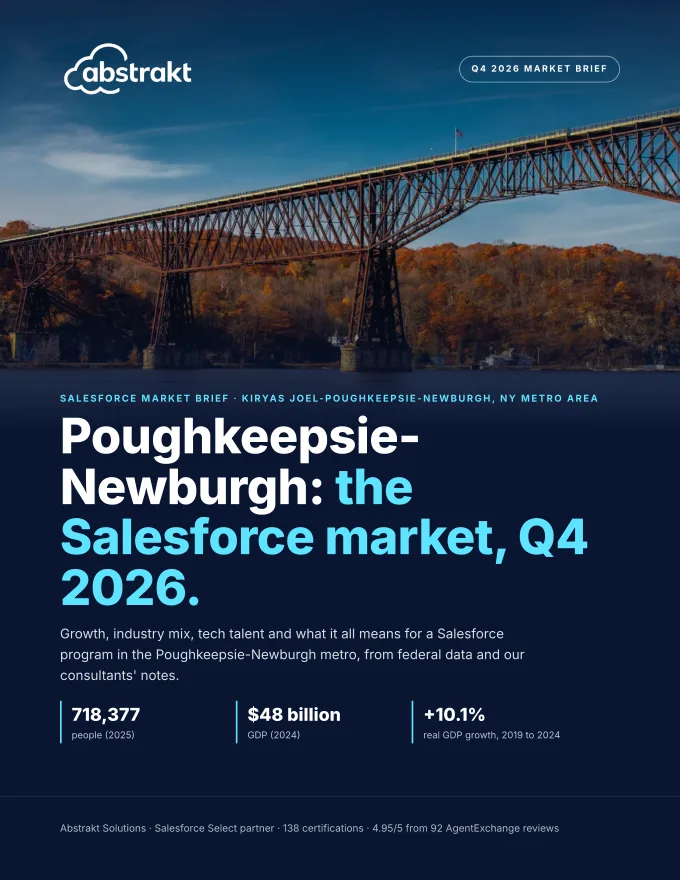
A free 23-page PDF with Poughkeepsie's growth ranked against 100 metros, its industry mix, tech wages and nearby markets. It is offered on the public Poughkeepsie page; send your customer there or get a copy for your own prep.
Get the Poughkeepsie brief →Co-sell with Abstrakt in Poughkeepsie
Working a Poughkeepsie account? Bring in a named consultant for discovery, scoping or a health check. We reply within 4 business hours.