

How Salesforce work starts in Charleston
Abstrakt Solutions is a Salesforce Consulting Partner for manufacturers, software companies and contractors in Berkeley, Charleston and Dorchester counties. Charleston is one of our focus markets.
What buyers here usually run into
- 1
Supplier demands from large OEMs
Suppliers to aerospace and automotive plants often manage quotes, programs and quality issues across email and spreadsheets. Salesforce linked to ERP keeps each OEM account in one view.
- 2
Estimates versus actual job costs
Construction firms commonly discover overruns after a job closes. Connecting estimating and field work lets managers compare costs with estimates as the job runs.
- 3
Scaling tech teams quickly
Growing software and services companies need a CRM that can be stood up fast and cleaned up later without rework, which is where a short, well-scoped implementation helps.
Budget, team and partner questions
What drives cost
Charleston cost drivers include ERP and quality system integration for manufacturing suppliers, pursuit and teaming design for defense and engineering firms, and estimating and crew scheduling for contractors. Fast-growing tech companies often pay more to clean up a hurried first build than they would have for a well-scoped one.
Admin or partner
Larger manufacturers and health organizations here often keep an internal admin and bring in a partner for integration or new programs. Software companies, engineering firms and contractors more often use managed services until Salesforce work fills a full-time role.
What buyers ask a partner
Ask for experience with supplier quality and warranty processes, government pursuit tracking, or construction job costing, depending on your business. Ask how the partner documents decisions so a later team can extend the build without rework.
The local economy and its biggest industries (4)
| Sector | Share of 2024 GDP | Where Salesforce fits |
|---|---|---|
| Manufacturing Salesforce for manufacturing → | 10.1% | Jetliner assembly plus car and van plants put aerospace and automotive production at the center of the sector. Manufacturers and suppliers need account plans, quoting and quality or service records tied to ERP. |
| Professional, scientific, and technical services Salesforce for professional services → | 8.8% | Charleston's second-largest sector includes defense technology contractors and software and engineering firms that need pursuit tracking, project delivery and client reporting. |
| Construction Salesforce for construction → | 6.8% | Builders and specialty contractors need estimating, job scheduling and crew management connected so costs can be compared with bids while work is under way. |
| Health care and social assistance Salesforce for health & life sciences → | 6.0% | With the medical university's hospital system and life sciences research in the region, health and life sciences organizations need patient or customer service, research partnerships and privacy-aware data design. |
Source: U.S. Bureau of Economic Analysis, GDP by county (CAGDP2), 2024, summed to the metro area; private sectors only, excluding real estate and government. “At least” marks sectors where BEA suppresses some county figures.
Regional target sectors named by local economic development groups: Aerospace, Automotive, Information Technology, Life Sciences, Logistics, Corporate Services & Headquarters.
Salesforce products that fit Charleston (6)
In the order we lead with them here, from the industries above.
Salesforce Sales Cloud
The CRM where sales pipeline lives, when it is built right.
Salesforce Field Service
Scheduling, dispatch, mobile work orders and parts for teams that work on site.
Salesforce Revenue Cloud / CPQ
Configure-price-quote, billing, subscription management, and quote-to-cash on Salesforce.
Salesforce Service Cloud
The operating system for modern customer service, case, knowledge, voice, and AI agent assist together.
Salesforce Experience Cloud
Customer, partner, and employee portals built on Salesforce.
Salesforce Agentforce
AI agents that handle real work inside Sales Cloud, Service Cloud, and Marketing Cloud.
Agentforce opportunities for Charleston manufacturers and service firms
Charleston's economy leans on manufacturing, 10.1% of metro GDP in 2024, alongside professional services at 8.8% and retail at 7.2%. Aerospace and automotive suppliers in the region deal with supplier quality cases, warranty claims and dealer inquiries, all of which suit AI case summaries and suggested resolutions drawn from engineering documentation. Professional firms can triage inbound leads by service line and urgency. Retailers can offer self-service answers on orders and bookings. Be clear about limits: an agent reflects the data it reads, so part numbers, account hierarchies and article ownership must be settled, and a person should approve any answer touching safety or warranty.
- Summarizing supplier quality and warranty cases
- Triaging leads by service line
- Self-service for orders and bookings
Services buyers here usually need (7)
Salesforce Implementation in Charleston
Most Charleston implementations we scope are shaped by the region's big assembly plants. Suppliers to jetliner, car and van production win business program by program, so the first design question is how programs, plants and part numbers relate to accounts. We settle that model in discovery workshops, build in a sandbox, load cleaned data and launch in phases: sales and program tracking first, then quality cases and service. Each team is trained on its own process, starting with the people who will enter data every day.
By industry in Charleston
- 1
Manufacturing
At roughly 10.1% of 2024 output, factories and their suppliers form the Charleston metro's biggest private sector. For a tier supplier, implementation means deciding early whether awarded volume lives in Manufacturing Cloud sales agreements or in custom objects, and how engineering changes flow back into quotes. We map those choices against your ERP before configuration begins. Getting the plant-and-program hierarchy right in phase one avoids a painful restructure once several OEM programs are running side by side.
- 2
Information Technology
The Charleston Regional Development Alliance lists information technology among its target sectors and counts more than 1,900 tech companies in the region. Young software firms here often implement Salesforce in a hurry after outgrowing a starter CRM. We keep the first release deliberately small, covering lead routing, opportunity stages and a subscription-aware account model, and leave room for renewals and usage data later. A quick launch then does not lock the company into a design it must undo as the customer base grows.
- 3
Construction
Builders and specialty contractors in the three-county region need an implementation that treats each job as more than an opportunity. We model bids, awarded projects and change orders as related records, add Field Service for crews only where scheduling pain justifies the licenses, and connect estimates to accounting so project managers can compare actual cost with the bid. Phasing matters here: preconstruction and sales usually launch first, and crew scheduling follows once the job records are trusted.
Raise before scoping
Model programs, not just accounts
An OEM plant, a vehicle or aircraft program and a part number are different things. Suppliers that cram all three onto the account record lose the history they need when a program comes up for re-sourcing. Define the program object and its links to plants during design, before sales starts entering data.
Stage quality after sales
Quality escapes, corrective actions and PPAP submissions matter to account managers, but they depend on clean part and program data. Launch the commercial model first, confirm the data holds up in daily use, then add quality cases so the service phase builds on records people already trust.
Right-size Field Service licensing
Contractors and equipment servicers rarely need a license for every crew member. Decide who dispatches, who completes work orders on mobile and who only needs to appear on a schedule, because that choice drives both subscription cost and the shape of the resource model.
Salesforce Integration in Charleston
For Charleston companies, integration work usually centers on the ERP. Suppliers need order status, shipments and part pricing visible to account managers; logistics firms need shipment events tied to customer accounts; software companies need billing alongside the pipeline. We document which system owns each field, choose between real-time and scheduled sync, and build with MuleSoft or lighter tools depending on volume. Every integration ships with error alerts and a runbook, so failures are caught and fixed before users notice stale data.
By industry in Charleston
- 1
Logistics
CRDA names logistics as a sector it recruits. Freight, warehousing and distribution firms in the region usually run a transportation or warehouse management system that holds the operational truth, while Salesforce holds accounts and pipeline. Integration brings shipment milestones, exceptions and volumes onto the account so sales and customer service see the same picture. We push summarized events rather than every scan, which keeps the org responsive and data storage predictable as shipment volume grows.
- 2
Manufacturing
Assembly plants in the region draw a supplier base that needs Salesforce and ERP working as one. Quotes should pull current costs and lead times from the ERP, orders should flow back to the account, and quality issues logged in Salesforce should reference the same part numbers engineering uses. We design the part and price master first, decide whether sync runs on events or a schedule, and build monitoring so a failed order message is spotted before the customer calls.
- 3
Life Sciences
Life sciences is a CRDA target sector, supported by the research activity around the region's medical university. Device, diagnostics and research-services companies here often need Salesforce connected to quality management, lab or clinical systems without copying regulated records into the CRM. We integrate by reference: Salesforce holds the account, the case and a link or summary, while the validated system keeps the controlled document. That pattern keeps audit scope narrow and still gives service teams the context they need.
Raise before scoping
Name a system of record
Field mapping comes second; deciding whose copy of a price, order or customer wins comes first. When two systems can both edit the same field, integrations end up overwriting good data. A one-page ownership table settles most arguments before they turn into defects during testing.
Budget for API limits
Every org has a finite daily allowance of inbound calls, and chatty feeds burn through it. High-volume shipment and usage data are the usual culprits, so we batch or summarize data where real time adds nothing and reserve event-driven calls for changes users must see immediately.
Assign someone to failures
Someone must be notified when a sync fails and know what to do next. We set up error logging, alerting and a short runbook, then agree who responds on your side, so an integration does not quietly stop for days before a rep notices missing orders.
Salesforce Optimization in Charleston
Optimization in Charleston usually begins with a question from leadership: why do sales, program and project numbers still come from spreadsheets? We look at how people actually use the org, where they skip steps, which automation fires twice and which reports nobody opens. Then we simplify page layouts, merge overlapping flows, rebuild the dashboards leaders rely on and retrain each role on the changed process. Work is delivered in short cycles, so each improvement can be judged before the next one starts.
By industry in Charleston
- 1
Retail trade
Stores and shops generated about 7.2% of local 2024 output; chains with several Charleston-area locations frequently pair a register system with a separate Salesforce org for service or loyalty. Optimization for them targets duplicate customer records, case routing that sends every inquiry to one queue, and marketing lists nobody trusts. We tighten matching rules, route cases by store and topic, and rebuild service dashboards so managers see response times by location instead of one blended number.
- 2
Aerospace
Aerospace is on the alliance's target-sector list, and suppliers to the region's widebody assembly work tend to have orgs that grew one program at a time. Typical symptoms include opportunity stages that mean different things to different program managers, quote approvals living in email, and quality case data too inconsistent to report on. We standardize stage definitions, move approvals into Salesforce and tighten required fields on quality cases, so account reviews draw on reliable history.
- 3
Corporate Services & Headquarters
Corporate services and headquarters operations are a CRDA target sector, and shared-service teams based here often support sales and service for business units elsewhere. Their orgs collect layer after layer of automation built for different divisions. Optimization means inventorying every flow, legacy process and trigger, retiring duplicates, and consolidating logic into fewer documented flows. We also rebuild reports on a common definition of pipeline and case volume, so headquarters compares divisions on the same terms.
Raise before scoping
Measure adoption before redesigning
Login counts say little. Look at which fields get filled, which stages get skipped and where users export to spreadsheets. That evidence shows whether the problem is design, training or process, and it keeps the redesign focused on the handful of screens people actually use.
Retire legacy automation deliberately
Older orgs in the region often still run Workflow Rules and Process Builder, which Salesforce no longer supports. Moving them to Flow is a chance to remove logic nobody needs, rather than a straight translation that preserves every old workaround and doubles the maintenance burden.
Train by role, not feature
A quality engineer, a program manager and an inside sales rep need different things from the same org. Short sessions built around each role's daily tasks change behavior more than a general tour of features, especially for plant staff with little time away from the floor.
Salesforce Managed Services in Charleston
Managed services for Charleston companies tends to track growth in programs and headcount. A supplier adds a new OEM program, a software firm adds a customer success team, and each change lands on whoever administers Salesforce. We take over that queue: requests are ranked with your leadership, small changes ship weekly, each seasonal Salesforce release is tested in a sandbox first, and larger items become scoped projects. You get a named lead who knows your org and a monthly summary of what changed.
By industry in Charleston
- 1
Professional, scientific, and technical services
Professional, scientific and technical services made up about 8.8% of the metro's 2024 GDP, and much of that work involves defense technology and engineering contractors. Their orgs need careful change control: pursuit stages tied to contract vehicles, capture reports leadership reviews every week, and permissions that keep proposal data limited to the right people. Our team handles those requests as documented tickets, tests each change against the reports it touches, and records who approved what for internal compliance reviews.
- 2
Automotive
Automotive is one of the alliance's target sectors, and suppliers to the region's car and van plants live with constant engineering change. That produces a steady stream of Salesforce work: new part numbers and program phases, adjusted quote templates, fresh quality case types and reports for each customer's scorecard. An ongoing team absorbs that volume so your quality and sales engineers do not turn into part-time admins. We also watch the automation that routes quality escapes, since a silent failure there reaches the customer quickly.
- 3
Health care and social assistance
Health care providers and life sciences groups around the region's academic hospital system carry Salesforce orgs where nearly every change touches protected data. Managed services here means reviewing each new field, report and sharing rule for privacy impact before it ships, keeping permission sets aligned as staff move between departments, and testing releases against patient-facing processes. We maintain a change log your compliance office can read, so an audit does not depend on one administrator's memory.
Raise before scoping
Agree on a ranking rule
When plant, sales and success teams all submit requests, the loudest one tends to win. Set a simple rule with leadership, such as revenue impact first and user count second, so the backlog is ranked the same way every month and nobody has to lobby for a ticket.
Test releases against quality automation
Salesforce's seasonal upgrades occasionally alter flow behavior without warning. For suppliers whose quality alerts run through automation, we replay those flows in a sandbox before the release reaches production, because a broken alert does far more damage than a cosmetic change.
Keep an internal owner
Outsourced administration works best with a named person inside the company who knows the business. That person approves priorities, answers process questions and handles simple user requests, while our team takes configuration, testing and anything that needs a developer or architect.
Salesforce Health Checks in Charleston
Charleston companies usually ask for a health check at a turning point: a new OEM program, a funding round, a change of admin, or a plan to try Agentforce. We review user access, sharing, profiles and permission sets, integration users, automation, code, unused fields and data quality on core objects, and we interview a few users from each team. You leave with findings sorted by severity and sized by effort, ready for your admin to work through or to hand back to us.
By industry in Charleston
- 1
Aerospace
Aerospace suppliers in the region, an alliance target sector, often hold customer and program data that falls under export or contractual controls. A health check for them looks hard at who can see what: sharing rules on program records, file access, external users on any portal, and whether field history tracking captures the changes auditors will ask about. We also flag custom code and integrations nobody owns anymore, since unmaintained components cause both security gaps and failed releases.
- 2
Professional, scientific, and technical services
Defense technology contractors and engineering firms make up much of the region's professional services sector. Their orgs frequently include capture data, teaming partner contacts and proposal files. A review confirms that proposal material is not visible org-wide, that departed staff lost access promptly, and that integration users are not running with administrator rights. We also estimate how much of the org is technical debt from earlier pursuits, so leadership can decide what to retire before adding AI features.
- 3
Life Sciences
Life sciences organizations tied to the region's research and academic medical community need a review that checks privacy controls as closely as configuration. We look at where protected or research data sits in Salesforce, whether encryption and event monitoring are in place where the data calls for them, and whether sandboxes hold unmasked copies of real records. Findings are ranked by risk, so a small team can close the exposures that matter first and schedule the rest.
Raise before scoping
Review access before Agentforce
An AI agent sees what its running user can see. If sharing is too open, Agentforce may surface records the requester should never read. Tighten permission sets and sharing first, then pick a narrow first use case whose data you have already reviewed.
Look at data, not just metadata
A clean configuration can still hold duplicate accounts, blank key fields and stale opportunities. We sample the objects your teams rely on most and report completeness and duplication, because AI features and dashboards both depend on data quality more than on setup.
Turn findings into a plan
A list of problems with no order becomes shelfware. We rank findings by risk and effort, group the quick fixes an admin can handle, and outline the larger items as scoped projects, so the review leads to change instead of a report nobody opens again.
Salesforce Implementation Rescue in Charleston
Rescue work in Charleston often follows fast growth. A supplier signed on to a new program, a tech company expanded its sales team quickly, and the Salesforce project was squeezed in around everything else. We start with triage: what is broken for users today, which data is untrustworthy, what the statement of work promised, and who still understands the design. Then we stabilize, decide component by component what to keep, fix or rebuild, and finish the remaining scope in phases with documentation.
By industry in Charleston
- 1
Automotive
Automotive suppliers that rushed Salesforce in alongside a new plant program often end up with a half-built quoting process and program data scattered across custom objects. Recovery starts by getting quotes out reliably again, since that is where revenue stalls. We then consolidate program records, reconnect the ERP feed that was left incomplete, and rebuild only the pieces that cannot be repaired. Sales and quality staff see steady improvement instead of waiting on a second big-bang launch.
- 2
Construction
Contractors sometimes buy Field Service licenses before the job and crew model is settled, then find that schedules and costs do not line up. A rescue sorts out the core records first: customers, projects, work orders and the link to estimating. Once job data is trustworthy, we reintroduce scheduling for the crews that need it and retire the workarounds foremen built in the meantime. Licenses that turned out to be unnecessary are flagged before renewal.
- 3
Information Technology
Software and IT services firms in the region, a sector CRDA targets, often launch Salesforce with a small internal team that later moves on. Rescue work for them begins with recovering access, documenting what the previous builder left behind, and repairing broken lead routing or renewal automation that is costing revenue now. We then align stages, subscription data and customer success processes with how the company sells today, rather than how it sold at launch.
Raise before scoping
Protect revenue processes first
Before redesigning anything, confirm that quotes go out, orders are recorded and cases get routed. Those processes pay the bills. Temporary fixes are acceptable during triage, as long as they are documented and scheduled for proper repair in the recovery plan.
Secure credentials and metadata
When a partner or employee leaves mid-project, access to sandboxes, integration accounts and source repositories can leave with them. Recover administrative access, rotate integration credentials and pull a full metadata backup before any changes, so nothing is lost while the project restarts.
Rebuild trust with a pilot
Nobody trusts the second launch of a system that burned them once. Relaunch to one team that is willing to give honest feedback, fix what they find, then extend to the rest. A visible success inside the company does more for adoption than any announcement from leadership.
Salesforce Migration in Charleston
Charleston clients tend to arrive with records spread over two or three tools, sometimes more. A growing software company may leave a starter CRM and a support desk at once; a contractor may be moving bids, customers and job history out of spreadsheets and an estimating tool. We inventory every source, decide what is worth moving, deduplicate and standardize accounts and contacts, and run test loads in a sandbox so users can validate records they know. Cutover is planned for a quiet period, with a brief freeze and a reconciliation report afterward.
By industry in Charleston
- 1
Construction
Construction contributed about 6.8% of the Charleston metro's 2024 GDP, and many builders and specialty trades still track bids, general contractors and job history in spreadsheets and estimating software. Migrating them means separating customers from projects, merging the same general contractor spelled several ways, and deciding how much closed-job history deserves a place in Salesforce. We usually bring active bids and recent jobs over in full, and summarize older work so estimators keep context without cluttering the new org.
- 2
Information Technology
Technology companies in the region, a CRDA target sector, often migrate twice: once from a starter CRM to Salesforce, and again when an acquisition brings in a second org. We map objects and custom fields between systems, carry opportunity history over with its original close dates, and preserve activity timelines where they inform renewals. Subscription and contract data gets special care, because a wrong renewal date after cutover costs more than any amount of cleanup beforehand.
- 3
Health care and social assistance
Clinics, home health agencies and social service organizations in Berkeley, Charleston and Dorchester counties frequently move from older case or donor systems into Salesforce. Migration here comes with privacy constraints: protected health information needs a signed BAA before it lands in the new org, sandbox copies must be masked, and access should be restricted from the first load. We map intake, referral and program records carefully, since a lost link between a client and their case is hard to rebuild.
Raise before scoping
Decide what not to migrate
Every source system carries records nobody has touched in years. Set an age threshold per object, for example deals closed before a date you pick, and park older rows in an archive users can still query. Smaller loads are faster to test and give users a cleaner starting point.
Validate with people who know it
Row counts prove records moved, not that they are right. Ask estimators, account managers or program staff to check accounts they know well in the sandbox. Their feedback catches mapping errors, such as swapped contact roles, that automated checks tend to miss.
Freeze and reconcile at cutover
Pick a cutover window when activity is light, freeze edits in the old system, run the final delta load and compare totals by object and owner. Keep the legacy system read-only for a period afterward so users can confirm anything that looks wrong.
Industry plays in Charleston (4)
Salesforce for Charleston Manufacturers
For manufacturers around Charleston, Salesforce is most useful when it reflects what large aerospace and automotive customers ask of their suppliers: fast answers on quality issues, clear status on orders and shipments, and one owner for every buyer relationship. We usually pair Sales Cloud with Service Cloud, link both to the ERP and quality system, and add a customer portal where order volume justifies it. The aim is a supplier that can answer an OEM's question in minutes rather than after an email chain.
The Bureau of Economic Analysis ranks manufacturing first among the Charleston-North Charleston metro's private sectors, at 10.1% of 2024 GDP, ahead of professional and technical services. The Charleston Regional Development Alliance's target list reads like a supply chain: aerospace, automotive and logistics sit beside information technology, life sciences and corporate headquarters. That mix produces a supplier base selling into a small number of very large customers, where program launches, quality documentation and on-time delivery weigh more heavily in the relationship than list price.
Use cases to open with
- 1
Quality cases by part and lot
When an aerospace or automotive customer raises a nonconformance, the supplier needs the part number, lot, shipment and prior history immediately. Service Cloud can open a case against the affected order line, pull lot and inspection data from the quality system, and track containment and corrective action to closure. Account managers see open quality issues before their next customer meeting instead of hearing about them there.
- 2
Coordinating plant launch programs
New and expanding assembly plants bring waves of sourcing activity, each with sample approvals, pricing rounds and ramp schedules. Opportunities modeled around launch milestones, with engineering, purchasing and quality contacts mapped on the account, let a supplier see which awards depend on which approvals. Revenue Cloud or CPQ keeps quoted prices aligned with ERP costs as volumes and specifications change during ramp-up.
- 3
Order and shipment visibility for buyers
Logistics-sensitive customers want to know where their parts are without calling customer service. An Experience Cloud portal fed by ERP order and shipping data lets buyers check status, download certificates and log requests on their own. Inside sales spends less time chasing tracking numbers, and every request lands as a case with a named owner and a response target that managers can report on.
Raise before scoping
Connect the quality system early
Aerospace and automotive customers expect traceable answers, and those answers live in the quality management system, not the CRM. Scope that integration in the first phase, agree which records Salesforce shows versus stores, and involve quality leads in testing so cases carry reliable data.
Mind export-controlled data
Suppliers to defense and aerospace programs may handle technical data subject to export controls. Keep drawings and controlled specifications in their governed repositories, reference them from Salesforce rather than uploading them, and have your compliance team confirm what may be stored where before build begins.
One account model for OEM groups
Large customers buy through several plants, programs and purchasing teams. Agree on a parent-child account structure and consistent naming for plants and buying centers before data migration, so pipeline, quality history and service requests roll up correctly for executive reviews.
Salesforce for Charleston Construction Firms
Construction firms around Charleston increasingly bid on plants, warehouses, technology facilities and the offices that follow them, often as subcontractors to large general contractors. Salesforce helps when it tracks each bid from invitation to award, keeps prequalification and safety documents current, and connects awarded work to scheduling and job costing. We build around the bid-heavy way these firms win work, integrate the accounting system, and give estimators and project managers one pipeline they both trust.
Construction contributed 6.8% of the Charleston-North Charleston metro's 2024 GDP in Bureau of Economic Analysis figures, ranking fourth among private sectors behind manufacturing, professional services and retail. The Charleston Regional Development Alliance does not list construction as a target sector, yet its targets drive much of the work: aerospace, automotive and logistics operations need plants and distribution space, and the Alliance also cites a multibillion-dollar data center investment in the region. For contractors, the market tilts toward large industrial and commercial projects alongside residential and service jobs.
Use cases to open with
- 1
Bid invitation to award tracking
Specialty contractors may price a steady stream of bids for the same handful of general contractors. Sales Cloud can log every invitation with scope, due date, estimator and bid amount, then record the award or loss reason. Over time, leadership and the chief estimator can see hit rates by customer, project type and estimator, and decide which invitations deserve a full estimate and which deserve a polite decline.
- 2
Prequalification and safety documents
Industrial owners and large general contractors ask for insurance certificates, safety records, training cards and licensing before a firm can bid. Storing those as tracked records with expiration dates, linked to the accounts that require them, lets the office renew documents before they lapse and answer prequalification questionnaires in an afternoon without hunting through shared drives or old email threads.
- 3
Scheduling crews across job sites
Once a job is won, Field Service can schedule crews and equipment across sites in Berkeley, Charleston and Dorchester counties, show foremen their assignments on a phone, and capture time, photos and daily notes. Project managers see progress against the plan while the job runs, and change orders captured in the field reach billing quickly instead of surfacing at month-end reconciliation.
Raise before scoping
Separate bids from projects
A bid and a live project are different records with different owners. Keep opportunities for pursuit and a project or work order structure for execution, linked but distinct, so win rates stay clean and field teams are not wading through lost bids.
Plan the accounting integration
Job costs, retainage and progress billing belong in construction accounting software. Decide which values Salesforce displays and how often they sync, and test with real jobs before launch so project managers and accounting are reading the same numbers when they review margin, retainage and billing together.
Adoption in the field
Foremen and superintendents will use a mobile app only if it saves them time. Keep field screens to a few taps, work offline where signal is weak, and train crews on site during their first live jobs, using real work orders rather than demo records.
Salesforce for Charleston Professional Services Firms
Charleston professional services firms tend to sell two ways at once: long pursuits for engineering or technical contracts, and faster work for commercial clients. Salesforce can hold both, with pursuit stages, teaming partners and bid decisions for the first, and a simpler pipeline for the second. We add resource forecasting so managers see which wins will need which skills, and connect delivery and billing systems so account leads understand margin as well as bookings.
Only manufacturing outranks professional, scientific and technical services among Charleston-North Charleston's private industries; Bureau of Economic Analysis county data give the sector 8.8% of 2024 GDP. Two of the Charleston Regional Development Alliance's targets, corporate services and headquarters plus information technology, sit squarely in this space, and the Alliance tallies 1,900+ tech firms regionally. Its other targets, aerospace, automotive, logistics and life sciences, generate demand for engineering, testing, software and consulting work. A community-sourced digital corridor initiative runs co-working space for tech firms, which adds a steady stream of young services companies to the mix.
Use cases to open with
- 1
Pursuits with teaming partners
Engineering and technical services firms often bid alongside partners, as prime or as subcontractor. Salesforce can track each pursuit from early intelligence through bid or no-bid, record teaming agreements and workshare, attach capture plans, and show leadership a weighted forecast by customer and contract vehicle. Lessons from lost bids stay on the record, so the next capture team does not start from zero.
- 2
Staffing forecasts from pipeline
Winning work nobody can staff is a real risk in a tight technical labor market. Opportunities can carry the roles, skills and start dates each win would require, rolled into a forecast that resource managers review weekly. Recruiting sees upcoming gaps early, and principals can decide whether to pursue work that would overload a practice before the proposal goes out.
- 3
Client service after award
Once a contract is signed, clients still call with change requests, questions about deliverables and new needs. Service Cloud can log those requests against the engagement, route them to the right project lead and track response times. Account leaders see each client's open issues and satisfaction before renewal or recompete discussions, rather than hearing about problems for the first time in a debrief.
Raise before scoping
Separate federal and commercial
Firms that work on defense or other federal programs may need to keep certain contract details out of a commercial cloud CRM. Decide early which data Salesforce holds, which stays in controlled systems, and how record types and permissions separate federal pursuits from commercial pipeline.
Connect project accounting
Hours, budgets, invoices and margins normally live in project accounting or ERP software. Map which figures account leads need inside Salesforce, at what grain and how often they refresh, so pipeline reviews and client conversations use numbers the controller would recognize and defend.
Keep the pipeline honest
Long pursuits invite optimistic probabilities. Define stage criteria in plain terms, require a next step and a decision date on every open pursuit, and review aging opportunities in a regular meeting. The forecast is only as useful as the discipline behind each stage.
Salesforce for Charleston Health and Life Sciences
In Charleston, health and life sciences work often starts in an academic medical setting and moves outward: to referring practices, to study participants, and to startups licensing new technology. Salesforce can support each step. Health Cloud or Service Cloud manages patient and referral relationships, Experience Cloud gives partners and participants a secure place to interact, and Sales Cloud helps young companies build their first pipeline. We design the data model and privacy controls before anything touches protected health information.
Health care and social assistance produced 6% of Charleston-North Charleston's 2024 GDP in Bureau of Economic Analysis figures, fifth among private sectors in a metro led by manufacturing. The Charleston Regional Development Alliance still lists life sciences among its six target industries. It credits the region's academic medical center with more than $350 million in annual research funding, and that center operates a life sciences innovation space and an institute for commercializing innovations. The sector here is therefore as much about research and spinouts as about hospital beds, which changes what a CRM needs to track.
Use cases to open with
- 1
Clinical study recruitment
Research teams need a steady flow of eligible participants without exposing more health data than necessary. Salesforce can manage interest forms, screening status and outreach for each study, with consent recorded before contact. Coordinators see which channels produce enrolled participants, and a portal lets volunteers update availability or ask questions without phone tag. Study data itself stays in the research systems built for it.
- 2
Referral network management
A specialty clinic in Charleston may draw patients from practices hours away in the Lowcountry and inland. Salesforce can track which practices refer, how quickly patients are scheduled and where referrals leak to other providers. Outreach staff decide which offices to visit next from that data rather than habit. Integration with scheduling and the electronic health record keeps the numbers current without manual entry.
- 3
Commercial teams for spinouts
A company licensing technology out of academic research often has scientists but no sales process. A lean Sales Cloud setup gives it accounts, opportunities, distributor relationships and a basic forecast, and Service Cloud can support early customers and product questions. We design it to scale, so the first salespeople are not replaced by a costly rebuild when the company raises more capital or grows its team.
Raise before scoping
HIPAA shapes the design
Once PHI enters the org, you need Salesforce's business associate agreement in place, fields locked down by role and integrations reviewed. Decide which clinical details Salesforce actually needs, which remain in the electronic health record, and who can see what, with your privacy officer involved from discovery.
Research and care differ
Study participants, patients and referring physicians follow different rules and workflows. Separate record types, consent models and permission sets keep research outreach from mixing with clinical communications, and make audits easier when an institutional review board or compliance office asks questions.
Startups need room to grow
Young life sciences companies often buy the smallest setup possible, then outgrow it. Choose a data model that can later handle distributors, quality complaints and regulated product information, even if only sales features go live first, so growth does not force a migration.
Case studies to send (3)
From the industries this market leans on. Client names are anonymized and these projects are not specific to Charleston.
The Charleston Salesforce market brief, Q4 2026
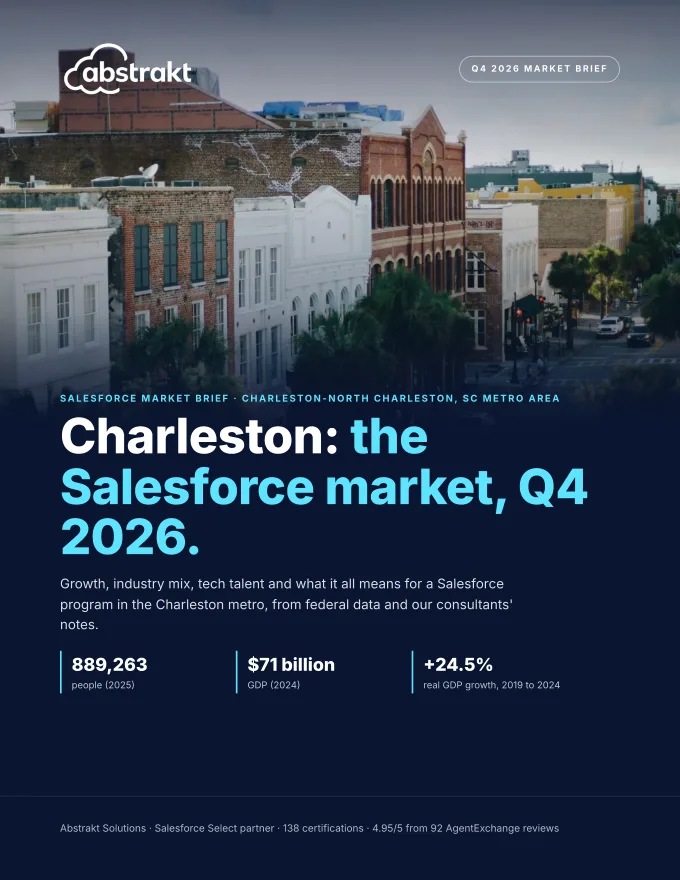
A free 22-page PDF with Charleston's growth ranked against 100 metros, its industry mix, tech wages and nearby markets. It is offered on the public Charleston page; send your customer there or get a copy for your own prep.
Get the Charleston brief →Co-sell with Abstrakt in Charleston
Working a Charleston account? Bring in a named consultant for discovery, scoping or a health check. We reply within 4 business hours.