

How Salesforce work starts in Dayton
Abstrakt Solutions, a Salesforce Consulting Partner, works with Dayton-area health systems, manufacturers and engineering firms that sell to both commercial and defense customers. Dayton is one of our focus markets.
What buyers here usually run into
- 1
Defense-grade access control
Companies that support defense programs often need tight permission models and deliberate decisions about which data belongs in a cloud CRM at all.
- 2
Quoting engineered products
Manufacturers of configured or made-to-order parts tend to quote from spreadsheets and email. Connecting quotes to product data and ERP cuts errors and turnaround time.
- 3
Service across locations
Logistics, distribution and health care organizations with several sites need one view of each customer or patient request, whichever location handles it.
Budget, team and partner questions
What drives cost
In Dayton the scope questions that move cost most are access control for defense-related work, how engineered products are quoted, and how many ERP and maintenance systems need to feed Salesforce. Health care projects add privacy design and testing. Deciding up front which data stays out of the org keeps both cost and risk down.
Admin or partner
Engineering and defense firms here often have strong IT staff but no one who owns Salesforce full time. A single admin can handle users and reports; a managed services team usually covers permission design, integration and release testing that one hire cannot.
What buyers ask a partner
Ask how the partner designs sharing and permission sets when some users touch defense programs and others do not. Ask for manufacturing quoting and ERP integration references, and how they document what each automation and agent can read.
The local economy and its biggest industries (4)
| Sector | Share of 2024 GDP | Where Salesforce fits |
|---|---|---|
| Health care and social assistance Salesforce for health & life sciences → | 10.7% | Health care is the metro’s largest private sector and one of DDC’s target industries. Providers and health services organizations here use Salesforce for patient outreach, referral tracking and service, built around privacy requirements. |
| Manufacturing Salesforce for manufacturing → | 9.9% | Aerospace suppliers, established medical-parts producers and newer electric-aviation entrants deal with engineered products, long quote cycles and ERP data that sales and service teams rarely see. |
| Professional, scientific, and technical services Salesforce for professional services → | 8.0% | Engineering, research and technology firms that support Air Force research and acquisition missions track long pursuits, teaming partners and contract milestones. Salesforce gives them one pipeline and a clear account history. |
| Finance and insurance Financial Services Cloud → | 7.2% | Banks, credit unions, lenders and insurance agencies serving the Dayton metro need household relationship views, compliant marketing and service in one system. |
Source: U.S. Bureau of Economic Analysis, GDP by county (CAGDP2), 2024, summed to the metro area; private sectors only, excluding real estate and government. “At least” marks sectors where BEA suppresses some county figures.
Regional target sectors named by local economic development groups: Aerospace & Defense, Advanced Manufacturing, Healthcare, Technology, Automotive, Logistics & Distribution.
Salesforce products that fit Dayton (6)
In the order we lead with them here, from the industries above.
Salesforce Sales Cloud
The CRM where sales pipeline lives, when it is built right.
Salesforce Service Cloud
The operating system for modern customer service, case, knowledge, voice, and AI agent assist together.
Salesforce Revenue Cloud / CPQ
Configure-price-quote, billing, subscription management, and quote-to-cash on Salesforce.
Salesforce Field Service
Scheduling, dispatch, mobile work orders and parts for teams that work on site.
MuleSoft
Enterprise API platform, for connecting Salesforce, ERP, data warehouses, and the rest of your stack.
Salesforce Agentforce
AI agents that handle real work inside Sales Cloud, Service Cloud, and Marketing Cloud.
Agentforce opportunities across Dayton health, defense, and industry
Health care and social assistance produced 10.7% of the Dayton metro's GDP in 2024, manufacturing 9.9%, and professional, scientific, and technical services 8.0%. That last group includes engineering and defense contractors whose sensitive data usually rules out broad AI access; narrow, well-permissioned tasks such as proposal-library search or meeting summaries are safer. Health systems can apply grounded self-service to billing and scheduling. Aerospace and automotive manufacturers often benefit most from field service assistance, giving technicians equipment history and likely fixes. Whatever the sector, we document which objects the agent reads, log its actions, and keep a reviewer on anything customer-facing.
- Permissioned proposal library search
- Billing and scheduling self-service
- Technician equipment history assistance
Services buyers here usually need (7)
Salesforce Implementation in Dayton
Implementing Salesforce in Dayton often means designing for two very different customer types in one org: commercial buyers and government or prime-contractor programs. Manufacturers and engineering firms here need both, and health care organizations need privacy built into the model from the first sprint. Discovery workshops come first, then we define the objects, record types and sharing rules before anything is built, configure in a sandbox, load reconciled data and go live in phases.
By industry in Dayton
- 1
Health care and social assistance
Health care is the largest private sector in the metro at about 10.7% of 2024 GDP, and it is also one of the Dayton Development Coalition's target industries. Providers implementing Salesforce usually begin with patient outreach, referral intake or a contact center. The early design choices concern which patient details are allowed in the org, how referral sources are modeled as accounts and which staff roles can see what, and those choices shape everything built afterward.
- 2
Aerospace & Defense
Aerospace and defense suppliers implement Salesforce to manage long pursuits, teaming partners and program milestones alongside commercial sales. The data model needs record types for different funding paths, fields for contract vehicles and a permission structure that keeps sensitive program details restricted. We also agree early on which information must never enter a commercial cloud org, so the implementation respects those boundaries by design rather than by user discipline. Capture reviews then run from one set of reports.
- 3
Automotive
Automotive is on the coalition's target list, and parts suppliers in the region sell to vehicle makers through program awards, annual price negotiations and engineering change requests. A Salesforce implementation for these suppliers models each vehicle program and part number as an opportunity or quote line, tracks expected volumes over the program's life and connects quality issues to the affected customer. Revenue Cloud handles pricing agreements once the core model is in place.
Raise before scoping
Separate commercial and government motions
A typical Dayton engineering or manufacturing firm answers both commercial purchase orders and defense solicitations. Record types, sales processes and page layouts for each keep the pipeline honest, and a shared account structure still gives leadership one view of every customer relationship across both markets.
Define what stays out of Salesforce
Controlled technical data and certain program information do not belong in a commercial org. Writing down those limits during design, and building field-level help and validation around them, prevents users from storing restricted material where it could create compliance problems later.
Plan sessions around your calendar
Workshops, stand-ups and launch support are booked inside your business day and kept clear of program reviews and month-end close, so the people who own each process can attend. Discovery, go-live and training get the most working-session time, because those are the points where decisions and habits are set.
Salesforce Integration in Dayton
In Dayton, nearly every Salesforce integration conversation starts with the ERP. Manufacturers and distributors keep pricing, inventory, orders and invoices there, while sellers and service staff work in Salesforce and ask around for status. Each shared field gets an owning system, each flow gets a direction and a schedule, and the tooling, MuleSoft or native connectors, follows from how many systems are in play. Error handling and monitoring are part of the build, so failures reach an admin instead of silently leaving sellers with stale data.
By industry in Dayton
- 1
Manufacturing
Dayton's manufacturers account for about 9.9% of metro GDP, and most of them run their operations from an ERP. For manufacturers, the core integration usually brings product, price and availability data from the ERP into Salesforce, sends approved quotes back as orders and returns shipment and invoice status to the account. Engineered-to-order products add a layer: configuration details must reach engineering or production systems accurately, so we define that handoff with both teams before building and test it with real past orders.
- 2
Aerospace & Defense
Aerospace suppliers and maintenance providers often run specialized maintenance, quality or program management systems that are the official record for compliance. Integration with Salesforce should share status, milestones and customer-facing details without copying regulated records. We design narrow, well-documented interfaces, restrict the integration user's permissions and log each transfer, so program security staff can see exactly what information moves between systems and in which direction. Nothing crosses the boundary unless someone has approved it.
- 3
Healthcare
Healthcare is one of the coalition's target sectors, and health organizations integrating Salesforce with scheduling, billing or clinical systems need to limit what crosses into the CRM. We usually bring in appointment, referral and contact details that outreach and service staff need, leave clinical documentation in its system of record, and use encryption and audit logging on sensitive fields. Each integration has a named owner and a documented purpose, which simplifies privacy reviews and later changes.
Raise before scoping
Choose middleware for growth
A pair of stable, low-volume connections rarely needs more than native tools or direct API calls. When several systems need to share data, or when on-premises applications are involved, MuleSoft provides reusable connections, central monitoring and a single place to change mappings, which keeps the integration landscape maintainable as you add systems.
Agree on sync timing
Not everything needs to move instantly. Inventory checks and credit status may need real-time calls, while order history and invoices can sync on a schedule. Matching timing to how each piece of data is used keeps API usage reasonable and systems responsive.
Test with production-like data
Integration bugs hide in edge cases: unusual part numbers, partial shipments, accounts with several ship-to addresses. We test with realistic samples drawn from your systems, with sensitive fields masked, before going live, and run the first production syncs in a monitored window.
Salesforce Health Checks in Dayton
For Dayton organizations, a health check usually starts with access control. Defense suppliers need to show that pursuit and program information is restricted, and health care organizations must prove patient-related data is protected. The review then covers custom code, automation, integrations, data quality and license use, working from read-only access. Each finding is ranked by risk and tied to the specific setting or component. It is also the first step we suggest before Agentforce, because an agent inherits whatever access and data quality the org already has.
By industry in Dayton
- 1
Aerospace & Defense
Aerospace and defense companies face customer security expectations and often internal compliance programs tied to their contracts. The review checks whether any fields or files contain information that should not be in a commercial org, how sharing rules limit pursuit and program records, whether login policies and multi-factor authentication are enforced and how integration users are scoped. Findings are written so your security staff can map them to the controls they already track.
- 2
Health care and social assistance
Health organizations grow their Salesforce use program by program, and permissions granted for one program tend to linger after it ends. The review looks for staff who kept access after changing roles, portals exposing more patient detail than intended and integration users with broader rights than their feeds require. Each finding notes which records are affected and how many users can reach them, giving privacy officers a clear basis for prioritizing fixes.
- 3
Advanced Manufacturing
Manufacturers with Revenue Cloud or CPQ often accumulate pricing rules, product options and custom code that slow quoting and make every change risky. The health check inventories that configuration, finds rules that no longer apply, measures test coverage on quote-related Apex and checks whether ERP integrations handle errors properly. The result is a prioritized technical debt list showing which cleanup would most improve quote speed and accuracy. Owners are assigned to each item before the readout ends.
Raise before scoping
Scope the review to your risks
A defense supplier and a health system worry about different things. Tell us which audits, customer questionnaires or incidents prompted the review, and we weight the effort accordingly, going deeper on access and data residency or on automation and code quality as needed.
Check the agent's running user
Before an Agentforce pilot, the review confirms what the agent's user could read and change, which knowledge articles it would rely on and how current they are. Narrowing that access and fixing stale content in advance avoids an agent that answers wrongly or reveals too much.
Budget for remediation
A health check finds problems; fixing them takes separate time. Ask for effort ratings on each finding so you can hand quick fixes to your admin, group larger items into a project, and schedule the remainder into the next budget period with a clear rationale.
Salesforce Optimization in Dayton
In Dayton, optimization mostly means closing the distance between the org as designed and the org as used. Sellers keep quoting in spreadsheets, technicians phone in updates, and managers rebuild reports each month. We measure adoption by role, simplify screens, consolidate old workflow rules and process builders into documented flows, and rebuild the reports that drive decisions. Work arrives in short releases, each tied to a goal such as quote turnaround or case resolution time.
By industry in Dayton
- 1
Retail trade
Retail trade carries about 6.1% weight in Dayton's 2024 economy, spread across stores, dealerships and service counters. Retailers and dealers using Salesforce for customer service or B2B accounts often find that cases are logged inconsistently and customer history is scattered across stores. Optimization standardizes case categories, adds macros and knowledge articles for common questions and builds a customer view that store and service staff share, so repeat questions are answered once instead of by every location.
- 2
Manufacturing
Manufacturers in the region often bought Revenue Cloud or CPQ and then watched sellers return to spreadsheets because quoting felt slower. Optimization trims product rules to those that affect price and configuration, fixes templates and approval chains and connects the quote to current ERP pricing. Service teams get similar attention: cases linked to assets and parts, so recurring product problems become visible to engineering instead of hidden in email threads.
- 3
Logistics & Distribution
Logistics and distribution is one of the coalition's target sectors, and distributors here frequently have Salesforce configured while inside sales keeps working from the ERP screen. Optimization puts order status, credit holds and open quotes on the account page, automates follow-up on quotes that have not converted and cleans up duplicate branch accounts. Sales managers get territory reports that reflect real orders rather than whatever reps remembered to log at the end of the week.
Raise before scoping
Start with the busiest screens
The account, opportunity and case pages are where most time is spent. Removing unused fields, reordering sections by role and adding related data from other systems usually produce the quickest adoption gains, and they are visible to every user on the first day after deployment.
Tie quotes to current pricing
A quote tool that shows outdated prices will be abandoned. Before redesigning templates or approvals, confirm how pricing reaches Salesforce from the ERP and how often. Fixing that feed is often the single change that brings sellers back to quoting inside the system.
Rebuild reports around decisions
Many orgs hold a great many reports, most of them near-copies. Ask leaders which decisions they make weekly and monthly, rebuild the reports that support those decisions and archive the rest. Fewer, trusted reports end the habit of exporting to spreadsheets to reconcile numbers.
Salesforce Managed Services in Dayton
For Dayton clients, managed services usually covers an org that is live and growing, maintained by one admin or by nobody in particular. Manufacturers add products and quote templates, engineering firms add pursuits and contract fields, and health organizations add programs. Tickets land in one queue that your internal owner ranks with us; each seasonal release is regression-tested first, access changes carry a named approver, and developers or integration specialists join only for tickets that need them. Monthly reviews show what changed and why.
By industry in Dayton
- 1
Professional, scientific, and technical services
Professional, scientific and technical services make up about 8.0% of metro GDP, and many firms in this group support Air Force research and acquisition work. Their orgs need steady care: new contract vehicles, updated capture stages, teaming records and permission changes as staff move between programs. We process those changes through a documented approval path, so access to pursuit information stays restricted to the right people month after month as the org evolves.
- 2
Advanced Manufacturing
Advanced manufacturing is one of the coalition's target sectors, and manufacturers depend on quote templates, pricing rules and product data that shift whenever engineering releases a new part or costs change. Ongoing support means updating Revenue Cloud product rules, monitoring the ERP sync that feeds prices and orders, and testing each Salesforce release against the quoting flow before sellers see it. Small, frequent updates keep configuration aligned with the catalog instead of drifting until an overhaul is unavoidable.
- 3
Healthcare
Health systems and health services organizations make frequent small changes: new outreach campaigns, referral sources, service queues and staff roles. Each change touches privacy, so our managed services tickets include a check on who will see the new data and how it reaches Salesforce. We keep a change log that compliance staff can review, and we run larger requests, such as a new program launch, as scheduled mini-projects rather than squeezing them between routine tickets.
Raise before scoping
Keep a documented approval trail
Defense-adjacent and health organizations need to show who approved each change to permissions and data access. We record requester, approver and deployment date for every ticket, which turns routine administration into evidence your auditors or program security staff can review without extra work.
Treat integrations as monitored assets
ERP, quoting and middleware connections fail quietly. As part of managed services, we watch MuleSoft or other integration logs, investigate errors and replay failed records. Catching a stalled order sync early prevents sellers from quoting against stale prices or promising dates the plant cannot meet.
Reserve capacity for release seasons
Salesforce ships major releases on a seasonal cycle, and each one can change screens, retire features or affect custom code. We hold back part of the backlog capacity around those releases for sandbox regression checks and user communication, so routine requests keep moving while the upgrade is verified.
Salesforce Implementation Rescue in Dayton
Rescues in Dayton frequently involve projects that tried to cover commercial and government sales, quoting and service all at once, and finished none of them well. In a few, the partner or the executive champion simply left before the work was done. The first stretch is diagnostic, comparing the build against the contract and against users' daily habits. Anything stopping daily work gets fixed immediately; after that every component receives a keep, repair or rebuild verdict, and teams return to the org one at a time with training and follow-up.
By industry in Dayton
- 1
Automotive
Automotive suppliers sometimes launch Salesforce with a generic opportunity model that cannot represent vehicle programs, annual volumes or price-down agreements. Recovery reshapes the data around programs and part numbers, reconnects the ERP so volumes and shipments appear automatically and rebuilds forecasting so it reflects program schedules. The relaunch starts with account managers for one customer group, whose reports then become the model for the rest of the sales team to follow.
- 2
Professional, scientific, and technical services
Engineering and technical services firms often inherit an org designed for transactional sales, leaving capture teams to track pursuits in spreadsheets. A rescue introduces stages that match capture reviews, adds teaming and contract vehicle records and migrates active pursuits from the spreadsheets. Old pursuit data is cleaned before it moves. Once leaders can run their pipeline review directly from Salesforce, the rest of the business development team usually follows without much persuasion.
- 3
Logistics & Distribution
Distributors sometimes go live with Salesforce while order and stock information stays locked in the ERP, so inside sales keeps working in the old screens. A rescue for them usually finishes the integration that was cut from scope, simplifies account records split across branches and relaunches with a single branch whose staff agree to work exclusively in Salesforce. Once that branch shows results, rolling out to the others is straightforward.
Raise before scoping
Secure access and credentials
When a partner exits abruptly, admin accounts, integration credentials and deployment tools may be tied to people who are gone. Our first task is to secure those, rotate secrets and confirm nothing is half deployed, which removes an immediate risk before any rebuilding begins.
Separate commercial and government fixes
Projects that mixed commercial and defense sales often fail because one design served neither. Untangling them into distinct record types and processes, while keeping a shared account model, lets each team relaunch on a structure that fits how it actually wins work.
Report progress to the sponsor
Troubled projects lose executive support long before they lose budget. Pick a few measures that matter to the sponsor, such as quotes created in Salesforce or active technicians, and report them after every release. Evidence of steady improvement is what secures funding for the later phases.
Salesforce Migration in Dayton
Few Dayton companies come to Salesforce from nothing; the usual starting point is an ERP customer tab, an aging on-premises CRM or a drive full of shared workbooks. Each source uses its own account names, codes and conventions. We profile the data, decide with each team what to migrate, deduplicate and standardize records, map them to the new model and run trial loads until counts and key reports match. Cutover is planned for a quiet window, and the old system stays readable for a period so nothing feels lost.
By industry in Dayton
- 1
Finance and insurance
At roughly 7.2% of Dayton's 2024 output, finance and insurance is smaller than health care or manufacturing but still sizable. Banks, credit unions and insurance agencies moving to Financial Services Cloud bring household and member data from core-connected CRMs or agency systems. Migration requires rebuilding relationships between people, households and accounts, carrying over consent and opt-out flags accurately and keeping the history regulators may ask about. We reconcile totals by branch or agency before cutover, so each location can confirm its data.
- 2
Advanced Manufacturing
Manufacturers often hold customer data in the ERP, quotes in spreadsheets and service history in a separate ticketing tool. Migrating to Salesforce means matching those records to single accounts, linking historical quotes to products that still exist and mapping installed equipment to the right customer site. We clean product and customer codes first, because mismatched codes are the most frequent reason quote and service history fails to connect after cutover.
- 3
Technology
Technology is one of the coalition's target sectors, and software, analytics and engineering firms here often start with a lightweight CRM that no longer fits their pursuits and contracts. Migration converts pipeline records into Salesforce opportunities with consistent stages, moves contracts and attachments, and maps custom fields to a cleaner model. We also remove duplicate contacts created by different business development staff, so each relationship history ends up in one place. Old reports are rebuilt against the new model.
Raise before scoping
Untangle ERP customer records
When the ERP has been the customer list for years, it often holds separate records for billing, shipping and each plant. Decide how those map to Salesforce accounts, locations and contacts before loading, or sellers will inherit a confusing list of near-identical accounts.
Standardize codes and values
Product families, industries, regions and status values tend to drift across systems. Agreeing on a standard picklist for each, and translating old values during migration, makes reports usable from the first day instead of requiring months of cleanup after go-live.
Rehearse the cutover
A full rehearsal in a sandbox exposes load-order problems, timeouts and missing lookups. We time each step, write the cutover checklist from the rehearsal and agree when users stop entering data in the old system, so the real weekend holds no surprises.
Industry plays in Dayton (4)
Salesforce for Dayton Manufacturers
Manufacturing around Dayton is tied closely to aerospace, defense and automotive programs, which means much of the selling is engineered, certified and subject to customer change. Salesforce works when it connects repair and production quotes to engineering data, tracks certifications and prime relationships, and gives customers clear answers on turnaround. We typically combine Sales Cloud with CPQ or Revenue Cloud, add Service Cloud for customer requests, and use MuleSoft to link ERP, PLM and shop-floor systems, with access controls set before any sensitive program data is loaded.
Manufacturing accounts for 9.9% of the Dayton-Kettering-Beavercreek metro's 2024 GDP, second only to health care among private sectors in Bureau of Economic Analysis data. Four of the Dayton Development Coalition's six target industries (aerospace and defense, advanced manufacturing, automotive, and logistics and distribution) describe a supplier economy. The Coalition describes the region as an emerging leader in digital engineering and digital manufacturing, and notes that the local Air Force base is home to the service's research laboratory and its materiel command. A university research institute also runs an advanced manufacturing support program for regional firms.
Use cases to open with
- 1
MRO repair quotes and turnaround
Maintenance, repair and overhaul shops quote work after teardown findings, then need customer approval before continuing. Salesforce can open a work request for each induction, attach inspection findings, build the repair quote with CPQ and capture approval electronically. Customers see status and expected return dates through a portal, and managers track turnaround time, approval delays and repeat findings by part number and customer.
- 2
Prime relationships and certifications
Suppliers pursuing defense and aerospace subcontracts must show quality certifications, cybersecurity readiness and past performance to each prime. Salesforce can track supplier approvals by prime and program, certification expiry dates, audit results and open corrective actions, alongside the opportunity pipeline. Business development teams know which primes can buy from them today and which approvals must be renewed before the next bid.
- 3
Engineering change requests from customers
Automotive and industrial customers frequently issue engineering changes that affect tooling, pricing and delivery. Service Cloud can log each request with affected part numbers and dates, route it to engineering through PLM integration, and trigger a repricing quote in CPQ when costs change. Account managers see pending changes before customer meetings, and finance can track whether cost increases from each change were actually recovered in price.
Raise before scoping
Controlled data boundaries
Defense suppliers may hold controlled unclassified or export-controlled information. Draw the line on controlled data first: what stays in the program's secured systems, whether a government cloud tenant is warranted, and which DFARS clauses or CMMC level your contracts carry. The security officer and contracts team own those calls.
Connect engineering systems
Repair findings, drawings and engineering changes live in PLM, quality and shop-floor systems. Reference or summarize them in Salesforce through MuleSoft rather than copying controlled documents, and agree on which system owns each part, revision and repair-finding record before interfaces are built.
Model certifications as data
Supplier approvals, aerospace and automotive quality certifications and customer audit results are often tracked in spreadsheets. Model them as records with owners, expiry dates and program links so sales, quality and leadership see readiness in the same place they see pipeline.
Salesforce for Dayton Health Care Organizations
Health care is the Dayton metro's largest private sector, so Salesforce here often supports large, multi-site organizations and the partners around them. Common uses include community outreach and screening events, care transitions from hospitals to post-acute providers, and patient requests for cost estimates or financial counseling. We typically build on Service Cloud and Experience Cloud, add Marketing Cloud for consent-based outreach and Agentforce for routine questions, and integrate the EHR and revenue cycle systems that remain authoritative.
Hospitals, physician practices and social assistance providers top the Dayton-Kettering-Beavercreek economy's private side, with 10.7% of 2024 GDP by Bureau of Economic Analysis count, edging out manufacturing at 9.9%. Healthcare also appears on the Dayton Development Coalition's short list of targets, one of six industries it pursues. The Coalition also emphasizes regional strengths in data analytics, cybersecurity and modeling, alongside a network of universities and a community college. For health organizations, that suggests a market with large care delivery systems and nearby analytical and technical expertise that can support data-driven outreach and operations.
Use cases to open with
- 1
Community screening and outreach events
Health organizations run screenings, education sessions and wellness events across neighborhoods and employer sites. Salesforce can manage event registration, follow-up tasks and consent-based communications through Marketing Cloud. Outreach teams see which communities and events lead to appointments or care enrollment, and leaders can direct resources toward areas with the greatest unmet need. Volunteers and partner organizations can be tracked as contacts, so repeat events build on what worked.
- 2
Care transitions to post-acute partners
Hospitals discharging patients to skilled nursing, home health or rehabilitation providers need timely acceptance and shared updates. An Experience Cloud partner portal lets approved post-acute partners receive referrals, request missing information and confirm acceptance. Case managers see pending placements, and leaders track delays and partner response times without relying on phone calls and fax. Faster placements free beds and reduce avoidable extra days.
- 3
Cost estimate and financial counseling requests
Patients increasingly ask what care will cost before scheduling. Service Cloud can capture estimate and financial counseling requests, route them by service and payer, and show status to patients through a portal. Agentforce can answer general billing questions and collect initial information, while financial counselors handle personal estimates and assistance applications, with the conversation history already attached to the request.
Raise before scoping
HIPAA and partner access
Portals for post-acute partners and patients expose protected health information outside the organization. Limit each partner's access to its referrals, use strong authentication, sign appropriate agreements and have privacy officers review sharing rules and audit reporting before launch. Remove partner users promptly when relationships end.
Revenue cycle system integration
Cost estimates and financial counseling depend on payer, benefit and billing data. Integrate with revenue cycle and estimation tools rather than recreating calculations in Salesforce, and ensure agents can see when an estimate was produced, by which system and on which payer information, so patients receive consistent answers.
Measure outreach outcomes
Event attendance alone does not show whether outreach improves care. Connect registrations and follow-ups to appointments or program enrollment where privacy rules allow, and define measures with community health leaders before launch, such as screenings completed, follow-up appointments kept and program enrollments by neighborhood.
Salesforce for Dayton Defense and Technical Services Firms
Dayton professional services firms often live inside a federal buying system: contract vehicles, task orders, small-business research awards and recompetes, plus a growing base of commercial work in digital engineering and analytics. Salesforce can organize that complexity with vehicles as parent records, task orders as opportunities, and people matched by clearance and skill. We keep sensitive contract data in controlled systems, use Salesforce for relationships, capture and staffing, and connect it to project accounting for backlog and margin.
Professional, scientific and technical work generates 8% of Dayton-Kettering-Beavercreek output by the Bureau of Economic Analysis's 2024 county count, trailing only health care and manufacturing on the private side. The Dayton Development Coalition lists aerospace and defense and technology among its targets and describes the region as an emerging leader in digital transformation, with expertise in cybersecurity, data analytics and modeling and simulation. It notes that the region's Air Force base hosts the headquarters of the service's research laboratory, its materiel command and its life cycle management center, which makes federal research and acquisition customers central to many local firms.
Use cases to open with
- 1
Vehicles and task orders
Firms holding places on multiple-award contracts compete for task orders that arrive with short response windows. Salesforce can model each contract vehicle with its ceiling, period and teaming partners, then track task orders as child opportunities with due dates, pricing status and outcomes. Leadership sees which vehicles actually produce work, and capture managers stop rebuilding the same history for every response.
- 2
Cleared staffing matches
Winning a task order means little if cleared, qualified people are not available on the start date. Salesforce can record each employee's clearance level, certifications, skills and current assignment end dates, then match them against open opportunities. Recruiting sees upcoming gaps by clearance and skill, and proposal managers name key personnel with confidence rather than scrambling after award, which evaluators and contracting officers both notice.
- 3
Research award pipeline
Small technology firms often grow through small-business innovation research awards before commercial sales. Salesforce can track topics, proposals, phases, technical points of contact and transition partners, and remind teams when follow-on opportunities open. Founders see which research lines are moving toward production contracts, and commercial pipeline for digital engineering or analytics work sits in the same org, so leadership sees how dependent the firm remains on research funding.
Raise before scoping
Keep CUI out
Controlled unclassified information and other sensitive contract data often cannot live in a standard commercial cloud setup. Decide with your security officer what Salesforce may hold, consider government cloud options where required, and train staff on what never belongs in notes or attachments.
Model vehicles properly
Contract vehicles, task orders, modifications and options do not fit a simple opportunity list. Design parent-child relationships and reporting early, so backlog, ceiling remaining, option years and recompete dates stay accurate and leaders can plan capture work well ahead of expiration rather than reacting to a draft solicitation.
Protect sensitive personnel data
Clearance details and personal information about employees need restricted access. Limit who can see clearance fields, avoid storing anything beyond what staffing requires, and confirm with your facility security officer what may be recorded in Salesforce at all, including whether clearance level itself is acceptable to store.
Salesforce for Dayton Insurers and Agencies
For Dayton insurance organizations, Salesforce works best when it follows the client relationship across lines and offices. An agency may place property and casualty coverage for a manufacturer, handle its employee benefits and insure its owners' households. Financial Services Cloud can connect those relationships, track renewals and open service items, and give every office the same view. We integrate with agency management or policy administration systems, and design privacy controls for personal and health-related information from the start.
Banks, carriers and agencies combined add up to 7.2% of the Dayton-Kettering-Beavercreek economy in 2024 by Bureau of Economic Analysis reckoning, a smaller slice than health care, manufacturing or professional services. The Dayton Development Coalition does not list insurance among its target industries, which focus on aerospace and defense, advanced manufacturing, healthcare, technology, automotive and logistics. Those sectors still shape the business: manufacturers and logistics operators buy commercial coverage, and large health care and defense-related employers buy group benefits. Local agencies and brokers therefore spend much of their time on commercial and employer relationships rather than purely personal lines.
Use cases to open with
- 1
Employer benefits renewals
Benefits brokers manage renewals, open enrollment and ongoing service for employer groups. Salesforce can track each group's plans, renewal dates, census updates, carrier quotes and enrollment meetings, and assign tasks to account managers on a renewal calendar. Brokers see which groups need marketing well before their renewal date, and service teams handle employee questions with the group's plan details in view.
- 2
Commercial accounts for manufacturers
Manufacturers and logistics firms carry property, liability, auto, workers' compensation and sometimes aviation or product coverages. Financial Services Cloud can gather policies, loss runs, certificates and renewal dates for each client, including subsidiaries and locations. Producers review total account revenue and exposure changes before renewal, and service staff issue certificates quickly for clients whose own customers, such as larger manufacturers or prime contractors, demand proof of coverage before work starts.
- 3
Service across agency offices
Agencies with several offices often answer calls from clients whose account manager sits elsewhere. Service Cloud gives every office the same client history, routes requests to the right team and tracks turnaround. Managers see workload by office and line, and clients get consistent answers whichever office picks up, without waiting for a callback from one person who may be out visiting another account.
Raise before scoping
Health information in benefits
Benefits work can expose employee health information. Keep claims-level and medical details out of Salesforce unless there is a clear need and an appropriate agreement, restrict access to benefits staff, and confirm HIPAA and state privacy obligations with compliance before build, since brokers can be business associates of group health plans.
Account hierarchies for commercial clients
Manufacturers often have parent companies, subsidiaries and several locations. Model the hierarchy before loading data, so policies, contacts, loss history and revenue roll up correctly and producers see the complete relationship when renewal or cross-selling conversations begin with the parent company.
Agency management system sync
Policy, billing and commission data typically live in the agency management system. Decide which fields Salesforce mirrors and how often, and avoid double entry, so account managers trust Salesforce for daily work without abandoning the system that accounting and commission reconciliation depend on.
Case studies to send (3)
From the industries this market leans on. Client names are anonymized and these projects are not specific to Dayton.
The Dayton Salesforce market brief, Q4 2026
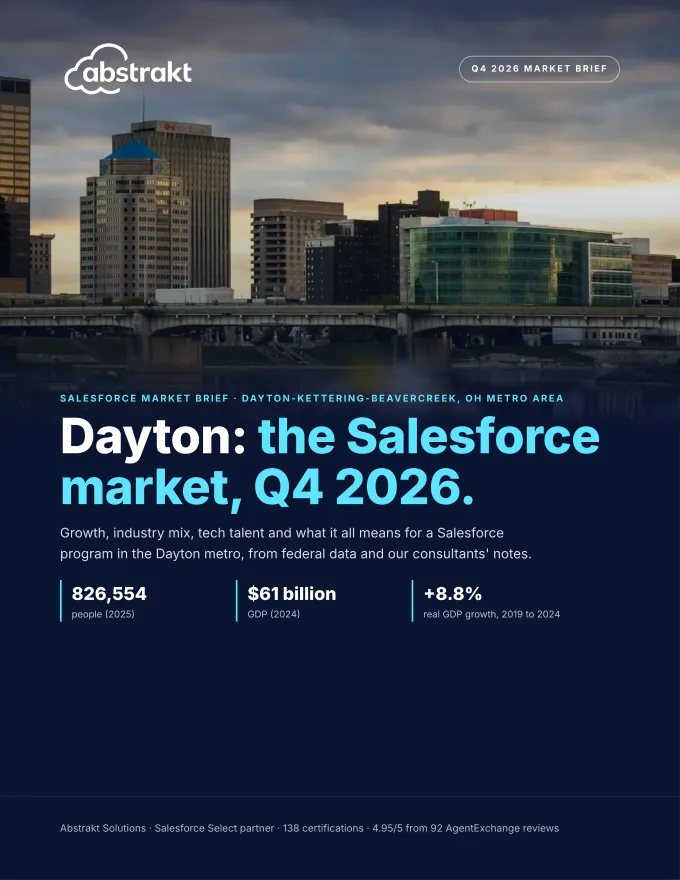
A free 24-page PDF with Dayton's growth ranked against 100 metros, its industry mix, tech wages and nearby markets. It is offered on the public Dayton page; send your customer there or get a copy for your own prep.
Get the Dayton brief →Co-sell with Abstrakt in Dayton
Working a Dayton account? Bring in a named consultant for discovery, scoping or a health check. We reply within 4 business hours.