

How Salesforce work starts in Honolulu
Abstrakt Solutions is a Salesforce Consulting Partner whose O‘ahu clients include health providers, hotels, retailers and contractors. Honolulu is one of our focus markets.
What buyers here usually run into
- 1
Building local ownership
Honolulu organizations often run Salesforce with very small teams, so projects need clear hand-offs, recorded sessions and admins who can own changes locally.
- 2
Health-system privacy and integration
Health and wellness organizations need Salesforce access models, consent handling and connections to clinical or billing systems designed carefully before anything goes live.
- 3
Guest and customer data spread across tools
Hospitality and retail businesses commonly hold customer data in booking, point-of-sale and email tools that do not talk to each other, which limits service and marketing.
Budget, team and partner questions
What drives cost
Honolulu costs depend first on how many booking, clinical, point-of-sale or estimating systems must connect, and on privacy design for health organizations. Documentation and training so a small internal team can own the result belong in the scope from the start.
Admin or partner
Many organizations here have one or two people responsible for Salesforce, so partners usually supply design, integration and backup administration. Clear hand-offs, documentation and admin training matter as much as the build.
What buyers ask a partner
Ask how the partner trains a small team to own changes, and for references in hospitality data unification or health privacy. Ask how they test agents against local place names and multilingual customers before launch.
The local economy and its biggest industries (4)
| Sector | Share of 2024 GDP | Where Salesforce fits |
|---|---|---|
| Health care and social assistance Salesforce for health & life sciences → | 7.8% | Honolulu's largest private sector is led by large health systems, where Salesforce work tends to center on patient and member service, referrals and outreach, built with privacy controls from the first design session. |
| Accommodation and food services Marketing Cloud → | 7.4% | Hotel groups and restaurant operators serving visitors need guest, group-sales and event records in one place, plus marketing that respects guest preferences. |
| Retail trade Salesforce for retail & consumer goods → | 6.8% | Island retailers and distributors deal with shipping lead times and a mix of resident and visitor customers, which makes clean customer data and service history more valuable. |
| Construction Salesforce for construction → | 5.5% | Contractors on O‘ahu juggle bids, crews and change orders across many job sites; Field Service and CPQ can tie estimates to what the work actually costs. |
Source: U.S. Bureau of Economic Analysis, GDP by county (CAGDP2), 2024, summed to the metro area; private sectors only, excluding real estate and government. “At least” marks sectors where BEA suppresses some county figures.
Regional target sectors named by local economic development groups: Technology, Creative, Health and Wellness, Agribusiness, Education (Private), Defense.
Salesforce products that fit Honolulu (6)
In the order we lead with them here, from the industries above.
Salesforce Service Cloud
The operating system for modern customer service, case, knowledge, voice, and AI agent assist together.
Salesforce Sales Cloud
The CRM where sales pipeline lives, when it is built right.
Salesforce Marketing Cloud
Cross-channel marketing, email, mobile, journey, and Data 360-powered personalization at scale.
Salesforce Field Service
Scheduling, dispatch, mobile work orders and parts for teams that work on site.
Salesforce Data 360 (Data Cloud)
Unify customer data into a real-time profile that powers segmentation, analytics, and AI.
Salesforce Agentforce
AI agents that handle real work inside Sales Cloud, Service Cloud, and Marketing Cloud.
Honolulu service businesses and grounded AI agents
Honolulu's private economy is spread across health care, hospitality, and retail rather than concentrated in one sector. That spread favors reusable AI patterns. A knowledge-grounded agent can answer patient intake questions for a clinic, reservation and policy questions for a hotel, or order questions for a retailer, as long as each draws only from content that business has approved. Service teams gain from automatic summaries when a conversation moves to a person. Transportation and construction firms may start with intake forms and lead triage. Local terminology, Hawaiian place names, and multilingual customers make testing important; we review sample conversations with staff before anything reaches the public.
- Clinic intake question answers
- Hotel reservation policy responses
- Handoff conversation summaries
Services buyers here usually need (7)
Salesforce Implementation in Honolulu
Implementing Salesforce in Honolulu starts with a data model for guests, patients or customers and the processes around them, then a delivery plan sized for lean teams and seasonal peaks. We record every design review and leave written decisions after each session, so people who missed a meeting can catch up. Discovery workshops, go-live and training are timed around your busy periods, and the rollout is phased so each launch is small enough for your staff to absorb.
By industry in Honolulu
- 1
Accommodation and food services
Hotels, resorts and restaurants together generate roughly 7.4% of Honolulu's 2024 metro GDP, which makes guest data a board-level asset here. For hotels, resorts and restaurant groups, implementation choices center on how a guest is represented when the same person books directly, through a travel seller or as part of a group. We design the guest, stay and event objects first, then decide what flows in from the property management system, so group sales and marketing both work from one profile.
- 2
Health and Wellness
Among DBEDT's targeted sectors, Health & Wellness leads Honolulu in both size and recent growth. Providers and wellness organizations implementing Salesforce need a design that separates relationship and coordination data from the clinical record, with privacy controls settled before any build. We usually phase intake and referral management first, add outreach once consent handling has been proven in use and bring in only the clinical data that coordinators and outreach staff genuinely need to do their jobs.
- 3
Retail trade
Island retailers serve residents and visitors alike and plan stock around mainland shipping. Implementing Salesforce for them usually means one customer record that connects store purchases, online orders and service requests, with loyalty or preference data marketing can act on. We scope the first phase around service and customer data, since that delivers value to store managers and support staff even before a single marketing journey is built or a loyalty rule is configured.
Raise before scoping
Protect time for design reviews
Island teams are lean, and the people making design decisions usually also run a front desk, a store or a clinic. Reserve fixed blocks for design reviews and user testing, and use recorded walkthroughs and written decision logs for everything else, so progress never waits on a shared calendar slot.
Make each workshop count
Plan the sessions that need everyone together, such as discovery workshops, go-live and hands-on training, well ahead of time. Prepare agendas and test data in advance so each session ends with decisions rather than more questions.
Grow a local owner early
Everyday questions are answered fastest by someone who works alongside the users. Name an internal admin early, include them in build sessions and hand over documentation phase by phase, so someone on the island can resolve everyday questions without waiting overnight.
Salesforce Managed Services in Honolulu
Managed services in Honolulu works best as a partnership with someone on your side: an internal admin or business owner who handles immediate questions while our team takes the request queue, Flow and development work, integration repairs and testing before each Salesforce release. Changes your owner approves are built and tested in a sandbox first, then deployed at a time agreed with the teams they affect. A monthly review with your owner sets priorities and shows what shipped.
By industry in Honolulu
- 1
Health care and social assistance
BEA ranks health care and social assistance first among Honolulu's private industries, at roughly 7.8% of 2024 metro output. Health systems, clinics and social service providers here change their Salesforce orgs as programs, referral partners and staffing shift. Managed services absorbs those changes through a documented queue, reviews user access as people join and leave, and tests each release against consent and privacy settings, keeping a change history compliance teams can read directly.
- 2
Education (Private)
Private education is on DBEDT's targeted list, and independent schools and private colleges use Salesforce for admissions, advancement and family communication. Their needs follow the academic calendar: application season, enrollment, giving campaigns and graduation all bring bursts of requests. A managed team plans capacity around those peaks, keeps marketing journeys and donor records tidy and repairs the connection to the student information system when it breaks in the middle of an admissions cycle.
- 3
Technology
Technology is another DBEDT target sector, including early-stage companies supported by state programs and university incubation. Small tech firms seldom need a full-time Salesforce developer, but their pricing, partner programs and support tiers change often. Managed services lets them add admin and development help as required, keeps the org aligned with each change in go-to-market and prevents the technical debt that quietly builds when founders configure Salesforce late at night between other jobs.
Raise before scoping
Write requests for async work
Because much of the collaboration happens outside shared hours, requests should arrive with context: who is affected, what result is expected and an example record. A simple intake form enforces that, and it cuts the back-and-forth that otherwise adds a day to every change.
Name an internal first responder
Someone on your staff should handle password resets, simple layout questions and urgent triage as they come up. Train that person on the org's structure and give them a clear path to escalate anything that cannot wait.
Schedule regular access reviews
Health, education and nonprofit organizations see frequent staff and volunteer turnover. Build a recurring access review into the managed services plan, removing departed users, checking permission sets and confirming that portal or community users see only the records they should.
Salesforce Integration in Honolulu
Integration in Honolulu is often about bringing scattered customer data together: property management and booking systems for hotels, point of sale for retailers, clinical and billing platforms for health providers and accounting software for contractors. Record ownership is settled on paper first, then the connection is built with MuleSoft, a lighter platform or direct APIs, whichever suits the volume. Because front-line staff often notice problems first, alerts and a clear runbook are part of every build.
By industry in Honolulu
- 1
Construction
Builders account for about 5.5% of O‘ahu's 2024 metro GDP, and contractors there typically keep estimates in one tool, accounting in another and scheduling in a third, which leaves Salesforce holding only part of the picture. Integration connects awarded bids to jobs in accounting, feeds approved change orders back to billing and pulls crew schedules into Field Service, so project managers and office staff stop reconciling the same numbers by hand.
- 2
Accommodation and food services
Hotels and restaurant groups run on property management, booking, point-of-sale and loyalty systems that each hold part of a guest's history. Integration brings stays, spend and preferences into one Salesforce profile, or into Data 360 (formerly Data Cloud) when sources multiply, so sales and marketing can act on them. We treat identity matching carefully, since guests book under different emails and names, and a bad merge harms service more than a missed one.
- 3
Health care and social assistance
Providers here connect Salesforce to electronic health records, scheduling and billing systems, but only for what coordination staff need. We favor narrow interfaces that carry appointment, referral and eligibility status rather than full clinical records, keeping the health record as the source for anything medical. Each flow is logged and permissioned, so privacy reviewers can see exactly what moves, where it lands in Salesforce and who is able to view it.
Raise before scoping
Route alerts to a named owner
A failed integration that nobody notices can quietly leave guest or order records out of date. Send alerts to someone on your team, document common fixes in a runbook and let error queues hold failed messages so nothing is lost overnight.
Match identities deliberately
Guests, patients and customers appear under different names, emails and phone numbers across systems. Agree on matching rules, and what happens with uncertain matches, before connecting sources, since an incorrect merge is harder to undo than a duplicate left for review.
Mind the no-DST clock
Hawaii does not observe daylight saving time, so scheduled syncs and time-stamped exchanges with mainland systems shift by an hour twice a year. Store times in a consistent standard, test jobs across each changeover and make sure reports display local Honolulu time.
Salesforce Health Checks in Honolulu
A Honolulu health check gives leadership a documented view of the org they rely on, which matters most when the people who built it have moved on or left little documentation behind. Sharing rules, record quality, automation, code, integration accounts and license use all get examined, and each issue is placed in a priority order you can act on. The work runs under read-only access, and results are presented in a live session with your leadership team.
By industry in Honolulu
- 1
Health and Wellness
Health and wellness organizations hold the most sensitive data in many Honolulu orgs, and their Salesforce use often expanded from outreach into referrals and care coordination. We confirm a Business Associate Agreement is in place, check that encryption covers what is actually stored and test whether marketing or volunteer users can open clinical fields or export them. Each finding cites the setting involved so privacy staff can track remediation to completion.
- 2
Defense
Defense is on DBEDT's list of target sectors, and contractors and suppliers serving it face strict expectations about who can access program and customer information. A health check reviews user provisioning and removal, multi-factor enforcement, connected apps and export permissions, and flags data that may not belong in a commercial CRM at all. Leadership gets a clear list of gaps to discuss with security officers before customers or auditors find them.
- 3
Technology
Honolulu technology companies, including early-stage firms from local incubation programs, often configure Salesforce themselves while building a product. By the time they raise capital or hire a sales team, the org carries improvised fields, duplicate accounts and automation nobody documented. The health check sorts what to keep from what to retire and shows plainly whether the data can support investor-grade forecasting, customer success tracking or an AI agent answering customers.
Raise before scoping
Include every external access path
Portals, connected apps and integration users often matter more than internal profiles. List everyone and everything that can reach the org from outside, including former implementation partners and outside vendors, confirm each still needs the access it holds and remove what it does not.
Test data before any agent
An Agentforce agent answering guests, patients or customers will rely on the records and sharing that exist on launch day. Measure duplicates, missing values and stale contacts on those objects first, and fix the worst problems before a pilot shapes opinions.
Plan the results session
Findings about access and data exposure are best discussed first with a small group, then shared more widely along with the remediation plan. Invite the leaders who own each finding to the live session, so questions about priority and risk are settled in one conversation.
Salesforce Optimization in Honolulu
Optimization suits Honolulu organizations that already run Salesforce but see staff working around it: front desks keeping guest notes elsewhere, store managers exporting lists to spreadsheets, project managers tracking change orders by email. Login and field-usage data, plus conversations with each team, show where to cut; from there, layouts shrink, duplicate customers merge, legacy automation moves to Flow and reports get rebuilt on agreed definitions. Changes ship in small batches, each paired with a short session for the roles it affects.
By industry in Honolulu
- 1
Retail trade
Retail trade accounts for about 6.8% of metro GDP, and island retailers often carry duplicate customer records created separately by stores, online orders and service desks. Optimization merges those duplicates, standardizes addresses and preference fields and rebuilds service and sales dashboards around one customer count. Store and service teams then see a single history per shopper, which makes loyalty offers and follow-up far more accurate than lists pulled from several systems.
- 2
Accommodation and food services
Hotels and restaurant groups frequently adopt Salesforce for group sales and then find inquiries, proposals and events tracked in several inconsistent ways. We standardize sales stages, retire fields nobody fills in, consolidate automation that sends duplicate notifications and rebuild pipeline reports by property and event type. Sales managers get forecasts they can defend in weekly revenue meetings, and event coordinators spend far less time copying details between records by hand.
- 3
Construction
Contractors on the island often find their project records incomplete because superintendents skip entry at the end of long days. We cut layouts to the fields that support billing and scheduling, add mobile-friendly screens for field updates and rebuild backlog and margin reports. The aim is a system site staff can update in minutes from a phone, not one that depends on office staff chasing information by text and email.
Raise before scoping
Fix the loudest complaint first
Ask each team what makes Salesforce frustrating and fix the most common complaint quickly. Visible early improvements build goodwill for the larger cleanup, especially when users are skeptical after an earlier rollout.
Clean customer data at the source
Deduplicating records once is not enough if stores, booking tools and web forms keep creating new duplicates. Add matching rules, required formats and validation where records enter, and review duplicate reports monthly so the cleanup holds long after the project ends.
Publish short release notes
Hotel chains and retailers with locations on more than one island often share a single org, so a tweak meant for one property can puzzle staff at the next. Publish brief notes with each batch, include before and after screenshots and name a contact at each property who fields questions from staff.
Salesforce Migration in Honolulu
Honolulu migrations often gather customer data from tools adopted one at a time: an entry-level CRM, a marketing email platform, spreadsheets for wholesale accounts or donors and exports from booking or point-of-sale systems. Each of those sources gets profiled for gaps and repeats, the people who rely on it sign off on how its fields translate, and the whole load is rehearsed in a sandbox. The cutover is timed to avoid your busiest season, and consultants stay on hand to answer questions through the first live days.
By industry in Honolulu
- 1
Agribusiness
Agribusiness appears among DBEDT's targeted sectors, and growers, food producers and distributors on O‘ahu frequently manage wholesale buyers, retail accounts and distributors in spreadsheets or small accounting-linked CRMs. Migration standardizes product and account names, links contacts to the right buyer and decides how much order history to bring. Cleaning before the load gives sales a trustworthy account list and lets them report by channel, island and product line from the first week.
- 2
Education (Private)
Private schools and colleges on DBEDT's target list often run admissions, alumni and giving in separate systems. Migrating them into Salesforce means matching the same family across inquiries, enrolled students and donors, deciding which historical gifts and interactions to keep and carrying consent preferences over exactly. We reconcile record counts and giving totals after each trial load, so advancement and finance teams can confirm nothing was lost or double counted.
- 3
Retail trade
Retailers moving to Salesforce from an older CRM or a marketing platform bring customer lists that overlap heavily, with the same shopper listed through store sign-ups, online accounts and email subscriptions. We merge them using agreed matching rules, carry over consent and preference data accurately and keep only the purchase history that service and marketing actually use, archiving the rest in a form that store and service staff can still search.
Raise before scoping
Trace every consent record
Opt-ins and unsubscribes collected in older tools must survive the move exactly. Map consent fields explicitly, test them with sample contacts and run a small send after migration, since emailing someone who opted out years ago damages both trust and deliverability.
Choose a quiet switchover window
Visitor peaks, holiday retail, admissions deadlines and harvest can each consume the staff you need for testing. Settle the date with department heads, lock the legacy tool for a short spell and keep consultants on call through the first live days.
Review mappings in writing
Field mappings and test loads get reviewed faster when every decision is written down. Share mapping documents with named reviewers, set response dates and hold live sessions for questions that need discussion.
Salesforce Implementation Rescue in Honolulu
Rescue projects in Honolulu often trace back to process as much as design: decisions made without the people who would use the system, a partner who left before handover, and a launch nobody on staff was trained to support. Recovery begins with reading the org and the contract side by side and interviewing island staff about what fails them; urgent blockers get fixed, and each component is then judged on its merits. The rest is finished in phases while a local owner is trained along the way.
By industry in Honolulu
- 1
Creative
Creative businesses on DBEDT's target list, such as production companies, agencies and design studios, often buy Salesforce to manage projects as well as clients, then abandon it when the build proves too rigid. We assess which objects support real production work, simplify the project and client structure and rebuild reporting around booked and delivered work, so producers see real value in keeping records current instead of reverting to shared spreadsheets.
- 2
Construction
Contractors sometimes launch Field Service or quoting only to find schedules unreliable and estimates needing manual correction. Rescue reproduces those failures with real jobs, separates configuration defects from design mistakes and fixes the rules that matter most to crews and estimators. Office and field staff are then retrained on the corrected process, starting with the teams whose complaints were loudest, so confidence in the system returns quickly across the company.
- 3
Health care and social assistance
Health and social service providers occasionally inherit an intake or care coordination build that staff find slower than the paper or phone process it replaced. We walk through the real workflow with frontline staff, measure where cases stall, check that privacy controls were set up correctly and simplify the process. The relaunch goes program by program, with local staff involved in testing, so frontline teams see their feedback reflected in what ships.
Raise before scoping
Recover access and knowledge
When a previous partner departs, design notes and integration details often leave in someone's inbox. Ask for every deliverable the contract promised, gather test scripts and meeting notes your staff kept, and list the logins and service accounts in use, so the assessment starts from documented facts.
Build local ownership into recovery
Many failed projects had no one on the island who understood the build. Assign an internal owner at the start of the rescue, involve them in every fix and hand over documentation phase by phase, so the recovered org does not depend on a distant partner.
Stabilize before new features
Pressure to deliver the originally promised features can crowd out basic fixes. Resolve the problems that stop daily work first, communicate those fixes clearly and only then resume the roadmap, so users see the system improving before being asked to learn more.
Industry plays in Honolulu (3)
Salesforce for Honolulu Health and Life Sciences
Health and wellness is Honolulu's largest targeted industry and its biggest private sector, so Salesforce projects range from provider care coordination and patient access to wellness businesses managing members and research groups tracking sponsors and collaborators. Common needs include a secure access model, clean integration with clinical systems, and service tools that work for small teams. We also train your own administrators so they can own routine changes with confidence.
Health care and social assistance leads Urban Honolulu's private sectors at 7.8% of 2024 metro GDP, according to Bureau of Economic Analysis county figures. Hawaii's Department of Business, Economic Development and Tourism targets health and wellness among its emerging industries, and its 2025 update reports that it was Honolulu's largest and fastest-growing targeted sector from 2014 to 2024. The state university system's research flagship recorded $516.0 million in extramural awards in fiscal 2026, giving the island a substantial research community alongside hospitals, clinics and wellness businesses.
Use cases to open with
- 1
Care coordination across providers
Patients often move between hospitals, clinics, home health and community services. Health Cloud care plans, care team records and referral tracking, integrated with EHR events, help coordinators see open tasks, upcoming appointments and barriers such as transportation, so fewer patients fall through gaps between organizations. Shared tasks let partner agencies confirm when a service has been delivered, closing the loop for coordinators.
- 2
Wellness membership management
Fitness, wellness and integrative health businesses manage memberships, packages, bookings and practitioner schedules. Salesforce with member records, scheduling integration and Marketing Cloud journeys supports onboarding, renewals and reactivation campaigns, and service cases capture feedback, giving owners a clearer view of retention than booking software alone provides and showing which programs keep members coming back. Practitioners see each member's history before appointments.
- 3
Research sponsor and grant tracking
Research groups manage sponsors, federal and private grants, collaborators and study milestones. Custom objects for proposals, awards and deliverables, with dashboards by principal investigator and sponsor, help research offices report activity and catch renewal deadlines, and give leadership visibility into the pipeline of pending funding well before budgets are set. Compliance reports for sponsors can be drafted from the same records, and effort certifications stay attached to each award.
Raise before scoping
Local ownership of the org
Small health and wellness teams cannot afford to wait on an outside vendor for every change. Train an internal administrator to handle routine changes, document every configuration, and agree on escalation windows, so urgent issues do not wait overnight for outside help to come online.
Privacy for patients and members
Clinical data is subject to HIPAA, and wellness businesses holding health details should apply similar discipline. Separate clinical and marketing data, restrict access by role, and record consent by channel, confirming obligations with your privacy officer before integrating any clinical source.
Right-size the license mix
Smaller organizations can easily overbuy industry clouds and add-ons. Match licenses to the users who truly need them, consider platform licenses for occasional staff, and add features in phases once adoption proves their value, rather than paying for capacity nobody uses.
Salesforce for Honolulu Retailers and Local Brands
Retailers and consumer brands in Honolulu serve two very different customers: residents who shop year-round and visitors who may buy once in person, then reorder online from home. Salesforce helps by connecting store, web and service interactions to one profile, so a visitor who bought in Waikiki can be recognized when ordering from the mainland. We configure Service Cloud for order and delivery questions, Marketing Cloud and Data 360 (formerly Data Cloud) for resident and visitor journeys, and Agentforce for questions that arrive while island staff are offline.
Retail trade produced 6.8% of Honolulu's 2024 metro GDP in Bureau of Economic Analysis county figures, third among private sectors after health care at 7.8% and accommodation and food services at 7.4%, the latter a reminder of how many shoppers are visitors. The state's economic development agency counts agribusiness and creative industries among Honolulu's targeted sectors, both of which feed local consumer products, and reports that Honolulu held 117,518, or 69%, of the state's 170,302 targeted-sector jobs in 2024.
Use cases to open with
- 1
Reorders after the trip
A shopper who discovers an island brand during a trip often wants to buy again after flying home. Capturing email and consent at the register or through a receipt, then unifying that profile with web orders in Data 360 (formerly Data Cloud), lets Marketing Cloud send timely reorder reminders and new-product news. Brands can see how much online revenue started with an in-store visit.
- 2
Resident loyalty programs
Residents shop year-round and expect recognition. Marketing Cloud journeys driven by purchase history can offer resident-specific promotions, event invitations and early access, while Service Cloud keeps any issues visible to staff at every store. Reports compare resident and visitor behavior by store, season and product category, so merchandising, promotions and staffing reflect who actually shops each location rather than who the team assumes does.
- 3
Order and shipping service
Island inventory arrives by ship, and customers ask about stock, backorders and delivery times to neighbor islands or the mainland. Service Cloud with order and inventory integration lets agents answer quickly with real dates, while Agentforce handles common questions outside island business hours, including the early hours when mainland customers are awake but island staff are not. Every conversation lands on the customer's record.
Raise before scoping
Time zones in customer service
Mainland customers start their day several hours before Honolulu does. Decide which questions Agentforce or self-service can answer fully, which cases wait for island staff, and set expectations clearly in auto-responses and on the website, so no shopper feels ignored overnight or over a holiday weekend.
Capture consent at the counter
Visitors are often reachable only through what they share at checkout before heading home. Build a quick, clear consent capture into point of sale or digital receipts, record where and when it came from, and honor those preferences across email, text and advertising audiences afterward.
Inventory data you can trust
Because replenishment takes longer on an island, customers asking about stock need accurate answers the first time. Sync inventory from point of sale and warehouse systems on a frequent schedule, show agents the expected arrival date for items on order, and avoid promising delivery the data cannot support.
Salesforce for Honolulu Construction Firms
Contractors in Honolulu price and schedule work around conditions few mainland firms face: materials shipped in with long lead times, a limited labor pool on one island, and a customer base that includes government and defense agencies alongside hotels, hospitals and homeowners. Salesforce ties bids, change orders and service work to shared customer and project records. On O‘ahu jobs, we usually pair a pursuit and bid pipeline with CPQ that bakes freight into every price, and with Field Service dispatch for maintenance crews, all fed by existing estimating and accounting data.
Builders share fourth place among Honolulu's private sectors with transportation and warehousing, each at 5.5% of 2024 output by the BEA's county tally. It does not appear on the state's list of targeted sectors, yet several of those sectors, including defense, health and wellness, private education and technology, depend on facilities that local contractors build and maintain. The state also runs manufacturing grants and an INNOVATE Hawai‘i manufacturing program through its technology development agency. Since the metro and the island are one and the same, crews never leave O‘ahu, but traffic and distance between sites still shape every schedule.
Use cases to open with
- 1
Bids that reflect shipping lead times
Materials arriving by ship can take far longer than on the mainland, and prices can move before they arrive. Sales Cloud can track each bid with its material assumptions, supplier quotes and validity dates, while CPQ applies consistent escalation and freight factors. Estimators can see which open bids rely on expiring quotes and update them before an award, protecting margin on jobs that take months to start.
- 2
Change order visibility
On island projects, a delayed shipment or unexpected site condition quickly becomes a change order. Salesforce can track each change order request, its value, approval status and effect on the customer relationship, pulling cost details from the job cost system. Leadership sees total pending changes by project and customer rather than discovering them at closeout, and can raise them with owners while memories are fresh.
- 3
Service and maintenance crews
Contractors who maintain building systems for hotels, hospitals and government facilities need reliable scheduling across O‘ahu's traffic and geography. Field Service assigns technicians by skill and location, tracks parts drawn from island stock, and records each visit with photos and signatures. Service agreements with defined response times are tracked automatically, and each building's history supports renewal and equipment replacement proposals.
Raise before scoping
Government and defense requirements
Public and defense work can carry specific documentation, security and reporting requirements for every contractor on the job. Keep sensitive project details in approved systems, store only what the business development team needs in Salesforce, and restrict record access to the people cleared for each program or agency.
Supplier quotes expire
Material pricing and freight rates can shift while island bids are pending for weeks. Track supplier quote expiration dates and assumptions on each bid, and set alerts so estimators refresh numbers before submission or award, rather than discovering the gap later during procurement and absorbing it.
Plan who supports the org
Field forms tend to break at inconvenient moments, often early on a job day. Agree on support windows, escalation paths and who administers the org locally, so superintendents and field teams are never waiting overnight for a fix to a broken form.
Case studies to send (2)
From the industries this market leans on. Client names are anonymized and these projects are not specific to Honolulu.
The Honolulu Salesforce market brief, Q4 2026
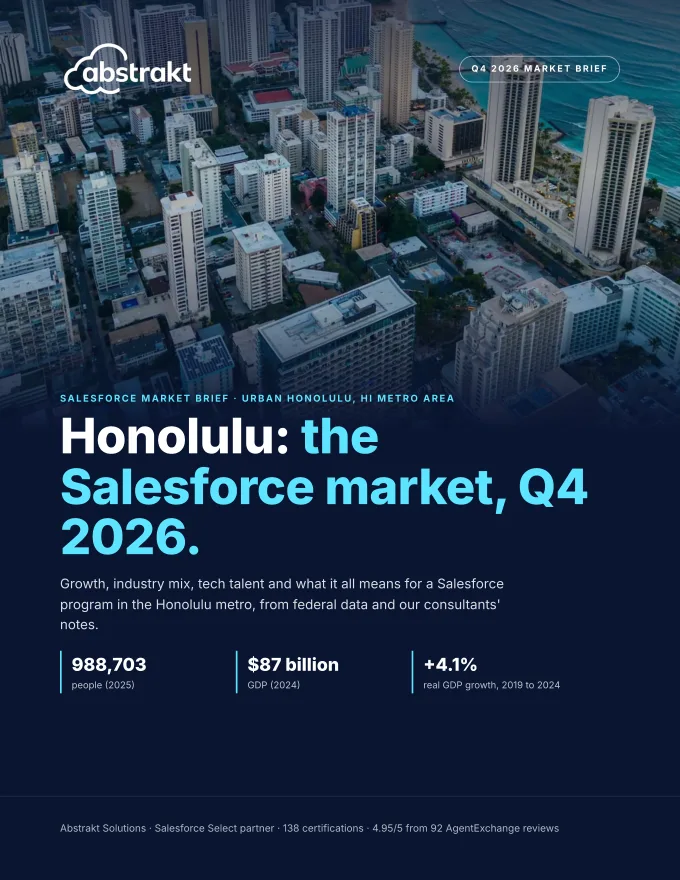
A free 20-page PDF with Honolulu's growth ranked against 100 metros, its industry mix, tech wages and nearby markets. It is offered on the public Honolulu page; send your customer there or get a copy for your own prep.
Get the Honolulu brief →Co-sell with Abstrakt in Honolulu
Working a Honolulu account? Bring in a named consultant for discovery, scoping or a health check. We reply within 4 business hours.