

How Salesforce work starts in Knoxville
Abstrakt Solutions, a Salesforce Consulting Partner, works with Knoxville-area manufacturers, health care organizations and retailers from first implementation through ongoing support. Knoxville is one of our focus markets.
What buyers here usually run into
- 1
Program-based manufacturing sales
Suppliers to automotive and energy customers often track programs, quotes and changes in spreadsheets. A CRM tied to ERP keeps each customer program visible.
- 2
Field crews without the right tools
Industrial and service businesses commonly schedule technicians and laborers by phone or calendar. Field Service can be scoped to fit, without licensing every worker.
- 3
Customer data spread across locations
Retail and multi-site businesses frequently hold customer records in several systems, which makes marketing and service inconsistent until the data is unified.
Budget, team and partner questions
What drives cost
Knoxville scope depends on which sector you are in. Nuclear and energy suppliers spend on access design and documentation controls, retailers on unifying customer records across locations, and manufacturers on ERP integration. Field Service for industrial crews can be scoped to the people who actually need licenses.
Admin or partner
Health systems and larger manufacturers here often have an internal Salesforce owner and use a partner for integration and new clouds. Retailers and smaller suppliers typically outsource administration and bring in specialists for Marketing Cloud or Data 360 work.
What buyers ask a partner
Ask for examples of restricted-access orgs for regulated suppliers, customer data unification for multi-location retail, and ERP integration for manufacturers. Ask how the partner scopes Field Service so you are not licensing every laborer.
The local economy and its biggest industries (4)
| Sector | Share of 2024 GDP | Where Salesforce fits |
|---|---|---|
| Manufacturing Salesforce for manufacturing → | 10.8% | Advanced manufacturing and nuclear technology are both Knox County target sectors, and manufacturing leads the metro's private economy with 10.8% of 2024 GDP. Sales, quoting and service work best when connected to ERP. |
| Health care and social assistance Salesforce for health & life sciences → | at least 8.9% | Care providers form the second-biggest private industry in the Knoxville area, trailing only factories in BEA's 2024 output data. Health organizations here need patient engagement and service workflows built around privacy requirements. |
| Retail trade Salesforce for retail & consumer goods → | 8.7% | Retail trade is the Knoxville metro's third-largest private sector. Retailers and consumer brands need customer service, loyalty and marketing data in one place. |
| Professional, scientific, and technical services Salesforce for professional services → | at least 6.1% | With a federal research lab and a nuclear security production site in the region, engineering and technical services firms need pursuit pipelines, project delivery and client reporting. |
Source: U.S. Bureau of Economic Analysis, GDP by county (CAGDP2), 2024, summed to the metro area; private sectors only, excluding real estate and government. “At least” marks sectors where BEA suppresses some county figures.
Regional target sectors named by local economic development groups: Advanced Manufacturing, Nuclear Technology, IT & Business Services, Supply Chain & Logistics, Food & Beverage, Transportation & Mobility.
Salesforce products that fit Knoxville (6)
In the order we lead with them here, from the industries above.
Salesforce Sales Cloud
The CRM where sales pipeline lives, when it is built right.
Salesforce Field Service
Scheduling, dispatch, mobile work orders and parts for teams that work on site.
Salesforce Service Cloud
The operating system for modern customer service, case, knowledge, voice, and AI agent assist together.
Salesforce Marketing Cloud
Cross-channel marketing, email, mobile, journey, and Data 360-powered personalization at scale.
Salesforce Agentforce
AI agents that handle real work inside Sales Cloud, Service Cloud, and Marketing Cloud.
Salesforce Data 360 (Data Cloud)
Unify customer data into a real-time profile that powers segmentation, analytics, and AI.
What AI can realistically handle for Knoxville companies
Knoxville's BEA profile for 2024 puts manufacturing first at 10.8% of metro GDP and retail trade at 8.7%, with health care also near the top. Retailers are the quickest to see results from knowledge-grounded self-service, since order, return and store-policy questions repeat constantly. Manufacturers, including suppliers tied to the region's nuclear and energy work, face stricter documentation rules; for them, AI is best used to read and summarize supplier correspondence while engineers keep authority over technical answers. Health groups can draft appointment reminders and billing responses for staff approval. Accurate product catalogs and a governed article library matter more here than any particular model setting.
- Order and return self-service
- Supplier correspondence summaries
- Staff-approved billing responses
Services buyers here usually need (7)
Salesforce Implementation in Knoxville
Knoxville implementations tend to split along one line: whether the company sells into the region's federal science and nuclear work or into commercial markets. Suppliers to the national lab and the weapons production complex need their data classified before design, so controlled technical detail never lands in the CRM. Commercial manufacturers, retailers and health organizations need a cleaner account model and a faster launch. Either way, we run design workshops with each team, configure in a sandbox, load reconciled data and go live team by team, with training written around each role's actual day.
By industry in Knoxville
- 1
Nuclear Technology
Nuclear technology appears on the East Tennessee Economic Development Agency's target list for Knox County, and suppliers in that chain face a design question most CRMs never ask: which data is allowed in at all? We work with your compliance lead to separate commercial records, such as contacts, pursuits and contract milestones, from export-controlled engineering content, which stays in approved systems and is referenced by document number. Permission sets, restriction rules and field-level security are defined before the first object is built.
- 2
Manufacturing
Plants turned out roughly 10.8% of Knoxville-area 2024 output, and one Blount County auto components factory ranks with the biggest payrolls in East Tennessee. For parts makers, the implementation hinges on how customer programs, ship-to plants and part families are modeled. We decide early whether volume forecasts live in Salesforce or stay in the ERP, then build quoting and service around that choice. Sales goes live first; warranty claims and returns follow once the product data has proved dependable.
- 3
Food & Beverage
ETEDA's Knox County profile also courts food and beverage makers. Producers and processors here usually sell through distributors, grocery buyers and foodservice accounts at the same time, and each channel wants different data. An implementation for them sets up account types per channel, a promotion and pricing structure that sales can realistically maintain, and service cases for quality complaints that trace back to a lot or production date. Marketing Cloud can follow once the account base is clean enough to segment.
Raise before scoping
Classify data before design
If any customer is a federal site or prime contractor, get a written ruling from compliance on what may be stored in a commercial Salesforce org. That one decision changes object design, file handling and sharing, and discovering it midway through a build means rework on almost every screen.
Launch by team, not feature
Rather than switching on sales, service and marketing together, bring one team live, let it settle for a few weeks, then add the next. East Tennessee companies with lean IT staff find this keeps support manageable and shows early results to skeptical managers.
Name one owner for parts
Product data usually lives in the ERP, engineering files and a pricing spreadsheet at once. Name a single owner and source for part numbers and list prices before quoting is configured, or the Salesforce catalog will drift away from the ERP soon after launch.
Salesforce Integration in Knoxville
Integration projects around Knoxville usually connect Salesforce to one operational system nobody wants to replace: an ERP in a parts plant, an EHR in a hospital network, a point-of-sale platform in a retail chain, or a warehouse system at a distributor. We agree which fields move, in which direction and how often, then build with MuleSoft, Data 360 (formerly Data Cloud) or native connectors depending on volume and budget. Monitoring, retry logic and a named owner for failures are part of every connection we deliver.
By industry in Knoxville
- 1
Supply Chain & Logistics
Supply chain and logistics is on the Knox County target list, and distributors and carriers here typically keep shipments, inventory and rates in dedicated systems. Integration gives account managers a view of volume trends, late shipments and open claims without logging into three tools. We summarize operational events into account-level metrics, push exceptions as cases for service teams, and leave detailed tracking where it already lives, which keeps data volumes and API usage under control.
- 2
Wholesale trade
Wholesale trade contributed at least 5.8% of metro GDP in 2024. Distributors depend on accurate pricing, stock levels and order history, and all three belong to the ERP. We integrate them into Salesforce so reps can quote from live availability, see what a customer bought last season and flag reorder opportunities. Customer-specific pricing is the difficult part; we usually read it from the ERP at quote time rather than copying every price agreement into Salesforce objects.
- 3
Health care and social assistance
Hospitals and physician groups in the region rarely want clinical data in their CRM, but they do want appointment status, referral outcomes and patient preferences visible to outreach and access teams. We integrate with the EHR through its supported interfaces, bringing in only the fields each team needs and keeping notes and results in the clinical system. Access is restricted by role, and every integration user is reviewed so it cannot read more than its purpose requires.
Raise before scoping
Map directions, not just fields
Draw up a simple grid: each column a system, each row a field, each cell marked create, edit or view. Two-way sync sounds convenient but multiplies the chances of conflict; most integrations work better when each field has exactly one writer and every other system reads.
Test with messy production data
Clean sample records make every integration look finished. Test with a copy of real data, including duplicates, missing values and odd characters, because those are exactly what break field mappings in the first week after launch and erode user trust very quickly.
Consider Data 360 for volume
When the goal is analysis or segmentation across large volumes, such as purchase or visit history, Data 360 (formerly Data Cloud) can ingest and unify the data without storing every row as a Salesforce record. Transactional sync still suits orders and cases that users act on directly.
Salesforce Implementation Rescue in Knoxville
Troubled Salesforce projects in Knoxville often share one cause: the design was set before anyone checked what plant, clinic or store staff actually do all day. Recovery starts with a short triage covering what works, what users avoid, which data is wrong and what the contract promised. We stabilize the essentials, then rebuild in phases alongside the plant, clinic and store staff who will depend on the system, checking each change against their real work. Documentation and handover are part of the plan from the start.
By industry in Knoxville
- 1
Advanced Manufacturing
Manufacturers on the county's advanced manufacturing target list sometimes inherit half-finished CPQ builds: product rules that cover only part of the catalog, pricing that disagrees with the ERP, and approval chains nobody follows. We freeze further configuration, confirm which quotes are being issued outside the system, and repair pricing and rules for the product families that bring in the most revenue first. The rest of the catalog follows in planned releases, each tested with the estimators who will use it.
- 2
Health care and social assistance
Stalled health care projects in the region often stop at the same point: integration with the clinical system proved harder than planned, and the Salesforce build waited. We separate what can go live without that integration, such as referral intake, outreach and patient service cases, from what truly depends on it. Staff start using the finished parts while the integration is redesigned, which restores momentum and gives sponsors something concrete to show their leadership.
- 3
Retail trade
Retailers sometimes launch Marketing Cloud and Service Cloud together, then find journeys sending to the wrong segments and agents working from duplicate customer records. Recovery begins by pausing risky sends, fixing consent and unsubscribe handling, and merging duplicates at the source. Once customer data is reliable, we rebuild the highest-value journeys and service processes one at a time, measuring each one against the results the original project was supposed to deliver.
Raise before scoping
Contain damage before redesign
If automation is sending wrong emails, creating duplicate records or corrupting pricing, switch it off first and use a manual workaround. Containment buys time for a proper diagnosis, and it prevents the data problems that make a later recovery slower and more expensive.
Re-baseline scope honestly
Requirements written before the project began often describe a company that has since changed. Compare it with current priorities, drop features that no longer matter, and agree on a smaller, credible scope. Sponsors respond better to a realistic plan than to a promise to deliver everything late.
Bring users into the rebuild
Invite a few respected users from each team into design sessions and testing. Their involvement catches mistakes early, and their endorsement carries more weight with colleagues than any message from the project team, which matters after a first attempt lost credibility.
Salesforce Optimization in Knoxville
Tuning a Knoxville org begins with numbers pulled from the org itself, not opinions. We pull field fill rates, login patterns, report usage and automation run history, then shadow a few people from each team to see where they leave Salesforce for a spreadsheet. From that picture we cut unused fields, merge flows that duplicate one another, rebuild the dashboards managers open every week and retrain roles on the adjusted process. Changes ship in small batches, so each one can be checked against the baseline.
By industry in Knoxville
- 1
Retail trade
Retail trade made up about 8.7% of the Knoxville metro's 2024 output. Retail orgs usually drift in two directions: marketing lists fill with duplicates, and service teams create case reasons faster than anyone reports on them. We consolidate customer matching rules, prune and regroup case reasons, and rebuild dashboards around the few measures store and district managers use, such as open complaints by location and loyalty sign-ups by channel.
- 2
Advanced Manufacturing
Advanced manufacturing tops the Knox County target list, and makers in this group often have orgs where each product line added its own opportunity process. Optimization aligns those into a shared stage model with product-specific steps only where they matter, retires quote templates nobody uses, and adds validation so forecast categories mean something. Reps get fewer clicks, and leadership gets a forecast that rolls up across product lines without manual adjustments in a spreadsheet.
- 3
Health care and social assistance
Clinics, home care agencies and community health organizations across the metro often adopted Salesforce for one program and extended it program by program. The result is a patchwork of intake forms, duplicate client records and automation that sends overlapping reminders. We merge intake into fewer guided flows, set up matching rules that respect privacy constraints, and rebuild outcome reports so program managers and funders see consistent numbers without keeping a separate spreadsheet.
Raise before scoping
Start from usage history
Salesforce records which reports run, which flows fire and which fields get filled. Reviewing that history before interviews keeps the conversation factual and exposes the features people claim to use but never touch, which are usually the first candidates for removal.
Fix page layouts early
Cluttered record pages are the cheapest problem to solve and the most visible to users. Dynamic Forms and role-specific layouts can hide the fields a person never needs, which earns goodwill before the harder work on automation and reporting begins.
Pick a few outcome measures
Choose measures tied to the business, such as quote turnaround, first response time on cases or the share of opportunities with a next step. Track them before and after each change, so optimization is judged on outcomes instead of on how many fields were deleted.
Salesforce Managed Services in Knoxville
In the Knoxville area, Salesforce often belongs to an IT generalist who also handles phones, laptops and the ERP. We act as the bench behind that one overextended generalist. We keep a single ranked list of requests, ship small changes on a regular cadence, check each Salesforce release in a sandbox before your users see it, and flag larger work so it can be scoped properly. Health systems, parts makers and retailers get the same routine, with a named lead who knows the org and the people who ask for changes.
By industry in Knoxville
- 1
Health care and social assistance
East Tennessee's hospitals, clinics and social service agencies produce no less than 8.9% of 2024 metro GDP, a share topped only by factories. Salesforce orgs in care organizations change constantly: new service lines, referral sources, outreach campaigns and turnover in patient access teams. Our ongoing work covers permission reviews each time roles shift, release testing against patient communications, and careful handling of any request that would expose protected data in reports or list views.
- 2
IT & Business Services
IT and business services is a Knox County target sector, and shared-service and outsourcing firms here often manage Salesforce for many client accounts or divisions at once. That creates a backlog heavy with small, repeated requests: new queues, email templates, entitlement rules and report variants. We template those changes so they are faster to deliver and consistent across clients, and we keep an eye on org limits, since multi-client setups tend to hit sharing and storage ceilings sooner than expected.
- 3
Retail trade
Retailers and travel-center operators in the region run customer programs that change with every promotion. Managed services here means a steady flow of loyalty rule adjustments, Marketing Cloud journey updates, new case reasons when a promotion confuses customers, and dashboards for store or district managers. We handle the requests on a predictable cadence and retest journeys and service automation after each Salesforce release, because a broken email journey during a promotion reaches a large share of customers at once.
Raise before scoping
Separate break-fix from projects
A locked-out nurse manager should never queue behind a console redesign. We run two lanes: quick fixes handled as they arrive, and planned work ranked monthly. Keeping them apart stops urgent noise from starving the improvements that actually change how teams work.
Document every change once
Lean IT teams in the region often lose Salesforce knowledge when one person leaves. Each change we make is logged with the request, the reason and the components touched, so the next admin, internal or ours, can see why a field or flow exists without reverse engineering it.
Review licenses before renewal
Ongoing support is a good vantage point for spotting unused seats, inactive users and add-ons nobody opened. We summarize license use ahead of your Salesforce renewal so the conversation with your account executive starts from facts rather than from last year's order form.
Salesforce Health Checks in Knoxville
A Knoxville health check is often prompted by a customer, not by IT. A federal prime asks for evidence of access controls, a hospital's compliance office requests an audit trail, or leadership wants Agentforce and needs to know whether the data can support it. We examine permissions, sharing, integration users, encryption, automation, custom code and data quality, then interview users from each team. Whatever blocks the goal that triggered the review sits at the top of our severity-sorted list.
By industry in Knoxville
- 1
Nuclear Technology
Firms in the nuclear supply chain, one of ETEDA's Knox County targets, need a review built around what the org must never hold. We search objects, notes and files for technical content that belongs in controlled systems, check who can export reports, and confirm that login policies, session settings and event monitoring match what customers expect. The output doubles as evidence for supplier security questionnaires, which is often the reason these reviews are commissioned in the first place.
- 2
Health care and social assistance
Health organizations in the metro, from the large regional networks to smaller clinics, carry Salesforce orgs where one misconfigured sharing rule can expose patient information. The review checks org-wide defaults, report and list-view access, guest user settings on any portal, and whether Shield encryption covers the fields that need it. We also look for automation that emails patient details and for sandboxes refreshed from production without masking, both of which turn up more often than expected.
- 3
IT & Business Services
IT and business services firms, another county target sector, often run Salesforce as the backbone for client delivery, so technical debt there slows the whole company. We measure how much custom code lacks tests, which Apex classes and flows overlap, how close the org is to storage and governor limits, and which managed packages are unused. The resulting plan separates cleanup your team can handle from structural work that needs an architect before AI features are layered on top.
Raise before scoping
Scope the review to a decision
A health check is most useful when it answers a specific question: can we add Agentforce, can we pass this customer's audit, can we merge this acquired org? Naming the decision up front lets the review go deep where it matters instead of wide everywhere.
Check integration and API users
Integration accounts are often created quickly with broad permissions and never revisited. Review each one's profile, IP restrictions and connected app settings. Over-privileged integration users are among the most frequent findings in any org and among the easiest to fix once identified.
Score the data agents will use
Agents reason over knowledge articles, case histories and account fields. If articles are outdated or case categories inconsistent, answers will be too. Part of the review scores those sources so you know what to clean before a pilot, not after customers see the results.
Salesforce Migration in Knoxville
Knoxville migrations often come with a merger attached. A manufacturer buys a competitor that used a different CRM, a health network absorbs practices with their own outreach tools, or a retailer consolidates marketing platforms. We inventory every source, profile the data for duplicates and gaps, agree on a target model, and rehearse loads in a sandbox with people who know the records. Cutover happens during a short freeze, followed by reconciliation reports that show every record accounted for.
By industry in Knoxville
- 1
Professional, scientific, and technical services
Professional, scientific and technical services accounted for at least 6.1% of 2024 metro GDP, a sector that includes engineering and technical firms working near the region's federal research and production sites. Their migrations usually involve years of pursuit history in spreadsheets or an older CRM, along with contacts who have moved between primes and subcontractors. We rebuild the account hierarchy carefully, keep historical pursuits for win-rate analysis, and screen notes fields for anything that should not move into a commercial system.
- 2
Transportation & Mobility
Transportation and mobility is a Knox County target sector, and fleet services, dealers and parts suppliers in that group often run on industry-specific systems that store customers, vehicles and service history together. Migrating to Salesforce means splitting those into accounts, assets and service records with the right relationships. We map vehicle or equipment identifiers first, since they tie everything else together, and verify service history on a sample of assets with the technicians who know them.
- 3
Food & Beverage
Food and beverage producers in the county frequently keep distributor and retailer relationships in a mix of spreadsheets, an older CRM and email. Migration means building one account list with channel and region tags, merging the same grocery or foodservice buyer entered in several forms, and carrying over promotion history that sales teams still reference. We agree on naming standards before loading, so the cleaned list stays tidy after go-live instead of sliding back into duplicates.
Raise before scoping
Profile data before mapping
Run counts of duplicates, blank fields and invalid values in each source before designing the target. Profiling often reveals that a field everyone considers essential is empty on most records, which changes both the mapping and the conversation about what to migrate.
Merge acquired orgs deliberately
When two companies' CRMs come together, decide which account wins when both hold the same customer, how owners are reassigned and which picklist values survive. Written, signed-off merge rules prevent a rushed cutover weekend from quietly doubling the apparent customer base.
Plan training around cutover
Users who log in on cutover day and cannot find their accounts lose confidence quickly. Schedule short training in the days before and after the switch, with a guide to where familiar records and fields now live, and keep a support channel open through the first week.
Industry plays in Knoxville (3)
Salesforce for Knoxville Manufacturers
Manufacturers around Knoxville sell into markets with very different expectations: nuclear customers want qualification packages and traceable records, mobility customers want fast RFQ turnaround, and food and beverage producers live on distributor and retail relationships. Salesforce works here when the design reflects which of those motions you run. We usually start with Sales Cloud and CPQ for quoting, add Service Cloud for customer document and quality requests, and connect both to the ERP so order and part data never need re-keying.
At 10.8% of 2024 GDP in Bureau of Economic Analysis county data, manufacturing outweighs every other private industry in the Knoxville metro. The East Tennessee Economic Development Agency's Knox County profile names advanced manufacturing, nuclear technology, food and beverage, and transportation and mobility among its targets, along with supply chain and logistics. A Department of Energy national laboratory nearby, which reports more than 7,000 scientists, engineers and staff, anchors the nuclear and materials side. That list covers one county rather than the whole metro, but it describes the plants and suppliers most regional manufacturers compete with or sell to.
Use cases to open with
- 1
RFQ desk with response tracking
Mobility and industrial customers send RFQs with drawings, annual volumes and due dates, and slow responses cost awards. Sales Cloud can capture each RFQ as an opportunity, route it to the right estimator, and measure response time by customer. CPQ or Revenue Cloud then builds the quote from ERP costs and approved margins, so pricing stays consistent even when several estimators are working at once.
- 2
Documentation requests for nuclear customers
Suppliers to nuclear programs field constant requests for certifications, material test reports and qualification records tied to specific orders. Service Cloud can log each request as a case linked to the order and part, attach references to controlled documents held in the quality system, and track delivery against the customer's deadline. Quality staff stop answering the same question twice, and account managers see what is outstanding.
- 3
Distributor and retail account coverage
Food and beverage manufacturers sell through distributors, brokers and retail buyers, each with its own promotions calendar and ordering pattern. Sales Cloud can map distributors to the retail accounts they serve, record promotions and new-item placements, and pull shipment data from the ERP. Sales leaders see which territories are growing and which distributors need attention before a quarterly business review, rather than piecing it together from emailed reports.
Raise before scoping
Respect nuclear quality programs
Suppliers working under nuclear quality assurance requirements must keep controlled records in their approved systems. Use Salesforce to track requests and relationships, reference controlled documents rather than copying them, and have your quality and compliance leads confirm the boundary before any build starts.
Model multiple selling motions
A single plant may quote engineered parts, sell stock items through distribution and support installed equipment. Rather than forcing one sales process, define separate record types and stages for each motion, with shared accounts, so reports compare like with like.
Keep ERP as the cost master
Quotes are only credible when costs are current. Make the ERP the source for part numbers, standard costs and lead times, sync them on a clear schedule, and restrict edits in Salesforce so estimators cannot drift from the numbers finance uses.
Salesforce for Knoxville Health Care Organizations
For health organizations around Knoxville, Salesforce is usually about coordination: getting referrals from surrounding counties into the right specialist, answering patient calls consistently, and building relationships with the employers whose workforces they serve. Service Cloud and an Experience Cloud portal handle the patient and referral side, while Sales Cloud supports employer and payer contracting. We keep protected health information to the minimum each process needs and integrate with the EHR, which remains the clinical system of record.
Health care and social assistance produced at least 8.9% of the Knoxville metro's 2024 GDP, according to Bureau of Economic Analysis county data, where some figures are withheld and the true share is likely higher. That places it second only to manufacturing. The East Tennessee Economic Development Agency's Knox County target list does not name health care or life sciences; it emphasizes advanced manufacturing, nuclear technology and IT and business services. Health care therefore shows up mainly as regional care delivery, with a large manufacturing workforce as one of its most important audiences.
Use cases to open with
- 1
Referrals from surrounding counties
Primary care offices across East Tennessee refer patients into specialists and hospitals in Knoxville, and referrals that go quiet become lost patients. Service Cloud can track each referral from receipt to scheduled appointment, flag those waiting too long, and send status back to the referring office through a secure portal. Outreach staff see which practices refer most and where volume is slipping.
- 2
Patient access center with AI assistance
A central patient access team answers questions about scheduling, locations, bills and preparation instructions. Service Cloud gives agents one view of each caller's open requests, and Agentforce can handle routine questions or draft replies grounded in approved knowledge articles, handing off to a person when the question involves clinical judgment. Supervisors track wait times, abandoned calls and repeat contacts by reason, and use that to adjust staffing and knowledge content.
- 3
Employer health partnerships
With manufacturing the region's largest private sector, plants are a natural market for occupational health, onsite clinics and direct employer programs. Sales Cloud can manage employer accounts, contract terms, services in place and renewal dates, while Service Cloud tracks employer requests such as pre-employment screenings. Business development teams see every employer relationship, its services and its renewal risk in one pipeline, and clinic leaders can see which employers are growing.
Raise before scoping
Minimize PHI in the CRM
HIPAA applies wherever protected health information is stored. Decide which processes truly need clinical data in Salesforce, keep the rest in the EHR, sign a business associate agreement, and use field-level security and encryption where required. Sign-off on where each data element lives should come from your privacy and compliance officers.
Plan the EHR interface carefully
Referral and scheduling data usually come from the EHR through FHIR APIs or an interface engine. Agree on a small, stable data set, define who owns each field, and test with de-identified records so a scheduling change in one system does not create confusion in the other.
Separate employer and patient records
Employer contracts and patient care are different relationships with different privacy rules. Keep employer accounts and occupational health programs apart from patient records, with sharing rules that stop business development staff from seeing clinical information they have no need to access.
Salesforce for Knoxville Retailers and Consumer Brands
Knoxville-area consumer businesses rarely sell through a single channel. A regional retailer runs stores and a website; a food or beverage producer sells to distributors, grocers and sometimes directly to consumers; a wholesaler manages trade accounts across several states. Salesforce can connect those channels: Data 360 (formerly Data Cloud) unifies customer records, Marketing Cloud personalizes outreach, and Service Cloud handles questions from shoppers and buyers alike. We start with the customer data you already have and the channel that matters most.
Retail trade contributes 8.7% of the Knoxville metro's 2024 GDP in Bureau of Economic Analysis county data, third among private sectors after manufacturing and health care, and wholesale trade adds at least 5.8%, a floor because some county figures are withheld. On the East Tennessee Economic Development Agency's Knox County profile, food and beverage and supply chain and logistics both appear as targets. Consumer goods here therefore span store operators, producers turning out packaged food and drinks, and the distributors moving goods between them. A single CRM design has to serve shoppers and trade buyers without confusing the two.
Use cases to open with
- 1
One profile per shopper
Point-of-sale, e-commerce, loyalty and email systems each hold part of a shopper's history. Data 360 (formerly Data Cloud) can match those records into one profile with purchases, preferences and consent, then share segments with Marketing Cloud and service agents. Store teams and customer service see the same person, and marketing stops sending a new-customer offer to someone who buys every week at another location.
- 2
Trade accounts for producers
A Tennessee snack or beverage brand might ship through three distributors and deal directly with a regional grocer, each on its own terms. Sales Cloud can manage each trade account, its buyers, shelf placements and promotional calendar, and track distributor depletion data brought in by integration. Account managers plan visits around which stores are growing, and leadership forecasts volume by channel and season instead of by spreadsheet.
- 3
Service for shoppers and buyers
A consumer asking about an order and a store buyer asking about a short shipment need different answers from different teams. Service Cloud routes each request by channel and customer type, pulls order details from commerce and ERP systems, and lets an Agentforce agent handle routine tracking questions. Complaints about product quality are logged in a way the operations team can trend over time.
Raise before scoping
Match identities with care
Unifying shopper records depends on email, phone and loyalty identifiers that are often incomplete. Define match rules conservatively, test them on real data and decide how to handle households, so personalization does not merge two different customers or expose one person's history to another.
Respect consent by channel
Email, text and advertising audiences each carry their own consent requirements. Capture opt-ins at every touchpoint, store them in one place that Marketing Cloud reads, and honor unsubscribes quickly across systems. Retailers that sell in several states should review state privacy laws with counsel.
Order and inventory integration
Service and sales teams lose credibility when order status or stock levels in Salesforce lag the source. Agree on which system owns orders, inventory and pricing, how quickly updates flow, and what staff see when an integration is down, before building service processes on top.
Case studies to send (2)
From the industries this market leans on. Client names are anonymized and these projects are not specific to Knoxville.
The Knoxville Salesforce market brief, Q4 2026
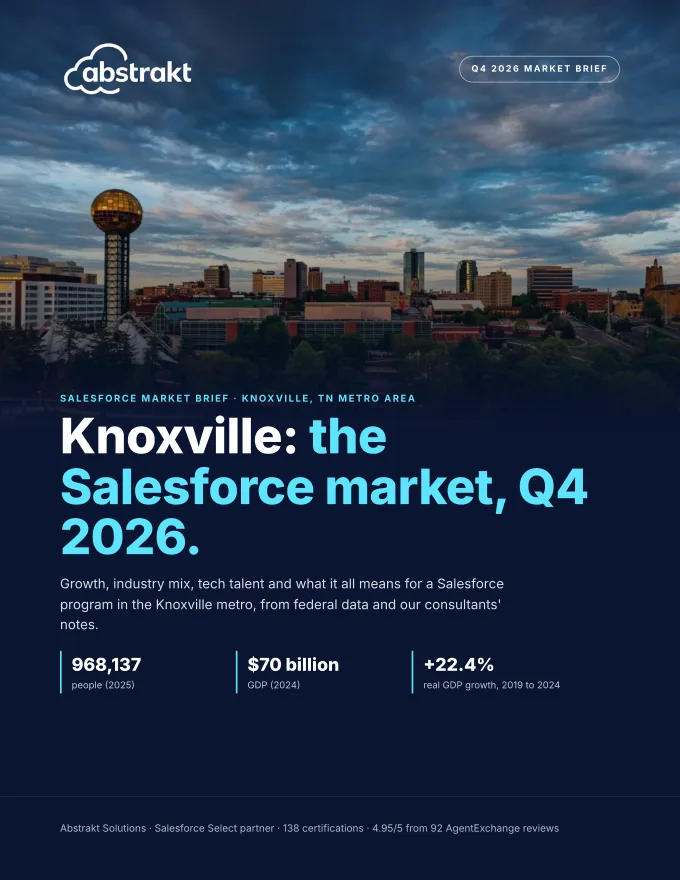
A free 21-page PDF with Knoxville's growth ranked against 100 metros, its industry mix, tech wages and nearby markets. It is offered on the public Knoxville page; send your customer there or get a copy for your own prep.
Get the Knoxville brief →Co-sell with Abstrakt in Knoxville
Working a Knoxville account? Bring in a named consultant for discovery, scoping or a health check. We reply within 4 business hours.