

How Salesforce work starts in Reno
Abstrakt Solutions, a Salesforce Consulting Partner, works with manufacturers, builders, logistics operators and health organizations in Reno, Sparks and the rest of Washoe and Storey counties. Reno is one of our focus markets.
What buyers here usually run into
- 1
Orders in one system, customers in another
Distribution and e-commerce companies often run orders, customer questions and sales in separate tools, so service agents rarely see the whole story.
- 2
High-volume back-office work
Shared-service and support centers handle large case volumes where routing, knowledge articles and automation decide whether teams keep up.
- 3
Tools added faster than they are joined up
Manufacturers and energy companies that expand quickly tend to add software as they go, and the result is duplicate records and reports nobody trusts.
Budget, team and partner questions
What drives cost
Reno scope is usually driven by how many disconnected systems are already in place. Matching customer records across ERP, warehouse and support tools, configured quoting for manufacturers, and job-cost links for contractors add the most work.
Admin or partner
Growing manufacturers and contractors here often hand Salesforce to an operations manager as a side duty. Managed services covers integration and releases until volume justifies an internal admin; high-volume back-office centers usually need one sooner.
What buyers ask a partner
Ask how the partner decides which system owns each customer and order field before integrating anything. Ask how they would route a high-volume support queue and how they test permission sets before an agent goes live.
The local economy and its biggest industries (4)
| Sector | Share of 2024 GDP | Where Salesforce fits |
|---|---|---|
| Manufacturing Salesforce for manufacturing → | 10.7% | Battery, electronics and advanced-manufacturing plants and the suppliers serving them manage key accounts, configured quotes and service requests that should connect back to ERP. |
| Construction Salesforce for construction → | 9.1% | Contractors building industrial, commercial and residential projects across Washoe and Storey counties need bids, crews, equipment and job costs visible in one place. |
| Health care and social assistance Salesforce for health & life sciences → | at least 6.2% | Hospitals, clinics and other employers in EDAWN’s health and medical sector need patient engagement and referral workflows, with access rules that keep protected health information limited to the right staff. |
| Finance and insurance Financial Services Cloud → | at least 6.1% | Financial services is one of EDAWN’s target sectors, and the banks, lenders, insurers and financial back-office teams here need client views, compliant communication and orderly case handling. |
Source: U.S. Bureau of Economic Analysis, GDP by county (CAGDP2), 2024, summed to the metro area; private sectors only, excluding real estate and government. “At least” marks sectors where BEA suppresses some county figures.
Regional target sectors named by local economic development groups: Technology, Advanced Manufacturing, Distribution, Logistics & E-Commerce, Back Office, Office Support, Renewable Energy, Financial Services, Aerospace & Defense, Health/Medical.
Salesforce products that fit Reno (6)
In the order we lead with them here, from the industries above.
Salesforce Service Cloud
The operating system for modern customer service, case, knowledge, voice, and AI agent assist together.
Salesforce Sales Cloud
The CRM where sales pipeline lives, when it is built right.
MuleSoft
Enterprise API platform, for connecting Salesforce, ERP, data warehouses, and the rest of your stack.
Salesforce Agentforce
AI agents that handle real work inside Sales Cloud, Service Cloud, and Marketing Cloud.
Salesforce Revenue Cloud / CPQ
Configure-price-quote, billing, subscription management, and quote-to-cash on Salesforce.
Salesforce Financial Services Cloud
Industry CRM for wealth management, banking, insurance, and lending, built for compliance from the start.
Reno manufacturing, construction and e-commerce: fitting AI in
BEA's 2024 figures show manufacturing at 10.7% of Reno's metro GDP and construction at 9.1%, while distribution and e-commerce feature in the regional growth plan. Fulfillment and e-commerce operators often have the cleanest case volume for automation: an agent can answer tracking and return questions from order data and send exceptions to a person with context attached. Electronics and equipment manufacturers can use case summaries for warranty claims. Construction firms tend to get more from Sales Cloud lead triage on bid invitations than from customer-facing agents. Any of these needs order and asset data that reconciles with the ERP, and permission sets that limit what an agent can see.
- Tracking and return question handling
- Warranty claim summaries
- Triaging bid invitations
Services buyers here usually need (7)
Salesforce Implementation in Reno
Around Reno and Sparks, implementation often follows a relocation or a rapid expansion. A company opens a fulfillment site, a component plant or a support center in Washoe or Storey County and needs a CRM that matches how the new operation actually runs. We start with the processes that touch customers most, such as shipper onboarding, key-account quoting or case handling, design the objects and access model around them, and launch in stages.
By industry in Reno
- 1
Distribution, Logistics & E-Commerce
Distribution, logistics and e-commerce appears on the regional development authority's list of key industries. Fulfillment and third-party logistics operators here manage shipper contracts, onboarding tasks and a steady flow of where-is-my-order questions. A first implementation typically covers shipper accounts with rate agreements, an onboarding checklist for each new client and a Service Cloud queue for inquiries, with warehouse data left in the warehouse system and surfaced later through integration. Each new client then follows the same onboarding steps, whoever handles it.
- 2
Manufacturing
Battery, electronics and other advanced plants help make manufacturing Reno's biggest private sector, worth about 10.7% of 2024 metro output. Suppliers selling into those plants deal with a small number of very large customers, each with multiple sites and buyers. We model those as account hierarchies, set up opportunity and quote processes for configured parts, and prepare the data model for an ERP link in a later phase. Key-account plans live on the parent account where every seller can see them.
- 3
Back Office, Office Support
Back-office and office-support operations are another sector the regional authority promotes. Companies opening shared-service centers in Northern Nevada usually implement Service Cloud first, for internal or customer case handling across email, chat and phone. We define case types and routing with the business units being served, write the first knowledge articles alongside the build and set service-level reporting from launch, so center leaders can show results to the business units they serve within the first reporting cycle.
Raise before scoping
Launch with the new site
Companies opening a Reno-area facility often want Salesforce live the day operations begin. That is achievable if the scope is narrow: the core accounts, one main process and basic reporting. Plan the broader rollout as a second phase once the site's real workflow is understood.
Cover every shift at go-live
Fulfillment and support operations often run early and late shifts, so go-live plans have to reach people who never attend a daytime meeting. Go-live coverage is set to match your full operating day, including shift changes, rather than standard office hours alone.
Separate plant and headquarters needs
When the Reno operation is one site of a larger company, find out early whether it will share an org with headquarters or run its own. The answer shapes the data model, security and integrations, and changing it after launch is costly.
Salesforce Integration in Reno
Most Reno integrations serve one goal: letting customer-facing staff answer questions without switching systems. Fulfillment operators need warehouse and shipment data in Service Cloud; manufacturers need ERP pricing, orders and inventory behind quotes; lenders and financial firms need core or loan data on the client record. We document which platform owns each field, pick APIs, scheduled syncs or MuleSoft for each flow based on volume and freshness, and set up alerts that notify a named person when anything fails.
By industry in Reno
- 1
Distribution, Logistics & E-Commerce
Fulfillment centers and e-commerce operators in the Reno-Sparks area handle huge volumes of order and shipment events. Integration brings order status, tracking numbers and exceptions from the warehouse management system into Service Cloud cases, so agents can answer shippers and consumers directly. With that data in place, Agentforce can resolve routine order-status requests on its own, leaving agents to handle damages, claims and unusual situations. Exceptions are flagged on the case automatically.
- 2
Advanced Manufacturing
Advanced manufacturers and their suppliers depend on ERP data for every quote: costs, lead times, available inventory and approved pricing. Our usual pattern mirrors the ERP's part list and contract prices into Revenue Cloud nightly, posts each signed quote to the ERP as a sales order and writes ship dates and invoice numbers back onto the opportunity. For suppliers serving large battery or electronics plants, the integration can also track each customer site's orders separately. Account managers see open orders by plant without asking customer service.
- 3
Finance and insurance
BEA data put finance and insurance at no less than 6.1% of Reno's 2024 output, a floor rather than an exact share. Lenders, insurers and financial back-office teams connect Salesforce to loan origination, core banking or policy platforms. We usually integrate summaries such as products held, balances and key dates rather than every transaction, restrict integration users to exactly the data they carry and document each flow so compliance staff can show auditors what moves between systems. Credentials rotate on a schedule IT controls.
Raise before scoping
Plan for event volume
Fulfillment operations can generate far more shipment updates than a CRM needs. Filter integrations to the events that matter to service, such as exceptions, delays and deliveries, and keep routine scans in the warehouse system to control API usage and storage.
Document field ownership
Write down which system controls prices, customer details and order status before building anything. Clear ownership prevents overwrites and tells support staff exactly where to correct a mistake when a customer spots one. Keep that table current as systems change.
Choose middleware deliberately
MuleSoft suits companies connecting several systems or reusing APIs across applications. Simpler needs can run on native tools. Deciding with your IT team, based on growth plans and support capacity, avoids both overbuilding and outgrowing a lightweight solution too soon.
Salesforce Managed Services in Reno
Reno-area companies using managed services tend to share a profile: a Salesforce org that matters to revenue or service, and an internal team too small to keep up with requests. Our consultants take over the queue, rank it with your owner each month and deliver changes through a sandbox with documented approvals. We rehearse every seasonal platform release on your core processes, watch integrations for failures and handle user changes as staff come and go. Configuration, code and design questions all go to the same group of people.
By industry in Reno
- 1
Financial Services
Financial services is one of the regional authority's target sectors, and the area hosts back-office operations for financial-software firms. Their Salesforce orgs often carry client and case data that auditors will ask about. A managed team logs every request with its business owner, keeps build and deployment separate, records approvals and maintains Financial Services Cloud configuration as products and regulations change, so each quarter's changes can be explained on request. Hotfixes get a lighter but still recorded sign-off.
- 2
Technology
Technology companies in the region, which the development authority describes as a growing part of the new economy, tend to change their go-to-market often: new pricing tiers, new territories, new partner programs. Each change ripples through Salesforce. Managed services keeps up with those shifts, updating lead routing, opportunity stages, quote templates and dashboards on a predictable schedule, and flags when a quick fix is starting to create technical debt. Revenue leaders see what shipped in a short monthly note.
- 3
Health/Medical
Washoe County clinics and care groups often land Salesforce in one department and leave it there with nobody formally in charge of it. Our team fills that gap, from reworking intake screens to onboarding new schedulers, and every deployment gets a privacy review before it moves. Requests arrive through one channel, so clinical managers always know where a request stands and when it will ship. Monthly summaries go to the department head.
Raise before scoping
Agree on escalation hours
With a two-hour time difference, decide which issues justify contacting us outside the overlap, how to reach the on-call consultant and what counts as urgent. Written rules prevent both unnecessary late-evening calls and genuine outages sitting unnoticed until morning. Review the rules after the first quarter.
Track technical debt openly
Fast-moving companies accumulate shortcuts. Ask your managed-services team to label any change that trades long-term quality for speed and keep a visible list, so debt is paid down deliberately instead of discovered during the next audit. Reserve a slice of monthly capacity for it.
Plan for agent features
If Agentforce is on your roadmap, managed services is where readiness work happens: cleaning knowledge articles, tightening permissions and structuring case data. Schedule that alongside regular requests so the AI project starts on solid ground, and review progress at each monthly meeting.
Salesforce Optimization in Reno
In Northern Nevada, orgs that need optimization were often built during a growth spurt and never revisited. Contractors keep bids in spreadsheets beside Salesforce, support centers fight routing rules that no longer match their volumes, and energy developers track projects in a structure designed for simple sales. We review usage by role, list every automation that touches key records and reconcile dashboards with finance. The resulting changes are released in small batches so users notice steady improvement rather than disruption.
By industry in Reno
- 1
Construction
Construction is the metro's second-largest private sector at about 9.1% of 2024 GDP, with contractors building industrial, commercial and residential projects across Washoe and Storey counties. Their orgs frequently have stale bids, duplicate general-contractor accounts and job costs nobody updates. Optimization tightens the bid pipeline, merges duplicate companies and adds a simple view of backlog by project type, so owners can see work secured and work pending in one place.
- 2
Back Office, Office Support
Support and shared-service centers live or die by routing and knowledge. Over time, queues multiply, case categories become too vague to report on and articles go stale. We rebuild routing around current case types and skills, refresh the knowledge base with the agents who use it, and replace ad-hoc reports with a small set of service-level and backlog measures. Agents spend less time transferring cases and more time resolving them.
- 3
Renewable Energy
Renewable energy is one of the development authority's key industries, and geothermal and solar developers here often forced project tracking into standard opportunities. Optimization gives development work its own structure: projects moving through prospecting, permitting, interconnection and operation, with landowners, utilities and partners related to each. Stage-based automation reminds teams of permit and contract deadlines, and leadership sees the portfolio by stage and region. Individual developers stop keeping personal trackers of their own sites and landowner calls.
Raise before scoping
Start with what users skip
Blank fields and unopened dashboards tell you where the design lost people. In Reno-area companies that grew quickly, the avoided areas are usually the ones added under deadline. Those are the best places to begin simplifying, because they cost users the most time.
Consolidate automation carefully
Growth-era orgs often have several automations updating the same records in different ways. Document each one, rebuild the logic in fewer flows, test in a sandbox with realistic data and release in small steps so any unexpected behavior is easy to trace.
Refresh knowledge before AI
If Agentforce is planned for a support center, optimization is the moment to fix the knowledge base. AI agents answer from articles and case history, so outdated or contradictory content leads directly to wrong answers for customers. Retire duplicate articles first.
Salesforce Health Checks in Reno
Reno health checks are usually prompted by one of three events: a compliance review at a health or financial organization, a technology company answering customer security questionnaires, or plans to deploy Agentforce. We review access and sharing, integration accounts and connected apps, accumulated automation, code and packages, the quality of core records and the accuracy of key dashboards. Admins get the technical detail behind every item; owners get a one-page view of what is exposed and what it would take to close.
By industry in Reno
- 1
Health care and social assistance
With health care worth at least 6.2% of 2024 metro output, and health and medical on the regional authority's list, provider orgs here deserve close scrutiny. The central question is whether anyone outside a patient's care or access team can open that patient's record. We check sharing, report and export permissions, portal access and field history on sensitive records, and look for clinical details stored in free-text fields where nobody intended them.
- 2
Financial Services
Lenders, financial-software firms and financial back-office operations use a health check to prepare for audits and vendor-risk reviews. We look at who can export client lists, which inactive logins still carry admin power, whether sign-in rules require a second factor, and what integration accounts are allowed to touch. Findings are written so compliance staff can map each one to a control and track remediation through to completion. Repeat findings from a prior audit are called out separately.
- 3
Technology
Technology companies selling to larger enterprises increasingly face security questionnaires about their CRM. A health check supplies evidence on access, authentication, integrations and data location. It also catalogs the technical debt that fast-growing companies build up, including conflicting automation, abandoned fields, unused packages and brittle custom code, and ranks it by the risk it poses to sales operations. Leadership receives a ranked shortlist sized to what their team can realistically tackle this quarter.
Raise before scoping
Prepare the org for Agentforce
AI agents act with whatever access they are given and answer from existing data. Before a pilot, confirm that sharing is tight, knowledge articles are current and duplicate records are merged. Otherwise the agent will reflect every existing problem back to customers.
Review integration credentials
Integration users often hold administrator-level rights for convenience, and their passwords or tokens rarely change. Include them in the review, reduce each to the minimum its feed requires and set a rotation schedule your IT team can maintain. Name an owner for each.
Assign remediation before starting
Decide who will act on the findings, whether internal staff, a managed-services team or a follow-on project, before the review begins. Findings addressed quickly stay accurate; those left for months need rechecking, which adds cost and delays the fixes that matter most.
Salesforce Migration in Reno
Reno migrations often involve companies that arrived from elsewhere or grew by acquisition, bringing data from several systems into one new org. A technology firm may combine two CRMs, an energy developer may consolidate project spreadsheets and a contractor may retire an old bid database. We profile each source, reconcile duplicates across them, agree a history cutoff and map every field. Trial loads are checked by your users in a sandbox, and cutover happens on a fixed date with the old tools locked afterward.
By industry in Reno
- 1
Technology
Technology is one of the development authority's key industries, and the authority runs startup programs to grow a homegrown tech community. Companies relocating or merging often arrive with two CRMs, or one CRM and a collection of spreadsheets. We combine them into a single org, reconcile accounts that exist in both, map subscription and renewal data carefully and rebuild only the automation that still serves the current sales process. Owners of each account are confirmed before load.
- 2
Renewable Energy
Geothermal and solar developers commonly track projects, landowners, permits and utility contacts in spreadsheets maintained by individual developers. Migration brings them into a project-centered Salesforce structure: each site becomes a project record, landowners and utilities become accounts and contacts are linked to every project they touch. Lease PDFs and permit files remain in your file repository; the project record carries a link plus expiry and renewal dates. Duplicate landowner entries are merged along the way.
- 3
Construction
Northern Nevada builders usually hand us a bid log where one general contractor appears under five spellings, and outcomes are recorded for some jobs but not others. We settle on one name per firm, attach each past bid to its owner, architect and GC, and fill in missing win or loss results with your estimators. Very old bids are exported to a file you keep; recent ones become opportunities, so pursuit reports work from the first morning after go-live.
Raise before scoping
Reconcile systems before merging
When two companies or two CRMs combine, the same customer often exists in both with different owners and details. Agree matching rules and a tiebreaker for conflicting values before loading, so the merged org starts with one clear record per customer.
Map ownership as well as data
Migrated records need owners who still work at the company. Map old users to current staff or queues, reassign orphaned accounts and confirm territories before cutover, otherwise records land with departed employees and disappear from everyone's views. Queues can hold anything unassigned.
Keep documents where they belong
Leases, contracts and drawings are often better left in a document system than loaded into Salesforce. Link to them from the relevant records instead, which saves storage and keeps version control where it already works. Store key dates on the record itself.
Salesforce Implementation Rescue in Reno
In and around Reno, projects usually go wrong because the business outran the design. A plant signed major new customers halfway through the build, a fulfillment operator took on clients whose onboarding looked nothing like the first ones, or a support center opened before its routing worked. Recovery begins with a frank inventory of the org and a list of what blocks people today. Those blockers get fixed first. After that, each piece is judged on evidence, and the unfinished scope is delivered with tests, written documentation and role training.
By industry in Reno
- 1
Advanced Manufacturing
Advanced manufacturers in the region usually get stuck where Revenue Cloud meets the ERP. Bundles reflect a catalog from a year ago, contract prices lag and approvals route to managers who have moved on. Recovery resets the product and price data from the ERP, redraws approval paths around the current org chart, and adds alerts so a failed sync is noticed the same day. Reps are brought back once a sample of recent real orders can be reproduced exactly as quotes.
- 2
Distribution, Logistics & E-Commerce
Fulfillment and e-commerce projects tend to crack when client number ten looks nothing like client number one. Onboarding varies by client, service cases route to the wrong teams and shipment data stops syncing when peak season arrives. We rebuild onboarding as reusable templates, re-route cases around today's clients and buildings, and load-test the warehouse integration at holiday volumes so it survives the next rush without silent gaps. Supervisors review the new routing before it goes live.
- 3
Back Office, Office Support
Shared-service centers sometimes open their doors before routing, knowledge and reporting are ready, and agents fall back on shared inboxes within weeks. We get assignment working first, then rewrite the knowledge base with the most experienced agents and give supervisors service-level reports that match what they see on the floor. Deferred items such as self-service or Agentforce come last, after the basic support loop runs without workarounds and agents stop reaching for the inbox.
Raise before scoping
Recover the paper trail
Request every contract, statement of work, design file and change log the prior partner produced, plus admin credentials. Without them, the assessment is guesswork about what was promised; with them, disputes about incomplete scope are settled by reading rather than arguing.
Earn trust with fixes
Hold back new features until the daily failures are gone: the broken sync, the quote that is wrong, the user locked out of a queue. Staff judge the recovery by whether their morning gets easier, so publish each fix as it lands.
Design for continued growth
If growth broke the first project, the recovered design must expect more of it. Build templates, routing and integrations that absorb new clients, sites and products without redesign, and test them at the volumes leadership is planning for, not just today's.
Industry plays in Reno (3)
Salesforce for Reno Manufacturers
Reno-area manufacturers often grow by attaching themselves to a few very large technology customers. Salesforce helps when it turns those relationships into managed accounts: supply agreements with forecast volumes, engineering contacts across several sites, quotes that respect tiered pricing, and returns handled against serial numbers. We build on Sales Cloud and CPQ, add Service Cloud for RMAs and technical questions, and use MuleSoft to bring ERP order and inventory data into view so sales is not guessing about capacity.
In the Washoe and Storey county metro, manufacturing produced 10.7% of 2024 GDP according to the Bureau of Economic Analysis, edging out construction for the top private spot. The regional economic development authority, now branded Northern NV Now, counts advanced manufacturing, technology, renewable energy, aerospace and defense, and distribution, logistics and e-commerce among its target industries. It has described electric-vehicle, battery and data-center operators as part of the region's new economy. For local plants, that often means customers who are large, technically demanding and fast-moving, with formal supplier qualification and forecast-driven purchasing.
Use cases to open with
- 1
Supply agreements and forecasts
Suppliers to large battery and electronics plants usually sell under agreements with forecast volumes that change frequently. Salesforce can store agreements, planned versus actual volumes and price tiers by part, so account managers see when a customer is pulling ahead of or falling behind forecast and can warn production planning before inventory piles up. Price tiers reset automatically when a customer crosses a volume threshold, so invoices and quotes stay consistent.
- 2
Returns and technical cases
When a component fails at a customer site, the supplier needs to log the return, capture failure data and coordinate a replacement fast. Service Cloud cases linked to serial numbers, lots and shipments give quality engineers the evidence for root-cause analysis and give the account team a clear answer for the customer's supplier scorecard. Repeated failures by part or lot become visible early, before a customer raises them in a business review.
- 3
New-customer qualification tracking
Winning a new technology customer can involve months of audits, samples and first-article approvals. Treating qualification as a tracked process in Salesforce, with milestones, document requests and named owners, shows leadership which accounts are close to production and which are stalled on paperwork that someone forgot to send back. Forecasts can then show qualified revenue separately from revenue that still depends on approvals.
Raise before scoping
Plan for integration volume
High-mix, high-volume plants push many orders, shipments and inventory changes through the ERP. Bring summarized data into Salesforce where possible, use MuleSoft or platform events for status that must be current, and test integration limits in a full sandbox before launch.
Protect customer confidential data
Large technology customers often require suppliers to restrict who sees drawings, pricing and forecast data. Mirror those contractual requirements in sharing rules, field-level security and file access, and document the design so you can show customers exactly how their information is controlled.
Keep pace with hiring
Northern Nevada companies riding new plant investment often hire sales, quality and service people in waves. Build role-based onboarding, clear page layouts and in-app guidance so new hires learn the process inside Salesforce rather than inheriting a departing colleague's workarounds and private spreadsheets. Assign a business owner to keep training materials current as the process changes.
Salesforce for Reno Construction Firms
Reno-area contractors often work for owners building plants, warehouses and data facilities on aggressive schedules, alongside commercial and residential work across Washoe County. Salesforce helps by tracking owner relationships and pursuits over years, turning estimates into consistent proposals, and running crews, equipment and subcontractors once jobs start. We integrate it with construction accounting and project tools so each system keeps its role, and we build reporting that puts backlog, margin and capacity side by side for leadership.
Builders and trades produced 9.1% of 2024 GDP in the Washoe and Storey county metro, the Bureau of Economic Analysis reports, a close second to manufacturing at 10.7%. Northern NV Now, the rebranded regional development authority, does not recruit contractors as such, yet nearly every sector it courts, from advanced manufacturing plants and technology operations to e-commerce warehouses and renewable projects, depends on large industrial buildings going up. The authority says the region's new economy is partly powered by technology and advanced manufacturing companies. Contractors here therefore build for fast-moving corporate owners as well as for the homes and services that follow new employers.
Use cases to open with
- 1
Backlog and capacity planning
When several large industrial awards land close together, the real question is whether the firm has superintendents, crews and equipment to deliver them. Salesforce can combine weighted pipeline with awarded backlog and planned start dates, and Tableau can chart that against crew and equipment availability by month. Leaders can then decline or reprice work they cannot staff instead of discovering the gap after mobilization.
- 2
Repeat-owner account plans
Corporate owners that build in phases at industrial sites east of Sparks tend to reward contractors who perform well. Account plans in Sales Cloud track each owner's upcoming phases, decision makers, safety and quality expectations, and past-project scorecards, so business development and operations prepare for the next award together. Notes from post-project reviews stay with the account rather than sitting in one manager's inbox.
- 3
Subcontractor compliance tracking
Large owners typically require insurance certificates, safety programs and licenses from every subcontractor on site. An Experience Cloud portal lets subs upload those documents, Salesforce tracks expiration dates and sends reminders, and project managers see at a glance who is cleared to mobilize. Expired coverage blocks scheduling in Field Service rather than surfacing during an owner audit, and prequalification scores gathered the same way inform the next bid.
Raise before scoping
Plan for owner-mandated tools
Big owners often dictate their own project platforms and reporting formats. Decide which data Salesforce needs from those systems, such as schedule milestones and change-order status, and accept that some projects will be tracked at summary level rather than forcing duplicate entry on project teams.
Onboard new field staff quickly
Contractors ramping up for large projects add superintendents and foremen in a hurry. Build role-based permission sets, short mobile training and simple job-assignment rules so a new hire can use the app on day one, and remove access promptly when project staff leave.
Respect owner confidentiality terms
Data-center and technology owners may treat site layouts, equipment lists and schedules as confidential. Restrict those project records to the assigned team, keep drawings in the owner's or project platform, and confirm contract terms about cloud storage before anything sensitive moves into Salesforce.
Salesforce for Reno Health Care
For Reno-area hospitals, clinics and specialty groups, Salesforce is most often used to run patient access and referral intake from one place, keep referring physicians informed, and absorb the high volume of calls and messages that comes with regional growth. Service Cloud with omnichannel routing and a knowledge base forms the core, Experience Cloud serves referring offices, and Agentforce handles routine questions once processes are settled. Access to protected health information is designed first, not bolted on.
Health care and social assistance generated at least 6.2% of the Reno metro's 2024 GDP in Bureau of Economic Analysis data, a lower bound because some county figures are withheld, which still places it among the five largest private sectors. The regional development authority now branded Northern NV Now lists health and medical among its key industries, alongside technology, advanced manufacturing and back-office operations. Nevada's land-grant university, founded in 1874 and classified as a top research institution, is based in Reno. With manufacturing, logistics and technology employers expanding, providers serve a large employer base as well as individual patients.
Use cases to open with
- 1
Contact-center routing and knowledge
Scheduling and billing lines strain as a region adds residents and employers. Omni-Channel routing sends calls, chats and web requests to agents by skill and language, while a knowledge base keeps answers on preparation, locations and insurance consistent. Supervisors watch queue times live and move staff between lines, and reporting shows which request types could shift to self-service without hurting patient experience.
- 2
Referral network visibility
Specialty groups depend on primary and urgent care referrals from across Washoe County and the rural areas beyond it. Logging each referral with source, reason and outcome shows which relationships are growing and which have gone quiet, and physician liaisons plan visits from that data. Referring offices receive status updates automatically, which cuts the calls asking whether a patient was ever seen.
- 3
Billing questions and payment plans
Billing calls often outnumber clinical ones. Service Cloud can display statement summaries pulled from the billing system, log each inquiry and dispute, and track payment-plan agreements with reminder schedules. Patterns in disputes, such as recurring coding or insurance errors, surface in reports for the revenue-cycle team to fix at the source, and patients get consistent answers regardless of who picks up.
Raise before scoping
Establish the HIPAA baseline
Before configuration, sign a business associate agreement with Salesforce, define which roles may see clinical versus demographic data, and enable encryption and event monitoring where needed. Document these controls for compliance review, and revisit them whenever a new department or integration joins the org.
Keep the chart in the EHR
Clinicians chart in the EHR, and that does not change. Pull only the appointment, referral and demographic data that Salesforce workflows need, write back only what the EHR team approves, and agree who resolves mismatches between the two systems, so clinicians never wonder which record is current.
Measure access, not activity
Call counts are easy to report and rarely useful. Better measures are time to next available appointment, referral-to-visit conversion and abandoned requests by specialty. Define those metrics before build so the data model captures the timestamps and outcomes needed to calculate them reliably.
Case studies to send (3)
From the industries this market leans on. Client names are anonymized and these projects are not specific to Reno.
The Reno Salesforce market brief, Q4 2026
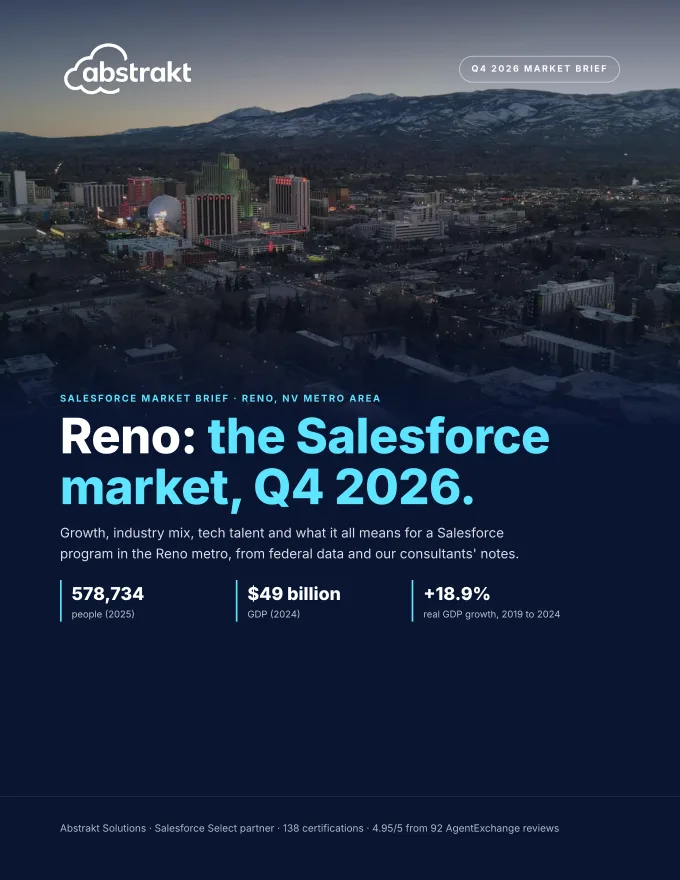
A free 22-page PDF with Reno's growth ranked against 100 metros, its industry mix, tech wages and nearby markets. It is offered on the public Reno page; send your customer there or get a copy for your own prep.
Get the Reno brief →Co-sell with Abstrakt in Reno
Working a Reno account? Bring in a named consultant for discovery, scoping or a health check. We reply within 4 business hours.