

How Salesforce work starts in Des Moines
Insurance carriers and agencies anchor our Salesforce consulting work in Greater Des Moines, alongside financial firms, equipment manufacturers and agribusinesses. Des Moines is one of our focus markets.
What buyers here usually run into
- 1
Agent and broker channels
Insurers that sell through independent agents and brokers commonly struggle to give those partners self-service access while keeping each agent’s book private.
- 2
Compliance in customer communications
Financial services marketing and follow-up must satisfy regulators, so automation, consent and record retention have to be designed in rather than added later.
- 3
Legacy systems of record
Long-established carriers and financial firms often hold policy and account data in older core systems, and Salesforce only helps when that data flows in reliably.
Budget, team and partner questions
What drives cost
Des Moines costs are set mostly by how many legacy systems of record Salesforce must connect to, how broker and agent access is designed, and how much compliance logic goes into communications. Ag equipment makers and distributors spend more on ERP and dealer portal scope. Migrating producer and policyholder data from agency tools adds cleanup time.
Admin or partner
Large carriers here usually own Salesforce internally and use partners for architecture, integration and peak delivery. Agencies, lenders and mid-sized distributors more often rely on managed services, with one internal person who owns priorities and change approval.
What buyers ask a partner
Ask for insurance references that include broker or agent portals and integration with policy admin systems. Ask how the partner documents agent behavior and change history, since carriers here treat that documentation as part of the deliverable.
The local economy and its biggest industries (4)
| Sector | Share of 2024 GDP | Where Salesforce fits |
|---|---|---|
| Finance and insurance Salesforce for insurance → | 30.8% | With dozens of carriers, a large benefits and retirement presence and brokerage-backed insurtech programs, Des Moines firms need agent and broker management, policyholder service and compliant marketing in one system. |
| Manufacturing Salesforce for manufacturing → | 7.6% | Equipment and advanced manufacturers in the region, including the ag machinery side of the economy, rely on dealer networks and service contracts that work best when Salesforce connects to ERP. |
| Wholesale trade Sales Cloud → | at least 6.8% | Distributors serving grocery, convenience retail and agriculture across Iowa need account-level pricing, reorder visibility and territory planning for field reps. |
| Health care and social assistance Salesforce for health & life sciences → | at least 5.6% | Health systems and health insurers here work side by side, so member and patient engagement, referral tracking and service need privacy-aware Salesforce design. |
Source: U.S. Bureau of Economic Analysis, GDP by county (CAGDP2), 2024, summed to the metro area; private sectors only, excluding real estate and government. “At least” marks sectors where BEA suppresses some county figures.
Regional target sectors named by local economic development groups: Insurance and Financial Services, Advanced Manufacturing, Ag Innovation, Digital Infrastructure & Data Centers, Technology, Logistics.
Salesforce products that fit Des Moines (6)
In the order we lead with them here, from the industries above.
Salesforce Financial Services Cloud
Industry CRM for wealth management, banking, insurance, and lending, built for compliance from the start.
Salesforce Sales Cloud
The CRM where sales pipeline lives, when it is built right.
Salesforce Service Cloud
The operating system for modern customer service, case, knowledge, voice, and AI agent assist together.
Salesforce Experience Cloud
Customer, partner, and employee portals built on Salesforce.
Salesforce Marketing Cloud
Cross-channel marketing, email, mobile, journey, and Data 360-powered personalization at scale.
Salesforce Data 360 (Data Cloud)
Unify customer data into a real-time profile that powers segmentation, analytics, and AI.
Insurance-heavy Des Moines and the AI question
Finance and insurance generated 30.8% of Des Moines metro GDP in 2024, an unusually high concentration that makes carrier and agency workflows the main AI opportunity. Underwriting assistants reading submissions, service agents summarizing policy histories, and drafted responses to agents and policyholders all fit. Manufacturing and agricultural businesses, the next tier, gain from dealer support and order inquiry handling. The groundwork is familiar to anyone in insurance: clean policy and producer data, strict role-based visibility, knowledge articles that match current filings, and a reviewer for every outbound message until error patterns are understood. Carriers also want model behavior documented, which we treat as a deliverable.
- Underwriting submission reading
- Policy history summaries
- Agricultural dealer order support
Services buyers here usually need (7)
Salesforce Implementation in Des Moines
Most Des Moines implementations are shaped by insurance and financial services, which made up 30.8% of metro GDP in 2024. That means designing Salesforce around producers, agencies, policyholders and plan sponsors while policy, billing and claims stay in core administration systems. We agree on the data model, and on what Salesforce will and will not own, before any build starts. Then we phase the rollout: distribution and producer management first, service and broker portals next, marketing automation last, with design workshops opening each phase and hands-on support at every go-live.
By industry in Des Moines
- 1
Insurance and Financial Services
The Greater Des Moines Partnership puts insurance and financial services first among its key industries and reports more than 80 insurance companies headquartered in the region. For carriers here, the first implementation decision is how to represent agencies, individual producers, appointments and licensing, because every later report depends on it. We usually model producers as contacts under agency accounts in Financial Services Cloud, hold appointment status on a related object, and bring policy summaries in by reference so underwriting systems remain the record of truth.
- 2
Advanced Manufacturing
Advanced manufacturing is another Partnership target sector, and in central Iowa it includes machinery builders that sell through dealer networks. An implementation for them starts with the account structure: dealers as partner accounts, end customers linked to the dealer that serves them, and installed equipment tracked as assets. Getting that hierarchy right in the first phase lets later phases add warranty cases, parts quoting and dealer portals without restructuring records that sales already depends on.
- 3
Health care and social assistance
Health care accounts for at least 5.6% of 2024 metro GDP, and hospital systems and health insurers operate side by side in the region. Implementations for providers begin with a decision about which patient data Salesforce may hold at all, then design referral intake, physician relations and access center workflows around that line. We set up field-level security, audit trails and consent records during the first phase, since privacy rules are far harder to layer onto an org already in daily use.
Raise before scoping
Define the system of record
Carriers and lenders here often run policy and account platforms that are decades old. Before configuring anything, write down which system owns each field, which direction data flows and how often it syncs. That short document prevents duplicate policy data in Salesforce and settles arguments between IT and distribution teams early.
Design consent and retention up front
Marketing to policyholders and plan participants carries regulatory weight. Build consent capture, communication preferences and record retention into the data model during the first phase, so marketing automation can be added later without re-architecting contact records that compliance has already approved.
Size phases to the business calendar
Insurers in the region face open enrollment, renewal seasons and year-end reporting that strain the same staff who test and train. Schedule build phases and go-lives around those peaks, and keep each phase small enough to launch in weeks rather than stalling behind one large release.
Salesforce Integration in Des Moines
Integration work in Des Moines is dominated by the region's insurance and financial core: policy administration, rating, claims and banking platforms, often batch oriented. Ownership of every data element is settled before a pattern is picked from real-time calls, batch syncs or middleware. The same rigor applies when a machinery maker or distributor wants ERP orders, price lists and stock levels visible in Salesforce. Each connection we build ships with retry logic, alerting and a documented owner on your side, so failed syncs are caught by someone watching, not by a frustrated user.
By industry in Des Moines
- 1
Finance and insurance
With insurance and banking so central to the local economy, the typical integration here links Salesforce to a policy or core platform that cannot be changed lightly. We usually bring policy, coverage and billing summaries into Financial Services Cloud on a schedule, push new submissions or service requests back through a controlled interface, and keep full records in the source system. Read-mostly designs like this respect change freeze windows at carriers and reduce the security review burden for each connection.
- 2
Logistics
Logistics is on the Partnership's target sector list, and carriers, warehouses and third-party logistics firms in the metro need Salesforce connected to transportation and warehouse management systems. With that link in place, account teams see shipment volumes, exceptions and open service issues beside the customer relationship. Event-driven integration suits them best: pass along only the milestones that matter, such as delays or damage claims, rather than flooding the org with every tracking scan the operation produces.
- 3
Technology
Technology is another Partnership target sector, supported by insurtech and ag tech accelerators in the region. Software firms selling to carriers and growers typically need Salesforce integrated with product usage data, subscription billing and support tools. We build those links so account managers see usage trends and open tickets before renewal conversations, and so finance can reconcile bookings in Salesforce with invoices in billing without manual exports at the end of every month.
Raise before scoping
Inventory every existing connection
Established firms often have integrations nobody remembers building, running under a former employee's credentials. List every connected app, integration user and scheduled job before adding more, and retire or re-secure the ones that remain, so the new architecture is not built on unknown dependencies.
Plan around batch windows
Many core insurance and banking platforms update overnight or in scheduled cycles. Design Salesforce screens and automation to show when data was last refreshed, and avoid automation that assumes real-time values, so service staff understand what they are looking at when a policyholder calls.
Assign integration ownership internally
Someone on your team should own each integration's health after launch: watching error logs, approving changes to field mappings and coordinating with the vendors of connected systems. Without a clear owner, silent failures accumulate until users notice missing data weeks later.
Salesforce Migration in Des Moines
Migrations in Des Moines often involve decades of producer, policyholder and member records spread across an aging CRM, an agency management tool and departmental spreadsheets. We profile that data first, decide what is worth moving, and deduplicate agencies and contacts before anything loads. Mapping is agreed with the business, not just IT, and test loads run in a full sandbox until counts and spot checks reconcile. Cutover happens in a planned window with a rollback path, and staff are trained on their own migrated data.
By industry in Des Moines
- 1
Insurance and Financial Services
Carriers and benefits firms moving to Salesforce frequently find the same agency listed several ways and producers still attached to agencies they left years ago. Migration for them includes an agency and producer cleanup stage: matching records against licensing and appointment data, merging duplicates and archiving inactive relationships. The result is a producer hierarchy distribution teams can trust from the first day, which does more for adoption than any new screen or dashboard.
- 2
Wholesale trade
Central Iowa distributors commonly migrate from an older CRM or from spreadsheets that individual reps maintain. The hard part is not the load itself but agreeing on one customer record when three reps describe the same grocery or farm account differently. We build match rules, resolve conflicts with sales managers, and migrate order history in summary form, so reps keep their context without dragging years of raw transactions into Salesforce.
- 3
Advanced Manufacturing
Equipment and component makers in the region often migrate from CRM modules bundled with their ERP or from older standalone tools. Their most valuable data is installed-base and service history, not just contacts. We map serial numbers, warranty dates and service records into Salesforce assets and cases, validate them against ERP, and decide with the service team how far back history needs to go, so field and support staff inherit usable records after cutover.
Raise before scoping
Decide what not to migrate
Moving everything feels safe but carries old problems forward. Set clear rules: inactive policyholders, opportunities closed before a cutoff date and unused custom fields may be archived rather than migrated. Keep the archive searchable for compliance, and load only data people will actually use.
Preserve audit and consent history
In regulated insurance and lending work, consent records, communication preferences and key activity history may need to survive the move intact. Identify those fields with compliance before mapping, migrate them with original dates and owners, and verify them explicitly during testing rather than assuming they came across.
Rehearse the cutover weekend
Run a full dress rehearsal of the final load in a sandbox, timing each step and confirming reconciliation reports. A rehearsal exposes slow loads, missing lookups and sequencing mistakes while there is still time to fix them without affecting users or delaying the launch.
Salesforce Health Checks in Des Moines
Many central Iowa orgs have passed through several admins and partners over a decade, and nobody holds a complete picture of them anymore; the health check supplies one. We review permissions and sharing, integration users, data quality, automation and Apex, managed packages, release readiness and adoption. For insurers and lenders, the security review carries particular weight because policyholder and account data attracts regulatory scrutiny. You receive a findings list ordered by risk and effort, where small admin fixes sit apart from project-sized work and anything that would undermine an AI pilot is flagged.
By industry in Des Moines
- 1
Finance and insurance
Regulators and customers expect carriers and banks to control tightly who can see personal and financial data. A health check tests that directly: which profiles can export data, which permission sets grant view-all access, how sharing rules expose policy and account records, and whether Shield or event monitoring is configured to match stated policy. We translate each finding into the setting to change, so compliance and admins can close gaps before an exam or vendor assessment.
- 2
Health care and social assistance
Hospital systems and health plans in the region hold protected health information, and Salesforce orgs that grew quickly around referrals or member service can expose more than intended. We look at who can read clinical and member fields, which reports and list views surface them, what guest users on public sites can reach, and which integration accounts carry sweeping rights. Findings are sorted so privacy-critical issues are fixed first and cosmetic cleanup waits its turn.
- 3
Technology
Technology firms in the Partnership's target sectors, from insurtech startups to established software vendors, often build fast and document little. Their health checks focus on technical debt: Apex without meaningful tests, triggers competing with flows on the same object, hard-coded record IDs, and managed packages no longer in use. The review produces a sequenced cleanup plan that engineering can schedule next to product work, before the debt starts blocking releases or AI features.
Raise before scoping
Audit before an Agentforce pilot
An AI agent can only use what it can see, and it sees whatever its permissions allow. Confirm record access, knowledge accuracy and data completeness for the pilot's use case during the health check, so the pilot tests the technology rather than your data problems.
Include vendor-installed packages
Insurance and lending orgs often carry packages for rating, document generation or compliance that vendors installed years ago. Review what each package can access, whether it is still licensed and used, and who supports it, since unmaintained packages quietly widen your security exposure.
Turn findings into a roadmap
A report that sits in a folder helps nobody. Agree before the review starts who will own the findings, how they will be prioritized against current projects and when progress will be checked, so the health check leads to scheduled work instead of a one-time read.
Salesforce Managed Services in Des Moines
For many Des Moines organizations, managed services replaces a single overstretched admin or a queue of requests nobody owns. We take on user administration, security reviews, release testing and a prioritized backlog of enhancements, working in regular sprints with your product owner. Because so much of the local economy is regulated insurance and lending work, change control matters: every change is documented, tested in a sandbox and approved before deployment, which leaves a clean trail when auditors or examiners ask how the org is maintained.
By industry in Des Moines
- 1
Finance and insurance
Insurance and banking make the regional economy unusually concentrated, and those firms treat Salesforce changes the way they treat any regulated system. A managed service for them includes periodic permission reviews, documented deployments with approval records, and regression testing of producer, policy and service processes before each seasonal Salesforce release. When examiners or internal audit ask who changed what, the change log and sandbox history answer the question without a scramble to reconstruct old decisions.
- 2
Wholesale trade
Wholesale trade adds at least 6.8% of 2024 metro GDP, and distributors in central Iowa supply grocery, convenience retail and farm customers. Their Salesforce needs change with product lines, territories and price lists, so a managed service spends much of its time on steady, small work: territory realignments, new price books, onboarding seasonal reps and fixing reports. Handling those on a predictable monthly cadence keeps sales operations from saving them up into disruptive projects.
- 3
Digital Infrastructure & Data Centers
The Partnership lists digital infrastructure and data centers among its target sectors, and colocation and connectivity providers run sales and service on capacity and contract data that changes weekly. Ongoing support for them means keeping capacity objects, quote templates and maintenance notification flows accurate as sites expand, and watching the integrations that feed provisioning status into Salesforce. A small, consistent team learns those custom objects once instead of relearning them with each ticket.
Raise before scoping
Agree on a backlog owner
A monthly support arrangement stays focused only if a single person inside your company decides which requests come first. Without that role, the loudest department wins each sprint. Name an owner, meet on a fixed cadence and review the backlog together, so enhancements for underwriting, sales and service are weighed against each other openly.
Reserve capacity for seasonal releases
Salesforce upgrades arrive on a seasonal schedule, and any one of them can alter flow behavior, Lightning page components or permission defaults. Set aside time in the monthly plan for preview sandbox testing, especially for processes that handle policy or account data, rather than treating release readiness as optional extra work.
Keep documentation current
Long-tenured admins often carry the org's design in their heads. Ask the managed service team to maintain living documentation of objects, automation and integrations as part of normal work, so knowledge survives staff turnover and a new hire can become productive within weeks.
Salesforce Optimization in Des Moines
Optimization in Des Moines usually follows years of steady additions: a producer object here, a workflow rule there, dashboards nobody maintains. Our first step is sitting with sales, service and distribution staff to see how they really work in the org. That observation drives the cleanup: unused fields and layouts go, legacy workflow rules and process builders get folded into Flow, and the dashboards leadership opens every week are rebuilt on agreed definitions. The goal is fewer clicks and numbers that match finance, while keeping years of relationship history intact.
By industry in Des Moines
- 1
Insurance and Financial Services
Carriers and benefits firms in the region often run Salesforce for distribution and service but still export data to spreadsheets for producer scorecards. Optimization moves that analysis back into the platform: consistent opportunity stages for group and individual business, reliable production fields fed from core systems, and dashboards that rank agencies by submissions, quotes and bound premium. When distribution leaders trust those dashboards, the weekly spreadsheet ritual disappears, and adoption rises because managers start asking for Salesforce data.
- 2
Manufacturing
Manufacturing contributes 7.6% of 2024 metro GDP, much of it equipment and advanced production sold through dealers and distributors. Optimization for these companies targets quoting friction and service visibility: simplifying opportunity layouts reps skip, tuning approval flows that hold quotes for days, and giving service teams a single view of each asset's warranty and case history. Small changes like these usually matter more to dealers and reps than any new feature layered on top.
- 3
Ag Innovation
Ag innovation is a Partnership target sector, and ag technology companies in the region tend to adopt Salesforce quickly and customize it even faster. By the time they reach commercial scale, their orgs often carry duplicate grower and dealer records, stages that ignore the agricultural calendar, and automation written by founders who have moved on. Optimization merges the records, realigns the sales cycle with how growers buy and documents what each automation does before anyone changes it.
Raise before scoping
Measure adoption before changing
Login counts alone mislead. Look at which records users create, which fields stay blank and which reports get opened, broken out by team. Those baselines show where the friction really is, and they give you something concrete to compare against once changes land.
Retire legacy automation carefully
In long-lived central Iowa orgs, a single account or policy object may be touched by several generations of automation at once, from workflow rules to Apex. Inventory everything that fires on key records such as accounts, policies and opportunities before consolidating, and test the combined result in a sandbox, since order of execution can change outcomes.
Reconcile reports with finance
When Salesforce pipeline or production figures disagree with finance, leaders stop trusting both. Agree on definitions for revenue, premium and close dates with finance first, then rebuild dashboards to match, so the numbers shown in board and distribution meetings come from one source.
Salesforce Implementation Rescue in Des Moines
Rescue work in Des Moines often begins with a Financial Services Cloud or Service Cloud project that missed its launch, or went live without the broker portal, integrations or reports it promised. We first stabilize anything blocking daily work, then assess the org, the original statement of work and user feedback. Each component is sorted into what works, what needs repair and what must be redone, and the remaining scope is delivered in short releases. The relaunch includes retraining for every affected team, because retraining is where trust is rebuilt.
By industry in Des Moines
- 1
Insurance and Financial Services
Carrier projects commonly stall on distribution complexity: agency hierarchies, producer appointments and commission rules that were underestimated at the start. Recovery narrows the first release to the producer and submission data distribution leaders need most, moves commission calculations back to the systems that already handle them and restores a working broker experience. Once agents and underwriters rely on that core, the remaining scope can be restarted with realistic estimates and a sponsor who believes them.
- 2
Advanced Manufacturing
Manufacturers' Salesforce projects tend to fail at the ERP boundary, when quotes, orders and pricing sync unreliably and reps go back to spreadsheets. A rescue starts by stabilizing that integration: correcting mappings, adding error handling and settling which system owns prices. With data flowing reliably, we revisit the quoting and service features that were deferred or abandoned, and bring them back to dealers and inside sales teams in stages, retraining each group as it returns.
- 3
Professional, scientific, and technical services
Professional, scientific and technical services contributes at least 5.1% of 2024 metro GDP, and consulting, engineering and advisory firms here often run lean internal IT. Their rescues usually involve an org built by a departed contractor, with project and resource tracking half finished and no documentation. We reconstruct the design from metadata, finish what matters for billing and utilization reporting, and hand over documentation their small team can maintain on its own.
Raise before scoping
Secure admin control first
Before diagnosing anything, confirm your organization holds system administrator access, integration credentials and ownership of any connected accounts. Rescues sometimes begin with the previous vendor controlling key logins, and recovering those protects you whatever happens next in the project or the vendor relationship.
Separate symptoms from causes
Slow pages, bad reports and user complaints are symptoms. The causes are usually a flawed data model, overloaded automation or a failing integration. Spend the first weeks diagnosing root causes, so recovery money goes toward fixes that last rather than surface patches.
Reset expectations with sponsors
Executive sponsors have often defended the project to their boards or leadership teams. Give them a plain assessment, a revised plan with smaller milestones and measures they can report, so confidence returns step by step instead of depending on one large relaunch date.
Industry plays in Des Moines (3)
Salesforce for Des Moines Insurers and Agencies
Des Moines is a headquarters market for insurance, so Salesforce here often serves carriers rather than only agencies. That means underwriting teams triaging submissions, distribution teams supporting independent agents and brokers, and service centers answering policyholders and employer groups. Financial Services Cloud provides the policy, producer and household structures, Experience Cloud gives agents and employers self-service, and Service Cloud handles volume. We integrate with policy administration and rating systems, which remain the system of record, so staff see current policy data without re-keying.
Finance and insurance generate 30.8% of the Des Moines-West Des Moines metro's 2024 GDP in Bureau of Economic Analysis figures, roughly four times the share of manufacturing, the next largest private sector. Insurance and financial services head the Greater Des Moines Partnership's target list. By the Partnership's count, 80+ insurers keep their home offices here, and it points to 2024 federal wage and employment data placing the metro 4th nationally for how densely underwriting jobs cluster. Insurtech accelerators, including one backed by privately held brokerage firms, add a steady flow of startups selling into those carriers.
Use cases to open with
- 1
Underwriting submission intake
Commercial and specialty underwriters receive submissions by email, portal and broker platforms, often with incomplete information. A submission object in Salesforce holds the application, loss runs and broker notes together, flags anything outside appetite, and queues the file for an underwriter whose authority and workload fit it. Brokers see status without calling, and underwriting leaders see volume, quote and bind ratios, and turnaround by line, broker and underwriter, which turns staffing and appetite debates into data.
- 2
Independent agent and broker portal
Carriers selling through independent agencies need to share appointments, commissions, marketing materials and quote status without exposing one agency's book to another. An Experience Cloud portal on Financial Services Cloud gives each agency its own view, supports new-business requests and training, and lets distribution managers track production, appointments and engagement across their territories, so they spend field time with the agencies most likely to grow.
- 3
Employer group and member service
Group benefits and health or life carriers serve both employer administrators and individual members. Service Cloud can route inquiries by group, product and channel, show eligibility and claim status from core systems, and let HR administrators manage requests in a portal. Agentforce can handle common questions, such as ID cards or enrollment deadlines, while complex issues go to trained staff.
Raise before scoping
Legacy policy systems first
Many carriers run long-established policy administration, billing and claims platforms. Decide which data Salesforce needs for each role, build stable interfaces through MuleSoft or existing middleware, and test performance with realistic volumes before extending automation or AI to the agents and members using that data.
State regulation and privacy
Insurance is regulated state by state, and customer data may be covered by GLBA privacy rules, HIPAA for certain health information and state insurance data security laws. Design consent, retention and access controls with compliance input, and have counsel confirm how each requirement applies to your products.
Separate producer and customer access
Agents, brokers, employer administrators and members all need portal access, but with very different permissions. Map each audience's data visibility before build, test sharing rules with realistic accounts, and review access regularly as agencies change appointments or employers change carriers.
Salesforce for Des Moines Wealth Managers
Wealth management in Des Moines often overlaps with insurance and retirement services, so advisors may handle investments, annuities, life policies and retirement plan rollovers for the same client. Salesforce, usually through Financial Services Cloud, brings those relationships into one household view. We add compliant marketing for rollover and planning outreach, client portals for document exchange, and integrations with custodians, planning software and insurance systems. The design respects supervision and recordkeeping requirements from the start rather than after launch.
Finance and insurance account for 30.8% of 2024 GDP in the Des Moines-West Des Moines metro, according to Bureau of Economic Analysis county figures, making it the dominant private sector by a wide margin. Advisory firms have no line of their own in those statistics; their output is folded into the same total as carriers, banks and retirement providers. The Greater Des Moines Partnership names insurance and financial services as a target sector and also targets ag innovation. For advisors, that points to a client base with retirement plan balances, insurance products and, in many families, agricultural land or businesses to plan around.
Use cases to open with
- 1
Household view across products
Clients may hold brokerage accounts, annuities, life insurance and workplace retirement assets across several providers. Financial Services Cloud can group them into households with roles, beneficiaries and financial accounts fed from custodians and carriers. Advisors prepare for reviews with the full picture, and service staff can answer beneficiary, required distribution or address-change questions without searching several systems or calling the custodian.
- 2
Rollover and planning outreach
Retirement plan participants approaching separation or retirement often need guidance on rollovers, income planning and insurance. Marketing Cloud can run consent-based journeys triggered by life events or advisor tasks, while Salesforce records every communication for supervision. Advisors see which prospects engaged and follow up while interest is fresh, and compliance teams can review campaign content, approvals and sends in one place instead of chasing email chains.
- 3
Family business and farm succession
Some clients' wealth is concentrated in family businesses, farmland or agricultural operations with several generations involved. Relationship groups in Financial Services Cloud can map owners, heirs, trustees and outside advisors, with planning milestones and documents tracked on the relationship. The whole team, including outside attorneys and accountants tracked as contacts, sees who must be involved before decisions about transfer, sale or estate planning, and nothing depends on one advisor's memory.
Raise before scoping
Supervision and recordkeeping
Broker-dealers and RIAs face FINRA and SEC expectations for communications, recordkeeping and supervision. Configure archiving, approval workflows and retention with your compliance team, and have them confirm how each rule applies to your registration, business model and use of text or social messaging with clients.
Custodian and carrier integrations
Accurate balances and policy details depend on feeds from custodians, planning tools and insurance carriers. Prioritize the integrations advisors rely on daily, define refresh schedules and reconciliation checks, and avoid manual updates that let the CRM drift from source records.
Licensing across roles
Advisors, insurance agents and service associates may hold different licenses and registrations. Use permission sets and workflow rules so tasks, recommendations and communications are assigned only to appropriately licensed staff, and keep an audit trail of who handled each client request.
Salesforce for Des Moines Manufacturers
Des Moines-area manufacturers often reach customers through someone else: an equipment dealer, a distributor or an OEM that builds their component into a larger machine. Salesforce works best when it gives those partners a proper home. Partner accounts, shared pipeline and a dealer portal sit alongside direct sales, while Revenue Cloud or CPQ handles configured quotes and Service Cloud tracks warranty claims and parts requests. We connect it to the ERP so pricing, orders and serial numbers match what the plant ships.
Factories and plants produced 7.6% of 2024 output in the Des Moines-West Des Moines metro, Bureau of Economic Analysis data show; that trails finance and insurance, at 30.8%, by a wide margin yet still ranks second and edges out wholesale trade. On the Greater Des Moines Partnership's target list, advanced manufacturing appears beside ag innovation and logistics. The region's ag-focused accelerator programs connect local manufacturing to agricultural customers. That leaves manufacturing a meaningful but secondary force in an economy shaped mostly by carriers and financial firms.
Use cases to open with
- 1
Dealer portal and shared pipeline
Manufacturers that sell through dealers often learn about lost deals months later. Give dealers an Experience Cloud login and they can register a sale, ask for pricing, reorder parts and pull spec sheets; channel managers then watch each territory's pipeline form in real time. Deal registration rules prevent conflicts between dealers, and leadership forecasts sell-through instead of guessing from shipments, which also sharpens production planning and inventory decisions.
- 2
Configured equipment quotes
Equipment and component makers juggle options, attachments, compatibility rules and dealer or volume pricing. Revenue Cloud or CPQ can enforce valid configurations, apply the right price book for each channel and route unusual discounts for approval. Quotes pull costs and part numbers from the ERP, so an accepted quote becomes an order without re-keying, and engineering is not interrupted by questions a rules engine can answer.
- 3
Warranty and parts service
After delivery, customers and dealers need warranty decisions, replacement parts and technical answers. Service Cloud can track every unit by serial number with its warranty terms, route claims and parts requests to the right team, and give dealers visibility through the portal. Quality engineers see recurring failure patterns by product and batch, which feeds design changes and supplier conversations rather than staying buried in email.
Raise before scoping
Decide the channel rules
Before building a dealer portal, agree on territory boundaries, deal registration terms, pricing visibility and what dealers can see about each other. Those policies drive sharing rules and page design, and changing them after launch means reworking permissions for every partner user.
Serial numbers as backbone
Warranty, service and repeat sales all depend on knowing which unit went to which customer through which dealer. Establish how serialized assets flow from ERP or shipping into Salesforce, and how ownership changes are recorded when equipment is resold or transferred between farms or companies.
Keep ERP authoritative
Pricing, costs, inventory and orders belong in the ERP for most manufacturers. Let Salesforce own pipeline, quotes, partner activity and service, define the sync direction for each object, and test integration with real configurations before any dealer or salesperson depends on it.
Case studies to send (3)
From the industries this market leans on. Client names are anonymized and these projects are not specific to Des Moines.
The Des Moines Salesforce market brief, Q4 2026
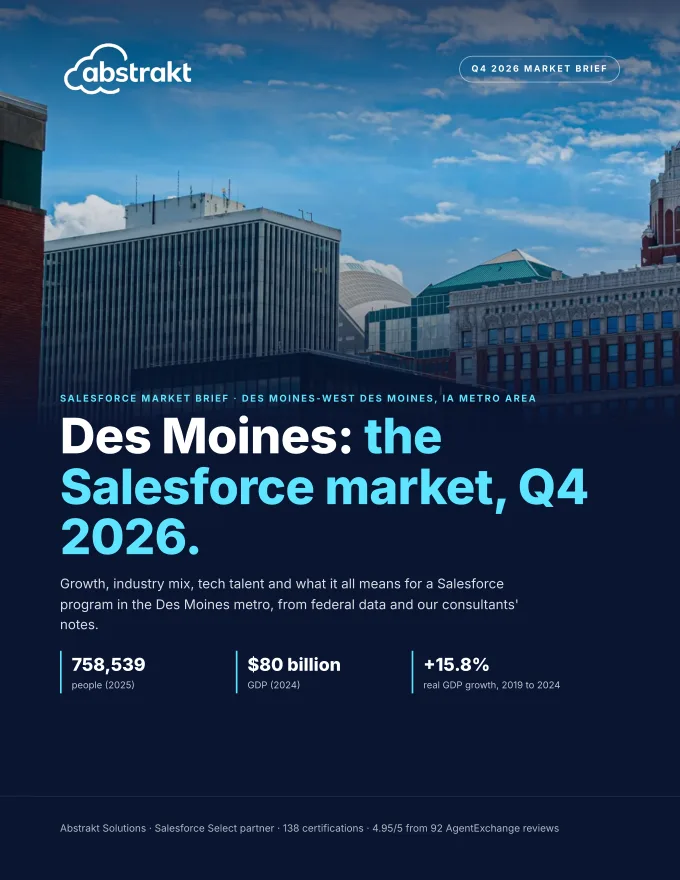
A free 24-page PDF with Des Moines's growth ranked against 100 metros, its industry mix, tech wages and nearby markets. It is offered on the public Des Moines page; send your customer there or get a copy for your own prep.
Get the Des Moines brief →Co-sell with Abstrakt in Des Moines
Working a Des Moines account? Bring in a named consultant for discovery, scoping or a health check. We reply within 4 business hours.