

How Salesforce work starts in Virginia Beach
Abstrakt Solutions, a Salesforce Consulting Partner, concentrates its Hampton Roads work on manufacturers, defense suppliers, health systems and retailers. Virginia Beach is one of our focus markets.
What buyers here usually run into
- 1
Long government pursuits
Defense and IT contractors often track capture work, teaming partners and contract vehicles outside their CRM. Salesforce helps when the pipeline reflects how government work is actually won.
- 2
Manufacturing data split from sales
Manufacturers serving defense and commercial customers commonly keep orders, quotes and service history in separate systems, so integration with ERP is usually the first priority.
- 3
Access control in sensitive environments
Organizations near defense work tend to review permissions and integrations closely, which makes a health check a sensible step before adding clouds or AI.
Budget, team and partner questions
What drives cost
In Hampton Roads, access control often drives scope: data classification, permissions that separate program teams and decisions about which records stay out of Salesforce. Manufacturers serving both defense and commercial customers add ERP integration. Health organizations add privacy design for patient intake.
Admin or partner
Larger contractors and health systems here often keep Salesforce ownership internal for security reasons and use a partner for architecture and integration. Smaller suppliers and retailers more often rely on managed services under their own access policies.
What buyers ask a partner
Ask how the partner classifies data and designs permissions for organizations near defense work. Manufacturers should ask about ERP integration for mixed defense and commercial customers.
The local economy and its biggest industries (4)
| Sector | Share of 2024 GDP | Where Salesforce fits |
|---|---|---|
| Manufacturing Salesforce for manufacturing → | at least 7.6% | Shipbuilding suppliers, food processors and advanced manufacturers in Hampton Roads juggle long production cycles, defense customers and commercial accounts. Salesforce connected to ERP gives sales and service one view of orders and installed equipment. |
| Health care and social assistance Salesforce for health & life sciences → | at least 7.0% | Health care is the metro's second-largest private sector. Providers and health organizations here need patient engagement, referral tracking and service processes built around privacy rules. |
| Professional, scientific, and technical services Salesforce for professional services → | at least 5.9% | The defense and IT contractors with operations in Hampton Roads run long pursuits, teaming arrangements and program-level relationships that are hard to manage in spreadsheets. |
| Retail trade Salesforce for retail & consumer goods → | 5.7% | Retailers and consumer brands in Hampton Roads need customer service, marketing and store-level data working together. |
Source: U.S. Bureau of Economic Analysis, GDP by county (CAGDP2), 2024, summed to the metro area; private sectors only, excluding real estate and government. “At least” marks sectors where BEA suppresses some county figures.
Regional target sectors named by local economic development groups: Defense (incl. Defense & Maritime), Energy (incl. Clean Energy / offshore wind), Logistics / Distribution & Logistics, Advanced Manufacturing, Business & Shared Services, Information Technology.
Salesforce products that fit Virginia Beach (6)
In the order we lead with them here, from the industries above.
Salesforce Sales Cloud
The CRM where sales pipeline lives, when it is built right.
Salesforce Service Cloud
The operating system for modern customer service, case, knowledge, voice, and AI agent assist together.
Salesforce Field Service
Scheduling, dispatch, mobile work orders and parts for teams that work on site.
Salesforce Marketing Cloud
Cross-channel marketing, email, mobile, journey, and Data 360-powered personalization at scale.
Salesforce Experience Cloud
Customer, partner, and employee portals built on Salesforce.
Salesforce Agentforce
AI agents that handle real work inside Sales Cloud, Service Cloud, and Marketing Cloud.
Virginia Beach shipyards, clinics and document-reading AI
Manufacturing, health care and professional services top the BEA sector list for the Virginia Beach metro, and the regional economic plan adds defense, maritime and logistics. Shipyard suppliers and defense contractors handle dense technical paperwork, so document reading is often the first real win: an agent extracts part numbers, dates and contract clauses into structured fields for a coordinator to confirm. Health providers can pilot drafted replies for appointment and referral questions. Logistics firms around the port can let an agent answer shipment status requests from existing case data. Controlled unclassified information changes the plan, so data classification and strict permissions come first, and some records should never reach an agent.
- Extracting contract clauses and part numbers
- Appointment and referral reply drafts
- Shipment status answers from cases
Services buyers here usually need (7)
Salesforce Implementation in Virginia Beach
Most first-time Salesforce implementations we scope in Hampton Roads have to serve two kinds of customers at once: commercial buyers and defense-related programs with tighter rules about who sees what. That makes the data model and the security design the first decisions, ahead of page layouts or automation. We run discovery workshops with capture, sales and service leaders, design accounts, programs and contacts around how you actually win work, build in a sandbox, then launch in phases so each team is productive before the next one starts.
By industry in Virginia Beach
- 1
Manufacturing
By BEA's 2024 figures, manufacturing leads the metro's private economy with a floor of 7.6% of output. Shipyard suppliers, food processors and fabricators here usually implement Salesforce to track quotes, orders and installed equipment in one place. The design question we settle early is where ERP stays the system of record, so the CRM holds customers, opportunities and service history without trying to become a second production system that nobody keeps current.
- 2
Defense (incl. Defense & Maritime)
The Hampton Roads Alliance lists defense and maritime among its target sectors, and companies in that orbit need Salesforce designed around programs, contract vehicles and teaming partners rather than a simple lead-to-close funnel. For implementation, that means custom objects for pursuits and vehicles, restricted record types for sensitive programs, and a clear rule about which technical information never enters the CRM. Getting those boundaries into the first release avoids a painful security redesign later.
- 3
Business & Shared Services
Shared services centers in the region, another Alliance target sector, typically implement Service Cloud to take requests from many business units or clients through one front door. The implementation work centers on queue design, entitlement rules that reflect each client's service levels and a knowledge base the agents trust. We model each internal or external client as an account with its own entitlements, so reporting by client is available from the first week rather than rebuilt after launch.
Raise before scoping
Decide what stays out
Companies close to defense work should agree in writing which data belongs in Salesforce and which stays in approved systems. Record that rule in the design document, build fields and validation around it, and train users on it, so nobody pastes controlled details into a notes field.
Plan for commercial and government
Firms that sell to both commercial customers and defense programs rarely share one sales process. Separate record types, stages and approval paths keep each process honest while still letting leadership see the whole pipeline in a single set of dashboards and forecasts.
Launch one team at a time
A phased launch lets sales go live on clean accounts and opportunities first, followed by service, field teams and partner access. Each release is small enough to train properly, and lessons from the first group shape the configuration for the next.
Salesforce Integration in Virginia Beach
Integration projects in Hampton Roads tend to follow the region's economy: port-linked distribution and logistics firms, manufacturers with established ERP systems, and health organizations with clinical and scheduling platforms. In each case the aim is the same, getting the right data into Salesforce at the right time without creating a second copy nobody trusts. We map which system owns each record, choose between real-time APIs, scheduled syncs and middleware, build error handling and monitoring, and document the whole flow so your team can support it.
By industry in Virginia Beach
- 1
Logistics / Distribution & Logistics
Logistics and distribution is one of the Hampton Roads Alliance's target sectors, and firms in it run on transportation, warehouse and customs systems. Customer service teams need shipment status, exceptions and delivery confirmations visible on the account without logging into three platforms. We usually bring milestone events into Salesforce as they happen, attach them to the customer and case, and send only exceptions to agents, so inbound volume stays manageable.
- 2
Advanced Manufacturing
Advanced manufacturing is another Alliance target sector, and plants here generally run a mature ERP that owns pricing, inventory and orders. The integration pattern that works is ERP as the source for products, prices and order status, with Salesforce sending approved quotes and new customer records back. For manufacturers with installed equipment, serial numbers and warranty dates flow in so Field Service technicians see the full service history before arriving on site.
- 3
Health care and social assistance
Health organizations in the region connect Salesforce to electronic health records, scheduling and referral platforms. The integration design question is how little protected information Salesforce needs to do its job. We often sync appointment and referral status plus a patient identifier, keep clinical detail in the source system, encrypt sensitive fields and log every integration user's access so privacy officers can see exactly what moves between systems and why it needs to.
Raise before scoping
Name a system of record
List each object two systems share, from customers to products to orders, and write down which platform may create and edit it and which may only read it. Two systems both allowed to edit the same field is the most common cause of integration drift, duplicate records and user mistrust.
Choose the right sync pattern
Not everything needs real time. Order status and shipment exceptions often do, while pricing updates and financial history can move nightly. Matching each flow to its business need keeps API usage reasonable and makes failures easier to diagnose and recover from.
Monitor failures from day one
Port and plant systems rarely announce a broken connection; a certificate lapses, a daily API allowance runs out or someone renames a field upstream. Error logging, alerts to a named owner and a simple retry process should be part of the build, not an afterthought discovered when sales reports go wrong.
Salesforce Health Checks in Virginia Beach
Hampton Roads organizations tend to ask for a health check when someone outside sales starts asking questions: a security officer preparing for a customer audit, a privacy lead reviewing patient data, or an executive considering Agentforce. Using read-only access you approve, we examine profiles and permission sets, sharing, login policies, connected apps, Apex, flows, integrations, data quality and usage. You receive a ranked list of findings with the specific setting or component involved, the risk it creates and the recommended fix, plus a walkthrough with your leadership.
By industry in Virginia Beach
- 1
Defense (incl. Defense & Maritime)
Defense and maritime suppliers, a target sector for the Hampton Roads Alliance, increasingly face customer questions about how commercial systems protect contract information. Our review hands their security lead evidence: multi-factor enforcement, session and IP policies, who can export data, which connected apps hold tokens and whether any sensitive program detail has drifted into notes or files. Each finding names the exact setting, so the security lead can close it and document the change.
- 2
Health care and social assistance
Hampton Roads health organizations tend to add programs to Salesforce one at a time, and the sharing model rarely gets revisited as each one lands. Our review traces who can view patient and referral records through profiles, permission sets, sharing rules and reports, checks field history and encryption on sensitive fields, and looks at integration users that may have broader access than any person. We sort the resulting list by how much patient information each gap exposes.
- 3
Information Technology
IT services companies, which the Alliance also targets, frequently customized their own Salesforce org themselves with developers who have since moved on. The health check measures what they left: Apex without test coverage, triggers and flows competing on the same objects, unused managed packages and hard-coded IDs that break in sandboxes. The result is a technical debt list with effort estimates, so the work can be scheduled rather than discovered in an outage.
Raise before scoping
Check agent access first
An Agentforce agent acts with the permissions of the user or integration it runs as. Before any pilot, confirm those permissions are narrow, the data the agent reads is current and duplicate records are merged, or the agent will repeat every existing problem at speed.
Include integration users
Integration accounts often hold the broadest access in the org and receive the least scrutiny. Review what each one can read and change, whether its credentials rotate and who owns it, because an overlooked integration user is a common path to unintended data exposure.
Turn findings into a plan
A report is only useful if someone acts on it. Rank findings by risk and effort, assign quick fixes to your admin, group larger items into an optimization project and set a date to recheck the most serious items after they are addressed.
Salesforce Managed Services in Virginia Beach
Managed services in Hampton Roads usually replace one of two things: a single overworked admin, or no admin at all since the implementation partner left. We take over user requests, permission changes and small fixes, test each Salesforce release in a sandbox before it reaches production, and work through a prioritized backlog every month. Health care, retail and IT services organizations here tend to use the arrangement to keep their org secure and current while their own staff stay focused on patients, stores and contracts.
By industry in Virginia Beach
- 1
Health care and social assistance
BEA's 2024 figures put health care second among Hampton Roads private industries, at no less than 7.0% of output. Clinics, outreach teams and community health nonprofits in the area run referrals, intake and patient reminders on Service Cloud, and those processes shift whenever programs or payers do. Our retainer absorbs the steady trickle of new queues, intake fields and access requests, checks each permission change against privacy rules and keeps a change log compliance staff can open at any time.
- 2
Retail trade
Retailers and consumer brands in Hampton Roads run customer service, loyalty and marketing journeys that shift with every season and promotion. Ongoing support for them means building and retiring campaigns and journeys quickly, keeping service macros and knowledge articles current, and watching data syncs from point-of-sale and ecommerce platforms so customer records stay accurate. Planning seasonal changes a month ahead in the backlog keeps peak periods calm for store and contact center teams.
- 3
Information Technology
The Hampton Roads Alliance counts information technology among its target sectors, and the region's IT services firms often support government customers with small internal teams. Their own Salesforce org frequently goes without care because every technical person is billable. Managed services gives them a named consultant for pipeline and contract tracking changes, quarterly access reviews and release testing, so the CRM keeps pace with new contract vehicles without pulling engineers off client work.
Raise before scoping
Test each Salesforce release
Salesforce ships three major releases a year, and each can change behavior that custom automation depends on. We read the notes, run your key processes in a preview sandbox and fix problems before the release reaches production, so users simply see new features instead of broken flows.
Keep one prioritized backlog
In most Hampton Roads orgs we inherit, change requests show up through email, chat, tickets and conversations in the hallway. Collecting them in one backlog, ranked with your business owner each month, keeps the retainer working on what matters most and gives leadership a clear record of what was delivered and what is waiting.
Schedule access reviews
Organizations handling patient or government-related data should review who has which permissions on a fixed schedule. A quarterly review of profiles, permission sets and inactive users catches drift early and produces dated documentation that auditors, customers and security officers can rely on.
Salesforce Optimization in Virginia Beach
Optimization work in Hampton Roads usually starts with a gap between what Salesforce was set up to do and what people actually do in it. Sellers log activity somewhere else, service agents copy data between screens, and managers export to spreadsheets to build a forecast. We interview users, review the automation and reports that exist, remove what nobody needs and redesign the pieces that slow people down. Retailers, shared services centers and professional services firms here each have a different version of that gap.
By industry in Virginia Beach
- 1
Retail trade
Retail trade makes up 5.7% of 2024 metro GDP in Hampton Roads. Retail and consumer-brand teams often inherit Marketing Cloud journeys and service processes built for an earlier strategy. Optimization for them means retiring stale journeys, cleaning up audience segments, measuring which emails actually drive store or online visits, and giving contact center agents one console view of orders, cases and loyalty status instead of several tabs.
- 2
Business & Shared Services
Shared services teams live on throughput, so optimization is about removing clicks and handoffs. We review case routing, queue rules and entitlement timers, replace manual triage with rules that route on request type and client, and tighten knowledge articles so agents close requests on first contact more often. Where a request type is routine and well documented, Agentforce can take the first pass once the knowledge base is dependable, leaving people free for the exceptions and escalations.
- 3
Professional, scientific, and technical services
Engineering, consulting and government IT services firms here frequently have pipelines full of opportunities that were never closed out, which makes forecasting useless. Optimization means redefining stages to match how pursuits progress, adding required fields only where decisions depend on them, and building dashboards that capture leaders can read in a minute. Cleaning out dead opportunities and duplicate contacts usually does more for trust in reporting than any new feature.
Raise before scoping
Start with user interviews
Metadata shows what was configured, not why people avoid it. Short sessions with sellers, agents and managers reveal the workarounds, duplicate entry and missing information that explain low adoption.
Consolidate overlapping automation
Orgs that several admins have touched usually carry legacy workflow rules and Process Builder automations next to newer flows, each one firing when a record saves. Consolidating them into a small number of well-documented flows speeds up saves, removes conflicting updates and makes every future change to those objects safer to test.
Rebuild reports around decisions
Hundreds of reports usually means nobody trusts any of them. Identify the handful of decisions leaders make each week, build dashboards for those, and archive the rest with a note on where they went. Fewer, accurate reports do more for adoption than any training session.
Salesforce Migration in Virginia Beach
Migrations in Hampton Roads often start from scattered sources rather than a single old CRM: pursuit trackers on shared drives, a contact database from an acquired firm and years of email. We inventory every source, decide which records are worth moving, map them to the Salesforce data model, then clean and deduplicate before loading. Test loads in a sandbox let your team check the results against what they know. We time the switchover so double entry across old and new systems ends almost as soon as it starts.
By industry in Virginia Beach
- 1
Professional, scientific, and technical services
Professional and technical services contribute at least 5.9% of 2024 metro GDP, and many firms in the sector support defense and government programs. Their history tends to sit in capture spreadsheets, proposal folders and a lightweight CRM. Migration for them means turning pursuit spreadsheets into opportunity records with contract vehicles and teaming partners attached, linking past proposals by reference, and deciding with the capture lead how much closed-lost history is worth carrying forward into the new org.
- 2
Energy
Energy, including offshore wind, is a Hampton Roads Alliance target sector, and suppliers entering that chain are often small companies whose contacts and prequalification status live in spreadsheets. Moving them to Salesforce is less about volume and more about structure: developers, tier-one contractors and projects need clear relationships from the start. We design that structure first, then migrate contacts and pursuits into it so reporting by offshore project, developer and contractor works from the first week.
- 3
Retail trade
Retailers and consumer brands moving customer service or marketing onto Salesforce carry large customer lists from ecommerce, loyalty and email tools, frequently with the same shopper appearing several times. The migration work is mostly identity: matching and merging records, carrying consent and unsubscribe status forward accurately and archiving inactive contacts rather than loading them, so the new org starts with a list marketing can actually use for its next seasonal campaign.
Raise before scoping
Carry consent forward accurately
Email opt-outs, preferences and consent dates must survive the migration exactly. Losing them exposes you to complaints and compliance problems. We map every consent field explicitly and reconcile totals before and after the load so nothing is lost or reset.
Clean before you load
Duplicates, inconsistent company names and missing owners are easier to fix in a staging file than in production. A deduplication and standardization pass before loading gives users a system they trust on the first day instead of one they learn to work around.
Keep history in proportion
Plenty of legacy records are worth keeping somewhere, just not in the new org. Agree on cutoffs for closed opportunities, old activities and inactive contacts, archive the rest in an accessible format, and you get a faster, cleaner org without losing anything you may need to consult later.
Salesforce Implementation Rescue in Virginia Beach
Rescue projects in Hampton Roads often trace back to a design that tried to serve commercial and defense-related work with one process, or to integrations with ERP and logistics systems that never worked reliably. We start with triage: a short, structured review of the org, the original scope and the people involved. Whatever stops people working today is removed first. Then each object, flow and integration is marked keep, repair or rebuild, the unfinished scope is completed and teams return to the system one at a time.
By industry in Virginia Beach
- 1
Manufacturing
Stalled manufacturing implementations here usually break at the ERP boundary: quotes built in Salesforce cannot be priced correctly, or orders fail to sync and reps stop trusting the data. Our rescue work stabilizes the integration first, often by narrowing it to the flows that matter most, then fixes the product catalog and quote process. Field and service teams are brought back into the system only once order data is dependable.
- 2
Professional, scientific, and technical services
Government services and engineering firms sometimes launch Salesforce with a pipeline modeled on commercial sales, then watch capture teams return to spreadsheets. Recovery means redesigning stages around how pursuits actually move, adding contract vehicles and teaming partners as proper records and migrating live pursuits out of the spreadsheets. We relaunch with the capture team first, because their adoption decides whether leadership trusts the pipeline again and funds the rest of the recovery.
- 3
Logistics / Distribution & Logistics
Logistics firms, a Hampton Roads Alliance target sector, sometimes find their Service Cloud launch overwhelmed by automated shipment updates creating thousands of cases. Rescue means pausing the noisy integrations, redefining which events deserve an agent's attention, rebuilding routing rules and clearing the backlog. Once agents can see real exceptions again, we reconnect the remaining feeds gradually and monitor case volumes daily with the operations team until they settle at a level agents can handle.
Raise before scoping
Triage before rebuilding anything
The urge after a failed launch is to start over. Most orgs contain a lot worth keeping. A structured triage of data model, automation, integrations and adoption shows what can be repaired, which saves time and money and preserves the parts users already rely on.
Stabilize what users touch daily
Fix the defects that stop people from doing their jobs before improving anything else. Restoring trust in daily screens, reports and integrations gives the recovery credibility and buys time to address deeper design problems properly rather than in a panic, with users watching.
Reset scope with leadership
Failed projects often carried more scope than the organization could absorb at once. Agree on a smaller first relaunch with executives, document what moves to later phases and report progress weekly, so the recovery is judged against realistic goals rather than the original, overloaded plan.
Industry plays in Virginia Beach (4)
Salesforce for Virginia Beach Manufacturers
Manufacturing around Virginia Beach is shaped by the water: maritime and defense work, port-driven logistics and a growing offshore energy supply chain. Many producers sell to prime contractors and government programs as well as commercial buyers, so Salesforce has to track long pursuits, contract vehicles and repair work orders alongside ordinary product sales. We design it to respect the compliance boundaries defense work imposes, connect it to ERP and project systems, and give leadership one view of commercial and program pipeline.
The Bureau of Economic Analysis's 2024 county figures put manufacturing at the top of the Virginia Beach metro's private sectors, at least 7.6% of GDP, with construction adding at least 5.2%. Hampton Roads Alliance lists defense and maritime, energy including offshore wind, logistics and advanced manufacturing among its target industries. A public research university in the region runs a modeling, analysis and simulation center, and a federal research laboratory adds to the region's research assets, giving local producers access to engineering and data talent.
Use cases to open with
- 1
Prime and program pursuits
Suppliers to shipyards and defense programs often pursue subcontracts that take many months to award and run for years. Sales Cloud can track each pursuit with the prime contractor, program, contract vehicle, teaming partners and capture milestones, and roll probable value into a forecast. Leadership sees which programs drive backlog, where bid resources are committed, and which relationships with primes need executive attention before the next solicitation opens.
- 2
Repair and overhaul work orders
Ship repair, marine equipment and industrial service companies juggle urgent work against planned availabilities. Field Service can schedule crews by skill, clearance and location, track parts and subcontracted work, and capture completion reports on mobile. Customers get faster status updates, and managers see labor utilization and margin by vessel, customer and job type rather than reconstructing it after invoices go out.
- 3
Offshore energy supply chain
As offshore wind development brings new buyers to the region, fabricators and component suppliers need to qualify, quote and track opportunities with developers and their tier suppliers. Salesforce can hold prequalification status, certifications, bid packages and site visit notes in one place, helping smaller manufacturers respond quickly to requests while keeping an organized record for future work. Leadership can also see how much of the pipeline depends on a single developer or project, which matters when schedules shift.
Raise before scoping
Protect controlled technical data
Shipyard drawings, specifications and program documents are sometimes subject to export rules or handling restrictions. Decide early whether such data belongs in Salesforce at all, evaluate government cloud options where it does, and restrict access by role and citizenship where required. Your security officer sets the rules; the configuration follows them.
Separate commercial and government
Government contracts carry different pricing, approval and reporting requirements than commercial orders. Use distinct record types, approval paths and reports, so commercial sales teams move quickly and program managers keep the documentation their contracting officers expect, without either group working around the other's rules.
Plan for project-based ERP
Many repair and fabrication firms run project-based accounting with labor tracking by job. Integrate so estimates, work orders and actual costs reconcile, and settle which system creates the job number, or teams will keep matching records by hand at month end and argue over which margin figure is correct.
Salesforce for Virginia Beach Professional Services
Professional services in the Virginia Beach area are closely tied to defense, maritime and federal research customers, alongside commercial clients across Hampton Roads. Firms here need Salesforce to manage capture pipelines tied to contract vehicles, track key personnel and teaming partners, and keep commercial business development separate but visible. We configure it around your pursuit stages and review gates, connect it to project and finance systems, and set up access controls that respect how sensitive government information must be handled.
Technical and consulting firms are a meaningful share of the coastal economy, with at least 5.9% of Virginia Beach metro GDP in 2024 by the Bureau of Economic Analysis's count. Hampton Roads Alliance targets information technology and business and shared services, and the region hosts a large base of defense and IT contractors. Regional university programs feed that workforce with graduates in simulation engineering, analytics and cyber defense. That mix produces firms that sell technical talent to government and commercial clients at the same time.
Use cases to open with
- 1
Capture and proposal management
Government services firms need to follow opportunities from early market research through source selection. Sales Cloud can track each opportunity by agency, contract vehicle, capture stage and probability, with proposal tasks, color-team reviews and teaming agreements attached. Business development leaders see pipeline by customer and capability, and executives can decide which pursuits deserve bid and proposal funding each quarter based on data rather than instinct.
- 2
Key personnel and teaming
Proposals often depend on named staff and partner firms. Salesforce can link pursuits to key personnel, their clearances and certifications, and to teaming partners with their roles and past performance. When a solicitation drops, capture managers can quickly assemble a compliant team, and leaders see which people are committed to too many bids at once or which partners have gone unused.
- 3
Commercial client development
Many Hampton Roads firms also serve commercial clients in logistics, health care and energy. Sales Cloud and Marketing Cloud manage those relationships, newsletters and events without mixing them with government pipeline. Practice leaders see cross-sell opportunities where a capability built for a defense customer could serve a commercial buyer, and marketing measures which campaigns lead to meetings. That helps firms diversify revenue beyond a single agency or program.
Raise before scoping
Scope sensitive information carefully
Proposal content, pricing and personnel data can be sensitive, and some government information must stay in approved environments. Decide which data Salesforce holds, apply role-based access and field-level security, and evaluate government cloud options with your security team before the first proposal record is created.
Align stages to review gates
Capture processes usually include formal bid decisions and color-team reviews. Map Salesforce stages and required fields to those gates, so pipeline reports mean the same thing to capture managers, proposal managers and executives across every business unit, and so stale pursuits are closed out rather than inflating the forecast.
Connect to finance and staffing
Won contracts need to flow into project accounting and staffing. Define how awards create projects, how funded value and ceiling are tracked, and how labor categories map across systems, so leadership can compare pipeline, backlog and staffing capacity together when deciding which bids to chase.
Salesforce for Virginia Beach Health Care Organizations
Health organizations in Hampton Roads serve a population that moves often and lives across a string of separate cities joined by bridges and tunnels. Salesforce helps them welcome new patients quickly, route calls and referrals to the closest appropriate site, and keep home care and post-acute partners coordinated after discharge. We connect Salesforce to the EHR for appointment and referral data, keep clinical documentation where it belongs, and design access around protected health information before any patient record is loaded.
Across the Virginia and North Carolina counties in the metro, care providers and social service agencies produce at least 7% of 2024 output by BEA's reckoning; that floor puts them second only to manufacturing, and suppressed county values mean the real share is higher. The Hampton Roads Alliance does not list health care among its target industries, which focus on defense, energy, logistics, advanced manufacturing, business services and IT. Health care matters here for a different reason: a not-for-profit health system is based in Norfolk, and the region's defense presence, including what is described as the world's largest naval base, brings a steady flow of families arriving and leaving.
Use cases to open with
- 1
Fast intake for relocating families
Families arriving with military or shipyard assignments often need new primary care, pediatric and specialty providers within weeks of moving. Service Cloud can run a dedicated new-patient intake queue that gathers insurance details, prior records requests and scheduling preferences in one flow, with an Experience Cloud form for online requests. Staff see where each family stands, and follow-up tasks keep records requests from stalling.
- 2
Referral routing across cities
A referral from a Chesapeake practice may be best served in Norfolk, Virginia Beach or across the water on the Peninsula. Salesforce can capture referrals from fax, portal and phone, match them to specialty, location and insurance rules, and track each one to a scheduled appointment. Physician liaisons can see which practices send patients and where referrals are leaking out of the system.
- 3
Post-discharge partner coordination
Home health, hospice and senior living partners need timely information when patients leave the hospital. An Experience Cloud partner portal can share discharge referrals, accept or decline responses and status updates, while care transition staff track follow-up calls in Service Cloud. Agentforce can remind patients about follow-up appointments and medication pickups, and escalate any reported symptoms or concerns to a nurse on the transitions team.
Raise before scoping
Plan for frequent address changes
A mobile patient population means contact details, insurance and primary care assignments change more often than average. Design duplicate matching, address validation and regular EHR syncs carefully, and give staff simple ways to update records so outreach and billing reach the right person.
Business associate agreements everywhere
Salesforce and any connected partner portal, messaging vendor or integration tool that touches patient data need appropriate agreements and security review. Inventory every system in the data flow before build, and confirm with your privacy officer which partners may see which fields.
Train around clinical shifts
Nurses, schedulers and liaisons work different hours across many sites. Offer short, role-based live training at larger facilities and recorded modules for others, and staff a support channel for the first weeks after go-live, when questions and workarounds appear.
Salesforce for Virginia Beach Retailers and Consumer Brands
Retail and consumer goods in Hampton Roads range from store networks run from regional headquarters to food processors selling through national grocers and resort-area shops that do most of their business in summer. Salesforce can manage facilities and vendor cases across a large store network, support key account teams selling branded food to retailers, and run seasonal campaigns for visitors and locals. We tie it to point-of-sale, ERP and facilities data so each team sees what is happening store by store.
Shops, chains and dealers generated 5.7% of Hampton Roads output in 2024 according to BEA county tallies, which ranks retail trade fourth, after the region's shipyards and factories, its hospitals and its professional firms. The Hampton Roads Alliance does not target retail directly, but its core industries include food and beverage processing, and logistics is one of its primary playbook industries. Store operations, branded food sales and port-driven distribution all shape retail work here.
Use cases to open with
- 1
Store maintenance and vendor cases
Chains with many stores field constant requests for broken coolers, lighting, doors and registers. Service Cloud can let store managers open cases from a simple form, route them to internal technicians or outside vendors, and track response against agreed service levels. Field Service can schedule in-house technicians by region. Operations leaders see recurring problems by store, asset and vendor, which informs repair-versus-replace decisions.
- 2
Grocery and retailer key accounts
Food and beverage processors sell through grocery chains, club stores and foodservice distributors, each with its own promotions, deductions and category reviews. Sales Cloud can hold account plans, promotion calendars and shipment data from ERP, while tasks track category review deadlines. Sales leaders compare planned and actual volume by customer and by quarter, and they can finally see which feature ads, displays and temporary price cuts actually paid off.
- 3
Seasonal visitor and local marketing
Oceanfront shops, outfitters and restaurants that also sell branded merchandise see heavy summer traffic, a busy spring and fall shoulder season, and a much quieter winter. Marketing Cloud can capture visitor and local sign-ups separately, send seasonal offers, and trigger win-back messages when past visitors plan return trips. Residents can receive off-season events, early-access sales and loyalty offers that keep registers moving during the months when visitors are scarce.
Raise before scoping
Model stores and assets
Store operations work depends on a clean list of locations, regions and equipment. Build a location hierarchy with key assets such as refrigeration units and HVAC systems before loading cases, so service history, warranties and vendor performance can be reported accurately.
Vendor access and performance
Outside repair vendors need to update work without seeing other vendors' jobs or internal costs. Use an Experience Cloud portal or mobile app with restricted access, agree on service-level measures in the vendor contract, and review scorecards with procurement each quarter.
Consumer consent by channel
Email, text and loyalty programs each need clear consent and preference handling. Capture where and when a customer opted in, store it with the profile, and honor opt-outs everywhere, especially when seasonal campaigns lead to many new sign-ups in a short period.
Case studies to send (3)
From the industries this market leans on. Client names are anonymized and these projects are not specific to Virginia Beach.
The Virginia Beach Salesforce market brief, Q4 2026
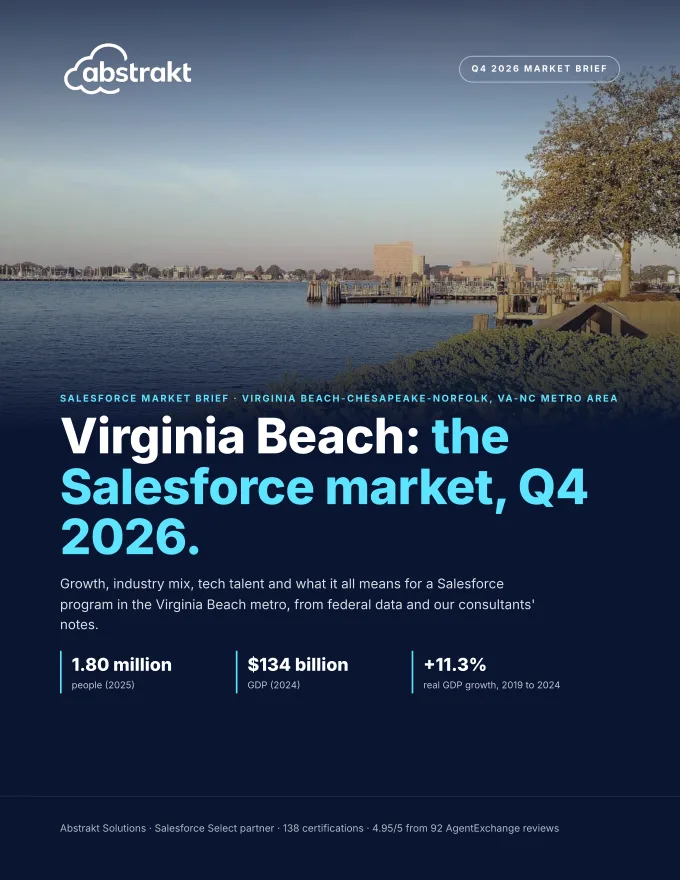
A free 25-page PDF with Virginia Beach's growth ranked against 100 metros, its industry mix, tech wages and nearby markets. It is offered on the public Virginia Beach page; send your customer there or get a copy for your own prep.
Get the Virginia Beach brief →Co-sell with Abstrakt in Virginia Beach
Working a Virginia Beach account? Bring in a named consultant for discovery, scoping or a health check. We reply within 4 business hours.